What’s stopping windy Western Australia from developing wind power?
Why isn’t WA harnessing wind power?, WA Today April 4, 2012 – Perth is an international hotspot for windsurfing and the destination of choice for the ISAF Sailing World Championships. If you thought Western Australia was a leader in wind power, think again.
New research reveals while Perth is the third windiest capital in the world, it is in the doldrums when it comes to wind power….. With an average wind speed of more than 27km/h and twelve operating wind farms lining the coast from Coral Bay to Albany, WA could be leading the nation. Continue reading
Western Australia’s Horizon Power’ s solar feed-in tariffs will especially benefit rural communities
 Solar households in towns located further from energy generation sources, or where power generation is expensive, will be offered higher prices for the electricity they export to the grid…. For households in regional and remote areas of Western Australia, under Horizon’s new feed in tariff structure the savings could be much higher.
Horizon Power To Offer Location Based Solar Feed In Tariff, Energy Matters, 3 April 12, In what appears to be a first for Australia, Western Australia’s Horizon Power will introduce area-specific solar feed-in tariffs. While owners of systems in some towns will receive a much higher rate, others will receive less.Horizon Power’s Renewable Energy Buyback Scheme rate is currently equivalent to a customer’s current electricity tariff, minus GST. Horizon’s incentive is in addition to Western Australia’s state government mandated feed in tariff rate of 8c per kilowatt hour. Continue reading
Australia urges Israel not to attack Iran’s nuclear facilities
Australia joins list of countries warning against Israeli strike on Iran, Haaretz, 31 March 12, Australian Foreign Affairs Minister Bob Carr phoned Lieberman to lay out Australia’s opposition to an attack on Iran’s nuclear facilities, and to say that sanctions need more time. By Barak Ravid More and more Western countries are joining a growing list of countries who are applying heavy international pressure on Israel to prevent it from attacking Iran’s nuclear facilities. The latest voice is that of the new Australian Foreign Affairs Minister Bob Carr….. http://www.haaretz.
Willy Brigitte, who planned attack on Lucas Heights Nuclear Reactor, arrested in France
 Militant who targeted Australian nuclear plant held in France http://articles.timesofindia.indiatimes.com/2012-03-31/europe/31266028_1_islamist-militants-nicolas-sarkozy-french-muslim Reuters Mar 31, 2012, PARIS: A French Muslim convert convicted in 2007 for planning an attack on an Australian nuclear plant is one of the suspected militants being held for questioning after a series of raids throughout France, a police source said on Saturday.
Willy Brigitte was arrested on Friday at his home in Asnieres, a northwestern suburb of Paris. Authorities found no weapons but seized his computer and a mobile phone, the source told Reuters.
Tony Fitzgerald, former NT Anti Racial Discrimination Commissioner, condemned Norther Territory Intervention
The central recommendation made by the Anti Discrimination Commission was:
The Northern Territory Emergency Response in its present form should be scrapped and transformed from a quick fix, law and order plan into a range of long term initiatives aimed at overcoming remote Indigenous disadvantage and raising indigenous quality of life.
Tony Fitzgerald – an unlikely Territorian hero Crikey, April 1, 2012 – , by Bob Gosford – he quotes Patrick Dodson: “…….Tony was the NT Anti Racial Discrimination Commissioner from 2002 until his passing in 2009.
As Commissioner, Tony was passionate about the need to promote a fair and just society that was free from racial discrimination and inequality…. the report from that review, the Little Children are Sacred Report, became the catalyst for the Howard Government to initiate the Northern Territory National Emergency Response.
Tony was highly critical of the Commonwealth Government’s Emergency Response to Aboriginal communities. He was particularly appalled at the intervention’s suspension of the Racial Discrimination Act, which since its enactment in 1975 has been important in ensuring the protection of all Australians from racial discrimination… Continue reading
Nyoongar Tent Embassy in Western Australia – push for Aboriginal Sovereignty
Nyoongar Tent Embassy puts sovereignty on the agenda, Green Left, March 31, 2012 By Alex Bainbridge, Perth A movement for Aboriginal sovereignty has galvanised around the February 12 formation of the Nyoongar Tent Embassy in Perth.
The embassy was directly inspired by two developments: the 40th anniversary of the Aboriginal Tent Embassy in Canberra, which promoted a national push for Aboriginal sovereignty, and the February 8 report about negotiations between the state government and the South West Aboriginal Land and Sea Council (SWALSC) about Nyoongar native title.
The embassy suffered a heavy blow on March 22 when an operation of more than 60 police tried to close the embassy down. However, the embassy has so far survived the attack and the subsequent increase in police harassment.
Bail conditions on key participants who were arrested that day have prevented them from returning to Matagarup (Heirisson Island), the site of the embassy.
The discussion since that event reveals that sovereignty is an idea that will not simply go away….. On March 28, 100 people took part in an Aboriginal rights rally organised by the Dumbartung Aboriginal Corporation. The rally explicitly rejected the state government offer of a $1 billion land and cash package to extinguish Nyoongar native title.
Instead the rally called for 5% of the value of economic activity in the Nyoongar land to be paid every year to Nyoongar people…..
The SWALSC has produced a document explaining its approach to negotiations with the state government. It said the maximum potential gains of pursuing any native title process were extremely restricted by the inherent limitations on native title from the original Mabo High Court decision and the later legal restrictions imposed by the Keating and Howard governments.
SWALSC said more can be gained by pursuing negotiations with the state government than a bid to gain native title rights through the courts. These are the only two ways to achieve native title rights. But the sovereignty movement says Aboriginal people deserve a lot more than just native title rights.
Greens politican Robin Chapple told Green Left Weekly that he believes the WA government has been happy to engineer a situation in which Aboriginal people are fighting among themselves and that this may even have been Premier Colin Barnett’s goal all along.
The next step for the Nyoongar Tent Embassy will be a rally on April 5 at 11am, starting at the Supreme Court Gardens and marching to Matagarup (Heirisson Island)… http://www.greenleft.org.au/node/50562
One Aboriginal elder may hamper the plans of uranium giant BHP Billiton
 LEGAL CHALLENGE OF FEDERAL ENVIRONMENT MINISTERS APPROVAL OF THE
  OLYMPIC DAM EXPANSION, Nectaria Calan, 31 March 12, Uncle Kevin Buzzacott, Arabunna elder and honorary president of the Australian Nuclear Free Alliance, is challenging the Federal Environment Minister’s approval of the Olympic Dam Expansion, on the grounds that various environmental impacts of the project were not properly considered. The case will be heard on the 3rd and 4th of April in the Federal Court, Adelaide.
This is an administrative challenge. If Uncle Kevin succeeds, the Minister will be forced to re-consider the approval and show that the contested environmental impacts have been properly considered. This may delay the project, and is well-timed in that the BHP Board of Directors are currently considering whether to proceed with the project.
BHP Billiton and the South Australian government have successfully applied to become parties to the proceedings. This means that they will be throwing their weight behind the Federal Environment Minister.
Australia, Cocos Islands and our regional neighbours do not need USA drones
 Stop pandering to the Americans http://www.theage.com.au/national/letters/stop-pandering-to-the-americans-20120329-1w12a.html#ixzz1qjD0C9Zs The Age, Adrian Jackson, March 30, 2012 SUGGESTIONS that the Cocos Islands could be abase for US drones is not in Australia’s national interest (”Australia may host US drones at Cocos”, The Age, 28/12). We have good relations with China and India, the new superpowers of the 21st century as the US and Europe decline. Why antagonise large nations in our region which are also good trading partners?
Australia is capable of patrolling the Indian Ocean off our west coast. If drones are to be operated from Australian soil, let it be drones owned by the RAAF, not the USAF. Have the Australian residents of the Cocos Islands been consulted?
We know how the residents of Diego Garcia and Bikini Atoll suffered forced relocation and how Okinawa has been treated by military base occupation. Many Okinawans loathe the Americans. Even the construction of the detention centre on Christmas Island causes problems for Australians, particularly house rent prices. Australians on the Cocos Islands deserve better and our government should not pander to the paranoia of the US.
Liberal/National M.P. wants uranium mining in New South Wales – just not in his backyard
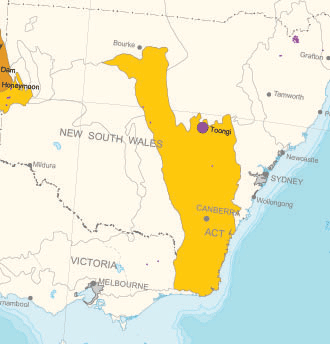
map shows uranium exploration areas in NSW
MP supports uranium exploration Northern Rivers Echo, Rebecca Masters | 30th March 2012 TWEED MP Geoff Provest has supported legislation changes that allow uranium exploration across the state but maintains he is still firmly against any form of mining on the Tweed..
… State Labor MP Walt Secord raised his fears in parliament this week that the legislation opened the door to uranium mining throughout the Clarence Moreton Basin on the north coast, potentially contaminating the environment and risking the health of communities in the Tweed.
“In 1986, in a spirit of bipartisanship, the NSW parliament agreed that the potential release of toxic elements could contaminate large areas of land and pollute our rivers,” Mr Secord said.
“They knew then, as Labor knows now, that there is still no failsafe way to transport and manage nuclear waste. “Make no mistake, the government’s decision to allow uranium exploration is a huge betrayal.”…….
Outside of parliament, Mr Provest has dismissed Mr Secord’s comments as “fear-mongering.”…….. “I will always be against any form of mining on the north coast, this is simply to give us an idea of what is in the ground.”
Australia’s nuclear industry exempted from laws on Aboriginal rights: is Warren Mundine unaware of this?
Aboriginal nuclear power promoter, Warren Mundine, was on the job today, with an article in the Financial Review. Mundine praised nuclear energy, and assured readers that the industry is going ahead. He made out that it is necessary for nuclear medicine. Most alarming of all, Mundine advocates the “full nuclear cycle”. That means Australia not only having nuclear power, but taking in nuclear waste from overseas countries.
We should not be all that surprised at Mundine’s pro nuke spruik. He has for a long time, been part of Australia’s nuclear lobby – its nuclear ‘spin machine’. – Christina Macpherson

FINANCIAL REVIEW JIM GREEN. 30 MARCH 12, As a co-convener of the Australian Uranium Association’s Indigenous Dialogue Group, it’s a shame that Warren Mundine turns a blind eye to the crude racism of Australia’s nuclear industry
He ought to have noted that last year’s amendments to the South Australian Roxby Downs Indenture Act 1982 retain exemptions from the SA Aboriginal Heritage Act. Traditional owners were not even consulted. The SA government’s spokesperson in Parliament said: “BHP were satisfied with the current arrangements and insisted on the continuation of these arrangements, and the government did not consult further than that.”
Mundine says that Australia has “a legal framework to negotiate equitably with the traditional owners on whose land many uranium deposits are found”. He ought to have noted that legislation was passed specifically to exempt the Ranger uranium mine in the Northern Territory from the Aboriginal Land Rights Act.
And Mundine ought to have noted that Resources Minister Martin Ferguson’s National Radioactive Waste Management Act overrides the Aboriginal Heritage Act, sidesteps the Aboriginal Land Rights Act and allows for the imposition of a dump on Aboriginal land even in the absence of any consultation with or consent from traditional owners. http://afr.com/p/opinion/our_radioactive_racism_UTpKFLGc40Yd3aBCYAJByM
Decentralised energy – you can start with a mixture of grid power and off-grid solar
 Hybrid solar: How to kiss the grid goodbye , REneweconomy, By Jeff Bye 30 March 2012 If ever there were a need to develop off-grid power systems it would have to be now, when transmission costs are now up to around 60 per cent of non-solar power bills.
Solar systems have historically been classified into two broad camps – “grid connected” or “off-grid” systems. This distinction has arisen due to historical segments of the market that needed solar to do different things. The vast majority of systems we see around Australia’s towns and cities are grid connected and have been driven by feed-in-tariffs and consumer desires to cut electricity costs and do something positive for the environment.
Off-grid systems have historically been the preserve of regional customers seeking to avoid expensive network augmentation costs to provide power to their remote locations. Off-grid systems are usually a lot more expensive as they require battery storage, more complicated control technology and often diesel backup generators to ensure the lights will always shine. Battery technology has also been a culprit as the memory effect of old-style lead-acid batteries has meant that battery arrays are oversized to ensure the depth of discharge is not high and hence battery life is extended.
An emerging trend though is for so-called hybrid systems which take a little from column A, and a little from column B. Such systems could either be described as an off-grid system which uses the grid as the standby generator or a grid-connected system with some added battery storage. Either way, these systems don’t require expensive diesel generators since the grid provides that service, and the size of the battery arrays can be downgraded as the cost of back-up power using off-peak grid electricity is much lower than that provided by diesel generators.
The technology that is making this possible is a new generation of products capable of directing energy flows as the consumer best desires….
Increasingly the electricity grid is moving towards Grid 2.0. Eventually, the networks will cease to become simply a delivery mechanism for electrons to your home and will morph into a shared network designed to help each energy user effectively manage their surplus or deficit of electrons to meet their needs. With this will come enormous changes to the business models of the network operators as customers gradually become more and more self-sufficient and use less and less from the grid….. http://reneweconomy.com.au/2012/hybrid-solar-how-to-kiss-the-grid-goodbye-59957
Urgent need for Australia to upgrade its “cheap and dirty” grid
“Australia can’t turn its back on the global shift from dirty to clean energy, from non-renewable to renewable, and from inefficient to efficient. It can’t do this anymore than it could resist the information technology age or the rise of China – and it is not in our national interest to do so.”
Cheap and dirty grid may be our biggest liability, REneweconomy By Giles Parkinson 30 March 2012 For decades Australia has boasted of its cheap and reliable electricity grid as the most potent sign of its economic competitiveness. But two new studies highlight the folly of resting on past laurels, and how Australia’s cheap and dirty grid has left our economy exposed and poorly prepared for the inevitable change to a low-carbon economy.
One study , by the University of Queensland and the Global Change Institute, suggests that Australia’s power system is among the least resilient in the world – even compared to other resource-rich nations such as Canada and Brazil – and presents a risk for consumers and investors alike.
The second report, prepared by The Climate Institute in conjunction with US industrial giant General Electric, finds that Australia is now ranked 16th among G20 countries in terms of the ability to prosper in a low-carbon economy, and is the only country to have gone backwards since 1995,… Continue reading
Renewable energy economics – sending shockwaves through fossil fuel lobby
Broader estimates produced by the International Energy Agency and the European Commission suggest that the final outcome of moving to renewables will be cost-neutral over the long term, and may even save money, but will likely cause a rise in costs over the short term because of new technologies and infrastructure investment.
More critically, it will also send shockwaves through the energy industry as economics of fossil fuel generators is undermined
In a renewable world, baseload generation is redundant, REneweconomy, By Giles Parkinson 29 March 2012 Energy Minister Martin Ferguson revealed the tenuous nature of his understanding of solar technologies in an interview on ABC TV’s 7.30 Report on Tuesday, referring to Solar Flagships projects as “solar baseload power.”
The Solar Flagships may be many things – big is one of them and possibly what Minister Ferguson meant. Or they may not be anything at all, given their problems in financing. But without storage one thing they certainly will not be is baseload. And even with storage, would solar ever work as baseload energy?
It is a common misconception, given that the energy grids for decades have been based on the principal of providing baseload energy, supplemented by peak-load power when demand is high. The question is often put: How could solar – or any other intermittent renewable ever be considered to be a source of baseload energy?
According to the latest study produced by experts at the UNSW, it may not need to. Continue reading
Success of solar energy electricity prices is frightening power generator industries
 Why power generators are terrified of solar http://www.crikey.com.au/2012/03/27/why-generators-are-terrified-of-solar/ Crikey.com by Giles Parkinson, of RenewEconomy, 28 March 12, ”….. the merit order effect and the impact that solar is having on electricity prices in Germany; and why utilities there and elsewhere are desperate to try to rein in the growth of solar PV in Europe.
It may also explain why Australian generators are fighting so hard against the extension of feed-in tariffs in this country….. that solar PV is not just licking the cream off the profits of the fossil fuel generators — as happens in Australia with a more modest rollout of PV — it is in fact eating their entire cake….. Continue reading
Premier Campbell Newman to stop Queensland’s solar thermal energy program
 Huge solar project in limbo as Newman pulls funding SMH, March 29, 2012 The first chance to test whether solar thermal energy can provide large-scale alternative power in Australia may be in doubt under the new LNP state government. The incoming Queensland government wants to pull out of an agreement formed by its predecessor to provide $75 million towards the $1.2 billion Solar Dawn solar research and power plant at Chinchilla, west
of Toowoomba, Premier Campbell Newman said yesterday.
The Solar Dawn project is set to be one of the largest of its kind in the world….. Solar Dawn is a 250 megawatt solar thermal project using sun-heated water in tubes to produce steam-driven energy, and is backed by the federal government and was supported by former Premier Anna Bligh. It is part of the federal government’s Solar Flagship Program. A similar project at Moree, in New South Wales, has received federal funding under the same program.
The University of Queensland has developed a $60 million research project to link to Solar Dawn.
UQ’s Professor Paul Meredith, the head of the university’s renewable energy research, said he was worried the LNP’s decision would damage what he thought was a worthwhile project and one that provided almost
400 jobs. http://www.brisbanetimes.com.au/queensland/huge-solar-project-in-limbo-as-newman-pulls-funding-20120328-1vynx.html#ixzz1qXtf3XFT
1 This month


Help Aunty Sue Protect Her Land and Sacred Sites From Destructive Rocket Testing.
.

Australians deserve the truth
about
AUKUS – https://aukuspublicinquiry.com/

PETITION – To: Prime Minister Anthony Albanese and the Australian Labor Government

of the week – Australians for War Powers Reform (AWPR)
To see nuclear-related stories in greater depth and intensity
 Antinuclear