Aboriginal Sovereignty – it’s about Respect, and Land – not about Money
 Aboriginal sovereignty must be on the agenda, says Michael Anderson, Green Left, March 7, 2012, By Kamala Emanuel, Perth http://www.greenleft.org.au/node/50262 About 50 people attended a forum addressed by Michael Anderson at the Curtin University Aboriginal Studies Centre on March 5. Anderson is a Gamilaroi man from New South Wales and is one of the four original founders of the Aboriginal Tent Embassy in Canberra in 1972.
The forum was organised by the Nyoongar Tent Embassy. Two days before, Anderson had addressed the WA Tent Embassy.
Anderson said Aboriginal people had never given up their sovereignty, that there had never been a defeat in declared war, that Aboriginal land had not been ceded and that the British crown had not asserted sovereignty over Aboriginal people.
He gave illustrations from case law, including letters and legislation from colonial times, to show that Aboriginal people were not British subjects and were they considered such. He described recent legal efforts examine whether Australian courts have jurisdiction over Aboriginal people. Anderson invited Aboriginal people of WA to take part in the formation of an interim Aboriginal government of national unity. So far, the interim government includes representatives of more than 40 Aboriginal nations from eastern Australia.
He described plans to have Aboriginal people recognised as a non-self-governing people by the United Nations. He also spoke of several legal initiatives, including a “writ of Mandamus” to get the British parliament to protect Aboriginal sovereignty, genocide proceedings against Britain in the European Union, and compensation and restitution claims for Aboriginal people with respect to mineral and petroleum exploitation.
The crowd received his words with enthusiasm. Many agreed with Anderson’s view Aboriginal sovereignty was “not about the money”. Anderson also said it was important to reject the Barnett state government’s proposed land deal with Nyoongar people in southwest Western Australia — a deal that would stamp out all native title claims over the region.
Doubts over whether or not BHP’s new big Olympic Dam uranium mine will go ahead

 Reuters report on mining conference in Canada Mar 6, 2012 By Euan Rocha TORONTO, March 6 – The Anglo-Australia mining giant, which already operates an underground mine at the site, has yet to sign off on the budget for
the open pit…. but BHP may opt to delay taking on the heavy financial burden that could easily be in the $10 billion to $20 billion range…..
…. PDAC, the mining industry’s largest annual gathering. The convention, organized by the Prospectors and Developers Association of Canada, opened in Toronto on Sunday.
Even though Olympic Dam, located 550 km (345 miles) north of Adelaide, is one of BHP’s biggest growth prospects, the cost of
digging the massive pit may prove prohibitive.
Last month the company reported a profit decline, and it struck a cautious tone on its expectations for growth in China, one of its
biggest markets. That has led some to speculate that the miner may delay spending on capital-intensive projects such as Olympic Dam and the Jansen potash project in the Canadian province of Saskatchewan.
In late 2011, BHP finalized state approvals to begin construction work on the open-pit phase of the Olympic Dam project, but the agreement would lapse around December if BHP delays its decision on proceeding.
“We want to see a board decision before the end of the year about substantial works beginning. If not, the approvals run out and BHP know this,” said Tom Koutsantonis, minister for mineral resources and energy for the state of South Australia.” I’m not in the business, and no government should be in the business, of allowing anyone to have massive tenements that they don’t develop …”-
A spokesman for BHP declined to comment on the remarks.
MASSIVE SCALE The sheer scale of the open-pit project is formidable. BHP will have to shovel rock for five to seven years before it reaches the Olympic Dam ore body, discovered in the mid-1970s…..
http://www.reuters.com/article/2012/03/06/canada-mining-pdac-olympicdam-idUSL2E8E60E220120306
Australian Labor government will not change its policy of opposition to nuclear power
 Despite pro nuclear Bob Carr joining the Ministry, the Australian Government opposes nuclear power plants. The Prime Minister was quoted in an article in 9 News, Mar 6 2012 By Julian Drape “…….The prime minister was also quizzed on Tuesday about incoming foreign minister Bob Carr’s stated support for nuclear power.
In response she said Labor’s policy was to oppose nuclear power plants in Australia “and it won’t be changing”.
“Our future as a country … is in making the best of our natural assets as well as continuing to use traditional sources of energy.
“We are a country with abundant sunshine. We are a country with a very, very, very long coastline which gives you access to tidal power.” Ms Gillard added that hot rocks energy could also be brought on stream.
Lynas moved its rare earths processing to Malaysia because of Malaysia’s less stringent laws
 ANAWA and EDO strongly believed that Lynas had chosen to move its operations to Malaysia because of the heavy metals and radioactive waste involved in the processing. “We believe Lynas picked Malaysia to save money and enable it to operate under less stringent laws,”
“The biggest concerns about the processing are the storage and waste management issues which are made more difficult in Gebeng which we understand to be wetlands.”
“There is no way it could operate the way it is in Malaysia over here,” he said. “Australia’s laws are much more stringent.”
 Aussie NGO: Gebeng not part of Lynas’ blueprint, Free Malaysia Today News, Stephanie Sta Maria | March 6, 2012 Anti Nuclear Alliance of Western Australia (ANAWA) claims that Lynas’ massive changes to its plan has resulted in its plant being built in Gebeng where laws are looser and labour is cheaper. PETALING JAYA: The Anti-Nuclear Alliance of Western Australia (ANAWA) has revealed that Lynas Corporation Ltd was supposed to build its plant in Western Australia and not Malaysia.
According to ANAWA, Lynas’ 14-year-old blueprint indicated that the Australian mining giant had orginally planned to build its processing plant in Meenar a decade ago. But until today there had been no signs of any development on the intended site.
ANAWA spokesperson Marcus Atkinson told FMT that the orginal approvals were given by the Environmental Protection Authority (EPA) for Lynas to ship rare earth to buyers and confirmed that he had viewed these relevant documents firsthand.
However, he said that Lynas had since made numerous alterations to its operations to the point that its rare earth refinery had now landed in Malaysia. “Instead of transporting processed rare earth, it is now shipping a concentrate which contains thorium and other radioactive material with more heavy metals,” he told FMT. Continue reading
Malaysia considering sending Lynas’ radioactive waste back to Western Australia

 No decision yet on sending Lynas waste to Western Australia The Star, Malaysia, KUALA LUMPUR, 7 March 12, : The Cabinet has not decided on a proposal asking Lynas Corp rare earth waste material to be sent back to Western Australia, said Green Technology, Energy and Water Minister Datuk Seri Peter Chin.
He said Western Australian Minister for Mines and Petroleum Norman Moore was entitled to his view that Australia would not accept responsibility for any waste produced by Lynas Malaysia Sdn Bhd. “Our Cabinet has not made a decision on the matter. Wait for it to be announced,” he said after the launch of the National Energy Security Conference 2012 yesterday.
Moore told the Australian parliament that the Western Australian government does not support the import and storage of other countries’ radioactive waste.
PKR MP Fuziah Salleh had proposed that the rare earth waste material for Lynas be returned to Australia. ….
http://thestar.com.my/news/story.asp?file=/2012/2/29/nation/10825847&sec=nation
Lynas Corporation agrees to sending rare earths residue away from Malaysia
 Lynas to send residue abroad if no suitable disposal site found in Malaysia The Star, Malaysia, By ONG HAN SEAN KUANTAN, March 6, 2012: Lynas Corp has already submitted a letter of undertaking to send its rare earth processing residue abroad if it cannot find a suitable waste disposal site in Malaysia. International Trade and Industry Minister Datuk Seri Mustapa Mohamed said the move was taken as an assurance to the people’s psychological and emotional safety.
“Even though the Government is satisfied there will be no radioactive residue produced during the plant’s operation, we have ordered Lynas to guarantee and plan the provision of a permanent waste disposal facility far from human population as recommended by the International Atomic Energy Agency.
“Failing which, Lynas has already expressed willingness to take the residue out of Malaysia,” said Mustapa in a joint statement with Pahang Mentri Besar Datuk Seri Adnan Yaakob here Tuesday.
He said the Government had also announced the setting up of an independent monitoring panel to audit the plant’s construction as an additional measure. On the residue’s radiation monitoring, Mustapa said the plant had yet to start operation and the Government had not appoint independent experts to analyse the radiation level of the residues produced by the
plant….. http://thestar.com.my/news/story.asp?file=/2012/3/6/nation/20120306154934&sec=nation
Mark Diesendorf refutes the pro nuclear Grattan Institute, on renewable energy
 Grattan overlooks the research showing that current prices of fossil fuels are too low because they don’t take into account the environmental, health and economic damage produced….. current market prices of energy technologies are less important than future projections, taking into account externalities and relative risks. What would be the costs of insuring a nuclear power station properly against a rare but catastrophic accident such as experienced at Chernobyl or Fukushima? The Japan Center for Economic Research estimates the partial costs of the Fukushima disaster at $US71-250 billion, yet TEPCO was insured for only $US1.5 billion.
Grattan omits to cite, let alone discuss, the two studies that suggest that 100 per cent renewable electricity may be technologically feasible for Australia.
In 2010 the ‘Zero Carbon Australia Stationary Energy Plan’ found that 100 per cent renewable energy is technically possible for Australia.
A peak at Australia’s energy future , Climate Spectator, Mark Diesendorf, 7 March, 12, A recent contribution to the debate over electricity futures for Australia comes from the Grattan Institute report “No quick fix for Australia’s future energy challenge’ Continue reading
7,200 jobs to be lost in Australian govt’s sudden closure of solar hot water rebate
GREEN DEALS: Solar surprise, Climate Spectator, Daniel Palmer, 7 March The federal government’s decision to abandon the solar hot water rebate (Renewable Energy Bonus Scheme) on Tuesday afternoon has been a major talking point, with manufacturers critical of the lack of consultation.
An initiative of the Coalition government in 2007, the Renewable Energy Bonus Scheme offered rebates of up to $1,000 for households that installed solar hot-water systems. It was always slated to end after five years (i.e. 2012) but the exact date for its cessation was widely expected to be June 30, the end of the financial year (and basically five years from its beginning on July 17, 2007). Hence the move to end the offer for rebated as of close of business Tuesday was met with more than a hint of surprise from the industry.
The industry has said that as many as 7,200 jobs (1,200 in manufacturing and 6,000 in installation) could be at stake. It is a blow to the likes of Dux and Rheem, but Dreyfus indicated that the government would be offering no special assistance……http://www.climatespectator.com.au/commentary/green-deals-solar-surprise
Australian Nuclear Science and Technology Organisation (ANSTO) pushing for nuclear power for New South Wales
 A NSW power trip, Climate Spectator, Keith Orchison, 6 Mar 12, “.. the NSW Legislative Assembly public accounts committee, chaired by Sydney North Shore MP Jonathan O’Dea, which has been given the task by the O’Farrell government of examining the economics of power generation.
…One answer, says the Australian Nuclear Science & Technology Organisation in a submission to the parliamentary committee, is to consider diversifying the NSW power system, adding renewables, fossil-fuelled plants with carbon capture and storage and reactors to the mix.
Energy security for NSW, says ANSTO, will be at risk without active consideration of nuclear energy, given that the future cost of carbon isn’t known and wind and what-not is intermittent. Given the availability and price challenges gas generation faces, it suggests the stability of nuclear power pricing should make it attractive…..” http://www.climatespectator.com.au/commentary/nsw-power-trip
NSW Wales government will dump radioactive waste at Kemps Creek
LETTER CONFIRMS O’FARRELL WILL DUMP RADIOACTIVE WASTE AT KEMP’S CREEK (NSW), Beyond Nuclear, 5 March 12, The O’Farrell Government has turned its back on the people of western Sydney – and confirmed it will break its election promise and dump tonnes of radioactive dirt from Hunters Hill in Kemps Creek. This is in addition to radioactive material from the former uranium smelter at Hunters Hill already being sent to the Lidcombe waste facility. In a February 7 letter to Liverpool City Council, the O’Farrell Government confirmed: The material to be removed from the Hunters Hill site is predominantly clean soil interspersed with traces of low level radioactive contamination, the SITA facility at Kemps Creek is the only facility in NSW licensed to accept this class of waste.Australian uranium can go to India’s nuclear weapons: Australia doesn’t care
Indian weapons programme will not deter uranium sale: Australia THE HINDU, NARAYAN LAKSHMAN, 25 FEB 12, Commenting on its decision to allow uranium exports to India, the Australian government this week said that if India hypothetically diverted its domestic uranium into weapons uses following such exports that would be “very upsetting and very bad,” but that development nevertheless “would not alter the direction of the Australian government’s policy.”

Responding to a question from The Hindu on whether resistance to nuclear trade with India in certain international institutions was problematic for this policy decision by Australia, the country’s Ambassador to the United States, Kim Beazley, explained that Australian policy in this regard was driven by two considerations.
The first, Ambassador Beazley said during a media interaction organised by the National Press Club’s International Correspondents Committee, was a statement of principle: “Yes, we are prepared to sell uranium to India. Previously our position was [that we were] not prepared to sell uranium to India.”….The Ambassador also supplied details explaining why Australia had shifted its stance on the matter, outlining several broad issues.
First, Mr. Beazley noted, the Gillard administration believed that so long as Australia had a nuclear agreement with India that was similar to what the U.S. had, that relationship would be “roughly within fingertip-touching distance” of the Nuclear Non-proliferation Treaty.
Second, he said, Australia “went down and signed that agreement with the Indians basically not because we need the sales. We sell enough uranium… So that’s not important to us. What is important to us is the character of the relationship we have with India, that’s why we made the changes.”
India had clearly conveyed to Australia that it “found us selling to the Chinese and us selling to the Russians and not selling to them to be something of an insult and that had to be dealt with.”
The Ambassador said that it had then become evident to their administration that Australia could not have the sort of relationship with India that it desired if it were operating on a basis that the Indians felt insulted by. “That policy had to change,” Mr. Beazley noted. http://www.thehindu.com/news/international/article2931333.ece?homepage=true
A history of dishonesty – Waubra Foundation, Landscape Guardians, and the Baillieu government.
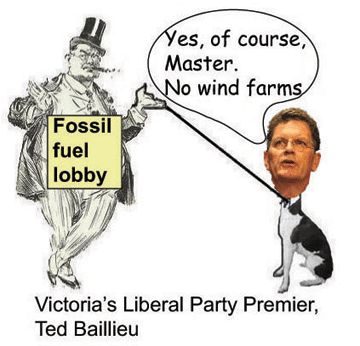 The question we, the voters, need to ask is: ‘how did such a sorry lot with such a transparent and dishonest agenda succeed in bringing the wind industry to its knees thus depriving the public of a chance to reduce our carbon emissions?’
The answer is that no government could have been so easily duped unless it was complicit.
It is clear that the scuttling of the wind industry in Victoria was a deliberate political ploy to appease the coal industry, with the Guardians’ scare campaign simply serving as window dressing to dupe the public into thinking it was all in our interest.
This is the third part of Independent Australia environment editor Sandi Keane’s trilogy on the role of deception in the public debate on global warming. The first part, Deception is our Product, looked at the role of clever PR practitioners hired by the mining oligarchs to trick the unsuspecting into sacrificing their interests for those of their clients. The second part was the handy guide: The Practical Guide to Trickery & Fakery in the Digital Age. This thirdinstalment is the actual case study of Sandi’s investigation of the Landscape Guardians and the Waubra Foundation.
CASE STUDY: The Landscape Guardians and the Waubra Foundation, Independent Australia, 6 March 12, It began early last year, when a mate who likes to argue the toss with me on enviro-issues tipped me off about the anti-wind group, the Landscape Guardians.
The first hint that these people were not the self-appointed protectors of the landscape they claimed to be was the name. No dinky di greenie group would knowingly jump into bed with the notorious UK Country Guardians, with its links to both climate skeptics and the nuclear industry. The pressure group was set up by Sir Bernard Ingham, who was a former press secretary to Margaret Thatcher, consultant to the nuclear industry and an acknowledged “black belt” in the art of spin. Continue reading
Bob Carr and Tony Abbott in perfect harmony
 Bob Carr: ‘I agree with Tony Abbott’, Green Left, March 5, 2012 By Peter Robson Prime Minister Julia Gillard anointed former NSW premier Bob Carr as the foreign minister on March 2. It awaits the approval of a joint sitting of NSW parliament but for all intents and purposes, Carr has just been catapulted to the third-highest political post in the land after being out of politics since 2005….. . We found a stand-out post from January 27. Here, Carr commented on the protest against opposition leader Tony Abbott and Gillard on January 26 by members of the Aboriginal Tent Embassy.
Carr said: “I agree with Tony Abbott and think his remarks entirely sensible. The Tent Embassy in Canberra says nothing to anyone and should have been quietly packed up years ago…….Carr also said: “The block-headed demonstration sets back reconciliation and would seal the defeat for Aboriginal recognition in the constitution if a referendum were pending.”
I think the best bit about being an Labor Party intellectual must be having the gall to tell an impoverished, oppressed minority — whose rate of imprisonment exceeds that of the imprisonment of blacks under South African Apartheid — that they are drawing too much attention to their cause. That takes some chutzpah….. In the context of discrimination of the kind his party supports by supporting the NT intervention, and the context of the vast gulf in living conditions and incarceration rates between black and white, such a policy would gut any attempt at “narrowing the gap”. It would, in short, be a policy of assimilation. Aboriginal disadvantage would become simply “disadvantage” — inexplicable, unsolvable, but most of all, no one’s fault.
Carr (bravely, Sir Humphry Appleby might say) started his post with “I agree with Tony Abbott …”. Maybe he should have just left it there. http://www.greenleft.org.au/node/50251
Carbon price is ‘business friendly’ – far from being a communist plot
 Global warming, a communist plot? Business Spectator: Tristan Edis , 6 Mar 2012 “….. within Australia, climate change science has become tarred as a cause of the left rather than an objective physical phenomenon. Attempts to use a price signal or a market in carbon permits to control the problem, one of the least communist ways of controlling emissions, are represented as the end of the world as we know it. We are told to expect mass job losses, a deep economic recession, the lights going out and even the loss of our democratic freedoms.
Some of this hysteria is clearly the product of public relations exercises by cold, calculating firms looking after their own self
interest, ….
For many of them climate change is seen through the lens of a broader battle against the left’s attempts to curtail achievement of their vision. This is perhaps best personified by someone like Hugh Morgan, former head of Western Mining and president of the Business Council of Australia. Morgan has been a major driver of Australia’s resources industry and has led fights on industrial relations, Aboriginal land rights, and other constraints on development of minerals resources.
When climate change emerged as a major problem in the 90s, Morgan was quick to act with the establishment of the Lavoissier Institute.
This association of climate change with broader causes of the left has been incredibly unfortunate. It means we now have a significant and incredibly influential segment of the business community that is almost irrational in its approach to government policies to control greenhouse gas emissions. Using a price signal or carbon permit market to control greenhouse gas emissions would be the most business friendly way of controlling our greenhouse gas emissions. It should not be seen as some kind of communist plot. http://www.businessspectator.com.au/bs.nsf/Article/climate-change-communist-plot-Nick-Minchin-politic-pd20120305-S492K?opendocument&src=rss
Lynas’ Mt Weld rare earths mines found to have out-dated safety permits
 Lynas’ Mt Weld Rare Earths Mines Safety Permits Outdated : http://community.nasdaq.com/News/2012-03/lynas-mt-weld-rare-earths-mines-safety-permits-outdated.aspx?storyid=125132#ixzz1oO63K2tj NASDAQ 3/5/2012 by Esther Tanquintic-Mis The controversy now has hit home. With Lynas Corp. still to fully arrest and win over the controversy surrounding its Lynas Advanced Materials Plant (LAMP) in Malaysia, here comes yet another information that could possibly whip up a storm right where its home base is.
In a statement released to media news agencies worldwide, the Anti-Nuclear Alliance of Western Australia (ANAWA) is set to file a motion today, Mar. 6, at the Environmental Protection Authority (EPA) to question the authenticity and effectiveness of the health and safety approvals issued to Lynas Corp. in reference to its Mt Weld rare earths mines in Western Australia.
According to the Free Malaysia Today, it was the Environmental Defenders Office of Australia that issued the media statement.
Marcus Atkinson, ANAWA spokesperson, alleged Lynas Corp. had made a number of alterations on the original health and safety approvals issued more than a decade ago for the operations of Mt Weld that did not undergo through the appropriate standard operating procedures relative to updating or modifying obsolete approvals.
“Lynas are currently operating under approvals issued to them 14 years ago,” Atkinson said, noting the terms and conditions contained in the original approvals could possibly no longer hold true to this day, specially “the amounts of radioactive materials being transported from Mt Weld through Fremantle Port.”
The Australian non-governmental organization urged the EPA to scrutinize the present operations at Mt Weld versus was what contained in the original health and safety approvals. “Health and safety issues need to be thoroughly examined to ensure the best protection of those involved in the handling of this material,” he said.
“The approvals given 14 years ago need to be re-examined by the EPA and stronger regulations need to be put in place to ease the fears of the community.” ANAWA also called for “extremely stringent” safeguards to protect Fremantle residents and other communities along the transport routes.
“We have made many mistakes in the past with the transport of lead and other materials, and we need to ensure that the same mistakes are not made with rare earth products,” Atkinson said.
Lynas Corp. is currently embroiled in a bitter battle against residents and political wannabes in Malaysia over its $200-million rare earths processing plant project in Gebeng, Kuantan.
1 This month


Help Aunty Sue Protect Her Land and Sacred Sites From Destructive Rocket Testing.
.

Australians deserve the truth
about
AUKUS – https://aukuspublicinquiry.com/

PETITION – To: Prime Minister Anthony Albanese and the Australian Labor Government

of the week – Australians for War Powers Reform (AWPR)
To see nuclear-related stories in greater depth and intensity
 Antinuclear