Australia’s fossil fuel, nuclear lobbies behind anti-wind power movement
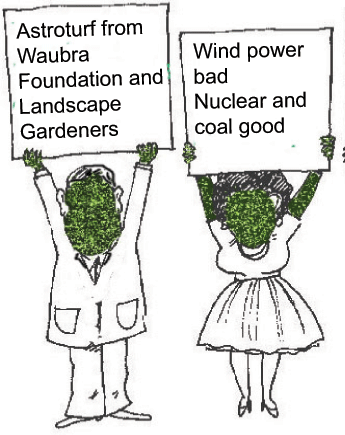 The British equivalent of landscape guardians, ”country guardians”, was funded and supported by elements of the British nuclear energy industry.
Wind farm opponents ‘aided and abetted’ by climate sceptic groups SMH, Ben Cubby, Josephine Tovey, 20 Dec 11 THE anti-wind farm movement that is gaining influence in the NSW Parliament is being ”aided and abetted” by climate sceptic groups and some mining figures.
The cabinet debated new wind farm guidelines yesterday, with division over whether NSW should follow Victoria and order wind turbines to be set further back from houses. The Shooters and Fishers Party, which shares the balance of power in
the upper house with the Christian Democrats, said yesterday it wanted a moratorium on new wind farms.
Industry sources said a US Tea Party-style ”astroturf” campaign, which mimics grassroots local opposition but is at least partly directed from elsewhere, was being waged against wind energy in NSW, which was expected to bring up to $10 billion in investment this decade as it accelerated to meet the national 20 per cent renewable energy target. Continue reading
Definitely no nuclear submarines for Australia
 Navy chief rules out nuclear subs, Canberra Times, BY DAVID ELLERY, 17 Dec, 2011 Nuclear submarines are off the menu for the Royal Australian Navy, according to its chief, Vice-Admiral Ray Griggs….Admiral Griggs told an Australian Strategic Policy Institute dinner in Canberra on Thursday night, ”In terms of nuclear submarines the Government position has been very clear – it has been consistently [that] the only thing that is ruled out is nuclear.”
Bleak prospects for Australian uranium miners: most States and ACT ban uranium mining
 Olga Galacho reports in the Herald Sun , 19 Dec “….In Western Australia, a pro-uranium conservative government faces a Labor Opposition that wants the mining banned. It is in WA that Toro will next year begin extracting uranium for the first time in that state from its $300 million Wiluna mine.
In Queensland, a state Labor government opposes uranium mining, unlike the Labor governments in South Australia and the Northern Territory.
In NSW and Victoria, freshly elected conservative governments have maintained their Labor predecessors’ ban on uranium
exploration……”It takes two election cycles to get a uranium operation up and running and in Australia, this is considered too high a political risk.”…..”
South Australian government silent on Aboriginal Heritage Act, and its implications for uranium mining
 The Government, however, remains silent on its responsibility in implementing the requirements of the Aboriginal Heritage Act,
“The traditional owners”.. are not even named in this news release.
The traditional owner group, known as the Yura Language Consultative Group, is disappointed the Minister for Aboriginal Affairs has failed to investigate its requests for a ministerial determination over the Beverley Four Mile and Mt Gee area as being culturally significant and intimately connected, despite a legal obligation to do so under the SA Aboriginal Heritage Act.
 Marsh: Cultural significance snubbed, The Advertiser, by:Jillian Marsh December 14, 2011 http://www.adelaidenow.com.au/news/opinion/marsh-cultural-significance-snubbed/story-e6freai3-1226221235838 THE news release entitled “Arkaroola to be protected forever” by the SA Government’s pledging a commitment of “unprecedented protection” is welcome news. This protection, on the basis of a comprehensive three-step process, is particularly welcome for traditional owners – members of the Adnyamathanha community.
This announcement follows the persistent public outcry over the past few years over exploration leases being granted in the Arkaroola Wilderness Sanctuary and, in particular, Mt Gee. Despite a shift in state political agencies towards a more sympathetic view of conservation concerns, all political parties remain hesitant in acknowledging the cultural significance of this region for the traditional owners. Continue reading
Australian uranium companies in Namibia – uranium turning into a “lame duck”
 After Fukushima, suddenly the expected darling of local mining investment, has turned into a pariah. Both the Areva and Marenica statements refer to events after Fukushima, highlighting the uncertainty that has entered the industry since the nuclear disaster in Japan……
Perhaps it is a case of both Kalahari Mineral and Extract Resources taking what they can get and opting out of an industry that is fast turning into a lame duck. [or a dead cat – I haven’t got a picture of a lame duck]
Namibia Economist 16 Dec 11 When three major players in one industry, all announce substantial shifts in strategy and/or focus in a very short span, it signals a fundamental change in the underlying assumptions. These past two weeks saw one surprise after another as first Extract Resources, then Marenica, and finally Areva announced a dramatic turn in their strategies which probably points to a change of heart and a significant reappraisal of prospects and strategies. Continue reading
Asian investor gives financial boost to Australia’s renewable energy fund
 Renewable energy fund launched in Sydney, SMH, December 15, 2011 An Asian investor will match the federal government dollar for dollar as part of a $200 million scheme to help local renewable energy companies get started. The commonwealth earlier this year pledged to pump $100 million into Australia’s largest renewable energy venture capital fund….. http://news.smh.com.au/breaking-news-national/renewable-energy-fund-launched-in-sydney-20111215-1ow1i.html
Climate denialist adopts creationist tactics to “educate” children
Plimer does very nicely from the mining industry which has set him up for a very comfortable retirement. He is a director of mining companies Ivanhoe Australia, Silver City Minerals and the UK-listed Kefi Minerals, , and is chairman of TNT Mines. He is reputed to earn more than $350,000 in director’s fees and shares — a lot more than he receives from the University of Adelaide where his fellow academics have written him off as a joke. He is also closely in cahoots with Australia’s richest miner, and individual, Gina Rinehart.
The launch of the book is funded by the notorious “cash for comment” right-wing skeptic group, the Institute of Public Affairs. . The IPA is run by ultra-right Liberals and funded by organisations which include BHP Billiton, Western Mining, Caltex, Esso Australia (subsidiary of Exxon), Shell, Woodside Petroleum, News Ltd, Philip Morris, British American Tobacco, to name a few. Rio Tinto was a sponsor.

 Plimer and Howard ape creationists, Independent Australia, 14 Dec 11, http://www.independentaustralia.net/2011/politics/plimer-and-howard-ape-creationists/ The mining lobby, with a helping hand from long-time chief climate change action roadblock, former Prime Minister John Howard, has taken a leaf out of the creationists playbook and is now trying to inculcate children with their unscientific nonsense. Environment editor
Sandi Keane reports. Oh my goodness, what next? The mining lobby, desperate to stop any regulation on Co2 and having failed to convert the grownups to climate skepticism, are now taking aim at our children! Climate skeptic, Ian Plimer, has really lost it this time. His new book is called “How to Get Expelled from School”, and it targets school children and teachers. According to Plimer:
“…these children are being fed environmental propaganda and these children are too young to be fed ideology.”
Does the book’s name ring a bell? The anti-scientific film entitled “Expelled: No Intelligence Allowed” was trotted by those crazies, the creationists, in the U.S. to try to stop the teaching of Darwin’s theory of evolution in American schools. Continue reading
Government of Australia’s URANIUM STATE, South Australia doing its best to kill renewable energy
 Green energy fund gets the chop BY: MICHAEL OWEN The Australian, December 16, 2011 A FUND to create a green energy industry will be axed in a cost-cutting measure by the South Australian government….. One of the most significant programs to be cut will be the Renewable Energy Fund, to deliver savings of more than $10 million a year. The
move will threaten the future of the five-member RenewablesSA board, chaired by prominent businessman Bruce Carter, and the role of the Commissioner for Renewable Energy, Tim O’Loughlin…..
Ousted premier Mike Rann launched the South Australian fund with an initial $20m in 2009 as the centrepiece of state Labor’s plan to become Australia’s green energy powerhouse.
It was to help the government reach its target of 33 per cent of renewable electricity generation by 2020 using wind, solar, geothermal and wave power. According to its website, the latest big announcement from the fund was a joint plan with new federal Industry Minister Greg Combet to use the fund to “create significant new job opportunities in
SA’s manufacturing sector”.
Mr Snelling refused to comment last night. Labor sources said cabinet chose to abolish the fund as it was hoped federal moves to invest in renewable energy because of the carbon tax would help reduce any political backlash.
Budget figures show that of the $10m allocated in 2009-10, just $2.7m had been spent by the fund, while last financial year just $2.9m of another $10m allocation had been
used…..http://www.theaustralian.com.au/national-affairs/climate/green-energy-fund-gets-the-chop/story-e6frg6xf-1226223413572
Australia’s fossil fuel industries determined to kill the Large Scale Renewable Energy Target (LRET)
what really scares the fossil fuel generators is the potential impact of a widespread deployment of solar, which some analysts predict could dominate the LRET rollout post 2015, as the cost of large-scale solar PV matches that of wind.
It is clear that there is a big push from industry and from the established generators to remove all “complementary measures” now that a carbon price has been implemented, and this includes the LRET – which, incidentally, is up for review next year.
 Why big energy wants to kill the Large Scale Renewable Energy Target (LRET) Climate Spectator, Giles Parkinson, , 16 Dec 2011 Ever heard of the merit order effect? Readers of this column may be familiar with it, because it is emerging as a key issue in the Australian electricity sector, and a flashpoint between the established fossil fuel generators and the new wave of renewable energy technologies, and a conflict between short term profits and long term gains.
The National Electricity Market, like many around in the world, is based on a merit order, where the plants with the cheapest marginal cost of fuel get preference. They bid into an energy stack until demand is filled. The price of electricity for that period is set by the bid of the last generator into the stack.
For decades, this has meant that the brown coal generators in Victoria, shoveling in cheap and dirty coal from their doorstep, go first, followed by black coal, gas, and then gas peaking stations when demand is really high. But the rollout of renewables has changed those dynamics, because their marginal cost of generation is next to nil, so they go first, forcing other generators further up the stack, meaning prices are pushed down, and some fossil fuel generators miss out altogether.
This has been a well documented effect in Europe and elsewhere, and is considered a virtue by the International Energy Agency, which says the merit order effect has meant that cost savings on wholesale energy prices have, in some cases, more than compensated for the cost of the subsidies that got the renewables built in the first place. Continue reading
Australian government’s planned nuclear waste dump breaks international safety standards
The government’s policy on the most hazardous radioactive waste is to store it in a large above-ground warehouse — indefinitely!
Contrary to the government spin therefore, the Federal Government’s policy on radioactive waste management is not a disposal solution to the most hazardous form of radioactive waste in Australia. This places the Australian Government in breach of its international treaty obligations, but, more importantly, does not eliminate the risks to humans and the environment.
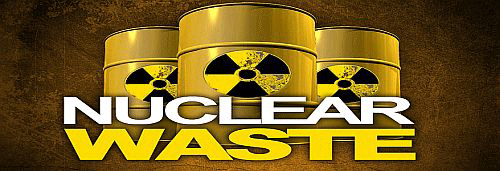 Australia’s lazy plan to dump nuclear wastes – `Solution’ brings more problems By DR PETER KARAMOSKOS Northern Territory News 10 Dec 11 THE proposed radioactive waste repository at Muckaty was determined less on scientific and public health criteria and more on opportunity. Indeed, Muckaty was not even identified as a preferred site in the NT in the original site selection process.
But the contention that is most in error is that the radioactive waste to be disposed of there is largely nuclear medicine waste. Nearly all such waste is actually short-lived and decays in local storage, and is subsequently disposed of safely without need for a repository.
While some medical-related radioactive waste requires appropriate disposal, it is only a very small proportion of the waste intended for the repository. The vast bulk of the waste that is intended to be disposed of at Muckaty is Lucas Heights nuclear reactor operational waste, and contaminated soil (10,000 drums) from CSIRO research on ore processing in the 1950s and 1960s. This waste requires isolation from the environment for up to 300 years (deemed low-level waste).
More hazardous waste (deemed intermediate level waste) arises from further Lucas Heights reactor operational waste, reprocessed spent fuel rods and residues from mineral sands processing. Intermediate-level waste requires isolation from the environment for thousands of years, most usually in an engineered disposal site up to a few hundred metres underground, as specified by the “Joint Convention on the Safety of Spent Fuel Management and on the Safety of
Radioactive Waste Management” a legally binding treaty of which Australia is a signatory. We also participate in the development of these international safety standards. Continue reading
Australia’s Energy Minister subtly sabotages photovolcaic solar energy
Ferguson labeled all clean technologies as expensive and requiring subsidies, however the figures in the white paper, concerning photovoltaics, are more than 12 months old and do not reflect the rapidly falling cost of photovoltaics.
Australian energy “white paper” neglects PV potential, PV Magazine, 14. DECEMBER  2011, BY: JONATHAN GIFFORD A strategy document released this week, on Australia’s energy future, seems to have
  overlooked the potential of photovoltaics in the country. Instead the report focused on unproven technology, like carbon capture and storage, and leaving the door open for thedevelopment of nuclear power stations.
The Australian Federal Government has released a draft energy “white paper” in an attempt to develop a clearer energy policy direction for the nation. While “accelerating cleaner energy outcomes” is identified as one of the policy priorities, it appears that a major role for photovoltaics has been eschewed in favor of alternative “cleaner” energy technologies, such as carbon capture and storage – forcoal-fired power plants, nuclear and geothermal power. Continue reading
Venture Capital Fund launched by Australian Government
Australian Government Launches A$200 Million Venture Capital Fund, WSJ, DECEMBER 15, 2011, By Gillian Tan The Australian Government has appointed Southern Cross Venture Partners as fund manager of the nation’s largest renewable energy venture capital fund, valued at 200 million Australian dollars (US$198 million).
Softbank China Venture Capital will match the Government’s A$100 million commitment and the pooled funds will assist high potential Australian renewable energy start-up companies by making early-stage, critical equity investments beginning in 2012.
Southern Cross Venture Partners has offices in Sydney as well as Palo Alto and Shanghai and according to its website, a typical initial investment will be between A$2 million and A$5 million with additional cash injections in later rounds……The Southern Cross Renewable Energy Fund forms part of the Australian Government’s $3.2 billion Australian Renewable Energy Agency.
http://blogs.wsj.com/dealjournalaustralia/2011/12/15/australian-government-launches-a200-million-venture-capital-fund/?mod=google_news_blog
Secret plans by Australian government to set up international nuclear waste dump
a five-square-kilometer space would be built on the ground and a 20-square-kilometer space would be created 500 meters below the ground to store 75,000 metric tons of radioactive waste……The candidate area spread from Western Australia to South Australia
 A plan to build a final disposal facility surfaced again in 2006 …The government that was then led by Prime Minister John Howard
Nuclear countries came close to solving problem of radioactive waste Mainichi Daily News. (By Haruyuki Aikawa, Japan December 13, 2011 LONDON — “…The Pangea group of experts funded by nuclear energy-related companies and general contractors from many countries had been secretly planning to build an international disposal site for spent nuclear fuel in Australia. However, the plan fell through after an Australian news organization exposed it.
Secret nuclear weapons plans for Australia – but files now mysteriously missing from National Archives
 Treasures of Australia’s past lost from the National Archives by:Herald Sun Patrick Lion From:The Daily Telegraph December 13, 2011 HUNDREDS of rare files – including secret plans for nuclear weapons and personal files of prime ministers – have gone missing from the library responsible for preserving Australia’s history.
Over the past two decades the National Archives has lost at least 748 historic items, some dating back more than 150 years, from its official collection of documents, government files, letters, recordings and photographs.
Among the missing files on nuclear weapons and uranium from the middle of last century is a 1956 report, The Clandestine Introduction Of Nuclear Weapons In Australia…… http://www.heraldsun.com.au/news/more-news/treasures-of-australias-past-lost-rare-items-missing-from-the-national-archives/story-fn7x8me2-1226220439496
Martin Ferguson, Australia’s Energy Minister, pushes nuclear, sabotages renewable energy
Ferguson stokes nuclear debate, ABC Radio P.M. December 13, 2011 Matt Peacock, The Energy Minister Martin Ferguson has urged the states to privatise their power assets. He’s also reignited the debate on nuclear power. The Greens say Mr Ferguson’s undermining the Government’s attempts to introduce renewable energy and most state governments have brushed aside Mr Ferguson’s push for privatisation.
That’s enraged the Greens who say that nuclear power is a dead end and that the white paper deliberately ignored the potential of the renewables. Stephen Dziedzic reports from Parliament House……
STEPHEN DZIEDZIC: The Federal Opposition’s energy spokesman Ian Macfarlane is also an advocate for nuclear power. He says the Coalition won’t consider nuclear while the community remains hostile to it, but that may change in the future…
IAN MACFARLANE: We haven’t had any active consideration of nuclear energy in Australia but the fact remains that nuclear energy is the one base load technology that is clean energy…
STEPHEN DZIEDZIC: The Greens are furious with Mr Ferguson. They say he’s biased against renewable energy and the figures the draft white paper cites on the cost of solar are out by a factor of at least two or three.
And the Greens Senator Christine Milne says Mr Ferguson is deliberately undermining the Government’s clean energy policies.
CHRISTINE MILNE: This long awaited energy paper it’s really a blast from the past. I mean Einstein once said that you can’t solve problems with the same thinking that created them.
And here you’ve got Martin Ferguson with the thinking that created the problems we’ve got with climate change coming out with predicting that the future is going to be based on coal and gas at the same time as the Prime Minister has announced that the reason she is giving Greg Combet industry and innovation is that she wants it linked to climate energy efficiency and the low carbon future. So these two policy areas are in complete collision course…. http://www.abc.net.au/news/2011-12-13/ferguson-stokes-nuclear-debate/3729494?section=business
1 This month


Help Aunty Sue Protect Her Land and Sacred Sites From Destructive Rocket Testing.
.

Australians deserve the truth
about
AUKUS – https://aukuspublicinquiry.com/

PETITION – To: Prime Minister Anthony Albanese and the Australian Labor Government

of the week – Australians for War Powers Reform (AWPR)
To see nuclear-related stories in greater depth and intensity
 Antinuclear