A pioneer wave energy project for Port Fairy, Victoria
 Wave energy to power homes, The Age, December 2, 2011 – A world-first wave energy project which mimics the movement of seaweed and kelp through the water will power hundreds of homes in Victoria’s south-west. The $14 million BioWAVE project is a single wave energy unit that will be anchored to the sea floor 30 metres underwater and about 800 metres from the shore at a site four kilometres west of Port Fairy.
The 450kW unit will be connected to the energy grid and power 300 homes by early 2013. The project is an example of biomimicry, in which biological traits are used in engineered systems. The Victorian government has put $5 million towards the project and other partners include AGL Energy Bluescope Steel, Lend Lease, Swinburne University, the University of Melbourne and the University of Sydney. Energy and Resources Minister Michael O’Brien said the project would also support the local economy and jobs. http://www.theage.com.au/environment/energy-smart/wave-energy-to-power–homes-20111202-1ob24.html#ixzz1fW5uImjT
Lack of principle in Australia selling uranium to nuclear-armed India, no proper safeguards
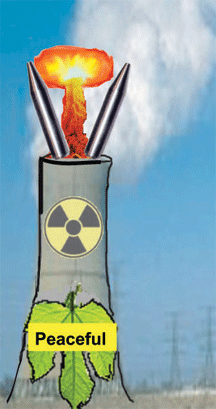 The alternative course for Australia is to side with the large majority of the world’s countries who want to re-establish and reinforce the principle that nuclear trade should be restricted to countries that have signed the Non-Proliferation Treaty and take seriously their non-proliferation and disarmament commitments.
We could take a principled rather than an unprincipled approach. We could lead rather than follow.
Safeguarding uranium exports to India Online Opinion , Dr Jim Green, 1 Dec 11 A big part of the PR pitch for uranium sales to nuclear-armed India is the assertion that ‘strict’ safeguards will ‘ensure’ peaceful use of Australian uranium. Sadly, it’s just PR.
The claim sits uncomfortably with the reality that safeguards are based on occasional inspections of some nuclear plants by the International Atomic Energy Agency (IAEA). The claim sits even more uncomfortably with the observations of recently-retired IAEA chief Mohamed El Baradei that the Agency’s basic rights of inspection are “fairly limited”, the safeguards system suffers from “vulnerabilities” and efforts to improve it have been “half-hearted”, and the system operates on a “shoestring budget…comparable to a local police department”. Continue reading
Kevin Rudd now denies plan for India, USA, Australia defence pact
Australia government denies backing India, U.S. security pact, Dec 2, 2011 (Reuters) – Australia denied on Friday it was pushing for a joint security pact with India and the United States, a tie-up that would likely add to China’s fears that wary neighbors were trying to encircle it.
Foreign Minister Kevin Rudd was quoted in an interview with the Australian Financial Review newspaper this week as backing the idea of a trilateral security pact. But a Rudd spokeswoman said he had been misinterpreted and had been responding to a question on the likely overturning soon of an Australian ban on uranium exports to India……
India’s foreign ministry spokesman said in a statement on the ministry website that New Delhi was “not aware of any such proposal”, while China’s military denounced the United States and Australia for recently upgrading military ties, warning such moves could erode trust and fan Cold War-era antagonism.
China is Australia’s biggest trading partner, with two-way trade in 2010 worth A$105 billion ($107 billion), up almost 24 percent on the previous year and driven by energy-hungry Chinese demand for Australian resources….. http://www.reuters.com/article/2011/12/02/us-china-us-australia-idUSTRE7B10BB20111202
Toro Energy looking for funds for Wiluna uranium project, but cautious about its future
TORO Energy will consider all project funding options as it moves towards developing Western Australia’s first uranium mine.. Adelaide Now, Christopher Russell December 01, 2011
Mr Hall told the company’s annual general meeting in Adelaide yesterday Toro estimated it will cost about $280 million to build the mine at Wiluna in south-central WA…..
Toro was looking for options to fund Wiluna, which would produce about 820 tonnes a year of uranium….. “In the current climate, the most likely method will be a joint venture partner who takes part-ownership in return for both funding and offtake of uranium….
Chairman Erica Smyth said the company was proceeding very cautiously……”We’re looking at all the options to finance this.” Both Dr Smyth and Mr Hall said the industry had been dealt a severe blow by the Fukushima disaster…. http://www.adelaidenow.com.au/business/toro-seeks-partners-for-280m-wa-mine/story-e6frede3-1226210632139
Prominent Labor politicians will vote against uranium sales to India

 Conroy to vote against uranium sales, The Age, 1 Dec 11VICTORIAN right-wing cabinet minister Stephen Conroy will break with his faction and with the Prime Minister by opposing uranium sales to India when the issue is debated this weekend. Senator Conroy told The Age yesterday he could not in good conscience support a change in the party’s platform at the national conference, despite Julia Gillard’s strong public call for reform. ”I won’t be supporting uranium sales to India,” the Communications Minister said. ”I have a long-standing position opposing the nuclear industry based on family experience.” Senator Conroy joins his cabinet colleague, the Left’s Anthony Albanese, in publicly breaking ranks with the Prime Minister’s position in support of uranium sales to India.
The controversial policy change – sought by energy-hungry India – is supported almost uniformly by the Labor Party’s Right faction, which has a majority at the national conference. It is opposed strongly by a majority of the party’s Left, which historically has been opposed to the uranium and nuclear industries, and concerned about proliferation risks.
Even though the majority of the Left faction is strongly opposed, the push for liberalising Labor’s uranium policy in recent years has been spear-headed by Martin Ferguson, Labor’s left-wing Resources Minister – a strong supporter of the uranium industry throughout his trade union and parliamentary careers.
The party platform prohibits uranium sales to countries outside the Nuclear Non-Proliferation Treaty. Given the ways the  numbers are trending, Labor’s national conference will make an exception for India. Right-wing powerbroker and union official Paul Howes – another long-time supporter of Australia’s uranium industry – said yesterday he expected a heated debate, but believed the Prime Minister’s position would prevail……
In 2007, former prime minister John Howard agreed to export Australian uranium to India, despite the fact it was outside the NPT. Kevin Rudd reversed that position when he took office later that year.
Indian officials have lobbied consistently for Labor to reinstate the Howard policy, and follow the United States, which is among a number of powerful nuclear countries to negotiate in recent years a bilateral nuclear co-operation agreement with Delhi. http://www.theage.com.au/national/conroy-to-vote-against-uranium-sales-20111130-1o76t.html#ixzz1fJVUtCG5
Australia to join USA-India defence pact – antagonising China
 U.S. officials have been particularly pushing Canberra to commit additionally to construction of a new fleet of 12 powerful missile submarines — possibly of U.S. design — in what would be the country’s largest sole defence acquisition.
URANIUM SALES TO INDIA…Rudd told the Australian Financial Review that a looming weekend vote and expected approval by Australia’s ruling Labor Party to drop a longstanding ban on uranium sales to non-Nuclear Proliferation Treaty countries like India could help clear the way for formation of a new pact.
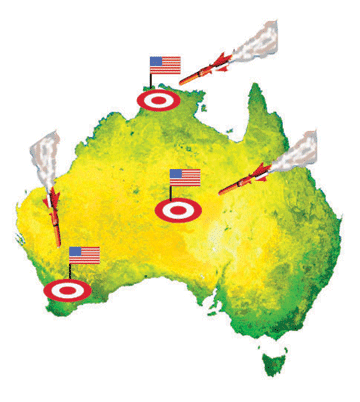 Australia backs security pact with U.S., India, By Rob Taylor, Additional reporting by Sui-Lee Wee in Beijing, Editing by Ed Davies and Jonathan Thatcher), CANBERRA | Wed Nov 30, 2011 (Reuters) – Australia’s foreign minister on Wednesday backed the formation of a security pact with India and the United States, a tie-up that could fuel China’s worries of being fenced in by wary neighbors.
It is the latest move by Australia to take a bigger role in the region’s security. Earlier this month, it agreed to host a de facto U.S. base in the north of the country which would provide military reach into southeast Asia and the South China Sea, where China has disputes with several other states over sovereignty…..
It was unclear why Rudd, a Mandarin-speaking Sinophile, would risk irritating Australia’s top trade partner China which is already nervous that Obama’s latest diplomatic push into the Asia-Pacific is part of broader U.S. policy to encircle it…..
prominent Chinese military commentator, People’s Liberation Army Major General Luo Yuan, said this week that Washington was clearly trying to fence in Beijing. Continue reading
Lawyers press for revealing secrets of Maralinga’s baby deaths after nuclear bomb testing
 the medical records of those 23 stillborn babies remain sealed and held by the National Archives of Australia.
Now, as British lawyers search for others to join the class action against the British Ministry of Defence, they will also push for the secrets of the Woomera baby graves to be revealed.
Secrecy surrounding the disturbing rate of baby deaths and research suggesting fallout from tests blanketed the town despite being more than 600km from the Maralinga testing sites, warrants those families investigating claims as part of the class act
The Children’s Graveyard at Woomera South Australia. Paul Langley’s Nuclear History Blog, 1 Dec 11 What was known and when?. SECRET records detailing the fate of dozens of babies born in the shadow of Maralinga’s nuclear testing hold the key to a case building as the state’s largest class action. More than 100 South Australians have joined a class action against the British Ministry of Defence over deaths and disabilities they believe were caused by nuclear testing at Maralinga more than 50 years ago.
Among them are families of the Woomera babies – more than 60 lives lost, many without explanation, during the decade of nuclear testing, up to 600km away. Lawyers running the case say it is “just the tip of the iceberg”. They have heard only from people who are “very confident” they have a case for compensation. Already, families of some of the stillborn children, hours-old babies and toddlers who account for more than half the plots in Woomera Cemetery for the 1950s and 1960s, have come forward….. Continue reading
Australian government policies force Aborigines off homelands (convenient for the nuclear industry)
 As Amnesty International has noted, the Government has decided to direct virtually all funding and investment in the Northern Territory to 21 “growth towns”. Thus, the 500 communities, which have about 35 per cent of the NT’s Indigenous population, were allocated $7.1 million out of the $672 million housing program. They note that “the Commonwealth Government has transferred the responsibility for homelands to the Northern Territory Government, whose own policy
clearly states no new homes on homelands in the Northern Territory”.
The result will be to force Indigenous communities from the land that has “social, cultural and economic significance to them”.
Destroying Indigenous communities and cultures, The Drum, Michael Brull , 1 Dec 11, Jenny Macklin has just delivered her second reading speech for the new intervention legislation. She had sought to soften the ground for this by announcing the new “evidence” which she claimed vindicated her measures, in the absence of any evidence of improving socio-economic conditions. Continue reading
As renewable energy costs go down, Australia should be partnering China in solar development
 wind is already cheaper than new-built coal in the US, and solar thermal with storage, and used as a peaking plant, will be competitive with peaking gas.
Australia should be pursuing a more strategic partnerships with China – like that between UNSW and Suntech, the world’s biggest solar PV maker
Why we don’t need coal, Climate Spectator, Giles Parkinson, 1 Dec 11 Last month, the International Energy Agency released a stunning report that suggested that the future of thermal coal exports could be threatened if the world ever decides to implement the policies to limit global warming to an average 2°C, rather than just merely talking about it, as they are doing in Durban this fortnight.
The coal industry laughed, suggesting such a scenario was highly unlikely. But what if technology took the decision out of the hands of politicians, as seems increasingly likely with the plunging costs of renewables, particularly solar PV, across the globe? And what does that mean also for Australia’s energy infrastructure, and the tens of billions of dollars that will be invested in the coming decade on the basis that business will continue as usual?
New forecasts from China suggest the cost of solar PV in that country will fall below that of coal-fired generation within 10 years. From that point, or even before, says Wu Dacheng, the vice chairman and secretary general of the China Photovoltaic Society, the country’s energy build out will be dominated by cheaper renewables. Continue reading
BHP Billiton trying to lock in huge new uranium mine by splurging money in advance of BHP Board’s decision?
 $1.3 billion is a lot of money to spend on a project that might never come to fruition. It’s a common tactic,
  but one that could come unstuck. But then, I’ve always suspected that Marius Kloppers, Dean Dalla Valle, like many bigwigs might feel that they have plenty of BHP money to splash around – perhaps an old-fashioned case of more money than sense.
The international news is not encouraging for the uranium industry – though I note that Australia’s mainstream media just ignores facts like – the expensive mess of nuclear transport in France and Germany, – the anti nuclear political strength gathering in France, – the huge anti nuclear movement and other nuclear hindrances in India, -and the ever downward price of uranium. – Christina Macpherson
South Australia Parliament approves BHP Billiton Olympic Dam expansion, by:Sarah Martin, Adelaide Now, :The Advertiser, November 30, 2011, BHP Billiton will start spending $1.2 billion on equipment for the Olympic Dam expansion in coming weeks after winning final approvals from Parliament for the deal to proceed.
The head of the company’s uranium operations, Dean Dalla Valle, said the approval paved the way for the $30 billion mine to be SouthAustralia’s economic driver for the next 40 years, but gave no guarantees BHP Billiton’s board would approve the project in 2012. Continue reading
Labor Senator and others take a principled stand against uranium exports to India
 Time to make a stand over uranium sales, The West, Senator Louise Pratt, 29 Nov 11 At the Labor Party national conference this weekend I will, as the Prime Minister has called on party members to do, be making a robust contribution to important debates. In particular, I will be arguing against the export of uranium to India. I do not believe there is a place for such an export in a world worried about nuclear weapons.
In 2007, I was proud when the newly elected Federal Labor government reinvigorated Australia’s commitment to nuclear disarmament, reversing the Howard government’s neglect of an important issue. Our concern about the poor state of the Treaty on the Non-Proliferation of Nuclear Weapons motivated us to support the establishment and work of the International Commission on Nuclear Non-Proliferation and Disarmament. Continue reading
Geothermal power for Australia should not be ignored
 A Clean Resource Too Large to be Ignored – Geothermal Power Gains Steam Triple Pundit By Andrew Burger | November 28th, “……..recent studies showing that the US, Canada, New Zealand and Australia – Western Australia in particular – have geothermal resources that dwarf their energy needs, and despite the fact that it’s a proven, time-tested, economic source of clean, reliable baseload power….
Uranium sales to India – nuclear weapons aspect ignored by media and government
 Yes, but India has nuclear weapons! Australia may begin exporting uranium to India, but proponents have hijacked what is primarily an arms control debate. Aljazeera, NAJ Taylo r 29 Nov 2011 “…..The Labor Party will vote on whether to change its policy position, thereby exporting uranium to India, at its national conference held in Sydney, December 2-4, 2011.
 As discussed in part one, on November 15 Australian Prime Minister Julia Gillard proposed an amendment to her party’s longstanding and non-negotiable position on uranium exports: that recipient states must be members of the Nuclear Nonproliferation Treaty (NPT).
The immediate response in Australian news media was politically orchestrated and myopically centred on Gillard’sbelief that Australia’s economy and job seekers will benefit, and that India requires a modern policy in line with “the international community”. Few commentators appeared committed to seriously debating the uranium exports in the gritty terms of arms control ……
according to the Australia and Japan-led International Commission on Nuclear Non-Proliferation and Disarmament report in 2009:
“10.5… One criticism – frequently voiced since the India agreement – is that [Nuclear Suppliers Group] members may be driven by commercial incentives to be less rigorous in their approach to countries not applying comprehensive safeguards or not party to the NPT.”
“10.7 The main substantive problem with the deal is that it removed all non-proliferation barriers to nuclear trade with India in return for very few significant non-proliferation and disarmament commitments by it. The view was taken that partial controls – with civilian facilities safeguarded – were better than none.”
Two years after these dire warnings – incidentally by an International Commission co-chaired by our former Foreign Minister Gareth Evans and instigated by then Prime Minister Kevin Rudd – Gillard also appears to be primarily “driven by commercial incentives” and a perceived diplomatic dividend…..
it’s not the strength or frequency of criticism of the existing policy that is troubling to me, but the flawed arms control logic within, and moral grandstanding of, their arguments.
For if this sort of willing delusion prevails, and uranium sales to India go ahead, then undoubtedly this will be a pivotal moment when nuclear arms control returns to those tense and cold days from which, this time, we may never turn back. http://www.aljazeera.com/indepth/opinion/2011/11/2011112414232543488.html
Australian Nuclear Science and Technology Organisation (ANSTO) buyng into the Thorium dream?
Anything to keep the nuclear industry alive?
Australian and Czech consortium announce thorium joint venture Australian Mining – Cole Latimer – 30 Nov 11 Arrangements will be discussed with the Australian Nuclear Science and Technology Organisation (ANSTO) which is responsible for monitoring the activity and … (Website was not available to me, – Christina Macpherson)
BHP BILLITON ABOVE THE LAW FOR ANOTHER 70 YEARS AND BEYOND
 The Roxby Downs Indenture Bill today passed the South Australian Upper House. It has now passed both houses of Parliament, enshrining in law an agreement that over-rides some 21 South Australian laws, including state legislation covering radiation protection.
“Since the negotiation of the Indenture Agreement, it has been clear that the parliamentary process would simply be a rubber stamp. For example, in the Parliamentary Select Committee hearing, the opposition had the chance to question BHP for an hour, and the nature of their investigations were along the lines of concerns for the caravans that may be inconvenienced if a road was closed, never mind the tailings dams that are designed to leak,” said Nectaria Calan from Friends of the Earth Adelaide.
“Neither Labor not Liberal have shown any inclination to critically scrutinise the implications of the project, with the government bending over backwards to accommodate the mining giant. BHP wanted to recognise a historical version of the Aboriginal Heritage Act that was repealed over 20 years ago – they got it. They wanted a mining lease that spans 70 years, despite the fact that their Environmental Impact Statement only covers 40 years – they got it. They wanted the right to be granted the expanded mining lease, covering nearly 50, 000 ha as freehold, free of charge – they got it. They wanted royalties capped for 45 years – they got it,” said Ms. Calan.
The scope of the Indenture Agreement extends far beyond the 40 years covered in the Environmental Impact Statement.
“It’s a strange state of affairs to have an Environmental Impact Statement that only covers 40 years, a mining lease granted for 70 years, and an indenture agreement that creates the right for future mining leases that will not expire until the last of the extended mining leases have expired. The intention appears to be to avoid any further Parliamentary scrutiny at all cost,” continued Ms. Calan.
1 This month


Help Aunty Sue Protect Her Land and Sacred Sites From Destructive Rocket Testing.
.

Australians deserve the truth
about
AUKUS – https://aukuspublicinquiry.com/

PETITION – To: Prime Minister Anthony Albanese and the Australian Labor Government

of the week – Australians for War Powers Reform (AWPR)
To see nuclear-related stories in greater depth and intensity
 Antinuclear