Non Government Organisations support Aboriginals, urge repeal of punitive Intervention legislation
“The compulsory nature of income management and its blanket imposition (in combination with other changes, such as local government reform, shire amalgamations and losses of local councils; changes to CDEP; the loss of the permit system; and changes in land tenure) are likely to have contributed to people’s feeling of a loss of freedom, empowerment and community control.”.
 Aboriginals of Australia: NGOs Urge Government to Repeal Intervention Legislation Unrepresented Nations and Peoples Organisation (UNPO) 26 Nov 11 Despite government-sanctioned reports that ‘welfare quarantining’ has resulted in the disenfranchisement of indigenous communities in their own affairs, Canberra has voted to extend the legislation. NGOs are particularly concerned with the development of a measure which would suspend welfare payments to parents whose children exhibit recidivism in low school attendance. Continue reading
Victorian govt leads the way from renewable energy, towards brown coal, then nuclear
 the massive 3,700 sq km lease EL4416 to Dr. John White’s Ignite Energy Resources. Cutting a swathe right across southern Gippsland’s prime coastal and tourism region, it runs the entire length of the spectacular 90 Mile Beach from the top of Wilsons Promontory to the Gippsland Lakes, half circling the towns of Bairnsdale, Sale and Traralgon.
when action on global warming can no longer be delayed, what will the Victorian government’s exit strategy be for brown coal? How will it placate community concern over food security and energy in a warming planet? In the absence of any willing investors left for wind or solar, are Victorians the first to be softened up for the nuclear debate we’re yet to have?
White is more than just a valued friend of the Liberal Party and former head of Prime Minister John Howard’s Uranium Industry Framework. White is a serious player in the international nuclear stakes and was the brainchild behind the “cradle to grave” business plan for President George Bush’s Global Nuclear Energy Partnership.
 Victoria goes dirty brown, Independent Australia, 25 Nov 11 IA INVESTIGATION: The new Victorian Government has abandoned any concerns for the environment in a rush to turn Victoria into a big, dirty, brown coal mine. Environment editorSandi Keane reports “…. Under recent legislation, new coal-fired power stations can be built 1km from the nearest residence (or just over 1km in the case of the Anglesea Primary School) – but not for a windfarm, which needs to be at least 2km away from the nearest complaining resident….the grab for arable land is on…..Over 40 per cent of Victoria is now under licence — a “ticking time bomb” according to Environment Victoria’s Make Wakeham. Its new website, CoalWatch, allows users to see at a glance which areas of Victorian have been leased to mining companies for the mining of brown coal….. Continue reading
In Australia Liberal and Labor follow G.W. Bush in fostering spread of nuclear technology and weapons
How Labor finished Bush’s uranium script The debate over uranium exports to India has ignored the most important argument of all, writesAndy Butfoy Inside Story, 23 November 2011 THE biggest threat facing humanity is the uncontrolled spread of nuclear weapons. Because it is the custodian of the world’s largest reserves of uranium, Australia has a special responsibility to help protect the global rules containing this danger. But you wouldn’t know this from reading Julia Gillard’s announcement backing the sale of uranium to India, or from listening to the subsequent comments from the opposition’s foreign affairs spokeswoman Julie Bishop. Continue reading
Australian Renewable Energy Agency (ARENA) – a new approach to management
 ARENA: A new approach to renewables, Climate Spectator, Scott Bouvier, 25 Nov 11 The Bills that set up the Australian Renewable Energy Agency (known as ARENA) quietly passed through Parliament this month. ARENA has been broadly welcomed as consolidating the management of multiple funding programs with greater independence. To date, ARENA has been promoted as business as usual, but with a new approach to management Continue reading
Energy farming an additional industry for rural Australia
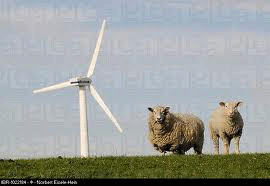 In Australia for many of us, isolation and lack of population limits such pursuits. Not so with renewable energy. It holds distinct advantages over traditional farming. It can be locally generated and locally used. We won’t face the market share and price squeezes that overseas competitors foist on us in other commodities.
I encourage state and federal politicians and bodies such as the National Farmers’ Federation and affiliated state representatives to lobby for renewable energy at ministerial level. After all it is a primary industry, no different to beef, sheep and viticulture.
Future in renewable energy, Weekly Times, 24 Nov 11 RENEWABLE energy is everybody’s concern, writes ROB NICHOLS Whether you believe the science on climate change or not, few would deny that a cleaner environment fuelled by renewable energy sources is a desirable goal. Far from threatening farming, this switch offers farmers and rural communities incredible opportunities.
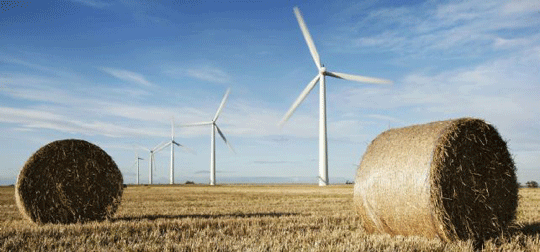
And these are big opportunities, as big as the opportunities afforded by fossil-fuel discoveries which have delivered spectacular fortunes to the world’s energy giants. After all, society’s insatiable desire for easier living and energy continues. Farmers have the resources – sun, wind, crops for biomass etc – plus the space to provide that energy.
Those resources can help us spread our financial risk, but we need to be quick. If we sit back and undervalue them, city and overseas investors will tap and rob our resources and export the financial gains away from our localities into the pockets of others. Failure to take control now will mean our businesses and communities will wither away and become irrelevant. Continue reading
Germany showing the way towards a distributed, decentralised energy future
 And will the rest of Europe follow? The poll-leading Socialists in France, after all, are talking of halving the country’s nuclear capacity. “Most of the world will follow this way, but it will be slow,” Dudenhauser says. “Everyone expected blackouts after the nuclear shutdown, but it didn’t happen. But it would not be manageable if everyone goes Germany’s way in the next two years.”
 Size not a factor in German power play , Climate Spectator, Giles
  Parkinson, 24 Nov 11 It seems strange that the world’s most cautious and best performing economy should be acting as some sort of crash test dummy for the world’s clean energy future. But this is exactly the position that Germany finds itself in following its commitment earlier this year to abandon nuclear energy and to push towards its vision of a fully renewable power supply by 2050.
And if this is the future, then companies that have based their models around the principal of centralised power stations may find little cause for comfort. But it is presenting enormous opportunities for those focused on the concept of distributed generation, particularly fuel cells – at least that’s the take of Roman Dudenhausen, the CEO and co-founder of German energy consultants ConEnergy, and a recently appointed director to the board of Australia’s Ceramic Fuels Cells. Continue reading
Australian company SILEX’s laser uranium enrichment technology – risks of nuclear weapons proliferation
 many of the good things GE is using to make a case about Silex—less use of resources and electricity and increased efficiency—are actually negatives that make it easier for rogue states to hide clandestine plants…..methods for the production and use of nuclear materials that would be more difficult to detect,” the report states
New Uranium Enrichment Technology Alarms Aviation Week, By Kristin Majcher Washington 23 Nov 11 General Electric says it has successfully tested a faster, cheaper way to produce nuclear reactor fuel, and is planning to commercialize the technology by building a facility in Wilmington, N.C. While the prospect of saving resources to generate energy at a lower price sounds like a breakthrough, scientists are concerned that the top-secret method of enrichment that GE is using will indirectly elevate proliferation risks around the world, thus inspiring rogue states to develop their own laser enrichment facilities for nuclear
weapons.
The enrichment technology is the Separation of Isotopes by Laser Excitation (Silex). It was developed by Silex of Australia in 1992. The technology company USEC funded early research on Silex, but abandoned it in favor of focusing on centrifuge enrichment. In 2006, GE signed an exclusive agreement to commercialize and license the technology and spearhead further research and development. Continue reading
Big energy purchase deal for New South Wales wind farm
 Origin Energy Buying Electricity From Gunning Wind Farm by Energy Matters, 24 Nov 11 Origin Energy has expanded its renewable energy portfolio, entering into a long-term power purchase agreement to buy electricity from Acciona’s Gunning Wind Farm.
Under the deal, Origin will initially purchase federal government issued Large-Scale Renewable Energy Certificates (LSREC) from Acciona for a period of two years, beginning January 2012. From January 1st 2014, the agreement allows Origin to buy both the LSRECs and the power generated by the wind farm for a further eight years; with an option to extend. Continue reading
Radiation health effects from rare earths plant – a warning for Australian company Lynas
 Industrial health expert T Jayabalan told FMT that he lived in Bukit Merah for three years during the 1980s, “collecting data” on the residents there. According to him, Lai Kwan and Cheah were only two of the many people he studied before presenting his findings to Malaysian courts. “Birth defects still exist,” he said, “and the number of miscarriages is incredibly high. Even if a foetus survives, it can still be born with leukemia and brain damage.”
“I’ve seen it happen with my own eyes. I’ve seen the suffering of these people. The only good thing about Lynas is that it hasn’t happened yet.”
 (includes VIDEO) Inside the world of a radiation victim, Free Malaysia Today Patrick Lee, November 24, 2011 VIDEO Tan Chui Mui’s short documentary is also about a mother’s undying love. Cheah was born in 1983, a year after Lai Kwan worked as a bricklayer at the Mitsubishi rare earth plant in Bukit Merah, Perak.
Cheah has multiple congenital defects, including a hole in the heart. He is also mentally deficient and virtually blind. And Lai Kwan is beside her son nearly every hour of her life, as portrayed in a short film entitled “Lai Kwan’s Love”…..
she tells the camera that she had no idea that the rare earth plant where she worked was handling toxic materials. Continue reading
Australia’s discriminates in favour of India, on uranium sales
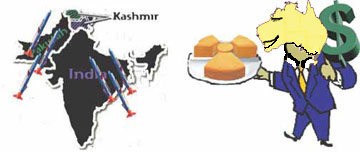 India is not a party to the NPT, has never been, has developed a nuclear weapons capability as a non-member of the Treaty, and accordingly, is in an entirely different position from China vis a vis Australian uranium export policy..
Surely the more appropriate sequence would have been to have the Cabinet discussion first, and make a fully-informed decision as to whether or not a change in the policy is desirable, and what its ramifications are, then take the matter to the party if needs be, armed with the support of a properly considered Cabinet decision…… Once she has made an exception for India, what is she going to say to our allies in Pakistan and her dear friends in Israel?
Nuclear policy and process dumped at the drop of a hat, The Drum, Paul Barratt, 21 Nov 11 The announcement by the Prime Minister that she intends at the forthcoming ALP National Conference to seek a change in the Party’s Platform to permit the export of uranium to India is of concern on three grounds: the content of the policy change; the apparent failure to extract anything in return for what is by any measure a major policy shift; and the extraordinary decision-making process by which this change is to be brought about.
The change has been presented publicly as little more than an administrative matter designed to correct an anomaly in our current export policy. The narrative runs that the policy discriminates against India because we are prepared to export uranium to China, a nuclear weapon state, but not to India for peaceful use. This is arrant nonsense. Continue reading
A few atomic veterans, previously excluded,can now claim compensation
Aussie nuke testing victims receive compo, News.com.au, 22 Nov 11 A HANDFUL of Australian veterans exposed to British nuclear testing in the 1950s and 60s who missed out on compensation will finally get payments and health care. Tonight the Senate passed laws to close loopholes that had inadvertently excluded about 10 victims….. The radiation victims were involved in maintenance, transporting or decontamination of aircraft used in the British nuclear test program….. Continue reading
In China, wind power racing ahead, while nuclear power declines
Nuclear power, on the other hand, is a tale of decline. China’s wind sector overshadows the 11GW worth of nuclear in their electricity supply. In only six years, wind has blossomed to deliver 55 per cent more electricity to the grid each year than nuclear – an energy source the Chinese have been building for the last 26 years.
The growth of nuclear in China, although slow, has slowed further
China’s massive deployments will be driving renewables down the cost curve, so Australia can invest in wind today with certainty that the technology is a wise long-term investment.
China’s path to renewable superpower Climate Spectator, Matthew Wright, 23 Nov 11 Comparing China’s wind and nuclear power sectors reveal much about the fortunes of new and old energy technologies. Wind power in China is growing at a blinding pace. China commenced construction of its first wind turbines in 2005 and in just six years has installed 58GW worth of wind power, which now contributes 128TWh to its grid. This is enough renewable electricity to power Australia’s most populous states – NSW and Victoria combined. Continue reading
Australia’s electric transport future – powered by sun and wind
 Australia needs to begin a deliberate and widespread push into electrifying its transport
  network, which means a big push for electric vehicles, but also a much higher ambition for renewable energy deployment. Siemens, Europe’s biggest supplier of energy equipment, which recently dumped nuclear from its portfolio after Germany’s withdrawal, suggests 40 per cent of Australia’s power generation should come from renewables – particularly solar and wind – by 2030.
An electric dream for transport, Climate Spectator Giles Parkinson, 23 Nov 11 Imagine an Australia with fast trains linking the major capital cities, diesel/electric trucks equipped with pantographs following overhead wires like trams in the inner city, electric vehicles dominating the passenger vehicle market, and 40 per cent of our electricity coming from renewable energy. Imagine, also, a smart phone-style “mobility manager” that allows you to make transport choices that can generate carbon credits, that can be accumulated and redeemed for restaurant vouchers, movie tickets and free travel. And all this by 2030. Continue reading
Australia will lose all Non Proliferation credibility in selling uranium to India
India continues to give assurances that imported materials are solely for civilian use, yet it refuses to sign the Comprehensive Test Ban Treaty and is yet to ratify the International Atomic Energy Safeguards Agreement.
Blindly following bad US policy is neither in our best interests nor the world’s. It would be a terrible compromise of our nation’s principles, and put at risk our enviable reputation as a responsible global citizen for very little short-term gain.
Gillard’s uranium-to-India play is a dangerous sellout, SMH, Senator Gavin Marshall, November 21, 2011 Australia risks contributing to the India-Pakistan nuclear arms race.

NEXT month’s ALP national conference will be asked to make a decision of global importance: whether to back Prime Minister Julia Gillard’s call for Australia to export uranium to India. Australia must decide whether to stand with the vast majority of nations in supporting the principle of nuclear disarmament, or to stand with those who continue to undermine it.
India is not the responsible nuclear citizen that many would have us believe. It has a long history of broken promises and reckless conduct relating to its nuclear programs. Continue reading
Poll shows Queenslanders reject uranium mining, and uranium sales to India
 Queenslanders reject Julia Gillard’s uranium sales to India, Galaxy Poll finds, by:Steven Scott , The Courier-Mail November 21, 2011 PRIME Minister Julia Gillard’s plan to allow uranium sales to India has been rejected by a majority of Queensland voters. And only a third of the state’s Labor voters back Ms Gillard’s controversial plan, a Galaxy poll conducted exclusively for The Courier-Mail found….
A meeting of left-wing Labor MPs in Canberra yesterday vowed to use the conference to fight against Ms Gillard’s plans to sell uranium to India because it has not signed the nuclear non-proliferation treaty. “It is a sell-out of everything we’ve stood for as a party over the last 40 years,” Left faction convener Doug Cameron said.
About 56 per cent of the state’s voters are opposed to selling uranium to India, according to the poll of 800 people on November 16 and 17. Opposition to the plans is even higher among Labor supporters, with 61 per cent rejecting it. The plans have pitted Ms Gillard against Queensland Premier Anna Bligh, who has refused to lift a ban on mining the state’s considerable uranium reserves….. http://www.couriermail.com.au/business/poll-backs-ban-on-uranium/story-fn7kjcme-1226200652135
1 This month


Help Aunty Sue Protect Her Land and Sacred Sites From Destructive Rocket Testing.
.

Australians deserve the truth
about
AUKUS – https://aukuspublicinquiry.com/

PETITION – To: Prime Minister Anthony Albanese and the Australian Labor Government

of the week – Australians for War Powers Reform (AWPR)
To see nuclear-related stories in greater depth and intensity
 Antinuclear