Victoria’s Baillieu Liberal government kills off community wind farm plans
 As of last month, the project is on hold, possibly dead, after the Baillieu government introduced Australia’s most restrictive wind farm regulations.
 Libs sweep wind from turbine sails, The Age, Adam Morton. September 24, 2011 — Nearly four years ago, a small group of Woodend residents hatched a plan to power the historic town entirely on renewable energy. Three wind turbines would be built in a pine forest six kilometres south of the town to generate enough energy to run not only Woodend, but also nearby Macedon, Mount Macedon and Newham.
Wind speeds were modelled to determine the best location, community forums held, more than 500 signatures collected in support, and initial steps taken to start raising the $14 million needed. A smaller number of people expressed objections. Continue reading
Australia gets Tea Party style anti carbon tax movement
The ABC’s Hungry Beast featured him as one arm of a very corrupt and conspiratorial octopus, in a report on US billionaires David and Charles Koch earlier this year.
But Andrews’ latest project, Stop Gillard’s Carbon Tax, is his most successful yet
Meet the man behind the anti-carbon tax lobby, RACHEL HILLS, 17TH SEPTEMBER 2011 The Spectator The New York Times dubbed it a ‘tempest with echoes of a tea party.’ Julia Gillard has called it the ‘Americanisation’ of Australian politics. Others say it’s just the latest iteration of the city-rural divide that saw the rise of One Nation in the 1990s, and the ‘Joh for Canberra’ revolt that thwarted John Howard’s ambitions in the 1980s.
For Tim Andrews, one of the masterminds behind the anti-carbon tax protests that have Labor’s hold on government on tenterhooks, it’s the start of something bigger: the rise of an activist centre-right with the potential to revolutionise Australian politics the same way the Tea Party has in the United States. Continue reading
Why there are only a few claims to Australian government from nuclear veterans
– “John” comments on Adelaide Now, 23 Sept 11 Mr Snowdon said “the Department of Veterans Affairs had received claims from a small number of personnel not currently eligible for compensation and health care from their participation in the British nuclear test program” Small number, because like my Grandfather who was there, they have passed away due to some form of cancer..If you stall long enough neither the British or the Australian governments will need to pay a dollar in compensation 57 plus years is a long time to admit you were at fault.
Nearly 60 years later, a few of Australia’s nuclear veterans will get some government help
British nuclear test compensation victory for RAAF personnel, Adelaide Now, September 22, 2011 A SMALL number of veterans of British nuclear tests conducted in Australia in the 1950s and 1960s will now be entitled to health care and compensation. Veterans Affairs Minister Warren Snowdon said the former RAAF personnel had previously been excluded as their involvement fell outside the currently legislated nuclear test areas or time periods. Mr Snowdon said others could also be eligible.
“The quality of the records from the test period, and the secrecy surrounding the operation, means that it is impossible to rule out the likelihood that new information may come to light which warrants further extension of coverage to additional groups of participants,” he told Federal Parliament.
Mr Snowdon said the Department of Veterans Affairs had received claims from a small number of personnel not currently eligible for compensation and health care from their participation in the British nuclear test program.
He said they were involved in the maintenance, transporting or decontamination of aircraft used in the nuclear test program outside the currently legislated nuclear test areas or time periods.
The maintenance and decontamination of the aircraft – mostly Canberra bombers – took place at Woomera and the Edinburgh air base, near Salisbury. Britain exploded seven atomic bombs in the South Australian outback in 1956-57 but continued the nuclear test program through to May 1963 with a large number of minor trials of items such as nuclear initiators. Nuclear test veterans have long sought a better deal, arguing that their health was affected by radiation exposure.
Debate on the Veterans’ Affairs Legislation Amendment (Participants in British Nuclear Tests) Bill 2011 was adjourned….http://www.adelaidenow.com.au/news/south-australia/british-nuclear-test-compensation-victory-for-raaf-personnel/story-e6frea83-1226143449967
South Australia’s Liberal Party says nuclear power uneconomic, goes for gas and trigeneration
South Australian Liberals to look at trigeneration power, VERITY EDWARDS, The Australian, September 23, 2011 SOUTH Australian Opposition leader Isobel Redmond has committed a future Liberal government to investigating trigeneration power, despite concerns about its cost and reliability.
Delivering a headland speech to the Australia-Israel Chamber of Commerce in Adelaide, Ms Redmond yesterday criticised the introduction of a carbon tax and price as “economically insane”, described nuclear power as uneconomical and said gas would be the state’s logical source of future energy.
“If elected, a Redmond Liberal government will conduct a feasibility study into a trigeneration network in Adelaide,” Ms Redmond told the lunch. Gas-fired trigeneration plants produce electricity and harness the heating and cooling by-products for use within buildings.
The City of Sydney last year announced it wanted to establish a network of trigeneration plants capable of generating 330MW of electricity by 2030, or up to 70 per cent of Sydney’s needs….http://www.theaustralian.com.au/national-affairs/state-politics/south-australian-liberals-to-look-at-trigeneration-power/story-e6frgczx-1226144067671
Australia’s Lynas company’s problems – share price, governance, Malaysia protests
 It is interesting to keep an eye on Australia’ s Lynas corporation. For one thing, that devious old propaganda
 merchant, Ziggy Switkowski is on Lynas’ board of directors. Wherever Ziggy is, spin will abound.
For another thing, Lynas is dedicated to make a mint out of rare earths processing in Malaysia. (nothing wrong with the idea – after, making a mint is the correct mission for a corporation – its only responsibility, unfortunately).
Still – the rare earths processing is fraught with danger. Both USA and China had to stop rare earths operations, due to very bad environmental pollution, though both are now starting again. China got away with it for ages, by putting the rare earths processing in a rural area, with an unsophisticated indigenous population. But Malaysia – that is a different situation, with a much more educated and urban population, who don’t want the pollution risk.
And now – Lynas has a couple of other problems – its plummeting share price, and some questions about corporate governance
Corporate governance guidelines outlined by the Australian Securities Exchange recommend that ”the role of chair and chief should not be exercised by the same individual”.
 Lynas is expected to report a full-year loss before tax of $57 million today as it ramps up towards production. Shares in Lynas closed 17.5¢, or 14 per cent, lower at $1.105 – more than 60 per cent off its April high of $2.70.
Lynas shareholders demand that chairman steps down, The Age, Philip Wen, September 23, 2011 A VOCAL group of retail shareholders in rare-earths miner Lynas is seeking to remove mining entrepreneur Nick Curtis as chairman, citing concerns over ”risks to corporate governance”. Continue reading
Uranium mining company Rio Tinto on a losing streak
 Rio Tinto: The Losing Streak Continues (RIO) Financial News Network, 09/22/2011, By Robert Cotte, Rio Tinto (NYSE:RIO) traded at a new 52-week low today of $45.56. So far today approximately 10 million shares have been exchanged, as compared to an average 30-day volume of 3.2 million shares.
Rio Tinto PLC is an international mining company. The Company has interests in mining for aluminum, borax, coal, copper, gold, iron ore, lead, silver, tin, uranium, zinc, titanium dioxide feedstock, diamonds, talc and zircon. Rio Tinto’s various mining operations are located in Australia, New Zealand, South Africa, the United States, South America, Europe, and Indonesia…… http://www.fnno.com/story/52-week-high-lows/331-rio-tinto-losing-streak-continues-rio-52-week-high-lows
Rio Tinto not really optimistic about uranium mining
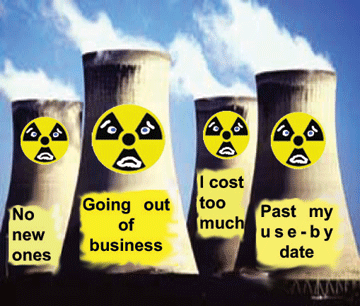 Rio Tinto hopes for a short nuclear slowdown, The Australian, Dow Jones Newswires , September 23, 2011 JAPAN’S Fukushima nuclear accident in March has damaged the credibility of the uranium mining industry and will slow nuclear power growth for up to two years, predicts a Rio Tinto executive…..
The medium-term outlook for uranium, the key fuel for nuclear reactors, remains clouded in the wake of the Fukushima crisis.The crisis began in March when explosions crippled the Fukushima reactor complex following the country’s devastating earthquake and tsunami. Rio Tinto is a major uranium producer via its majority ownership of Energy Resources of Australia and the huge Rossing Uranium mine in Namibia….
Mr Lloyd said that, in addition to uncertainty about demand, the “high capital cost” of new nuclear reactors might be an issue for the sector as it sought to attract funding in coming years. ……http://www.theaustralian.com.au/business/mining-energy/rio-tinto-hopes-for-a-short-nuclear-slowdown/story-e6frg9df-1226144025698
UN report on Nuclear Safety has implications for Australia
Today, 22 Sept 11, a special UN meeting will examine responses to Fukushima and the role/safety of nuclear power.
UN Secretary General Ban Ki Moon commissioned a multi-agency report to help guide this discussion.
It is available via http://www.reachingcriticalwill.org/political/energy/hlm/UN-system-wide-study.pdf
Dave Sweeney Comments on the United Nations system-wide study on the implications of the accident at the Fukushima Daiichi nuclear power plant – September 2011
The report has been primarily drafted by the pro-nuclear International Atomic Energy Agency and is framed with the assumption that nuclear power is here to stay – Nuclear power has been and will remain a significant contributor to meeting global energy needs (16)
Within this flawed context there is much value and campaign utility in the report. Continue reading
Nuclear power a victim of, not a solution to – climate chnage
rather than being a solution to climate change, nuclear is actually significantly undermined by climate change. The coalition does not want to address climate change, but we are going to have more extreme weather events in Australia, more high-temperature days. It is completely unsuitable technology in this country. But I do want on the record that Senator Abetz reiterated that it is coalition policy to build nuclear reactors in Australia. He still has not said where he would build them—
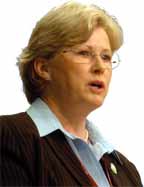 Australian Parliament, Senate speech, Senator Christine Milne, 21 Sept 11“……..On climate change, there is this ridiculous assertion that nuclear energy is required to address climate change. It is actually the opposite. In this report it states that the assumptions that need to be reviewed are regarding the types of accidents that are possible. The report says that an assessment of those accidents was way too modest and that they need to look at the possible effects of climate change in relation to nuclear energy. That is because nuclear cannot take the heat. We have seen right around the world in the last decade several occasions where nuclear reactors have had to be closed down because of extreme heat conditions, which will be increasing as the rate of climate change accelerates.
Let me give you a few examples. In July 2010 in Alabama we saw the shutdown of nuclear facilities to the point where it cost that energy agency or energy department $50 million, all of which had to be paid for by customers in Tennessee, when they had to close down the reactors because they could not cool them, there was no water to be able to do it, and also they could not dispose of the hot water into river systems which were already depleted. Continue reading
South Australian government secrecy on expansion of BHP’s Olympic Damn
 Release ‘secret’ Roxby report, 22 Sept 11, The Greens have called for the immediate release of a hidden report that captures the views of State Government agencies on the Olympic Dam
Mega-expansion.
Called the ‘Assessment Report’, it is a compulsory step in the approval process for a major development. It summarises the responses by various government agencies to the proponent’s Supplementary Environmental Impact Statement (EIS) and is supposed to be released before the Government announces its approval of a project. However, for recent controversial projects the Rann Government has chosen to only release the Report after they have announced their decision. “The only reason the Government is choosing not to release the Assessment Report now is to avoid scrutiny,” said SA Greens Parliamentary leader Mark
Parnell.
“The Government is holding back the Report’s release for political reasons – keeping the SA community in the dark. This means that the public doesn’t get a chance to respond. It also allows the Government to dodge tricky questions as the media and others tend to focus on the approval decision, rather than what Government agencies actually think.
“The Rann Government has form in releasing the Assessment Report only after they announce their decision on a project. They did it for Buckland Park and they did it for the Port Stanvac desal plant. “For a project as important as the Olympic Dam expansion, the Government should be giving the SA community more opportunities to be involved in the
final decision, not less. “For example, the Assessment Report will be able to tell us what
Government agencies like SARDI really think about the proposed desalination plant at Pt Lowly.
“The Greens call on the State Government to immediately release the Assessment Report, well before they announce their decision on the OlympicDam Expansion.
Despite hazards, Australian company Lynas pushing ahead with Malaysian rare earths project
Rare earths mining and processing is difficult, expensive and rarely ecologically friendly. It produces enormous quantities of wastewater, requires vast amounts of energy, uses toxic materials in the refining process and can produce radioactive materials with half-lives of hundreds of years.
Prime Minister Najib Tun Razak and other government officials have continued to insist the plant won’t open until all safety and environmental concerns are met. …
Head of Australia’s Non-proliferation Office pushed for nuclear power
 Leaked cables show nuclear power push, SMH, Dan Oakes, September 20, 2011 THE HEAD of Australia’s nuclear safeguard authority advised the then prime minister Kevin Rudd that no scheme to limit carbon emissions would succeed without the building of civilian nuclear power stations, according to leaked US diplomatic cables.
A report on a 2008 meeting between US and Australian officials – released by WikiLeaks – records John Carlson, then director-general of Australian Safeguards and Non-proliferation Office, as saying that he doubted there would be any shift in the Labor Party’s opposition to nuclear power…… Read more: http://www.smh.com.au/national/leaked-cables-show-nuclear-power-push-20110919-1ki2h.html#ixzz1YWyYtdBb
Information about rare earths, but not much about their dangerous wastes
ABC radio conducted this informative interview on rare earths – but rather light-pedalled their radioactive waste problem – C.M.
The role of rare earths in your day to day life, ABC Radio 17 Sept 11, Philip Clark“……..the nature of some of these deposits is that they are quite complex. In essence they… as you mentioned, there’s lots of elements, particularly they’re present in small quantities. They’re in quite complex minerals, often in phosphate minerals; often they have uranium and thorium and other elements associated with them. That leads to complications in processing to some extent, but it also leads to regulatory issues, because around the world—in this country as well—there are jurisdictions that do not want or don’t allow at this stage, mining of uranium, even though that uranium might be a very, very small amount, as it generally is with these deposits.
I guess the other part of the processing—and it’s what’s really occurred I think in Malaysia recently—it is a complex… with so many elements and very complicated but manageable process route to get each of these elements out, and they’re very valuable, you do need to use sophisticated chemical processes and they need to be strictly and adequately policed……
Philip Clark: My guest is Peter Arden. He’s a scientist and resources analyst at Ord Minnett. We’re talking about rare earths. These are unusual minerals, but with big uses in electronics—television sets, mobile phones, batteries, powerful magnets, all use these materials and most of the world’s supply at the moment is controlled by China. Is there an opportunity for Australia here?
The processing of these minerals, though, is the key, isn’t it? That’s not straightforward, you need a processing plant, and extracting the actual rare earth from the mineral can be complex, can’t it?… in addition to the rare earths you generally find, as we’ve talked about, other elements—uranium and so on.
Clean Energy Council once again to be run by fossil fuel interests?
 Some years ago, the Clean Energy Council was heavily influenced by the fossil fuel industries – and so, not at all to be trusted on matters of renewable energy.
The Clean Energy Council cleaned up its act. But now – is it once again to be dominated by fossil fuel interests? – C.M
[AGL – one of] the big three energy “gentailers” – along with Origin and TruEnergy – which already wield extraordinary power over the clean energy industry and effectively hold the power of veto over which projects and which technologies get funding….the concentration of power in the hands of the gentailers is not good, and it is their influence, rather than bad policy, that is often blamed for blocking the rollout of renewables.
Australia’s clean power struggle, 20 Sep 2011, Climate Spectator, Giles Parkinson The naming of AGL Energy CEO Michael Fraser as the new chairman of the Clean Energy Council caused barely a ripple of interest in the mainstream media last week, but it has created some anxiety in the local renewables industry……. Continue reading
1 This month


Help Aunty Sue Protect Her Land and Sacred Sites From Destructive Rocket Testing.
.

Australians deserve the truth
about
AUKUS – https://aukuspublicinquiry.com/

PETITION – To: Prime Minister Anthony Albanese and the Australian Labor Government

of the week – Australians for War Powers Reform (AWPR)
To see nuclear-related stories in greater depth and intensity
 Antinuclear