New South Wales Productivity Commission slammed for recommending nuclear power while ignoring offshore wind,

NSW Productivity Commission slammed for recommending nuclear power while ignoring offshore wind, https://www.miragenews.com/nsw-productivity-commission-slammed-for-571554/
Maritime Union of Australia
The NSW Productivity Commission is under fire for recommending the NSW Government lift the state’s ban on nuclear power while ignoring proven, lower-cost renewable energy sources such as offshore wind.
Among 60 recommendations aimed at driving productivity and economic growth, the NSW Productivity Commission White Paper released this week proposed the ban on nuclear generation be lifted for small modular reactors.The same report made no mention of offshore wind generation, despite the proven technology producing a growing share of electricity around the world and several major proposals awaiting approval off the NSW coast.
This is despite the CSIRO’s most recent report on electricity generation costs showing that SMR nuclear reactors cost approximately $16,000 per kilowatt, nearly three times offshore wind. Recent UK analysis has found the cost of developing offshore wind is even lower.
The Maritime Union of Australia said it was staggering that the NSW Productivity Commission would recommend resources be thrown into small modular nuclear reactors — a technology that doesn’t yet exist — instead of cheaper, cleaner, proven technologies like offshore wind.“It is unbelievable that the NSW Productivity Commission would propose a major regulatory overhaul for a theoretical technology that doesn’t operate anywhere on earth, yet not even mention one of the fastest growing forms of energy generation,” MUA Deputy National Secretary Warren Smith said.
Rather than waste years debating a theoretical technology, which will come with huge costs and substantial safety concerns, the NSW Government should be getting on with supporting the development of reliable, cheap, and plentiful offshore wind resources.“The NSW Productivity Commission’s focus on an industry that doesn’t even exist, while ignoring a proven technology that can deliver power and jobs for NSW right now, shows an ideological pro-nuclear agenda has been put ahead of the state’s economic interests.“Small nuclear reactors have been promised for half a century, but as yet not one exists. Most countries with nuclear power are moving away from the technology, with new reactors running hugely over budget, requiring massive taxpayer subsidies, and locking in higher power prices for consumers.“In contrast, offshore wind technology continues to mature, delivering massive growth at ever-lower prices.
“Australia has the advantage of long coastlines close to population centres, along with highly skilled seafarers and offshore oil and gas workers who could be utilised to construct local wind projects.“The development of an offshore wind industry would also provide an opportunity to transition highly-skilled workers from fossil fuel industries into a clean, green alternative.“With the urgent need to reduce carbon emissions to address global heating, it’s absurd that the NSW Productivity Commission would suggest sitting on our hands for a decade in the hope a theoretical technology will magically fix the problem when we already have solutions available.“NSW has an opportunity to become a major exporter of clean, renewable energy, securing our economy for the future, but only if the Berejiklian Government takes immediate steps to support proven technologies.”
At Kimba, the National Radioactive Waste Management Faciity (NRWMF) insert themselves into community events
Kazzii Jai, No Nuclear waste dump anywhere, 5 June 21, Photos from the NRWMF page This time, it was a Ladies Morning Tea, with Jenny Baldock and Maree Barford. Jeff Baldock and his wife Jenny put up not ONE nominated piece of land (was knocked back outright ), not TWO (second one was not taken further in the second round of nominations – nominations which SHOULD NOT have occurred – the forever changing goalposts kicked in then!), but THREE pieces of land for this NUCLEAR DUMP!
Now tell me – who else in Australia was THAT DETERMINED to make their land A NUCLEAR WASTELAND….and worse – ON EXPORT AGRICULTURAL LAND – with NO PAST OR CURRENT HISTORY OF NUCLEAR INDUSTRY EVER!!! And guess what – Not even the uranium mining companies would come to the party on this one!!! Telling isn’t it!!!S
Photos are featured on the National Radioactive Waste Management Faciity (NRWMF) page where NRWMF AGAIN are inserting themselves – wanted or not -into community events!
Maree Barford is a paid employee of the NRWMF… PLUS recipient of Community Benefits Fund through her other job of co-managing the Kimba Hotel!
New South Wales Deputy Premier in the grip of the nuclear lobby

NSW Deputy Premier says nuclear power is the future as ban remains Radio 2 GB, 04/06/2021, BEN FORDHAM NSW Deputy Premier John Barilaro says nuclear power is the way forward.However, it is currently illegal in Australia along with the mining of uranium in states like NSW.Mr Barilaro told Ben Fordham he’s looking at reintroducing a bill to lift the ban on mining uranium.“If you really want clean, green energy … to run an average home for 75 years it takes 150 tonnes of coal, to do it with uranium you’re talking about 2kg.“We would be ripe as a nation if we lift the ban today to absolutely embrace it.” https://www.2gb.com/nsw-deputy-premier-says-nuclear-power-is-the-future-as-ban-remains/
Australia’s nuclear waste policy shambles
In developing this plan, ANSTO had the option of choosing a different process.
They had the option of disposing of the wastes from O.P.A.L. to the USA, providing a cheaper alternative for ANSTO:
Australia’s nuclear waste policy shambles https://independentaustralia.net/politics/politics-display/australias-nuclear-waste-policy-shambles,15146B 2 June 2021 The Government is scrambling to figure out a solution to Australia’s nuclear waste problem with a new bill before the Senate, writes Noel Wauchope.
TO BE FAIR, Australia is not alone in having a shambolic policy on nuclear wastes. Russia, China, India and even France and the UK are secretive about all aspects of the nuclear fuel chain. But the USA, the first and biggest of the nuclear countries, has openly described its struggles with this problem.
I’ve always thought that America summed up its nuclear waste policy best in its Nuclear Waste Confidence Rule — first promulgated in 1984 and upgraded several times since. This rule, charmingly optimistic, stated that a permanent nuclear waste disposal solution would be found (no details, they didn’t know where, didn’t know when). But therefore, the nuclear industry could confidently continue to make radioactive trash.
It’s no surprise that Australia, too, is struggling with its relatively small amount of nuclear waste.
Indeed, as Griffith University Professor Ian Lowe has pointed out, Australia dodged a bullet in not having nuclear power:
“We were just lucky to avoid having nuclear power stations with mountains of accumulated waste, for which there is no effective permanent solution.”
Still, Australia’s one nuclear reactor, run by the Australian Nuclear Science and Technology Organisation (ANSTO) at Lucas Heights, Sydney, is now mired in problems about what to do with its nuclear waste.
The added problem is that by its licence for this storage facility, ANSTO was required to ‘submit a plan, by no later than June 2020, for removal of the waste stored in the facility’. This has resulted in the Federal Government’s rather frenzied efforts over recent years to draw up a plan for a “permanent” nuclear waste facility, culminating in its present bill before the Senate.
The National Radioactive Waste Management Amendment (Site Specification, Community Fund and Other Measures) Bill 2020 (NRWMA) specifies a farming property, Napandee, near Kimba, South Australia as the site for this still “interim” nuclear waste facility. The bill is cunningly devised so that when it’s passed, there can be no judicial review of it, nor of the selected location.
Another impetus for this bill is consideration of the local community at Barden Ridge (formerly called Lucas Heights). When the original High Flux Australian Reactor (HIFAR) nuclear research reactor started operations in 1958, Lucas Heights was then a remote bushland site well outside the suburban area of Sydney. Nuclear development was meshed in secrecy and controlled by influential experts Philip Baxter and Ernest Titterton, without much understanding by the Parliament or the public. It was the time of British atomic weapons tests in Australia and heightened fears about the cold war. Little attention was paid to the subject of radioactive wastes.
As Sydney grew, Lucas Heights became more of a suburb and public awareness of the danger of ionising radiation grew. In 1992, local residents voted to rename the suburb of Lucas Heights and in 1996 it officially became Barden Ridge. It is widely accepted that this was done to increase the real estate value of the area, as it would no longer be instantly associated with the original reactor, the HIFAR nuclear reactor.
The local community supports the present Open Pool Australian Lightwater (O.P.A.L.) nuclear reactor but doesn’t want its radioactive wastes. The Sutherland Shire Council in 2013 said that they liked having the nuclear reactor, but not the radioactive wastes. The presence of nuclear wastes is an issue. Local people and Council were relieved to learn of the Federal Government’s plan to set up a waste facility in another state.
Nevertheless, this nuclear waste bill is contentious. Over 1,700 kilometres away from Barden Ridge, a Kimba community ballot resulted in 452 voters, out of 824 eligible voters, supported hosting the waste facility — hardly an overwhelming endorsement. And the Barngarla Aboriginal Traditional Owners, who were excluded from this ballot, held their own ballot, unanimously opposing the plan.
Local farmers opposing the facility set up their own group to lobby the Government — “No Radioactive Waste on Agricultural Land in Kimba or SA”. There is also significant opposition to the plan from the wider Australian community. Of the 105 submissions listed on the Parliamentary website, the majority were opposed to the NRWMA Bill. (A breakdown of the submissions is here.)
The situation with the NRWMA Bill, passed in the House of Representatives but now before the Senate, is tricky and complicated. To start with, the proposed facility is in no way a permanent disposal. It is an “interim” storage, with the reactor wastes to be in big canisters just as at the Lucas Heights facility. If the Senate votes against it, the Government’s nuclear waste plan is in disarray. Resources Minister Keith Pitt has the power to formally designate the Napandee site, but then the Government might be faced with a legal challenge against this.
The background of the nuclear waste management is that ANSTO contracted with the French company Areva, to send the first (HIFAR) reactor’s spent fuel rods to France for processing and to take back the processed wastes. Later, in 2017, a similar treaty ensured that the O.P.A.L. reactor’s wastes would go to France until 31 December 2030, with Australia accepting the return of radioactive waste arising from that reprocessing, with final return by 31 December 2040. So, a final resting place will be needed for this material.
In developing this plan, ANSTO had the option of choosing a different process.
They had the option of disposing of the wastes from O.P.A.L. to the USA, providing a cheaper alternative for ANSTO:
‘These wastes were [to] be retained in the U.S. without any associated return of equivalent wastes to Australia and the financial cost involved was only for the one-way shipment to the U.S. — significantly less than the now additional cost in reprocessing and in required in-perpetuity management and final disposal of this first decade of O.P.A.L.’
By now, this option looks like ancient history. Too late now? Probably so.
Yet, in a puzzling development, we learn that approximately 2,000 tonnes of radioactive material are to be excavated from the Sydney suburb of Hunters Hill and shipped to Idaho, USA. The radioactive soil is to be sealed in bags, loaded into shipping containers and taken to a secure facility in the Eastern Sydney suburb of Matraville before shipping overseas in scheduled consignments. ANSTO will oversee the process over an18-month-long mission.
Permanent export of radioactive wastes from a Sydney suburb can happen. There is very little information made public on how this latest decision was reached.
In the meantime, while everyone seems focused on the pandemic, the Senate is in no hurry to vote on the NRWMA Bill. Perhaps that is a hot potato best left for after the Federal Election. Labor is opposed to the bill and the votes of the cross-benchers will be critical. One of them, Senator Rex Patrick, is unearthing details of the negotiations between the Kimba District Council and the Federal and South Australian Governments. The South Australian Civil and Administrative Tribunal has ruled that this information should not be kept secret.
Minister Keith Pitt has redoubled efforts to ensure the support of the Kimba community for the waste dump, announcing an extra $2 million to bring a new Community Benefit Program round up to $6 million.
Both the previous Resources Minister, Matt Canavan, and ANSTO’s previous CEO, Adi Paterson, were forceful and enthusiastic promoters of the nuclear industry and the Kimba waste facility plan. In these uncertain times of pandemic, it’s not easy to tell if their replacements can push this project along with the same fervour.
Meanwhile, the Kimba town community, the Barngarla people, the farmers and quite a few others wait in limbo.
Small nuclear reactors for New South Wales ? – dirty, dangerous, and uneconomic
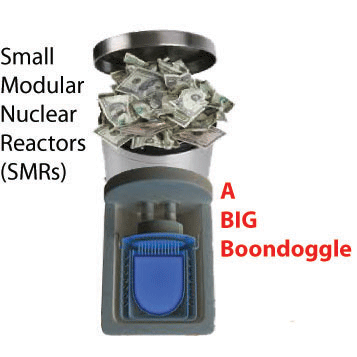
Expensive and dangerous: Nuclear doesn’t stack up https://www.miragenews.com/expensive-and-dangerous-nuclear-doesnt-stack-up-570069/m Electrical Trades Union
Lifting the ban on nuclear power generation in NSW using unproven small-scale reactors will only push up power bills, damage the environment and compromise safety, according to the Electrical Trades Union.
ETU National and NSW Secretary, Allen Hicks, said nuclear power would be hugely expensive compared to renewable energy, and that small nuclear reactors were still a pipe dream.
The recommendation around small scale reactors is one of 60 contained in the NSW Productivity Commission’s White Paper, which is supposedly designed to reboot the state’s economy.
“The Productivity Commission has lost the plot if it thinks small modular reactors, a technology that has been ‘just around the corner’ since the 1970’s but still doesn’t exist, is the answer to NSW’s productivity growth,” Allen Hicks said.
“Even if someone finally manages to build one that works, the electricity price forecast for their output is six times more expensive than renewables.
“Why does the Productivity Commission want NSW residents paying six times more for their electricity?”
“There are massive offshore wind projects waiting for federal approval off the NSW coast near Newcastle, Wollongong and Eden. Rather than pie-in-the sky nuclear nonsense we should get on with approving this clean energy and getting it into out grid.
The commission says lifting the ban would provide another source of firming capacity in the grid. But its own report admits “a wide degree of uncertainty” about small-scale nuclear reactors, mainly due to cost.
NSW Treasurer Dominic Perrottet said the government “will consider everything” in the report.
But Mr Hicks said the State Government must hit the stop button on nuclear power, as the business model for a dirty and dangerous technology did not stack up.
“Even if they improve the technology, a small modular reactor would take far too long to build, and we don’t have time to waste in the fight against climate change,” Mr Hicks said.
“Globally, most countries are moving away from nuclear power. Few new reactors are being built and nuclear companies are going bankrupt or facing financial distress.
Mr Hicks said the government should instead continue to focus on renewable energy.
“With a bit of foresight, some investment and some big thinkers, Australia is uniquely positioned in the world to become a renewable energy leader.
“Boosting the economy, providing more jobs, and dealing with climate change are big problems, but nuclear power is not the answer.”
Mulga Rock Uranium Project – VIMY’S MINE – UNWANTED AND UNECONOMIC

VIMY’S MINE – UNWANTED AND UNECONOMIC, https://www.ccwa.org.au/vimy_s_mine_unwanted?utm_campaign=nuclear_news164&utm_medium=email&utm_source=ccwa By Mia Pepper
Deputy Chair of the Mineral Policy Institute. BY KIM SMITH JUNE 02, 2021
Vimy Resources (aka Narnoo Mining) advertisement in Saturdays Kalgoorlie Miner is part of an extended last-ditch attempt to start a mine that is unwanted, uneconomic, does not have full and final approval or the financing needed to start mining.
Saturday’s ad suggests that Vimy will begin work at the site in Q4 2021. There are several critical elements for mining to commence that are not yet in place and are unlikely to be resolved by Q4 2021. The companies Mine Closure Plan and Mine Plan are not yet approved by the Department of Mines and previous attempts to have these plans approved have failed. There are also Works Approvals, export and other licenses and permits that are still required. The company does not have an Indigenous Land Use Agreement with the Upurli Upurli Nguratja Native Title claimant group – pre-empting mining without an ILUA drastically impacts that groups ability to negotiate or determine what should or shouldn’t happen on their country.
Perhaps the clearest pre-requisite to begin mining is a company’s Final Investment Decision and the finances to cover the capital costs. Without the ability to fund the project and meet the requirements of mining any ground-disturbing activities are pre-emptive and irresponsible. The capital cost for the Mulga Rock project is $493 million. Vimy’s March quarterly report shows Vimy raised over $18 million, since then they have raised a further $9 million. $27 million is a far cry from the $493 million needed to meet full capital costs. But it is enough to do some serious damage in the Yellow Sandplain Priority Ecological Community in the Great Victoria Desert, home to the endangered Sandhill Dunnart and other important vulnerable, migratory and priority species of flora and fauna. The company’s share value is down 97% since their inception in 2008 and has a long way to go to secure finance for a project that is just not economic. Until the company can demonstrate they have the capital funds to get the project off the ground they should not be allowed to embark on pre-emptive ground-disturbing activities.
One thing more dangerous than a uranium mine is an uneconomic uranium mine and ideologically driven company. Despite the lack of funding, final licenses and permits, an ILUA, social license and bipartisan support Vimy’s Mulga Rock project still presents a very real threat to the environment and the WA taxpayer. The WA government should make decisions based on evidence, not enthusiasm and should not facilitate this poorly considered project.
Australia/UK Free Trade Agreement will give corporations the right to sue governments.

Australia/UK Free Trade Agreement: What’s the Scam? https://www.michaelwest.com.au/australia-uk-free-trade-agreement-whats-the-scam/
by Michael West | May 31, 2021 The British Trade Minister has confirmed that corporations are likely to have the right to sue the Australian and UK governments if governments make laws which hit their profits. What’s the scam?
ISDS is the scam; Investor-State Dispute Settlement that is, clauses buried in “Free Trade” agreements, such as this one, which allow corporations to sue governments in obscure foreign tribunals. Australia’s most celebrated ISDS case was brought by tobacco giant Phillip Morris which sued Australia in Hong Kong when Australia introduced its wonderfully successful plain packaging laws.
“There are now over 1,000 known ISDS cases, with increasing numbers against health and environment laws, including laws to address climate change,” says Patricia Ranald convenor of the Australian Fair Trade & Investment Network (AFTINET).
“ISDS would give UK corporations the right to sue Australia over democratic legal changes in Australia. For example, British aged care company BUPA could claim compensation if the government follows the recommendations of the Royal Commission into Aged Care Quality and Safety and regulates for improved staffing levels and quality of care.”
Just another chapter in the saga of rising corporate power over democracy.
The appalling mistreatment of Australian citizen, Julian Assange, – by USA, UK, and Australia
CHRIS HEDGES ON THE RULING CLASS’ REVENGE AGAINST JULIAN ASSANGE, May 31, 2021 · by Rise Up Times ·
Pulitzer Prize-winner Chris Hedges joins Robert Scheer to discuss the WikiLeaks founder’s plight as he languishes in a British prison. SCHEER INTELLIGENCE: A ROBERT SCHEER PODCAST
BY MODERATOR SCHEERPOST MAY 7, 2021
The mistreatment of WikiLeaks founder Julian Assange over the past decade has been defined as “psychological torture” by the UN Special Rapporteur on Torture, Nils Melzer. Yet, there is still no real end in sight to Assange’s promethean plight. Several months after a British judge blocked his extradition to the U.S.–citing that conditions in America’s inhumane prison system would be detrimental to his health–the WikiLeaks founder continues to be held in a maximum security prison in the U.K. The U.S. government, first under Donald Trump’s rule and now under Joe Biden’s, is appealing the extradition ruling. With a new decision in the case is due to be announced any day now, Pulitzer Prize-winning journalist and ScheerPost columnist Chris Hedges joins Robert Scheer on this week’s installment of “Scheer Intelligence” to discuss what Hedges has called Assange’s “martyrdom.”
Scheer and Hedges assert that Assange’s case is a clear threat to freedom of the press given that he acted in the capacity of a publisher in the same way the global media outlets that printed the content released by WikiLeaks did. Should the publishers of the Washington Post, New York Times and other media have been charged with a crime for publishing the content? Hedges and Scheer, who have both been staunch supporters of the WikiLeaks founder, conclude that there can only be one reason for all recent Republican and Democratic administrations to doggedly persecute Assange: he is a major threat to the establishment’s most sinister interests.
“Your job [as a publisher] is not to be partisan,” says Hedges. “Your job is to expose the machinations of power, the crimes of power, the lies of power–whoever’s in power. And that’s precisely what Julian did. when he was going after Bush with the Iraq War Logs, the Democrats loved him. But as soon as his journalistic integrity led him to also expose the inner workings of the Democratic Party establishment, they turned on him as vociferously as the Republicans.
“I’ve been stunned at what an egregious assault [Assange’s persecution] is on press freedom and how the institutions that purport to care about freedom of the press have been complicit in the persecution of Julian.”
As Assange is tortured before our eyes, Hedges decries the silence of organizations such as PEN, which “are tasked with holding up the kind of liberties and press freedoms that we care about.” The award-winning journalist argues that PEN and others have not only sold out to their liberal donor base, but have been “taken over” by Democratic establishment figures such as Suzanne Nossel, the current head of PEN America and former member of the State Department under Secretary of State Hillary Clinton. Scheer also highlights the plight of another person who has become collateral damage in America’s tyrannical mission against Assange.
“The real hero of this whole thing is Chelsea Manning,” says Scheer. “The U.S. government has been tormenting Chelsea Manning because they basically want to get her to say: ‘Julian Assange put me up to this; he’s the really bad guy.’ It’s a horrible story of government torture and manipulation that you have this rare, exemplary citizen, Chelsea Manning, who does the right thing and says our government, in our name, is committing war crimes–killing innocent children and journalists and everything–and then they want to now break her so she’ll go against Julian Assange.”
Listen to the full conversation between Hedges and Scheer as they examine in detail the U.K.’s role in the Assange trial, as well as discuss the very real dangers the results of the case could pose to journalists and journalism the world over.
TRANSCRIPT
RS: Hi, this is Robert Scheer with another edition of Scheer Intelligence, where the intelligence comes from my guests. And in this case, unquestionably; a very shrewd observer, Chris Hedges, longtime correspondent, bureau chief for the New York Times, and wrote for a lot of other publications.
But I want to get Chris on now with some urgency, because I’m really concerned about the fate of Julian Assange. I’ve turned 85; in my whole life I don’t think I’ve had, experienced a case of such splendid indifference to press freedom and the suffering of a brave journalist in this country, in the United States. He’s of course not from the U.S., which makes it even more appalling that he’s being held under terrible conditions in an English prison……………….. https://riseuptimes.org/2021/05/31/chris-hedges-on-the-ruling-class-revenge-against-julian-assange/
Chris Hedges on the Ruling Class’ Revenge Against Julian Assange — Rise Up Times

“The whole process has really been a mockery of the rule of law. Julian is not a U.S. citizen; WikiLeaks is not a U.S.-based publication.”
Chris Hedges on the Ruling Class’ Revenge Against Julian Assange — Rise Up Times
Tough environmental regulation brings economic benefits. Australia lags behind all OECD countries
Using the example nations – Australia, Germany, United States and United Kingdom – against the OECD average, Denmark had the highest and Germany the second-highest average score over the 17 years of all 22 OECD countries (see
And Australia had the worst.
TOUGHER ENVIRONMENTAL POLICIES CAN CREATE ECONOMIC WINNERS
There seems to be a working assumption that if Australia adopts tougher environmental policies, our economic growth will be undermined. But new research finds the opposite is true , Pursuit, By Dr Ou Yang, University of Melbourne 31 May 21, No longer concerns for a distant future, climate change and environmental degradation are an urgent challenge facing the planet. And they’re happening now.
According to the 2019 United Nations Climate Change report, between 1990 and 2016, global aggregate greenhouse gas emissions increased by 46.7 per cent. In 2018, the global mean temperature had risen about 1°C above the pre-industrial baseline.
As the US and EU move forward with their green recovery, there was little talk of the climate crisis or the environment in Australia’s 2021 Federal budget.
While Australia’s largest trading partners make bigger and bolder commitments to decarbonisation and use their COVID-19 recovery budgets to maximise the opportunity to boost a clean energy transition, the Australian government has committed to a gas-fired recovery over a green one, pouring billions into fossil fuel projects.
Instead of adopting a wide range of more effective and efficient environmental policies, like price and tax mechanisms, the government has pinned its hopes on a low-emissions technology plan.
The Morrison government’s increasing support for fossil fuel projects seems to have some elements in common with former US president Donald Trump’s 2020 Executive Order which allowed US federal agencies to bypass environmental protection laws and fast-track pipeline, highway and other infrastructure projects.
Trump declared regulatory delays would hinder “our economic recovery from the national emergency”.
Likewise, in 2017, Trump withdrew the US from the Paris Agreement for international climate action for the same reason. The Agreement, he said, would undermine the US economy “and put us at a permanent disadvantage to the other countries of the world”.
All of these recent policy moves seem to be made with the notion that greater action on environmental policy harms a nation’s productivity growth. But experts like Australian economist Ross Garnaut argue that taking greater action on climate change now could actually benefit our economy in the long run.
And this is a position our recently published research supports.
Our study looked at the environmental policies of 22 countries belonging to the Organisation for Economic Co-operation and Development (OECD), alongside their productivity growth, finding some positive evidence of the economic effect of environmental policies.
Using the OECD’s Environmental Stringency Policy Index, we rated each nations’ environmental policies including Australia and the US, between 1990 and 2007, in order to investigate the impact of greater environmental policy actions on a nation’s productivity.
These policies include taxes on carbon and subsidies for renewable energy, as well as regulations like limits on sulphur content in diesel.
The model we used is flexible enough to capture country-specific effects of taking greater environmental action on a nation’s productivity growth.
We can also identify the causal impact of environmental policies on productivity by exploiting the time-series variation within each country, which basically measures the movements of productivity caused by changes in policy stringency.
Our research, published in Energy Economics looking at 22 OECD countries, found that all of this group had gradually tightened their environmental regulation between 1990 and 2007.
Using the example nations – Australia, Germany, United States and United Kingdom – against the OECD average, Denmark had the highest and Germany the second-highest average score over the 17 years of all 22 OECD countries (see Figure 1 on original).
And Australia had the worst.
By examining short and long-term effects, our results show that while environmental regulations do increase the cost of production initially – for example, a carbon tax makes coal more expensive, which increases the costs of metal production – adopting tighter environmental policies boosts a country’s productivity in the long run.
This positive effect is more noticeable in countries that showed leadership on environmental protection and adopted tougher environmental policies.
According to our estimates, during the 17-year sample period, if an average OECD country had increased the stringency of its environmental policies by one unit, its annual productivity growth rate in three years’ time would have increased by about 0.71 percentage points from -0.09 per cent to 0.62 per cent………….
Our findings show that while there might be a short-term hike in cost, countries whose governments implement strong environmental regulations reap the productivity – and economic growth – rewards in the long term. https://pursuit.unimelb.edu.au/articles/tougher-environmental-policies-can-create-economic-winners
Nuclear trash – a tale of two Sydney suburbs

Radioactive trash – a tale of two Sydney suburbs, https://johnmenadue.com/radioactive-trash-a-tale-of-two-sydney-suburbs/ By Noel Wauchope, May 26, 2021
Australia is relatively clear of nuclear reprocessing waste problems. But the Sydney suburbs of Hunters Hill and Barden Ridge have radioactive wastes from uranium processing which have been sitting there for decades. A bill is now before the Senate addressing the issue.
Australia does have radioactive waste problems in the lingering concerns over historic atomic bomb test sites in South Australia., and in both the functioning and the closed uranium mines. But there is only one uranium-processing facility producing radioactive wastes, the Opal nuclear research reactor at Lucas Heights in Sydney.
Now, Federal and State governments are making decisions on the disposal of these wastes. But there is still uncertainty and lack of public information on just how [or whether] these decisions will be carried out. For example, there’s no detail on transport routes, dates etc.
There are significant differences between the situations of the two suburbs. Perhaps the most significant one is that at Barden Ridge, the nearby Opal nuclear research reactor will be continuing to produce nuclear wastes for the foreseeable future, whereas the Hunters Hill wastes are set for final and permanent removal. Hunters Hill residents have been worried about this for over a century. For Barden Ridge, it has been been recognised as a problem for a much shorter time.
2021 looks like being a watershed year for both.
Hunters Hill.
n 1911, radium was a valuable commodity, and was processed was processed at Hunters Hill, Some 2,000 tonnes of uranium ore were transported from Radium Hill in South Australia, to extract the radium. Several tonnes of uranium oxide were left, and also thorium 230, which itself decays to form more radium and is therefore dangerous for thousands of years. The project closed in 1915. From then on, it was a saga of mistakes and failed attempts to clean up this remaining debris. There was a tin smelter there until 1964.
Then the Australian Atomic Energy Commission (AAEC, now ANSTO) decided it was safe for housing. In the following years, residents and others became concerned about the uranium tailings spread over 6 housing blocks, in Nelson’s Parade, with the risk to health. They were met with cover-ups and obfuscation from the government. Health tests were kept secret, radiation hotspots were found, and cancers and deaths were claimed to be linked to this, and legal cases ensued.
Government plans to solve the problem included dumping the wastes at sea. This was resisted by environmentalists. The next plan was to dump it in Western NSW. This was strongly opposed by Aborigines from the area’s Bakandii tribe. When several Nelson Parade residents fell ill in the 1970s, the NSW government purchased several houses and demolished them, but failed to remediate the site.
in 1981 The then NSW Premier, Mr Wran asked South Australia to take 5,000 tonnes of contaminated soil. A NSW Upper House Inquiry in 2008 led to the government attempting to plan for the clean-up of 2,000 tonnes of radioactive waste. The Australian Radiation Protection and Nuclear Safety Agency said radioactive waste from Hunters Hill wasn’t permitted to be stored at ANSTO’s Lucas Heights interim waste storage facility.
In 2012, most of the contaminated earth was reclassified as ”restricted solid waste”. Two Sydney suburbs were mooted as destinations for the wastes – Kemps Creek and Lidcombe. This was resisted by the local residents. Then in 2019, the New South Wales government proposed to store the contaminated soil on site in an ”encapsulated” form. This was vigorously rejected by the Hunters Hill residents.
Now, in 2021, beginning in July, New South Wales Property and Housing Minister Melinda Pavey announced that the radioactive material will beexcavated and and be shipped to Idaho ,USA. The contaminated soil is to be sealed in bags, loaded into shipping containers and taken to a secure facility in the Eastern Sydney suburb of Matraville before shipping them overseas in scheduled consignments. ANSTO would oversee the process with up to 1800 tonnes to be transported to Idaho in an18-month-long mission.
Barden Ridge.
The radioactive waste problem of formerly Lucas Heights has a more recent history, with the original HIFAR nuclear research reactor starting operations in 1958. Lucas Heights was then a remote bushland site well outside the suburban area of Sydney. Nuclear development was meshed in secrecy, and controlled by influential experts Philip Baxter, and Ernest Titterton., without much understanding by the parliament or the public. It was the time of British atomic weapons tests in Australia, and heightened fears about the cold war. Little attention was paid to the subject of radioactive wastes.
In later years, as Sydney grew, Lucas Heights did become more of a suburb. And the Three Mile Island 1979 and Chernobyl 1986 nuclear accidents aroused a general awareness of nuclear risks. Radioactive wastes from Fisherman’s Bend in Victoria was brought to Lucas Heights in 1990. By now, public concern was raised. When Lucas Heights agreed to take the waste from St Mary’s Defence Base NSW (1991) the Sutherland Shire Council won a court case against ANSTO to stop Lucas Heights taking waste from other entities.
In 1992, local residents voted to rename the suburb of Lucas Heights, and in 1996 it officially became Barden Ridge. It is widely accepted that this was done to increase the real estate value of the area, as it would no longer be instantly associated with the HIFAR nuclear reactor.
Barden Ridge has a conservative community, historically voting Liberal, that accepts the reality of ANSTO and the now Opal nuclear reactor, with the jobs that come with it. Still, the presence of nuclear wastes is an issue. The Sutherland Shire Council in 2013 said that they liked having the nuclear reactor, but not the radioactive wastes. Local people and Council were relieved to learn, in 1997, of the federal government’s plan to set up a waste facility in another State. Sutherland Shire Council rejoiced in 2014, when the federal government announced plans for a nuclear waste facility in the Northern Territory.
Which brings us to the Australian Government’s Bill about radioactive waste, now before the Australian Senate, the National Radioactive Waste Management Amendment (Site Specification, Community Fund and Other Measures) Bill 2020. This Bill specifies Napandee, a farm near Kimba, South Australia, as the nation’s nuclear waste dump. Resources Minister Keith Pitt has recently announced more grants to the local community .Yet there is significant local opposition to the plan, from Aborigines and farmers. If this Bill is passed, there can be no judicial review of the decision. So, Barden Ridge residents will get their solution. Or maybe not.
The Hunters Hill solution is an unusual one, and quite a precedent. There could still be some opposition to the planned process. The Barden Ridge one is also fraught with problems, as nuclear waste will continue to be produced by the nearby nuclear reactor. The Senate might not pass this Bill, leaving the Resources Minister with the option of declaring the Napandee site, which would then open the matter up for court action.
It’s again ‘wait and see’ time for two worried communities.
Australian Robert Floyd to head the Comprehensive Nuclear-Test-Ban Treaty Organisation.
‘Never in my wildest dreams’: The Australian set to head UN body policing nuclear weapons has grand plans, SMH, By Anthony Galloway, May 30, 2021 When Australian Robert Floyd began his career as a biological scientist, he had no aspirations of heading a United Nations body charged with policing the world for any signs of nuclear tests. He did not foresee a life of negotiating with the world’s major powers to ban all testing of nuclear weapons.
But that is exactly what is in store for him after last week being elected as the first Australian executive secretary of the Comprehensive Nuclear-Test-Ban Treaty Organisation.
………… He will take up his position in Vienna in August, after 10 years as the Director-General of the Australian Safeguards and Non-Proliferation Office, which implements Australia’s treaty obligations on weapons of mass destruction……..
The CTBTO is the organisation charged with policing the Comprehensive Nuclear-Test-Ban Treaty, which was adopted by the United Nations General Assembly in 1996 and seeks to ban all nuclear tests.
But the treaty is not legally binding because eight countries have held off on ratifying it: the US, China, North Korea, India, Pakistan, Iran, Israel and Egypt.
Floyd concedes it is unlikely that he will convince all eight countries to ratify the treaty, but he is going to try to get some of them across the line before his four-year term is up.
…….. The CTBTO has an arsenal of more than 300 monitoring stations that can pick up seismic vibrations or radioactive particles in the air, ocean or atmosphere. Floyd says this allows it to detect a nuclear explosion “anywhere, anytime”.
“That network produces data that no country can have by themselves. So everyone sees value in the treaty,” he says.
………. Unlike other nuclear treaties, the CTBT is not about nuclear getting states to rid themselves of nuclear weapons; it is focused on convincing them not to test them. ………..https://www.smh.com.au/politics/federal/never-in-my-wildest-dreams-the-australian-set-to-head-un-body-policing-nuclear-weapons-has-grand-plans-20210527-p57vlf.html
Environmentalists and Aboriginal traditional owners object to rocket launching on South Australian protected heritage land, at Whaler’s Way.
Rocket launching proposals worry traditional owners, environmentalists, but company committed to holistic care of the land, ABC Eyre Peninsula / By Evelyn Leckie 28 May 21, Popular South Australian tourist spot Whalers Way could become the site of three test rocket launches later this year, causing concern among some environmentalists and traditional owners.
Key points:
- Traditional owners and conservationists have raised concerns about the proposed site for three rocket launches this year
- Nature Conservation SA holds concerns over two threatened species
- Southern Launch says it’s committed to a holistic approach to care for the area during its testing program.
SA space industry leader Southern Launch is looking to conduct test launches on privately owned land, with a view to making the area a permanent launching site in the future to send satellites into space.
Nature Conservation Society of SA advocate Julia Peacock said the area, on the state’s rugged southern coast, wasn’t the right site to conduct test launches.
“It’s a really special conservation area,” she said.
“It’s actually specifically protected under environment legislation that’s called a heritage agreement, which means a private landholder agreement to protect that area so we would really like to see that agreement honoured.
We’re also really concerned that it is habitat for a number of species of conservation concern.”
Ms Peacock said the society was worried about threatened species in the area such as southern emu wrens and white-fronted whip birds.
“They’re very small and shy birds, so they’re quite hard to see,” she said.
We’re concerned that we’re building an industrial facility that involves explosions that are noisy and causes vibrations — that those species are going to be frightened.
“It’s going to change their behaviour and impact the way they want to move through this area.”
‘Let it be natural’
Nauo elder Jody Miller said there were a lot of cultural issues out at Whalers Way.
“It’s significant culturally, there are stories [out there] and we don’t want to destroy anything,” Mr Miller said.
“If it’s just left alone, let it be natural, people can see this for the next generation — everybody’s children as well as my children.”
Holistic protection
Southern Launch CEO Lloyd Damp said the testing program would provide the chance to specifically measure what the noise effect would have on local species.
“We’re working with one of the best universities in Australia to undertake the measurements and then provide that for the environmental impact statement assessment,” Mr Damp said……….. https://www.abc.net.au/news/2021-05-28/rocket-launching-proposals-worry-environmentalists/100173472
Australia, the USA’s only ”best friend” in the Indo Pacific, to deploy more USA military equipment, heightening the threat against China.

Zhang Junshe, a senior research fellow at the PLA Naval Military Studies Research Institute, told the Global Times on Friday that Australia is likely to allow the US to deploy more military equipment on its soil, making it the only US friend on its Indo-Pacific strategy.
By doing this, Australia will make itself a target for future military conflicts between the US and other countries, Zhang said, adding that a responsible government which really cares about the interests of its people would never allow it.
China urged to increase sea-based nuclear deterrent amid US intensified strategic threat https://www.globaltimes.cn/page/202105/1224773.shtml By Zhang Hui May 28, 2021 Facing a serious strategic threat from the US, China was urged to increase the number of nuclear weapons, especially its sea-based nuclear deterrent of intercontinental submarine-launched ballistic missiles, to deter potential military action by US warmongers, Chinese military experts said on Friday, after reports that the US’ new defense budget will modernize its nuclear arsenal to deter China.
Having a nuclear arsenal appropriate to China’s position will help safeguard national security, sovereignty and development interests and establish a more stable and peaceful world order, which will be beneficial for the world, they said.The US defense budget, set to be sent to Congress on Friday, is expected to include investments in troop readiness, space, and the Pacific Deterrence Initiative aimed at countering China’s military existence in the region, and nuclear weapons technology, Reuters reported on Thursday.
However, Chinese military experts believe that US attempts of increasing military deployment in the Indo-Pacific region will not increase returns for the US as most countries in the region will not allow the flames of war initiated by the US to burn themselves.
The US would buy ships and jets and develop and test hypersonic weapons and other “next-generation” weapons systems to build capabilities to counter Russia and China. The total national security budget will be $753 billion, a 1.7 percent increase over the 2021 figure, Reuters said.
China has kept its defense spending at around 1.3 percent of GDP in recent years, which is far below the average global level of 2.6 percent, data shows. The US, by far the world’s top military spender, has spent about four times that of China in recent years.
Chinese analysts said China has never taken aim at US military spending, nor does China want to engage in any form of arms race with the US.
But the US has applied greater military pressure on China, sending warships and warplanes at an increasing frequency to the South China Sea and Taiwan Straits.
The US is also preparing what US media called its “biggest navy exercise in a generation with 25,000 personnel across 17 time zones,” as it’s preparing for a “possible conflict” with China and Russia.
The US attempted to deepen the militarization of space with its new budget plan, including its investment on future weapons. Considering that the US deems China its top imaginary enemy, China needs to increase the quantity and quality of nuclear weapons, especially submarine-launched ballistic missiles, to effectively safeguard its national security, sovereignty and development interests, Song Zhongping, a Chinese military expert and TV commentator, told the Global Times on Friday.
Some military experts said China should increase the number of its most advanced intercontinental ballistic missiles (ICBM), the DF-41, which has the longest operational range among all Chinese ICBMs.
Facing a serious strategic threat from the US, China was urged to increase the number of nuclear weapons, especially its sea-based nuclear deterrent of intercontinental submarine-launched ballistic missiles, to deter potential military action by US warmongers, Chinese military experts said on Friday, after reports that the US’ new defense budget will modernize its nuclear arsenal to deter China.
Having a nuclear arsenal appropriate to China’s position will help safeguard national security, sovereignty and development interests and establish a more stable and peaceful world order, which will be beneficial for the world, they said.
Song said that strengthening sea-based strategic nuclear deterrence is also an important direction for China’s future development, as these weapons are better at stealth and secondary nuclear strikes.
China could use its most advanced submarine-launched ballistic missile (SLBM) to effectively counter the US threat, Song said.
China just commissioned three PLA Navy warships, namely the Changzheng 18, the Dalian and the Hainan, at a naval port in Sanya, South China’s Hainan Province in April. Observers identified the Changzheng 18 as a likely Type 09IV nuclear-powered strategic ballistic missile submarine.
Burning themselves
The US Pacific Deterrence Initiative, created to counter China, focuses on competition in the Indo-Pacific and aims to boost US preparedness in the region by funding radars, satellites and missile systems, according to Reuters.
Wei Dongxu, a Beijing-based military expert, told the Global Times on Friday that the initiative enables the US to use a variety of spy satellites to conduct reconnaissance and intelligence gathering to provide extensive and accurate intelligence support for US military operations, including joint military operations with its allies, and the US will also use allies, such as US overseas military bases, to deploy more radar systems to guide its weapons.
On the day its budget was sent to Congress, US Secretary of Defense Lloyd Austin was expected to meet with India’s Minister of External Affairs, Subrahmanyam Jaishankar, as part of India’s first cabinet-level visit to Washington, the Pentagon said.
“The secretary’s meeting with the external affairs minister will continue discussions that the two held in New Delhi in March and will continue the robust bilateral defense and security relationship between our two countries,” the Pentagon said.
Chinese military experts said it’s likely that India would buy more American weapons, have more military drills with the US or deepen its cooperation with the US in military intelligence sharing, and the US will use these in exchange for India’s cooperation for its Indo-Pacific strategy.
But India will have second thoughts on US military deployment on its soil, Song said, noting that weapons and radar deployment involves a country’s sovereignty, and India, which has been claiming to pursue an independent foreign policy, will unlikely give the US a satisfactory answer.
Even if India would like to deepen its military cooperation with the US, certain cooperation such as opening military bases to the US is not an option for India, Song said.
India may not be a very ideal partner, and most of US allies in Asia, including Japan and South Korea, also fear that the flames of war would eventually burn themselves.
In South Korea, protests against US military presence have become louder in the past years, and South Korea will not allow the US to turn Northeast Asia into a battlefield and drag itself into war, nor will it sacrifice its relations with China, observers said.
Zhang Junshe, a senior research fellow at the PLA Naval Military Studies Research Institute, told the Global Times on Friday that Australia is likely to allow the US to deploy more military equipment on its soil, making it the only US friend on its Indo-Pacific strategy.
By doing this, Australia will make itself a target for future military conflicts between the US and other countries, Zhang said, adding that a responsible government which really cares about the interests of its people would never allow it.
New research highlights need for international standards to safeguard against plutonium ”hot” particles.
New study delves into issues relating to soils around Maralinga region, https://www.portlincolntimes.com.au/story/7262167/study-shows-radioactive-particles-from-nuclear-testing-persist-at-maralinga, Luca Cetta,
A new study has highlighted the first international standards needed to safeguard against contamination from nuclear testing, and a Kokatha Elder says the impact of nuclear testing at Maralinga cannot be forgotten.
More than 100 kilograms of highly toxic uranium and plutonium was dispersed in the form of tiny ‘hot’ radioactive particles after nuclear tests were conducted by the British in remote areas of South Australia, including Maralinga.
Scientists have new evidence these radioactive particles persist in soils to this day, more than 60 years after the detonations.
The British detonated nine nuclear bombs and conducted nuclear tests in South Australia between 1953 and 1963.
There had previously been limited understanding in how plutonium was released from the particles into the environment for uptake by wildlife around Maralinga.
The new study, published in Nature’s Scientific Reports, led by Monash University researchers, warns the hot particles are more complex and varied than previously thought.
Currently, there are no international best practice standards for the environmental impact or risk assessment of plutonium and uranium-rich hot particles released during nuclear testing.
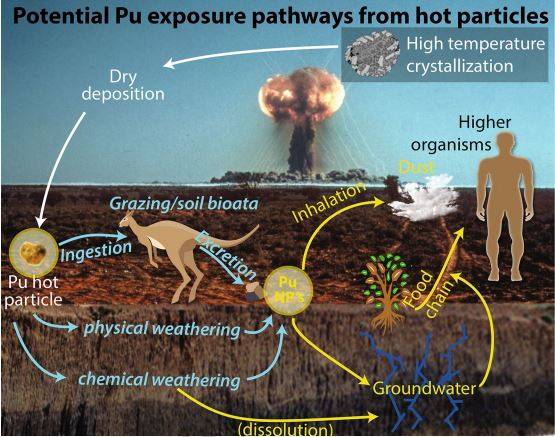
This study provides the first mechanism for future modelling to predict the environmental life cycle of plutonium from hot particles, including how they are slowly broken down in the environment over a long period, and potentially exposed to animals and humans through inhalation, soil or ground water.
“The resulting radioactive contamination and cover-up continues to haunt us,” lead study author from Monash University’s School of Earth, Atmosphere and Environment Dr Megan Cook said.
“The results of our study profoundly changes our understanding of the nature of hot particles at Maralinga – despite the fact that those were some of the best studied particles anywhere in the world.”
Sue Haseldine, who grew up in the Koonibba district in the 1950s and 1960s, has long campaigned against nuclear testing and weapons.
She has been part of the International Campaign to Abolish Nuclear Weapons (ICAN), an organisation awarded the Nobel Peace Prize in 2017, and has spoken about her experience growing up in the shadow of nuclear testing at Maralinga.
Ms Haseldine said the people in the area had long-suspected there were health issues deriving from those tests.
“Experts would tell you that radiation will not last for 60 years, nor 60,000, but for a long, long time, and it is still causing troubles today,” she said.
“The old ladies told me these cancers and illnesses were not around before the bomb and over the years I have seen the rates go up.
“There are a lot more younger people with heart problems – it is known that radiation problems can cause heart diseases – and it is coming down through the generations.”
Ms Haseldine said the testing and fallout from Maralinga was not spoken about enough and that was why her campaigning with ICAN was so important.
“It is important to let people know what the government’s legacy is to us through their testing and we have to keep the past alive to protect the future, so they don’t do it to future generations,” she said.
“I grew up in the Koonibba district, but the radiation didn’t just stay in the Maralinga area.”
Study co-author professor Joël Brugger said the study invited a revisit of the implications of earlier results for the fate of plutonium at Maralinga.
“Understanding the fate of hot particles in the arid environment setting of the Australian outback is critical for securing Australia in case of nuclear incidents in the region, and returning all the native land affected by the British tests to the traditional Anangu owners of the Maralinga Tjarutja lands.”
The research team used synchrotron radiation at the Diamond Light Source near Oxford in the United Kingdom to decipher the physical and chemical make-up of the particles.
At Monash, they dissected some of the hot particles using a nano-sized ion beam, and further characterised the complex make-up of these particles down to the nano-size.
“It’s a major breakthrough,” study co-author associate professor Vanessa Wong said.
“Our observations of the hot particles from Maralinga provide a clear explanation for the complex and variable behaviour of different hot particles with respect to the chemical and physical weathering that has hindered predictive modelling to this day.
“This study provides a mechanistic foundation for predicting the future evolution of hot particles from high-temperature nuclear events and the likely exposure pathways.”
The researchers demonstrated the complexity of the hot particles arose from the cooling of polymetallic melts from thousands of degrees Celsius in the explosion cloud during their formation.
“We found that the particles contained low-valence plutonium-uranium-carbon compounds that are typically highly reactive – which is unexpected for particles that survived for over 30 years in the environment,” corresponding author Dr Barbara Etschmann said.
1 This month
Chernobyl: The Lost Tapes – A good documentary on Chernobyl on SBS available On Demand for the next 3 weeks– https://www.sbs.com.au/ondemand/tv-program/chernobyl-the-lost-tapes/2352741955560
15 April – Zoom –Nuclear Power is Not the Solution
Apr 15, 2026 01:00 AM in Canberra, Melbourne, Sydney

Join the International Physicians for the Prevention of Nuclear War (IPPNW) on Tuesday, April 14th for a timely webinar exploring the risks associated with nuclear power and challenging the myth that it offers a simple, safe, carbon-free solution to the climate crisis

21 April Webinar: No Nuclear Weapons in Australia
Start: 2026-04-21 18:00:00 UTC Canberra, Melbourne, Sydney (GMT+10:00)
End: 2026-04-21 19:30:00 UTC Canberra, Melbourne, Sydney (GMT+10:00)
Event Type: Virtual
A virtual link will be communicated before the event.
Host Contact Info: australia@icanw.org

of the week – Australians for War Powers Reform (AWPR)
To see nuclear-related stories in greater depth and intensity
 Antinuclear