Remote communities affected by uranium in drinking water
Uranium in Australian Drinking Water Snapshot, Friends of the Earth Australia, JUN 12, 2021
THOUSANDS OF REMOTE RESIDENTS EXPOSED TO LEVELS OF URANIUM ABOVE GUIDELINE LEVELS. The recently published WA Auditor Report “Delivering Essential Services to Remote Aboriginal Communities” has raised more concerns regarding water quality in remote Aboriginal communities in three regions of Western Australia: The Goldfields, the Pilbara and Kimberleys……….
Uranium is a radioactive heavy metal where exposure has been associated with kidney damage. Uranium has also been linked to reproductive problems and DNA damage.
Impacted Western Australian communities
The total number of WA remote residents impacted by uranium above guideline levels in drinking water probably now totals around 500 people (with perhaps an additional 500 – 1000 people in the Northern Territory). There have also been hundreds more people in Queensland and New South Wales exposed to relatively high levels of uranium in their drinking water over the past few years. The majority of people impacted will be Aboriginal.
Uranium in drinking water can be difficult to treat if no alternative supplies can be found. The source of the uranium in impacted communities is sourced from local geological formations and groundwater………
Uranium breaches were confined to four communities in the Pilbara in 2018/20: Pia Wadjari (8), Burringurrah (5), Parngurr (3) and Kiwikurra (1). Crocodile Hole in the Kimberley also reported one breach. …..
Despite problems in Western Australia, the Northern Territory also continues to suffer from uranium in drinking water in a number of communities. Chronic breaches have occurred in 3 communities, Laramba, Willowra and Wilora over the past decade and probably much longer.
The three communities where uranium levels consistently exceed Australian drinking water guidelines in the Northern Territory. Laramba residents have most likely been exposed to uranium at levels 2-3 times higher than the Australian Drinking Water Guidelines for many years. The highest recorded levels at Laramba each year also appear to be increasing……
Uranium in drinking water has also recently occurred in three Queensland communities. The highest levels were detected in January 2021 at Dajarra (population 200 located 1000km west of Mackay) in western Queensland at 0.046mg/L, almost three times higher than the safe guideline…….
In October 2016 uranium above guideline levels was also detected in the New South Wales communities of Kootingal, Moonbi and Bendemeer. Tamworth Regional Council apologised for the “oversight”, which had left residents’ drinking water with high levels of uranium for at least two years…..
Radionuclides or radiating emitting elements in drinking water (breaching 1mSv/yr) over the past decade or so have included the communities Kings Canyon, Alice Springs, Borroloola and Binjari in the NT. The Victorian community of Goorambat also recorded levels of Alpha activity for radionuclides over guideline levels in 2012/13.
Wilmington SA, had radon (a radioactive gas produced from decay of radium 226 in soil and minerals) detected in the community above guideline levels of 500Bq/L in October 2018. In South Australia uranium guidelines were breached at Saltia Creek (October 2019) and Woolshed Creek over 2016/17, however at both of these locations water is deemed to be non-potable.
Existing and “Decommissioned” uranium mines also continue to leach radioactive water into the environment and will continue to do so for thousands of years. BHP’s Olympic Dam mine has a history including seepage from tailing impoundments into underlying groundwater. Ranger Uranium Mine (where toxic tailings are currently being dumped into pits) has leached contamination into Kakadu National Park, Rum Jungle uranium mine (1954-71) caused Acid Mine Drainage pollution to the East Finniss River where 640,000 tonnes of tailings were discharged damaging 100sqkm of floodplains. Mary Kathleen Mine and Ben Lomond Mine in Queensland have also caused downstream pollution. Anyone downstream of these leaking mine sites could also be jeopardised through exposure to waterways downstream of the mines. Nuclear blasts at Maralinga and Emu Field in the 1950’s also lead widespread contamination of Australia through nuclear fallout, including drinking water reservoirs and water tanks. https://www.foe.org.au/uranium_in_australian_drinking_water_snapshot
Australia’s News Corpse, Nine media, and Resources Minister Keith Pitt have been duped by the Minerals Council of Australia.
Australia’s major media organisations, News Corp and Nine Entertainment, have been duped by the mining lobby’s false claims about its contribution to Australia. The industry peak body, Minerals Council of Australia, has failed to include in its analysis the more than $72 billion in GST rebates the industry has received between 2010 and 2018, and an estimated $80.6 billion over the past 10 years.
The Australian, the Australian Financial Review, and the Minister for Resources Keith Pitt have consistently repeated the misleading claims provided to them by the mining lobby via the firm the MCA hired to conduct its reports, Deloitte Access Economics.
Deloitte found that the minerals industry had contributed more than $238 billion in company tax and royalty payments since 2010, with $132 billion from company tax alone.
However, the report avoids mentioning that the mining industry, as an exporting industry, receives a huge GST rebate every year…………. https://www.michaelwest.com.au/murdoch-media-nine-entertainment-mining-lobby-busted-for-record-bullartistry-go-into-hiding/
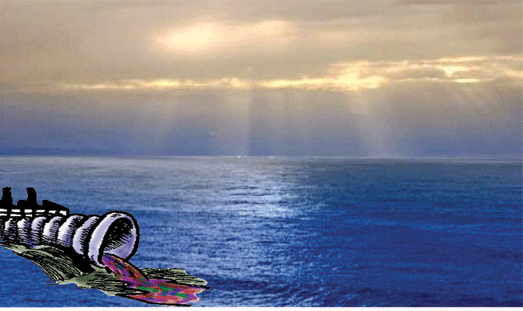
Australian group writes to Japanese Ambassador, calls for halt to plan to empty Fukushima nuclear wastewater into the Pacific.
ACE Nuclear Free Collective . Friends of the Earth Australia, 14/06/21
To Ambassador YAMAGAMI Shingo,
We, the undersigned, are sending this letter to express our concern at the recent decision of the Japanese government to release around 1.25 million tons of treated wastewater from the Fukushima Daiichi site into the Pacific Ocean. Treatment cannot remove all radioactive contaminants from the wastewater. We join international calls for the Japanese government to reconsider its decision and pursue alternative options for long term storage.
We are concerned that Japanese government claims that the treated wastewater is “safe” enough to drink, ignores the inability of the Multi-Nuclide Removal Facility used for treatment remove radioactive materials such as tritium. Plans to dilute the wastewater to solve this issue do not change the amount of radioactive material that will be released and could accumulate in parts of the marine environment.
We are concerned about the effects of the wastewater on the wide Pacific region as the Pacific accounts for around 58% of the world’s fisheries, and many of the region’s nations are dependent on these resources. In addition, many of these states have long suffered from the effects of nuclear testing and illicit dumping of nuclear waste by wealthy nations.
We the undersigned call on the Japanese government to:
・Withdraws its plan to release wastewater from the Fukushima Daiichi site into the Pacific Ocean.
・Disclose all relevant information about the wastewater issue in a transparent fashion.
Dr Jim Green gives an update on the Australian government’s new strategy to get a nuclear waste dump at Kimba, South Australia.
Dr Jim Green, Friends of the Earth, 12 June 21, After being deadlocked in the Senate for exactly twelve months Resource Minister Pitt is introducing a revised radwaste amendment next Tuesday morning (June 15) that seeks to negate key objections to the federal governments approach to the siting of a national radioactive waste facility near Kimba in regional SA.
The changes mean that the Minister – rather than the Parliament – will choose a site and that choice will then be subject to legal review through Administrative Decisions (Judicial Review) Act 1979 (ADJR) processes.
In some ways this is a positive campaign outcome – the federal agenda has been effectively stalled since Feb 2020 and the Minster has had to abandon his push to remove the right of legal recourse, an important reaffirmation of a (limited) check and balance. However, it does mean that the federal effort and momentum to advance the facility will soon significantly escalate.
The amendment restores the three shortlisted SA sites (Lyndhurst, Napandee, and Wallerberdina) as being open for consideration. This is despite Wallerberdina (the Flinders Ranges site) having been ruled out of consideration in December 2019 by former Minister Canavan.
The last listed supplementary explanatory memorandum on the right hand side of the below link outlines the main changes to the revised amendment.
https://www.aph.gov.au/Parliamentary_Business/Bills_Legislation/Bills_Search_Results/Result?bId=r6500
<https://www.aph.gov.au/Parliamentary_Business/Bills_Legislation/Bills_Search_Results/Result?bId=r6500>
I have not had formal confirmation but it is likely that this revised approach will satisfy federal Labor and that the Bill will be passed. After this it is expected that Minister Pitt will move to formally declare the Napandee site, near Kimba.
Once this happens it is expected the Barngarla lawyers (the Adelaide based firm Norman Waterhouse) will file a challenge to the site selection. This development will require a re-calibration – but not a fundamental change – of our strategy and an increased public face to the campaign for responsible radioactive waste management.
Murdoch’s NewsCorpse trying hard to get the Australian Government to privatise the Australian Broadcasting Corporation (ABC)
Privatising the ABC: What’s the Scam? https://www.michaelwest.com.au/privatising-the-abc-whats-the-scam/Michael West | Jun 11, 2021 | What’s the scam?
Murdoch’s maddies at Sky News and The Australian have been banging on, more shrilly than ever, about privatising the ABC. What’s the scam?
The scam is they have no idea what they are talking about. Nor apparently do they want to know what they are talking about. The latest set of ABC financial statements show an enterprise which costs $1bn to fund each year and ABC itself recorded income of just $65m last year.
In the event of a sale therefore, the buyer would have to come up with a cool $900 odd million to fund the ABC. A privatised ABC would then burst into the advertising market and crush the commercial networks which are already financially stressed. It would cost thousands of jobs and send the networks bust. They can ill afford to lose $100m in ad revenue to the ABC, let alone $900m.
The only positive outcome would be that Sky News’ own tiny ad revenue would also be walloped.
Samantha Chard, General Manager, Australian Radioactive Waste Management Agency – doubletalk about nuclear waste transport.
Kazzi Jai No nuclear waste dump anywhere in South Australia ,11 June 21.

“Ms Chard also noted that aside from the TN81, other intermediate level waste will not look substantially different to the low level waste packages.
It is likely that transportation of intermediate level waste will be discrete to avoid someone potentially doing something they should not; however all trucks need to note if they are transporting a hazardous substance.”
Short post today – but something I have been meaning to address….
…..”to avoid someone potentially doing something they should not”…..WTF is that???? Are they only NOW ADMITTING how SERIOUS the TRANSPORT of this waste is SECURITY WISE???????
Then….”however all trucks need to note if they are transporting a hazardous substance”….Again – WTF – or are they trying to REWRITE THE AUSTRALIAN DANGEROUS TRANSPORT CODE????
“Mickey Mouse Operation” are the words which spring to mind
Predictably transport of intermediate waste will be done under the cover of darkness, just like the whole process has been. https://www.facebook.com/groups/1314655315214929
ANSTO’s desperate and dishonest spin to promote the nuclear industry

Kazzi Jai No radioactive waste dump anywhere in South Australia 10 June 21 “Desperate times call for desperate measures”….seems to be the apt phrase used to describe the Nuclear Industry more and more these months!
Seems Australian taxpayers are yet again footing the bill for the Nuclear Industry and its associated waste yet again – and our Environment and Future generations will suffer for it!
“It is likely that every Australian will need nuclear medicine in their lifetime for diagnosis of a variety of heart, lung and muscular-skeletal conditions, or treatment of specific types of cancers,” Mr Griffiths said.“
Where is the reference for this claim? It was NEVER ADDRESSED when it was first claimed that 1 in 2 Australians will need nuclear medicine a number of years ago…..then last year 1 in 3…..then suddenly now EVERY Australian will need nuclear medicine!! Or do we just TRUST Mr Griffiths on his word??
Is this “nuclear medicine” as a generic term…including LINAC Radiotherapy treatment which does not use radioactive isotopes? – Or is this addressing only “nuclear derived isotopes”? Is it only “isotopes” sourced from ANSTO….or cyclotron derived isotopes from private practises using cyclotrons/imaging partnership centres??
Too many questions, not enough answers…..A case of Blurred Lines much!!
Ah, but there’s more!
“….”To support this, ANSTO’s new nuclear medicine facility delivers thousands of doses of nuclear medicine to more than 220 hospitals and nuclear medicine centres each week.”
He said the new facility, which was announced in 2012 and commenced production in 2019, had already become a “critical part of the nuclear medicine supply chain“.
So….ANM is the ANSTO Nuclear Medicine Facility which comprises of an export scale Mo-99 Manufacturing Facility and Synroc Waste Treatment plant for the liquid component of Mo-99 manufacture waste product. Why do they insist on dropping the “Molydenum-99” term in the name for the facility – when that is what was applied for in 2012 to ARPANSA for licencing……Australian Nuclear Medicine Molydenum-99 Facility (ANM Mo99) ??
.And notice NO MENTION of becoming one of the MAJOR EXPORTERS FOR Mo-99 GLOBALLY – ramping up to 10 million doses per annum…..those paltry POSSIBLE doses of 10,000 available doses for Australian Hospitals per week pales in significance!
“….A by-product of that is the 30 litres of intermediate-level radioactive waste produced at the site each week.
The waste is being held in tanks while the new SyMo facility is constructed, but once it is complete, the waste will be solidified using ANSTO’s Synroc technology.
Mr Griffiths said Synroc was an innovative, cost-effective, low-risk way to reduce waste volume by taking it from liquid form and solidifying it into a synthetic rock so it is suitable for permanent storage.“
Now, a “by-product” is a product that is produced as a secondary product of a product in my books. How EXACTLY is this nuclear waste classified in any realm as a “by-product”?? It is nuclear waste!
Again – slippery terms to cover what the reality is!
And finally – Synroc is NOT a cost-effective way to reduce volume – OTHERWISE OTHER COUNTRIES WOULD HAVE ALREADY EMBRACED IT – WHICH THEY HAVEN’T!!
Seems Australian taxpayers are yet again footing the bill for the Nuclear Industry and its associated waste yet again – and our Environment and Future generations will suffer for it! https://www.theleader.com.au/…/radioactive-waste…/…
The unrealistic push for nuclear reactors helps the coal and gas industries to hang on
Nuclear power is a stalking horse for gas https://independentaustralia.net/environment/environment-display/nuclear-power-is-a-stalking-horse-for-gas,15174
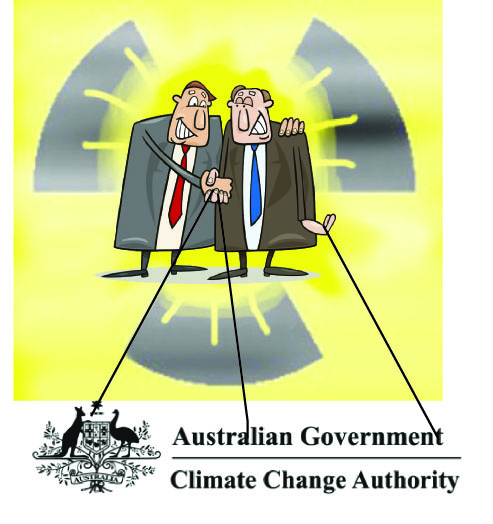
By John Quiggin | 9 June 2021, The recently appointed Chair of the Climate Change Authority, Origin Energy boss Grant King, has yet again raised the idea that nuclear energy is an important policy option for Australia.
This idea has been a staple of rightwing politics for years, in spite of (or rather because of) steadily accumulating evidence that solar PV and wind are the most efficient alternatives to carbon-based fuels.
Australia has had a long string of inquiries into nuclear power, going back to the Switkowski review in 2006. All have concluded that nuclear power is unlikely to be a feasible option for Australia any time soon.
The most recent comprehensive assessment was the South Australian Nuclear Fuel Cycle Royal Commission which concluded, in 2016, that nuclear power was unlikely to be commercially viable in the foreseeable future.
Meanwhile, the world has moved on from nuclear power. There are still around 50 nuclear plants under construction around the world, mostly way over time and over budget. But, outside China, there hasn’t been a new project committed since the UK Government committed to the Hinkley Point C reactor in 2013.
Hinkley Point C will almost certainly be the last nuclear plant built using the European EPR design. Two more, in France and Finland, are many years behind schedule, but will presumably be finished, or left unfinished, in the next couple of years. China built a couple of EPR reactors but hasn’t commissioned any more.
Other designs which seemed promising have also been abandoned. The AP1000, which once seemed to be the leading contender, sent its designers (Westinghouse) broke. The rights to the CANDU reactor, produced by Atomic Energy of Canada Limited, were sold for a pittance a decade ago. South Korea has stopped new nuclear construction, effectively killing off KEPCO’s APR-1400 design, though a few projects remain to be completed.
The result is that only two large-scale nuclear designs are available for new projects: Russia’s VVER-1200 and China’s Hualong One. Neither is approved for construction by Western authorities like the U.S. Nuclear Regulatory Commission. In view of concerns about safety standards and broader geopolitical tensions, neither is likely to be.
These points have been implicitly accepted in recent discussions of nuclear power. Large-scale nuclear reactors like those constructed over the last 50 years or so have quietly disappeared from discussion.
Instead, attention has been focused on the new idea of “small modular reactors” (SMRs). There is nothing new about small reactors. They are used routinely in nuclear submarines, for example. The problem is because they cannot capture economies of scale, small reactors are uneconomic as sources of electricity for general use.
The “modular” idea is that, if plants can be constructed in batches in a factory, economies in manufacturing will outweigh the loss of economies of scale.
This idea remains untested.

The leading contender for the construction of small modular reactors is Nuscale, which plans to build a prototype plant, consisting of 12 60 MW reactors by 2030. That’s a big blowout from the target date of 2023 announced in 2014 and from an even earlier target date of 2018, proposed around 2008.
In fact, the announced deployment data has been eight to ten years in the future ever since the project began in the early 2000s.
As well as constant delays, the Nuscale project has experienced the same cost escalation as larger nuclear projects. Over the past two years, the cost of the pilot project has risen from $3 billion to $6 billion, partly offset by a $1.4 billion injection from the U.S. Department of Energy.
Even if there are no further delays and cost escalation, it will take at least until 2035 before the pilot plant can be properly evaluated. The establishment of large scale manufacturing and the first installations in the U.S. will take at least ten more years. Even in the most optimistic scenarios, there is no prospect of SMRs operating in Australia before 2050.
To be fair, King couched his discussion in terms of options for the next 30, 40 or 50 years. But even Scott Morrison concedes that we should be aiming to reach zero net emissions by 2050. That entails completely decarbonising electricity generation well before 2050.
Nuclear power ceased to be a realistic option at least a decade ago. The only reason it keeps being raised is to obscure the necessity of a rapid and comprehensive shift to solar and wind energy. Nuclear power is not a realistic energy source. Rather, it has been a stalking horse for coal and more recently, gas.
It’s not surprising, therefore, to see it being promoted by a leading figure in the gas industry.
John Quiggin is Professor of Economics at the University of Queensland. His new book, The Economic Consequences of the Pandemic, will be published by Yale University Press in late 2021.
Australia’s incompetent leadership – continued subservience to American militarism

Australia is in denial over one-way relationship with U.S. https://independentaustralia.net/politics/politics-display/australia-is-in-denial-over-one-way-relationship-with-us,15171#.YMBaWGL2H14.twitter By Bruce Haigh | 9 June 2021, Tensions with China resulting in economic sanctions are the result of Australia’s blind allegiance to the USA that began decades ago, writes Bruce Haigh.
AFTER THE AMERICAN defeat by the Japanese in the Philippines, it needed a base from which to regroup, resupply and take the fight back through the Pacific. Australia was a bread bowl, training camp and aircraft carrier. Its north was intersected with airfields used by American bombers and fighters in attacks against Japanese bases and shipping on and around Papua New Guinea, the Solomons and other nearby Islands.
Australia was fearful of attack by the Japanese after their rapid advance through south Asia and the Pacific. The Americans arrived as the Japanese were advancing over PNG toward Port Moresby. The Australian Army had been conducting a successful fighting retreat in order to shorten their supply line, extend that of the Japanese and organise a major offensive. Douglas MacArthur, the arrogant American general in command, sacked a number of Australian generals and ordered the retreat to stop.
Instead of being angry with MacArthur, the average Australian thought he was a hero. The myth was born that America had saved Australia, whereas America came to Australia purely for self-interest. Australians were impressed with American largesse and technology. Many bought into the American “dream”. This was the point at which America could do no wrong. The ANZUS Treaty came into being at the time of the Cold War and hostilities in Korea. America was seen by Australians as the protector against Russian and Chinese expansionism.
Australia was also seduced by American consumerism, Hollywood, Nashville and Detroit. A common language facilitated the absorption of American culture. Military, academic and business exchanges grew. However, it was largely a one-way street, although that went mostly unnoticed in Australia given the sycophantic nature of the relationship. Australians were in awe of American power and wealth.
They undertook no foreign policy initiatives without first checking with the Americans. The exception being the recognition of China by the Whitlam Government in 1972, which many junior diplomats welcomed with pride and pleasure. Australia bought into the American line on the civil war in Viet Nam, much to its subsequent but unacknowledged regret. That did not stop the “provincial” Prime Minister, John Howard, from buying into the wars in Iraq and Afghanistan as a favour to the equally limited George Bush.
Australia bought military hardware from the Americans, under pressure, to increase U.S. force structure in the region. We bought the F-111 which took forever to iron out the cracks (pun intended), the single screw FFGs, the next to useless Abrams tanks, the F35 flying lemon and to boost the alliance, Australia has ordered 12 submarines from the French which it does not need.
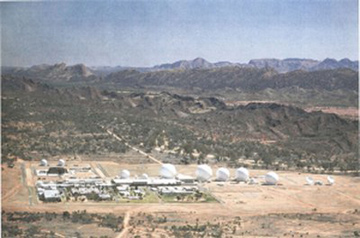
America has a highly sophisticated spy base, Pine Gap, in the Northern Territory, but from which Australia is excluded from sharing sensitive information. They have access to Tindal Airbase from which B52s, in theory, could bomb submarine pens in Sanya and they have established a military base in Darwin for 10,000 American marines.
None of this offers any advantage for Australia, although the Americans have convinced the conservative governing establishment that it does. They believe that no matter what, Australian interests are best served by remaining in lockstep with American interests. The Australian Government lacks emotional intelligence and courage. They are “provincial” politicians who know and understand very little of the wider world. To illustrate the point, the Government does not believe in climate change, at least insofar as believing in the efficacy of fossil fuels.
As products of the Howard-era Prime Ministers, Tony Abbott, Malcolm Turnbull and, most recently, Scott Morrison have all demonstrated blind faith in the American alliance. They have placed a great deal of trust in the word of Americans. Morrison has possibly been the most naive and gullible. He took Trump at his word — a big mistake. Trump fired up Morrison over China and convinced him that not only did the COVID-19 virus originate in Wuhan, but he should unilaterally make a demand that an international investigation take place. Morrison took Australia way out in front with an unsustainable and undiplomatic demand — the U.S. and Trump stood in the background and grinned.
Australia refused to back down and apologise, so China imposed sanctions on a range of Australian imports in order to obtain a change of attitude on the part of Australia. The loss of income has not been felt because of unprecedented levels of borrowing by Australia to meet the economic challenges of COVID-19. And Australia has allowed itself to be lulled into a false sense of security by words of reassurance from U.S. Secretary of State Antony Blinken, who guaranteed that America had Australia’s back.
It does not and it never did. America acts purely in self-interest. Australia, because of its long love affair with the U.S. and its inferiority complex, is in denial. Australia seems blind to the fact that the U.S. has stepped in to supply China with many of the goods denied through trade sanctions.
China does not seem to understand the extent of the incompetence and naivety of the Australian leadership. Thinking people and intellectuals in Australia are appalled at Morrison and his Government. However, tough Chinese sanctions and harsh words have only given Morrison the domestic ammunition he needs to bolster his claims that China is aggressively expansionist and seeks to dominate the region. Bruce Haigh is a political commentator and retired diplomat.
Your G7 greenwashing guide: How Australia will feign climate ambition — RenewEconomy

Instead of focusing on reducing emissions, Australia’s government is putting great effort into greenwashing and twisting statistics. Here’s how. The post Your G7 greenwashing guide: How Australia will feign climate ambition appeared first on RenewEconomy.
Your G7 greenwashing guide: How Australia will feign climate ambition — RenewEconomy
Australia’s Climate Change Authority now taken over by the nuclear lobby, and influenced by ”secret society” of nuclear promoters.
Grant King flags “secret society” working to lift nuclear power ban, https://reneweconomy.com.au/grant-king-flags-secret-society-working-to-lift-nuclear-power-ban/ .
Michael Mazengarb 7 June 2021 The recently appointed chair of the Climate Change Authority, Grant King, has spoken of his support for nuclear power, and the presence of a ‘secret society’ preparing to lobby governments to lift the ban on nuclear power in Australia.
In a speech to the Minerals Council of Australia, one of his first since his appointment to the CCA was announced in April, King also indicated that he would advocate for clean energy technologies that are compatible with continued fossil fuel use, such as carbon capture and storage.
Everything that reduces emissions is good,” King told the conference. There is no good or bad reduction of emissions. If we are storing carbon safely, that is as good as reducing emissions in some other location, and you cannot get to net zero any other way than recognising that duality exists,” King said.
“There is an enormous amount of sunk capital in old technologies, and their ability to be adapted and evolved and to make a difference today is far greater than people estimate.
“But we like the shiny new stuff, because we think new stuff is better than old stuff, even if you’ve got to wait ten or 20 years for it to be competitive.”
Interestingly, King – a former CEO of Origin Energy – indicated he would use his new position at the CCA to reinvigorate the debate around nuclear power, saying that he believed the economics of small modular reactors could be feasible.
“If we want to get into a debate, it is important that we throw nuclear into the mix and say Australia is going to have to come to grips with that issue and is going to have to decide whether or not it lifts that regulatory prohibition and allows the innovation and investment that is now happening, particularly for modular reactor technology, to be applicable here in Australia,” King said.
“The story is good in terms of risks and the things that we as a generation grew up fearing, we were taught to get under the desk just in case, that is all going to go away.”
King said there was something akin to a “secret society” that had been working in the background to advocate for legislative reforms to lift the prohibition on nuclear power.
“The prohibition has to be lifted and there is a secret society of people out there trying to figure out what conversation needs to be had with the government to lift that prohibition.”
Nuclear energy projects are currently prohibited in Australia under the Environmental Protection and Biodiversity Conservation Act, and suggestions of any lifting of the ban have long been politically contentious, even if many in the Coalition, and some in Labor, support the ban’s removal.
Small modular reactors have been touted as a potentially lower cost and safer way of producing electricity from nuclear fuels, but have had no real-world deployments as a commercial technology.
US-based TerraPower, which has received financial backing from Bill Gates and Warren Buffet, is looking to deploy one of the next-generation nuclear reactors in the state of Wyoming. The project will replace a coal-fired generator and is expected to take at least seven years to get up and running.
As CEO of Origin Energy, King oversaw the company’s significant push into the LNG gas market, and was later the president of the Business Council of Australia.
King was also commissioned to undertake a review of the Morrison government’s Emissions Reduction Fund, recommending that the fund be opened up to providing support for carbon capture projects and to pay large-industrial firms to cut their emissions.
New South Wales Productivity Commission slammed for recommending nuclear power while ignoring offshore wind,

NSW Productivity Commission slammed for recommending nuclear power while ignoring offshore wind, https://www.miragenews.com/nsw-productivity-commission-slammed-for-571554/
Maritime Union of Australia
The NSW Productivity Commission is under fire for recommending the NSW Government lift the state’s ban on nuclear power while ignoring proven, lower-cost renewable energy sources such as offshore wind.
Among 60 recommendations aimed at driving productivity and economic growth, the NSW Productivity Commission White Paper released this week proposed the ban on nuclear generation be lifted for small modular reactors.The same report made no mention of offshore wind generation, despite the proven technology producing a growing share of electricity around the world and several major proposals awaiting approval off the NSW coast.
This is despite the CSIRO’s most recent report on electricity generation costs showing that SMR nuclear reactors cost approximately $16,000 per kilowatt, nearly three times offshore wind. Recent UK analysis has found the cost of developing offshore wind is even lower.
The Maritime Union of Australia said it was staggering that the NSW Productivity Commission would recommend resources be thrown into small modular nuclear reactors — a technology that doesn’t yet exist — instead of cheaper, cleaner, proven technologies like offshore wind.“It is unbelievable that the NSW Productivity Commission would propose a major regulatory overhaul for a theoretical technology that doesn’t operate anywhere on earth, yet not even mention one of the fastest growing forms of energy generation,” MUA Deputy National Secretary Warren Smith said.
Rather than waste years debating a theoretical technology, which will come with huge costs and substantial safety concerns, the NSW Government should be getting on with supporting the development of reliable, cheap, and plentiful offshore wind resources.“The NSW Productivity Commission’s focus on an industry that doesn’t even exist, while ignoring a proven technology that can deliver power and jobs for NSW right now, shows an ideological pro-nuclear agenda has been put ahead of the state’s economic interests.“Small nuclear reactors have been promised for half a century, but as yet not one exists. Most countries with nuclear power are moving away from the technology, with new reactors running hugely over budget, requiring massive taxpayer subsidies, and locking in higher power prices for consumers.“In contrast, offshore wind technology continues to mature, delivering massive growth at ever-lower prices.
“Australia has the advantage of long coastlines close to population centres, along with highly skilled seafarers and offshore oil and gas workers who could be utilised to construct local wind projects.“The development of an offshore wind industry would also provide an opportunity to transition highly-skilled workers from fossil fuel industries into a clean, green alternative.“With the urgent need to reduce carbon emissions to address global heating, it’s absurd that the NSW Productivity Commission would suggest sitting on our hands for a decade in the hope a theoretical technology will magically fix the problem when we already have solutions available.“NSW has an opportunity to become a major exporter of clean, renewable energy, securing our economy for the future, but only if the Berejiklian Government takes immediate steps to support proven technologies.”
At Kimba, the National Radioactive Waste Management Faciity (NRWMF) insert themselves into community events
Kazzii Jai, No Nuclear waste dump anywhere, 5 June 21, Photos from the NRWMF page This time, it was a Ladies Morning Tea, with Jenny Baldock and Maree Barford. Jeff Baldock and his wife Jenny put up not ONE nominated piece of land (was knocked back outright ), not TWO (second one was not taken further in the second round of nominations – nominations which SHOULD NOT have occurred – the forever changing goalposts kicked in then!), but THREE pieces of land for this NUCLEAR DUMP!
Now tell me – who else in Australia was THAT DETERMINED to make their land A NUCLEAR WASTELAND….and worse – ON EXPORT AGRICULTURAL LAND – with NO PAST OR CURRENT HISTORY OF NUCLEAR INDUSTRY EVER!!! And guess what – Not even the uranium mining companies would come to the party on this one!!! Telling isn’t it!!!S
Photos are featured on the National Radioactive Waste Management Faciity (NRWMF) page where NRWMF AGAIN are inserting themselves – wanted or not -into community events!
Maree Barford is a paid employee of the NRWMF… PLUS recipient of Community Benefits Fund through her other job of co-managing the Kimba Hotel!
New South Wales Deputy Premier in the grip of the nuclear lobby

NSW Deputy Premier says nuclear power is the future as ban remains Radio 2 GB, 04/06/2021, BEN FORDHAM NSW Deputy Premier John Barilaro says nuclear power is the way forward.However, it is currently illegal in Australia along with the mining of uranium in states like NSW.Mr Barilaro told Ben Fordham he’s looking at reintroducing a bill to lift the ban on mining uranium.“If you really want clean, green energy … to run an average home for 75 years it takes 150 tonnes of coal, to do it with uranium you’re talking about 2kg.“We would be ripe as a nation if we lift the ban today to absolutely embrace it.” https://www.2gb.com/nsw-deputy-premier-says-nuclear-power-is-the-future-as-ban-remains/
Australia’s nuclear waste policy shambles
In developing this plan, ANSTO had the option of choosing a different process.
They had the option of disposing of the wastes from O.P.A.L. to the USA, providing a cheaper alternative for ANSTO:
Australia’s nuclear waste policy shambles https://independentaustralia.net/politics/politics-display/australias-nuclear-waste-policy-shambles,15146B 2 June 2021 The Government is scrambling to figure out a solution to Australia’s nuclear waste problem with a new bill before the Senate, writes Noel Wauchope.
TO BE FAIR, Australia is not alone in having a shambolic policy on nuclear wastes. Russia, China, India and even France and the UK are secretive about all aspects of the nuclear fuel chain. But the USA, the first and biggest of the nuclear countries, has openly described its struggles with this problem.
I’ve always thought that America summed up its nuclear waste policy best in its Nuclear Waste Confidence Rule — first promulgated in 1984 and upgraded several times since. This rule, charmingly optimistic, stated that a permanent nuclear waste disposal solution would be found (no details, they didn’t know where, didn’t know when). But therefore, the nuclear industry could confidently continue to make radioactive trash.
It’s no surprise that Australia, too, is struggling with its relatively small amount of nuclear waste.
Indeed, as Griffith University Professor Ian Lowe has pointed out, Australia dodged a bullet in not having nuclear power:
“We were just lucky to avoid having nuclear power stations with mountains of accumulated waste, for which there is no effective permanent solution.”
Still, Australia’s one nuclear reactor, run by the Australian Nuclear Science and Technology Organisation (ANSTO) at Lucas Heights, Sydney, is now mired in problems about what to do with its nuclear waste.
The added problem is that by its licence for this storage facility, ANSTO was required to ‘submit a plan, by no later than June 2020, for removal of the waste stored in the facility’. This has resulted in the Federal Government’s rather frenzied efforts over recent years to draw up a plan for a “permanent” nuclear waste facility, culminating in its present bill before the Senate.
The National Radioactive Waste Management Amendment (Site Specification, Community Fund and Other Measures) Bill 2020 (NRWMA) specifies a farming property, Napandee, near Kimba, South Australia as the site for this still “interim” nuclear waste facility. The bill is cunningly devised so that when it’s passed, there can be no judicial review of it, nor of the selected location.
Another impetus for this bill is consideration of the local community at Barden Ridge (formerly called Lucas Heights). When the original High Flux Australian Reactor (HIFAR) nuclear research reactor started operations in 1958, Lucas Heights was then a remote bushland site well outside the suburban area of Sydney. Nuclear development was meshed in secrecy and controlled by influential experts Philip Baxter and Ernest Titterton, without much understanding by the Parliament or the public. It was the time of British atomic weapons tests in Australia and heightened fears about the cold war. Little attention was paid to the subject of radioactive wastes.
As Sydney grew, Lucas Heights became more of a suburb and public awareness of the danger of ionising radiation grew. In 1992, local residents voted to rename the suburb of Lucas Heights and in 1996 it officially became Barden Ridge. It is widely accepted that this was done to increase the real estate value of the area, as it would no longer be instantly associated with the original reactor, the HIFAR nuclear reactor.
The local community supports the present Open Pool Australian Lightwater (O.P.A.L.) nuclear reactor but doesn’t want its radioactive wastes. The Sutherland Shire Council in 2013 said that they liked having the nuclear reactor, but not the radioactive wastes. The presence of nuclear wastes is an issue. Local people and Council were relieved to learn of the Federal Government’s plan to set up a waste facility in another state.
Nevertheless, this nuclear waste bill is contentious. Over 1,700 kilometres away from Barden Ridge, a Kimba community ballot resulted in 452 voters, out of 824 eligible voters, supported hosting the waste facility — hardly an overwhelming endorsement. And the Barngarla Aboriginal Traditional Owners, who were excluded from this ballot, held their own ballot, unanimously opposing the plan.
Local farmers opposing the facility set up their own group to lobby the Government — “No Radioactive Waste on Agricultural Land in Kimba or SA”. There is also significant opposition to the plan from the wider Australian community. Of the 105 submissions listed on the Parliamentary website, the majority were opposed to the NRWMA Bill. (A breakdown of the submissions is here.)
The situation with the NRWMA Bill, passed in the House of Representatives but now before the Senate, is tricky and complicated. To start with, the proposed facility is in no way a permanent disposal. It is an “interim” storage, with the reactor wastes to be in big canisters just as at the Lucas Heights facility. If the Senate votes against it, the Government’s nuclear waste plan is in disarray. Resources Minister Keith Pitt has the power to formally designate the Napandee site, but then the Government might be faced with a legal challenge against this.
The background of the nuclear waste management is that ANSTO contracted with the French company Areva, to send the first (HIFAR) reactor’s spent fuel rods to France for processing and to take back the processed wastes. Later, in 2017, a similar treaty ensured that the O.P.A.L. reactor’s wastes would go to France until 31 December 2030, with Australia accepting the return of radioactive waste arising from that reprocessing, with final return by 31 December 2040. So, a final resting place will be needed for this material.
In developing this plan, ANSTO had the option of choosing a different process.
They had the option of disposing of the wastes from O.P.A.L. to the USA, providing a cheaper alternative for ANSTO:
‘These wastes were [to] be retained in the U.S. without any associated return of equivalent wastes to Australia and the financial cost involved was only for the one-way shipment to the U.S. — significantly less than the now additional cost in reprocessing and in required in-perpetuity management and final disposal of this first decade of O.P.A.L.’
By now, this option looks like ancient history. Too late now? Probably so.
Yet, in a puzzling development, we learn that approximately 2,000 tonnes of radioactive material are to be excavated from the Sydney suburb of Hunters Hill and shipped to Idaho, USA. The radioactive soil is to be sealed in bags, loaded into shipping containers and taken to a secure facility in the Eastern Sydney suburb of Matraville before shipping overseas in scheduled consignments. ANSTO will oversee the process over an18-month-long mission.
Permanent export of radioactive wastes from a Sydney suburb can happen. There is very little information made public on how this latest decision was reached.
In the meantime, while everyone seems focused on the pandemic, the Senate is in no hurry to vote on the NRWMA Bill. Perhaps that is a hot potato best left for after the Federal Election. Labor is opposed to the bill and the votes of the cross-benchers will be critical. One of them, Senator Rex Patrick, is unearthing details of the negotiations between the Kimba District Council and the Federal and South Australian Governments. The South Australian Civil and Administrative Tribunal has ruled that this information should not be kept secret.
Minister Keith Pitt has redoubled efforts to ensure the support of the Kimba community for the waste dump, announcing an extra $2 million to bring a new Community Benefit Program round up to $6 million.
Both the previous Resources Minister, Matt Canavan, and ANSTO’s previous CEO, Adi Paterson, were forceful and enthusiastic promoters of the nuclear industry and the Kimba waste facility plan. In these uncertain times of pandemic, it’s not easy to tell if their replacements can push this project along with the same fervour.
Meanwhile, the Kimba town community, the Barngarla people, the farmers and quite a few others wait in limbo.
1 This month
17 October, Free Public Talk on Nuclear Issues in South Australia
David Noonan will speak on public interest concerns over the new Roxby Downs Indenture Act 2026 on BHP copper-uranium mining and ore processing in SA, and on how AUKUS may face SA with a High-Level nuclear waste agenda.
Dr Jim Green will discuss international developments in the field of nuclear power including ‘small modular reactors’ and Generation 4 ‘advanced’ nuclear reactor concepts.


Help Aunty Sue Protect Her Land and Sacred Sites From Destructive Rocket Testing.
.

Australians deserve the truth
about
AUKUS – https://aukuspublicinquiry.com/

PETITION – To: Prime Minister Anthony Albanese and the Australian Labor Government

of the week – Australians for War Powers Reform (AWPR)
To see nuclear-related stories in greater depth and intensity

