Australian government plan for a nuclear waste dump tears apart the small rural community of Kimba
Kimba: A town torn apart by nuclear waste proposal https://independentaustralia.net/environment/environment-display/kimba-a-town-torn-apart-by-nuclear-waste-proposal-,15027 By Noel Wauchope | 28 April 2021
Bogged down in the Australian Senate is a Bill that selects a farming area, Napandee, near Kimba, South Australia, as Australia’s national radioactive waste dump. If that Bill becomes law, that matter will be settled, and there will be no possibility of legal appeal against it.
From a small close-knit community, in a top Australian wheat-growing area, Kimba has become a place of tension. In 2016, a farmer, Jeff Baldock, offered part of his land, Napandee, for the radioactive waste facility, and the offer was accepted by the Federal Government. From then on, the debate has raged in the area, and beyond it. It’s not always a reasonable discussion, and social media has made this worse. Now, years later, there’s no sign of a resolution to this matter. Residents try to get on with their lives, in this uneasy situation. Some people have left town, some are not speaking to former acquaintances. Opinions are black and white, or the subject is avoided completely – there’s no middle ground.
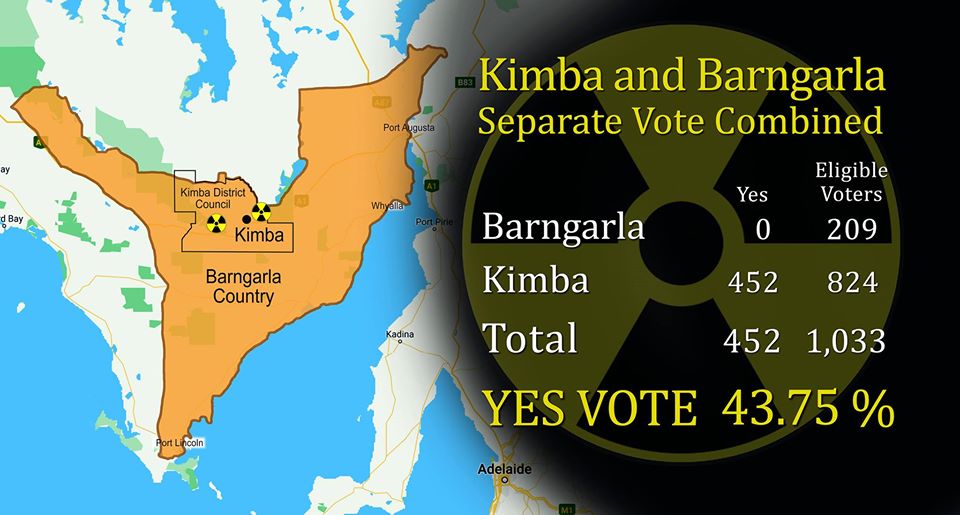
The Federal government’s plan for a nuclear waste facility at Kimba hit the Aboriginal community of the Eyre Peninsula hardest. The Barngarla people, Native Title holders, were excluded from the government’s ”community ballot” held in 2019. Voting was restricted to those living within the Kimba local council area . The Barngarla held their own ballot, resulting in a unanimous ”No” to the dump. Nevertheless, some Aboriginal people supported the plan, and this dispute has divided families.
”As an ally and advocate for Indigenous peoples for more than 30 years, I was appalled at the terrible toll fighting the nuclear waste facility took upon my friends. I watched one of my closest friends visibly age as she surrendered her art practice and her enjoyment of life to dedicate herself to challenging it. ”
– Felicity Wright – Submission to Senate Committee on National Radioactive Waste Management Amendment (Site Specification, Community Fund and Other Measures) Bill 2020 [Provisions] Submission 98
The non indigenous community has been equally affected. There were two community ballots held, 2017 and 2019. While in both cases the result favoured the nuclear waste facility, it was far from overwhelming support. At the final ballot, 824 people were eligible to vote: of 735 votes accepted, 452 said “Yes”.
The plan for the facility was pitched to the community as a medical necessity for Australia. It was an attractive idea. On the one hand Kimba could proudly provide a service to the nation. On the other hand, it was bringing a new industry, and new jobs, to a sometimes drought-stricken agricultural area. More immediate benefits: the farmer who volunteered land would be paid at 4 times the market value. A Community Benefits scheme brings up to $11 million to the town, over the next 4 years, and $20 million when the dump is up and running.
The plan was greeted with enthusiasm from some residents. They relied on the copious information provided by the the Department of Industry Innovation and Science, and by the former Resources Minister, Matt Canavan. When it was pointed out to Mr Canavan that some residents close to the selected site were ineligiblt to vote, he promised that their views would be included. But then he left that Ministry.
The Industry Department has controlled the information reaching the community, and has provided the visiting experts. There has not been any debate provided, with opposing views. Still, there is strong opposition, led by farmers. The group No Radioactive Waste on Agricultural Land in Kimba or SA, is optimistic thar Kimba, despite the prevailing mood of anxiety, can survive and go ahead, without the waste facility.
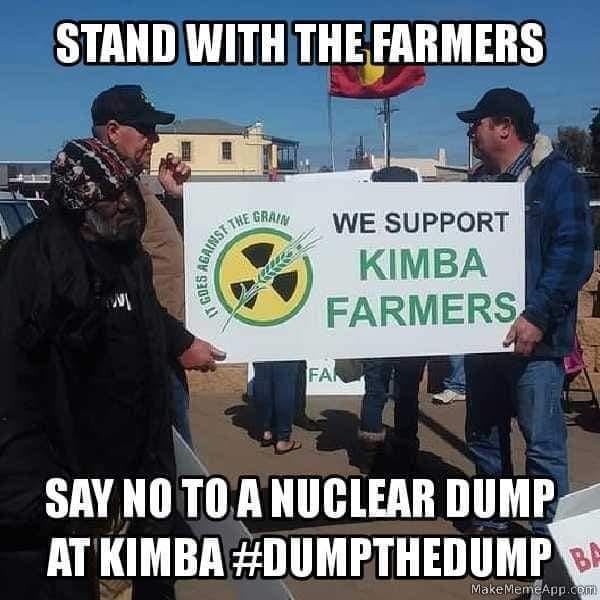
The group, of 5 years’ standing has researched the issue, and sent submissions to Parliament. Radioactive waste is not recommended for agricultural land. There are concerns about possibile environmental pollution, damage to groundwater. Perception of the area is important, and the presence of a radioactive waste dump could be very damaging to its clean, green image .
Community understanding is at the heart of this problem. The current Resources Minister, Keith Pitt, enthused about the facility, describing it to the Nationals Federal Conference on 27 March 2021 as “a low-level nuclear waste facility to house the by-products from cancer treatment.”
That’s a misleading statement. The waste proposed to be taken to the nuclear dump is waste generated from the industrial production of these isotopes. – not their usage!
There is uncertainty about the toxicity of the nuclear wastes to be placed in “interim storage” at Napandee, with the classification of these wastes as “intermediate level”, but the same wastes classified in Fance as “high level”.
The Kimba community remains troubled, as this nuclear waste problem remains paralysed in the Senate. Freedom of Information documents revealed that the government is well aware of mental health problems likely to be caused by the issue.
Minister Pitt has the option of clearly designating Napandee as the site for the nuclear waste dump. That could solve the problem, and certainly bring clarity to the Kimba community. But, the hitch for the government is that if he does this, it will be possible for opponents of the plan to take legal action against it.
Australian govt keeps mum about Japan’s plan to dump nuclear waste-water into the Pacific (no suprise – it originated from Australian uranium)

Australian Government quiet over Japan’s nuclear waste condemnation, Independent Australia, By Dave Sweeney | 23 April 2021While Japan faces international backlash over its decision to dump contaminated wastewater, Australia remains quiet due to its part in the Fukushima disaster, writes Dave Sweeney.
AGAINST A BACKDROP of runners carrying a small torch to light the Olympic flame for the July Tokyo Olympics, there are growing flames of discontent over the Japanese Government’s plan to release large volumes of contaminated wastewater from the stricken Fukushima nuclear plant directly into the Pacific Ocean.
…………Whatever the water’s pathway, it is now polluted. And, with the volume growing each day, direct ocean disposal is the quickest and cheapest management option.
The aqua dump plan, set to start in two years and continue in stages for years to come, has attracted fierce domestic and international criticism.
In a rare moment of unity, Taiwan has condemned the move while China has described the plan as “extremely irresponsible”. South Korea has seen street protests and a move from President Moon Jae-in to explore legal options, including through the International Tribunal for the Law of the Sea.
A Philippines presidential spokesperson highlighted that “we are one ecosystem… we are interconnected” and three U.N. Human Rights rapporteurs specialising in food, toxics and the environment declared that the release ‘into the marine environment imposes considerable risks to the full enjoyment of the human rights of concerned populations in and beyond the borders of Japan’.
TEPCO has stated that the water will be treated before release using a system known as A.L.P.S. — the Advanced Liquid Processing System.
However, TEPCO’s assurances are cold comfort to many.
The company was caught out in 2018 having falsely claimed that earlier releases contained no radioactive materials. This time, TEPCO has changed its tune and acknowledges that radioactive tritium will be released along with the dumped water. Tritium is very difficult to separate from water as it is a radioactive isotope of hydrogen that remains active for between 60-100 years.
Many observers also hold grave concerns that other longer-lived radioactive wastes including ruthenium, cobalt, strontium and plutonium could also be discharged into the Pacific given that not all are always captured by the A.L.P.S. process.
This concern has seen Pacific activists refer to the Japanese nuclear sector as a house without a toilet and the Pacific Islands Forum declare that:
‘…steps have not been sufficiently taken to address the potential harm to our Blue Pacific Continent, including possible environmental, health, and economic impacts. Our fisheries and oceans resources are critical to our Pacific livelihoods and must be protected.’……..
Critics are concerned that the plan is not based on the best possible technology, but rather being driven by corner and cost-cutting.
Japanese and international groups and experts called for other options to be fully evaluated before direct release was approved. These include continued interim tank storage, enhanced evaporation and mortar solidification, where contaminated water is mixed with cement and sand and stored. This technique is used to manage liquid contaminants at other nuclear facilities, including Savannah River in the USA.
Some Australian environment groups have criticised the direct dumping plan and used the recent tenth anniversary of the Fukushima disaster to call on the Japanese Government to reconsider this approach.
To date, the Australian Government has made no comment or call. This is hardly surprising given that Australian uranium was inside the Fukushima reactors at the time of the meltdown. Since this time, successive Australian governments have avoided any comment or criticism and instead prioritised trying to find new markets for our flatlining uranium sector.
As an island nation steeped in coastal culture and salt-water stories, the deliberate degradation of our shared global waters should be a concern. The long-term protection of communities, cultures, creatures and currents needs to be given preference over short-term nuclear industry expedience. Dave Sweeney is the Australian Conservation Foundation’s nuclear-free campaigner and was a founding member of ICAN. You can follow him on Twitter @nukedavesweeney. https://independentaustralia.net/politics/politics-display/australian-government-quiet-over-japans-nuclear-waste-condemnation,15015
Scott Morrison’s climate summit speech was littered with downright dodgy claims,
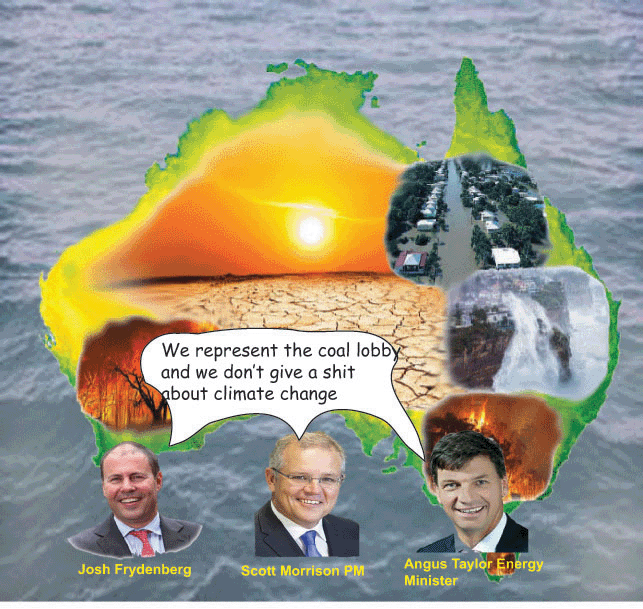
Scott Morrison’s climate summit speech was littered with downright dodgy claims, https://thenewdaily.com.au/news/politics/australian-politics/2021/04/24/scott-morrison-climate-summit-facts/ Richie Merzian, I have sat through countless speeches on climate change from world leaders, both working for the government and outside it, and Prime Minister Scott Morrison’s rant at President Joe Biden’s climate summit last night was one of the worst performances I have ever seen.
Technical glitches and the dreaded mute button were the least of Morrison’s worries, as he mounted the (virtual) stage, armed with three-word slogans, self-congratulations, and downright dodgy greenhouse gas emission numbers.
Most major nations before him (and there were many) had pledged stronger climate targets or concrete policies to curb carbon pollution. Japan and Canada vowed significant increases on their 2030 targets. India and the Republic of Korea announced new partnerships with the United States. Even Brazil, a highly problematic country in the climate space, announced it would advance its carbon neutrality target by a decade.
In contrast, Morrison’s speech was heavy on bluster, light on policy. No new commitments were brought to the table, further cementing Australia’s inadequate Paris target of a 26-28 per cent reduction in greenhouse gas emissions by 2030. Then like the dinner guest that turns up to a pot-luck empty-handed and complains about what others have brought, Morrison dismissed the serious efforts of other nations whilst offering nothing himself.
When it came time to talk numbers, Morrison’s claim that we have reduced emissions by 19 per cent broadly and 36 per cent excluding exports, had me and many others dumfounded. Where did these numbers come from? What dodgy accounting tricks were at play? Turns out 19 per cent is cherry-picked from the middle of the pandemic and the 36 per cent number is just off the reservation. The PM is reinventing UN accounting rules, asking the world to forget about the rising emissions from the production of gas and coal we export!
If there is one thing we can establish, Morrison can always be relied upon for accounting tricks. Until recently, the Morrison government tried to cash in on leftover carbon credits from the last climate agreement, to avoid reducing emissions required under the current Paris Agreement. This is What dodgy accounting tricks were at play? Turns out 19 per cent is cherry-picked from the middle of the pandemic and the 36 per cent number is just off the reservation. The PM is reinventing UN accounting rules, asking the world to forget about the rising emissions from the production of gas and coal we export!
If there is one thing we can establish, Morrison can always be relied upon for accounting tricks. Until recently, the Morrison government tried to cash in on leftover carbon credits from the last climate agreement, to avoid reducing emissions required under the current Paris Agreement. This is akin to attempting to use an old Starbucks loyalty card to pay for a Big Mac. Only after he was named and shamed by his international peers did Morrison back away from this dodgy loophole.
Much like a guest knows there are topics you do not talk about at a dinner party, every world leader knows the formalities and conventions of a climate summit. Every world leader it seems, bar Morrison. After undermining the speakers before him by belittling ‘targets’ and ‘promises’ with a tone-deaf arrogance, Morrison went on to awkwardly name-check his big-polluting industry mates, and claim Australia would somehow replicate the US’ success in Silicon Valley through our own ‘hydrogen valleys’.
Morrison rattled off ‘pioneering Australian companies’ from BHP to RioTinto, seemingly forgetting he was speaking on the international stage not addressing the Business Council of Australia at some inner-city wine bar. Perhaps most bizarre, was the name-dropping of Allan Finkel. While most Australian’s probably don’t know who Allan Finkel is, let alone the rest of the world – those who do, likely know him as the former Chief Scientist whose controversial views on gas sparked an open letter from leading Australian scientists.
In December 2019, when I watched Angus Taylor address the United Nations climate talks in Madrid without acknowledging the catastrophic bushfires that were devastating the nation, I thought I’d seen Aussie climate diplomacy at its worst. Then came Morrison’s performance at this summit.
Fortunately, the US had placed Morrison so far down the speaking list that President Biden had already left the room.
The United States – the world’s largest economy and second-largest polluter after China kicked off the event by announcing it would at least halve emissions by 2030, a target that Australia Institute research shows Australia should replicate. If it did, then we would have something to brag about.
Richie Merzian is Climate & Energy Program Director at The Australia Institute. You can follow him on Twitter at @richiemerzian.
Scott Morrison’s plan for Australia to fund small nuclear reactors and other very dubious technologies that purport to combat global heating.

Australia to fund low-emissions research as world sets ambitious climate targets, The Age, By Mike Foley, April 21, 2021,
The government is offering $566 million to global experts who want to collaborate with Australia on clean energy projects, with ‘green steel’, battery storage and even research on nuclear fission reactors among the possible tech options.
Australia will help fund groundbreaking research in low-emissions technology as the Morrison government confronts increasingly ambitious climate commitments from major trading partners ahead of a global climate summit.
Prime Minister Scott Morrison will announce a $566 million investment in research partnerships with other countries for new technology like green steel, small modular nuclear reactors, and soil carbon sequestration. He said the technology from the deals would benefit Australian export industries such as agriculture, coal, aluminium and gas…….
Australia’s focus on international action contrasts with the increasingly ambitious 2030 emissions targets that developed nations are announcing in the lead-up to US President Joe Biden’s international climate summit on Thursday…….
But Energy and Emissions Reduction Minister Angus Taylor said one country alone cannot make commercially viable the low emissions solutions needed to replace polluting technologies, or roll them out at scale……..
The partnership funding is a commitment in the upcoming federal budget. The Morrison government has entered discussions with the US, UK, Japan, Korea and Germany…..
Funds will be invested in research and development partnerships in line with Australia’s technology roadmap, which has prioritised hydrogen, low-emissions steel and aluminium, battery storage, and soil carbon sequestration on farmland….”
The Morrison government will also seek to collaborate with the US and UK on small modular nuclear reactors, which are not yet commercially viable. It has no plan to remove Australia’s ban on nuclear power or fuel processing.. … https://www.theage.com.au/politics/federal/australia-to-fund-low-emissions-research-as-world-sets-ambitious-climate-targets-20210421-p57l5v.html
Australian Strategic Policy Institute sees nuclear submarines as a step towards the full nuclear chain
Nuclear submarines could lead to nuclear power for Australia, The Strategist 15 Apr 21‘‘………..Submarines could lead to a broad nuclear industry in Australia. This possibility will be the subject of a seminar to be held at ASPI on Thursday 15 July, jointly hosted by the Submarine Institute of Australia and UNSW Canberra. More information is available here….””
https://www.aspistrategist.org.au/nuclear-submarines-could-lead-to-nuclear-power-for-australia/
Unrelenting dishonest propaganda leading us to war against China
Not sleepwalking but marching with eyes wide open to war. Independent Australia, By William Briggs | 13 April 2021 While the USA moves towards war, anti-China rhetoric grows on a daily basis and the idea of war is being sold as the “right” thing, writes Dr William Briggs.
A LIE told often enough can become accepted, but it can never be the truth. China has been declared a threat to all that we hold dear, but it is just not so. China, for all its faults, is not a threat and nor is it practising genocide!
The Uyghur genocide claim gets bigger as each day dawns. Peter Hartcher, in The Age on the 10 April, writes of this genocide and of ‘the evil genius of the system of genocide with Chinese characteristics.’ The “genius” according to Hartcher is that the Chinese are allowing the Uyghurs to live. What a clever and cunning genocide that is!
The plight of the Uyghurs is but the latest lurid episode in a sustained and enormously successful push to demonise China in the eyes of the world. The motivations behind this are simple enough. China’s economic star is rising and America’s best days are behind it.
The world is certainly on the edge of a precipice. There is a broad acceptance, despite an embarrassing lack of evidence, that China is an enemy and, as an enemy, a threat. Nobody is ever eager for war, but people have often enough been persuaded that war is an acceptable option. This is particularly so when an existential threat exists, or in this case, is manufactured. The potential for war, justifications for it and warnings of how it might almost “accidentally” become a reality have come to dominate thought……..
If the USA goes to war with China, it will not be by chance. It has been meticulously planned, costed, budgeted for and the weapons, including “low-yield” nuclear weapons, have been manufactured and deployed by the USA. The world should be aghast at such blatant preparations, but it is not. Those who would take us to war need first to convince us that we have no option, that we are protecting freedom, that we are standing for justice and that a threat exists that the enemy is engaging in genocide.
In the space of just a decade, the people have come to accept this. China has gone from economic saviour of the world to arch enemy. Governments begin the process but could not be expected to convince the people alone. Television and print media: editorials, opinion pieces from leading journalists and international editors, columnists and experts, have all played a decisive role.
A recent poll by the Lowy Institute showed that in 2018, 52 per cent of Australians believed that China would act responsibly in the world. Two very short years later and that figure had dropped to just 23 per cent! The polls are then used by the same anti-China crusaders to prove that a problem exists. They are happy to ignore the effect that a daily barrage of anti-China campaigning can do and how it can shift people’s views…….
The most recent reporting of the treatment of the Uyghurs is that the Chinese are engaged in a campaign of genocide. Genocide was practised in Nazi Germany, in Kampuchea, in Rwanda, in Armenia, in Australia, but to suggest that the Chinese behaviour towards the Uyghurs, while quite possibly repressive, even reprehensible, is genocidal is ludicrous.
There has been discrimination and persecution. Life, for the Uyghurs, has never been easy. However, the West paid little or no attention to these people until about the time that the USA began to talk of “containing” China. It was, for the USA, a fortuitous discovery.
The Chinese, at the end of the 20th Century, waged a campaign against Islamist separatist groups that had become active within the Uyghur population. Violence met violence and conditions worsened for the Uyghurs. None of this concerned Washington. What happened to make things change so dramatically? The Chinese, in all likelihood, did step up repressions but the USA have manipulated events to suit a specific propaganda purpose.
Uyghur stories become more and more horrifying. The Western media was once content to rail against the existence of “re-education” camps. Then it was reports of campaigns of mass rape and then mass sterilisation programs. This morphed into claims of social genocide. Reports of forced labour emerged and evolved into stories of slave labour. The term “social” genocide came into use but has now been shortened to genocide.
This ramping up of rhetoric has one real purpose. China must, at every turn, be shown to be a malignant force. The editorialists, international editors, columnists and journalists have become a willing and shameless weapon in this campaign. If it all ends in war it will not be a chance thing. The world will not be “sleepwalking”.
Nobody wants war but we are being prepared for it. https://independentaustralia.net/politics/politics-display/not-sleepwalking-but-marching-with-eyes-wide-open-to-war,14982#.YHZ_2MRzAdY.twitter
Two years since Julian Assange was seized from the Ecuadorian Embassy
the Biden administration has continued Trump’s pursuit of the WikiLeaks founder—in 2010, Biden had labelled him a “high-tech terrorist”.

Two years since Assange was seized from the Ecuadorian Embassy, World Socialist Website, Thomas Scripps, 9 April 2021 Two years ago on Sunday, WikiLeaks founder Julian Assange was seized from the Ecuadorian embassy in London. He has been incarcerated ever since, fighting extradition to the United States where he faces life imprisonment in barbaric conditions for exposing war crimes, coup plots, mass state surveillance, torture and corruption.
On April 11, 2019, Assange’s political asylum status was revoked by the Ecuadorian government and British police entered the embassy building, dragging him away. The recently published diaries of former Foreign Office minister Sir Alan Duncan confirm the involvement of the highest levels of the state in this lawless operation.
Duncan explains how he watched the police raid on a live feed from the “Operations Room at the top of the Foreign Office.” Codenamed “Pelican”, Duncan recalled how one of its officials looked on, “wearing a pelican-motif tie.” Duncan’s diary entry concludes, “So, job done at last—and we take a commemorative photo of Team Pelican. It had taken many months of patient diplomatic negotiation, and in the end it went off without a hitch. I do millions of interviews, trying to keep the smirk off my face.”
The sadism of the British state’s snatch-and-grab operation was matched only by the degraded efforts of the pseudo-left to vilify Assange and blacken his reputation in support of a manufactured sexual assault investigation launched by Sweden in 2010. Rightly fearing that his extradition to Sweden would be a stepping-stone to US extradition, Assange sought asylum in the Ecuadorian embassy. While he was there, his former “media partners”, most prominently the Guardian, and an international roll call of pseudo-left groups, launched a despicable years’ long slander campaign to smear him as a sexual predator………………
The Trump administration, it was later revealed, was working with the CIA to spy on Assange, including his privileged communications with lawyers and doctors, and to steal his personal documents. CIA operatives discussed plans for Assange’s kidnap or assassination, until Ecuadorian President Lenin Moreno agreed to turn him over to the UK police.
Once in the hands of the British state, Assange was subjected to two years of pseudo-legal persecution, culminating in a degrading show trial. Hauled in front of Westminster Magistrates Court just hours after he was seized from the embassy, Assange was found guilty of violating bail. District judge Michael Snow declared, “His assertion that he has not had a fair hearing is laughable. And his behaviour is that of a narcissist who cannot get beyond his own selfish interests.”………..
Assange’s time in Belmarsh was characterised by the repeated and flagrant denial of his legal rights, aimed at crushing him and which left him suicidal. He was repeatedly denied proper access to his lawyers and to materials necessary to prepare his defence. When Assange reached the end of his sentence, District Judge Vanessa Baraitser ordered that he continue to be held in Belmarsh on remand. During the initial week of Assange’s extradition hearing, held in February 2020 at Woolwich Crown Court, he was held in a glass box, with Baraitser preventing him from speaking or communicating effectively with his lawyers. He was stripped twice and handcuffed 11 times on the first day.
In the run-up to the main hearing at Westminster Magistrates Court in September 2020, Assange was repeatedly denied bail, even as COVID-19, to which he is especially vulnerable on account of a respiratory condition, ripped through Belmarsh prison.
The US government used this time to develop its monstrous assault on democratic rights. The initial indictment of the WikiLeaks founder, unsealed on the day of his seizure from the embassy, charged him with conspiracy to commit computer intrusion, with a maximum sentence of five years. On May 23, 2019, the US unveiled 17 new charges under the 1918 Espionage Act with a combined potential sentence of 170 years. These charges have chilling implications for freedom of the press, criminalising basic journalistic practices and holding them tantamount to treason or espionage.
Another superseding indictment was issued on June 24, 2020, after one phase of Assange’s hearing had been completed and a matter of weeks before the defence was due to submit its skeleton argument for the second. Besides being a gross abuse of due process, the new indictment, based largely on testimony from FBI informants with histories of fraud and entrapment, expanded the framework of the charges to an even wider range of journalistic activity.
The immense significance of WikiLeaks’ and Assange’s journalism, and the criminality of their persecution, was underscored at his hearing in September. Dozens of witnesses spoke to WikiLeaks’ pioneering source protection and the global impact of releases like the Collateral Murder video, revealing the massacre of Iraqi civilians, journalists and first responders by a US Apache helicopter gunship. The US case was exposed as a groundless, vindictive witch-hunt designed to destroy Assange and set a dictatorial precedent for what will happen to any journalists who dare expose imperialist crimes.
With a ruling in favour of extradition considered all but assured, Baraitser delivered a surprise decision against on January 4 of this year. But her politically calculated ruling blocked the extradition request solely on the grounds that it would be oppressive by reason of Assange’s compromised mental health and his risk of suicide if he were imprisoned in the US. She accepted every other element of the prosecution’s case, including its denial of free speech and freedom of the press, and its justification of the abuse of Assange’s democratic rights.
This left the gate wide open to a US appeal. The US Department of Justice quickly responded, “While we are extremely disappointed in the court’s ultimate decision, we are gratified that the United States prevailed on every point of law raised. In particular, the court rejected all of Mr. Assange’s arguments regarding political motivation, political offense, fair trial, and freedom of speech. We will continue to seek Mr. Assange’s extradition to the United States.”………
the Biden administration has continued Trump’s pursuit of the WikiLeaks founder—in 2010, Biden had labelled him a “high-tech terrorist”. As the World Socialist Web Site and the International Committee of the Fourth International (ICFI) have warned, Assange’s persecution is integral to the war drive of US imperialism, escalated by Trump and now intensified by his successor.
Biden has engaged in an aggressive anti-China campaign and is whipping up anti-Chinese xenophobia at home, promoting conspiracy theories on the origin of COVID-19. The US and its allies stand on a cliff edge with Russia over Crimea and eastern Ukraine, with NATO’s endless anti-Russia provocations and proxy incursions threatening to spill into war.
Military conflicts of such catastrophic scope can only be pursued abroad by destroying democratic rights at home. WikiLeaks’ releases of the Afghanistan and Iraq war logs were a spark to mass anti-war sentiment all over the world. The ruling class in the imperialist countries around the world are determined to prevent their war plans and crimes being reported and have sought to crack down on left-wing, socialist and anti-war opposition. The Assange case is emblematic of this turn to dictatorship.
In the two years since Assange’s arrest, two sharply opposed political perspectives have defined themselves in the fight for his freedom. The official campaign, run by Don’t Extradite Assange (DEA), has based itself on rotten appeals to the state and its representatives. The DEA’s first champion was former Labour leader Jeremy Corbyn. Throughout the 2019 general election, as leader of the Labour Party, Corbyn maintained a politically criminal silence on Assange, blocking the development of a mass movement against British and US imperialism to secure his freedom. When Corbyn did finally speak, it was to appeal to Boris Johnson and the British justice system that had trampled Assange’s democratic rights………..
The pandemic has proved beyond all doubt that there is no constituency in the ruling class for even the most basic democratic rights, including the right to protest and assembly and the right to life. It has responded to the virus with a policy of social murder and by advancing its preparations for state repression and war on a vast scale……….
On the second anniversary of the WikiLeaks founder’s seizure, we reaffirm our demand for Assange’s immediate, unconditional freedom and our commitment to a programme of class struggle to achieve it. https://www.wsws.org/en/articles/2021/04/10/assa-j01.html?pk_campaign=assange-newsletter&pk_kwd=wsws
With uranium mining closed, Kakadu ‘stagnates” during long wait for proposed federal funding.
| Fears Kakadu is ‘probably going to stagnate’ during the long wait for promised federal funding, ABC By Roxanne Fitzgerald 11 Apr 21, The federal government has been urged to fast-track an investment worth more than $200 million it promised two years ago to revitalise the world heritage-listed Kakadu National Park. Key points: Kakadu National Park has been waiting two years for a pivotal federal investmentPoliticians and traditional owners fear Kakadu will ‘stagnate’ without it A Senior Advisory Group has been established to examine the management of the park. The Australian government has allocated only $5.4 million so far to transition Jabiru — the community in the centre of the park — from a mining town into a world-class tourism hub. Outlined in 2019 federal budget papers, the $216.2 million was also meant to fund road upgrades, a new park visitor centre and more than $50 million in tourism infrastructure over a 10-year timeframe.The federal government’s promised spending has now grown to $276 million. Parks Australia has blamed the COVID-19 pandemic and consultations with traditional owners for delays in approving funding………….. . https://www.abc.net.au/news/2021-04-11/nt-calls-for-kakadu-investment-to-be-fast-tracked/100054140 |
Chinese-Australian uranium and rare earths mining company meets political opposition in Greenland
Left-wing party opposed to rare earth mining project wins Greenland election, A left-wing environmentalist party opposed to a controversial mining project won a clear victory in Greenland’s parliamentary election, according to results released Wednesday. https://www.france24.com/en/europe/20210407-left-wing-party-opposed-to-rare-earth-mining-project-wins-greenland-election 7 Apr 21,
With 36.6 percent of the vote, Inuit Ataqatigiit (IA) was ahead of Siumut, a social democratic party that has dominated politics in the Danish territory since it gained autonomy in 1979.
“Thank you to the people who trusted us to work with the people in the centre for the next four years,” IA leader Mute Egede said on KNR public television after the results were announced.
IA, which was previously in opposition, is expected to grab 12 out of the 31 seats in the Inatsisartut, the local parliament, up from eight currently.
But without an absolute majority, the most likely scenario is that IA joins forces with smaller parties to form a coalition. Siumut, which headed the outgoing government, was partly weakened by internal struggles. It gained 29.4 percent of the vote, still two percentage points higher than its results in the 2018 election.
The dividing line between the two parties was whether to authorise a controversial giant rare earth and uranium mining project, which is currently the subject of public hearings.
The Kuannersuit deposit, in the island’s south, is considered one of the world’s richest in uranium and rare earth minerals — a group of 17 metals used as components in everything from smartphones to electric cars and weapons.
IA has called for a moratorium on uranium mining, which would effectively put a halt to the project.
Divisions over Kuannersuit originally triggered the snap election in the territory after one of the smaller parties left the ruling Siumut coalition.
Opponents say the project, led by the Chinese-owned Australian group Greenland Minerals, has too many environmental risks, including radioactive waste.
Egede told KNR he would immediately start discussions to “explore different forms of cooperation” before forming a coalition government.
The 34-year-old, who has been a member of the Inatsisartut since 2015, took over the reins of the left-green party a little over two years ago.
Australia’s part in continuing nuclear havoc in Pacific islands – legacy of atomic bomb tests
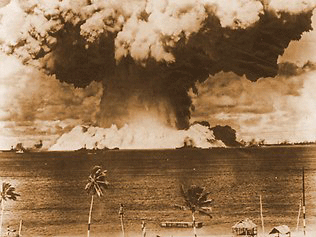
| 75 years after nuclear testing in the Pacific began, the fallout continues to wreak havoc https://theconversation.com/75-years-after-nuclear-testing-in-the-pacific-began-the-fallout-continues-to-wreak-havoc-158208?fbclid=IwAR3q9QJvy507ds2kD0ibOvkD6ZzxFqgGjfHsGrwqJUVMNpujOu8sAeLVPtY April 6, 2021 Patricia A. O’Brien Patricia A. O’Brien is a Friend of The Conversation.Historian, Visiting Fellow in the School of History, Australian National University and Adjunct Professor in the Asian Studies Program, Georgetown University, This year marks 75 years since the United States launched its immense atomic testing program in the Pacific. The historical fallout from tests carried out over 12 years in the Marshall Islands, then a UN Trust Territory governed by the US, have framed seven decades of US relations with the Pacific nation.Due to the dramatic effects of climate change, the legacies of this history are shaping the present in myriad ways. This history has Australian dimensions too, though decades of diplomatic distance between Australia and the Marshall Islands have hidden an entangled atomic past. In 1946, the Marshall Islands seemed very close for many Australians. They feared the imminent launch of the US’s atomic testing program on Bikini Atoll might split the earth in two, catastrophically change the earth’s climate, or produce earthquakes and deadly tidal waves. A map accompanying one report noted Sydney was only 3,100 miles from ground zero. Residents as far away as Perth were warned if their houses shook on July 1, “it may be the atom bomb test”. Australia was “included in the tests” as a site for recording blast effects and monitoring for atom bombs detonated anywhere in the world by hostile nations. This Australian site served to keep enemies in check and achieve one of the Pacific testing program’s objectives: to deter future war. The other justification was the advancement of science. The earth did not split in two after the initial test (unless you were Marshallese) so they continued; 66 others followed over the next 12 years. But the insidious and multiple harms to people and place, regularly covered up or denied publicly, became increasingly hard to hide. Radiation poisoning, birth defects, leukaemia, thyroid and other cancers became prevalent in exposed Marshallese, at least four islands were “partially or completely vapourised”, the exposed Marshallese “became subjects of a medical research program” and atomic refugees. (Bikinians were allowed to return to their atoll for a decade before the US government removed them again when it was realised a careless error falsely claimed radiation levels were safe in 1968.) In late 1947, the US moved its operations to Eniwetok Atoll, a decision, it was argued, to ensure additional safety. Eniwetok was more isolated and winds were less likely to carry radioactive particles to populated areas. Australian reports noted this site was only 3,200 miles from Sydney. Troubling reports of radioactive clouds as far away as the French Alps and the known shocking health effects appeared. Dissenting voices were initially muted due to the steep escalation of the Cold War and Soviet atomic weapon tests beginning in 1949. Opinion in Australia split along political lines. Conservative Cold War warriors, chief among them Robert Menzies who became prime minister again in 1949, kept Australia in lockstep with the US, and downplayed the ill-effects of testing. Left-wing elements in Australia continued to draw attention to the “horrors” it unleashed. The atomic question came home in 1952, when the first of 12 British atomic tests began on the Montebello Islands, off Western Australia. Australia’s involvement in atomic testing expanded again in 1954, when it began supplying South Australian-mined uranium to the US and UK’s joint defence purchasing authority, the Combined Development Agency. Australia’s economic stake in the atomic age from 1954 collided with the galvanisation of global public opinion against US testing in Eniwetok. The massive “Castle Bravo” hydrogen bomb test in March exposed Marshall Islanders and a Japanese fishing crew on The Lucky Dragon to catastrophic radiation levels “equal to that received by Japanese people less than two miles from ground zero” in the 1945 Hiroshima and Nagasaki atomic blasts. Graphic details of the fishermen’s suffering and deaths and a Marshallese petition to the United Nations followed. When a UN resolution to halt US testing was voted on in July, Australia voted for its continuation. But the tide of public opinion was turning against testing. The events of 1954 dispelled the notion atomic waste was safe and could be contained. The problem of radioactive fish travelling into Australian waters highlighted these new dangers, which spurred increasing world wide protests until the US finally ceased testing in the Marshalls in 1958. In the 1970s, US atomic waste was concentrated under the Runit Island dome, part of Enewetak Atoll (about 3,200 miles from Sydney). Recent alarming descriptions of how precarious and dangerous this structure is due to age, sea water inundation and storm damage exacerbated by climate change were contested in a 2020 Trump-era report. The Biden administration’s current renegotiation of the Compact of Free Association with the Republic of the Marshall Islands, and its prioritisation of action on climate change, will put Runit Island high on the agenda. There is an opportunity for historical redress for the US that is even more urgent given the upsurge in discrimination against US-based Pacific Islander communities devastated by the COVID-19 pandemic. Some are peoples displaced by the tests. Australia is also embarking on a new level of engagement with the Marshall Islands: it is due to open its first embassy in the capital Majuro in 2021.It should be remembered this bilateral relationship has an atomic history too. Australia supported the US testing program, assisted with data collection and voted in the UN for its continuation when Marshallese pleaded for it to be stopped. It is also likely Australian-sourced atomic waste lies within Runit Island, cementing Australia in this history. |
Scott Morrison’s $billion missile spend, a gift to foreign war companies and their sponsor, the Australian Strategic Policy Institute, (ASPI)
Foreign war lobby gets a $billion for missiles – media fawns
https://www.michaelwest.com.au/foreign-war-lobby-gets-a-billion-for-missiles-media-fawns/ 4 Apr 21,
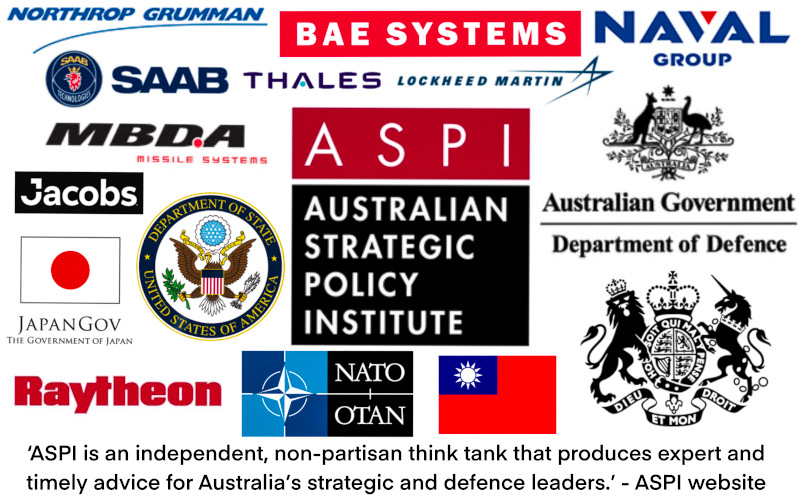
Scott Morrison’s latest billion-dollar missile spend was deftly leaked to the media then talked up by ASPI whose sponsors have raked in $51 billion in Defence Department contracts while doling cash to the conflicted “think-tank”. Marcus Rubenstein investigates.
No sooner had Scott Morrison’s new cabinet been sworn in than it was back to business, feeding out distractions to the Canberra press gallery.
Nearly 14 hours before the prime minister announced to the nation that Australia was going to spend a billion dollars on building “our own missiles” Greg Sheridan from The Australian had the scoop—along with The Age/SMH, Nine Newspapers stablemate Australian Financial Review and the ABC. Along with the ranks of metropolitan mainstream media dailies who all fell in line behind the announcement.
And with military precision they all fired off their online reports at 10:30pm… or, to be more precise, 22:30 hrs.
The Age and Sydney Morning Herald both quoted ASPI (Australian Strategic Policy Institute) in their coverage as did The Conversation, along with others they listed potential weapons maker partners for this home grown missile mission.
Apart from the glaring fact that none of these companies are actually Australian, most were listed by ASPI in a report it published last year. Of the five potential partner companies being touted by mainstream media— Raytheon (USA), Lockheed Martin (USA), Kongsberg (Norway), Rafeal (Israel) and BAE Systems (UK)—all but one is a long-term financial backer of ASPI.
As is de rigueur there was no mention that ASPI’s enthusiasm for substantial new military expenditure was directed towards spending on weapons made by their sponsors.
A number of media reports included PR handout images from US missile maker Raytheon, which for years was a loyal ASPI sponsor and also the former employer of, recently demoted, Defence Minister Linda Reynolds.
The actual announcement was made by the prime minister, not at Parliament House, but at the South Australian facility of Raytheon.
Government access for weapons makers
Since ASPI’s foundation in 2001, when it was created to challenge the policy direction of Defence, it has become more and more commercialised.
This fact was highlighted by ASPI’s founding Executive Director Hugh White, who wrote on the 15th anniversary of its foundation, “The quality of defence policy slumped… [and] ASPI’s focus inevitably swung round to contributing to public debates not government policy-making.”
Under Hugh White’s leadership, ASPI preserved a great deal of independence and only took an average of $28,000 per year in commercial revenue.
In the last financial year, under the leadership of (former Howard Government adviser) Peter Jennings, ASPI raked in $6,953,000 in commercial revenue. Yet it maintains its façade of independence of outside influence.
ASPI sponsor, French-owned Naval Group was awarded the contract for Australia’s controversial $80 billion future submarine project. It has been in the headlines recently after an independent report released in March found the project was “dangerously off track”.
In 2016, when the contract was awarded Jennings, wrote a glowing opinion piece, about his sponsor, under the headline “Vive Australia’s choice of a French submarine”.
The release of the Future Submarines Report was very critical of the entire project and there were suggestions from highly credentialed defence strategists that Australia should walk away from the deal.
In response, ASPI wrote that not only should Naval Group keeps its contract but the Royal Australian Navy should commission un-maned Orca submarines whilst waiting decades for the French submarines order to be fulfilled.
And who makes the Orca? Another ASPI sponsor, Boeing Defense.
This comes after revelations in March that ASPI had been commissioned to write a report critical of the federal government’s awarding of cloud computing contracts to Australian company Canberra Data Centres (CDC).
As it transpires, ASPI had been commissioned to write the report by lobbying firm Australian Public Affairs (APA); the Commonwealth Lobbyists Register reveals APA represent CDC’s three main commercial rivals.
Last October, ASPI’s Peter Jennings told the ABC, “ASPI’s work as a think tank is genuinely independent” and suggestions it was controlled by sponsors were “frankly nonsense”.
The massive ASPI payoff
ASPI is not an independent think tank, it is in fact a Commonwealth Company which reports to the parliament through the Defence Ministry. In its latest annual report ASPI singled out the then Defence Minister for her “continuing close personal engagement and support”.
In her first speech as Defence Minister, Linda Reynolds boasted of her close friendship with ASPI’s Peter Jennings.
Clearly ASPI’s boss and his board, which is chaired by former Chief of the Army, Lt Gen (Ret’d) Kenneth Gillespie and includes former Liberal Defence Minister Brendan Nelson, has access to the highest levels of government and the Defence Department.
Since ASPI’s inception it has received sponsorship from 12 manufacturers of weapons and weapons systems. Over that period, they have been awarded 9,423 Defence Department contracts with a total value of $51.2 billion.
This does not include another 49 ASPI sponsors who do not manufacture weapons, yet Department of Finance data, reveals have benefitted from more than $30 billion in defence contracts since 2001.
ASPI’s most recent annual report revealed that in the year before the COVID-19 pandemic, it hosted 142 separate events and meetings, many of them bringing together defence policy makers and defence suppliers.
At one such event in 2019, sponsored by Thales, Northrop Grumman and Lockheed Martin, then Defence Minister Linda Reynolds was keynote speaker. Presumably executives from these foreign weapons makers had some level of access to the minister.
Department of Finance figures later revealed that ministerial and department staff were charged $30,723 by ASPI in order to attend that speech.
Greenland might reject Australian-Chinese company Greenland Minerals in its bid to mine rare earths
Telegraph 4th April 2021, AS elections go, it sounds rather minor-league: a contest with just 40,000 voters, triggered by a planning row in one of the most remote, inhospitable corners of the planet. On Tuesday, though, diplomats from Washington to
Beijing will be watching carefully as Greenland holds snap parliamentary polls. With a total of population of just 56,000, its electorate is smaller than some British town councils – yet their vote over the vexed issue of the Kvanefjeld mine project could have implications not just for Greenland, but the global superpower race.
Overlooking the tiny fishing settlement of Narsaq, where locals live mainly off catching whales and seals, the project
aims to tap into one of world’s biggest deposits of “rare earth” minerals – materials as vital to the 21st-century as oil was to the 20th. Their supermagnetic, superconductive properties are used in everything from i-Phones and solar panels through to hybrid cars and weapons systems.
Yet while they are key to the goals of a high-tech, low-carbon world, extracting them itself can be an environmentally-hazardous process – a point not lost on Greenland’s residents, some of whom are sceptical of promises from the Australian firm behind the project, Greenland Minerals, that strict anti-pollution measures will be enforced.
Frontrunners in the election are the Left-wing, pro-green Inuit Ataqatigiit party, who could throw the mine project out altogether, despite warnings from rival parties that Greenland’s isolated economy must end its dependence on fishing. But for others, the stakes are about much more than even that. Of particular concern is that Greenland Minerals is part-owned by Shenghe Holdings, a Chinese firm with close ties to the Beijing government.
Labor Party’s platform on uranium/nuclear and radioactive waste issues.

Dave Sweeey, 31 Mar 21, At its National Conference federal Labor adopted the platform (below) on uranium/nuclear and radioactive waste issues.
Clearly it is not what we would write but there’s a lot that is useful and important – including options to further contest Australian uranium sales, a commitment to responsible radioactive waste management and a rejection of domestic nuclear power.
Yesterday federal Labor also clearly reaffirmed its commitment to sign and ratify the Treaty on the Prohibition of Nuclear Weapons (the ICAN Ban) in government.
Uranium
1. The production of uranium and its use in the nuclear fuel cycle present unique and unprecedented
hazards and risks, including:
Threats to human health and the local environment in the mining and milling of uranium and
management of radioactive materials, which demand the enforcement of strict safety
procedures;
The generation of products that are usable as the raw materials for nuclear weapons
manufacture, which demands the enforcement of effective controls against diversion; and
The generation of highly toxic radioactive waste by-products that demand permanently safe
disposal methods.
2 Labor accordingly will allow the mining and export of uranium only under the most stringent
conditions.
3. In relation to mining and milling, Labor will:
Ensure the safety of workers in the uranium industry is given priority. Labor has established a
compulsory register for workers in the uranium industry that includes regular health checks
and ongoing monitoring. The register is held by an independent agency and will be subject to
privacy provisions;
Ensure Australian uranium mining, milling and rehabilitation is based on world best practice
standards, extensive continuing research on environmental impacts and the health and
safety of employees and affected communities, particularly Indigenous communities;
Ensure the Australian public is informed about the quality of the environmental performance
of uranium mines through public accountability mechanisms;
Foster a constructive relationship between mining companies and Indigenous communities
affected by uranium mining; and
Prohibit the mining of uranium within national parks under International Union for
Conservation of Nature protected area category 1A, category 1B, and category 2, and listed
world heritage areas.
4. In relation to exports other than to India, Labor will allow the export of uranium only to those
countries that observe the Nuclear Non-Proliferation Treaty (NPT), are committed to nonproliferation
policies, and have ratified international and bilateral nuclear safeguards agreements.
Labor will export uranium only to countries that maintain strict safeguards and security controls
over their nuclear power industries.
5. In relation to India, an important strategic partner for Australia, commitments and responsible
actions in support of nuclear non-proliferation, consistent with international guidelines on nuclear
supply, will provide an acceptable basis for peaceful nuclear cooperation, including the export of
uranium, subject to the application of strong safeguards.
6. In addition, Labor will work towards:
Strengthening export control regimes and the rights and authority of the International
Atomic Energy Agency (IAEA);
Appropriate international responses to violations of existing safeguard commitments;
Limiting the processing of weapon usable material (separation of plutonium and high
enriched uranium in civilian programs);
Tightening controls over the export of nuclear material and technology;
Universalising of the IAEA additional protocol making it mandatory for all states and
members of the Nuclear Suppliers Group to adhere to the additional protocol as a condition
of supply to all their transfers;
Criminalising actions of individuals and companies that assist in nuclear proliferation;
The development of an international guarantee of nuclear fuel supply to states foregoing
sensitive nuclear technologies;
Revising the NPT to prevent countries from withdrawing from the NPT and passing a new
resolution in the United Nations Security Council addressing the penalties for withdrawal
from the NPT;
Encouraging all nuclear states to join the NPT;
Reserving the right to withhold supplies of uranium permanently, indefinitely or for a
specified period from any country that ceases to observe the non-proliferation safeguards
and security conditions applied to Australian uranium exports to that country, or which
adopts nuclear practices or policies that do not further advance the cause of nuclear nonproliferation;
Supporting the maintenance and enhancement of international and Australian safeguards to
ensure that uranium mined in Australia, and nuclear products derived from it, are used only
for civil purposes by approved instrumentalities in approved countries that are signatories to
the NPT (with the exception of India) and with whom Australia has safeguard arrangements;
and
Seeking adequate international resourcing of the IAEA to ensure its effectiveness in
undertaking its charter.
7. Labor will progress these commitments through diplomatic means including the re-establishment
of the Canberra Commission to re-invigorate Australia’s tradition of middle power, multilateral
diplomacy. In doing so, Labor believes that as a non-nuclear armed nation and a good international
citizen, Australia can make a significant contribution to promoting disarmament, the reduction of
nuclear stockpiles, and the responsible use of nuclear technology.
8. Labor will:
Vigorously and totally oppose the ocean dumping of radioactive waste;
Prohibit the establishment of nuclear power plants and all other stages of the nuclear fuel
cycle in Australia;
Fully meet all Australia’s obligations as a party to the NPT; and
Remain strongly opposed to the importation and storage of nuclear waste that is sourced
from overseas in Australia.
9. Labor acknowledges that radioactive waste management is a complex policy challenge that
requires the highest levels of transparency and evidence, while balancing the need of the
community to benefit from treatments for diseases like cancer. Accordingly, Labor will act in
accordance with scientific evidence, and with full transparency, broad public input and best
practice technical and consultative standards, taking into account the views of traditional owners,
to progress responsible radioactive waste management
New research into the effects of nuclear bomb tests on Montebello islands
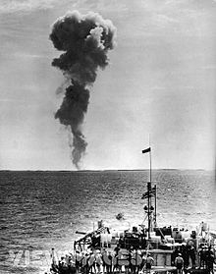 By Susan Standen 22 Mar 21, A new Edith Cowan University research project hopes to collect important data on the impact of historical nuclear testing in the remote Montebello Islands area. Key points:
Sixty years after the British government conducted nuclear explosion testing on the islands, there is little data available to find how much residue plutonium still exists. The project hopes to be the first study to outline how and where man-made radioactivity is still existing in the marine sediment. Collections of sediment are being collected from remote field trips to the islands to analyse amounts of residue plutonium radionuclides.,,,,,,,,,,,, Ms Hoffman says other island nations affected by nuclear blasts will be able to use the Montebello Islands research as a reference baseline to start their own investigations. Will it inform health research? Ms Hoffman says the first step is to find out what remains there as a legacy………….. The project is a collaboration between the Edith Cowan University, the Department of Biodiversity and Conservation and the Australian Radiation Protection and Nuclear Safety Agency. https://www.abc.net.au/news/2021-03-22/montebellos-nucelar-fallout-research/13260242 |
|
Why Boris Johnson rejected Scott Morrison as speaker at climate summit, to Morrison’s fury
|
Boris Johnson outlines why Scott Morrison was rejected to speak at climate summit, The Age, By Rob Harris March 22, 2021 British Prime Minister Boris Johnson told Scott Morrison that Australia was denied the opportunity to speak at last year’s climate summit because he wanted to encourage nations to set more ambitious emissions reduction targets.
Mr Johnson, who is rallying the world’s leading economies towards achieving net zero emissions by 2050, explained his rationale in a letter to the Australian Prime Minister in December last year while acknowledging the domestic political challenge over climate policy. Mr Johnson had originally invited Mr Morrison to speak at the December 12 summit but later walked away from the offer amid a behind-the-scenes diplomatic tussle over whether Australia’s climate change policies were insufficient to warrant a speaking slot………. While Mr Morrison told Parliament at the time he was not bothered by the snub, the government was privately furious behind the scenes and much of its anger was directed towards the British PM, who hosted the conference in partnership with the UN and France. Mr Johnson said Mr Morrison should understand that “we have tried to set a high bar for this summit to encourage countries to come forward with ambitious commitments”………https://www.theage.com.au/politics/federal/boris-johnson-outlines-why-scott-morrison-was-rejected-to-speak-at-climate-summit-20210322-p57d2o.html |
|
1 This month
Chernobyl: The Lost Tapes – A good documentary on Chernobyl on SBS available On Demand for the next 3 weeks– https://www.sbs.com.au/ondemand/tv-program/chernobyl-the-lost-tapes/2352741955560
15 April – Zoom –Nuclear Power is Not the Solution
Apr 15, 2026 01:00 AM in Canberra, Melbourne, Sydney

Join the International Physicians for the Prevention of Nuclear War (IPPNW) on Tuesday, April 14th for a timely webinar exploring the risks associated with nuclear power and challenging the myth that it offers a simple, safe, carbon-free solution to the climate crisis

21 April Webinar: No Nuclear Weapons in Australia
Start: 2026-04-21 18:00:00 UTC Canberra, Melbourne, Sydney (GMT+10:00)
End: 2026-04-21 19:30:00 UTC Canberra, Melbourne, Sydney (GMT+10:00)
Event Type: Virtual
A virtual link will be communicated before the event.
Host Contact Info: australia@icanw.org

of the week – Australians for War Powers Reform (AWPR)
To see nuclear-related stories in greater depth and intensity
 Antinuclear