Australia risks bringing on a nuclear war with China. Urgent need to change foreign policy.
Nuclear’: Grim prediction for what war with China would look like, Yahoo News. Brooke Rolfe· News ReporterSat, 8 May 2021
Australia’s escalating rift with China could see the hypothetical prospect of war swiftly become a reality if the government doesn’t urgently rethink its approach, according to Hugh White, a leading expert on Australia’s strategic defence………..
Now our government has begun, with disconcerting nonchalance, to talk of war,” he wrote in The Saturday Paper.
“And yet our government seems to have no idea how serious, and dangerous, our situation has become, and has no viable plan to fix it. This must count as one of the biggest failures of statecraft in Australia’s history.”………..
“It would be a war the US and its allies would have no clear chance of winning. Indeed, it is not even clear what winning a war with a country such as China means. And it would very likely become a nuclear war,” he wrote.
Recent reports from the government saying Australia’s troops should be ready for a military conflict suggest Prime Minister Scott Morrison and Defence Minister Peter Dutton are prepared to go to war with China, Prof White noted.
He urged against any notion of heated conflict and implored the Federal Government to rethink its relationship with China from the ground up.
China’s inevitable rise needs to be accepted, combined with “a new order in Asia” which includes the rise of India and Indonesia.
“Australia must conceive a new relationship with China, one that takes account of this reality and works to balance and protect the full range of our interests … this would require hard work, deep thought and subtle execution. It would mean a revolution in our foreign policy.”…….
He urged against any notion of heated conflict and implored the Federal Government to rethink its relationship with China from the ground up.
China’s inevitable rise needs to be accepted, combined with “a new order in Asia” which includes the rise of India and Indonesia.
“Australia must conceive a new relationship with China, one that takes account of this reality and works to balance and protect the full range of our interests … this would require hard work, deep thought and subtle execution. It would mean a revolution in our foreign policy.” https://au.news.yahoo.com/nuclear-grim-prediction-for-what-war-with-china-would-look-like-051637841.html
Gun totin’ gay-marriage opposing, sports-rorting Senator Bridget McKenzie leads the National Party’s push on behalf of the nuclear lobby.

Sky News.6 May 21, Nationals Senator Bridget McKenzie, Nationals Senators earlier this year drafted legislation which would allow the Clean Energy Finance Corporation to invest in nuclear power. Ms McKenzie told Sky News host Alan Jones “we’re still waiting” for Energy Minister Angus Taylor to put the legislation through parliament and spark debate on the issue.
Hunters Hill low level radioactive trash to be sent to USA
Are you turning green?‘: Neighbours’ relief as radioactive land to be shipped overseas, rioritised. https://www.smh.com.au/national/nsw/are-you-turning-green-neighbours-relief-as-radioactive-land-to-be-shipped-overseas-20210429-p57nk3.html. , 30 Apr 21,
April 30, 2021 — Up to 1800 tonnes of contaminated land affecting six waterfront properties in one of Sydney’s wealthiest suburbs will be sealed up and shipped to the US in a NSW government resolution that ends decades of anxiety over the harbourside blight.
After more than 100 years, pollution from a carbolic acid plant and a uranium refinery that led to the government’s acquisition of three Hunters Hill homes since the 1980s, and later prompted a parliamentary inquiry over health concerns, will be exported to Idaho over a meticulous, 18-month operation starting from July.
Following media reports that deaths and illnesses of former residents could possibly be attributed to contamination, a NSW parliamentary inquiry was set up in 2008 to determine the extent of radioactivity on the site, concluding it was difficult to establish any link between any reported cancer cases and the low doses of radiation.
However, it found there was a need to remediate the site, which included the government-owned foreshore.
In 2012, Property NSW attempted to have the material sent to a landfill in Kemps Creek, in western Sydney, but the proposal was abandoned after fierce backlash from the community.
A May 2019 proposal to encapsulate the contaminated material onsite in purpose-built cement “containment cells” was also rejected by residents as well as the local council………
Mr Stokes said the latest proposal had overwhelming support from the community and that he was pleased the stakeholders had finally reached an agreement.
“This safe and secure plan will mean these waterfront properties, which have laid dormant for decades, can now be used once the waste is safely moved away,” Mr Stokes said.
Member for Lane Cove and government minister Anthony Roberts, whose electorate serves the area, said the decision would be welcomed by residents after the waste “caused a lot of stress over the decades”.
Two of the three lots owned by the government are empty, while one contains an unused four-storey home with an indoor swimming pool that will have to be demolished. It is likely all lots will be sold on the private market once they are decontaminated.
According to a recent NSW government report on the remediation project, the fresh plan involves excavating the contaminated soil, sealing it in bags, loading them into shipping containers and transporting them to a secure facility in Matraville before shipping them overseas in scheduled consignments.
Property and Housing Minister Melinda Pavey said ANSTO would oversee the excavation and transport of the material and the safety of residents would be prioritised.
Nobel prize winner Beatrice Fihn urges Australia to join the Nuclear Weapons Ban Treaty, as public support for it grows
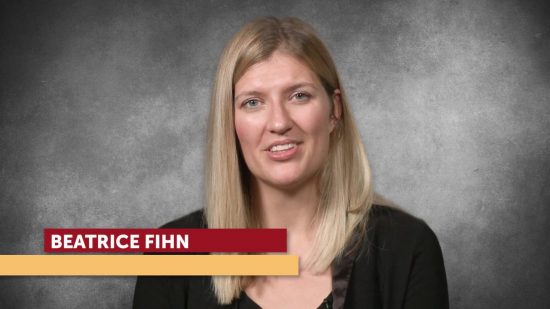
Australian government urged to heed public support for treaty banning nuclear weapons. Nobel prize-winning anti-nuclear campaigner Beatrice Fihn says ‘change is not only possible, it’s inevitable’ https://www.theguardian.com/australia-news/2021/may/06/australian-government-urged-to-heed-public-support-for-treaty-banning-nuclear-weaponsDaniel Hurst Foreign affairs and defence correspondent@danielhurstbne Thu 6 May 2021
The Australian government is being urged to rethink its opposition to a new international treaty banning nuclear weapons, with a leading campaigner warning of the “indiscriminate destructiveness” of such arms.
Beatrice Fihn, the head of the Nobel prize-winning International Campaign to Abolish Nuclear Weapons (Ican), will use a speech in Tasmania on Thursday to implore the government to heed strong public support for joining the treaty.
“Change is not only possible; it’s inevitable,” Fihn will say when she presents the annual Red Cross Oration at the University of Tasmania.
The Australian government has not joined the Treaty on the Prohibition of Nuclear Weapons, a relatively new agreement that requires parties not to develop, test, produce, acquire, possess, stockpile, use or threaten to use nuclear weapons.
So far, the treaty has been signed by 86 countries, of which 54 have formally ratified it – but it has been snubbed by the nuclear weapons states including the US, Russia and China.
“Australia does not support the Treaty on the Prohibition of Nuclear Weapons,” a spokesperson for the Department of Foreign Affairs and Trade said on Wednesday.
The Australian government argues the new treaty “would not eliminate a single nuclear weapon” because none of the nuclear weapons states have signed it and because it “ignores the realities of the global security environment”.
The government also says the treaty would be inconsistent with its US alliance obligations. However, campaigners point out that several US allies, such as New Zealand, Thailand and the Philippines, have already ratified the treaty.
Fihn, who is based in Geneva and will be addressing the University of Tasmania via video link, will call on the government to act on the “strong and growing support that exists in Australia for this crucial new piece of international law”.
According to prepared remarks provided to Guardian Australia in advance, she will describe the treaty as an “incredible step forward towards a world without nuclear weapons”.
Fihn will say the countries that have joined the treaty are “leading the way forward to a world without nuclear weapons”.
“Meanwhile, in countries that have not yet joined the treaty, including Australia, people are speaking up against nuclear weapons and calling on their countries to join,” she will say.
“Cities around the world, including Berlin, Paris and Washington DC are adopting resolutions calling on their governments to join. In fact, the very first city to sign our Cities Appeal was Melbourne, followed soon after by Sydney – and we’re delighted that the City of Hobart is also on board.”
Polling commissioned by Greenpeace in 2017 found 72.7% of 1,669 Australians surveyed said they supported a ban on nuclear weapons as a step towards the elimination of all nuclear weapons.
“From Australia to Canada, Germany, Japan and the United Kingdom, polls show that the majority of people want their government to join,” Fihn will say.
“Thousands of parliamentarians have pledged to work to bring their respective countries on board. In Australia, 88 of the current members of parliament have taken Ican’s pledge.”
The Ican pledge commits parliamentarians “to work for the signature and ratification of this landmark treaty by our respective countries”.
The federal MPs and senators who have signed up are mostly Labor politicians, including the opposition leader, Anthony Albanese, who has been campaigning against nuclear weapons since early in his political career.
The list also includes the Greens leader, Adam Bandt, and crossbenchers. The Liberal National party MP for Flynn in central Queensland, Ken O’Dowd, has also signed up.
In Thursday’s speech, Fihn will also emphasise the need to “amplify the voices of First Nations peoples in Australia and the Pacific who continue to suffer the horrendous impacts of nuclear tests carried out on their lands and in their waters by the United Kingdom, the United States and France”.
More than 75 years after the US bombing of the Japanese cities of Nagasaki and Hiroshima in 1945, she says, nuclear-armed states are spending billions of dollars each year to build new weapons and to keep the 13,000 existing weapons.
But Fihn says nuclear-armed states “do not prepare for what comes next, after the bombs are dropped”, citing reports that about 80% of hospitals were destroyed in Hiroshima. Out of 300 doctors in the city, 270 died or were injured; out of 1,780 nurses, 1,654 were killed or injured.
“They do not prepare for the hundreds of thousands of burn victims, for the blasted hospitals, for the injured and dying medical professionals left to heal an entire city,” Fihn says.
“The trauma of overwhelmed hospitals and overburdened doctors and nurses around the world who are struggling to meet the needs of patients during the Covid-19 pandemic shows just how impossible it would be for medical infrastructure to respond to even one nuclear weapon detonation.” The Australian government and other non-signatories are being encouraged to send officials to attend, as observers, the first meeting of parties in Vienna early next year.
Guardian Australia understands Australia will consider attendance closer to the event.
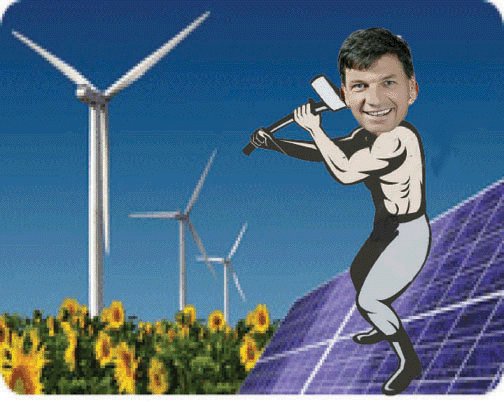
Angus Taylor, Energy Minister – incompetent and ignorant – SO – VOTE HIM OUT

campaign gathers momentum
Kazzi Jai No nuclear waste dump anywhere in South Australia, 4 May 21
maybe we should start a campaign…. for the Federal Election coming ….with t-shirts which say VOTE RAMSEY OUT!Idea taken from this Bulletin article! ·
CAMPAIGN TO OUST ANGUS TAYLOR GATHERS MOMENTUM
The successful campaign to remove former Liberal prime minister Tony Abbott from his Warringah seat during the 2019 Federal Election is being replicated in other electorates.
A 30-year-old pilot from Thirlmere in the Hume electorate’s north-eastern corner – who has avoided politics until now – is behind the grassroots independent movement to oust his Liberal member and the Minister for Energy, Angus Taylor.
Alex Murphy followed the Vote Tony Out campaign and wondered why there wasn’t similar action to remove Mr Taylor.He set about canvassing local voters in 2020 through the Voices of Hume group. He found others were unhappy with the MP’s energy, climate and emissions reduction policies and involvement in the GrassGate, WaterGate and Clover Moore controversies.
Within three months, the campaign has attracted 350 subscribers and gained momentum by selling T-shirts, face masks and tote bags through social media, emails and meetings.
Its first meeting in Wollondilly on 17 April attracted between 50 and 60 people. The next Vote Angus Out meeting is scheduled for 30 May in Goulburn.
Vote Angus Out campaigners are mostly farmers and retirees who disapprove of many of the MP’s decisions, including his support for fracking on farmland and lack of support for the dairy industry, increasing the age pension and encouraging Australian-based industry.
”He’s there to represent the gas and oil industries first and foremost,” Mr Murphy said.
Mr Murphy believes there is more support for Mr Taylor’s removal, assuming retirees only represent the campaign’s demographic because they have more time on their hands.He also bases subscriber numbers on social media follows and email opens. However, if retirees are the true campaign demographic, there would be many who don’t use social media or email.
“People are getting sick of the same old things happening, and a lot of retirees see it as a way to leave something for their children and grandchildren,” Mr Murphy said.
Mr Murphy said he’s confident Mr Taylor will be gone by the next federal election and is seeking advice from Vote Tony Out campaigners.
It makes our job a lot easier to have a politician who is so easily targeted. His inaction on climate change and emissions reduction, and the fact he’s been implicated in a number of scandals, make him an easy target,” he said.
Mr Taylor was also recently voted the most incompetent cabinet member in the Morrison Government in a poll conducted by The Australian Financial Review.
On the other hand, Mr Murphy recognises that the Hume electorate is a safe Liberal seat.It will be a challenge to convince people not to vote for him, but at the same time, it’s certainly going to be a lot easier for us to convince people not to vote for Angus than not to vote for a lot of other politicians,” he said.
That’s why the Vote Angus Out campaign is also focusing its efforts on finding a strong independent candidate.“The problem is, a lot of the big parties are just as bad at taking large donations from fossil fuel companies. We really want to put forward someone who isn’t going to be beholden to those big donors,” Mr Murphy said.
Similar campaigns are also on the hunt for independents to challenge the Liberal member for North Sydney, Trent Zimmerman, and the Liberal member for Bradfield, Paul Fletcher. Both seats neighbour Tony Abbott’s former seat of Warringah. The Riot ACT / Hannah Sparks
Are The Greens taking over from Labor as Australia’s progressive party – Tasmanian election results suggest this.
Have the Greens taken over the progressive mantle from Labor? South Wind, 4 May 2021 by Peter Boyer
Peter Gutwein’s win on Saturday is only part of the story of a fascinating election. ”……….. Predictably, Peter Gutwein won the election on the back of his fine response to COVID-19, recording an exceptional personal vote. People appreciated that this leader, in response to expert scientific advice, could make tough, confronting decisions.
But as the Greens’ Cassy O’Connor pointed out on Saturday night, while the premier chose to follow the science around contagious disease, he has relegated to a secondary position the science that warns of an unfolding climate catastrophe.
In building the Greens as a political force, founding leader Bob Brown fostered the view – perhaps unintentionally – that his party was the only way to environmental salvation. In times past I’ve found myself irritated by what seemed to be the Greens’ uncompromising approach to wicked policy dilemmas. Kevin Rudd’s doomed carbon pricing scheme was one such case.
In 2010, for the first and still the only time in Australia, the Greens became an integral part of government in Tasmania. Leader Nick McKim and then Cassy O’Connor took on the climate challenge on the basis that this responsibility is shared by all jurisdictions, everywhere.
That work culminated in O’Connor’s 2013 strategic plan, which remains the standout among a plethora of such documents that have arrived with fanfare over the years before being quietly shelved. Eight years later, her election night speech showed that this was no accident.
The buzz of leadership doesn’t rest easily with complex, slow-burning issues like climate change. Perhaps taking a cue from Rudd’s unseemly demise in 2010, Australia’s major party leaders and MPs continue to avoid making climate a front-rank policy issue.
Nowhere was that better illustrated than in the last parliament, in a debate over whether Tasmania should declare itself to be in a climate emergency. The only MPs arguing cogently for this fully justified move were O’Connor and her deputy, Rosalie Woodruff, while the rest of the parliament played partisan games.
On Saturday night O’Connor spoke of the Greens’ proposal for a bill to mandate planning for sequestering carbon, adapting to climate change, and annual sectoral emission targets, contrasting that with the major parties’ failure to come up with any coherent climate policy: “a shameful indictment”.
“We hear some Liberals gloating about the state’s climate record while they accelerate native forest logging,” she said. “Tasmania’s status as a net carbon sink is the result of decades of commitment and heart from the broader conservation movement and civil society, and the Greens’ hard work to protect this island’s extraordinary carbon rich forests.”…….
It was a long speech, bringing to mind another politician inclined to go on a bit, Gough Whitlam. The point about both is that they covered a lot of ground and had things to say that mattered, about life, community and government. O’Connor is a leader of real substance……
A century ago another small progressive party was said to be a mere annoyance that would soon disappear. The Labor Party rose to power as a voice for the powerless. On Saturday night, the most effective voice for that noble cause was O’Connor’s….. https://southwind.com.au/2021/05/04/have-the-greens-taken-over-the-progressive-mantle-from-labor/
Greenland’s election won by party opposing Chinese-backed Australian uranium and rare earths company
Greenland’s Rare-Earth Election
A vote last month answered an important question about the world’s largest island. The Atlantic, ROBINSON MEYER 3May 21, ”’……… Since 1979, the ruling Siumut party has dominated Greenland’s elections; in all those years it has lost power only once, in 2009, after the island reformed its government and loosened ties with Denmark, which has ruled it for three centuries. Earlier this month, the democratic-socialist Inuit Ataqatigiit party (IA), Greenlandic for “Community for the People,” won an election with more than a third of the vote, after centering its campaign on a promise to cancel the controversial mining project.
Greenland, the world’s largest island, is populated by about 56,000 people, and its election is, in some ways, an extremely local story. The mining project is called Kvanefjeld, and it would excavate thorium, uranium, and rare-earth elements. Kvanefjeld is less than four miles from Narsaq, one of the larger cities in South Greenland and a local tourism center. (It also has an excellent brewery.)
“There is no way for me to have the mine, because it’s only six kilometers from our town,” Mariane Paviasen, 56, a local activist who ran for Parliament under IA, told me in an interview before the election.
But the election touches on some of the biggest issues in global politics: climate change, mineral economics, and indigenous sovereignty. Rare earths are used to make finely tuned magnets that are essential to modern electronics, including electric vehicles and wind turbines. There is some irony here: Greenland, whose ice sheet is a visual metaphor for the inevitability of climate change, will be mined to power the only technology that can stop it. But the actual interest here is not so overdetermined—like all true climate stories, it draws together questions of money, land, power, and growth. IA’s answer to those questions is not to oppose all extraction, but it has taken a less friendly stance toward some proposed projects. It is particularly opposed to mining that could create radioactive waste……..
The plans for Kvanefjeld had long been paused, according to Zane Cooper, an anthropologist at the University of Pennsylvania who studies how communities respond to mineral extraction. Then, during the pandemic, the plans seemed to accelerate. Greenland Minerals Ltd., an Australian-headquartered but Chinese-backed company, began pressing its plans forward, and the ruling Siumut party complied. The local population had worries, particularly about uranium, which is often found next to thorium, itself a sign of rare earths. A rushed series of public meetings in February gave residents little warning about how rumored uranium dust would affect their farms and settlements. When someone called in a bomb threat to a meeting that Siumut officials were due to attend, they canceled their appearance. Another party, the Democrats, announced it would leave the governing coalition, depriving Siumut of its majority and precipitating snap elections.
The election, on April 6, saw a major victory for IA. It won overwhelmingly in southern Greenland.
IA does not oppose most mining; what it opposes is uranium mining. Another mine, about 30 miles from Narsaq, meets its approval, and the party supports developing mineral extraction as part of a broader strategy. “I think it will work better for us to have our own mining company in Greenland,” Paviasen said. She also supports more economic diversification, embracing a larger role for tourism and local agriculture. Most vegetables in Greenland are imported from Denmark.
Greenland’s blessing and curse is the large block grant, equivalent to more than $500 million, that it receives every year from the Danish government. It makes up about half of Greenland’s annual budget. Greenland has promised to deposit about a third of the revenue from its mineral wealth into a sovereign-wealth fund modeled off the Norwegian oil fund, which could help it replace the Danish block grant
If IA does find a way to instill some measure of economic autarky in Greenland, then it would be the world’s first completely independent indigenous country, Cooper said. Onlookers expect that Greenland would seek independence from Denmark faster under the separatist IA party than the more moderate Siumut. But that remains a ways off: First, IA must figure out how, and whether, it can cancel the mine in a fjord. Greenland Minerals has vowed to fight the decision in court and in international trade tribunals. (Múte Egede, the new IA prime minister, did not respond to a request for comment.) It may seem like a narrow question, but it could have sweeping implications for the island’s 56,000 inhabitants—and for how the world’s largest powers comport themselves with regard to the world’s largest island.
If IA does find a way to instill some measure of economic autarky in Greenland, then it would be the world’s first completely independent indigenous country, Cooper said. Onlookers expect that Greenland would seek independence from Denmark faster under the separatist IA party than the more moderate Siumut. But that remains a ways off: First, IA must figure out how, and whether, it can cancel the mine in a fjord. Greenland Minerals has vowed to fight the decision in court and in international trade tribunals. (Múte Egede, the new IA prime minister, did not respond to a request for comment.) It may seem like a narrow question, but it could have sweeping implications for the island’s 56,000 inhabitants—and for how the world’s largest powers comport themselves with regard to the world’s largest island. https://www.theatlantic.com/science/archive/2021/05/greenlands-rare-earth-election/618785/
Australia represented (by Ben Heard) in Moscow in launch of Rosatom’s pro nuclear propaganda campaign.
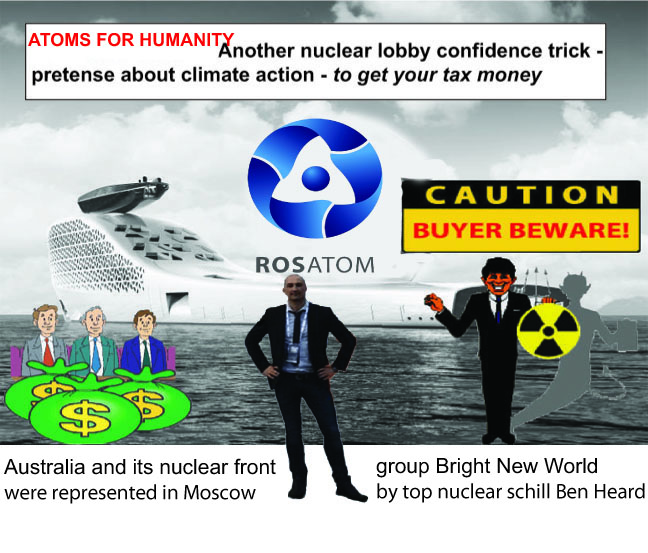
Thousands Join Launch Of Rosatom’s Atoms For Humanity Nuclear Awareness Campaign, By India Education Diary Bureau Admin May 3, 2021 Moscow: On April 30, over 3200 people from some 40 countries watched Rosatom’s Atoms for Humanity new nuclear awareness campaign launch event. The project is aimed at demonstrating the importance of nuclear technologies in achieving the UN Sustainable Goals through human-centered stories.
The project launch event Why Humanity Needs Nuclear brought together Polina Lion, Chief Sustainability Officer at Rosatom, Sama Bilbao y León, Director General of the World Nuclear Association, Dr. Maher Aziz, member of the World Energy Council, Ben Heard, founder of the Bright New World and Sergio Orlandi and Head of Central Engineering and Plant Directorate at ITER. Heroes of Atoms for Humanity joined the event to share their experiences participating in the campaign.
The [?] esteemed speakers discussed social, economic and environmental benefits of nuclear technologies and their invaluable contribution to solving the most urgent challenges of today and tomorrow.
UK in secret talks with Australia and others, about mining rare earths
Telegraph 2nd May 2021, Fears China will “turn off the taps” on Britain’s green revolution
has forced ministers to enter secret talks with seven commonwealth
countries to mine their rare earths. Officials from the Department of
International Trade and the Foreign Office have had meetings with
representatives from Australia, Canada, Malawi and Tanzania in a bid to
persuade them to supply rare earths, as well as critical metals such as
lithium to the UK.
Rare earths are found in abundance across the world, but
are difficult to process and China controls around 90 per cent of the
market. The UK has no known deposits of rare earths, unlike other major
economies such as the US, Canada and Australia, which are also grappling
with the problem. Rare earths are used in a wide variety of technology,
from fighter jets, to MRI machines and loudspeakers, but also in the motors
of electric vehicles and in wind turbines, and the worldwide transition to
green infrastructure is expected to put pressure on global demand.
”Low Level” radioactive trash to be removed to USA from posh Sydney suburb, while govt plans to send Higher Level nuclear waste to Kimba, rural South Australia.

This is very interesting. They say it’s ”low leve” – presumably ”safe”. Yet for the residents of a posh Sydney suburb, its worth a century-long fight to get it removed – and sent to America !! Makes you see why the residents of Lucas Heights , – now called Bardon Ridge – might be keen to have their much higher-level radioactive trash foisted on distant rural Kimba, South Australia
Hunters Hill radioactive waste to be removed sent to United States https://www.abc.net.au/news/2021-04-30/hunters-hill-radioactive-waste-to-be-removed-sent-to-us/1001
By Rani Hayman 1 May 21,
Key points:
- The land was the former site of the Radium Hill refinery, which closed in 1915
- The removal will begin in the coming weeks and take 12 months
- Melinda Pavey said the issue had taken a long time to resolve because it was “complicated”
Several properties on Nelson Parade at Hunters Hill were built on land contaminated by a former uranium processing site, which closed in 1915.
The area was also occupied by a carbolic acid plant until the early 1900s and a tin smelter until the 1960s.
Residents have spent decades fighting for the state government to remove the affected soil.
Finally, their calls have been heard, with the waste due to be excavated and sent to the United States.
Philippa Clark from the Nelson Parade Action Group said she was pleased the issued had finally been resolved.
“This is the way you deal with this kind of contamination and the best way possible for us and the environment and future generations,” she said.
The NSW government said the process would begin in the next few weeks and was expected to take 12 months.
The Minister for Water, Property and Housing Melinda Pavey said the health and safety of the community would be the main priority during site remediation works and the transportation of the material.
“The Australian Nuclear Science and Technology Organisation (ANSTO) will supervise the excavation and packing of the contaminated material into sealed bags and containers prior to transport to the USA,” she said.
While there is a sense of relief within the community, the decades-long battle has put strain on the affected residents.
When asked why it has taken so long to find a solution, Ms Pavey said: “Because it was complicated.”
A parliamentary committee in 2008 called for a comprehensive remediation plan for the site and in 2014 the Environmental Protection Agency (EPA) issued a management order to Property NSW to commence the works — although it said the development consent still had not been issued.
A plan to move the contaminated material to Kemps Creek in Sydney’s west was also abandoned in 2014 following community backlash.
The Mayor of Hunters Hill, Ross Williams, said the residents were looking forward to the area being rehabilitated.
“It’s been a health issue and a legacy issue for all that time.
It’s low-level radioactive material and it came from an industry that was essential [really?] back in those days,” he said.
“In modern times the environmental consequences wouldn’t have been tolerated.
“Once it’s totally cleaned up it will be available for any use.”
Ms Clark is pleased with the outcome despite how long it has taken.
“The government has listened to what we all wanted and what the parliamentary inquiry recommendation had been,” she said.
“We overwhelmingly just want to see ordinary houses and [go] back to [living in] an ordinary street, but without the stigma and without the constant anxiety that we’ve had to live with.”
Australia sleepwalks towards nuclear war – enthusiasm for nuclear rockets and submarines.
Small nuclear reactors (SMRs) are being pitched to Australians as ”climate salvation”, ”cheap electricity” etc. Of course this is nonsense. But the toxic macho nuclear zealots are confident that SMRs will have a great future in nuclear wars on land, on sea, in space.

SPACE: Australia’s ”cultural cringe” is so obvious, in the fervour for space research. Breathless enthusiasm in media coverage of rockets, space exploration . Yet the truth is that Australian space research is tied to America’s goal of militarising space. We hold events like The Australian International Aerospace and Defence Exposition – pitched as family entertainment:
”THE AIRSHOW will feature the raw potency and power of modern military aviation. The thrust and grunt of the latest military heavy metal will take centre stage. The stars of the show will be state-of-the-art jet fighters, bombers and giant heavy lift leviathans from home and abroad. See them so close you could almost touch them. Shudder to the roar of their mighty jet turbines as they perform high octane routines and simulated combat manoeuvres. Marvel as swarms of attack helicopters join in the fray.”
Of course, if we can help the American drive for weapons in space, it is all the better to have the tax-payer fund our space research.
SUBMARINES. Australia’s nuclear zealots have long been working away for nuclear submarines…… way before the so-called ”neutral” nuclear military fan Kevin Scarce was made head of the South Australian Nuclear Fuel Chain Royal Commission, in 2016.
A push for nuclear submarines has been part of Australia’s appalling history of submarine deals in recent years. Part of this mess was recently exposed by Michelle Fahy in Murder, corruption, bombings – the company at centre of Australia’s submarine deal. But the whole sorry tale goes further. It probably explains why the Australian government chose the super costly French submarine design – in the hopes that it could easily be transformed from a diesal to a nuclear -powered form.
Impelled by the very right-wing Australian Strategic Policy Institute, the push continues. Academia is co-opted, as The University of New South Wales joins with the Submarine Institute to promote nuclear submarines in a July 15 Canberra seminar. The speakers include well known nuclear propagandists Tom Frame, Kevin Scarce, and Hugh White.
Tom Frame has also recently published a book, rapturously received by the nuclear lobby, enthusing about nuclear submarines, and recommending them as Australia’s way into the full nuclear fuel chain, and into the space race .
With Australia’s Murdoch media monopoly, and the ever-weakening ABC, the public is unaware of these machinations towards Australia’s role in nuclear militarism. The push for small nuclear reactors is the starting point.
Australian government plan for a nuclear waste dump tears apart the small rural community of Kimba
Kimba: A town torn apart by nuclear waste proposal https://independentaustralia.net/environment/environment-display/kimba-a-town-torn-apart-by-nuclear-waste-proposal-,15027 By Noel Wauchope | 28 April 2021
Bogged down in the Australian Senate is a Bill that selects a farming area, Napandee, near Kimba, South Australia, as Australia’s national radioactive waste dump. If that Bill becomes law, that matter will be settled, and there will be no possibility of legal appeal against it.
From a small close-knit community, in a top Australian wheat-growing area, Kimba has become a place of tension. In 2016, a farmer, Jeff Baldock, offered part of his land, Napandee, for the radioactive waste facility, and the offer was accepted by the Federal Government. From then on, the debate has raged in the area, and beyond it. It’s not always a reasonable discussion, and social media has made this worse. Now, years later, there’s no sign of a resolution to this matter. Residents try to get on with their lives, in this uneasy situation. Some people have left town, some are not speaking to former acquaintances. Opinions are black and white, or the subject is avoided completely – there’s no middle ground.
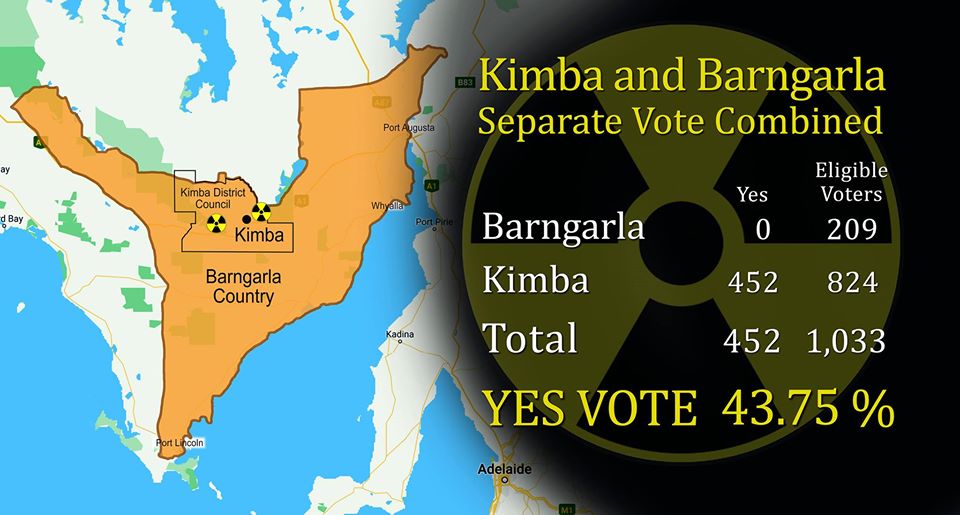
The Federal government’s plan for a nuclear waste facility at Kimba hit the Aboriginal community of the Eyre Peninsula hardest. The Barngarla people, Native Title holders, were excluded from the government’s ”community ballot” held in 2019. Voting was restricted to those living within the Kimba local council area . The Barngarla held their own ballot, resulting in a unanimous ”No” to the dump. Nevertheless, some Aboriginal people supported the plan, and this dispute has divided families.
”As an ally and advocate for Indigenous peoples for more than 30 years, I was appalled at the terrible toll fighting the nuclear waste facility took upon my friends. I watched one of my closest friends visibly age as she surrendered her art practice and her enjoyment of life to dedicate herself to challenging it. ”
– Felicity Wright – Submission to Senate Committee on National Radioactive Waste Management Amendment (Site Specification, Community Fund and Other Measures) Bill 2020 [Provisions] Submission 98
The non indigenous community has been equally affected. There were two community ballots held, 2017 and 2019. While in both cases the result favoured the nuclear waste facility, it was far from overwhelming support. At the final ballot, 824 people were eligible to vote: of 735 votes accepted, 452 said “Yes”.
The plan for the facility was pitched to the community as a medical necessity for Australia. It was an attractive idea. On the one hand Kimba could proudly provide a service to the nation. On the other hand, it was bringing a new industry, and new jobs, to a sometimes drought-stricken agricultural area. More immediate benefits: the farmer who volunteered land would be paid at 4 times the market value. A Community Benefits scheme brings up to $11 million to the town, over the next 4 years, and $20 million when the dump is up and running.
The plan was greeted with enthusiasm from some residents. They relied on the copious information provided by the the Department of Industry Innovation and Science, and by the former Resources Minister, Matt Canavan. When it was pointed out to Mr Canavan that some residents close to the selected site were ineligiblt to vote, he promised that their views would be included. But then he left that Ministry.
The Industry Department has controlled the information reaching the community, and has provided the visiting experts. There has not been any debate provided, with opposing views. Still, there is strong opposition, led by farmers. The group No Radioactive Waste on Agricultural Land in Kimba or SA, is optimistic thar Kimba, despite the prevailing mood of anxiety, can survive and go ahead, without the waste facility.
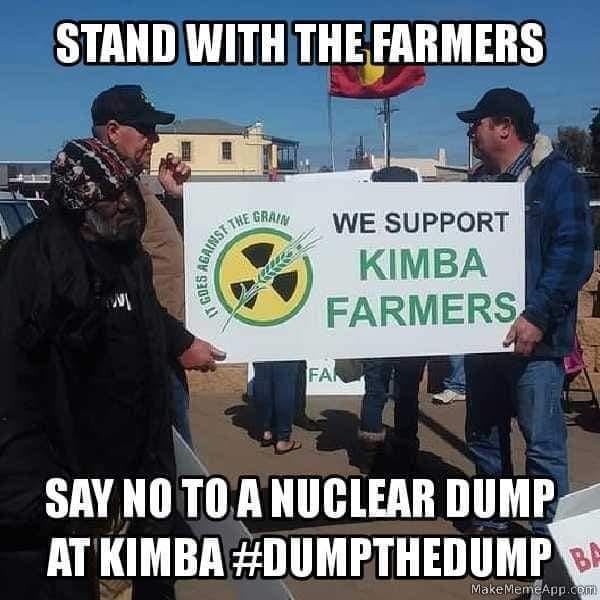
The group, of 5 years’ standing has researched the issue, and sent submissions to Parliament. Radioactive waste is not recommended for agricultural land. There are concerns about possibile environmental pollution, damage to groundwater. Perception of the area is important, and the presence of a radioactive waste dump could be very damaging to its clean, green image .
Community understanding is at the heart of this problem. The current Resources Minister, Keith Pitt, enthused about the facility, describing it to the Nationals Federal Conference on 27 March 2021 as “a low-level nuclear waste facility to house the by-products from cancer treatment.”
That’s a misleading statement. The waste proposed to be taken to the nuclear dump is waste generated from the industrial production of these isotopes. – not their usage!
There is uncertainty about the toxicity of the nuclear wastes to be placed in “interim storage” at Napandee, with the classification of these wastes as “intermediate level”, but the same wastes classified in Fance as “high level”.
The Kimba community remains troubled, as this nuclear waste problem remains paralysed in the Senate. Freedom of Information documents revealed that the government is well aware of mental health problems likely to be caused by the issue.
Minister Pitt has the option of clearly designating Napandee as the site for the nuclear waste dump. That could solve the problem, and certainly bring clarity to the Kimba community. But, the hitch for the government is that if he does this, it will be possible for opponents of the plan to take legal action against it.
Australian govt keeps mum about Japan’s plan to dump nuclear waste-water into the Pacific (no suprise – it originated from Australian uranium)

Australian Government quiet over Japan’s nuclear waste condemnation, Independent Australia, By Dave Sweeney | 23 April 2021While Japan faces international backlash over its decision to dump contaminated wastewater, Australia remains quiet due to its part in the Fukushima disaster, writes Dave Sweeney.
AGAINST A BACKDROP of runners carrying a small torch to light the Olympic flame for the July Tokyo Olympics, there are growing flames of discontent over the Japanese Government’s plan to release large volumes of contaminated wastewater from the stricken Fukushima nuclear plant directly into the Pacific Ocean.
…………Whatever the water’s pathway, it is now polluted. And, with the volume growing each day, direct ocean disposal is the quickest and cheapest management option.
The aqua dump plan, set to start in two years and continue in stages for years to come, has attracted fierce domestic and international criticism.
In a rare moment of unity, Taiwan has condemned the move while China has described the plan as “extremely irresponsible”. South Korea has seen street protests and a move from President Moon Jae-in to explore legal options, including through the International Tribunal for the Law of the Sea.
A Philippines presidential spokesperson highlighted that “we are one ecosystem… we are interconnected” and three U.N. Human Rights rapporteurs specialising in food, toxics and the environment declared that the release ‘into the marine environment imposes considerable risks to the full enjoyment of the human rights of concerned populations in and beyond the borders of Japan’.
TEPCO has stated that the water will be treated before release using a system known as A.L.P.S. — the Advanced Liquid Processing System.
However, TEPCO’s assurances are cold comfort to many.
The company was caught out in 2018 having falsely claimed that earlier releases contained no radioactive materials. This time, TEPCO has changed its tune and acknowledges that radioactive tritium will be released along with the dumped water. Tritium is very difficult to separate from water as it is a radioactive isotope of hydrogen that remains active for between 60-100 years.
Many observers also hold grave concerns that other longer-lived radioactive wastes including ruthenium, cobalt, strontium and plutonium could also be discharged into the Pacific given that not all are always captured by the A.L.P.S. process.
This concern has seen Pacific activists refer to the Japanese nuclear sector as a house without a toilet and the Pacific Islands Forum declare that:
‘…steps have not been sufficiently taken to address the potential harm to our Blue Pacific Continent, including possible environmental, health, and economic impacts. Our fisheries and oceans resources are critical to our Pacific livelihoods and must be protected.’……..
Critics are concerned that the plan is not based on the best possible technology, but rather being driven by corner and cost-cutting.
Japanese and international groups and experts called for other options to be fully evaluated before direct release was approved. These include continued interim tank storage, enhanced evaporation and mortar solidification, where contaminated water is mixed with cement and sand and stored. This technique is used to manage liquid contaminants at other nuclear facilities, including Savannah River in the USA.
Some Australian environment groups have criticised the direct dumping plan and used the recent tenth anniversary of the Fukushima disaster to call on the Japanese Government to reconsider this approach.
To date, the Australian Government has made no comment or call. This is hardly surprising given that Australian uranium was inside the Fukushima reactors at the time of the meltdown. Since this time, successive Australian governments have avoided any comment or criticism and instead prioritised trying to find new markets for our flatlining uranium sector.
As an island nation steeped in coastal culture and salt-water stories, the deliberate degradation of our shared global waters should be a concern. The long-term protection of communities, cultures, creatures and currents needs to be given preference over short-term nuclear industry expedience. Dave Sweeney is the Australian Conservation Foundation’s nuclear-free campaigner and was a founding member of ICAN. You can follow him on Twitter @nukedavesweeney. https://independentaustralia.net/politics/politics-display/australian-government-quiet-over-japans-nuclear-waste-condemnation,15015
Scott Morrison’s climate summit speech was littered with downright dodgy claims,
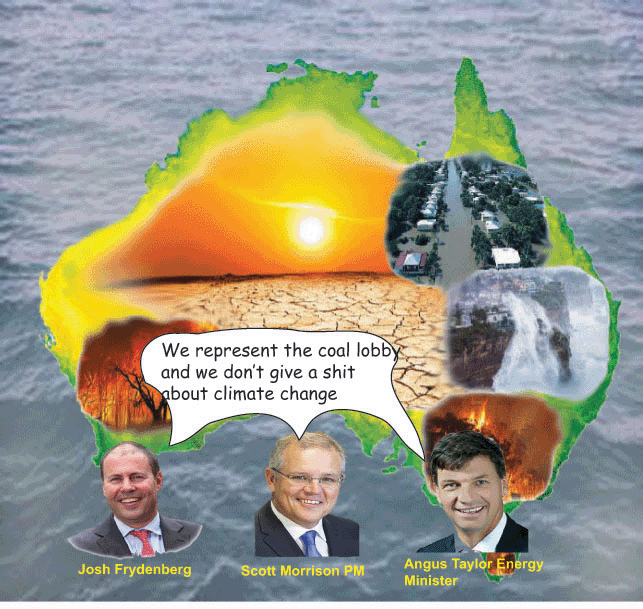
Scott Morrison’s climate summit speech was littered with downright dodgy claims, https://thenewdaily.com.au/news/politics/australian-politics/2021/04/24/scott-morrison-climate-summit-facts/ Richie Merzian, I have sat through countless speeches on climate change from world leaders, both working for the government and outside it, and Prime Minister Scott Morrison’s rant at President Joe Biden’s climate summit last night was one of the worst performances I have ever seen.
Technical glitches and the dreaded mute button were the least of Morrison’s worries, as he mounted the (virtual) stage, armed with three-word slogans, self-congratulations, and downright dodgy greenhouse gas emission numbers.
Most major nations before him (and there were many) had pledged stronger climate targets or concrete policies to curb carbon pollution. Japan and Canada vowed significant increases on their 2030 targets. India and the Republic of Korea announced new partnerships with the United States. Even Brazil, a highly problematic country in the climate space, announced it would advance its carbon neutrality target by a decade.
In contrast, Morrison’s speech was heavy on bluster, light on policy. No new commitments were brought to the table, further cementing Australia’s inadequate Paris target of a 26-28 per cent reduction in greenhouse gas emissions by 2030. Then like the dinner guest that turns up to a pot-luck empty-handed and complains about what others have brought, Morrison dismissed the serious efforts of other nations whilst offering nothing himself.
When it came time to talk numbers, Morrison’s claim that we have reduced emissions by 19 per cent broadly and 36 per cent excluding exports, had me and many others dumfounded. Where did these numbers come from? What dodgy accounting tricks were at play? Turns out 19 per cent is cherry-picked from the middle of the pandemic and the 36 per cent number is just off the reservation. The PM is reinventing UN accounting rules, asking the world to forget about the rising emissions from the production of gas and coal we export!
If there is one thing we can establish, Morrison can always be relied upon for accounting tricks. Until recently, the Morrison government tried to cash in on leftover carbon credits from the last climate agreement, to avoid reducing emissions required under the current Paris Agreement. This is What dodgy accounting tricks were at play? Turns out 19 per cent is cherry-picked from the middle of the pandemic and the 36 per cent number is just off the reservation. The PM is reinventing UN accounting rules, asking the world to forget about the rising emissions from the production of gas and coal we export!
If there is one thing we can establish, Morrison can always be relied upon for accounting tricks. Until recently, the Morrison government tried to cash in on leftover carbon credits from the last climate agreement, to avoid reducing emissions required under the current Paris Agreement. This is akin to attempting to use an old Starbucks loyalty card to pay for a Big Mac. Only after he was named and shamed by his international peers did Morrison back away from this dodgy loophole.
Much like a guest knows there are topics you do not talk about at a dinner party, every world leader knows the formalities and conventions of a climate summit. Every world leader it seems, bar Morrison. After undermining the speakers before him by belittling ‘targets’ and ‘promises’ with a tone-deaf arrogance, Morrison went on to awkwardly name-check his big-polluting industry mates, and claim Australia would somehow replicate the US’ success in Silicon Valley through our own ‘hydrogen valleys’.
Morrison rattled off ‘pioneering Australian companies’ from BHP to RioTinto, seemingly forgetting he was speaking on the international stage not addressing the Business Council of Australia at some inner-city wine bar. Perhaps most bizarre, was the name-dropping of Allan Finkel. While most Australian’s probably don’t know who Allan Finkel is, let alone the rest of the world – those who do, likely know him as the former Chief Scientist whose controversial views on gas sparked an open letter from leading Australian scientists.
In December 2019, when I watched Angus Taylor address the United Nations climate talks in Madrid without acknowledging the catastrophic bushfires that were devastating the nation, I thought I’d seen Aussie climate diplomacy at its worst. Then came Morrison’s performance at this summit.
Fortunately, the US had placed Morrison so far down the speaking list that President Biden had already left the room.
The United States – the world’s largest economy and second-largest polluter after China kicked off the event by announcing it would at least halve emissions by 2030, a target that Australia Institute research shows Australia should replicate. If it did, then we would have something to brag about.
Richie Merzian is Climate & Energy Program Director at The Australia Institute. You can follow him on Twitter at @richiemerzian.
Scott Morrison’s plan for Australia to fund small nuclear reactors and other very dubious technologies that purport to combat global heating.

Australia to fund low-emissions research as world sets ambitious climate targets, The Age, By Mike Foley, April 21, 2021,
The government is offering $566 million to global experts who want to collaborate with Australia on clean energy projects, with ‘green steel’, battery storage and even research on nuclear fission reactors among the possible tech options.
Australia will help fund groundbreaking research in low-emissions technology as the Morrison government confronts increasingly ambitious climate commitments from major trading partners ahead of a global climate summit.
Prime Minister Scott Morrison will announce a $566 million investment in research partnerships with other countries for new technology like green steel, small modular nuclear reactors, and soil carbon sequestration. He said the technology from the deals would benefit Australian export industries such as agriculture, coal, aluminium and gas…….
Australia’s focus on international action contrasts with the increasingly ambitious 2030 emissions targets that developed nations are announcing in the lead-up to US President Joe Biden’s international climate summit on Thursday…….
But Energy and Emissions Reduction Minister Angus Taylor said one country alone cannot make commercially viable the low emissions solutions needed to replace polluting technologies, or roll them out at scale……..
The partnership funding is a commitment in the upcoming federal budget. The Morrison government has entered discussions with the US, UK, Japan, Korea and Germany…..
Funds will be invested in research and development partnerships in line with Australia’s technology roadmap, which has prioritised hydrogen, low-emissions steel and aluminium, battery storage, and soil carbon sequestration on farmland….”
The Morrison government will also seek to collaborate with the US and UK on small modular nuclear reactors, which are not yet commercially viable. It has no plan to remove Australia’s ban on nuclear power or fuel processing.. … https://www.theage.com.au/politics/federal/australia-to-fund-low-emissions-research-as-world-sets-ambitious-climate-targets-20210421-p57l5v.html
1 This month
17 October, Free Public Talk on Nuclear Issues in South Australia
David Noonan will speak on public interest concerns over the new Roxby Downs Indenture Act 2026 on BHP copper-uranium mining and ore processing in SA, and on how AUKUS may face SA with a High-Level nuclear waste agenda.
Dr Jim Green will discuss international developments in the field of nuclear power including ‘small modular reactors’ and Generation 4 ‘advanced’ nuclear reactor concepts.


Help Aunty Sue Protect Her Land and Sacred Sites From Destructive Rocket Testing.
.

Australians deserve the truth
about
AUKUS – https://aukuspublicinquiry.com/

PETITION – To: Prime Minister Anthony Albanese and the Australian Labor Government

of the week – Australians for War Powers Reform (AWPR)
To see nuclear-related stories in greater depth and intensity

