Updated Tue Police say they have arrested 10 protesters who were blockading the road to the Abbot Point coal terminal near Bowen in central Queensland.
About 50 people, including members of anti-Adani group Front Line Action on Coal, held banners and voiced their concerns at plans to develop the Carmichael coal mine facility in the north of the Galilee Basin in central Queensland.
Police said they charged 10 people with trespassing on business land, and those arrested had been taken to the Bowen watch house.
Whitsundays Police inspector Steve O’Connell said it was unfortunate arrests had to be made, but he was happy with the overall peaceful nature of the protest.
“At this time with climate change and the knowledge we have on that, that it is not a good time to be opening a large coal mine,” Ms Smith said.
“With the extreme weather events that have been happening, coal is the thing that is fuelling this.
“I am here for future generations to protect this great place that we have.”
Local councillor Mike Brunker said the protesters did not represent the views of local residents who opposed the protest.
“Finally now we see a bit of light at the end of the tunnel, and now we come and see this sort of rubbish. People are sick of it,” Cr Brunker said.
Security ramped up at water reservoir
Whitsundays Mayor Andrew Wilcox said the council was taking extra measures to protect the Bowen water supply after activists hung a banner on the town’s reservoir.
Cr Wilcox said the council was not taking any risks.
“We’re taking extra precautions now. We are just making sure we’re doing more patrols,” Cr Wilcox said.
“At the end of the day it’s already all secured, but we’re just doing that and we’re also putting some cameras around the place.
“And then if we do catch some of these people, we hope that they face the long arm of the law.
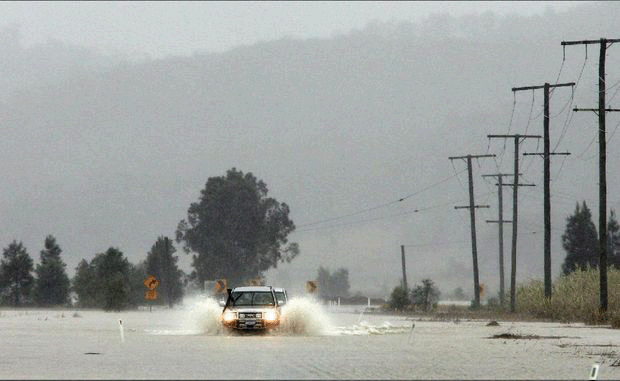
Flooding proved how vulnerable Coast is to climate change, Sunshine Coast Daily, Bill Hoffman | 26th Aug 2017 THE Sunshine Coast received a taste Monday night of the future normal for low-lying coastal communities everywhere when, in the middle of a drought-like winter, water flooded through storm water outlets and over the top of revetment walls and onto key streets across the region.
The cause wasn’t an intense east coast low, a cyclone or intense rain event normally associated with flooding of low-lying areas across the region. If it had occurred during daylight, particularly at peak hour, Mooloolaba would have been left grid-locked and Bradman Avenue, Maroochydore, reduced to one-lane along the river.
Twin Waters residents would have seen water up into the parks and footpaths along Twin Waters Drive and the river spilling into bushland for more than 100 metres along Nojoor Road.
At Caloundra the vulnerability of Tay and Maloja Avenues at Bulcock Beach would have been fully exposed.
What occurred required no more than a couple of days of strong southerly winds blowing up the NSW and Victorian coasts to set off the Ekman Transport Effect which lifted the Highest Astronomical Tide for the season at Mooloolaba from 2.03metres by additional 0.4 of a metre.
While for many the resulting impact of that degree of sea level rise went largely unnoticed, scientists at the University of the Sunshine Coast and hydrologists took note.
They are in agreement that Monday night’s short-term increase in sea levels afforded a glimpse of the future impact of the best-case 0.8 metre permanent rise now locked in by 2100 because of climate change.
The Ekman Transport Effect refers to the shift leftward that occurs when sustained winds blow in a consistent direction over the ocean moving the top 30m layer of water. The resultant upwelling is most likely to occur along New South Wales, south-east Queensland and the Bonney Coast (South Australia) coastlines.
Professor Tim Smith, director of the University of the Sunshine Coast Sustainability Research Centre, says the region has received a wake-up call in terms of what it needs to prepare for. “We are pretty lucky it was not combined with other things to intensify the situation like a low-pressure system or a high-intensity rainfall event or it would have been a much more devastating outcome,” Prof Smith said.
“We have to think about the design and placement of infrastructure and assets. We can’t continually defend and protect ad finitum. “Alternative adaptation strategies will be needed.”
He says the options are limited. The first is to try to protect assets without changing their location. Professor Smith said the approach was the emphasis of local authorities across Australia who don’t want to change but preferred to protect investments made in calm weather 40 years ago.He said the problem was that the environment was not static and could not be controlled.
The second strategy was to accept there were going to be impacts and to retrofit existing settlement and infrastructure to experience less damage. “You could raise houses to protect from periodic impacts if you were willing to live with them,” Prof Smith said.
The other option was to retreat in the process relocating settlement and assets out of harm’s way. “That’s a taboo subject, he said. “People don’t want to talk about it but eventually we will need to have a serious discussion.”
Hilo in Hawaii, Grantham in Queensland’s Lockyer Valley and Twin Rivers in New Zealand all provide limited examples of communities that have bitten the bullet and shifted their communities out of harm’s way.
“We can’t keep building walls higher and higher,” Prof Smith said. “The longer we leave it the more difficult it will become. The sooner we act the better.” He says the danger of protecting assets is that the protection gives confidence to put more in harm’s way, doubling the risk.
Preparing for climate change is important for communities like Bundaberg where flooding is already a significant threat, says Bundaberg MP Leanne Donaldson.
According to the Queensland Climate Adaptation Strategy report, Queensland already experiences climate extremes such as floods, droughts, heatwaves and bushfires and climate change is likely to exacerbate the frequency and/or severity of these events.
Ms Donaldson said the government was having ongoing discussions with the insurance industry to see how actions to reduce exposure to climate hazards could reduce insurance premiums.
“However, the Queensland Climate Adaptation Strategy identifies the need to improve access to information on insurance options as a method to manage climate risk, and to investigate how we can improve access to finance for priority activities that improve our readiness and resilience to climate change,” she said.
Ms Donaldson said the suggestion of building ground floors that were ready for floods, was raised as just one example of many innovative solutions the sector might consider when adapting to changed weather patterns and greater climate risk.
“Whether it’s finding innovative solutions to make homes more flood resistant, or choosing to build in locations that are less prone to flooding, it is important that these risks are considered when planning our infrastructure,” Ms Donaldson said.
“There is a lot of work going into this area at the moment, particularly on how these climate risks can be better incorporated into planning guidelines.
“It’s also important to note that flooding is just one of many climate hazards identified in the sector adaptation plan that need to be considered when planning for changes in the climate.”
Ms Donaldson said the Built Environment and Infrastructure Sector Adaptation Plan will not affect the 10-year Flood Action Plan for the Bundaberg region.
“However, adapting to climate change is complimentary to building resilience and fulfilling the actions included in the Burnett River Floodplain,” she said.
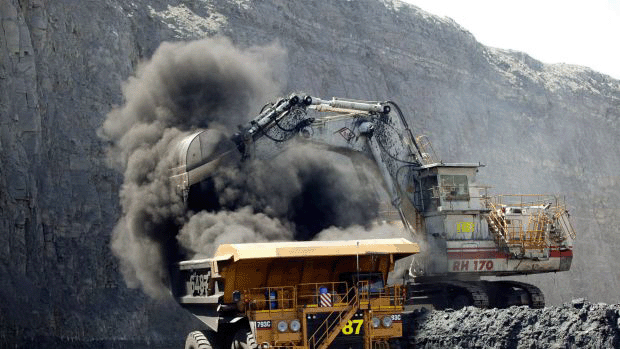
Australia now exports about 200m tonnes. Adani project is, by any measure, a massive expansion that could push the world measurably closer to breaching the goals of the Paris climate agreement……
“The [Adani Carmichael coal] project is not on the radar, not expected to happen, immaterial for India’s energy plans given the progressive move away from imported thermal coal and just unbankable for Indian banks given excessive Adani group debt.”
Coal in decline: Adani in question and Australia out of stepSpecial report: India and China are shifting away from coal imports and coal-fired power while a mega-mine is planned for Queensland. Where does this leave coal in Australia?
Coal in decline: an industry on life support, Guardian, by Adam Morton , 24 Aug 17, The Paris-based International Energy Agency ……suggested investment in new coal power across the globe has peaked and is on the verge of a steep decline. In a coinciding media briefing, the IEA chief economist, Laszlo Varro, declared the “century of coal” that started in 2000 – evident in the extraordinary wave of investment by emerging Asian nations – may already be over.
It is becoming clear that Chinese coal demand has peaked,” he went on. “The outlook for imports [to] India and other countries is uncertain.”
What does this mean for Australia, producer of about 30% of the world’s coal, as it plans a vast expansion in production in outback Queensland?……
Market analysts at Citi Research last month warned investors that the outlook for coal stocks was pessimistic: major banks were financing fewer projects; Donald Trump’s much-vaunted pro-coal and anti-climate change stance was having little impact in the US…..
In a report for the Australian Conservation Foundation, consultants ACIL Allenagreed. “At present, there is considerable pessimism regarding the long-term outlook for prices of thermal coal in international markets,” it said. “This is reflected in forecasts by credible Australian and international agencies.” Continue reading →
“Responding to a Supreme Court decision in Brisbane today, Traditional Owners fighting Adani’s proposed Carmichael coal mine say that yet again the Queensland Government and Adani have benefited from laws designed to suppress Aboriginal peoples’ rights.
“The Queensland Court of Appeal today upheld an earlier decision that the Queensland Minister for Mines did not have to afford Wangan and Jagalingou people natural justice when he issued the mining leases for Adani’s Carmichael Mine. The Wangan and Jagalingou Traditional Owners Council
is now seeking legal advice on grounds to appeal to the High Court.
“Senior spokesperson for the W&J Traditional Owners Council, Adrian Burragubba, says,
““Where there’s mining there’s no justice for Traditional Owners. The mineral resources regime so often puts massive barriers in the way of Traditional Owners and the wider community which opposes coal mining in Queensland.
““We appealed the decision of Queensland Mines Minister, Anthony Lynham MP, to issue leases over our country to Adani, only to find our common law right to natural justice is of little worth. We have always aimed higher than this in pursuit of our rights. We are not deterred by today’s outcome.
““The Court decision has let the Minister get away with sacrificing our heritage and sacred places to promote his own political interests.
““Instead of standing up for our rights in the lands and water of our ancestors, in April 2016 the Queensland Government preferred not to wait for our fight to be resolved in the Federal Court court and instead issued leases to Adani. …
““As Traditional Owners we wait more than a decade for our native title claim to be dealt with, while Adani can get a lease quickly, without our consent and with no money for its project.
““We have clearly and unambiguously rejected a land use deal with this shyster company, yet they push on. … ““We are not done yet. We will exhaust all legal avenues in our fight to for our rights and to protect our country. … “We have further litigation challenging their fake ‘land use agreement’ in the Court, with a hearing date set for March 2018.
““There will be no surrender. … ”, Mr Burragubba concluded.”
By Republic on 14 August 2017,Construction at the $360 million Mount Emerald Wind Farm near Mareeba reached an important milestone last week when the first of 53 turbine foundations was put in place.
The 800-tonne foundation which is buried to ground level provides an immovable anchor for each turbine and consists of a 50-tonne reinforced steel cage filled with around 350m3 tonnes of concrete, or up to 70 truckloads.
Ratch Australia Corporation Executive General Manager Business Development, Mr Anthony Yeates, said the first foundation was always a special milestone in wind farm construction. Continue reading →
The Age, Jorge Branco, 11 Aug 17, Indian mining giant Adani has been fined $12,000 for a stormwater breach at its Abbot Point coal terminal during Tropical Cyclone Debbie.
The Adani-owned Abbot Point Bulk Coal was granted a temporary licence to more than triple its “suspended solids” releases during the severe weather in March. But the Department of Environment and Heritage Protection claimed more than eight times that amount was released into the ocean near the north Queensland facility.
The fine did not relate to water released into the surrounding wetlands, which was still under investigation. Activists released striking photos of the difference in the wetlands before and after the cyclone, claiming coal had turned the area black, but Adani said it had complied with the conditions of its licence.
The breach related to stormwater released on the other side of the facility, into the ocean.At the time, a company spokesman said no spill had made its way into the sea and the Queensland Resources Council said “water absorbs light so it is usually black in the images”.
According to the Environment Department, the Temporary Emissions Licence allowed Abbot Point Bulk Coal to release stormwater with a suspended solid limit of 100mg per litre during the high rainfall.
But on April 6, the company informed the department it had breached the conditions with the release of stormwater containing 806mg/L of suspended solids, the department said…….
Mackay Conservation Group co-ordinator Peter McCallum criticised the fine, saying it would encourage future harm rather than deter it.
“Adani is likely to make a business decision that it is cheaper to pollute the Caley Valley wetlands and the waters of the Great Barrier Reef than to put in place infrastructure that will ensure the sensitive environments at Abbot Point are never damaged again,” said the man, whose organisation released the before and after photos of the wetlands.
“Without sufficient penalties for breaching environmental conditions there’s little point in having them.”…….
Why Sunshine Coast church groups fear climate change https://www.sunshinecoastdaily.com.au/news/why-sunshine-coast-church-groups-fear-climate-chan/3209868/, Bill Hoffman | 8th Aug 2017 CONCERN for the welfare of future generations and protection of the environment were the principal concerns that drove more than 1000 people of faith on the Sunshine Coast to sign a petition calling on the Federal Government to do more to address the looming impact of climate change.
The petition signed by 1053 people has been presented to Fisher MP Andrew Wallace calling for stronger action on greenhouse gas emissions and for Australia to increase its assistance to vulnerable nations already struggling to respond to the impacts of climate change.
It drew together the Caloundra Catholic Community Social Justice Network, the Caloundra Uniting Church Social Justice Group and the Anglican Church.
Bob Cullen of the Caloundra Catholic Community Social Justice Network said he had been inspired to launch the petition by the 2015 “On Care for Our Common Home” letter from Pope Francis.
“The Pope said that climate change represents one of the principal challenges facing humanity today,” Mr Cullen said. Mr Cullen joined Mrs Wendy Lowry of the Caloundra Uniting Church Dr Ray Barraclough of the Anglican Church to present the petition to Mr Wallace.
“When I met two people from islands to the north of Australia and heard their poignant descriptions of losing their homelands because of sea level rise caused by climate change, I realised the need for action,” Mr Cullen said.
“Rising sea levels have seen communities lose sources of clean drinking water to flooding and salinity. In the worst cases, communities have been forced to abandon their homes and to watch their family graves being washed away.”
Dr Ray Barraclough, who has taught students from Kiribati and Tuvalu, has seen families forced to leave their ancestral homes.
Mrs Wendy Lowry expressed her deep concern about the legacy being left for future generations.
“I have 12 grandchildren and am concerned about the pollution that we are leaving for their generation,” she said.
Mr Cullen said the meeting with the Fisher MP ended with the prayer Mr Wallace had concluded his Maiden Speech to the House of Representatives: ‘God grant me the serenity to accept the things I cannot change, courage to change the things I can, and wisdom to know the difference’.
The Fisher petition was part of a Community Climate Petitions campaign raised simultaneously in almost 100 federal electorates across Australia.
It was driven by a diversity of faiths including Christians, Buddhists, Muslims, Jews and Brahma Kumaris.
It was supported by the Australian Religious Response to Climate Change, Caritas Australia, Catholic Earthcare, Common Grace, Edmund Rice Centre, Pacific Calling Partnership, TEAR Australia and the Uniting Church in Australia.
Equis plans 1,000MW solar farm in heart of Queensland’s gas country, REneweconomy By Giles Parkinson on 7 August 2017 Singapore-based renewable energy developer Equis Energy has announced plans to build a 1,000MW solar farm – which would be Australia’s largest – in the heart of Queensland’s coal and gas region in the Surat Basin.
The Wandoan solar farm, to be built near the town of the same name, adds considerably to the huge pipeline of wind and solar projects in Queensland, which now stands at more than 4,000MW.
Wandoan won approval from the Western Downs Council late last week and will begin construction when the first of several negotiations on off-take agreements is complete.
The $1.5 billion project is expected to be built in stages, and Equis could go bigger – this plant is likely to cover 1,400 hectares but is has more than 5000 hectares available.
Equis is taking advantage of existing infrastructure, including new transmission assets, which has been built to support the gas industry. Demand for energy is highest in the region because of the gas export industry.
Equis is also planning to build the 127MW Tailem Bend solar project in South Australia, to be built near a 28M diesel plant owned by Snowy Hydro.
That solar farm will begin construction when negotiations for contracts are concluded, and Equis also has an interest in the 150MW Collinsville north solar farm, where PPAs are also under construction, and other projects in the pipeline in South Australia and NSW.
All project are considered to be “battery storage ready”…….
Queensland Resources Council denies urging Great Barrier Reef experts to ignore climate change, ABC, By Louisa Rebgetz, 2 Aug 17, The mining industry’s lobby group urged key advisors on the Great Barrier Reef not to consider climate change in the Reef 2050 plan, according to documents.
However, the Queensland Resources Council (QRC) said its position on climate change had been misrepresented in the notes, taken at Reef Advisory Committee (RAC) meetings in May this year.
The RAC’s role is to advise marine park authorities on ways to address risks to the reef and to assist with policy development.
The ABC has obtained an earlier copy of two reports by the Reef 2050 Independent Expert Panel and the RAC from meetings to advise on responding to mass coral bleaching events on the reef.
Committee members expressed the view both the Australian and Queensland Government’s position on coal extraction was “not consistent with its position on protecting the Great Barrier Reef” and stated the Adani’s Carmichael coal mine “should not proceed”.
The documents contained notes detailing the QRC’s position and stated the QRC did not support the committee making statements regarding climate change.
According to the notes, the QRC argued there was no direct scientific link between coal mining and climate change.
The Queensland state government has commissioned the QCoast2100 program. This program aims to help with the development of coastal climate adaptation plans for Queensland communities exposed to sea-level rise.
Although the largest population centres in Queensland are in the state’s southeast, several of the most populous regional centres in Australia are located along the Great Barrier Reef coastline between Gladstone and Cape York. These include Townsville, Cairns, Gladstone, Mackay and Port Douglas.
A major task in developing coastal adaptation plans under the QCoast2100 program is to model inundation from a range of scenarios for sea-level rises and assess how assets will be inundated in the future. However, another threat is on the horizon.
How urban centres are protected
Urban centres along the reef’s coastline, which forms the majority of the Queensland coast, are protected from major ocean storms by natural deposits of coastal sediments. These include dunes and associated vegetation such as coastal forests, wetlands and mangrove systems.
These natural features continue to exist largely because the Great Barrier Reef’s outer reefs dampen incoming ocean waves. Although exposed to the occasional cyclone – which can lead to short-term erosion at specific locations – much of the coastal zone inside the reef is slowly growing out into the sea.
This increasing buffer zone can form a natural barrier to coastal recession.
A recently released report estimated the total economic, social and icon asset value of the Great Barrier Reef at A$56 billion. By design, this report did not include many of the ecosystem services the reef provides. One of these is its role in reducing the energy of waves that impact the coastline behind the reef.
However, an earlier assessment of the total economic value of ecosystem services delivered by the reef estimated the present coastal protection benefit is worth at least A$10 billion.
Despite the inherent uncertainties in such assessments, it is clear the reef acts to reduce incoming wave energy and its impacts on cities and towns along much of the Queensland coastline. The total economic value of these benefits is in the billions of dollars.
What role is bleaching playing?
The Great Barrier Reef’s ability to keep protecting the Queensland shoreline, and communities living along it, depends upon the ability of individual reefs in the system to grow vertically to “keep up” with rising sea level.
The jury is still out on whether the outer reefs will be able to keep up with predicted rises. This is an active area of research.
However, it is clear reefs that are extensively affected by coral bleaching will struggle to maintain the essential processes required for productive reef-building. Many reefs are now experiencing net erosion.
Predictions of ocean warming suggest that bleaching events will become even more common in coming decades. Increasing levels of atmospheric carbon dioxide are also making the oceans more acidic, which makes it more difficult for organisms such as corals to maintain their skeletons, which are made of calcium carbonate. This mineral dissolves more rapidly with increasing acidification, reducing the reef’s capacity to recover from storm damage and coral bleaching.
Therefore, as bleaching events and acidification continue, the outer reefs that protect the Queensland coast from ocean waves will increasingly struggle to perform this function.
In turn, over time the Queensland coast will potentially suffer from more coastal erosion, which may increase the vulnerability of coastal infrastructure. This effect, combined with rising sea levels leading to more coastal inundation events, multiples the risks to coastal settlements and infrastructure.
Chris Calcino, The Cairns PostJuly 29, 2017 AN anti-Adani motion from members of Labor’s Barron River branch has been scrapped before the party’s State Conference today.
Nuclear-powered USS Ronald Reagan heads into Brisbane, Warwick Daily News Jodie Munro O’Brien, The Courier-Mail | 22nd Jul 2017 “….The USS Ronald Reagan, named after America’s 40th president, was commissioned in July 2003 and has been based in Yokosuka, Japan since late 2015.
The Nimitz class airline carrier – which towers 20 storeys above the waterline, is 334m long and 77m wide – is scheduled to pull into Brisbane for a port visit late Sunday, but no public tours are available.
The flight deck of the nuclear-powered ship is 1.82 hectares (4.5 acres) in size, which is where the approximately 65 aircraft are either parked, or taking off or landing at any time of the night or day at high speeds.
Aircraft attached to the ship, which was about 644km off the coast of Brisbane this week as part of Exercise Talisman Sabre, are US Navy F/A 18 Super Hornets, an E-2 Hawkeye, EA-18 G Growlers, MH-60 R/S Seahawk helicopters and a C-2 Greyhound.
Even with ear plugs, a helmet and additional ear protection on, the noise on the flight deck from the mostly hornets taking off every minute or two can still sound like a powerful, giant vacuum cleaner.
A steam-powered catapult system helps launch most aircraft off the ship in what feels like a human slingshot, sending a plane from zero to hundreds of km/hr in mere seconds…..
On top of being a mobile military airport, the USS Ronald Regan is its own floating city, with at least 5000 sailors on board at any time……
Talisman Sabre is a biennial joint Australia-United States military exercise that started in June.





 Antinuclear