‘Barbaric’: Farmers rattled as Adani coal mine granted unlimited water access, Brisbane Times, Peter Hannam, 6 Apr 17, The proposed Adani coal mine has been granted unlimited access to groundwater by the Queensland government in a move farmers fear would allow it to drain huge amounts of water from the Great Artesian Basin.
According to a copy of Adani’s water licence obtained by Fairfax Media, the $16 billion Carmichael mine merely needs to monitor and report the amount of water it extracts with a permit that runs until 2077.
The mine, the biggest of nine proposed for the Galilee Basin west of Rockhampton, can conduct its own review of its groundwater model without independent or government oversight.
There are also no impact levels specified that would trigger a halt to mining, with the company able to offset any significant water loss elsewhere, the licence shows.
“It’s bloody-minded and barbaric,” said Bruce Currie, a grazier who lives in the region and has joined legal action against Galilee mines. “This is going to definitely impact on the integrity of [the Great Artesian Basin].”
According to a supplementary environmental impact statement, the mine will draw 26 million litres of water per day from its pits by 2029 as it ramps out annual production to as much as 60 million tonnes. Over its life, the mine’s water tally would reach an estimated 355 billion litres……….
The licence would not be subject to the new Water Act Referral Panel set up to ensure “the sustainable management of water in Queensland”……
Opponents, though, argue the coal is largely poor quality and the basin will require huge subsidies to become viable. Burning the fuel would also release a “carbon bomb” that would contribute to harming the Great Barrier Reef, which is already being hammered by unprecedented coral bleaching blamed on global warming.
Fairfax also sought comment from Adani Mining, the local subsidiary of the Indian company.
Without the water, their businesses are basically finished.
Limited scrutiny Unlike other controversial mines, such as the New Acland coal mine planned for the Darling Downs, Adani’s water usage is not subject to public submissions and appeals, said Jo Bragg, chief executive of Queensland’s Environmental Defenders Office.
“If at first you don’t stack up economically, make the public pay for it.”
“This could be the mantra that delivers Adani’s Carmichael mega coal mine in the Galilee Basin
at the expense of the environment, culture, our prospects of a stable climate and in defiance of sound economics. …
“Since buying the coal tenements from Linc Energy in 2010, Adani has failed to secure a single private backer for the Carmichael mine.
“In fact, since then, 17 banks have either publicly distanced themselves from Galilee Basin
coal export projects or introduced policies that prevent them lending to the Carmichael mine. …
“In an industry where sentiment and market signals have a huge impact, leadership from private banks like Westpac can do more than just prevent a project like Adani’s Carmichael coal mine, and its impacts on people, the environment and climate. It can help prevent Australians for having to pay for the privilege.”
Watch out, Gold Coast, climate change is pushing cyclones further South Cyclone the size of Debbie could be catastrophic for Gold Coast, modelling shows, The Age, Eryk Bagshaw, 2 Apr 17,
A cyclone the size of Debbie could have catastrophic consequences on the Gold Coast, new modelling has shown, as climate change pushes cyclones further south and puts tens of billions of dollars worth of infrastructure at risk.
Under modelling compiled by Deloitte’s principal actuary Sharanjit Paddam and James Cook University, a shift in the cyclone-prone region of just three degrees would cause winds in excess of 260km/h to hit the Gold Coast and stretch as far as Brisbane, where many homes and towers do not meet cyclonic safety standards.
The “sting in the tail” of ex-Cyclone Debbie battered the Gold Coast this week with winds half as strong as those that hit Bowen and Proserpine, along with torrential downpours. Continue reading →
Queensland Cyclone Debbie: Economic impact, Courier Mail, April 2, 2017 QUEENSLAND coal exports may have taken a $1.5 billion hit from Cyclone Debbie as more than 22 mines were forced to halt production while roads and ports were shut.
Economists also tip a hit to the state Budget, with a temporary loss of coal royalties and lost agricultural production. But they also warn that negative talk about the impact on resorts could hurt tourism operators unaffected by the weather.
Energy analysts IHS said about 10 million tonnes of coal production was lost as buyers went elsewhere.
Mines will also be affected by impassable roads and flooded pits, but the losses aren’t expected to be anywhere near those incurred by Cyclone Yasi, when about 40 million tonnes of production was lost.
“The Courier-Mail has reported today that the Palaszczuk government is set to grant a water licence for Adani to suck millions of litres of groundwater for its mega-polluting Carmichael Coal Mine in secret.
“‘The Queensland Government have created one rule for Adani and a different set of rules for everyone else when it comes to managing groundwater.’ said ACF Healthy Ecosystems Campaigner Basha Stasak.
“‘This is a secret decision to prop up a mine that will help destroy the Reef and the 70,000 Queensland jobs that rely on it. A secret decision to prop up a mine that no one else will fund because it is too risky and dangerous for the climate. … “
Norfolk Island has “too much” solar, now it wants storage,REneweconomy, By Giles Parkinson on 30 March 2017 Norfolk Island, the former penal colony and now tourist destination located nearly 1,500km off the east coast of Australia, is calling for proposals for energy storage to maximise its use of solar PV, minimise a growing “solar debt,” and cut its crippling electricity costs.
The island, with a population of around 1750, and a floating tourist population of 300-600 people, has one of the highest penetrations of rooftop PV, with 1.4MW of solar that produces more than its daytime demand.
This is despite the fact that the Norfolk Island regional council actually brought the installation of solar PV to a halt in 2013 with a moratorium designed to stop the “ad hoc” installations, and because it had no other means of controlling and managing the output.
Now, things have changed.
The cash-strapped administration wants to try and store the excess output of solar so it can reduce its reliance on diesel, cut its hefty electricity charge of 62c/kWh (unlike other islands, like King Island, it gets no subsidies), address the growing bank of “grid credits” given to those who produce excess power from their PV and perhaps allow more people who don’t have solar PV to add it to their rooftops.
Back in 1997, the council bought the last of its six second hand 1MW diesel generators, partly on the assumption that demand would grow. Instead it has fallen around 20 per cent, and it only ever uses two of the units at most, and outside peak times it uses only one.
The council says the oversupply of solar is occurring each day “at all times of the year and not only in summer” when the sun is out.
Because the diesel generator needs to operate at a minimum 30 per cent capacity, excess solar output is shed via a 400kW load bank. Excess solar did not get a cash tariff, but grid credits that are now amassing into a considerable continent liability.
“The fuel savings from less usage of diesel in the daytime have not been matched by actual savings as, effectively, those PV consumers (generating more than they or their fellow consumers are using during daylight hours) are resulting in the need for Norfolk Island Electricity (NIE) to shed the excess in daylight whilst then burning diesel at night time to supply both PV and non-PV connected households at no/limited cost to the PV consumer.”
So, now it is is looking for battery storage as part of a wholesale review of its pricing structures, and as the administration comes under pressure from households that have not been allowed to install solar PV, but can clearly see it as a cheaper option than the current grid prices…….http://reneweconomy.com.au/norfolk-island-much-solar-now-wants-storage-58159/
It takes a very special person to label the photographed, documented, filmed and studied phenomenon of mass coral bleaching on the Great Barrier Reef“fake news”.
You need lashings of chutzpah, blinkers the size of Donald Trump’s hairspray bill and more hubris than you can shake a branch of dead coral at.
It also helps if you can hide inside the bubble of the hyper-partisan Breitbart media outlet, whose former boss is the US president’s chief strategist.
So our special person is the British journalist James Delingpole who, when he’s not denying the impacts of coral bleaching, is denying the science of human-caused climate change, which he says is “the biggest scam in the history of the world”.
Delingpole was offended this week by an editorial in the Washington Post that read: “Humans are killing the Great Barrier Reef, one of the world’s greatest natural wonders, and there’s nothing Australians on their own can do about it. We are all responsible.”
Like the thriving polar bear, like the recovering ice caps, like the doing-just-fine Pacific islands, the Great Barrier Reef has become a totem for the liberal-left not because it’s in any kind of danger but because it’s big and famous and photogenic and lots and lots of people would be really sad if it disappeared. But it’s not going to disappear. That’s just a #fakenews lie designed to promote the climate alarmist agenda.
Now before we go on, let’s deal with some language here.
When we talk about the reef dying, what we are talking about are the corals that form the reef’s structure – the things that when in a good state of health can be splendorous enough to support about 69,000 jobs in Queensland and add about $6bn to Australia’s economy every year.
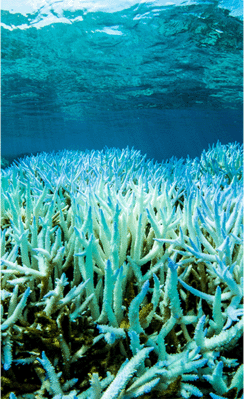
The Great Barrier Reef has suffered mass coral bleaching three times – in 1998, 2002 and 2016 – with a fourth episode now unfolding. The cause is increasing ocean temperatures.
“Is the Great Barrier Reef dying due to climate change caused by man’s selfishness and greed?” asks Delingpole, before giving a long list of people and groups who he thinks will answer yes, including “the Guardian” and “any marine biologist”.
“Have they been out there personally – as I have – to check. No of course not,” says Delingpole.
Yes. James Delingpole has been out there “personally” to check, but all those other people haven’t. He doesn’t say when he went but he has written about one trip before. It was back in late April 2012. Everything was fine, he said, based on that one visit. I can’t find any times when he has mentioned another trip since.
So here’s the rhetorical question – one that I can barely believe I’m asking, even rhetorically.
I mean, come on? Why can those two things – Delingpole making a boat trip with mates and a coordinated and exhaustive scientific monitoring and data-gathering exercise – not be the same?
So it seems we are now at a stage where absolutely nothing is real unless you have seen it for yourself, so you can dismiss all of the photographs and video footage of bleached and dead coral, the testimony of countless marine biologists (who, we apparently also have to point out, have been to the reef ) and the observations made by the government agency that manages the reef.
Senator Pauline Hanson and her One Nation climate science-denying colleagues tried to pull a similar stunt last year by taking a dive on a part of the reef that had escaped bleaching and then claiming this as proof that everything was OK everywhere else…….
Government ministers at federal and state levels, of both political stripes, claim they want to protect the reef.
The Stop Adani Alliance will lobby against the coalmine in northern Queensland, citing new polling that shows three-quarters of Australians oppose subsidies for the mine when told the government plans to loan its owners $1bn.
The alliance’s declaration argues the mine will “fuel catastrophic climate change” because burning 2.3bn tonnes of coal from the mine over 60 years of operation would create 4.6bn tonnes of carbon dioxide. It states the project would “trash Indigenous rights”, citing the fact Adani does not have the consent of the Wangan and Jagalingou people.
The alliance’s members include the Bob Brown Foundation, the Australian Conservation Foundation, 350.org, Get Up, the Australian Youth Climate Coalition, the Seed Indigenous Youth Climate Network and the Australian Marine Conservation Society.
The alliance will call for:
Urgent and serious action to cut carbon pollution;
A complete withdrawal of the Adani Carmichael mine, rail and port project;
A ban on new coalmines and expansions in Australia; and
An end to public subsidies for polluting projects.
Brown said the groups were “drawing a line in the sand with Adani, just as previous generations did with the Franklin River dam”, a campaign of which he was a leader.
“Adani’s coalmine will be the most dangerous in our history, ramping up global carbon pollution precisely when emissions need to be drastically cut,” he said.
Brown will be joined at the launch in Canberra by alliance spokesman and president of the Australian Conservation Foundation, Geoff Cousins, and Seed Indigenous Youth Climate Network codirector Amelia Telford.
According to a new ReachTel poll taken on 14 March, 74.8% of voters agree that “Adani should fund its own project” rather than rely on a proposed $1bn loan from the federal government.
The poll replicates results in January that showed three-quarters of respondents were opposed to loaning $1bn for a train line to the Adani coalmine.
“Dear Mr Adani,
“We are writing to respectfully ask you to abandon the Adani Group’s proposal to dig the Carmichael coal mine in Queensland’s Galilee Basin.
“We would like to put to you three reasons why this mine should never go ahead.
“One, the Carmichael mine would be the biggest coal mine ever dug in Australia.
Once its coal is burnt, it will contribute more climate-changing pollution to the atmosphere
than the entire country of New Zealand does every year. …
“Two,coal is a killer.
Coal is the biggest single cause of air pollution in Australia. …
Last month The Lancet, one of the world’s leading medical journals, published a report that described your company’s Carmichael mine proposal as a “public health disaster”. …
“Three, this mine proposal does not have wide public support in Australia
and does not have the support of the Traditional Owners of the land where the mine would be dug.
There are concerns about the impact the mine will have on groundwater resources and on nearby farmers who rely on this water for their livelihoods. …
“We the undersigned – and we believe all Australians – would support and welcome moves by your company to invest further in renewable energy in Australia. … “
” New poll shows three quarters of people believe Qld Premier & Regional Mayors, in India today, should pursue solar not coal.
Meeting between Adani HQ Senior Management and community delegation of Geoff Cousins AO, Qld farmer, tourism operator and reef campaigner.
With the hotly contested Third Test between India and Australia underway, former Cricket Captain Ian Chappell says renewable energy is the future. … ”
~ Joshua Robertson @jrojourno 16 March 2017: ” … The Chappells, well-known through their sporting exploits in India where the Australian team is currently playing, joined 90 prominent Australians in the letter, which will be delivered to Adani’s head office on Thursday. … ”
Adani: Indian fishermen warn Australia against environmental impact ahead of coal mine talks ABC AM By South Asia correspondent James Bennett , 17 Mar 17 Fishermen in India say a local Adani project is harming them and killing off sea life, warning Australia to be wary as Queensland’s Premier Annastacia Palaszczuk prepares to decide whether to proceed with the Carmichael coal mine.
Key points:
Noor Mohammad said the Adani project’s coal dust, stream discharge harmed the community
Adani has been heavily criticised for a series of environmental breaches during construction of Gujarat project
Comment was sought from Adani on measures it had taken to address the ash problem, but the ABC received no response
Ms Palaszczuk and eight regional mayors are preparing to sit down with the chairman of Adani Enterprises, Gautam Adani, ahead of the company deciding whether to proceed with the proposed mine.
CEFC tips another $70m into big solar, as market confidence soars, REneweconomy,
By Sophie Vorrath on 13 March 2017 The Clean Energy Finance Corporation has signed off on Australia’s largest single large-scale solar financing deal to date, tipping another $70 million into a total of 165MW of big solar capacity in Queensland and Victoria and heralding a new level of investor confidence in the nation’s large-scale renewable energy market.
The three projects, which are being developed by Edify Energy alongside international renewable energy investor Wirsol, include the Whitsunday and Hamilton Solar Farms in Queensland, both 57.5MW, and the Gannawarra Solar Farm in Victoria, at 50MW.
The “benchmark” financing deal – announced on Monday – commits the CEFC, the Commonwealth Bank and Germany’s NORD/LB to a syndicated senior debt facility to support the three projects, with Edify and Wirsol are providing equity. Continue reading →
The Queensland government has attacked the LNP opposition and the Murdoch media for unfounded, baseless and “lazy” criticism of its plans to source 50 per cent of its electricity needs from renewable energy by 2030.
The conservative LNP has been getting a big run in the Murdoch press with a new anti-renewables campaign, which has wound up significantly since the start of the year with a host of new solar projects that will add 1GW of solar power to the state’s grid.
But Bailey wondered why the LNP hadn’t even bothered to make a submission to the government’s renewable energy review that it attacks so much. In total, 2,300 submissions were received, but none from the LNP or any of its MPs.
“Once again, all we’re hearing is anti-renewables doom and gloom, but of the 2023 submissions received by the Independent Panel following their public forums across the state, not one of them was from the LNP,” he said.
“On the leash of their Canberra mates, they run around the state, scaremongering and threatening to scrap Queensland’s RET if elected, but they were too lazy to do the work – to make a submission where it actually counts.
The LNP, in recent days, have been trying to make much of a report in The Australian which breathlessly announced in an “exclusive” story on its front page on Monday that it had acquired a “leaked” copy of an Australian Energy Market Operator submission into the Queensland government plans.
And while AEMO had warned that coal generators in Queensland may close earlier than expected, a line that the Murdoch media was keen to play up (it even wrote a follow-up story and an editorial the following day), Bailey pointed out that these generators were young, and most importantly, mostly government-owned.
That means that the Queensland government will not be in the same position as South Australia, which has had to watch with growing frustration as the private owners of the biggest gas plants in the state decide not to switch on during high demand periods, claiming they can find no economic incentive to help keep the lights on for their customers.
On the subject of South Australia, premier Jay Weatherill said the state had no intention of rowing back on its 2025 target of 50 per cent renewables, saying to do so it would have to effectively “physically prevent” developments in their tracks.
That much is true, because the build-out of the Hornsdale wind farm and the Tailem Bend solar project will take the state to 50 per cent wind and solar by the end of this year.
Weatherill says the biggest threat to power prices in South Australia is the lack of competition among generators, something that can addressed by having more renewable energy and other technologies such as battery storage.
Weatherill says the state will “soon” release” its planned intervention to ensure that no more rolling stoppages occur – as they did last month – while some gas generators sit idle. From that point of view, he must envy Queensland’s ownership of power generators.
Back in Queensland, Bailey also said Queensland has a high amount of (mostly government-owned) flexible gas-fired generation, which enables the system to ramp up quickly.
He said the government had confidence in the modelling, and in its conclusions that it would be broadly cost neutral to electricity consumers, and would not affect reliability.
Bailey also said the Palaszczuk Government is committed to transitioning to a clean energy future gradually and sustainably, while keeping affordability and network reliability front and centre.
“We’ve kick-started a renewable energy boom with more than 1GW of privately funded renewable energy projects currently in the works delivering more than $2 billion of new investment to Queensland and more than 1900 direct jobs, mostly in our regions,” he said.
“Energy is undergoing a transformational change in the way it is generated, transported and used – the former LNP government did nothing to prepare for this.
“Importantly, the benefits of the RET to the Queensland economy, particularly in regional areas will be largely driven by the additional $6 billion investment in renewable energy, and a projected increase of around 6,400-6,700 jobs per year on average between 2020 and 2030.
“The anti-renewables LNP have no credibility on energy policy. They oversaw the loss of 1300 renewable industry jobs while in government and inflicted 43 per cent electricity price hikes on consumers.”
Coal mining town Collinsville vies to become Australia’s solar capital, ABC By Ben Millington, 5 Mar 17, While many of Australia’s mining regions have been hit hard by the resources sector downturn, solar is providing rays of hope for the small town of Collinsville in north Queensland.
Three hours south of Townsville, Collinsville has a proud, long history of coal mining, boasting it had the last working pit ponies in Australia — up until 1990.
But this coal-fired town is poised for a rebrand. Solar companies are vying to take advantage of the region’s 300 days a year of perfect sunshine.
In August, the Australian Renewable Energy Agency announced it would provide $9.5 million to both Edify Energy’s 70MW Whitsunday Solar Farm and RATCH Australia Corporation’s 43MW Collinsville Solar Project.
“It’s a very good place for solar because of the radiation levels in north Queensland,” he said. “For example, our site in Collinsville will produce double the amount of power than a project in the UK, and about 5 to 10 per cent more than in New South Wales or Victoria.”
Plan to pump energy into Queensland grid Another advantage in Collinsville is a decommissioned power station that sits on its outskirts. Both projects plan to utilise the infrastructure to pump energy straight into the Queensland grid.
Silence is Complicity in Reef’s Destructuon #auspol , John Pratt, 1 M ar 17 Big tourism must demand action to save the reef – its business depends on it
According to a blog post on the home page of the tourism giant Mantra Group, a “family holiday in Queensland would be incomplete without a visit to the beautiful Great Barrier Reef, the largest coral reef system in the world”.
Which raises the question, why isn’t the Mantra Group – one of Australia’s largest hotel and resort operators, with more than $8bn in asset management including a string of resorts in north Queensland – vociferous in demanding action to save the reef?
The question could not be more pertinent given the return of the threat of coral bleaching.
Mantra and other huge hospitality companies with interests on the reef, including Marriott and Accor, were conspicuously muted during the great bleaching of 2015-16.
Nor have any of these companies spoken out strongly against the Carmichael coalmine proposal – despite the mortal threat that fossil-fuel expansion poses to the reef their businesses depend on.
As the Queensland Tourism Industry Council boss, Daniel Gschwind, told the Monthly:
“It’s hard to see how the further development or expansion of the coal industry can support or in any way contribute positively to the future of the reef … There is no denying that the further extraction and burning of fossil fuels is a negative for the reef.”
Port Douglas sits at the hinge of the central and northern sectors of the Great Barrier Reef.
Presumably a large number of those who choose to stay in resorts like the Mantra Aqueous – or the Accor-owned Sea Temple or the Marriott-owned Sheraton Mirage, both also in Port Douglas – have been drawn there by the promise of the reef.
And while the vast majority of the reef experienced some damage, it is the northern sector that experienced the worst.
Last November a team of experts from James Cook University led by Prof Terry Hughes estimated that two-thirds of the corals in the reef’s northern part had died.
I snorkelled some of the impacted areas. I’d seen plenty of images and vision but nothing really prepares you for the scale of the carnage when the algae-covered remains spread out beneath you, all around, in every direction, as far as your goggled eyes can see.
Gschwind believes that most tour operators are not just on the reef “to make a buck” but rather “have a deep, almost spiritual, connection to the places they visit and take their visitors to” so “their interest is very much also in conservation”. The 170 tourism operators who wrote an open letter to the prime minister last year opposing the Carmichael coalmine are no doubt in this category.
But in the fight for the reef’s future, the big end of the tourism street has gone missing. The likes of Mantra, Accor and Marriott profit from the astonishing beauty of the fish and the coral – but where is the much-vaunted corporate leadership when the Great Barrier Reef needs defenders?……. https://wordpress.com/read/feeds/17124327/posts/1356978618









 Antinuclear