 The Great Barrier Reef and the coal mine that could kill it, Guardian, Tim Flannery, 2 Aug 14 These are dark days for Australia’s Great Barrier Reef. On 29 July, the last major regulatory hurdle facing the development of Australia’s largest coal mine was removed by Greg Hunt, minister for the environment. The Carmichael coal mine, owned by India’s Adani Group, will cover 200 sq km and produce 60m tonnes of coal a year – enough to supply electricity for 100 million people. Located in Queensland’s Galilee Basin, 400km inland from the reef, it will require a major rail line, which is yet to receive final approval, to transport the coal, which must then be loaded on to ships at the ports of Hay Point and Abbot Point, near Gladstone on the Queensland coast, adjacent to the southern section of the reef. Both ports require dredging and expansion to manage the increased volume of shipping. Once aboard, the coal must be shipped safely through the coral labyrinth that is the Great Barrier Reef, and on to India, where it will be burned in great coal-fired power plants.
The proposed development will affect the reef at just about every stage. Indeed, so vast is the project’s reach that it is best thought of not as an Australian, or even an Australian-Indian project, but one of global impact and significance………..
Today, the Carmichael mine development is occurring adjacent to what is now a very sick Great Barrier Reef. A 2012 study established that around half of the coral composing the reef is already dead – killed by pesticide runoff, muddy sediment from land clearing, predatory starfish, coral bleaching and various other impacts. The coal mine development will add significant new pressures. First will come the dredging for the new ports. The 5m or more tonnes of mud, along with whatever toxins they contain, will be dug up, transported and dumped into the middle of the reef area. Some studies suggest that the suffocating sediment will not drift far enough to harm the majority of the reef. But who can say what impact tides, currents or cyclones, which are frequent in the area, will have on the muddy mass?
The raw coal itself will be another pollutant. Coal dust and coal fragments already find their way from stockpiles, conveyor belts and loaders into the waters of the reef. Indeed, existing coal loaders have already dumped enough coal for it to have spread along the length and breadth of the reef. In areas near the loaders, enough has accumulated to have a toxic effect on the corals that grow there.
There is also the ever-present possibility of a coal ship running aground on the reef……….
If the Carmichael coal mine is a global story, and the Great Barrier Reef a global asset, then the issue should not be left to Australia alone to decide. The citizens of the world deserve a say on whether their children should have the opportunity to see the wonder that is the reef. Opportunities to do this abound. Petitioning national governments to put climate change on the agenda of the G20 summit, to be held in Australia in November this year, is one. Pushing governments to play a constructive role at the 2015 climate negotiations in Paris is another, as is letting the Australian government know directly that everybody has a stake in the reef, and that it needs to act to secure its future. The Great Barrier Reef does not have to die in a greenhouse disaster like the one that devastated the world’s oceans 55 million years ago. But if we don’t act decisively, and soon, to stem our greenhouse gas emissions, it will. http://www.theguardian.com/environment/2014/aug/01/-sp-great-barrier-reef-and-coal-mine-could-kill-it
August 2, 2014
Posted by Christina Macpherson |
AUSTRALIA - NATIONAL, environment, Queensland |
Leave a comment

 Queenslanders want renewables to become the ‘norm’ http://reneweconomy.com.au/2014/queenslanders-want-renewables-to-become-the-norm-89672 By Giles Parkinson on 1 August 2014
Queenslanders have given renewable energy an overwhelming vote of support, telling the state government as part of its 30-year “Queensland Plan” that they want renewables to become the “norm” in the state. The document,
produced after consultations with 80,000 Queenslanders, states that their goal is for renewable and alternative energy to become the norm.
That would mean that “alternative, renewable energy is a Queensland commodity. It is affordable, commercially viable and available to all Queenslanders. Our infrastructure supports these renewable energy solutions.”
The document also states: “Increasingly, Queenslanders are turning to renewable energy alternatives. In the coming decades, as new technologies emerge, cleaner alternative energy sources may help us become better and wiser at using natural resources so they are protected and last longer.”
Premier Campbell Newman hailed the plan as “a massive and exemplary exercise in listening and consulting which involved various discussion forums from summits and community think tanks to boardroom workshops and robust family debates.”
But Queenslanders shouldn’t get too excited about Newman’s LNP government making a sudden lunge towards clean energy.
Queensland may well have more rooftop solar PV than any other state – 1.1GW out of a country total of 3.4GW – but it has very few large scale renewable energy projects, and little prospect of more in the near term. Network operators have also introduced new rules that may prevent new solar installations from exporting their output back into the grid.
The Newman Government has constantly derided “green schemes”, such as the solar feed-in tariff, for contributing towards higher power prices, even though it has benefited from a huge increase in dividends from the state owned network operators derived from big increases in network costs.
The government also wants the renewable energy target brought to a halt, rather than expanded. This appears designed to accommodate the needs of the state-owned fossil fuel generators, Stanwell Corp and CS Energy, which have called for renewable support schemes to end.
Stanwell Corp, in particular, has been critical of the role that rooftop solar has played in lowering wholesale electricity prices and forcing its books into the red.
The Queensland Energy Minister, Mick McArdle, said in his submission to the RET Review panel, that efforts to reduce emissions should be delayed until the state is rich enough.
So, how will the Newman government respond to the desire of its constituents expressed in the Queensland Plan?
The document includes some suggestions about how Queenslanders can “turn their ideas into action” and “make our vision a reality”.
Specifically, the document recommends:
“Subscribe to local and international think tanks and keep up to date about alternative energy solutions and environmental issues.”
Well, that’s a start. We trust, however, that the Newman government is not suggesting the Institute of Public Affairs. We’d recommend The Australian Institute, or the Centre for Policy Development. And RenewEconomy.
August 2, 2014
Posted by Christina Macpherson |
energy, Queensland |
Leave a comment
1 Aug 14 State government plans released today and promoting a fast tracked uranium industry in Queensland have been described by ACF as fanciful and irresponsible.
“The LNP’s promotion of uranium mining has the logic of a problem gambler,” said ACF nuclear free campaigner Dave Sweeney. “It is a bad policy based on a broken promise and is driven by enthusiasm rather than evidence”.
Ahead of the 2012 state election Campbell Newman declared it was ‘very, very clear that we have no plans to develop any sort of uranium mines in Queensland’. After the election and without any independent assessment or public consultation the LNP back-flipped on uranium and today Mines Minister Cripps is championing the sector.
His industry promotion is deeply flawed, including in relation to:
(i) Economic benefits – these have never independently tested by LNP and the Australian uranium industry has been  seriously hurt and constrained by market fallout from Fukushima with the uranium price hovering around nine-year lows amid weak demand.
The Ministers spruiking of uranium as an economic bonanza has been released as Australia’s longest operating uranium mine – Energy Resources of Australia’s Ranger mine in Kakadu – announced a further half year operating loss of $127 million.
“Queenslanders would do well to look at the facts before signing on to the fiction. This is an absurd time to be giving a green light to yellowcake,” said Mr Sweeney.
(ii) Royalty payments: the Minister’s talk of “royalties to fund school and health services, roads and public infrastructure” fails to acknowledge that the Queensland Resources Council is currently involved in closed door talks with the LNP seeking to negotiate reduced or suspended royalties for any future state uranium mine.
(iii) Uranium transport: Minister Cripps dismissal of community concerns over the possible future movement of uranium through a Queensland port lacks credibility. The LNP government has not ruled out any such movements, the Port of Townsville has formally expressed interest in facilitating such movements, the federal government and uranium industry lobbyists are pushing for a new export site on the east coast and the proposed Ben Lomond deposit is just up the road.
In today’s media when asked whether it was possible for a Queensland port to be granted permission to be used as an export point, Mr Cripps would not rule it out: “Well if an application comes forward to assess a port for the export of uranium oxide, I mean, we’ll take it and we’ll assess it.”
“The Queensland community and environment deserve better than backflips, backroom deals and backward thinking,” said Mr Sweeney.
“If Minister Cripps thinks this industry adds up he should have no problem with an independent public Inquiry into the cost and consequences of the LNP’s plan for uranium mining. This industry is contested and contaminating and demands scrutiny and rigour, not wishful thinking and lame assurances,” said Mr Sweeney.
Further context or comment: Dave Sweeney 0408 317 812
August 1, 2014
Posted by Christina Macpherson |
business, Queensland, uranium |
Leave a comment
Australian War Memorial should recognise revised Aboriginal death toll: researcher, Brisbane Times July 17, 2014 Cameron Atfield Brisbane Times and Sun-Herald journalist New research that has calculated an Aboriginal death toll of more than 65,000 in Queensland alone during the so-called frontier wars has renewed calls for formal recognition at the Australian War Memorial.
But the AWM in Canberra has dismissed the idea, saying recognition should instead be in the National Museum.
The research, presented to the Australian Historical Association’s Conflict in History conference last week at the University of Queensland, estimated 66,680 deaths between 1788 and 1930.
Of those deaths, 65,180 were indigenous, which is more than six times what was previously thought. The report’s co-author, historian Professor Raymond Evans, said the calculations were based on official records, witnesses’ reports and the number of patrols undertaken by the colonial Queensland government’s Native Police.
Professor Evans said the 65,180 figure was “conservative” and could be as high as 115,000.
“This is just Queensland – imagine what the nation-wide figure could be,” he said.
“If you say it’s a war, you at least allow the fact that Aboriginal people fought hard to defend their lands, so you can say they were warriors and they were fighting for their country. “They were fighting for Australia, for their land.”
Professor Evans said the estimated death toll was at least on a par with Australian casualties during World War I.
“The Australian War Memorial should recognise this as a war. It’s got such a high death rate, it was fought over a long period of time and it was fought between different communities, different nations, for territory,” he said.
“It’s a fight for land and territorial possession and it has many features of warfare and, of course, a huge death rate.” http://www.brisbanetimes.com.au/queensland/australian-war-memorial-should-recognise-revised-aboriginal-death-toll-researcher-20140716-ztqr6.html#ixzz388vSgyg2
July 21, 2014
Posted by Christina Macpherson |
aboriginal issues, AUSTRALIA - NATIONAL, Queensland |
Leave a comment
Cr Veitch, who will address an anti-uranium protest rally in Townsville later this month, said he believed that aside from the “extreme consequences” for Townsville if something went wrong at the mine, it could invite terrorists into our backyard.
“There is a risk nuclear products could fall into the wrong hands in the Middle East or Eastern Asia,” he said.
Cr Veitch said “there is always that possibility,” that the uranium mine could make Townsville a target for terrorists. Especially with the large military base (at Lavarack).”…….
With any uranium mining operations at Ben Lomond certain to include a highly radioactive tailings dam, he said it was an “impossibility” to ensure safety at the mine in a tropical region prone to cyclones.
“They definitely haven’t been able to contain spills in tropical Australia and I think it would be an impossibility at this location,” he said.
“The State Mining Warden of the time closed it down (in 1981) because they considered it unsafe … what makes it safe now?……
Citizens Against Mining Ben Lomond spokesman David Sewell fears radioactive materials could be transported via the city to the port and then on to the Great Barrier Reef.
The protest march will start at 9.30am on July 27 on the grassed area behind the Picnic Bay Surf Life Saving Club.
July 19, 2014
Posted by Christina Macpherson |
Queensland, safety, uranium |
Leave a comment
Queensland lifts its uranium ban, but is the price worth the cost? The Conversation Maxine Newlands Lecturer in Journalism, Researcher in Environmental Politics at James Cook University Liz Tynan Senior Lecturer and Co-ordinator Research Student Academic Support at James Cook University 1 July 14,
As of today, Queensland has lifted a 32-year ban on uranium mining. That decision was taken within months of the 2012 state election, despite Premier Campbell Newman’s pre-election promise not to restart mining the radioactive mineral.
Miners are being invited to apply to restart the industry under the Queensland’s government’s uranium action plan, which will mean Canadian company Mega Uranium can reopen the Ben Lomond and other mines in north Queensland.
Queensland’s resumption of uranium mining comes only days after Australia’s newest uranium mine, Four Mile in South Australia, officially opened on 25 June.
 Yet the price of uranium has fallen from a high in 2007 of US$70 a pound to $US28, due to factors including oversupplyand what the Wall Street Journal has described as a “post-Fukushima funk”.
Given the prices are so low that The Australian has reportedthat Four Mile is already losing money, while the Beverley mine has been mothballed since January, why are Australian states looking to open more mines?………….
Battles ahead over Queensland exports
The highest concentration of Queensland’s uranium mines sit in the northern tropics, an area prone to Category 5 cyclones.
A 2013 Swiss study found uranium was far more mobile than originally thought. Uranium once extracted, becomes soluble in water, increasing the chances of contamination or radioactive dust carried in high winds and heavy rainfall.
If Ben Lomond is reopened, the quickest way to export its uranium would be through the city of Townsville, home to 190,000 people, which is only 50km from the mine.
The Port of Townsville has said it has the capability to “facilitate the transportation and export of yellowcake”. The Queensland’s government’s uranium action plan recommends that:
Queensland’s efforts should be [put] on facilitating the use of existing ports and shipping lanes by industry for the export of uranium.
However, the Port of Townsville sits within the Great Barrier Reef World Heritage Area and close to sensitive environments including the Great Barrier Reef Marine Park, dugong protected areas, seagrass beds, fringing coral reefs and mangrove forests.
Last year, Great Barrier Reef Marine Park Authority chairman Russell Reichelt told the ABC that:
I think shipping of any toxic cargo would be of concern. But really we would have to see a proposal and we would have to consider that.
So this is set to be a contentious issue: while economic development of the north has bipartisan support at a federal, state and local government level, a number of locals and environmental groups have said they will challenge any plans to reopen uranium mines and exports from Queensland.
The big question for Queensland residents to consider now is whether the return of uranium mining to the state will be worth the wait for the uranium price to recover, given the risks attached to transporting the mineral through populated and environmentally-sensitive areas.http://theconversation.com/queensland-lifts-its-uranium-ban-but-is-the-price-worth-the-cost-28105
July 2, 2014
Posted by Christina Macpherson |
environment, Queensland, uranium |
Leave a comment
 Caloundra and Ipswich tops for solar: Energex Tony Moore BRISBANETIMES.COM.AU SENIOR REPORTER, 13 June 14 The retirees, holiday makers and young families of Caloundra and the working class city of Ipswich have Southeast Queensland’s highest proportion of solar systems according to a breakdown of Energex data.
The breakdown from Energex figures shows some remarkable variations from conventional thinking.
There are fewer solar systems in West End (295), Highgate Hill (210) and South Brisbane (70), than in Inala (982) or Durack (645).
There are more in Carindale (1523) and Rochedale South (1465) than in Premier Campbell Newman’s home suburb of Ashgrove (691).
Queensland Treasurer Tim Nicholls sparked a massive outcry last week when he described some solar energy users as part of the “champagne sippers and the latte set.”
Jeremy Rich, from one of Australia’s longest-running solar energy companies, Energy Matters, said Mr Nicholls’ comments were simply wrong. “It is obvious those statements are emotional statements, without looking at the data,” Mr Rich said. “Because when you look at the data it shows that it is totally the opposite,” he said. “It is the low to middle income areas of Australia that are hurting the most.”
Their company data is similar to the Energex breakdown, showing a major interest in solar energy in Ipswich, Capalaba, Browns Plains and Cleveland in four of the top five spots.
Central Ipswich – home to Swanbank power station – has 50 per cent solar energy penetration, Mr Rich said.
Ipswich homes under the postcode of 4305 – including the suburbs from Raceview through to Brassall – have 5197 solar installations.
Caloundra’s postcode of 4551 – including Caloundra, Caloundra West, Currimundi and Dickey Beach – has 6311 solar installations up to May 2014………
A quick top 10 of Energex’s solar hot spots and their postcodes are:
1: Caloundra 4551: 6311 solar installations
2: Ipswich central east 4305: 5197 solar installations from Raceview to Brassall
3: Advancetown/Gold Coast hinterland 4211: solar 4941 installations
4: Buderim 4556: 4379 solar installations
5: Beenleigh 4207: 4363 solar installations
6: Bray Park 4500: 3931 solar installations
7: Ipswich south-west 4300: Goodna/Camira to Springfield: 3930 solar installations
8: Amberley, Barellan Point and Blacksoil 4306: 3910 solar installations
9: Mt Cotton and Redland Bay 4165: 3810 solar installations
10: Gympie and its surrounds 4570: 3678 solar installations. http://www.brisbanetimes.com.au/queensland/caloundra-and-ipswich-tops-for-solar-energex-20140612-zs66n.html#ixzz34fZsRL6G
June 14, 2014
Posted by Christina Macpherson |
Queensland, solar |
Leave a comment
 Wind farm opponents welcome intervention ABC Rural By Charlie McKillop, 12 June 14, Queensland Deputy Premier Jeff Seeney will determine the fate of a controversial wind farm proposed on the far north’s Atherton Tableland.
Mr Seeney has informed the Mareeba Council he’s decided to ‘call in’ the development application to establish 75 wind turbines at Mt Emerald, about 100 kilometres west of Cairns.
The move has been welcomed by both the mayor of Mareeba, Tom Gilmore, and opponents of the wind farm, who agree the size and complexity of the assessment is beyond the technical and financial resources of the council.
But Steve Lavis, from the Tablelands Wind Turbine Action Group, admits he has reservations about the decision being taken out of the local community…….http://www.abc.net.au/news/2014-06-12/wind-farm-opponents-hopeful-about-intervention/5519106
June 13, 2014
Posted by Christina Macpherson |
Queensland, wind |
Leave a comment
CEC: Renewable Energy Target not power price villain: Queensland Competition Authority http://ecogeneration.com.au/news/cec_renewable_energy_target_not_power_price_villain_queensland_competition_/087591/ Tue, 10 June 2014
The Queensland Competition Authority (QCA) confirmed on Friday what the clean energy industry has been saying for years – that the Renewable Energy Target is not a major factor in rising power prices.
Clean Energy Council media release 2 June 2014
Clean Energy Council Policy Director Russell Marsh said the latest price determination from the QCA showed that in 2014-2015 the cost of the Renewable Energy Target to Queensland households will fall, while all other parts of the average electricity bill will rise.
“In particular, power bills are set to jump due to the increasing cost of gas and the costs of the poles and wires in the electricity network,” Mr Marsh said.
“The Renewable Energy Target makes up less than 3 per cent of the average power bill, supports thousands of jobs and is an insurance policy against the future cost of gas power, which some analysts predict may be the defining energy challenge of this decade.” The Renewable Energy Target is designed to ensure at least 20 per cent of Australia’s electricity comes from renewable energy such as wind, hydro, solar and bioenergy like sugar cane waste by 2020 – at the lowest cost. The policy is currently under review, leading to uncertainty which has frozen investment in the sector until it has been completed.
Mr Marsh said the cost to consumers was a major part of the current review process, and four studies this year had shown that power prices would actually increase slightly if the Renewable Energy Target was removed.
“Removing the Renewable Energy Target would mean that we need to source more power from increasingly expensive gas, driving up costs for energy users such as mums and dads and manufacturers. We have already seen the start of this in Queensland with the latest price determination from the QCA.
“The Australian Industry Group, which represents some 60,000 businesses including many manufacturers, has also recognised that there would be no benefit to consumers if the Renewable Energy Target was reduced.”
June 11, 2014
Posted by Christina Macpherson |
energy, Queensland |
Leave a comment
Rio Tinto to deploy 6.7MW solar PV + storage at off-grid mine
REneweconomy By Giles Parkinson on 22 May 2014 A ground-breaking, $23.4 million project to cut out daytime diesel consumption at Rio Tinto bauxite mine at Weipa could unlock billions of dollars of similar investments in the mining industry – which is weighed down by soaring energy costs.
Mining giant Rio Tinto is to host a $23.4 million solar PV plus storage facility at its Weipa bauxite mine, that is the first of its type and scale in the world and could unleash billions of dollars of similar investment. Rio Tinto Alcan – with the help of the Australian Renewable Energy Agency – is to install a 1.7MW solar PV array at its Weipa bauxite mine later this year, and then add a further 5MW of solar PV and battery storage.
The Weipa mine is located on the Cape York Peninsula at the very northern tip of eastern Australia, and relies on expensive diesel that has to be shipped in.
The first phase of the solar project – to be built with First Solar thin-film modules and constructed by Australian solar firm Ingenero – is expected to reduce daytime diesel demand from the mine’s 26MW diesel generator by up to 20 per cent.
However, the addition of more solar and storage to balance out intermittency could reduce daytime diesel consumption altogether at certain times.
The Weipa project was the first of around 70 submissions – worth several billion dollars of investment – from mining operators in Australia for funding for such ground breaking projects under ARENA’s $400 million remote energy program.
The ending of the commodities boom has made miners more focused on energy costs. Continue reading →
May 23, 2014
Posted by Christina Macpherson |
Queensland, solar |
Leave a comment
 AUDIO: Cheaper electricity from Weipa solar project final act of axed renewable energy agencyhttp://www.abc.net.au/news/2014-05-22/cheaper-electricity-from-weipa-solar-project-final/5469770?section=qld Many remote communities around Australia are totally reliant on costly diesel fuel to provide the electricity that most take for granted. But the far north Queensland mining town of Weipa is adding solar energy to the mix in what’s being called an Australian first. It could be the final act for an agency that’s facing the axe after last week’s savage federal budget.
May 22, 2014
Posted by Christina Macpherson |
Audiovisual, Queensland, solar |
Leave a comment
 Queensland University tries to block climate research
 GRAHAM LLOYD
THE AUSTRALIAN MAY 17, 2014 THE University of Queensland has threatened legal action to stop the release of data used in a paper that establishes a 97 per cent scientific consensus on anthropogenic climate change
May 17, 2014
Posted by Christina Macpherson |
civil liberties, Queensland |
Leave a comment
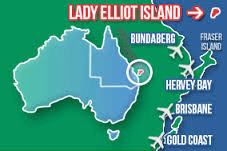 More renewable energy in the wind for Lady Elliot Island http://www.abc.net.au/news/2014-05-12/more-renewable-energy-in-the-wind-for-lady-elliot/5445804 By Frances Adcock Operators on Lady Elliot Island, north-east of Bundaberg, will consider installing wind generators to further improve the island’s energy efficiency.
One-hundred new solar panels will be installed at the island’s hybrid solar power station, which has provided more than half of the island’s power since 2008.
The island’s resort manager, Peter Gash, wants the island to become even more reliant on renewable energy.
“By Christmas we’d hope to do it by, we’d like to install a 10 kilowatt wind generator which will continue to feed power into the battery and into the grid, night and day, and if we can get the success we are hoping for with our 10 to 12 kilowatt wind generator and our 73 kilowatt of solar we will be hopeful we will be somewhere up around 90 per cent renewable,” he said.
He says after the installation of the new panels, more than 70 per cent of the island will be reliant on renewable energy. “We have a barge coming out on Wednesday and there is 125 panels on that and they are 260 watts per panel and they will go up on two separate roofs, and that’s a 16 and 17 kilowatt system,” he said.
“So another 33 kilowatts, so another 125 panels, so that puts us up at 73 kilowatts of power which is a substantial amount of power.”
May 13, 2014
Posted by Christina Macpherson |
Queensland, solar, wind |
Leave a comment
 Uranium mining to face delays North West Star By CHRIS BURNS May 5, 2014,
QUEENSLAND Resources Council chief executive Michael Roche says he does not expect a rush of uranium mine development in the North West when Queensland regulations are approved later this year.
Mr Roche based his views on the length of time it took for uranium mines to be built after Western Australia approved legislation. The experience in Western Australia after they gave the go-ahead to uranium mining is that it took over four years for the first mine to get through all the approval stages,” Mr Roche said.
May 6, 2014
Posted by Christina Macpherson |
business, Queensland, uranium |
Leave a comment
 Uranium debate heats up in Mount Isa Queensland labour senator Jan McLucas says the state’s uranium deposits are too small to warrant developing the industry. ABC Rural By Virginia Tapp, 1 May 14
“These mines at Valhalla and Westmoreland are not huge deposits, they will not employ large numbers of people like Mount Isa, Cloncurry and Century have done.
“These are small mines and I don’t think they are the answer to the question of employment in the Mount Isa region.”…….Senator McLucas also claims there is not enough information about managing uranium mines in areas that experience intermittent periods of very high rain fall and flooding.
She says parts of the abandoned Mary Kathleen uranium mine, situation between Mount Isa and Cloncurry, are still radioactive.

“The residents of Mount Isa are still living with the results of that mine and the inadequate capping of the spoil and the contamination of the land that even graziers today won’t go near.”…….
[Queensland Department of Natural Resources and Mines and the Department of Environment and Heritage Protection joint statement] ……”We are still assessing the condition of the Mary Kathleen site and looking at whether it could be mined again in the future.
“Contamination issues at the site may not have been properly addressed in the past.”…..http://www.abc.net.au/news/2014-05-01/uranium-debate-queensland/5423232
May 2, 2014
Posted by Christina Macpherson |
employment, environment, Queensland, uranium |
Leave a comment







 Antinuclear