A Big Lobbying Force for Small Solar Power – SOLAR CITIZENS launched today
 Solar Citizens Officially Launches Today http://www.energymatters.com.au/index.php?main_page=news_article&article_id=3736 by Energy Matters, 14 May 13 Solar Citizens aims to bring together existing and future solar owners in Australia and to help see solar installed on every suitable rooftop in the nation. The project is an offshoot of 100% Renewable; a non-partisan organisation established to help move Australia towards a renewable energy future.
 While the solar revolution is well under way and millions of systems have been installed in Australia; there are some dark clouds on the horizon. “But despite the many reasons to go solar, some big energy companies don’t want to see Australians take back control of their own energy needs. They want to make connecting to solar harder, not easier,” says part of a statement on the Solar Citizens web site.
According to Solar Citizens, Australians have invested $8 billion so far in small scale solar power systems.
Calculations performed by national solar provider Energy Matters estimate that collectively, the 1 million plus solar panel arrays in the nation will generate around $913 million worth of electricity (retail value) over the next 12 months – making these households a threat to Big Energy in Australia.
Solar Citizens says it will strive to protect the rights of solar households, lobbying to ensure they are treated with respect and paid a fair price for the power they contribute to the mains grid. With potentially nearly 2 million households as participants including solar hot water system owners; the group could become a powerful voice.
Solar Citizens’ first two campaigns focus on looming issues in Tasmania and Queensland. The Queensland campaign highlights concerns regarding a proposal from the Queensland Competition Authority to move solar power owners on to a different electricity billing system that could see increased charges for solar households.
The campaign for Tasmania is in relation to the privatising Aurora’s electricity retailer arm, to occur in January 2014. There are fears that as a result, solar feed-in tariffs could be slashed. Both campaigns involve petitions that will be presented to relevant authorities.
“Solar Citizens” will tackle Queensland’s anti solar recommendations
Sun power advocacy lights up http://www.theage.com.au/business/carbon-economy/sun-power-advocacy-lights-up-20130512-2jg4w.html May 13, 2013 Peter Hannam
The million-plus Australian residents with solar panels on their roofs will be less likely to be treated poorly by power companies and politicians following the creation of a new advocacy group, its backers say.
The group, Solar Citizens, expects to muster tens of thousands of members in a bid to defend the rights of the million-plus homes with panels on their roofs. “People are feeling vulnerable having invested thousands of dollars in solar panels,” Greg Evans, manager of Solar Citizens, said. “We think there is a pushback going on.”
In recent months, corporate chiefs including Origin Energy’s managing director Grant King have blamed efforts to promote solar and wind energy for driving up electricity costs. If solar PV owners retain access to the grid but source little power from it, costs will be higher for everybody else, Mr King said in March.
Mr Evans, though, said about 2.5 million Australians live in home with solar PV or solar hot water systems, or both. He predicted many of these households, ranging from outer suburbs to the bush, had sunk $8 billion into PV alone and would be prepared to protect the value of that investment.
Among the group’s first actions would be to campaign against the introduction of recommendations from Queensland’s Competition Authority that would force solar owners to pay more to connect to the grid.
“They’re suggesting solar users should pay time of use tariffs when consuming electricity from the grid and it’s not clear other consumers will be obliged to do that,” Mr Evans said.
“If they’re going to do that fairly (in Queensland), they’re going to have to do that for everyone who gets an air-conditioner,” Craig Memery, energy policy advocate at the Alternative Technology Association, said. “Those who don’t have air-conditioners very heavily cross-subsidise those who do.” Mr Memery said it was very important that conditions PV owners signed up for are preserved. With their numbers swelling at the rate of thousands across the country, their clout is only likely to grow.
“It’s at the point where politicians will have to listen to what this group has to say.”
Queensland government guts laws protecting water from coal seam gas operations

 Australia: Wide-ranging changes to Queensland’s land and water legislation passed, Clayton UTZ 11 May 2013 A petroleum tenure holder in Queensland will now be able to use associated water “for any purpose”.

The Land, Water and Other Legislation Amendment Act 2013 (Qld) was passed by Parliament on 2 May 2013 and introduces a large number of legislative amendments across a wide range of Acts impacting, primarily, the land and water regulatory portfolios, but also making important amendments that impact upon the petroleum industry, particularly in relation to water bores and the use and transportation of CSG water.
Some of the key amendments in this Act for petroleum industry proponents are outlined below.
Removal of restriction on use of CSG water Continue reading
No to uranium mining in Queensland: ALP reaffirms their stand
 Qld State ALP reaffirms support for uranium ban http://workersbushtelegraph.com.au/2013/04/17/qld-state-alp-reaffirms-support-for-uranium-ban/ “Environmentalists welcome the State ALP’s reaffirmation of their policy of opposition to uranium mining in Queensland” said Friends of the Earth spokesperson, Ms Robin Taubenfeld.
Yesterday Jackie Trad, State ALP member for South Brisbane tabled a report, published by environmental groups and trade unions, in State Parliament.
The report, “High Risk – Low Return: The case against uranium mining in Queensland” exposes the State Government’s claims about jobs and royalties as being without substance.
Jackie Trad MP argued that the uranium industry was only likely to create 155 long-term jobs, according to a Deloitte Access Economics report from 2008. Jackie Trad MP argued that the risk to agricultural and tourism jobs far outweighed claims made by the Premier, claiming “The risks to both the reputation and sustainability of our agricultural industry and food security from uranium mining are real.”
Ms Trad has said that “Queenslanders need to ask themselves this very important question – is the small economic return on uranium mining worth the risk it poses to established industries, our precious environment and the health and safety of workers?”
Robin Taubenfeld said “State investment in renewable energy would create more jobs. The uranium industry has a terrible accident history and this poses a significant threat to the environment and our way of life in Queensland.”
The “High Risk – Low Return” report can be downloaded from http://www.qnfa.org.
Very little economic benefit to Queensland, in uranium mining
 NGOs release alternative report to Uranium Implementation Committee
Queensland Nuclear Free Alliance March 18, 2013
High Risk – Low Returns: the case against uranium mining in Queensland is the NGO and civil society response to the LNPs undemocratic decision to go ahead with uranium mining in our state.
Read the report http://qnfa.files.wordpress.com/2013/03/180313highcost-lowreturn-uinqld.pdf
In October 2012 the LNP government broke its clear commitment not to allow uranium mining in Queensland. This commitment was the position of the LNP at the March 2012 state election and was reaffirmed after they took office. In the absence of open, inclusive and evidence based policy making the Newman LNP government has set up the Uranium Implementation Committee. The Committee has not sought broad community input and has not been asked to assess the arguments for and against uranium mining in Queensland. The Committee’s mandate is the far narrower task of recommending how uranium mining should be managed, not whether it should occur.
Why should Queensland forego the economic benefits of uranium mining when some other states permit uranium mines? In a nutshell, it is because the economic benefits are grossly overstated and are outweighed by the wide-ranging environmental, public health and weapons proliferation problems and risks.
Uranium accounted for 0.19 per cent of Australia’s export revenue in 2011/12 (the last available figures). By the most generous estimate, uranium accounts for 0.015% of all jobs in Australia. For Queensland, there is the additional limitation that the state has around just 2% of Australia’s uranium resources. Clearly, the industry has no capacity to deliver significant economic or employment benefits.
Instead of acknowledging the extremely limited economic potential of uranium mining in Queensland the LNP state government, the Australian Uranium Association and the Queensland Resources Council have continued a pattern of extravagant and unsubstantiated claims regarding jobs, revenue and royalties. Enthusiasm is no substitute for evidence and limited sectoral self-interest is not the same as the public interest. Continue reading
Queensland’s way of slowing down solar rooftop energy
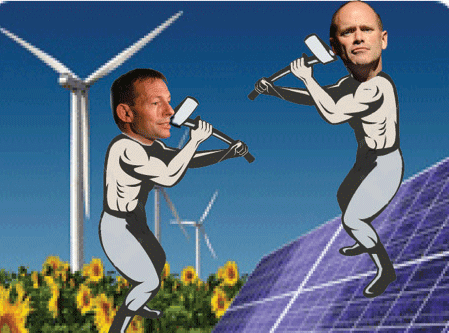 Political moves in Australia’s renewable energy landscape, PV Magazine 25 MARCH 2013 BY: JONATHAN GIFFORD, “……….In the state of Queensland, where over 1 GW of photovoltaics is expected to have been installed when its Feed In Tariff expires on July 10, a report into the electricity market has suggested new pricing structures for households installing a photovoltaic array……
The report recommended that a price of AUD0.0755/kWh be paid for electricity fed back into the grid from photovoltaic arrays, in south east Queensland, in 2013/14. It also found that compulsory minimum FITs were not required, and left the possibility of “gross FITs” open. Gross Feed In Tariffs have been vigorously opposed by the solar and renewable energy industry as they essentially prevent the self-consumption of electricity from a rooftop array.
In areas outside of the major population centers in the state, the Competition Authority report recommends the monopoly utility pay between AUD0.08 – AUD0.14/kWh for solar electricity from households.
The report has been criticized by supporters of renewable energy, because it does not take into account the advantages and savings that additional photovoltaic capacity adds, but rather assesses it only as a cost. These advantages include the reduction of wholesale electricity prices – the “merit order effect” – and a reduction of demand in peak times.
The report was also illustrative of some of the potential obstacles the solar industry may face in the future in Australia. The Queensland Department of Energy Supply and Water proposed to the Competition Authority that a limit be introduced to the amount of electricity that could quality for a FIT from each household and even the right of utilities to refuse solar connections http://www.pv-magazine.com/news/details/beitrag/political-moves-in-australias-renewable-energy-landscape_100010677/#ixzz2OxVmPPeE
Uranium through Great Barrier Reef? Financial foolishness, and ecological crime!
The price tag of the uranium deposits in Queensland, if all extracted and sold is about $10 billion. A pretty big chunk of cash, but worth only a paltry two years of tourism dollars that the Great Barrier Reef brings in.
To anyone who has looked in wonderment at the fish on a reef, this is not an “Australian issue”, this is an issue that speaks to how we want to leave the world to future generations. Our kids will remember visiting a reef teeming with tropical fish, turtles and fluorescent coral, but what will they remember if it isn’t there to be seen? They sure as heck won’t remember the quick buck made by uranium mining companies a few decades previous
Radioactive scuba diving a potential new Aussie destination sport http://www.vancouverobserver.com/city/outdoors/radioactive-scuba-diving-potential-new-aussie-destination-sport Kevin Grandia Mar 19th, 2013 Okay, I am exaggerating, but only slightly, but new anti-regulation laws have recently been passed in Australia that could mean uranium will be shipped out directly over this oceanic masterpiece of nature. Continue reading
30 years after closing, Queensland’s Mary Kathleen uranium mine still leaks radioactive water
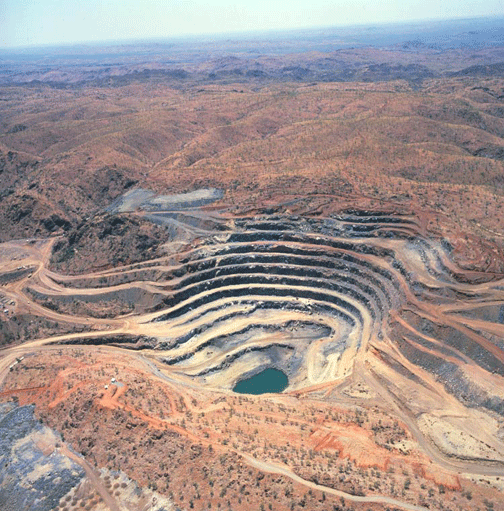 Queensland’s last uranium mine still leaking radioactive water 30 years after production stopped John McCarthy The Courier-Mail March 21, 2013 THE state’s last uranium mine at Mary Kathleen – in the Selwyn Range between Mount Isa and Cloncurry – is still leaking radioactive water from the site 30 years after production stopped. But, according to a committee report handed to the State Government this week, the return of uranium mining to Queensland is “risky but manageable”.
“The uranium mining industry has a number of inherent environmental risks,” the report said….. The report says the Mary Kathleen mine’s pit is still full of highly contaminated water to a depth of about 50m, and since the mine closed in 1982, several other studies have found “ongoing environmental legacy issues”.
Those include the seepage of acidic, metal-rich, radioactive waters from the base of the tailings dam into the former evaporation ponds and local drainage system.
Australian Conservation Foundation spokesman Dave Sweeney said there was no evidence that uranium mining was safe because not one former mine had been rehabilitated properly.
“In the Northern Territory there is a range of old mines, maybe a dozen or more, that are still being cleaned up 50 years after the event,” Mr Sweeney said…… http://www.couriermail.com.au/news/queensland/queenslands-last-uranium-mine-still-leaking-radioactive-water-30-years-after-production-stopped/story-e6freoof-1226601866129
Queensland Government apparently willing to export uranium through Great Barrier Reef
Uranium export through Reef not ruled out 9 News, March 18, 2013 The Queensland government won’t rule out exporting uranium through the Great Barrier Reef, after receiving a report advocating a return to mining the radioactive material.Natural Resources and Mines Minister Andrew Cripps made the concession on Monday after receiving 40 recommendations from a committee tasked with examining the resurrection of the uranium mining industry.
Uranium mining was banned in Queensland in 1989 and the material hasn’t actually been mined since 1982. The Uranium Mining Implementation Committee’s report has recommended uranium be exported from ports in Adelaide and Darwin, given they already have the appropriate environmental licences.
However, committee chairman Paul Bell says the option is open for a port to be opened up in Queensland if demand warrants it. Talks have already been held with the Port of Townsville, he says.
Mr Cripps has not ruled out shipping uranium through the reef…. green groups remain unimpressed and have hit out at the government for lifting the ban despite saying before the election that it had no plans to do so.
An anti-uranium mining alliance of key environmental groups produced its own report on Monday, labelling the industry “high risk, low return”. “Premier (Campbell) Newman was elected with a no-mines position and then broke this commitment without evidence, independent assessment or consultation,” alliance spokeswoman Robin Taubenfield said in a statement.
Fall in the value of Queensland’s uranium resources – a non viable industry
 Five sizing up uranium
John McCarthy
Courier Mail 1/3/13
QUEENSLAND’S uranium resource has been estimated at 40,000 tonnes, with five companies expected to vie to be the first to develop it.
AREVA Resources Australia, Paladin Energy and its associate Summit Resources, Laramide Resources and Mega Uranium are in the mix, according to the Australian Uranium Association.
But the resource estimate has led to environmentalists claiming the industry is nowhere near as viable as the Government and the industry had previously claimed.
The Australian Conservation Foundation said that estimate would be worth only $3.36 billion on current spot prices, 75 per cent lower than the industry’s previous estimate of $18 billion.
‘‘In the case of Queensland, claims made about in-situ resources need to factor in the technically difficult – and therefore uncertain and potentially expensive – nature of a number of these deposits,’’ the ACF’s Dave Sweeney said.
‘‘Obviously there is a vast chasm between the two figures of $18 billion figure and $3.36 billion – the October 2012 figure is 5.4 times higher than the February 2013 figure.
‘‘Put another way, the value of Queensland’s uranium resource has fallen by $14.64 billion in the short space of four months.
‘‘If this pattern continues, the value of Queensland’s uranium resource will fall to zero in March 2013.’’
However, only about 10 per cent of the uranium market is on the spot price with the rest negotiated in long-term contracts that differ widely from the current market price.
The ACF is pushing the debate towards a comparison of the industry’s viability against its potential impact and have made a submission to the State Government’s implementation committee headed by Paul Bell which will report in March…
The uranium market is a dead cat, even in China, for the foreseeable future
 It’s now clear that the “nuclear renaissance” is dead in the US.
The situation in Europe, and of course in Japan, is even worse. Again, and despite the absence of cheap gas, the economics simply don’t stack up
[China’s] plans for renewables have been steadily upgraded, China’s nuclear plans were scaled back substantially after Fukushima…. the establishment of a track record of safe construction and operation in China will take at least a decade, which means that any global renaissance won’t start delivering benefits until after 2030.
the current decline looks set to continue for a long time. Unless new mines are profitable at prices of $40/tonne or less, they will probably be uneconomic.
Uranium exports: bonanza or bust? http://johnquiggin.com/2013/02/23/uranium-exports-bonanza-or-bust/ February 23rd, 2013 John Quiggin Note: The usual sitewide ban on discussions of nuclear power is lifted, for this post only
Queensland’s ban on uranium mining was lifted last year, and a committee is due to report soon on the conditions under which mining might be restarted. As recently as a year ago, the prospects for uranium exports looked bright, despite the Fukushima disaster. In March last year, the Bureau of Resource and Energy Economics predicted “prices close to $100 a pound between now and 2015, rising to $124 in 2016 and $141.6 in 2017, in constant 2011-12 Australian dollars.”
In reality, however, the price has fallen to $US43/pound in early 2013 and looks set to decline further. Looking ahead, the future of nuclear power looks bleaker than at any time since the industry began. Continue reading
Queensland’s Premier blames rising electricity prices on solar energy: this doesn’t ring true
Newman playing dangerous game of solar politics REneweconomy, By Giles Parkinson 25 February 2013 Queensland Premier Campbell Newman and his team feigned to receive the shock of their lives when the Queensland Competition Authority delivered its recommended 21 per cent price hike for the 2013/14 year.
And there were no prizes for guessing who Newman would blame – rooftop solar, the carbon price and the federal Government. Anyone but himself, and his own team.
Queensland consumers should be worried about rising electricity prices. But they should be more concerned about a government that clings to a century old energy system, is relying on short-term bandaid solutions such as price freezes, and is refusing to adapt or embrace to the new technologies and business models that will deliver the cost-effective solutions of the future.
Solar, carbon, and Gillard are easy targets to wrap up in a sound bite and a newspaper or internet headline. But by sheeting the blame on renewables, and by appearing more focused on protecting the revenues of the state-owned network providers and generators – possibly because those assets are up for sale – Newman is digging himself into an even bigger hole and causing even greater pain for the public.
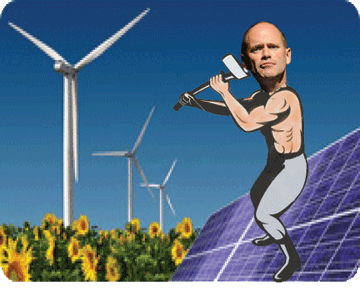
Energy experts say the Newman policy cocktail – a combination of state subsidies on electricity use, price freezes, tariff designs that add fixed costs and do not encourage peak demand reduction or energy efficiency, and his choice of demonising new technology rather than embracing it, will simply accelerate a spiral towards stranded assets rather than an efficient network.
Even the QCA got into the anti-renewable rhetoric late last week, suggesting in its press release that the increases were partly the result of the rising cost of renewable energy targets. But its own report tells us the opposite is true. The cost of the large scale target is steady (and might produce some benefit to the state if it bothered to actually built something), and the costs of the small scale scheme (rooftop solar PV and solar hot water) will fall by 17.1%, according to the QCA figures….. http://reneweconomy.com.au/2013/newman-playing-dangerous-game-of-solar-politics-21866
Queenslanders to get huge hike in electricity prices – but they can still go solar
 Electricity Bills In Queensland To Jump 21% http://www.energymatters.com.au/index.php?main_page=news_article&article_id=3608 25 Feb 13, Electricity bills in Queensland look set to rise again from July 1 for households and businesses; with low consumption households feeling the biggest effects.
A draft determination by the Queensland Competition Authority shows an increase in annual bills for average households on Tariff 11 of $253 a year.
Businesses in Queensland will bear the burden of a 12% – 16% rise.
The main components in the increase are related to network costs followed by retailer costs.
Households that have been particularly energy efficient will be punished under the proposed increases.
“Previously, the Tariff 11 service charge has been too low and the usage charge has been too high. So low-use customers have not been paying enough to
cover the costs of their supply and high-use customers have been paying more than the cost of their supply,” says the QCA
“This is changing, so that customers’ bills better reflect the costs of their electricity use. As a result, low consumption customers will see a high percentage increase in their bill as the fixed service fee is increased.”
The QCA is seeking feedback on the draft determination and its Final Determination will be released by the end of May 2013.
The added financial burden could see more households making the switch to solar; particularly among the 42,000 Queenslanders who were approved for the 44c feed in tariff last year; but are yet to install a system.
According to data from national solar provider Energy Matters, applicants that gained approval for the 44c feed in tariff last year could miss out on over $70,000 in financial benefits over the life of a 5kW solar power system if they fail to have an array installed by the deadline.
Energy Matters states applicants do not have to purchase their system from the solar company noted on the original application. With a rush on installation bookings expected to start soon, the company encourages applicants to call Energy Matters on 133 SUN (133 786) for further details.
For those who didn’t receive approval for the 44c, installing solar is still an effective way to reduce electricity bills. For example, Energy Matters states a 3kW system installed in Queensland can provide $1,066 – $1,470 in electricity bill savings annually.
Renewable energy yes! including household rooftop solar – says University of Queensland
Renewable energy critical for competitive Australian power system- University of Queensland, 22 Feb 13, An immediate investment in multiple energy technologies is vital for meeting carbon abatement targets and building a robust power system, a new study from the Global Change Institute at The University of Queensland has found.
• The resilience of Australia’s power system is currently poor (better only than India and South Africa) and is not compensated by low electricity costs.
• Even with a high carbon price, the power system is not on-track to cut emissions by 80%, in line Australia’s 2050 emissions targets*.
• There is no cost premium associated with shifting from ‘business-as-usual’ to renewable, distributed generation and carbon capture and storage. There is, however, evidence of a cost premium for shifting away from coal.
• Australia will benefit from investment in large-scale renewable energy projects to operate alongside coal in the foreseeable future and eventually replace the role of coal.
• Consumer action must not be overlooked and will be an integral part of any successful model, however an in-depth study into the effect of distributed generation (eg household rooftop solar panels) on the distribution network is urgent and overdue. ….. http://www.uq.edu.au/news/?article=25857
Delay for uranium mining in Queensland – it’s not economic
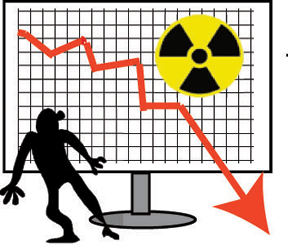 Mining uranium “a little time” away http://blogs.abc.net.au/queensland/2013/02/mining-uranium-a-little-time-away.html 04 February 2013 by Emma Cillekens Mining uranium in Queensland is still “a little time” away, according to the chair of a committee appointed by the State Government to assess best practice approaches to the mining.
The Uranium Implementation Committee toured Mount Isa late last week to speak to local authorities, mining companies and traditional owner groups about mining uranium.
The group also visited the last operating uranium mine in the state, Mary Kathleen mine (pictured), which closed in the early 80s.
Committee chair Paul Bell says there are still a couple of things that need to be considered before uranium mining can happen.
“There’s a challenge at the moment, the price [of uranium] is very low,” he said.
“Any application for a mining application approval will in itself take two to three years.”
The committee will spend three weeks working on recommendations and will present a report to the State Government next month.
1 This month

of the week – Australians for War Powers Reform (AWPR)
To see nuclear-related stories in greater depth and intensity
 Antinuclear