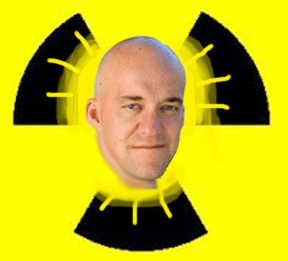
 Jim Green, 19 Feb 16 Tas Uni academic Barry Brook’s university webpage says that in 2005 he was listed as one of the “2000 Outstanding Scientists of the 21st Century” by the International Biographical Centre (IBC). But the IBC is a zero-credibility money making operation.
The WA Government’s Dept of Commerce ‘ScamNet’ website states: “The material promoting the International Biographical Centre creates a false impression about the credentials of the organisation. It also wrongly implies that the receiver of the letter has been picked through a special research process considering their work and qualifications.”
If there was any doubt about the IBC’s illegitimacy, one of Brook’s academic colleagues nominated a squeaky toy lobster and Prof. Lobster was accepted for inclusion as one of the ‘2000 Outstanding Scientists of the 21st Century’. And the IBC has accepted a nomination for Clive Palmer to be listed as one of the ‘2000 Outstanding Intellectuals of the 21st Century’. A ‘Medal of Intellect’ will be sent to Palmer on payment of a $240 fee.
Feel free to test the IBC’s credibility yourself … you’ll have no trouble getting the Wiggles or the Bananas in Pyjamas or Thomas the Tank Engine accepted as Outstanding Scientists or Outstanding Intellectuals.
Given that the illegitimacy of the IBC is beyond doubt, why does the IBC accolade remain on Brook’s university webpage?
Sources:
February 19, 2016
Posted by Christina Macpherson |
AUSTRALIA - NATIONAL, NUCLEAR ROYAL COMMISSION 2016, reference, secrets and lies |
2 Comments
 Jim Green, 19 Feb 16 Tas Uni academic Barry Brook’s university webpage says that in 2005 he was listed as one of the “2000 Outstanding Scientists of the 21st Century” by the International Biographical Centre (IBC). But the IBC is a zero-credibility money making operation.
The WA Government’s Dept of Commerce ‘ScamNet’ website states: “The material promoting the International Biographical Centre creates a false impression about the credentials of the organisation. It also wrongly implies that the receiver of the letter has been picked through a special research process considering their work and qualifications.”
If there was any doubt about the IBC’s illegitimacy, one of Brook’s academic colleagues nominated a squeaky toy lobster and Prof. Lobster was accepted for inclusion as one of the ‘2000 Outstanding Scientists of the 21st Century’. And the IBC has accepted a nomination for Clive Palmer to be listed as one of the ‘2000 Outstanding Intellectuals of the 21st Century’. A ‘Medal of Intellect’ will be sent to Palmer on payment of a $240 fee.
Feel free to test the IBC’s credibility yourself … you’ll have no trouble getting the Wiggles or the Bananas in Pyjamas or Thomas the Tank Engine accepted as Outstanding Scientists or Outstanding Intellectuals.
Given that the illegitimacy of the IBC is beyond doubt, why does the IBC accolade remain on Brook’s university webpage?
Sources:
February 19, 2016
Posted by Christina Macpherson |
NUCLEAR ROYAL COMMISSION 2016, reference, spinbuster |
Leave a comment
The endeavours of our scientists and engineers are needed in dealing with the many facets of climate challenge, including the transition to renewable energy, and they should be focused on this.
 Nuclear waste dump just another bad option — what about renewable energy? http://www.adelaidenow.com.au/news/opinion/nuclear-waste-dump-just-another-bad-option–what-about-renewable-energy/news-story/92f494cdde1dcae41481a45e5ac4f4ac February 18, 2016 John Willoughby The Advertiser SOUTH Australia’s Nuclear Fuel Cycle Royal Commission, in its tentative findings, has recommended avoiding some bad options: no nuclear power generation and no reprocessing or fuel leasing in the foreseeable future.
However, a bad option it found acceptable is allowing a proportion of the world’s most dangerous high-level nuclear waste to be transported to SA for long-term disposal. Continue reading →
February 19, 2016
Posted by Christina Macpherson |
NUCLEAR ROYAL COMMISSION 2016, South Australia, wastes |
1 Comment
Nuclear Fuel Cycle Royal Commission Tentative Findings – A Critique Dr Dennis Matthews (BSc Hon, PhD) 18 Feb 16 In supporting uranium mining the Commissioner states that post-decommissioning impacts are addressed by a regulator holding a financial security or bond but then admits that the state’s largest uranium mining project, Olympic Dam, is exempt from this requirement.
 The commissioner states “Without nuclear power generation, a used fuel reprocessing facility would not be needed in South Australia, nor would it be commercially viable.” He then goes on to say that it is therefore unnecessary to address the environmental and health risks of reprocessing. However, when it comes to discussing nuclear power for SA he says “It would be wise to plan now to ensure that nuclear power would be available should it be required”. The basis for not considering the environmental and health risks of reprocessing is therefore invalid.
In discussing the major nuclear power accidents at Three Mile Island, Chernobyl, and Fukushima the  commissioner disregards deaths that occur years after exposure to ionising radiation. The probability of such deaths may be calculated using the same data that is used in calculating allowable exposures to ionising radiation, which he accepts as justified on the basis of the precautionary principle. Like the nuclear industry in general, the Commissioner considers only deaths from high doses of ionising radiation, for which cause and effect are inescapable. Even in this case he neglects to include the deaths of those who were involved in removing highly radioactive debris from the reactor building. Slavish adherence to pro-nuclear propaganda suggests that the commissioner was far from objective.
Given the economic, environmental and health consequences of Three Mile Island, Chernobyl, and Fukushima it is hard to understand the commissioner’s conclusion that “The risk of nuclear accident should not of itself preclude consideration of nuclear power as a future electricity generation option”. 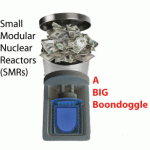 This callous disregard for the facts is frequently encountered in the arguments of pro-nuclear advocates.
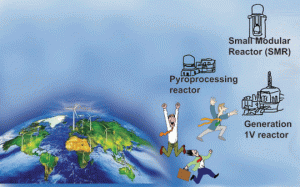
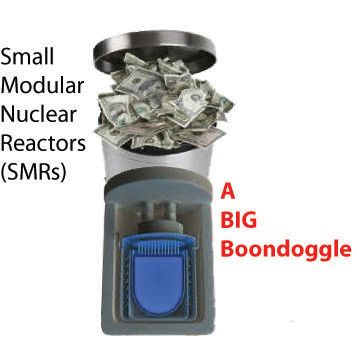
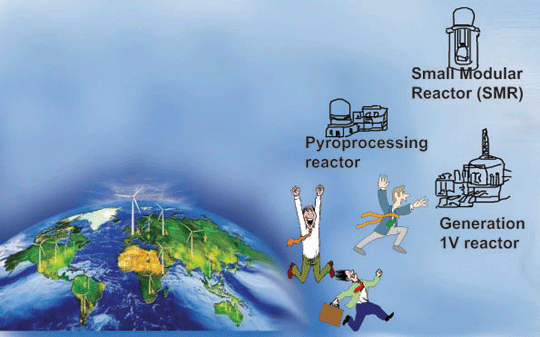
The Commissioner favours consideration of small modular nuclear reactors for SA.
Despite recent decreases in peak demand and the shift of peak demand to later in the day, the Commissioner claims that solar PV has had little effect on peak demand requirements.
The Commissioner claims “there is value in having nuclear as an option that can be readily implemented”.
In relation to nuclear waste importing, storage and disposal the Commissioner states that it would be necessary to develop an associated scientific research group focused on processes for nuclear waste “management, storage and disposal and on possible future use”. The latter presumably refers to reprocessing of used (or spent) fuel into new fuel.
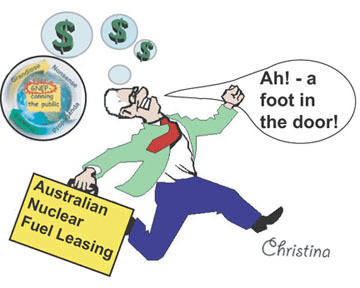
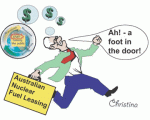 The reprocessing option is clearly spelt out in the section on fuel leasing.
“Fuel leasing based on an operating storage and disposal facility might resolve some of the significant economic barriers to new entrants seeking to provide global conversion, enrichment and fabrication services.”
“The decision to progress any uranium processing aspect of fuel leasing would predominantly be a commercial one.”
“A staged process to the development of any fuel leasing program would seem to have the
best prospects for success. Such a staged approach might involve: initially:
 a focus on storage and disposal of waste
second, the sale of uranium, with agreement to dispose of used fuel, to utilities  that have existing commercial arrangements for conversion, enrichment and fuel
  fabrication services
finally, the development of international partnerships to establish South Australian facilities undertaking 
 conversion, enrichment and fabrication, including
the participation of those using these services.”
Despite significant public and community opposition to uranium mining at Roxby Downs , Honeymoon and Beverley, for which neither public nor community consent was sought or obtained, the Commissioner claims “An  expansion of uranium mining would involve the continuation of a lawful activity” and that “No additional measures to further regulate community consent or community engagement with respect to new uranium mining projects appear required”.
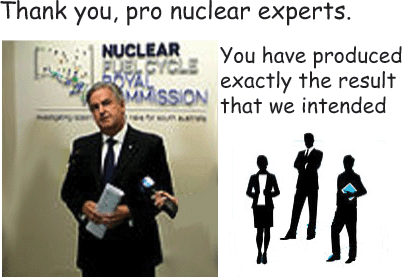
The Commissioner states “any progress towards an activity is based on a principle of negotiation in good faith on equal terms”. Given the heavily biased terms of reference of the Commission, the choice of pro-nuclear sympathiser as its chair, and the choice of committee stacked in favour of the nuclear industry then the commission failed the Commissioners own rules of community engagement.
The Commissioner states “There are existing regulatory mechanisms for the protection and preservation of heritage” but then goes on to point out, without any criticism or recommendations for remedial measures, that the largest uranium mining project in SA (the Olympic Dam Project) is excluded from these mechanisms.
The Commissioner correctly states, that in determining ionising radiation exposure, a precautionary approach is appropriate. His constant comparison of ionising radiation exposure due to uranium mining with that from background levels of ionising radiation is at odds with the precautionary principle. There is no evidence that exposure to background ionising radiation is safe. The implied suggestion that exposure to other sources of ionising is OK if it is comparable to that from background ionising radiation is misleading.
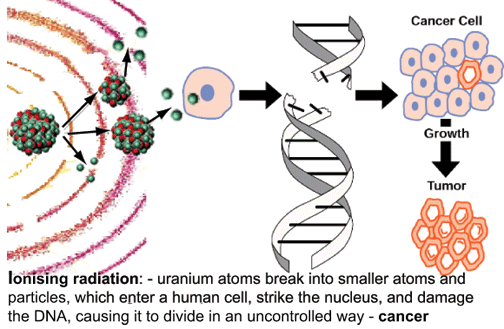
The Commissioner’s focus on acute radiation syndrome (ARS) due to relatively high levels of exposure to ionising radiation ignores the accepted scientific position that all levels of exposure are harmful, and it discards the precautionary principle which he claims to support. Just because, in cases of exposure that does not cause ARS, there is no known way of linking cause and effect does not mean that there is no effect. The scientific position is that the effect is proportional to the dose at all levels of exposure. The fact that the effects are not immediately obvious or (like asbestos and smoking) are manifest years after the exposure is no basis for ignoring them.
The fact that it is difficult to manufacture nuclear weapons from various sources of uranium and plutonium is no reason to discount the possibility as demonstrated by India’s use of Canadian low grade uranium to make a nuclear weapon.
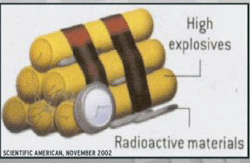
 There is no mention of the use of nuclear waste to make a conventional, non-nuclear, but highly radioactive, “dirty bomb”. Given the Commissioner’s support for importing thousands of tonnes of high level nuclear waste and the global expansion of radical, fanatical terrorist activities, this is a serious oversight.
On the issue of insurance for nuclear activities the Commissioner makes the telling remark that insurance in Australia is not  sufficient to cover the risks involved in an expanded nuclear industry and that “the state and federal governments would become insurers of last resort”. This, in effect, would be a large tax-payer funded subsidy to the nuclear industry. The Commissioner made no recommendation about changing this situation.
 The Commissioner notes that “building up a sufficient level of local engineering expertise requires time, commitment and advanced planning”. Such a level of nuclear engineering expertise would open the door to a wide variety of nuclear projects including, as we saw with the aborted 1969 Jervis Bay project in NSW, nuclear weapons production.
February 17, 2016
Posted by Christina Macpherson |
AUSTRALIA - NATIONAL, NUCLEAR ROYAL COMMISSION 2016, South Australia |
Leave a comment
Why would the world accept Australia’s offer to store nuclear waste? http://theconversation.com/why-would-the-world-accept-australias-offer-to-store-nuclear-waste-54742 Mark Diesendorf While acknowledging that nuclear electricity is not commercially viable in South Australia, the Royal Commission’s tentative findings give strong support to the extraordinary notion that the state should attempt to profit by storing high-level nuclear waste from countries that do have nuclear power.
The scheme envisages a combination of above-ground temporary storage in dry casks, together with storage in a permanent underground repository. In practice, almost all the imported waste would be stored initially in dry casks for several decades before being transferred to the proposed underground storage area, where they would have to be managed for hundreds of thousands of years.
I will examine each of the two storage systems separately.
Temporary above-ground storage
Hundreds of thousands of tonnes of high-level waste from nuclear power stations, both spent fuel rods and reprocessed waste, are in temporary storage around the world. They are “hot” in both temperature and radioactivity. Some are sitting in steel-lined concrete pools near reactors, while others are stored in so-called “dry casks”.
The idea that Australia could obtain a significant amount of this overseas waste for temporary storage in dry casks seems to be based on the dubious assumption that it would be cheaper for overseas countries to pay for shipping their dry casks to Australia for storage than to continue to store them where they are.
But it follows that if Australia could somehow offer an attractive price, then so could other countries with more experience in handling nuclear waste, as pointed out by the Australia Institute. The Royal Commission’s new findings do not reveal the cost of dry cask storage.
Permanent underground storage
The Royal Commission assumes that the “conservative baseline price” that could be received for permanent underground storage is A$1.75 million per tonne of heavy metal, including the operational cost. It is unclear whether this includes storage in dry casks for several decades. The report does not reveal the corresponding cost per tonne, although its bottom-line figures predict an extraordinary 77% undiscounted profit over the lifetime of the project.
These claimed huge profits are based on a long report by Jacobs & MCM, released just a week ago and which few people will have digested in full so far. Hardly any of the assumptions of this new report are mentioned by the Royal Commission’s tentative findings. In reality it is still unclear how much the proposed facility would cost to run, or what kind of return on investment it might create.
It is a heroic fantasy to imagine that Australia would finance and build a permanent underground nuclear waste repository when the United States, an established nuclear nation, has so far failed, and similar facilities in Sweden and Finland are still under construction. The United States spent US$13.5 billion on preparing its proposed site at Yucca Mountain, Nevada. Its estimated total cost rose to US$96 billion (in 1998 prices) before the project was scrapped by President Obama.
The Royal Commission discusses the alleged economic benefits of underground storage, while failing to acknowledge the economic risks of Australia paying huge capital and operating costs to manage high-level waste for hundreds of thousands of years by means of unproven technologies and short-lived social institutions.
Although storing waste temporarily in dry casks is technically relatively easy, building the permanent underground repository would be very expensive. Therefore, if this scheme were commenced by storing dry casks, it’s possible that the underground repository, which would not be needed for decades, would never be built.
Then South Australia (and Australian taxpayers) could be stuck with managing a huge number of dry casks far beyond their lifetimes. As the casks began to decay and release their contents, the financial burden on future generations, and the environmental and health risks, would be substantial.
February 17, 2016
Posted by Christina Macpherson |
AUSTRALIA - NATIONAL, NUCLEAR ROYAL COMMISSION 2016, South Australia |
Leave a comment
Despite what nuclear boosters tell us about wind and solar, numerous reports, including by the Australian Energy Market Operator, the French government, and various think tanks, say 100% renewable energy based largely around wind and solar is perfectly feasible, and will likely even reduce costs.
Nuclear commission findings spell more trouble for wind and solar in Australia REneweconomy, By Giles Parkinson on 15 February 2016 “………The Royal Commission has chosen to run with some of those myths, which is disappointing, but not surprising given that one of the biggest proponents is a web-site operated by one of the commissioners, Professor Barry Brook. A paper co-authored by Brook is repeatedly cited in the commission’s report and by pro-nuclear submissions to the commission.
Among these myths, promoted by Scarce on Monday, is the need for more peaking gas and imports in South Australia because of the growth in wind and solar. Actually, as has been pointed out repeatedly,South Australia now uses less peaking gas and less imports from Victoria than before it produced a lot of wind and solar.
The document also says that solar PV has had a negligible impact on peak demand in South Australia. Actually, it has had a significant impact on peak demand, pushing the peak from late afternoon and into the evening and made it smaller, to the benefit of the network in heat waves.
The royal commission document also says battery storage applications are not yet commercial. Actually, they are, and Ergon Energy has already rolled out dozens of 100kWh, utility-scale battery storage arrays, saying it reduces grid upgrade costs by one-third – with no subsidy. Continue reading →
February 17, 2016
Posted by Christina Macpherson |
AUSTRALIA - NATIONAL, energy, NUCLEAR ROYAL COMMISSION 2016 |
1 Comment
Karina Lester’s father was affected by the Maralinga atomic tests in the 1950s in outback SA and vowed she would fight to keep any dump out of Aboriginal communities.
“I want to urge all my Anangu representatives and also the wider Aboriginal community to be very actively involved in this and to speak up to tell their stories, because we all have a story to talk about how this nuclear [testing] has impacted on us,” she said.
“We’ve got cultural responsibilities and we’ve also got responsibilities to our next generation.
“It is very immoral and it’s catastrophic to be talking about waste. The waste is not going to end up in Adelaide — it will be remote South Australia.” – ABC News 15 Feb 16
February 15, 2016
Posted by Christina Macpherson |
aboriginal issues, NUCLEAR ROYAL COMMISSION 2016, South Australia |
Leave a comment
 The Age today reported on the South Australian Nuclear Fuel Chain Royal Commission. I guess we should be thankful that this news actually got into more than just the South Australian press and the corporate mouthpiece THE AUSTRALIAN.
Of course, this is in the Business section, not the major part of the paper. . After all, it’s not as if the question of importing radioactive trash is of concern to Australian sin general. Or is it?
Anyway – some of the contradictions, omissions and problems in the Royal Commission findings, as reported.
QUESTIONS
Optimism about money?. I really doubt that anyone has a clue about the long term costs of the 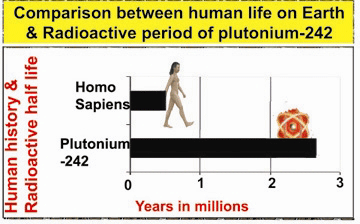
nuclear waste import plan.
“…….. waste disposal facility could deliver $5 billion in revenue annually for the first 30 years, and would be “highly profitable” because of strong demand from other countries……..
Mr Scarce said he had been conservative in his assumptions.
“I want to under-promise and over-deliver,” he said…..”
“Facility could be open in a decade“….Really?
“He [Scarce] said during the life of a nuclear storage facility, a net present value of profits of more than $51 billion had been calculated”. Why hasn’t some other country with nuclear expertise and experience grasped this opportunity?
The tax-payer will be up for huge costs?
“He [Scarce] recommended that such a facility be government owned.….. the facility would require a dedicated port facility, airport and rail freight line”. Who pays for all that?
OMISSIONS
“There are significant quantities of used fuel from nuclear reactors in temporary storage in the Asia-Pacific region and these quantities will grow ” -not a mention of the transport problems and dangers .
CONTRADICTIONS
“There’s always an opportunity if we dawdle that someone would take the competitive advantage away from us,” he [Scarce] said…
…..Mr Weatherill said.“The critical thing here is we don’t rush the process. There’s no doubt there’s some exciting possibilities for South Australia contained in the report”…… [this statement appears in the online version, but not in the print version]
February 15, 2016
Posted by Christina Macpherson |
AUSTRALIA - NATIONAL, media, NUCLEAR ROYAL COMMISSION 2016 |
1 Comment
Chris Murray 16 Feb 16 The issue of low level radiation is crucial to the nuclear debate. If the threshold/hormesis outliers are successful in their campaign, radiation protection limits will be raised and nuclear costs will fall dramatically.
It is unfortunate therefore that The Royal Commission is so economical with the truth on low level radiation. It specifically quotes WHO and UNSCEAR to paint a particular picture. The omission of very relevant material from the same sources does not inspire confidence in its findings. Although it states that “a precautionary approach is appropriate”, by minimizing the possible casualties from Chernobyl and Fukushima, it effectively dumps any such precautionary approach.
While UNSCEAR, citing uncertainties, refuses to give any estimates for the absolute number of casualties from Chernobyl, it does state that “”Although the numbers of cancers projected to be induced by radiation exposure after the accident are very small relative to the baseline cancer risk, THEY COULD BE SUBSTANTIAL IN ABSOLUTE TERMS”
(My emphasis – even a “very small” increase of say, 0.5%, in baseline risk would cause 5,000 extra cancers in a 5 million population, assuming normal cancer mortality of 20% of all deaths.)
Also unmentioned is that the WHO/Chernobyl Forum (of which UNSCEAR was a member) stated that
“The Expert Group concluded that there may be up to 4 000 additional cancer deaths among the three highest exposed groups over their lifetime (240 000 liquidators; 116 000 evacuees and the 270 000 residents of the SCZs)”
http://www.who.int/ionizing_radiation/chernobyl/backgrounder/en/
(this is for the most exposed areas alone)
Also ignored is that the WHO/CF, while acknowledging considerable uncertainties (which can lead to underestimation of effects as easily as overestimation), estimated a possible further 5,000 fatal cancers from the most contaminated areas in wider Belarus, Russia and Ukraine, giving a total of 9,000.
“Predictions, generally based on the LNT model, suggest that up to 5 000 additional cancer deaths may occur in this population from radiation exposure, “
http://www.who.int/ionizing_radiation/chernobyl/backgrounder/en/
Nor is there any mention that even UNSCEAR accepts a proven risk down to 10 mSv:
“Risk estimates vary with age, with younger people generally being more sensitive; studies of in utero radiation exposures show that the foetus is particularly sensitive, with elevated risk being detected at doses of 10 mSv and above.”
Also ignored is that UNSCEAR, in its recent Fukushima report, no longer uses a DDREF (Dose and Dose Rate Effectiveness Factor). No DDREF means that the 9,000 could legitimately be doubled to 18,000. And again, this is from the most contaminated areas. The fallout and its effects did not stop there, unless one is claiming a definite threshold, an ideological position rejected again and again by the scientific establishment (See the recent US EPA statement athttp://www.regulations.gov/#!documentDetail;D=NRC-2015-0057-0436 ).
Again, unmentioned in the report, the WHO/CF admits that “Chernobyl may also cause cancers in Europe outside Belarus, the Russian Federation and Ukraine.“
The Commission seems to have adopted the nuclear industry spin that low level radiation is of no concern if it’s comparable to background radiation. This is like saying it’s ok to deliberately electrocute people so long as the numbers are comparable to those killed by “natural electricity” ie lightning. The Commission seems to have no awareness that the BEIR VII committee, the ICRP, the 21st H L Gray conference etc. examined the “evidence” for the claim that background radiation was harmless and found it wanting, the studies either being ecological or lacking statistical power.
Likewise the Commission seem unaware that a recent study – A record-based case-control study of natural background radiation and the incidence of childhood leukaemia and other cancers in Great Britain during 1980-2006 – has shown that background radiation may be responsible for 12% of childhood leukaemias. And if it’s responsible for leukaemia, it is almost certainly responsible for other cancers.
One of the authors of this study is Richard Wakeford, the former BNFL principal research sciencist, who can hardly be accused of being an unscientific tree-hugger, an anti-nuke idealogue, a Greenpeace or coal industry shill, etc. etc.
Shockingly, none of this, much from the Commission’s own sources, is mentioned. Instead it hides behind “ongoing scientific debate”, and cherrypicks the most reassuring quotes.
February 15, 2016
Posted by Christina Macpherson |
AUSTRALIA - NATIONAL, health, NUCLEAR ROYAL COMMISSION 2016, South Australia |
1 Comment
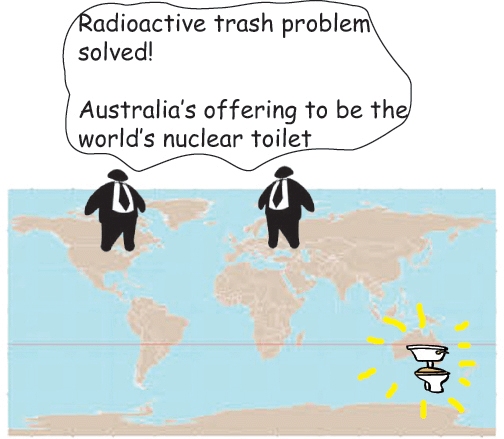
SA nuclear inquiry backs waste dump South Australia should take the world’s nuclear waste in
 exchange for billions of dollars in revenue and thousands of jobs, the state’s nuclear royal commission has found.
But it would not be viable for SA to host a nuclear power plant or to expand into fuel processing in the foreseeable future.
Former governor Kevin Scarce on Monday handed down the royal commission’s initial findings after months of analysis and public consultation.
His inquiry has strongly backed SA taking nuclear waste, a position that is sure to attract fierce opposition from green groups. Under the model proposed by the commission, an above-ground storage site would initially host nuclear waste in “casks” made of metal or concrete.
The waste would then be stored deep underground in purpose-built canisters.
A storage and disposal facility with a capacity of 138,000 tonnes – or about 13 per cent of the world’s projected used fuel inventory – would generate more than $257 billion in revenue over its 120-year lifespan.
Total costs for the facility would reach $145 billion, including the construction of a dedicated port facility, airport and freight rail line, independent modelling shows.
The report assumes it would take 25 years to build the facility, with employment peaking at up to 5000 jobs before tailing off to 600 during operations.
A waste and storage facility could generate more than $5 billion in annual revenue before the yearly waste intake peaks after 30 years and concludes after 70 years.
The commission has also proposed the creation of a state wealth fund in which all profits and a portion of gross revenue would be invested.
Mr Scarce said waste storage presented significant opportunities for the SA economy.
……Any move to embrace nuclear storage would require changes to state and federal legislation.
The commission found that it would not be commercially viable for SA to generate electricity from a nuclear power plant or develop uranium processing facilities.
But the state should still prepare for the possibility of sourcing nuclear power……..http://www.9news.com.au/national/2016/02/15/03/33/sa-nuclear-inquiry-to-present-findings
February 15, 2016
Posted by Christina Macpherson |
NUCLEAR ROYAL COMMISSION 2016 |
1 Comment
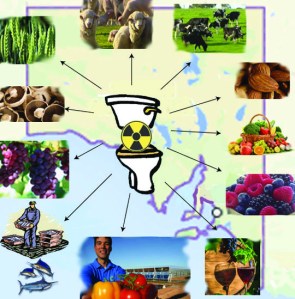 Today’s Royal Commission ‘Tentative Findings’ report clearly states that nuclear power will not be economically viable. It also says that uranium conversion, uranium enrichment and nuclear fuel reprocessing are not economically viable. The state’s peak environmental body Conservation Council SA welcomes these findings.
However the report says that South Australia should consider importing international nuclear waste.
“We have had the Royal Commission, now any nuclear waste dump needs South Australia’s permission”, says Conservation SA Chief Executive Craig Wilkins.
“This is a decision for all South Australians. The issue of genuine acceptance and consent is absolutely critical.
“If we pursue a nuclear waste dump path, we are saying “the best we can do is accept the worst the world has got”. I honestly think we can do better than that.”
An opinion poll commissioned by The Advertiser last year found that less than one in six (15.7%) South Australians support a nuclear waste dump in SA.*
“Now comes the hard part. We’ve had a technocratic, distant process so far – now it turns to real people, real places and real values,” says Mr Wilkins.
“The Royal Commission presents an optimistic view of potential profits from offering Australia as the world’s nuclear waste dump. The Commission acknowledges that nuclear waste needs to be isolated from the environment for “many hundreds of thousands of years” yet there is no attempt to cost the management of waste over those timeframes.
“If there’s one thing we know, the nuclear industry is expert at overstating the benefits and radically understating the costs and risks.
“Ultimately, we think it’s essential that all current and future South Australians should have the freedom to choose. Saying yes to nuclear makes that choice forever, there is no going back.”
February 15, 2016
Posted by Christina Macpherson |
NUCLEAR ROYAL COMMISSION 2016, politics, South Australia |
Leave a comment
The tentative findings of the Royal Commission into the Nuclear Fuel Cycle, released this morning tell us what we already know, according to Greens SA Parliamentary Leader, Mark Parnell MLC.
As predicted when the Royal Commission was established – this process is all about softening South Australians up to be the World’s nuclear waste dump.
We’ve known for years that the uranium reprocessing market is “uncertain” and that there is “no opportunity for commercial development” [Royal Commission quotes]. We’ve also known for decades that nuclear power for SA is “not commercially viable … in the foreseeable future” [Royal Commission quotes].
“The outcome of the Royal Commission isn’t at all surprising. The Greens knew that the most likely result of this process was to support South Australia becoming the World’s nuclear waste dump.
However, the Royal Commission’s tentative findings on the nuclear waste dump are based on dubious economics, heroic assumptions and a big dose of guess work. The Commission has identified a problem that lasts hundreds of thousands of years and proposed a solution with income that lasts just a few decades, but with costs lasting virtually forever. If anything goes wrong in the future – we’re on our own.
“The Greens are calling on the Weatherill Labor Government to protect our State’s reputation and not leave our descendants to deal with a toxic future as their legacy.
Previous State Labor Premier Mike Rann fought off a Liberal plan for a national nuclear waste dump in South Australia last decade. The current proposals are far more sinister and dangerous because they involve South Australia taking the most dangerous radioactive waste on the planet.
South Australians will now need to ask themselves and their politicians: “Is this the best future that we can aspire to?”
February 15, 2016
Posted by Christina Macpherson |
NUCLEAR ROYAL COMMISSION 2016, politics, South Australia |
Leave a comment
 MR JACOBI: Ms Skarbek is the chief executive officer and executive director of Climate Works Australia since its inception in 2009 and she’s been leading the organisations working in analysing emissions reductions opportunities and partnering with business and government in unblocking barriers to their implementation. She’s also a director of the Clean Energy Finance Corporation, a trustee of the Sustainable Melbourne Fund, a member of the Australian Government’s Energy White Paper Reference Panel, and the Grattan Institute Energy Program Reference Panel. …..
She’s principally to give evidence today in relation to a report published by Climate Works Australia in September 2014 entitled Pathways to Decarbonisation in 2005, How Australia Can Prosper in a Low Carbon World…….
 Anna Skarbek : Extract of evidence given at Nuclear Royal Commission Hearing 9 Sept 15 “…Based on today’s estimates, the real question is: what are the technologies that you need in the 2040s, after we’ve had the 2030s, where renewables have become the majority share? What we find is that there’s still a little bit of coal in the system that you see. It’s begun to retire by 2030, but it’s not all gone. So then the question is: what replaces that baseload? What we find is that renewables can do more than half of the system, based on, if you like, current technologies and management. So demand management, weather forecasting, allows the intermittent sources of electricity to be managed quite successfully for over half, up to around two‑thirds, of the electricity grid…….
it was striking to us in doing this work how blessed Australia is for options in terms of transitioning to a low carbon economy.
We’ve modelled these three scenarios because we could be a 100 per cent renewable powered economy if we wanted to be……..
I see from how rapidly renewable energy technology costs have fallen that they often outperform what the estimate of future costs on paper today says. So it’s possible that renewable costs could fall further than what we have published in this report because past evidence has suggested that’s certainly been the case historically. In that case, renewables would become more competitive than the nuclear and the CCS options that we’ve looked at, unless those technologies also fell further…..”http://nuclearrc.sa.gov.au/videos/climate-change-energy-policy-992015-11am/
February 15, 2016
Posted by Christina Macpherson |
NUCLEAR ROYAL COMMISSION 2016 |
Leave a comment
Royal Commission in to nuclear power for SA says it’s not commercially viable for now The Advertiser 15 Feb 16 Business Editor Christopher Russell NUCLEAR power for
electricity in South Australia is not commercially viable at the moment, the royal commission says…….“It would be wise to plan now to ensure that nuclear power would be available should it be required.”…….
The commission said nuclear power plants were “very complex systems designed and operated by humans, who can make mistakes”.
It warns that there can be no guarantee there will never be an accident but goes on to say “the risk of nuclear accident should not of itself preclude consideration of nuclear power as a future electricity generation option”.
The commission considered the three major international nuclear accidents – Fukushima Daiichi in Japan in 2011, Chernobyl in the Ukraine in 1986 and Three Mile Island in the US in 1979. It said each accident had been thoroughly investigated, leading to lessons which have been applied to enhance safety.
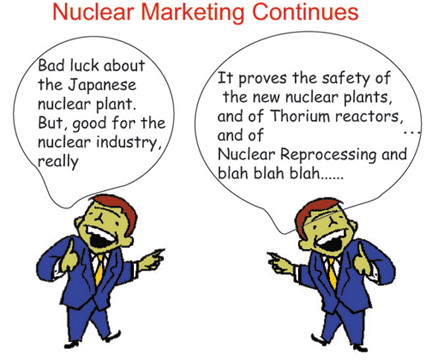
Commissioner Kevin Scarce said safety was paramount but successful risk management was not beyond SA’s capability. “We believe with the new technology developed since Fukushima, with appropriate regulatory oversight, that nuclear power should not be automatically ignored as a future generation technology,” he said.
In addition to receiving submissions and hearing from expert witnesses, the royal commission contracted two professional reports into the viability of nuclear power in SA.
Estimates of costs and a possible business case were studied by consultants WSP/Parsons Brinckerhoff.Separately DGA Consulting/Carisway looked at how nuclear power plant in SA could be linked in with the national electricity market which is supplied by both fossil fuel and renewable sources.
The reports found demand in SA’s electricity market was in decline which would work against nuclear power……
The commission heard evidence about Generation IV reactors which use a different cooling mechanism and are able to take nuclear waste from earlier generation reactors……
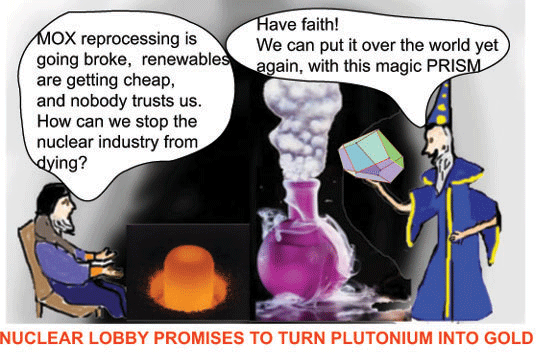
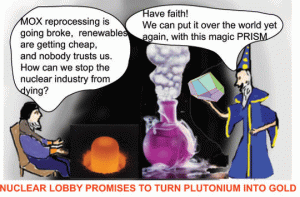 The PRISM – or Power Reactor Innovative Small Module – employs the latest technology but is still at an experimental phase.
Because this technology was currently unproven, the commission saw it as a future possibility and was not in favour of SA being the testbed or a first of a kind technology. http://www.adelaidenow.com.au/business/royal-commission-in-to-nuclear-power-for-sa-says-its-not-commercially-viable-for-now/news-story/41b42ca6e2127a3f285005f1e3f61315
February 15, 2016
Posted by Christina Macpherson |
AUSTRALIA - NATIONAL, NUCLEAR ROYAL COMMISSION 2016, South Australia |
Leave a comment
Friends of the Earth anti-nuclear campaigner Dr Jim Green said the contents of today’s findings were a “foregone conclusion” accusing the commission of bias.
“We expect that [the findings] will be mostly interested in the idea of making money out of importing high-level nuclear waste,” he said.
Professor Ian Lowe: – “if the royal commission sticks to the facts and what’s proven, I think they’ll inevitably conclude there’s not a strong case for South Australia getting heavily involved in the nuclear industry,”
 Nuclear dump tipped for South Australia amid ‘desperate’ times, ABC News 15 Feb 16
South Australia’s nuclear royal commission is set to release its tentative findings this morning, with experts from both sides of the debate predicting an outcome in favour of a nuclear dump………The issue has long stirred emotions in South Australia, with former premier Mike Rann and former prime minister John Howard at odds over a nuclear waste dump at Woomera for six years before the proposal was ultimately scrapped in 2004.
Current Premier Jay Weatherill is more receptive to the idea and set up the royal commission, saying there were economic opportunities in the mining, enrichment, energy and storage phases of the fuel cycle.
Flinders University associate professor of politics Haydon Manning said the Premier was looking for political gains as the state struggled with unemployment.
“If you understand the mood of South Australia, there is a degree of desperation,” Mr Manning said…….. Continue reading →
February 15, 2016
Posted by Christina Macpherson |
NUCLEAR ROYAL COMMISSION 2016 |
Leave a comment








 Antinuclear