#NuclearCommissionSA moves on to phase about overturning Australia’s federal law on waste dumping
 Scarce to meet pro-nuke chief scientist as conclusions emerge. IN
  Daily, Tom Richardson 10 Dec 15 “…….Nuclear royal commissioner Kevin Scarce has indicated that some of his inquiry’s terms of reference may not be viable, as the commission prepares to wrap up its major phase of evidence-gathering.
Scarce will next week meet Australia’s new chief scientist Dr Alan Finkel, a nuclear power advocate.
“He’s got considerable experience in the industry, (so) we’re going across to talk with him about nuclear issues from a national perspective,” Scarce said.
“I think it’s important that we’re starting to see a national debate of the issue … because there’s federal legislation that needs to be changed as well as state legislation, were we to proceed.”
South Australia Nuclear Fuel Chain Royal Commission quietly spinning to rural SA
 It’s hard to keep up with developments in the South Australian Nuclear Fuel Chain Royal Commission.
On the one hand, as Kevin Scarce has recently revealed, the first move for the nuclear lobby is to get rid of Australia’s national legislation against setting up a nuclear waste dump. (There is special legislation allowing only the Lucas Height reprocessed nuclear wastes to be deposited)
On the other hand, the Royal Commission is keeping a very low profile, nationally.
Do they think that rural South Australia is stupid? Quietly quietly, the Royal Commission is doing its propaganda bit in rural centres – at Port Pirie Yacht club (3/12), at Port Lincoln and Whyalla this week.
Former Santos CEO warns on the diseconomics of nuclear operations in Australia
 x-Santos CEO says megaprojects tough in Aust and nuclear needs upfront revenue December 10, 2015, SMH, Simon Evans An Australian nuclear industry would have to overcome very high construction costs and would only be built if there is certainty beforehand that it can generate secure revenue over a long period, former Santos chief executive David Knox said.
Mr Knox said that assuming the construction costs of overseas megaprojects can be directly translated to be similar in Australia is fraught with danger. That’s because the logistics, large distances, higher labour costs and finding the right skilled workers makes it more challenging.
“This can be a trap, of course,” Mr Knox told South Australia’s royal commission into the nuclear industry on Thursday.
“The whole logistics exercise of doing a megaproject in Australia does make it more challenging.”
He said the large geographic distances from specialist manufacturers of equipment offshore, the need to import certain levels of specialist expertise and skills, and the higher costs of labour are influencing factors. He gave the example of an Australian worker costing an overall $100 an hour, compared with $50 an hour for a Gulf of Mexico project in the northern hemisphere.
He emphasised that Santos had no wish to enter the nuclear industry, but he was giving evidence on the broad issue of building large infrastructure projects and the potential pitfalls……
A nuclear project would need to demonstrate at the start that it could generate revenue for a long time, similar to the LNG contracts that Santos had signed, which lasted for 20 years……..
The head of the nuclear royal commission, Kevin Scarce, is due to hand down preliminary findings in February, ahead of a final report in May 2016, on whether South Australia should expand into nuclear waste storage, enrichment and power generation……. http://www.smh.com.au/business/exsantos-ceo-says-megaprojects-tough-in-aust-and-nuclear-needs-upfront-revenue-20151209-gljwl0.html#ixzz3twyrGFxv
Nuclear Royal Commission blocks lessons learned from Maralinga
 The carefully engineered terms of reference for the Royal Commission into the Nuclear Fuel Cycle in South Australia are being used to block a thorough investigation of the ongoing effects of radiation from the fallout of the Maralinga bomb test on Indigenous communities across South Australia. This is the latest example of Kevin Scarce and the Royal Commission ignoring and disrespecting Aboriginal people. He can expect fierce resistance from Aboriginal people in the firing line from plans to dump high-level nuclear waste in South Australia and other plans to expand the state’s role in the nuclear industry.
Ms Rosemary Lester, a second generation survivor of the Maralinga atomic tests, met with Commissioner Scarce today, and asked him whether he would be making comment on the effects of radiation on Indigenous communities from the Maralinga bomb tests. The Commissioner said, ‘I’ll be reporting only on the effects on the entire community from the nuclear fuel cycle’. He stated that the history and effects of the Maralinga tests were outside the scope of the Commission’s terms of reference saying; ‘Issues of Maralinga are not linked to the terms of reference that I have’.
However, it is argued by Ms Lester, that a closer examination of the terms of reference require that the Commission enquires into the risks and opportunities associated with processing, management, storage and disposal of waste and that it includes an inquiry into the full impact of these on the South Australian community (incorporating regional, remote and Aboriginal communities) including potential impacts on health and safety. Moreover, the terms of reference clearly state that “consideration should be given, as appropriate, to their future impact…” Ms Lester argues that the Inquiry must investigate and consider Maralinga as a major incident of radiation exposure in South Australia that affected all Australians, especially remote Indigenous communities living across the Maralinga Tjarutja region, and that irreversible contamination continues to degrade the environment.
Leaving aside semantic interpretations of the terms of reference, there is unfinished business from Maralinga. It is a disgrace that Commissioner Scarce refuses to investigate these issues and it is a disgrace that the SA Government wants to increase radiological risks – risks that impact disproportionately on Aboriginal communities – when the health and environmental issues from Maralinga remain unresolved.
When pressed about the effects on Indigenous communities of the Ranger Uranium Mine in Northern Territory as a result of leaks and mismanagement of the waste storage, his response was that “The situation in Ranger is very different to other sites in South Australia”. Ms Lester says, “Irrespective of where these catastrophic incidents occurred, it is critically important that the universal lessons from such incidents are recognised and should form a central focus of the Commission’s work. It is clear that the dangers inherent in uranium and its use are well within this Commission’s terms of reference. It seems curious that the Commissioner has gone to great lengths to travel and inquire into nuclear sites across the world, including Fukushima and Scandinavia, and yet will not acknowledge the critical relevance of the Ranger experience.”
Rose Lester continues:
“The very narrow and selective interpretations of the Commission’s terms of reference are at best disingenuous and at worst another example of nuclear racism. This interpretation ignores the critical issues of the mismanagement and inability to safely dispose of radioactive waste. By adopting a legalistic approach to the terms of reference the Commissioner ignores the spirit that underpins the Inquiry. It is critical, and within the Commission’s scope, to focus on the risks associated with the management, storage and disposal of nuclear waste.”
#NuclearCommissionSAust: expert recommends medical nuclear waste to be stored at LOCAL level, not centralised dump
 Nuclear waste best stored locally, SA royal commission to be told by medical researcher, ABC News 3 Dec 15 By Nicola Gage Local disposal of nuclear waste in South Australia would be the best option for medical facilities and research, a radiation oncology researcher says.
Key points:
- Radiation researcher says medical waste should be stored locally
- Sending SA nuclear waste to Lucas Heights NSW is expensive, she says
- SA researchers could make use of some waste stored locally at a central facility
Professor Eva Bezak from the University of South Australia will give her evidence today to the state’s royal commission into the nuclear fuel cycle…..
Professor Bezak said South Australia’s nuclear waste currently was stored at the state’s hospitals and universities. She said it was expensive to send waste to New South Wales for storage at a facility at Lucas Heights.
“If we want to get rid of the waste in South Australia at the moment, we basically have to pay other companies for services to remove the waste and store it elsewhere,” she said…….
Professor Bezak said she hoped there would be a measured community response to the royal commission’s findings, with its final report due next May. “We should be applying science, common sense, we should be looking at the needs of the society,” she said.”We should be looking at what is the best way to safely produce the isotopes and to safely store any radioactive waste.”
The royal commission’s public access sessions will continue until the middle of this month and some early findings are expected to be released in February.
A fourth round of regional community meetings is currently being held by the royal commission, at Renmark, Berri and Port Pirie. http://www.abc.net.au/news/2015-12-03/nuclear-medical-waste-best-stored-locally-sa-researcher-says/6996626
Uranium enrichment a severe nuclear weapons proliferation risk
Uranium enrichment akin to “bomb starter kits”: IN Daily 3 Dec 15 A former federal Foreign Minister has warned South Australia’s nuclear royal commission against pursuing domestic enrichment, saying the technology was akin to “bomb starter kits”. Gareth Evans, who was Labor’s Foreign Minister in the 1980s and ‘90s and later Deputy Leader of the party, told a public hearing of the commission today there was “no good reason at all for Australia to go down the enrichment path”, arguing instead that to “actively foreswear that path … would be a positive contribution”.
He said there were “very obvious proliferation risks associated with allowing any state to develop its own enrichment capability, because of the obvious reality that the technology required is … exactly the same technology that’s involved in enriching up to weapons grade”.
“Once you get into that game, you are in the business of having bomb starter kits,” he said, observing that “a world that’s anxious to avoid proliferation … ought to be anxious to avoid further spread of bomb starter kits”.
He also questioned the commercial viability of enrichment without a significant number of domestic reactors.http://indaily.com.au/news/local/2015/12/02/uranium-enrichment-akin-to-bomb-starter-kits-gareth-evans/
Royal Commission hears that nuclear is a poor solution to Climate Change
 SA NUCLEAR FUEL CYCLE ROYAL COMMISSION PROFESSOR HENRY SOKOLSKI, The Nonproliferation Policy Education Centre TRANSCRIPT OF PROCEEDINGS ADELAIDE, 25 NOVEMBER 2015 DAY 27
excerpt:
COMMISSIONER: We had it put to us that nuclear power generation might be the saviour in terms of climate change. Would you add that to your economic analysis of light-water reactors in terms of accepting their development?
PROFESSOR SOKOLSKI: I think I would not, and I’ll tell you why. This is a topic which has been debated very extensively here in the States and as a result, the folks promoting nuclear power and the folks who are against nuclear power have gotten focused on very, very detailed analytical models. The best, or I should say the one used the most, is put out by an auditing firm called McKenzie. This model has been used by Greenpeace analysts and the largest 25 merchant utility utilising nuclear power, Epsilon, and they both use this model and they both agree that it’s a good model, and this model tells you that you should do about ten other things first if you’re serious about reducing carbon before you buy a new power reactor. That strikes me as very, very interesting and as positive.
More recently, I think you can read an article that was put out by Chris Buckley in the New York Times, and he makes the case that others do, that China must go with nuclear to reduce its carbon footprint. But he repeats the claim by the government of China that at most by 2030 if every one of the 35 reactors they built was built on time, which will be a remarkable achievement, they will only have 10 per cent of their electricity generation supplied by nuclear. The rest will likely be fossil fuels. I think this tells you how far you can go with nuclear. First, not very and second, there are quicker ways to reduce carbon that are cheaper.
Mostly it has to do with management of consumption which is a fancy word or phrase for turning the lights off more regularly and the second thing is doing natural gas substitutions for coal. Those are your quickest, cheapest ways to most dramatically reduce carbon and that is the project probably of the next 45 three decades. That is where you will make your advances. Also grid……to me http://nuclearrc.sa.gov.au/app/uploads/mp/files/videos/files/151125-topic-16-day-3-transcript.v1.pdf
#NuclearCommissionSAust on HIGH LEVEL WASTE STORAGE AND DISPOSAL
HIGH LEVEL WASTE STORAGE AND DISPOSAL
SA NUCLEAR FUEL CYCLE ROYAL COMMISSION SPEAKERS: DR MARK NUTT Argonne National Laborator WEDNESDAY, 25 NOVEMBER 2015 DAY 27 – excerpts from transcript
“……COMMISSIONER: can you tell us where the current US plans are for a high-level waste facility?
DR NUTT: As of right now, I would say they’re a little bit uncertain……So right now it’s really doing groundwork activity, open storage and disposal, to essentially be ready for when a decision is made to proceed with national policy towards disposal and storage. [ed: USA doesn’t know what to do with the wastes]
….DR NUTT: In terms of low-level waste generation it is probably – it is the biggest contributor. We have 100 – roughly 100 operating reactors that – the maintenance of the reactors, the clean up of the cooling systems all generate low-level waste that has to be disposed of. There are smaller contributions 45 from medical, industrial applications of radioactive materials that then become .SA Nuclear 25.11.15 P-1460 Spark and Cannon low-level waste. So by far in terms of volume it’s the nuclear industry that dominates the low-level waste disposal….. [ed: mdical wastes are not the problem, as ANSTO pretends]
…….it’s this inter-generational equity that people of today are gathering the benefits from nuclear electricity or nuclear energy and should deal with the problems of today and not pass the problems down…..[nuclear industry pretend to care about future generations, but no thought of stopping producing radioactive trash]
…there is a general consensus that it’s indeed temporary, that the ultimate 35 solution should be disposition of it in a geologic repository. There may be – there is countries that are considering fuel cycles where you might reprocess and recycle materials back to the reactor but either way you are going to generate high-level waste that would need to be disposed of. [ed: so new reactors that supposedly ‘eat wastes’ still produce wastes]
….We’ve gone towards interim dry storage at the reactor sites because all of the spent fuel pools for the US fleet are essentially full….[ waste pools full BUT THEY STILL KEEP MAKING THE STUFF!]
COMMISSIONER: Can I just pick up on the dry storage Dr Nutt? What sort of studies have been conducted in the US to look at the longevity of these dry storage casks and is there a view about – conservative view about how long they will last? S
R NUTT: I don’t – no one has done a study to put a – what I’ll call a line in the sand for how long they can last. Our regulatory framework allows storage up to 60 years, dry storage. We have studies underway within the Department of Energy’s programme, the Electric Power Research Institute which is our utilities research arm. It’s also investigating various aspects associated with 15 extended storage. The Electric Power Research Institute runs a group called the Extend Storage Collaboration Project which is involved in – a number of countries are involved with it that are dealing with the same issues that we are. So there is a lot of work going on looking at extended storage and what it entails. There has been several gap analyses done to identify what the key 20 issues are and the R&D’s under way to try to resolve those, so that there is confidence in extended storage. (there seems no reason for this confidence: sound like blind faith]
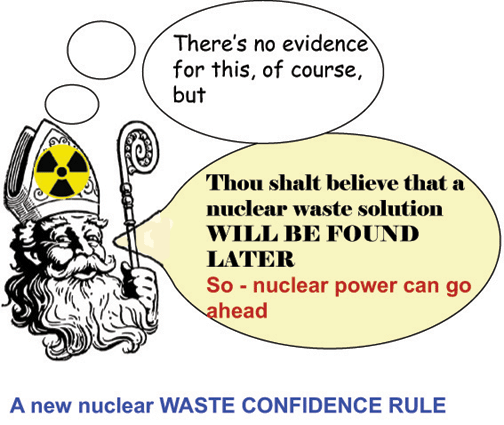
… When you get in to disposals, where I believe things get a little bit different because you are 20 dealing with long timeframes, you’re dealing with geologic systems, you are a large – sometimes large areas or footprints for the disposal facility and it leads to a little different type of safety case that one needs to consider to help build confidence in the safety of – the long term safety of the facility……[means they’ve got to convince the public somehow?]
DR NUTT: I’ll say it’s not possible to validate the long-term disposal models in the traditional sense. In that you can’t do an experiment and then run the 30 model and validate the experiment for the repository itself. You can do a variety of techniques to again demonstrate your confidence in the models and their ability to reasonably predict or estimate exposures out in the future…[ that doesn’t make ME feel confident]
Dr Edwin Lyman: Direct nuclear waste disposal is best: pyroreprocessing has dangers
 In the second part of his evidence to South Australia’s Nuclear Royal Commission, Dr Lyman explains that direct disposal is the safest and the most prudent approach for nuclear power. In recycling, as in pyroreprocessing, the risks outweigh the benefits.
Dr Lyman has studied pyroreprocessing in great detail. The fact that its products are highly radioactive does not act to deter thieves, especially those aiming to use these products for weapons proliferation.
Also, “the IEA is still struggling to provide even technical approaches for how you would get weapons grade accountancy in pyroprocessing, and that’s a great concern”……”Many minor actinides that would be in the pyroprocessing product are also weapons useable “… “It’s also easy, if that combination were to be stolen, to separate out plutonium from the minor actinides”.
Lyman describes the pyroreprocessing process as an “unmanageable enterprise”. The United States decided not to pursue re-processing and fast reactors in the 1970s, for these very same risks of terrorism and weapons proliferation.
SA NUCLEAR FUEL CYCLE ROYAL COMMISSION DR EDWIN LYMAN, Union of Concerned Scientists TRANSCRIPT OF PROCEEDINGS ADELAIDE 7.30 AM, TUESDAY, 17 NOVEMBER 2015 DAY 23
The Commission’s first witness today, Dr Edwin Lyman, is a senior scientist in the global security program at the Union of Concerned Scientists in the United States. His areas of interests include nuclear proliferation, terrorism and nuclear power safety and security, and he’s published articles in a number of 5 journals and magazines on these topics. Dr Lyman is a member of the Institute of Nuclear Materials Management and has given evidence before the US Congress and Nuclear Regulatory Commission, the NRC, on multiple occasions. 10 Prior to joining the Union of Concerned Scientists, Dr Lyman was president of the Nuclear Control Institute, the CI, in Washington, an organisation concerned with nuclear proliferation. The Commission calls Dr Edwin Lyman……..
The transcript of Dr Lyman’s interview can be read at http://nuclearrc.sa.gov.au/app/uploads/mp/files/videos/files/151117-topic-14-day-1-transcript-full.v5.pdf
Dr Edwin Lyman at Nuclear Royal Commission, speaks on waste transport problems.
Dr Lyman’s evidence can be pretty heavy going for the non technical reader. First, he explained safety problems in standards for transportation casks for land or sea shipment of spent fuel, high-level radioactive waste and specially with materials like plutonium or plutonium oxide. These standards have not been updated over many decades, and the USA Nuclear Regulatory Commission (NRC) has not yet carried out tests intended to address this problem.
If a transport package of radioactive material is lost in the ocean, it could lead to significant long term contamination, if the package is not retrieved.
With increased transport, and speed of transport, of radioactive wastes, the risk of such accidents is increased, and the NRC would have confidence in the current standard for transporting wastes.
Apart from accidents, the other big danger is terrorism.
SA NUCLEAR FUEL CYCLE ROYAL COMMISSION DR EDWIN LYMAN, Union of Concerned Scientists TRANSCRIPT OF PROCEEDINGS ADELAIDE 7.30 AM, TUESDAY, 17 NOVEMBER 2015 DAY 23
The Commission’s first witness today, Dr Edwin Lyman, is a senior scientist in the global security program at the Union of Concerned Scientists in the United States. His areas of interests include nuclear proliferation, terrorism and nuclear power safety and security, and he’s published articles in a number of 5 journals and magazines on these topics. Dr Lyman is a member of the Institute of Nuclear Materials Management and has given evidence before the US Congress and Nuclear Regulatory Commission, the NRC, on multiple occasions. 10 Prior to joining the Union of Concerned Scientists, Dr Lyman was president of the Nuclear Control Institute, the CI, in Washington, an organisation concerned with nuclear proliferation. The Commission calls Dr Edwin Lyman……..
The transcript of Dr Lyman’s interview can be read at http://nuclearrc.sa.gov.au/app/uploads/mp/files/videos/files/151117-topic-14-day-1-transcript-full.v5.pdf
Nov 16 Royal Commission public hearing with Maralinga Tjarutja & Yalata Community Incorporated
In all the drama about nuclear waste returning from France, we need to be mindful that this has nothing to do with the Royal Commission proposal to import the world’s radioactive trash to Australia.
On 16 November the RC’s public hearing topic will be COMMUNITY ENGAGEMENT & NUCLEAR FACILITIES – ENGAGEMENT WITH ABORIGINAL COMMUNITIES. TThe speakers will include two representing the Maralinga Tjarutja & Yalata Community Incorporated – a group whose Submission to the RC was not negative.
Costs of new nuclear, high, higher and astronomic
 You’ll never guess how much this Australian nuclear power plant will cost, http://www.bizjournals.com/pittsburgh/blog/energy/2015/11/youll-never-guess-how-much-this-australian-nuclear.html Matt Stroud, energy reporter for the Pittsburgh Business Times. Nov 6, 2015 A nuclear power plant has never been built in Australia before, but Westinghouse is putting a price tag on a new one they’re hoping to build there.
The price? About $12.3 billion.
 Australian state of South Australia should build the nation’s first nuclear power plant — Westinghouse executive Rita Bowser said that price was all inclusive, according to The Advertiser in Adelaide, South Australia. It would include land, environmental safeguards and construction.
Australia has zero nuclear power plants — and is known for being extremely averse to nuclear energy; it won’t even allow nuclear ships into its ports.
 The historical aversion won’t affect the price much, apparently; the company’s guesstimate is in line with its current Vogtle project in Georgia, which has been plagued by cost overruns. It’s less than a comparable Chinese project, set to cost $24 billion. And it’s cheap in comparison to a project proposed in Johannesburg that could cost $100 billion.
The South Australia project’s future is fluid at the moment: the Nuclear Royal Commission hasn’t even decided whether it wants to recommend a nuclear facility.
That decision is set to come in May 2016. Tokyo-based Toshiba Corp. (TYO: 6502) owns 87 percent of the Cranberry-based Westinghouse Electric Co.
Forget climate change spin: Nuclear lobby’s aim is South Australia as radioactive trash dump
But the main game according to recent statements by Turnbull is to establish South Australia as a permanent waste dump for the world’s 350,000 tonnes of spent fuel containing more than 100 isotopes including plutonium-239 which lasts 250,000 years – one millionth of a gram is carcinogenic, americium, more toxic than plutonium and strontium-90 and caesium-137 lasting 300 years .

Increased uranium mining and more radioactive waste would be bad news for Australia http://www.theage.com.au/comment/increased-uranium-mining-and-more- radioactive-waste-would-be-bad-news-for-australia-20151103-gkpyp3.html November 4, 2015 Helen Caldicott
The nuclear industry may advocate in Paris that nuclear power is the answer to global warming. When Malcolm Turnbull mooted the question about storing radioactive waste in Australia, I felt that I finally understood the aim of the Nuclear Fuel Cycle Royal Commission being conducted in South Australia. Then I wondered whether the nuclear industry is going to propose in Paris that nuclear power as the answer to global warming.
A curious situation is developing in South Australia that will have serious health ramifications, especially for Aboriginal communities, and will also severely impair the state’s reputation for its superb wine and food. Continue reading
#NuclearCommissionSAust THE APPEARANCE OF BIAS – NOT A GOOD LOOK
THE ROYAL COMMISSION INTO THE NUCLEAR FUEL CYCLE: Thursday 5th November, 2015
Today the Royal Commission into the Nuclear Fuel Cycle will be hearing oral evidence from London based insurance company Nuclear Risk Insurers, on the subject of insuring against a nuclear accident. On October 2015, Dr Timothy Stone, member of the Royal Commission’s Executive Advisory Committee, was appointed director of this company.
“How critically will evidence given by this company be treated, when a member of the Executive Advisory Committee is also one of its directors?” asked Nectaria Calan of Friends of the Earth Adelaide.
On Friday 30th October GE Hitachi gave oral evidence to the Royal Commission on their new PRISM reactor design. GE Hitachi is a global nuclear alliance between General Electric (US) and Hitachi (Japan). Hitachi is the parent company of Horizon Nuclear Power, a UK energy company developing new nuclear power stations, of which Dr Stone is also a director.
“Dr Stone’s connections with these companies highlights the broader issue here, which is his direct involvement in the nuclear industry, regardless of whether companies he’s employed by are giving evidence. He also owns Alpha-n Infrastructure, an elusive company with a partially built website which promotes nuclear power. This interest has not been disclosed by the Royal Commission on its website,” said Ms Calan.
Dr Stone is not the only Royal Commission member directly involved in the nuclear industry. Julian Kelly, its Technical Research Team Leader, is currently the Chief Technology Officer of Thor Energy, a Norwegian company focusing on the use of Thorium in nuclear reactors.
“If you’re directly involved in the very industry the Royal Commission is considering expanding, you potentially stand to gain something if a recommendation is made that this industry expand. At the very least there is an appearance of bias here that will undermine the credibility of the Royal Commissions findings,” said Ms Calan.
Don’t let strident pro nuclear voices drown out alternative voices
Gone Nuclear Fishing, The Adelaide Review, 2 Nov 15 John Spoehr With the nuclear Royal Commission, the South Australian Government has unexpectedly opened up a debate about our role in the nuclear fuel cycle. ……My own position at the outset is that it is not possible to examine the nuclear fuel cycle, and all that the nuclear industry entails, without detailed comparisons with the range of alternatives that are available to us in tackling climate change and building an energy industry for the future. Fair comparisons need to be commissioned and sought from a wide range of experts and subject to peer assessment. A citizens’ jury could be presented with the evidence to form another step in the advisory chain.
I am willing to listen to all sides of the debate while maintaining the highest levels of scepticism along the way. I need to be convinced, however, that Australia’s deeper participation in the nuclear fuel cycle is a superior journey to the alternatives available to us – particularly advanced solar thermal and energy storage technologies. Safety concerns and proliferation risks need to be honestly addressed. Other parts of the world might require other energy mixes, dictated by local realities and natural advantages but our position need not be dictated by what might be best applied in other nations to bring about sustainable reductions in greenhouse gases……
we need to ensure that the loudest and most well-resourced voices don’t drown out a robust debate about the alternatives available to us. http://adelaidereview.com.au/opinion/gone-nuclear-fishing/
1 This month

of the week – Australians for War Powers Reform (AWPR)
To see nuclear-related stories in greater depth and intensity
 Antinuclear