#NuclearCommissionSA chief dismisses ‘overheated’ worries about #nuclear industry
 Nuclear inquiry head says objections to uranium ‘overheated’ http://www.afr.com/news/nuclear-inquiry-head-says-objections-to-uranium-overheated-20151030-gkn2mo
by Simon Evans The former admiral overseeing South Australia’s nuclear inquiry says he is trying to be as straight as possible on what can be a divisive issue, but some concerns about the nuclear industry go too far.
Kevin Scarce, who was appointed by South Australian Premier Jay Weatherill this year to investigate if South Australia should go into nuclear enrichment, storage of waste and power generation, says he is on target to deliver preliminary findings by February before a final report by May. He says he is focused on objective evidence and tapping into global expertise, and accepts that many people have passionate views about the nuclear industry.
“Some of those concerns are overheated,” he told AFR Weekend. “I think it’s really important that we investigate all the issues and rely on fact-based evidence.”
Mr Scarce, who was governor of South Australia for seven years until mid-2014, has taken evidence from more than 60 witnesses. The latest on Friday was Eric Loewen, the chief consulting engineer at United States firm GE Hitachi Nuclear Energy.
Dr Loewen is an expert in the development of the company’s new generation of small, modular nuclear reactors designed to recycle spent nuclear fuel.
He was asked about the approximate costs of the new generation PRISM reactor, and said a United States Department of Energy report had estimated it at about $6 billion.
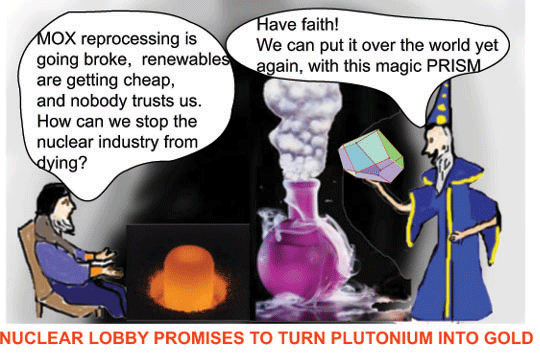
“We would describe that cost as very reasonable,” Dr Loewen said. Continue reading
Fed up with the #NuclearCommissionSAust
 Yes, I am fed up with the charade of this Royal Commission – its pro nuclear bias is apparent from the very start – with nuclear enthusiasts strongly represented, starting from Commissioner Kevin Scarce.
Today I looked for the transcript of the hearing with Dr Helen Caldicott on 27 October. Well, it’s hard to find. When you go to the appropriate page on the Commission’s website – not a mention of Dr Caldicott, though she was the first speaker that day.
The one that they do mention is Professor Geraldine Thomas, Imperial College London. Prof Thomas is a very well known pro nuclear speaker. She appeared prominently on the nuclear dragon thing soft sell series on SBS. Thomas has spruiked about radioactive iodine, but conveniently has ignored other radioactive isotopes. (I’ve not read her latest spruik to the RC, but you can bet your boots that she is lobbying away there for the nuclear cause. Sadly Imperial College is becoming notorious for this.)
I have been reading through the transcript of Dr Caldicott’s speech, or more correctly, interrogation. by the redoubtable Mr Jacobi.
I am amazed at the aggressive questioning of Dr Caldicott – it seems to me to be aimed at discreditiing her.
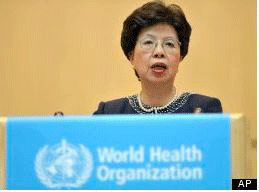 Not long ago, Dr Margaret Chan of the World Health Organisation stated “There is no safe low level of radiation”
Yet when Dr Caldicott said that same thing, she was subjected to aggressive questioning and demand for exact sources.
I wonder whether Mr Jacobi would have subjected the head of the WHO to the same insulting inqusition.
Conflict of interest in nuclear authorities: Dr Gordon Edwards explains
 Dr Gordon Edwards at SA NUCLEAR FUEL CYCLE ROYAL COMMISSION hearing, 21 October 15
Dr Edwards gave a wonderful explanation of the danger of nuclear technology, focussing on explaining radioactivity.
He also spoke of his concerns about the independence of nuclear regulators, and of safety measures needed for population near nuclear facilities, for example, how Canada supplies potassium iodate pills to communities.
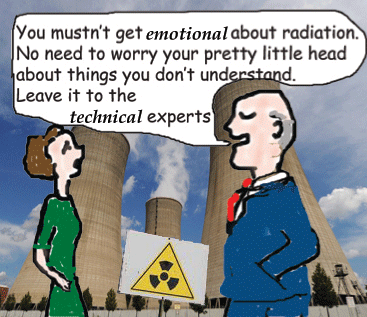
Extract DR EDWARDS: The complexity of the technology means that a lot of people 45 are mystified by it, including decision-makers, and politicians, for example, .SA Nuclear 21.10.15 P-742 Spark and Cannon generally don’t necessarily have a background in nuclear science. One of the only ones I know, I think, was Jimmy Carter, he was actually a nuclear engineer in the American nuclear navy. But outside of him, I don’t think of any major politician who has a background in nuclear science.
So that the technology is sufficiently complicated that people tend to be mystified by it and therefore feel a little bit – they find it difficult to judge, other than by trusting the experts in the industry itself. The difficulty with trusting the people in the industry itself, is that there is either consciously or unconsciously a kind of a conflict of interest there because they are devoted to the industry 10 and they want the industry to succeed and of course they try to reassure the public that it’s safe and they try their best to make it safe but there is this problem of – well, what if they weren’t so devoted to the industry and had the same knowledge, would they make the same judgment? Would they perhaps see it as being unsafe? And one of the difficulties with dangerous technologies 15 is that people who work on the technology feel conflicted and it’s difficult to blow the whistle on a technology that you truly believe in. So this is an inherent problem.
Similarly when you have a regulator, although independence is the goal, it’s 20 difficult to maintain that independence. The people in the regulatory body are often drawn from the very industry that they are regulating because they are experienced in that field and consequently you need people with understanding and expertise, so how do you kind of keep regulatory independent when in fact there is this constant interaction between the people in the regulatory body and 25 the people in the industry. They tend to come to see themselves as colleagues and if I might draw an analogy, you might think of the regulator as drifting towards being more of a coach than a referee…….So this problem of independence is not an easy one to deal with…….
Another thing that I think would be very helpful in my own opinion would be regulators, as the industry itself, they tend to be very top heavy with engineers and physical scientists, geologists and such like, 5 chemists, the so-called hard scientists and they tend to be extremely thin on biomedical expertise. I think it’s very helpful to have some biomedical expertise in the regulatory body because they have a different perspective. They have a different approach and also if and when things do go wrong, the biomedical team can be very helpful in advising the public and the workers and 10 everybody, as to what kind of precautions to take in terms of protecting yourself. What kind of foods should be avoided? What kind of measures should be taken? I think it would be very reassuring to the public to have such people on board.
Moreover, if you had a health department, which we do not have in our regulator, if you had a health department staffed with competent and independent biomedical people, they could also help to educate workers and the public as to why we are so careful with this technology. Why we must invest in all these safety precautions because they could make it clear what the dangers are. Continue reading
#NuclearCommissionSAust plans for radioactive trash dumping on Aboriginal land: a confusing issue
SA Royal Commission: Nuke waste dump on Aboriginal land? Really?, Independent Australia Noel Wauchope 23 October 2015 THIS IS clearly a terribly important question that needs discussion. When and if theNuclear Fuel Cycle Royal Commission (RC) ultimately results in establishing a nuclear waste import business in South Australia, it is a certain bet that it will be on Aboriginal land.
There are relatively few published submissions from Aboriginal people and organisations. However, these cannot be easily lumped into pro or anti nuclear boxes. There are some passionately anti nuclear ones. There are no passionately pro nuclear ones, but there’s more than a hint of support in the two submissions that take an apparently neutral stance. The RC has allowed Aboriginal people to choose whether or not their submissions are published.
A pro nuclear submission might evoke condemnation from environmentalists and other Aboriginal groups. This fact is recognised in the submission by Maralinga Tjarutja and Yalata Community Incorporated: …..
Nuclear lobby plans to further override South Australia’s Aboriginal Heritage Act
IN the mire of technical jargon at the hearings of the Nuclear Fuel Chain Royal Commission South Australia, sometimes a little gem emerges on what they really want to happen.
Ploughing through the pitch of James Voss for importing radioactive trash, at the 15th October hearing, Philip White alerted me to this little gem, from Voss:
“There clearly has to be a siting undertaking – siting of facility for storage. Within that, there has to be a broad set of agreements with the host – with South Australia…. This might be an equivalency to the indenture agreement between Olympic Dam and the state.”
Sounds inoccuous, doesn’t it? But as Philip White says: “The indenture agreement precedent might sound great for them, but we need to expose the racism of that approach.”
Nectaria Calan comments – “That’s really interesting and corroborates our suspicions that the indenture is indeed a dangerous precedent for the nuclear industry in SA. Imagine a waste dump exempt from parts of the Radiation Protection Act.” Calan has previously written on this Act:
“exemptions from the Environmental Protection Act (1993) are of particular concern. The exclusion of this Act means that the Olympic Dam mine is not subject to the same environmental regulatory framework as other industrial projects in South Australia, and the Environmental Protection Authority (EPA), which administers the Act, is excluded from its monitoring role. BHP’s environmental performance is instead the responsibility of the Minister for Mineral Resources Development, who, based on BHP’s own reports, has full discretion to approve or reject programmes for the management and rehabilitation of the environment, without any obligation to consult with other agencies.”
The Josephite SA Reconciliation Circle are well aware of the real effect of Roxby Downs (Indenture Ratification) Act , amended 2011. In their submission to the Royal Commission they state:
“Aboriginal Heritage Act
Our Members are particularly concerned that the Royal Commission is actually circulating
information that claims that the mining of uranium in SA is controlled by various legislative
safeguards including any protection afforded to Aboriginal Traditional Owners by the SA
Aboriginal Heritage Act.
Our members’ collective memory is very clear that the reverse is the actual truth. The 1982 SA
Roxby Downs Indenture Act initially for the original joint venturers, BP and Western Mining,
and later Western Mining and then BHP Billiton, EXEMPTED each operator from the
Aboriginal Heritage Act.
The Aboriginal Heritage Act needs to be
• reinstated as a genuine safeguard containing rules to be followed, and
• restored to its original strength
If this is not sufficient then Traditional Owners in our democracy need to be given the power
to refuse to have facilities on their lands – whether under native title or land rights legislation- that will imperil the health of their country, groundwater and the health of the
community members now and for future generations.”
Small Nuclear Reactors lobby turns to Australia, as safety rules too strong in USA
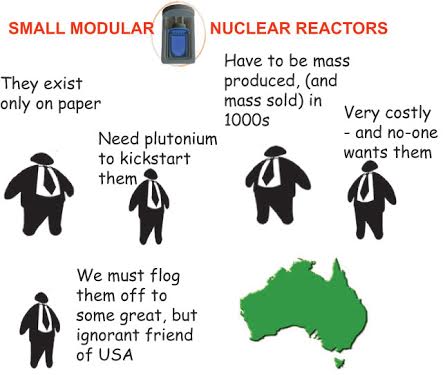 Why Australia is important to the Small Nuclear lobby. Independent Australia
the nuclear lobby’s spiel to Australia is something different, and very original. No dispute — because the argument is that small reactors would further the large reactor industry.
First articulated by Oscar Archer on ABC RN, March 2015, the idea is that Australia, in setting up small nuclear reactors, would enable the conventional nuclear industry and uranium mining to flourish:….. As Archer says, Australia would indeed be the pioneer for the new technology.
And that’s what the USA “new nuclear” lobby desperately needs. They need this, because they’re finding it impossible to go ahead in America. Why? Well it’s those pesky safety regulations imposed by the Nuclear Regulatory Commission.
What the “Small Nuclear” lobby needs is a “nuclear friendly” country – one with less stringent safety
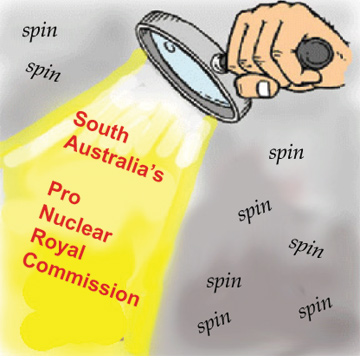 regulations – to set up their nuclear reactors on a test site. Hence the enthusiasm of those lobbyists for the South Australia Nuclear Fuel Chain Royal Commission, as shown, for example, in a recent Royal Commission hearing speech by Thomas Marcille of Holtec International nuclear company.
……… the Nuclear Regulatory Commission(NRC) has proved to be real nuisance since it tightened regulations for the licensing process after the Fukushima nuclear disaster. The new nuclear marketers have had to go overseas, first to China, then perhaps to Australia?…. https://independentaustralia.net/environment/environment-display/why-australia-is-important-to-the-small-nuclear-lobby,8263
Eloquent Submission to #NuclearCommissionSAust – an Aboriginal Perspective
 Submission to: Nuclear Fuel Cycle Royal Commission South Australia Prepared by Breony Carbines on behalf of West Mallee Protection
“West Mallee Protection are a conservation group made up of Aboriginal and non-Aboriginalmembers based in Ceduna on the west coast of South Australia. Our On country work includes cultural maintenance of water rock holes and monitoring of biodiversity in the last stretch of intact stunted mallee country. WMP also works to ensure that this area is protected now and well into the future.”
I found it very hard to select an extract from this submission, because I didn’t want to exclude any of it. This submission is expressed with clear and forceful logic: it contains excellent references and recommendations.
Here’s what they had to say about the Commission’s question onsetting up a nuclear waste dump:
#NuclearCommissionSAust’s plan to bring radioactive trash to Australia – by Leasing
Next Thursday’s (Oct 15) Adelaide public hearing at the Nuclear Fuel Chain Royal Commission (NFCRC) could be an interesting one.
It will be about the concept of leasing uranium – the idea that Australia continues to “own” uranium , so contracts to take back all radioactive trash.
It’s not a new idea – pushed for decades by Dr John White

and by the former Global Nuclear Energy Partnership (GNEP) and the current International Framework for Nuclear Energy Cooperation (IFNEC)

Topics to be addressed at this public session: Concept of nuclear fuel leasing and potential demand for those services. The international and commercial arrangements necessary to establish a fuel leasing operation
Dr Caldicott’s submission concerning radiation #NuclearCommissionSAust
Dr Helen Caldicott Submission to the Nuclear Fuel Chain Royal Commission http://www.helencaldicott.com/submission-to-the-nuclear-fuel-cycle-royal-commission/
Excerpt – Types of ionizing radiation
- X-rays are electromagnetic, and cause mutations the instant they pass through the body.
- Similarly, gamma radiation is also electromagnetic, being emitted by radioactive materials generated in nuclear reactors and from some naturally occurring radioactive elements in the soil.
- Alpha radiation is particulate and is composed of two protons and two neutrons emitted from uranium atoms and other dangerous elements generated in reactors (such as plutonium, americium, curium, einsteinium, etc – all which are known as alpha emitters and have an atomic weight greater than uranium). Alpha particles travel a very short distance in the human body. They cannot penetrate the layers of dead skin in the epidermis to damage living skin cells. But when these radioactive elements enter the lung, liver, bone or other organs, they transfer a large dose of radiation over a long period of time to a very small volume of cells. Most of these cells are killed; however, some on the edge of the radiation field remain viable to be mutated, and cancer may later develop. Alpha emitters are among the most carcinogenic materials known.
- Beta radiation, like alpha radiation, is also particulate. It is a charged electron emitted from radioactive elements such as strontium 90, cesium 137 and iodine 131. The beta particle is light in mass, travels further than an alpha particle and is also mutagenic.
- Neutron radiation is released during the fission process in a reactor or a bomb. Reactor 1 at Fukushima has been periodically emitting neutron radiation as sections of the molten core become intermittently critical. Neutrons are large radioactive particles that travel many kilometers, and they pass through everything including concrete and steel. There is no way to hide from them and they are extremely mutagenic.
So, let’s describe just five of the radioactive elements that are continually being released into the air and water at Fukushima. Remember, though, there are over 200 such elements each with its own half-life, biological characteristic and pathway in the food chain and the human body. Most have never had their biological pathways examined. They are invisible, tasteless and odourless. When the cancer manifests it is impossible to determine its aetiology, but there is a large body of literature proving that radiation causes cancer, including the data from Hiroshima and Nagasaki. Continue reading
#NuclearCommissionSAust hearing – is the Small Modular Reactor (SMR) a lemon?
Plough your way through the transcript of the October 7th hearing of the South Australia Nuclear Fuel Chain Royal Commission, and amidst all the technical hype, you will find some sobering points.
The speaker was Mr Thomas Marcille, of Holtec International, developer of the SMR-160, who enthused about that SMRs future, and explained its safety features etc.
Yet there were bits that would make even a greedy Australian nuke enthusiast pause:
“COMMISSIONER: Would it be fair to say that you’re expecting SMR or the 30 application of them outside the US more than inside?
MR MARCILLE: No question ……As a data point, I think that would suggest that the vast market is outside of the United States………, it’s possible for a national regulator outside the United States to first licence the SMR-160.”
He goes on to explain that the USA’s now more rigourous licensing process “part 52 or design certificate” is “far too arduous in terms of time and cost and risk.”
[translation – nobody in USA wants to buy the SMR, and it can’t get licensing there]
“our concept is to develop a preliminary design specification and a preliminary safety analysis report and to then achieve an opportunity with a commercial client to submit that preliminary safety analysis report under the review of a competent regulator for consideration of granting a construction permit. At such time the design will matriculate through the engineering specifications, the procurement specifications and the construction drawings. It’s unlikely that Holtec will continue to develop towards final safety analysis and final design unless a client steps forth.”
[translation – we’re not going ahead with licensing until after we’ve signed up an overseas buyer, such as Australia] [Holtec will] “continue the investment in the business and the technology if and as the marketplace develops”
The Commissioner asked Mr Marcille about “ comparison to larger plants the cost economies and the advantages of small modular reactors.” and about “the extent to which companies expect to have an order book of plants to manufacture and the extent to which they can enjoy economies of scale 25 because they’re manufacturing multiple versions of the same item “.
MR MARCILLE: Let me help by saying that – let me liken a large light-water reactor to a large apple and suggest that a lot of people think of small modular reactors as little apples. I would ask you to think of a small modular reactor like the SMR160 not as a little apple but a little orange. So now I’m comparing a big apple to a little orange and they’re entirely different. The apple is sweet, 40 the orange is sour. You get the picture…….
Mr Marcille continued with a lengthy and complex answer to this question, which included stressing the large costs of large reactors. I did not find it convincing .
Today’s Royal Commission Hearings – on financial viability of nuclear operations
Today’s royal commission hearings are about the financial viability of enrichment, electricity and a waste dump.
South Australia as radioactive trash dump our best nuclear bet – Kevin Scarce
Nuclear power option years away: royal commissioner Kevin Scarce http://www.theaustralian.com.au/national-affairs/state-politics/nuclear-power-option-years-away-royal-commissioner-kevin-scarce/story-e6frgczx-1227556819827?sv=631d9f761d476c7a142e1be7add844b1
OCTOBER 5, 2015 Michael Owen SA Bureau Chief Adelaide There is a decade of regulatory and legislative change required before any real work can begin on establishing a nuclear energy industry in Australia, royal commissioner Kevin Scarce says.
Those changes would require federal and state bipartisanship, meaning tangible economic benefits of expanding nuclear activity would not be apparent until at least 2030. We need to be realistic about what the opportunities will be,” Mr Scarce, a former South Australia governor, told The Australian. “If we do decide to participate (in the nuclear cycle), you’d want to grow some jobs, some expertise, and grow the technical know-how to go into other elements of nuclear — it has to have some economic benefits, and part of this royal commission is to look 10-15 years into the future and see what else is being developed to see if there is a need for nuclear in our power-generation mix.”
The Nuclear Fuel Cycle Royal Commission was established by Labor Premier Jay Weatherill to look at South Australia’s involvement in the mining, enrichment, energy and storage phases in the life cycle of nuclear fuel, given the state has one of the world’s biggest uranium deposits and has been involved in uranium production for more than 25 years.
Mr Weatherill’s government is grappling with the worst unemployment rate of any state amid the decline of manufacturing. The Premier is keen to explore the economic benefits of a deeper involvement in the nuclear sector.
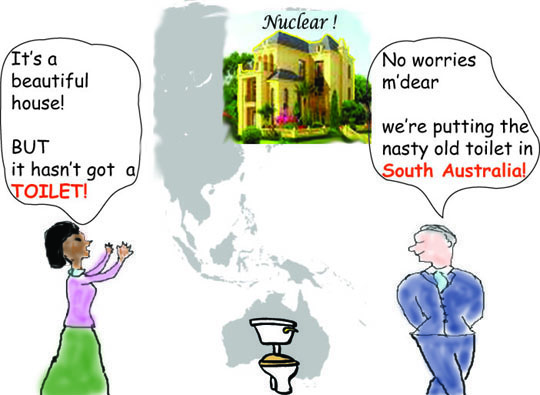
Mr Scarce said it might be that, given Australia’s energy demand was decreasing, coupled with an abundance of renewables, nuclear generators were not necessary. This would leave a nuclear waste dump as the most likely source of economic benefit.
Mr Scarce said it was “absolutely” the case that there was a decade of bipartisan legislative and regulatory change that had to occur before any nuclear industry could be up and running. “One should not think that if we turn the switch on at the end of this royal commission after the government has had a look at it that benefits will be delivered within the decade — they won’t be,” he said.
“In order to provide the investment certainty that would be required, because of the length and cost of this industry, if you don’t have bipartisan support at both the state and federal level, an industry will not go anywhere.”
Mr Scarce said the state opposition had been very supportive, as had the government, which established the inquiry. However, there could be major hurdles under any future federal Labor government. A decision to change the ALP national platform opposing a nuclear industry has been delayed until after the release of the commission’s report, due on May 6.
Former prime minister Tony Abbott has said there was no need for Australia to pursue nuclear energy because of the nation’s large coal and gas reserves, although he said nuclear energy would help cut carbon pollution.
Mr Scarce, who has visited several countries on fact-finding missions this year, will begin 30 days of public hearings until December.
#NuclearCommissionSAust – An Aboriginal group slams its processes
monetary compensation via Native Title is not the solution – don’t insult us by simply hying to buy our consent and silence our concerns
SUBMISSION TO THE NUCLEAR FUEL CYCLE ROYAL COMMISSION.
FROM: ANGGUMATHANHA CAMP LAW MOB
Extract Why we are not satisfied with the way this Royal Commission has been conducted: Yaiinidlha Udnyu ngawarla wanggaanggu, wanhanga Yura Ngawarla wanggaanggu?
always in English, where’s the Yura Ngawarla (our first language)?
The issues of engagement are many. To date we have found the process of engagement used by
the Royal Conuuission to be very off putting as it’s been run in a real Udnyu (whitefella) way.
The lack of an intelpreter service means we are forced to try and engage using English (or rely on the goodwill of caring community members), and often this means we cannot be part of the engagement process. Even a Plain English summary of the four papers would have been helpful, and more opportunity for people to give oral submissions in their first language with a translator to interpret. We say that govemment and industry have a moral and ethical obligation to include us as citizens of Australia, and as Traditional Owners of our Country. We suspect that many other Australians would have benefited from a Plain English version of the papers and this was suggested by many people who went to the first lot of community meetings held by Kevin Scarce and his team. Not everyone has good English literacy.
Requiring a JP’s signature is a barrier to participation and suggests that ordinary people cannot
be trusted; not everyone has easy access to a JP, and the timeline puts pressure on people to do
this. We feel this is likely to intimidate people and discourage many from participating.We strongly recommend that the Royal Commission do more work on the following issues:
- Provide the public with better understanding of the health, cultural, and social impacts in other
countries of an expanding nuclear industry (including public anxiety, contaminated areas, effects 0n public health); - Provide adequate resources to enable all Australians to be part of an informed process – put
people before profit; - The lack of advertising, and very short notice on several occasions suggests that government and
industry and not serious about wanting to engage with public opinion and don’t value our input. - Many people think this suggests the proposal is ‘a done deal’ and that it will go ahead anyway.
- Timelines are short, information is hard to access, there is no interpreter service available, and
the meetings have been very poorly advertised. - Engagement opportunities need to be fair and equitable (readily available to all people) and the Native Title interest is no more important than the wider community.
- A closed and secretive approach makes engagement difficult for the average person on the street, and near impossible for Aboriginal people to participate.
- Government continue to use an assimilatory process; they ignore us by refusing to translate
information into our first language, and they make no effort to understand our views in our
languages as the First Australians. The lack of a well-thought out engagement strategy tells us that our views are not important, that government and industry will do what they want regardless of public wishes. - Develop a compensation package for the likely economic impacts from the negative associations of nuclear industry on local and regional economy – ego Loss of prices in crops, housing, land, as a result of contamination threats, accidents and breaches of EPA regulations;
- Develop actual measures to counter threats from terrorist organisations re: protection to avoid nuclear site attacks, and local capacity to deal with emergency situations;
- Tell the public what risk management plans need to be developed for communities impacted by transportation along the travel routes – for example, who will respond to a truck accident and are they equipped to deal with it; Informed awareness among communities that live along the designated travel routes so they can make decisions about their future.
- The nuclear industry must find ways to show respect for the rights of Traditional Owners who are concerned about or opposed to the nuclear industry – monetary compensation via Native Title is not the solution – don’t insult us by simply hying to buy our consent and silence our concerns;
 Provide means for ongoing and independent monitoring of dangerous levels of airbome and water-based contaminants in groundwater, along transportation routes, after accidents, and among food sources used by Aboriginal people ego Nguri, urdlu and warratyi varlu, awi. We have a right to measure and monitor levels of radiation like other people do in countries such as the USA. We know from the Kakadu mine in NT that there is a major problem there with water management that is yet to be resolved.
Dr Arjun Makhijani explains why Small Modular Nuclear Reactors (SMRs) are doomed to fail
PUBLIC HEARING, SA NUCLEAR FUEL CYCLE ROYAL COMMISSION DR ARJUN MAKHIJANI, Institute for Energy and Environmental Research ADELAIDE , THURSDAY, 1 OCTOBER 2015
Excerpt “…….the core idea of an SMR is that you have smaller reactors. Of course you lose the economies of scale, reactors are big because cost of materials goes according to surface area, and power production goes according to volume, and the larger the reactor the smaller the material needed per kilowatt.
That is the theory and that is why there were small reactors in the fifties, they were proposed and we went to bigger reactors because they were cheaper, all other things being equal. So you go back to smaller reactors, the underlying technology will tell you that the costs per kilowatt, in terms of materials and labour, the number of wells you need per kilowatt, the amount of steel you need per kilowatt will all go up.
The proposal is that all of these costs would be offset by assembly line manufacturing. So you won’t have to set it up on site. And in theory it is a fair idea to evaluate and you ask what is the size of the assembly line you need? And who is going to create this assembly line and the required supply chain, the vessels and the pumps and valves and all of it? So if you look at what the Department of Energy has said, what the industry itself has said is that you can’t – so you are really displacing the heavy capital cost upstream from the reactor sites……
so now instead of having a 10 billion dollar problem, you have got a 50 or a 100 million dollar problem because to .SA Nuclear 01.10.15 P-431 Spark and Cannon set up a supply chain for say 100 or 150 reactors a year, you need that scale of investment……
you need a supply chain investment that is about the same order of kind of an assembly line for airbuses or (indistinct) So it’s very, very huge. So who is 5 going to make all of these orders that will cause some private party to make that investment in the assembly line? With airbuses we know they get advance orders of hundreds of aircraft and they set up their assembly lines. The answer to that question is, no one other than governments…….
How you would handle such a system from a regulatory point of view is 15 mysterious to me because when you have assembly lines, as I note in my paper, you have recalls. Today we have got an 11 million car recall, one of the most reputable companies from perhaps the most technologically reputable country in the world, Germany. What are we going to do if we have 2,000 assembly line reactors that are found to have a fault through design? By design I mean 20 as not properly conceived, or through some cover up, like what happened with Volkswagen. How are we going to deal with it? Are we going to shut them down? Are we going to send them to the manufacturer? Are we going to – it’s unclear…..
the fine 25 print of small module reactors is much, much more complicated economically and in terms of the risks and investments, than their performance have led you to believe. That’s why they’re not – I mean I think – at least two of the four companies that are embarked on it, are already not pursuing it in the United States. Fallen apart before anything was built…. ” http://nuclearrc.sa.gov.au/app/uploads/mp/files/videos/files/151001-topic-4-day-2-transcript-full.v2.pdf
The pro nuclear front group Breakthrough Institute joins push for nuclear power in South Australia
The Breakthrough Institute (BI) was notorious for its attacks on Al Gore and climate scientists.It has a long history of trying to discredit renewable energy, in particular, attacking Germany’s Energiewende. More recently, BI has discovered climate change, as that is a useful tactic in their long-running promotion of new nuclear technology
the promoters of new nuclear reactors for South Australia certainly include idealistic and altruistic people, some of whom have bought the BI’s message.
Who wants to be a nuclear billionaire? Independent Australia, 1 Oct 15 Noel Wauchope navigates the complex web of ambiguity behind submissions to South Australia’s Nuclear Fuel Chain Royal Commission.. Some promoters of nuclear industry expansion have very altruistic motivations.
Just who are the people who want South Australia to be a nuclear industry hub? The submissions to the Royal Commission give some indications, though it is not easy to work this out……
The pro nuclear submissions on the whole, come from interested parties, where a commercial or career motive can be discerned: that is often clearly shown, but sometimes is not apparent. There are also some pro nuclear submissions that are quite cautious about promoting development, and a few who are inclined towards sitting on the fence.
Of the 94 pro nuclear submissions published, 46 come from companies or organisations connected with the nuclear industry. But who knows how many nuclear companies really did send in submissions, as theirs were allowed to not be published, due to ‘commercial in confidence’?
….most favoured topic, as with the organisations, was Issues Paper 3, “ELECTRICITY GENERATION”…
Their backgrounds? 20 of the [pro nuclear] 48 individuals are now, or were formerly, employed in a nuclear or nuclear-related company, government or university department.(1) In some cases they state this clearly, in other cases it is not apparent…..
Then there are the 2 career politicians, Sen Sean Edwards and MP Tom Kenyon, who have hitched their political future to the nuclear star.
Then there are nuclear publicists, who are not necessarily engineers or involved in the nuclear industry, but who have become well known for their pro nuclear articles or lobbying. There are only 4 listed names that could be described as pro nuclear publicists (2)
….the majority of the pro nuclear submissions enthuse about new nuclear reactors – “Generation IV” Small Modular Reactors” “Liquid Fluoride Thorium Reactors”.
When you add those individual submissions to the 46 from nuclear-related organisations, it looks as if the overwhelming support for new nuclear reactors comes from interested parties – nuclear related companies, or individuals connected to the industry, who seek profit or career advancement. Continue reading
1 This month

of the week – Australians for War Powers Reform (AWPR)
To see nuclear-related stories in greater depth and intensity
 Antinuclear