Credibility of South Australia’s Nuclear Royal Commission in tatters?
Today’s Age discusses the planned Australian Royal Commission into Juvenile Justice in the Northern Territory. The appointed Commissioner, Brian Martin, has resigned because he recognised a perception of bias by the community, however well qualified he might be for the position.
The South Australian Royal Commissioner, Kevin Scarce, was not only not qualified, with no legal background, but IS clearly perceived as biased.
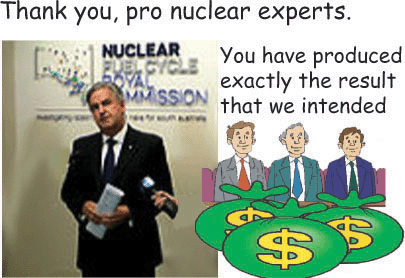 Kevin Scarce has a conflict of interest, as a shareholder in Rio Tinto, and as a member of CEDA (the Committee for Economic Development In Australia). CEDA’s Policy Perspectives of Nov 2011 clearly supports and promotes the growth of South Australia’s nuclear industry. The Royal Commissioner selected predominantly pro-nuclear experts for the Commission’s Advisory Committee.
Speaking in November 2014 at a Flinders University guest lecture, Scarce acknowledged being an “an advocate for a nuclear industry”.
Mark Kenny, writing in The Age today says:
Indeed, Martin acknowledged this [public confidence] was the crucial factor – irrespective of the facts. He observed if any public doubts about the impartiality or commitment to the unvarnished truth were allowed to “fester” during the commission’s long months, its outcomes would be compromised.
Philip White reports onNuclear Royal Commission’s presentation to TAFE students
 Philip White, 28 July 16 A video consultation session for TAFE staff and students was held on July 28 from 12-1pm. Below is a brief report.
The session started with a 15 minutes Scarce presentation video. I think it was from the press conference for the release of the RC report, but am not sure. One thing that struck me was how Scarce used words like ‘trace’ to imply that the amount of radionuclides after 1,000 years would be negligible.
John Phelan of the Nuclear Fuel Cycle Royal Commission Consultation and Response Agency (CARA) followed up with comments about process.
I was one of only two knowledgeable participants, the other being a nuclear proponent who wanted the dump to go ahead quickly and thought the costs were exaggerated. He thought in a few years we would need nuclear reactors.
A couple of regional TAFE lecturers complained about the lack of notice (meaning they hadn’t read the email sent to all staff and students) and lack of information (meaning they hadn’t been picked up in the RC’s regional propaganda tours). One lecturer confused this with the Commonwealth dump, thinking it would be located near her property in Quorn. John Phelan clarified that this consultation was just about an international dump.
2. Process
I made the following points about process:
(1) These consultations (and also the educational materials they apparently plan to provide to schools) should include presentations both for and against the proposal. Without that the public does not have a basis for thinking critically.
(2) The first Citizens’ Jury was flawed because it was inappropriate for it to be tasked with summarising the RC report.
(3) Referring to the forthcoming second “Citizens Jury”, a 350 person group should not be called a Citizens Jury.
Re (2), Phelan had said in his initial presentation that summarising the RC report was a (the) role of the first Citizens Jury, encouraging people to read this wonderful synopsis.
Members on this email list may recall that I have previously pointed out this flaw of the first citizens jury. I went to the trouble of ringing Iain Walker of NewDemocracy about this. He said the jurors were told to “prioritise” not to “summarise”. I then pointed out that the first sentence of their report says “summarise”. Walker said it was not the organisers’ role to change what the jury wrote, implying that the jury members had misinterpreted their role. But in today’s video conference Phelan was completely clear that they were asked to “summarise”. In my view, asking a Citizens Jury to summarise (or even prioritise) an official document is an abuse of the Citizens Jury method. Citizens Juries are a method of gaining incite into the judgements of informed citizens. They should not be used to help the government (or the Royal Commission) communicate its message.
Re (1), Phelan showed no interest in taking on board my suggestion that all consultations should include presentations from both pro and con perspectives. He responded that they were trying to present facts not opinions, claiming that the RC report was factual. I pointed out that the RC report was not a factual document. It is a selection of facts and perspectives, that there were lots of facts and perspectives that were left out, and that the report reflected the biases in the makeup of the RC.
I suspect that there is some confusion in the government about what it is trying to do with this public consultation process—whether it is trying to stimulate an informed debate, or whether it is just trying to persuade the public to let it build the international nuclear waste dump that it already knows it wants.
It is counter-intuitive for governments and bureaucracies to promote critical thinking among the public, but I suggest we challenge them to give equal time to critics and proponents. When they refuse, then we can call them out. We will have proof that their process was a sham. In the unlikely event that they agree to this demand, we should accept it in the confidence that we can win this argument. Of course, it would be difficult for critics to resource such a project, but we can cross that bridge when we come to it.
3. Waste dump
I pointed out that cost estimates for nuclear projects are generally gross underestimates and that SA would be left with a huge financial and nuclear burden if the costs end up exceeding the revenues. There would be no way of sending the waste back to the countries of origin.
South Australian Nuclear Royal Commission Did Not Give The Citizens’ Jury The Full Picture
 Submission to JOINT COMMITTEE ON FINDINGS OF THE NUCLEAR FUEL CYCLE ROYAL COMMISSION Makes the case that Australians are being denied the bigger picture, and the NFCRC was deliberately or negligently selective in their assessment of evidence received. https://www.academia.edu/27087058/Submission_to_Joint_Committee_on_Findings_of_the_Nuclear_Fuel_Cycle_Royal_Commission
“………I believe that the South Australian people have a right to know about the implications of all relevant nuclear materials handling processes and their consequences for human health and the environment in advance of making or influencing any government decision to accept or reject spent nuclear fuel.
I am concerned that the Citizens’ Jury currently tasked with simplifying the Nuclear Fuel Cycle Royal Commission may not comprehend the full extent of the Commission’s recommendations- that is, that they are seeking to enable currently prohibited industrial activities across the whole nuclear fuel cycle.[1] Nuclear Fuel Cycle Royal Commission, Government of South Australia, ‘Nuclear Fuel Cycle Royal Commission Report’, 2016: pg. XV. http://yoursay.sa.gov.au/system/NFCRC_Final_Report_Web.pdf . Accessed 2016-07-01……..
3. the question arises: how selective or otherwise was the process of assembling its Final Report and recommendations? Why was certain information received not included in the Commission’s final report?
4. the first Citizens’ Jury did not hear from a presenter who was appropriately knowledgeable on matters of radio-biology and the pathways and effects of exposure to nuclear materials in environmental or occupational contexts (with respect to uranium and nuclear fuel). The only medical professional to address the jurors for any significant length of time was Associate Professor Michael Penniment.
It is my opinion that by not providing fundamental information about the connection between radiationexposure and the development of cancers and leukaemia, the Department of the Premier andCabinet is preventing the jurors from being able to adequately consider risks, which being bombarded by the opportunity of waste storage, and the numerous mechanical processes which would need to occur to enable it………
CHERNOBYL In his presentation to the jurors, Penniment went on to describe the consequences of Chernobyl incorrectly, stating that only 28 people died as a result of the incident, and that those were the first responder clean-up workers. This misinformation conflicts with all recent accounts of the disaster, including those published in the Nuclear Fuel Cycle Royal Commission’s own Final Report. No-one present in the room was able to correct him……
5 I supplied evidence to the Commission for its consideration demonstrating the different approaches taken to measuring and estimating the human health consequences of Chernobyl in my submission to the Tentative Findings. I had hoped that the Commission would compare these with its own references to UNSCEAR and the WHO. No such comparisons were reflected in the Final Report…….
FUKUSHIMA In the case of the 2011 Fukushima disaster, the Commission’s final report fails to reflect the gravity, extent of harm and technical complexities related to the incident and the response thus far……
6. [On the health effects on nuclear workers]
The Commissioner’s response to my question and correction demonstrate that the Commissioner was at that time unaware of the problematic nature of the elevated risk of cancers and leukemias experiencedby nuclear industry workers, despite my submissions. This also confirmed that the evidence I provided to the Commission was ignored, either wilfully or negligently. I reach this conclusion with confidence, given Chad Jacobi’s recent admission that all submissions were read by the Commission, and by him personally.[11]
I have received further confirmation from the Royal Commission’s Chief of Staff, Greg Ward that Chad Jacobi was the chief author of the final report. If Jacobi read all of my submissions, what cause did he have to ignore the evidence that I provided?
NUCLEAR FACILITY EFFLUENT & EMISSIONS In my submissions to the Commission, I drew attention to several studies which identified or analyses clusters of leukemias in close proximity to nuclear facilities…….. The Commission chose not to include this controversial subject in its final report, despite a preliminary search revealing a substantial number of peer-reviewed medical research papers exploring this topic……..
NUCLEAR FUEL LEASING The Final Report refers to the prospect of establishing a nuclear fuel leasing scheme in South Australia, contingent on the establishment of a permanent storage facility for spent nuclear fuel. The report then goes on to say that such a program could provide a competitive advantage capable of improving prospects for the development of additional uranium processing activities in South Australia……..This process of gradual expansion into enrichment and fuel processing is summarised….
By my assessment, these statements reveal the broader intent of the Commission’s recommendations, yet this information is buried deep inside the body of the Final Report. The Commission suggests that South Australia work with established nuclear industrial players to add value to the currently exported product: uranium oxide concentrate.
RECOMMENDATIONS
Global nuclear industry promoters influencing SA nuclear waste plan
 27 July 2016 The Australian Conservation Foundation will today table to a South Australian Parliamentary committee information showing a key adviser to the state’s recent nuclear Royal Commission is a nuclear ‘true believer’ who was behind a failed attempt to open a global radioactive waste dump in Australia in the 1990s.
Charles McCombie, who was technical manager of Pangea Resources – a consortium that tried to advance a waste dump in Australia during the 1990s – is a foundation partner of MCM, a Swiss based firm contracted by the Royal Commission to model economic and technical information and analyse potential customer demand and economics.
MCM’s report strongly influenced the Commission’s enthusiastic pro-dump recommendations. Mr McCombie is also President of ARIUS, the Association for Regional & International Underground Storage. MCM and ARIUS both aim to advance global radioactive waste disposal, raising questions about the independence and objectivity of the advice provided.
MCM has stated that a positive state government response to the Royal Commission report would ‘change the worldwide paradigm of radioactive waste management’.
“In the late 1990s public outrage forced Pangea to abandon its dumping plan”, said ACF campaigner Dave Sweeney. “Today a pro-nuclear Royal Commission is using public funds so Pangea’s inheritors can re-write the proposal. South Australians deserve better.
“Understandably there is concern about commercial interests pushing a plan to ship, store and bury the largest amount of the world’s worst nuclear waste in South Australia.
“The permanent risk of nuclear waste demands the highest level of scrutiny and transparency, not limited disclosure and insiders promoting a pre-determined agenda.
“Radioactive waste management is complex, contaminating and costly – and it lasts far longer than any politician or headline. It needs real analysis, not industry assumptions.
“ACF urges Premier Jay Weatherill to seek an independent review of the Royal Commission’s research and recommendations and not to further advance this high risk plan based on a report that is compromised, deeply deficient and unfit for purpose.”
South Australia is targeted for five nuclear dumps and high level waste processing
 SA is targeted for five nuclear dumps and high level waste processing
Brief by David Noonan, Independent Environment Campaigner
The Nuclear Royal Commission recommended SA pursue nuclear waste storage and disposal “as soon as possible” – requiring five waste dumps and a high level nuclear waste encapsulation processing facility.
The Final Report Ch.5 “nuclear waste” and the Findings Report (p.16-20) are reliant on a consultancy “Radioactive waste storage and disposal facilities in SA” by Jacobs MCM, summarised in Appendix J.
SA is targeted for above ground high level nuclear waste storage, without a capacity to dispose of wastes, exposing our society to the risk of profound adverse impacts, potential terrorism and ongoing liabilities.
The State government is in denial on the importance of nuclear waste dump siting by claiming social consent could be granted before we know what’s involved in siting up to five nuclear dumps across SA.
Affected regions and waste transport routes are fundamental pre-requisites to transparency and to an informed public debate on potential consent to take any further steps in this nuclear waste agenda.
First: a dedicated new deep sea Nuclear port is to receive waste ships every 24 to 30 days for decades, to store high level waste on site following each shipment, and to operate for up to 70 years.
The coastal region south of Whyalla and north of Tumby Bay is the likely location for this Nuclear port.
South Australia is targeted for a globally unprecedented scale of high level nuclear waste shipments. Some 400 waste shipments totalling 90 000 tonnes of high level waste and requiring 9 000 transport casks are to be brought into SA in the first 30 year period of proposed Nuclear port operations.
This is in excess of the global total of 80 000 tonnes of high level nuclear waste shipped around the world in the 45 year period from 1971 to 2015, according to the World Nuclear Association report “Transport of Radioactive Materials” (Sept 2015) and the Jacobs MCM consultancy (Feb 2016, p.152).
Second: an above ground nuclear waste Storage facility is to take on approx. 50 000 tonnes high level waste before a Disposal facility could first start to operate in Project Year 28 (Jacobs p.5 Fig.3).
SA is proposed to import high level waste at 3 000 tonnes a year, twice the claimed rate of waste disposal (Jacobs p.114), with storage to increase to 70 000 tonnes. The Store is to operate for up to 100 years.
The Nuclear Commission budgeted to locate the waste Storage facility 5 to 10 km from the Nuclear port.
The Nuclear port and above ground waste Storage facility are to be approved in Project Year 5, ahead of pre-commitment contracts for 15 500 tonnes high level waste in Year 6 and waste imports in Year 11.
South Australia needs to know the proposed region for siting the Nuclear port AND whether the nuclear waste Store is to be adjacent to the port (likely on Eyre Peninsula) or sited in the north of SA.
Third: a Low Level Waste Repository for burial of radioactive wastes derived from all operations including final decommissioning of all nuclear facilities is proposed to be located in north SA. This Repository has a nominal waste burial capacity of 80 000 m3 of radioactive wastes (Jacobs p.144). This is some eight times the total scale of the proposed National Radioactive Waste Repository.
Questions about Senator Sean Edwards’ nuclear waste proposal
 Nuclear Fuel Cycle Watch, Andrew Allison July 21 Rumour has it that once of the anonymous countries that Sean Edwards will not name is South Korea. One might speculate about where the money for Sean Edwards’ very glossy submission to the NFCRC came from? ….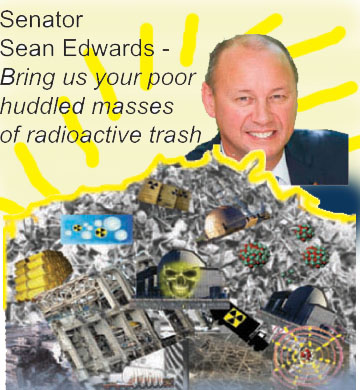
I have many reservations about Sean Edwards’ proposal, but two obvious questions come to mind:
1/ If the deep-underground storage of nuclear waste is a “solved” problem and South Australia can supposedly acquire and implement the technology at low cost (leading to high profits…) then why can’t South Korea do that?
2/ If the generation IV reactors are going to solve the waste storage problem then why can’t an advanced technological country like South Korea do that? https://www.facebook.com/groups/1021186047913052/
South Australia: Resuscitating a Nuclear Waste Nightmare
The project to bury the world’s nuclear poison in the heart of the Australian desert has not sprung out of a void. It is an idea that has been insidiously festering for two decades in a variety of incarnations.
The first stirrings of the hellish project to turn Australia into the world’s nuclear dumping ground emerged in the late 1990s when Pangea Resources, a U.K. based company promoted the construction of a commercially-operated international waste repository in Western Australia. The project was supported by a $40 million budget, 80% of which came from British Nuclear Fuels Limited (wholly owned by the U.K. government), with the remaining 20% from two nuclear waste management companies.
Australia’s Overflowing Nuclear Waste Dumps
One of the more disturbing elements of the Royal Commission report is its explicit endorsement of the progressive nuclearisation of the planet over the course of the next century. But given the make-up of the Royal Commission, this comes as no surprise.
Poison In The Heart: The Nuclear Wasting Of South Australia Counter Currents by Vincent Di Stefano — July 22, 2016 “……..It is a curious thing to observe the confidence with which the recent Nuclear Fuel Cycle Royal Commission has embraced the promotion of South Australia as the ideal destination for over one third of the world’s accumulated stores of spent nuclear fuel. This spent fuel, together with the 400,000 cubic metres of intermediate-level nuclear waste that the Royal Commission recommends be transported to South Australia, represents a problem that nations with decades-long histories of nuclear energy production have failed to resolve. The entrancement induced by a whiff of billions of dollars of new revenue presently has a closed circle of nuclear advocates and politicians straining to persuade the people of South Australia to obligingly make their way as latter-day lemmings towards a dangerous and uncharted nuclear abyss.
In the short term, the Commission calls for the transportation of vast tonnages of highly radioactive materials from around the planet for decades-long storage in above-ground facilities. In the longer term, it proposes the construction of a deep underground repository for the “permanent” burial of the most dangerous wastes produced by a destructive and senescent civilisation. Continue reading
Adelaide: the next steps in South Australia’s nuclear brainwash
The next step in the international nuclear waste dump campaign from the government is “community consultation” and they are visiting 100 sites around SA. People’s opinions will be used to gauge whether there is community consent or not.
South Australia’s Premier Jay Weatherill and his Citizens’ Jury Nuclear Deception
 Weatherill trumps up Citizens’ Jury Report in push for SA nuke waste dump, Independent Australia 15 July 2016, Noel Wauchope, who has been covering the Nuclear Fuel Cycle Royal Commission for IA, calls SA Premier Jay Weatherill out over a sleight of hand following the Nuclear Citizen’s Report this week.
SA Premier Jay Weatherill received the Nuclear Citizen’s Jury Report on 10 July. He said that it was a “commonsense” report and that:
“they [the jury] are asking us to also change the legislation to undertake that work”
(i.e: the work of investigating overseas markets for sending nuclear wastes to South Australia)
Here’s where the sleight of hand comes in. That call to change legislation did not come from the Citizens’ Jury. It came from the pro-nuclear Nuclear Fuel Cycle Royal Commission (NFCRC), and the jury was merely doing its appointed task — which was to paraphrase the NFCRC’s recommendations. Throughout the jury process, the jury members were reminded that they had no brief to make any decisions or recommendations and they conscientiously stuck to that rule.
Now I think we know why Weatherill was so adamant that this group be called a “jury”. A later group of 350 members, will also be called a “jury”. There is some possibility that this number 350 could be taken as an adequate sample of the South Australian population of 1.712 million. So again, by regurgitating the NFCRC’s recommendations, this might conceivably be portrayed as the “verdict”of the people. That’s a lot safer than a referendum. …….
NFCRC is over, and finished, but hey — not so! The next move is a massive public advertising process and this kicked off with the recent Citizens’ Jury, which, while being organised by the South Australian firm DemocracyCo, was master-minded and controlled by NFCRC personnel. The witnesses were predominantly pro-nuclear, speakers from NFCRC were prominent and NFCRC staff were present at many, if not all, sessions.
Several times, during hearings, and Q and A sessions, the jury was reminded of the necessity to change State and Federal legislation.
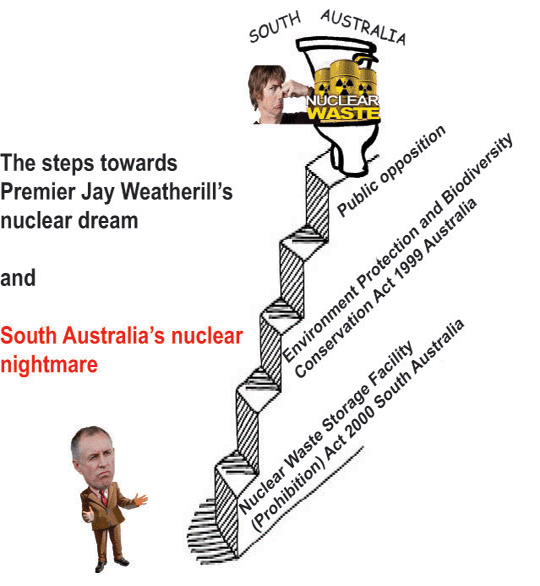
This process had, in fact, already begun, with legislative change that had to be made retrospective, seeing that the government had already spent $7.2 million on the Royal Commission. It is rare for legislation to be made retrospective. As the Greens’ Mark Parnell commented:
‘The retrospective clause is basically saying that if anyone did anything illegal we now legalise it.’
The South Australia Nuclear Waste Storage Facility (Prohibition) Act 2000 used to say:
13 — No public money to be used to encourage or finance construction or operation of nuclear waste storage facility
(1) Despite any other Act or law to the contrary, no public money may be appropriated, expended or advanced to any person for the purpose of encouraging or financing any activity associated with the construction or operation of a nuclear waste storage facility in this State
This section was amended in May 2016. The government wanted to remove Section 13, altogether. However, after several efforts on this, (Greens’ Mark Parnell objecting), Section 13 was amended, to include a new provision:
‘(2) Subsection (1) does not prohibit the appropriation, expenditure or advancement to a person of public money for the purpose of encouraging or financing community consultation or debate on the desirability or otherwise of constructing or operating a nuclear waste storage facility in this State.’
That was a small step forward for the nuclear cause.
Now for a bigger step. The government needs to drastically amend the South Australia Nuclear Waste Storage Facility (Prohibition) Act 2000. Later on, they need to get changes made to the national legislation — The Environment Protection and Biodiversity Conservation Act 1999 (the EPBC Act). They’d probably like these national powers to be removed and have these topics placed under State laws.
In building their argument for changing the law, the Weatherill Government needs to gather persuasive evidence about the proposed economic bonanza to come from importing foreign nuclear wastes. That means another round of expensive trips overseas, and a lot of advertising and promotional meetings in South Australia.
All this can now be justified, because, according to the government, the Citizens’ Jury called for more information, especially on economics, and even more importantly, called for changing the law on importing nuclear waste.
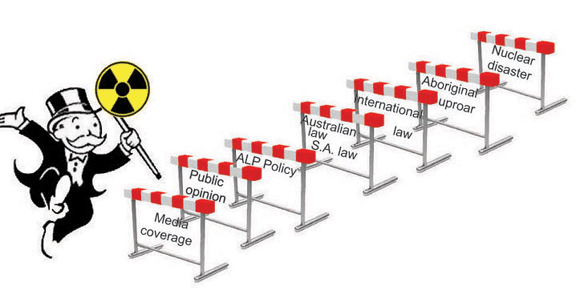
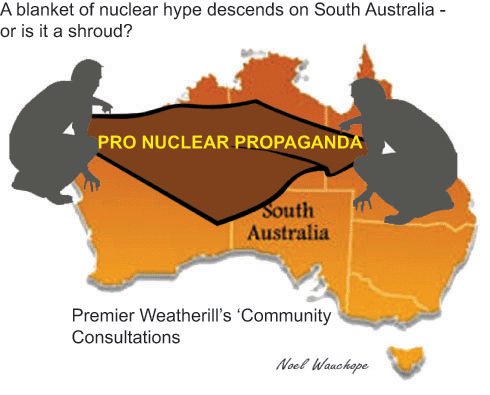
The fact that this jury group diligently summarised the Royal Commission report, without themselves making any recommendations, will almost certainly get lost in the onslaught of pro-nuclear hype that is about to descend upon the South Australian population. https://independentaustralia.net/environment/environment-display/weatherill-trumps-up-citizens-jury-report-in-push-for-sa-nuke-waste-dump,9237
Craig Wilkins, Conservation Council of South Australia, at parliamentary Nuclear Inquiry
Citizens Jury Panel 1: Craig Wilkins
 TRANSCRIPT OF EVIDENCE TO SOUTH AUSTRALIAN PARLIAMENTARY
  COMMITTEE, 15 July 16
 No Profit in Nuclear waste
- A minimal safety margin requires that high level waste not be imported before an agreed licensed geological disposal site…
- High level nuclear waste disposal costs can double in a decade…..
- Dubious claim that disposal of nuclear waste in SA costs one quarter less than in experienced countries….
- SA faces a $60 billion debt in costs across 37 years of ongoing nuclear waste storage operations and nuclear facility decommissioning after the last receipt of overseas revenues for waste imports….
- Nuclear contingency costs are unfunded…
Brief (July 2016) by David Noonan, Independent Environment Campaigner
South Australians are being misled by inflated revenue claims, untenable assumptions and under-reported nuclear waste costs. Reality check analysis shows there is no profit in nuclear waste.
Nuclear waste costs are fast rising and unrelenting for decades after the last recite of waste imports regardless of whether or not claimed revenues and fixed prices over time prove to be realistic or illusory.
The Nuclear Royal Commission Final Report Ch.5 “Management, storage and disposal of nuclear waste” and the Nuclear Commission Tentative Findings Report (p.16-20) present a nuclear waste baseline business case that is near solely reliant on a consultancy “Radioactive waste storage and disposal facilities in SA” (Feb 2016) by Jacobs MCM, summarised in Final Report Appendix J.
There is no market based evidence for the Final Report revenue assumptions and claimed income.
Claimed revenues are a tonnage based multiplier: inflated tonnage equals misleading revenues.
Claimed revenues are doubled by an assumption SA can take twice the waste the US failed to achieve. Continue reading
David Noonan at Parliamentary Nuclear Committee- “waste plan is based on misleading assumptions”
JOINT COMMITTEE ON THE FINDINGS OF THE NUCLEAR FUEL CYCLE ROYAL COMMISSION
If I could make a key point of guidance for the committee’s consideration and due deliberations and any recommendations that you would make, I draw your attention to the objects of the Nuclear Waste Storage Facility (Prohibition) Act 2000 which states:
…”to protect the health, safety and welfare of the people of South Australia and to protect the environment in which they live”…
The act then goes on to prohibit certain classes of nuclear waste storage and disposal facilities. I think that recommendation, those objects to protect the health, safety and welfare of the people of South Australia and the environment in which they live, should be the overriding guidance that this committee considers in how you address the findings of the nuclear royal commission and the business case as presented by the Jacobs Consultancy which is I think the primary matter that lies behind the nuclear commission’s findings and final report.
In my opinion, the nuclear commission, the findings and the final report, and the Jacobs Consultancy on which it is heavily reliant, present a number of assumptions which effectively mislead the public.
The project is projected to be at an inflated scale which has significant consequences both for the reality of the project but also for the claimed revenues. The revenues in this matter are a tonnage-based revenue multiplier. By Jacobs proposing that the world’s largest ever nuclear waste project in the world—the Yucca Mountain project in the USA, a project which failed and was cancelled by President Obama in 2009—could be doubled in scale has a significant question as to whether that is remotely reasonable, realistic, and whether that is a matter that effectively doubles the claimed revenues for the project. If this project had started with a proposal to equal the world’s largest ever proposed nuclear waste project, then the revenues would be half what they are presented in the report—half the numbers that are presented in the report—just on that step alone, that reality test of not exceeding what has ever been envisaged before in terms of scale of nuclear waste projects around the world. The project essentially also maximises aboveground storage, and I believe that compromises safety and it is an unnecessary step.
I believe that in a more realistic scenario, in more realistic time lines where this national matter—a matter that has no mandate to proceed—a matter that would not just realise bipartisan political support at state and federal level, it also needs to realise independent oversight and federal regulation. I believe it would have to be federal regulation and not state regulation. The state could be seen to have a significant conflict of interest in attempting to regulate this matter. Overseas players, whether it is the IAEA, client countries, and the public expectations in those countries, would reasonably expect as do the international conventions that such matters of highlevel nuclear waste be managed by a federal government and a federal authority, not by state.
I think that it is reasonable to project that that independent oversight would require a number of key steps and different time lines and different decision point assumptions than what are presented in the Jacobs report and the nuclear commission findings. The key one of those, I think, is that as an absolute minimum independent oversight would require that Australia not accept high-level nuclear waste prior to having an agreed licensed site for the potential geological disposal of that waste. That is a really key fundamental step that I believe public confidence, public consent, political support and independent oversight would rely on, not just in Australia but overseas through all the levels from consent of the state at a national and international level.
That one step alone—and I would consider that a four-year safety margin in the project that proposed imports could not be envisaged to be credible prior to what the project says is year 15 where they might first realise an agreed licensed site. That four-year safety margin actually realises a 40 per cent reduction in the claimed net present value of the project. A very small step, a very small initial step, in change of time line takes off 40 per cent of the claimed net present value the project is supposed to realise for South Australia………See: http://www.parliament.sa.gov.au/Committees/Pages/Committees.aspx?CTId=2&CId=333
Indigenous opposition to the international waste dump plan
 Nuclear waste dump case unravels, World News Report, 13 July 16 , Green Left By Renfrey Clarke “……..Yankunytjatjara Native Title Aboriginal Corporation chairperson Karina Lester told a packed venue at a June 16 meeting: “The overwhelming majority of traditional owners … continue to speak out against establishing an international waste dump.”
Indigenous spokespeople have condemned the project since it was first mooted. In May last year, soon after the royal commission on South Australian involvement in the nuclear cycle began its work, representatives of 12 Aboriginal peoples met in Port Augusta.
 The gathering issued a statement that said: “South Australian Traditional Owners say NO! We oppose plans for uranium mining, nuclear reactors and nuclear waste dumps on our lands.
“We call on the Australian population to support us in our campaign to prevent dirty and dangerous nuclear projects being imposed on our lands and our lives and future generations.”
The prime site for the long-term waste repository is on the lands of the Kokatha people, near the towns of Woomera and Roxby Downs.
The Transcontinental Railway crosses the region and, as the Australian explained on June 27, the ancient rocks of the underlying Stuart Shelf are “considered by experts to have the best geological conditions for a nuclear dump”.
Early this year Dr Tim Johnson of the nuclear industry consulting firm Jacobs MCM told the royal commission his company envisaged a new port being built on the South Australian coastline to service the project. An interim storage facility nearby would hold newly-arrived wastes above ground for some decades, until they had cooled sufficiently to be transported by rail to the permanent dumpsite.
The only practical location for the port and above-ground repository would be on the western shore of Spencer Gulf, south of the city of Whyalla. Spencer Gulf is a shallow, confined inlet whose waters mix only slowly with those of the Southern Ocean. Any accident that released substantial quantities of radioactive material into the gulf would be catastrophic for the marine environment. Profitable fishing, fish-farming and oyster-growing industries would be wiped out, and the recreational fishing that is a favourite pastime of local residents would become impossible.
To connect the above-ground repository to the rail network, a new line would need to be built from the present railhead at Whyalla. Taking wastes north for permanent storage, trains would pass by the outskirts of Whyalla and Port Augusta.
Initially, the materials transported would be large quantities of low and intermediate-level waste, also planned for importation and burial. But after several decades, transport of high-level wastes would begin and would continue for another 70 years.
Awareness is growing in the Spencer Gulf region of the dangers posed by the nuclear industry. On June 24 in Port Augusta about 80 people took part in a protest against the federal plans to site a separate dump, for Australian-derived low-level radioactive wastes, near the Flinders Ranges’ tourist area………..https://world.einnews.com/article/334731841/OM4SBscz5Dp42697
South Australian Labor’s push for nuclear waste importing is unravelling already
The case presented by the nuclear dumpsters is dissolving. Outspoken opposition from traditional owners is exposing, as a racist charade, the government’s attempts to manufacture “consent”.
The people of the upper Spencer Gulf cities will not be reconciled to having trainloads of lethal wastes rumbling past their doors for the next century. And the economic case for the dump scheme would merit an “F” in any respectable business course.
 Nuclear waste dump case unravels, World News Report, 13 July 16 , Green Left By Renfrey Clarke Armed with the findings of the Nuclear Fuel Cycle Royal Commission, South Australian Labor Premier Jay Weatherill is pressing ahead with plans to import as much as a third of the world’s high-level nuclear reactor waste and store it in the state’s outback.
There are compelling reasons to reject it. The project, it now emerges, could go ahead only over resistance from Indigenous traditional landowners, some of whom took part in the Lizard Bites Back convergence in early July.
There are serious environmental dangers in unloading the wastes, maintaining them above ground for decades while they cool and transporting them for final burial. Tens of thousands of people would be at risk.
Several devastating critiques have also shown that the economic case for the scheme is largely guesswork. Conceivably, the project would run at a loss — while burdening South Australians with the costs and dangers of tending to the world’s greatest single radiation hazard, effectively forever…….
Consultation?
Another element of the pro-nuclear “educational process” is to be the work of a “Nuclear Consultation and Response Agency” that will visit “all major regional centres, more than 50 remote towns and all Aboriginal communities” in a “dedicated program to ensure all South Australians can have their say about the state’s future involvement in the nuclear industry”.
There is no guarantee, however, that the massaging will work. For all the loot promised by the Advertiser, public opinion for and against the waste dump plan seems evenly split and active resistance is growing.
In mid-May Indigenous, health, union, faith and conservation groups joined in setting up a No Dump Alliance. On June 25, some 80 protestors heckled Weatherill as he arrived to address the opening session of his first “citizens’ jury”.
A 200-strong July protest at Roxby Downs, Lizard Bites Back, also condemned the government’s plan for a nuclear waste dump on Indigenous land. Spokesperson Nectaria Calan said the convergence was focused on the connections between uranium mining and nuclear waste. “A responsible approach to managing nuclear waste would begin with stopping its production”, she said.
The case presented by the nuclear dumpsters is dissolving. Outspoken opposition from traditional owners is exposing, as a racist charade, the government’s attempts to manufacture “consent”.
The people of the upper Spencer Gulf cities will not be reconciled to having trainloads of lethal wastes rumbling past their doors for the next century. And the economic case for the dump scheme would merit an “F” in any respectable business course. https://world.einnews.com/article/334731841/OM4SBscz5Dp42697
Enice Marsh at the Nuclear Citizens’ Jury – about the Federal nuclear waste dump
 “……..JUROR: Enice, you are representing all of the Adnyamathanha people.
1 This month.
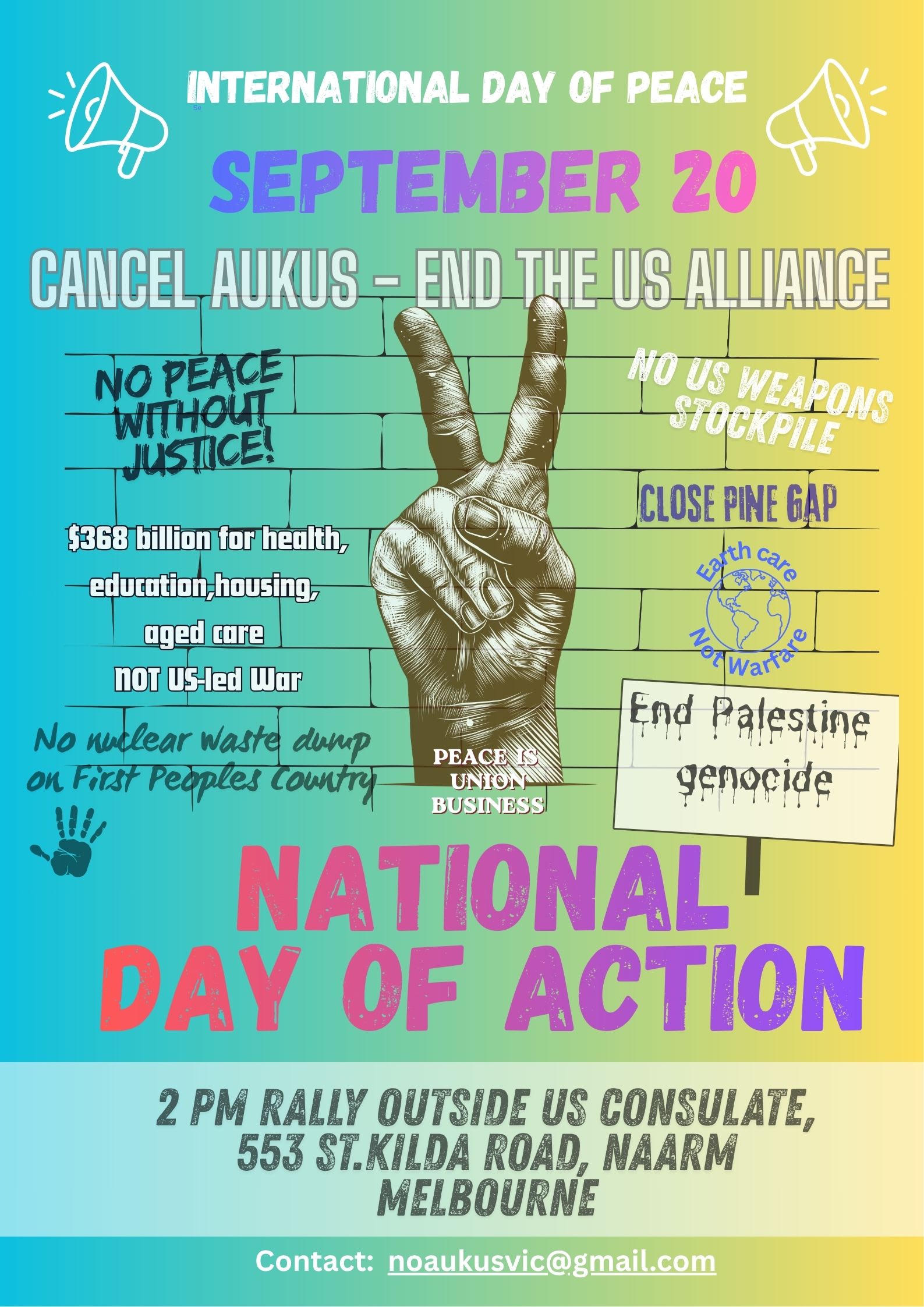
20 September –National Day of Action in Melbourne on the International Day of Peace


Help Aunty Sue Protect Her Land and Sacred Sites From Destructive Rocket Testing.
.

Australians deserve the truth
about
AUKUS – https://aukuspublicinquiry.com/
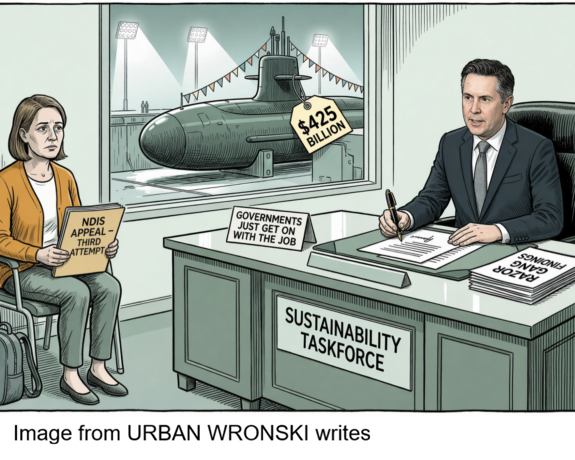

PETITION – To: Prime Minister Anthony Albanese and the Australian Labor Government

of the week – Australians for War Powers Reform (AWPR)
To see nuclear-related stories in greater depth and intensity
 Antinuclear