For the public good: Submission to #NuclearCommissionSAust from Robert Eastman
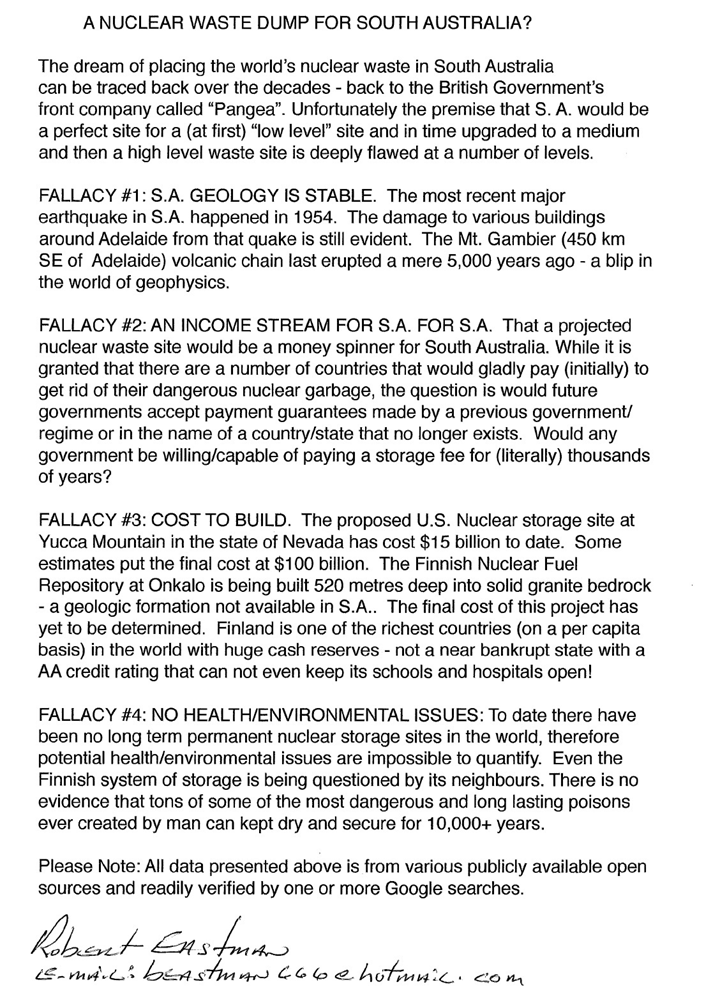
 Robert Eastman’s Submission to South Australia Nuclear fuel Chain Royal Commission – on the issue of Nuclear Waste Importing. Eastman provides documentary information on various requirements.
A song of praise for Synroc – Roger Smart’s Submission to #NuclearCommissionSAust
 Roger Smart’s Submission to South Australia Nuclear Fuel Chain Royal Commission.
– a very short submission on the subject of nuclear wastes. It canned be summed up as a Song Of Praise for the Synroc Technology for storing nuclear wastes.
EXTRACT: “The safest and cheapest option available for disposal of high level nuclear waste”
Nuclear Waste Management (NWM) — an Adelaide based Company founded in 1985……..
In 1991 NWM signed a Heads of Agreement with Mayak Production Enterprise, owned by the Russian Ministry of Power and Energy and Greenlawn Association of the Russian Federation to commence a study for the construction of a SYNROC plant. The Russians selected SYNROC as their preferred waste form for the treatment and disposal of their high level waste. They also commenced geological studies to find sites for the disposal of SYNROC in deep drill holes.
………. it proved impossible to find the political/financial and corporate leadership to secure the funding. The reasons were many but during the 80’s and 90’s, the nuclear industry was on the defensive and investment, other that in programs already in place, was greatly reduced. Consequently, NWM ceased operation in 1998
……. A detailed brochure and other material on SYNROC and NWM have been provided to the Executive of the Royal Commission”
**********************************************************************************************
 Nuclear accident much worse than reported , April 28, 1993 The nuclear accident at the Tomsk-7 reprocessing plant in Siberia on April 6 was much bigger than first reported, and now may seriously impede expansion of the nuclear fuel cycle in Australia.
Spokesperson John Hallam for the antinuclear groups Friends of the Earth and Movement Against Uranium Mining said, “Proposals to build a replacement research reactor in Sydney and a nuclear waste repository in the NT based on Synroc technology would be compromised by a public realisation that both projects depend on the same sort of technology for waste handling that failed so badly at Tomsk”.
Hallam said that information from Russian green groups indicated that the accident was not a 3 on the international nuclear event scale, as earlier claimed, but at least a 5. Chernobyl was a 6…..www.greenleft.org.au/node/4227
ARIUS ASSOCIATION’s Submission to #NuclearCommissionSAust confuses ethics with greed
AriusAssociation Submission to the Royal Commission on Management, Storage and Disposal of Nuclear and Radioactive Waste
Arius is a a non profit body, (but friendly to the nuclear industry). It addresses nuclear waste disposal. It details structures and measures needed. Arius relies heavily on information from [the failed South Australian] Pangea Project. Its purported aim is for an “ethical project” – ‘to fulfil our ethical responsibilities to future generations’
Arius is upbeat about economic advantages, upbeat about safety and security. It appears to be complacent about a safe uneventful future for nuclear industry.
Nowhere does Arius discuss the historic disasters of the nuclear industry, its intrinsic connection with nuclear weapons proliferation, not the increasing risks of terrorism.
In discussing nuclear waste from an ethical point of view, the option of just stopping making the stuff is not considered.
Despite Arius’ confidence in nuclear industry waste disposal technology, they are ware of the implications:
” The Extremely Long Times that must be considered Repository safety analyses are routinely carried out for a million years into the future. These time scales challenge the conventional basis for the design of technological systems. Designs for such systems are usually based on a combination of past experience and theoretical projections, which can be supported by testing and observations of performance on relevant time scales. Because it is not possible to test and observe the engineered components of a repository over representative time scales, a repository’s safety would ideally be guaranteed by natural processes that have already demonstrated their performance over millions of years.”
However, their central theme seems to be to enthuse over the financial benefits to South Australia.
David Bowman’s Pro Nuclear Submission – Nuclear waste dump to help wildlife!!
 Submission to the Nuclear Fuel Cycle Royal Commission Professor David Bowman, School of Biological Sciences, University of Tasmania
EXTRACT
“I believe there is scope to use uranium mining and nuclear waste storage as a source of funding to tackle the urgent challenge of biodiversity, and particularly the threats to our unique and threatened Australian mammal fauna in the longer term
…….Australia’s insularity, tectonic and political stability make it an ideal setting for high-level nuclear waste storage. Uranium mining and waste storage could potentially provide a funding base for an internationally significant conservation intervention throughout outback Australia. To provide this capital and revenue, I suggest the expectations of mine site restoration are changed from attempts to restore mined areas to their original condition, and instead focus on containing pollution from these sites.
Savings should be invested in establishing at least ten very large predator-proof exclosures (> 500 km2) in the surrounding unmined landscapes in outback Australia. Further, exhausted sites associated with mining in geological stable and arid areas like Olympic Dam could be used for high-level nuclear waste disposal. Income associated with storage of nuclear waste, and the requirement they are managed over the long term (> 100 years), would provide funding for ongoing Aboriginal ranger programs to manage country throughout outback Australia…..”
Golder Associates – another pro nuclear Submission to #NuclearCommissionSAust
You can access this one from http://nuclearrc.sa.gov.au/submissions/?search=Submissions.
Golder Associates Submission on Management, Storage and Disposal of Nuclear and Radioactive Waste. An engineering company, its aim is to show how they have designed and developed projects, and worked with Indigenous and local communities.
Worked with Pangea , ANSTO , AREVA, Ontario Power Generation, They set out an Adaptive Phase Management approach. Set out process for building support with indigenous communities.
BHP not interested in nuclear waste import – Submission to #NuclearCommissionSAust
BHP’s Submission on wastes is very short. Two major points –
- reiterates call to remove uranium mining from being listed as a Matter of National
Environmental Significance 9NES) in the Federal Government’s Environment Protection and Biodiversity Conservation Act (EPBC Act). - doesn’t want to have any involvement in storage or disposal of nuclear waste.
BHP Billiton Submission to Royal Commission http://nuclearrc.sa.gov.au/app/uploads/2015/11/BHP-Billiton-03-08-2015.pdf
EXTRACT “Management, Storage and Disposal of Nuclear and Radioactive Waste BHP Billiton’s experience with radioactive waste management and storage at Olympic Dam is limited to the storage of tailings and other low level contaminated materials generated during the treatment of ore……
Tailings storage and management is common in mining operations throughout the world, and in this respect the management of tailings at Olympic Dam is no different to that of other BHP Billiton operations not involving uranium (e.g. copper or nickel), or indeed other mining operations worldwide.
Given this similarity, the demonstrated level of environmental management and the low level of radioactivity involved, the treatment of tailings from uranium operations should be considered as akin to that of other metal mining operations. Correspondingly, it does not warrant being considered a matter of national environmental significance that triggers the requirements of the EPBC Act.
BHP Billiton does not handle or manage intermediate and high-level radioactive wastes. Nevertheless we understand that current thinking is toward long term storage rather than disposal, as it is foreseeable that the contained energy may be able to be harnessed in the future.
Irrespective of whether storage or disposal is preferred, BHP Billiton considers that either option would be inconsistent with our core business of mining and the production of high quality copper and associated by-products at Olympic Dam.”
Change Australia’s Environmental Protection Laws – ANSTO”s submission to #NuclearCommissionSAust
 EXTRACT from ANSTO Submission http://nuclearrc.sa.gov.au/app/uploads/2015/11/Australian-Nuclear-Science-and-Technology-Organisation-03-08-2015.pdf
Legislative and regulatory
Significant legislative changes would be required in order to develop a South Australian nuclear power industry. At present, nuclear power is prohibited in Australia. At the Commonwealth level, the Environment Protection and Biodiversity Conservation Act 1999 (Cth) effectively prohibits the construction or operation of nuclear fuel fabrication plants, nuclear power plants, enrichment plants or reprocessing facilities.
In addition, the Australian Radiation Protection and Nuclear Safety Act 1998 (Cth) prevents the CEO of ARPANSA from licensing the siting,construction or operation of such facilities by Commonwealth entities. At the South Australian level, there is a conditional ban on conversion and enrichment (see section 27 of the RadiationProtection and Control Act 1982).
In addition to the removal of those legislative barriers, legislation would also be required in order to upgrade the existing regulatory structure or create new a regulatory structure capable of performing the functions required for the licensing of nuclear power reactors. There would
also need to be legislation governing nuclear liability in order to bring Australia into line with international norms……..
BHP’s Submission to #NuclearCommissionSAust – “No particular health risks from uranium mining”
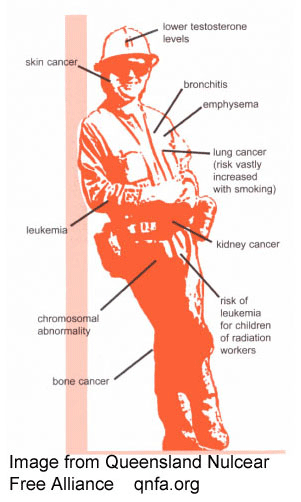 A not very exciting Submission, in which BHP outlines its work at Olympic Dam. The major point is that BHP wants to remove uranium mining from being listed as a Matter of National Environmental Significance 9NES) in the Federal Government’s Environment Protection and Biodiversity Conservation Act (EPBC Act).
BHP maintains that the health risks from uranium mining are not really different from the risks in any other type of mining.
On the future for the uranium market, BHP is cagey, pointing out that copper is the major money-spinner from Olympic Dam
BHP Billiton – Submission to RC ISSUESPAPER 1 Exploration, Extraction and Milling http://nuclearrc.sa.gov.au/app/uploads/2015/11/BHP-Billiton-03-08-2015.pdf
EXTRACT
“…..We believe this Commission to be an important opportunity to seek changes that will reduce barriers to entry into uranium extraction and exploration. We make two important recommendations: Continue reading
Australian Workers Union complacent about health, sends pro nuclear Submission to #NuclearCommissionSAust
Not surprisingly, the AWU Submission concentrates on JOBS. They quote (to my mind) some rather ambitious and over-confident forecasts on the employment future, with the nuclear fuel chain.
AWU enthusiasm focuses on the opportunities in uranium mining, – says little about o the other phases of the full nuclear chain. Confident of the economic benefits of that chain, and keen for nuclear waste importing.
Notably, their Submission says very little about health: it is very complacent about radiation safety.
AUSTRALIAN WORKERS UNION SUBMISSION TO SA Nuclear Royal Commission http://nuclearrc.sa.gov.au/app/uploads/2015/11/Australian-Workers-Union-03-08-2015.pdf
Scott McDine- National Secretary The Australian Workers’ Union Level10, 377-383 Sussex Street, Sydney NSW 2000 Phone: 02 8005 3333 1 Fax: 02 8005 3300 Website: www.awu.net.au I Email: members@nat.awu.net.au
EXTRACT
“……This submission asserts that the potential economic and employment benefits of the nuclear fuel cycle are vast, and that failure to act would represent a lost opportunity for South Australia. It also acknowledges Australia’s capacity to manage the safety, environmental and security risks associated with the nuclear industry…… Continue reading
AREVA’s published Submission to #NuclearCommissionSAust
 The RC published only one Submission, from AREVA Australia I think that we can be pretty confident that AREVA sent in other Submissions , including one on waste management.
The published Submission is pretty boring – deals only with uranium mining and exploration. AREVA does acknowledge the current poor uranium market, but looks to future growth, without any convincing reason. I list some extracts below, – they are not very notable.
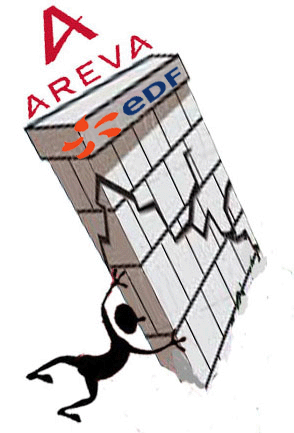
I thought that the relatively large time that the RC spent with AREVA was more interesting. Ironically, the RC in France met with AREVA on the day after President Hollande ordered AREVA to merge with EDF, to save it from bankruptcy.
4 June 15 Visit to AREVA Tricastin, France.
- Explanation of AREVA’s conversion plant and the development of the project;
- Tour of conversion plant construction site;
- Explanation of AREVA’s Georges Besse II operating enrichment plant;
- Tour of GB II enrichment plant facilities.
Visit to AREVA Melox, France.
- Explanation of AREVA’s operating mixed oxide fuel fabrication plant and the use of mixed oxide fuels;Tour of mixed oxide fuel fabrication facilities.
5 June 15 Visit to AREVA La Hague, France.
Visit to EDF Flamanville, France.
8 June 15 Meeting with AREVA.
- Discussion of future nuclear energy demand, barriers to investment in the nuclear fuel cycle and the economics of investment.
SUBMISSION SOUTH AUSTRALIA: NUCLEAR FUEL CYCLE ROYAL COMMISSION
ISSUE PAPER #1 EXPLORATION EXTRACTION AND MILLING
IAN JOHN (JOE) POTTER RP GEO 24 JULY 2015
AREVA Resources Australia Pty Ltd A.B.N. 44 009 758 481 68 Greenhill Rd Wayville SA 5034 Tel: + 61 8 8292 9300 Fax: + 61 8 8377 7903 Email: infoARA@areva.com
“INTRODUCTION
AREVA is at present the world’s largest, integrated company in the nuclear cycle”…. (Ed. note. -That’s no longer true)
“CONCLUSIONS and RECOMMENDATIONS Continue reading
ANSTO’s Submission to #NuclearCommissionSAust – not keen on Thorium
Thorium fuelled nuclear power reactors are often put forward as a possible alternative to uranium 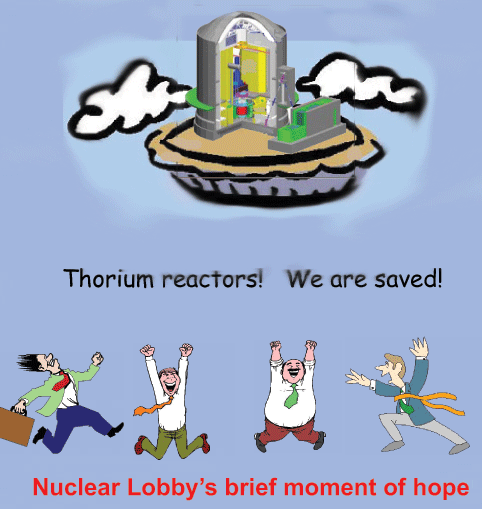 fuelled reactors on the basis of a number of arguments, not all of which are accurate. For example, proponents of thorium reactors often claim that the thorium fuel cycle is resistantto proliferation risks.
However, the production of uranium‐233 during the thorium fuel cycle presents a potential proliferation risk that would require similar safeguards to those in place for the uranium fuel cycle today (ANSTO 2013).
Although the thorium fuel cycle is a theoretically feasible source of energy, there is limited evidence that significant investment in future thorium technologies would improve on the well established technologies and systems in place for the uranium fuel cycle, for which Australia is already one of the world’s largest exporters…..
ANSTO’s Submission (on all 4 Issues papers) says surprisingly little about nuclear waste management. It directs those remarks to how expert ANSTO itself is at managing nuclear waste.
It is enthusiastic about the future for nuclear power, but I note that it uses that “escape” word “potential” when predicting that good future. No author is named.
ANSTO Submission http://nuclearrc.sa.gov.au/app/uploads/2015/11/Australian-Nuclear-Science-and-Technology-Organisation-03-08-2015.pdf EXTRACTS
“nuclear power, in countries with limited potential for hydropower, is the most efficient and cost‐effective low emissions fit‐for‐service base‐load electricity generation option……
new generation nuclear power plants under construction across the world represent a mature and safe technology; and future nuclear technology has the potential to further improve safety while reducing cost and up‐front capital investment requirements…..
“Safety Continue reading
Let’s examine the pro nuclear Submissions to #NuclearCommissionSAust: here’s one
An example of pro nuke submission from an individual representing in a company. His theme is that waste import would be a great economic boon to South Australia, but only if it is part of a full nuclear fuel chain. He quotes some significant safety risks, but seems to dismiss them as not so serious. He is delightfully enthusiastic, but vague, on the economic benefits.
Henry Askin sent in a submission on Nuclear Waste (Issues paper4 ) http://nuclearrc.sa.gov.au/app/uploads/2015/11/Henry-Askin-24-07-2015.pdf )
Dr. Henry J Askin Director, U-SAFE PTY LTD U-Safe Pty. Ltd. was founded in 2006 to promote the construction and operation of a safe permanent storage and disposal repository for the radioactive by-products of the nuclear fuel cycle.
Askin’s conclusion is vague on the economic result of importing nuclear waste, by itself. But enthusiastic if it is part of the whole nuclear fuel chain:
“The economic benefits will depend on the extent of commitment to the full nuclear fuel cycle, the cost of studying and building the repository, the operating costs and moreover the extent of funding provided by the eventual client entities. Estimation of costs is highly problematic, since there are no equivalent benchmark projects available……
It is not practical to establish an enrichment and reprocessing facility in the state unless in conjunction with nuclear power generation as well. These processes are intensive in electricity consumption and would result in very significant greenhouse gas emissions if conventionally powered. On the other hand, if it were decided to establish a full nuclear fuel cycle industry necessarily including the adoption of nuclear power generation, the economic benefits would be incalculable.
Effects would spread directly throughout the various areas of transport, high technology processing and fabrication of fuel rods, material supply and construction and the initiation of tertiary specialist training in all aspects of nuclear engineering, and spill widely throughout the general service and retail economy.”
Economics. He starts with enthusiasm for the economic benefits of waste importing:
“It is without question that if a best in class ILW and HLW repository was accessible the electricity utilities operating the nuclear power stations and the reprocessing facilities would avail themselves of it. This is evidenced by the 1998/1999 campaign by Pangea Resources seeking to establish a deep subsurface repository in Western Australia. The company was created by British Nuclear Fuels, Golder Associates and Nagra, the latter being a Swiss radioactive waste management entity. Management of the public relations was a spectacular failure, with both WA and SA introducing legislation prohibiting the establishment of nuclear waste waste dumps in 1999 and 2000 respectively.
However Pangea, now known as ARIUS, continues efforts internationally.”
“Considering the increasing imperatives to remove HLW from vulnerable temporary storage in the vicinity of source reactors, safe disposal would not be expected to be price or cost sensitive. In fact, the generators of this waste would in all probability be prepared to fund the construction of the repository in addition to paying ongoing storage costs for the operation and maintenance of the facility.”
But it would really only be economic if Australia first had the full nuclear fuel chain:
“If the industrial capacity to conduct such full cycle processing were to be established in the state, the magnitude of the resulting economic benefits would go a long way towards the acceptance of international waste and the concomitant construction of the deep storage repository. “
On the safe storage/disposal of nuclear waste:
Within salt domes or mines ……….The most successful of these is the Waste Isolation Pilot Plant (WIPP), opened for business in 1999 at Carlsbad New Mexico. ( ha ha successful?)
Drigg is a surface storage facility (ha ha currently threatened by flooding in Cumbria)
He then lists the technical problems in geology for waste disposal
On security risks:
“The principal security risks would appear to be related to protest activities by anti nuclear groups and more seriously, terrorist action. The former would be unlikely to penetrate the perimeter of the surrounding exclusion zone, and be limited to hindrance of transport logistics for limited periods. There is abundant experience in managing this category of essentially nuisance behavior and is not considered to be of concern.
Far more serious is the possibility of terrorist attack with the objective of acquiring ILW and/or HLW for the assembly of devices capable of area denial in populated or strategic locations, the ‘dirty bomb’ strategy. Although the material would be potentially lethal for those involved, in this age of suicide bombing this is perhaps not an inhibition. However if a deep burial repository were to be established in a remote semi desert area of inland Australia unauthorized access would be a major challenge”
On transport:
“The greatest vulnerability would lie not with the repository itself but with the waste delivery transport chain” “Transport of waste to the repository could pose hazards but is unlikely to adversely affect the environment to any greater extent than normal transport” (ha ha what about the huge derailment of sulphuric acid transport, Queensland, in December?)
Bill Fisher spells it out on nuclear waste – Submission to #NuclearCommissionSAust
Bill Fisher Nuclear Fuel Cycle Royal Commission – Submission – All Issues
Introduction I frequently make submissions to parliamentary enquiries on matters nuclear: most recently the Enquiry into Nuclear Non-proliferation and Disarmament and the Enquiry into expansion of the Roxby mine. My submission is usually among the large majority (about 90%) opposed to uranium mining and export. The usual 90% majority is usually ignored! The 10% who are listened to are uranium industry representatives, governments and government departments, and a few scientists who are on the payroll of the uranium industry or the government. While this is a significant problem in the case of federal governments, it is far worse in South Australia, where the Roxby Downs Indenture Act is designed to override virtually all other legislation, and government departments which are supposed to monitor mining and export also act as promoters and protectors of the industry…..
#NuclearCommissionSAust plans for radioactive trash dumping on Aboriginal land: a confusing issue
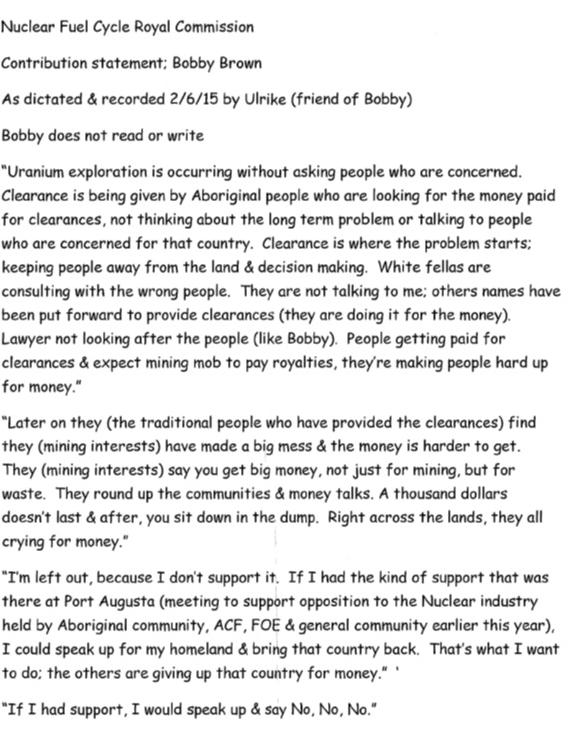
SA Royal Commission: Nuke waste dump on Aboriginal land? Really?, Independent Australia Noel Wauchope 23 October 2015 THIS IS clearly a terribly important question that needs discussion. When and if theNuclear Fuel Cycle Royal Commission (RC) ultimately results in establishing a nuclear waste import business in South Australia, it is a certain bet that it will be on Aboriginal land.
There are relatively few published submissions from Aboriginal people and organisations. However, these cannot be easily lumped into pro or anti nuclear boxes. There are some passionately anti nuclear ones. There are no passionately pro nuclear ones, but there’s more than a hint of support in the two submissions that take an apparently neutral stance. The RC has allowed Aboriginal people to choose whether or not their submissions are published.
A pro nuclear submission might evoke condemnation from environmentalists and other Aboriginal groups. This fact is recognised in the submission by Maralinga Tjarutja and Yalata Community Incorporated: …..
1 This month

of the week – Australians for War Powers Reform (AWPR)
To see nuclear-related stories in greater depth and intensity
 Antinuclear