MARK COLVIN: The head of BHP Billiton, Marius Kloppers, says he cannot guarantee that the company will redevelop the Olympic Dam mine in the future.
South Australia’s wind energy bonanza
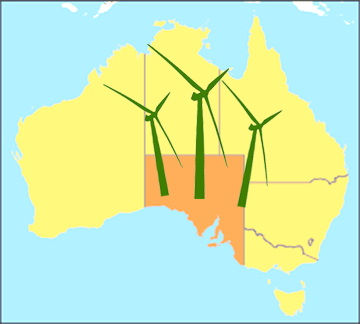 Wind accounts for 58% of energy use in South Australia, By Giles Parkinson on 6 September 2012 It’s been another big week for wind production in South Australia – as another spring weather system with high winds makes wind energy the dominant force in local energy production.
According to figures pulled together by consultants Intelligent Energy Systems using data from the Australian Market Operator, wind energy produced accounted for 57.9 per cent of demand in the state on Tuesday, and followed up with 55 per cent of total demand on Wednesday……
exports from South Australia to other states. On Tuesday, the state was exporting almost all day, as the wind output was quite consistent. On Wednesday, it exported for most of the day and there is a bit of pink at the top in the late afternoon to indicate coal imported from Victoria. (South Australia’s coal generators are in mothballs right now due to the impact of wind, and lower demand, and the carbon price)……
These one day graphs, of course, are just snapshots of an overall trend happening in the state, and across the National Electricity Market, that will only become more apparent as the amount of wind and solar installed in the country increases. Indeed drew Reidy, from IES says these days only rank as the 6th and 12th highest in terms of energy produced on a single day, and 5th and 6th in terms of percentage of demand. The highest day in terms of output was on August 17 this year, while the highest in terms of percentage of demand came in February 5, when wind accounted for 64.1 per cent of demand across the day.
The Clean Energy Council’s Russell March said it was proof that wind energy can generate real power – and lots of it. “This type of significant wind generation is common in South Australia,” he said. In 2011/12, according to AEMO data, wind produced 24 per cent of the state’s generation, overtaking coal. And, Russell noted, AEMO data shows that emissions from South Australia’s electricity sector have dropped every year since 2005/06, and have reduced by more than 27 per cent over the last five years.
“All this wind is putting SA way ahead of the curve on the national Renewable Energy Target, helping provide farmers and local business owners in regional areas with extra income. It also means that the state’s residents collectively have a lower carbon price bill, while getting fully compensated from the Federal Government under the scheme.” Indeed, on Tuesday and Wednesday, the state enjoyed not just by far the cleanest energy in the country, but also the cheapest, with average prices over the day at $43/MWh, compared to more than $52/MWh for NSW….. http://reneweconomy.com.au/2012/wind-accounts-for-58-of-energy-use-in-south-australia-75810
South Australia’s massive Olympic Dam dream down the toilet
Analysts had calculated the expansion would have cost BHP close to US$30 billion over several years as it developed a pit more than 4 kilometers long, 3.5 kilometers wide and 1 kilometer deep…. the plans had also envisaged the construction of a desalination plant, new port andairport facilities and expanded work accommodation.
 BHP Gives South Australia No Guarantees For Olympic Dam Fox Business September 03, 2012 Dow Jones Newswires BHP Billiton (BHP) Chief Executive Marius Kloppers in a meeting Monday could provide no revised schedule, or guarantees, to the state premier of South Australia for the expansion of the Olympic Dam copper and uranium mine… Continue reading
South Australian govt and BHP Billiton gloomy about the future of Olympic Dam uranium mine
Kloppers’ bleak Olympic hopes by: Michael Owen, The Australian September 04, A BLEAK outlook has been presented by BHP Billiton chief executive Marius Kloppers for an expanded Olympic Dam mine ever operating in South Australia.
Mr Kloppers yesterday held talks with Premier Jay Weatherill in Adelaide to explain why the miner’s board last month indefinitely shelved the $28.7 billion project. He emerged from the hour-long meeting to say there was no timeframe for the project and no guarantee it would ever go ahead.
This came more than a week after The Weekend Australian revealed that Mr Kloppers had warned the expansion might never happen because the project was now dependent on the uncertain development of cheaper “leaching” technology to expand the mine’s future production. He had said that unlike “optimistic” scientists, the miner was “insufficiently certain that an eventual project will happen”. Mr Kloppers reiterated that message yesterday after meeting with the Premier. “We have been working and expending a lot of money on trying to make this project a reality,” Mr Kloppers said…… “I can’t give you any timeframe on how these things could progress.”
Asked if he could give a guarantee the mine would be redeveloped, he said: “No, I cannot.”
Mr Weatherill tried to maintain a positive message, but conceded the current model planned for the expansion “does not work”.. they are not able to advance a time when the technology will be proven, nor are they able to give us certainty about whether the technology will be capable of being proven, and therefore they will not be in a position to give us certainty about when the mine proceeds.”…
Mr Weatherill said that after his meeting yesterday, any future expansion was even further away than he had previously thought……
The opposition said all of the government’s tough-talking about BHP meeting its December deadline to go-ahead with the expansion and the project’s benefits for the state, had proven to be “bluff and bluster”. http://www.theaustralian.com.au/national-affairs/kloppers-bleak-olympic-hopes/story-fn59niix-1226464289847
BHP talking about leaching methods for Olympic Dam uranium mine
 AUDIO No guarantee for Olympic Dam mine expansion ABC Radio P.M. http://www.abc.net.au/pm/content/2012/s3581996.htm Nicola Gage reported this story Sept 3 2012,
“……NICOLA GAGE: Mr Weatherill says he was informed on the different technologies BHP are looking into. That included new forms of conveyor belts, and the potential use of heap leach technology.

JAY WEATHERILL: Which has been investigated in laboratories and is, over a period of six years, has been scaled up to a certain size in terms of tests, but needs to be tested further to see whether it can be brought to scale and be used for full production.
NICOLA GAGE: Heap leach technology was flagged as an alternative extraction option in BHP’s original environmental impact statement in May 2009. The company already uses it in South America.
Professor Bill Skinner specialises in environmental surface science at the University of South Australia.
BILL SKINNER: There is a precedent for heap leaching technology in Australia, so it’s not exactly a unique process in Australia.
NICOLA GAGE: While it might be considered a new technology in the public arena, the process has been around for years. But Professor Skinner says difficulties with constancy made it expensive.
BILL SKINNER: In the last few years, quite a lot more has been learned about the process that goes on inside a heap leach, and how one treats the ore in order to make sure that one heap behaves very similar to another, and sort of keep reproducibility up, because after all, that reproducibility of the process governs the constant, if you like, valuable recovery from those heaps.
NICOLA GAGE: Questions have been raised about whether another environmental impact statement would be needed with any future expansion. Premier Jay Weatherill.
JAY WEATHERILL: Because we don’t know what the technology is, it’s, it becomes difficult for us to make an assessment about whether there is any additional environment risk. We know that there are some leaching technologies that are used in different parts of the state, but on the face of it, yes, they do raise environmental issues. So, of course, there’s the feasibility of the technology, but then there’s the environmental approvals that may go with that.
NICOLA GAGE: The company’s 15,000-page environmental impact statement expires in 2016. …
Flinders University participates in USA Department of Energy’s pro nuclear propaganda
 Christina Macpherson 3 Sept 12, 18 months after the Fukushima nuclear accident, the truth is filtering out, about the continuing release of radiation from the crippled reactors, as radioactive water seeps into the ground below them, and radiation levels linger in the Fukushima area. The Chernobyl disaster’s health effects on the Ukrainian population are becoming widely known, but the evacuation following the 1986 Chernobyl nuclear accident was managed more swiftly, and permanently, than the Fukushima evacuation.
How important is the impact of continuing low level radiation on children’s health? We have our answer already in the high rate of thyroid disorders among Fukushma’s children.
It is shameful that an Australian university should participate in the USA’s Department of Energy’s propaganda to promote nuclear power, and whitewash the reality of ionising radiation’s harmful effect on human health:
Radiation response a meltdown in reason Flinders University News, July 14th, 2011 Published by FU Marketing and Communications. The possibility that low doses of radiation may prevent or delay the progression of cancer is being explored by a Flinders University research team led by Professor Pam Sykes in a move that runs counter to the widely held perception that exposure to any radiation is harmful.
Professor Sykes, recently appointed to the University’s Strategic Professorship in Preventive Cancer Biology in the Flinders Centre for Cancer Prevention and Control says the public panic in response to nuclear accidents such as that at Fukushima in Japan is the result of a general ignorance about radiation.
“…….. radiation is not the poison, the dose is,” Professor Sykes said……. “It’s now been accepted that they should not have evacuated so many people because the biggest detriment from Chernobyl was that they were dramatically disadvantaged, both economically and socially. Many suffered depression thinking they were going to die of cancer…..
Professor Sykes’ research, which involves doses of radiation that are up to three orders of magnitude lower than those used by other investigators, has been funded by the US Department of Energy Low Dose Radiation Research Program for almost 10 years…… Studies in Canada and Japan have also shown that low doses of radiation given to mice delay the onset of cancer, and reduce the symptoms of diabetes and atherosclerosis, improving the span and quality of life of the affected animals.
Professor Sykes and her team are currently examining low dose radiation therapy in reducing or preventing prostate cancer
BHP Billiton downsizes Olympic Dam project, as uranium market collapses
BHP Billiton Shrinks Project Team for Olympic Dam Mine, WSJ, BY ROBB M. STEWART, August 29, 2012, MELBOURNE—BHP Billiton Ltd. is reducing the size of the project team working on scaled-back plans to expand its Olympic Dam copper and uranium mine in South Australia, with roughly 140 employees facing transfer or lay off.
Melbourne-based BHP, the world’s largest mining company by market value, last week cut or deferred billions of dollars in proposed investments and said it wouldn’t approve any new major project until at least the middle of next year as costs continue to soar and commodity prices slump. The highest-profile casualty of the clamp down on spending was its US$30 billion Olympic Dam project, and …subscribers only http://online.wsj.com/article SB10000872396390444506004577618130532297156.html
South Australia can now develop its diversified economy, with the Olympic mirage gone
Mining in SA is still a minnow compared with the state’s traditional economic base. Manufacturing accounts for about 11  per cent of economic activity, agriculture 6 per cent and mining 4 per cent, boosted by high commodity prices…. despite government rhetoric, SA is far from a mining state.
those things that are the reason why South Australia existed: our agriculture, fishing, aquaculture, food processing,
Prospects take a dive with shelving of Olympic Dam expansion BY: SARAH MARTIN, SA POLITICAL REPORTER The Australian August 25, 2012 BHP Billiton’s Olympic Dam mine expansion would have created a hole in the ground as deep as South Australia’s highest peak.
An open pit 4km long, 5km wide and 1km deep was to be dug across five years to create the world’s largest copper and uranium mine at Roxby Downs in the state’s outback, 560km north of Adelaide.
But it was not to be.
{ at left, BHP’s CEO Marius Kloppers and former S.A. Premier Mike Rann, in the heady days of their ill-judged fervour for Olympic Dam) BHP’s decision this week to shelve the $30 billion project has left SA without the mining boom it was promised. For almost a  decade, former premier Mike Rann and treasurer Kevin Foley spruiked the transformative power of the mine project,
proclaiming it an economic panacea for the state……
The mine’s promise continued to be sold by the Weatherill administration after Rann’s departure, with budget figures predicated on the mine going ahead, even while a global commodity downturn made its prospects doubtful…..
Adelaide-based chief economist of Prescott Securities Darryl Gobbett
says the government had promised a mining boom that would not
eventuate.
“I think they have hyped up what was going to happen before the
event,” he says. …… Continue reading
King Uranium is losing not only its Big Mine, but also its Adelaide Castle!
 BHP dumps Adelaide tower plans BY: SARAH DANCKERT The Australian August 25, 2012 BHP Billiton has scrapped plans to take a long-term lease on a purpose-built $250 million office tower in central Adelaide following its decision to shelve the expansion of its Olympic Dam mine.
The miner is also understood to be considering reducing the amount of existing office space it leases, said to be about 10,000sqm, in what will be a blow for the Adelaide office market…. Adelaide property professionals are maintaining a stiff upper lip despite the miner’s devastating decision to put on ice the $US30 billion ($28.6bn) expansion of the uranium and copper mine, 560km north of the city.
Earlier this year the miner began sounding out developers for a purpose-built office tower in the city’s central business district to house the new employees. BHP Billiton established its uranium headquarters in Adelaide in 2009 when the company created the Uranium Customer Sector Group.
Up until recently BHP Billiton was seeking a long-term lease on a state-of-the-art office that would be built for the resources group in the heart of the city. The lease was to include naming rights over the building. Continue reading
South Australia better off without the Great Big New Uranium Mine?
The union movement sees an upside to the delay at Olympic Dam, urging the state government to use it to fight for a better deal for SA.
 SA Unions state secretary Janet Giles said benefits from the mining industry should flow to the whole community, and the state government would be wise to show caution when dealing with BHP Billiton in the future.
Olympic delay no mining death knell Sky News, August 24, 2012 South Australia’s peak mining group says BHP Billiton’s decision to delay the expansion at Olympic Dam is not all doom and gloom.
Chief executive Jason Kuchel said SA’s mining industry had diversified dramatically over the past decade and the state currently had 20 major mines in production with many more projects in the pipeline…..
‘South Australia has a lot on the go with several new mining regions, exciting oil and gas developments, and a multitude of small and mid-tier miners who collectively could bring just as much, if not more, benefit to the state than the expansion of Olympic Dam.’ Continue reading
South Australia just escaped a very poor deal of Olympic Dam as “China’s quarry”
 SA government now wary of BHP: premier, Yahoo Finance, AAP – Wed, Aug 22, 2012 “…He [Premier Jay Weatherill ] said South Australia was now entitled to be wary when dealing with the company in future and warned the government would take a tougher approach to negotiations if asked to approve expansion a third time.
“We’ve been given to understand that BHP were proceeding with an expansion once. We’ve been given to believe that BHP will proceed with an expansion twice,” Mr Weatherill said. “If they come to us and seek permissions and approvals on a third
occasion, we will be taking a different approach to the negotiations….
the Greens said the delay was a “get-out-of-jail card” giving the government the chance to negotiate a much better deal.
“The 2011 deal was economically irresponsible, environmentally reckless and would have left South Australia as little more than China’s quarry,” Greens MP Mark Parnell said. “Despite giving the company nearly everything it wanted, it still
didn’t stack up economically.”… Continue reading
Decision to stop new Olympic Dam uranium mine was unavoidable
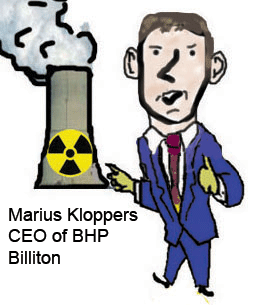 New era for BHP shareholders Financial Review 24 AUG 2012 TONY BOYD Marius Kloppers secured his job by delaying $30 billion in capital projects in Australia but he needs to do much more to get the BHP Billiton machine humming at optimum speed….
There was an inevitability to the project delays….. Olympic Dam might have been justified several years ago when its cost was estimated at $15 billion. But at a cost double that amount and with Australia’s high construction and infrastructure cost base, it was untenable.
Kloppers said the project never actually jumped the hurdle called “economic concept”, which meant BHP was never able to talk seriously with a potential Chinese partner to develop the world’s largest uranium deposit and fourth largest copper and gold deposit….
His outlook statement issued with the full-year results was seen by several analysts as bullish. But coverage will be dominated by the Olympic Dam decision because of its widespread implications.
Analysts think it is unlikely that a large-scale development project will proceed at the site in South Australia…. Given the company’s desire to operate within a credit rating envelope that delivers it low-costing debt, the Olympic Dam decision was unavoidable. Continue reading
Can Olympic Dam copper mine be developed without uranium recovery?
Dr Gavin M. Mudd Environmental Engineering, Monash University December 2010
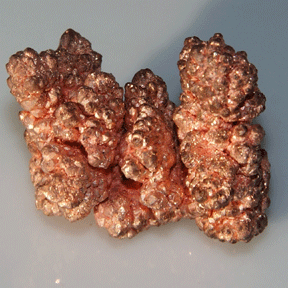
“…… – it is eminently reasonable to propose a process flow sheet for Olympic Dam which does not include recovery of the uranium but still allows for copper, gold and silver to be produced.
http://users.monash.edu.au/~gmudd/files/ODam-Cu-only.pdf
Of course, a more modern idea is in design. Designing technologies so that it is practical and relatively easy to RECYCLE copper – C.M.
Open cut mine at Olympic Dam dead in the water? perhaps just copper extraction now?
Writing on the wall now gospel The Age, August 23, 2012 Malcolm Maiden “…..The decision to defer the Olympic Dam open-cut project was forced by a tightening cost-benefit equation as capital costs rose and commodity prices eased.
BHP said at its announcement that it would investigate ”an alternative, less capital-intensive” open-pit design, and is expected to focus on copper extraction technologies, among other things.
The biggest cost in the project is digging the open-cut quarry. There is no way to significantly downsize project costs without reducing the size of the hole, and the amount of overburden that needs to be removed before the ore body is exposed.
The final outcome is in the hands of the markets and the copper price, but the full-blown open-cut idea may be dead.
http://www.theage.com.au/business/writing-on-the-wall-now-gospel-20120822-24mqf.html#ixzz24PobKbbu
The Olympic Dam uranium project – uneconomic, unnecessary for South Australia
At its peak, the mine was expected to consume more electricity than the city of Adelaide, and 100 Olympic swimming pools worth of fresh water every day.
Olympic Dam was too expensive.
South Australia will be fine. Mining accounts for a relatively small share of South Australia’s overall economy, and only 1 per cent of its employment.
the carbon emissions from Olympic Dam would have dwarfed all the gains in emissions reductions that South Australia has made in renewable energy in recent years
The Olympic Dam Delay Has A Silver Lining New Matilda, By Ben Eltham 23 Aug 12, Why did BHP Billiton halt the Olympic Dam mine? The project was just too expensive. The decision is good news for the South Australian environment, writes Ben Eltham
Picture a hole in the ground four kilometres long and one kilometre deep. Picture a manmade mountain of dirt next to it nearly as high — a mountain of dirt dug from the ground and heaped next to that hole, a new landmark on the South Australian horizon.
Picture a mega-project so large and so thirsty that it would have required a new baseload electricity generator to meet its power needs, and a new desalination plant hundreds of kilometres away on the coast to make the water it required.
Picture a mine so vast, it would have increased the world supply of Uranium by a third.
This was the vast edifice that was to be Olympic Dam — when finished, the largest mine in the world. Continue reading
Former South Australian Premier Mike Rann – a uranium legacy in tatters
 In the end, they weren’t able to deliver the new jobs, the billions in taxes and the mining boom.
The Olympic Dam expansion is now a genuine “mirage in the desert”…..
How Olympic Dam became a mirage in the desert, Crikey, by Kevin Naughton of InDaily, 23 Aug 12, It’s seven years since an excited Premier Mike Rann and his then-deputy Kevin Foley started briefing media executives about an imminent mining boom. Central to the spruik was BHP’s new estimation of Olympic Dam, the copper, gold and uranium mine in South Australia that it had just bought from Western Mining Corporation……
Ousted by the party’s powerful right wing in July, Rann brokered a deal to hang on until late October, so he could see the amended Olympic Dam Indenture Agreement deal through Parliament, adding to his legacy. That legacy now has a hole in it; on a political scale, larger than the one BHP talked of digging.
In a curious political twist dating back 30 years when the ALP was split over whether the original mine should go ahead, Rann labelled it a “mirage in the desert”. Rann had come to SA in 1977 as an anti-uranium campaigner from New Zealand and scored a job with then-premier Don Dunstan. Dunstan resigned in 1979 and incoming Liberal premier David Tonkin became an advocate for mining in the state’s north, but the numbers in Parliament were tight. Continue reading
1 This month



Help Aunty Sue Protect Her Land and Sacred Sites From Destructive Rocket Testing.
.

Australians deserve the truth
about
AUKUS – https://aukuspublicinquiry.com/

PETITION – To: Prime Minister Anthony Albanese and the Australian Labor Government

of the week – Australians for War Powers Reform (AWPR)
To see nuclear-related stories in greater depth and intensity

