‘Up to $12,000 owing to Adnyamathanha girl’: Grandmother
‘Up to $12,000 owing to Adnyamathanha girl’: Grandmother, Transcontinental, Greg Mayfield 4 Sep 19
Indigenous woman Janette Milera is caught between two worlds.
Smart as a whip, and adept with her mobile phone and laptop, she is fighting to bridge the gap between the ancient tribal lands of her forebears and the modern reality of mining royalties.
The royalties flow to the tribal land-owners from an estimated $30-40 million payment so far by Beverley uranium mine in the outback under Native Title.
“There should be some sort of Royal Commission or something into the way Native Title operates,” she said.
She said Aboriginal people faced enough difficulties, without missing out on royalties. On behalf of her grand-daughter, she applied to the association in 2013 for payment of royalties, declaring that her grand-daughter had Adnyamathanha heritage and filling out a membership form for the corporation.
The association had replied that they would look into it.
“I am frustrated considering all the emails saying they were going to sort it out for her,” she said. “We hoped she could use the money to set up her own little house or flat when she moves out. She could have everything. She is missing out.”
Ms Milera, of Plympton Park, is an Arabunna woman who formerly lived in Port Augusta where she helped set up the local Community Development Employment Project, now Bungala Corporation. The association has been contacted for comment. The valuable royalties flow to the association from Heathgate Resources’ Beverley uranium mine on Adnyamathanha land in the outback. https://www.transcontinental.com.au/story/6346351/where-are-the-royalties/?cs=1538&fbclid=IwAR02tzupZOSaQT3oidg05qkwkgLjHIj9jM0YTCB5ndwGjF8HiPN8OTOHDsA
South Australian law – no public money towards nuclear waste dumping facility
NUCLEAR WASTE STORAGE FACILITY (PROHIBITION) ACT 2000 – SECT 13
13—No public money to be used to encourage or finance construction or operation of nuclear waste storage facility
(1) Despite any other Act or law to the contrary, no public money may be appropriated, expended or advanced to any person for the purpose of encouraging or financing any activity associated with the construction or operation of a nuclear waste storage facility in this State.
(2) Subsection (1) does not prohibit the appropriation, expenditure or advancement to a person of public money for the purpose of financing the maintenance or sharing of information or to enable the State to engage with other jurisdictions.
The Kimba nuclear waste dump ballot – breaching South Australian law?

ENuFF[SA], 21 Aug 19, Today Kimba Council announced a date for a community ballot on the radioactive suppository ~ October 3rd.
http://www.kimba.sa.gov.au/page.aspx?u=408&c=10102
The legality of conducting such a ballot needs to be tested in the courts, since s.13 of the Radioactive Waste Storage Facility (Prohibition) Act SA 2000 prohibits public monies being spent “…. encouraging or financing any activity associated with the construction or operation of a nuclear waste storage facility in this State.”
http://classic.austlii.edu.au/au/legis/sa/consol_act/nwsfa2000430/s13.html
This concerns & will affect ALL South Australians, not just Kimba. We should start a fund for a court injunction based upon s.13 “… any activity …” of the Radioactive Waste Facility [Prohibition] Act ~ & then engage Maurice Blackburn Lawyers [eg] to mount a case against the ballot.
Council announces dates for Kimba radioactive waste ballot
 Council announces dates for Kimba radioactive waste ballot, Kimba District Council, 21 Aug 19, The Kimba community will have its say on the of the Commonwealth Government’s proposed National Radioactive Waste Management Facility at one of two nominated sites in the district from October 3.
The District Council of Kimba today announced the dates for the long-awaited ballot, which has been delayed for more than 12 months due to litigation.
While the favourable judgment received by Council in the Federal Court of Australia on 12 July has been appealed, Mayor Dean Johnson said that there was no legal impediment to the ballot proceeding to determine the level of community support as part of the overall site selection process.
“Council’s position has always been to facilitate the ballot on behalf of the Minister for Resources and Northern Australia so our community could have its voice heard, and we reaffirmed that position at our ordinary meeting last week,” he explained.
“We were advised this morning that the Minister no longer requests that the Kimba and Hawker ballots to be run concurrently, so Council has commenced planning with a view to ballot papers being posted out on 3 October.”
The ballot will be run in a manner identical to that scheduled to be held in 2018, and applications from eligible ratepayers and residents for inclusion on the voters roll will be open for a period of three weeks from 23 August 2019 until midday on 13 September 2019…..http://www.kimba.sa.gov.au/page.aspx?u=408&c=10102&fbclid=IwAR1y2ZfiGYV6gFpnvtTkWYWNs1_LcelO3cQ1iLG3RaC22tVRoHy0NHQ2igg
Nuclear waste: Kimba committee even discussed transitioning out of the site selection process
Life after nuclear decision discussed, Eyre Tribune, Rachel McDonald 16 Aug 19,
Assisting the Kimba community in transitioning out of the site selection process should it not be chosen for the National Radioactive Waste Management Facility (NRWMF) was among issues discussed at a consultative committee meeting on Wednesday.
The committee, made up of Kimba community members both for and against hosting the facility near Kimba met with NRWMF taskforce general manager Sam Chard.
Despite the BDAC appealing the decision, the Kimba District Council this week announced its intentions to move forward with the ballot.
“We’re open to their suggestions about how we might do this,” she said.
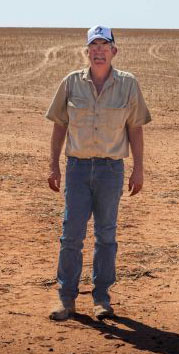 Jeff Baldock, who sits on the committee and volunteered the Napandee site, said he was pleased to resume discussion and see movement in the ballot process…… [Ed. Note: Mr Baldock’s property is said to be the Government’s favoured site for the waste dump – a useful little additional money-spinner for a farmer]
Another topic discussed at the meeting was the decision to increase the footprint of the site to allow a larger buffer zone between the facility and its neighbours …..
After community members wishing to observe the meetings expressed concern about restrictions on note taking during meetings, reviewing the observer code of conduct was on the agenda…..
Minutes of the committee meetings are released on the department website. https://www.eyretribune.com.au/story/6331281/life-after-nuclear-decision-discussed/?fbclid=IwAR2ODEstxlVCJUe64cS9huIKT3AV98Jyxy5r9WEfM7n-SMhJGarPzuZUlhU
South Australian students plan more climate action -“No jobs on a dead planet”
Tom Webster and Guthrow Taylor Johnson are among 12 student protesters skipping school between 9am and 3pm on Friday each week with no intention of stopping in the near future.
The weekly strikes follow mass school walkouts across the globe earlier this year, including in South Australia.
On March 15, thousands of high school and university students swarmed King William Street demanding politicians take a firmer stance on climate change.
During the event, Adelaide School 4 Climate spokesperson Doha Khan called on her peers to boycott Friday classes until the Federal election.
lthough the election came and went, Taylor Johnson said the group wouldn’t stop protesting until their key demands were met.
“We want no more new fossil fuel projects in Australia,” he said.
“Starting with saying no to Adani, which is going to be the biggest coal mine in the Southern Hemisphere if the government allows them to build it.
“We also want 100 per cent renewables by 2030 and we want a just transition for workers in fossil fuel industries for them to go into renewables.”
The South Australian climate strikes are part of an international movement led by 16-year-old Swedish climate activist Greta Thunberg.
In 2018, Thunberg spent every school day sitting outside of Sweden’s parliament protesting the country’s inaction on climate change. Thunberg later reduced her strikes to every Friday, kicking off a movement of Friday school protests.
A wave of school and university strikes demanding more progressive climate policy has since erupted across the globe.
Last Friday, the National Union of Students led university students in Australian capital cities in striking against climate change.
Webster said while many of their fellow weekly protesters were attending the strike he and Taylor Johnson – who are both still in high school – felt it was important to continue their parliamentary protest as well.
Taylor Johnson said the pair planned to join the next major climate strike, to be held on September 20, and hoped to see his peers there.
“Right now, in Australia, [there’s] a lot of climate deniers. So, it’s up to Australia to both lead the way in climate policies and set an example to other countries,” Taylor Johnson said.
A Seaton High School year 11 student, Taylor Johnson said he originally struggled to find a balance between his studies, social life and activism but has managed to navigate the three successfully…. https://indaily.com.au/news/2019/08/16/no-jobs-on-a-dead-planet-the-sa-students-who-wont-give-up-on-the-climate-change-strike/
21 August Senator Matt Canavan to hold closed meeting , then 2 open ones, in region designated for nuclear waste dumping

Queensland Sinister Matt Canavan is having a closed door meeting with the Barndioota Consultative Committee before the Hawker meeting. No doubt the serious nuclear waste dump decisions will be made then
But there’ll be open meetings – ?window dressing – at Hawker 21 August, and at Kimba 22 August.
21 August Wed 3.30 – 430 pm Hawker Sports Centre – Druitt Range Drive, Hawker
22 August Thurs 11 a.m – 12. pm Kimba Gateway Hotel- 40 High St Kimba
Kimba Council renews commitment to local community ballot on nuclear waste dump

Despite this, Kimba mayor Dean Johnson said the council had received legal advice that the ballot process could now resume.
“There’s no legal impediment to us proceeding with the ballot,” he said.
Mr Johnson said the council had received a “strong judgement” in the federal court, and he encouraged the community to read it themselves.
He said the Resources Minister had requested the council proceed with the ballot, and it was important to give the Kimba community their vote on whether the waste management facility should go ahead in the district
“Our community have been in a holding pattern for a very long time… our main objective is to give our community an opportunity to have their say.”
He said he believed it was the responsibility of the Department of Industry, Innovation and Science to make sure the Barngarla people were properly consulted during the site selection process.
South Australian Labor – too pro environment ?
|
Our own base rejected us”: Labor warned on ‘pro-environment’ agenda, InDaily, Tom Richardson @tomrichardson, 2 Aug 19
The ALP’s recent caucus strategy meeting in the Barossa – colloquially known as the ‘Labor Love-In’ – was given detailed analysis of the federal election results in SA, with a breakdown of booths relevant to state seats. Results in the key Liberal-held marginal of Boothby, obtained by InDaily, show strong swings to Labor in more affluent areas, including Hills districts such as Belair and Blackwood, with swings away from the party in more traditional working class booths such as Edwardstown, Ascot Park and South Plympton. Boothby was retained by Nicolle Flint on a 1.4 margin, despite a 1.3 per cent swing against her after a federal boundary redistribution. A Labor insider says the Boothby booth result is indicative of a broader trend seen “in every seat in the country” – which they insist dispels the popular election post-mortem that Labor’s financial reform policies cost them the poll. “The principal conclusion you come to from that data is that there are mild swings in the wealthiest parts of the seat to Labor, and big swings in the working class areas against Labor – that would rather suggest it wasn’t the franking credits that lost us the election,” the source said. “It was something more fundamental – it was our own base that rejected us. “Did they reject us on the franking credits [or a] scare campaign on negative gearing policy? Maybe. “Or did they get the sense that we were more pro-environment than pro-jobs?” That conclusion is one being impressed on Peter Malinauskas’s state caucus, with insiders insisting Boothby “doesn’t augur well for a state result”…….. But ALP insiders aren’t universally convinced that the lesson from the federal result is to eschew a strong climate change agenda, which was a hallmark of Labor’s 16 years in government. …… https://indaily.com.au/news/politics/2019/08/02/our-own-base-rejected-us-labor-warned-on-pro-environment-agenda/ |
|
John Quiggan demolishes the case for Small Modular Nuclear Reactors in South Australia
 JOHN QUIGGIN John Quiggin is Professor of Economics at the University of Queensland.
John Quiggan’s Submission to the #NuclearCommissionSAust addressed Question 3.2 of the Issues Papers:
“Are there commercial reactor technologies (or emerging technologies which may be commercially available in the next two decades) than can be installed and connected to the NEM?”
Extract “….Business SA wants Australia to adopt the PRISM reactor, a so-called Generation IV design. Unfortunately, “design” is the operative word here: PRISM is, literally, still on the drawing
(Tell them they’re dreaming • Inside Story http://insidestory.org.au/tell-them-theyre-dreaming 3 of 4 26/06/2015)
It does not exist even in prototype form. The US Department of Energy, along with designers GE and Hitachi, looked at the idea of building such a prototype at the Department’s Savannah River plant a few years ago, but the project has gone nowhere.
Much the same is true of another popular piece of nuclear vaporware, the “small modular reactor.” All but one of the American firms hoping to produce a prototype have abandoned or scaled back their efforts. The remaining candidate, NuScale, is hoping to have its first US plant operational by 2024, with commercial-scale production some time in the 2030s.
And, of course, there’s no guarantee that the new designs will work in economic terms, or that the problems of waste disposal and proliferation can be resolved. Even assuming this optimistic projection is met, small modular reactors aren’t going to be a viable option for Australia any time soon.
Unfortunately, that didn’t stop the Bureau of Resources and Energy Economics from asserting, in its 2012 Australian Energy Technology Assessment, that “SMR technology could potentially be commercially available in the next five to ten years” and presenting it as a low-cost option for 2020. This absurdly optimistic claim was abandoned in the 2013 update, which drastically increased the estimated costs and dropped the claim that the technology would be feasible in 2020.
There is still a chance for nuclear power to contribute to decarbonisation of the global economy in China and other countries with an existing program or the state power to force through a crash program. But these conditions don’t exist in Australia, and there is no serious prospect that they will do so in time to play a substantial role in decarbonisation. Anyone who pretends nuclear power is a serious option for Australia under current conditions is dreaming or, worse still, deliberately diverting attention from the real issues. ……….” http://nuclearrc.sa.gov.au/app/uploads/2015/09/John-Quiggin-29-06-2015.pdf
Huge volumes of water gulped by Olympic Dam uranium mine – even more with expanded mine
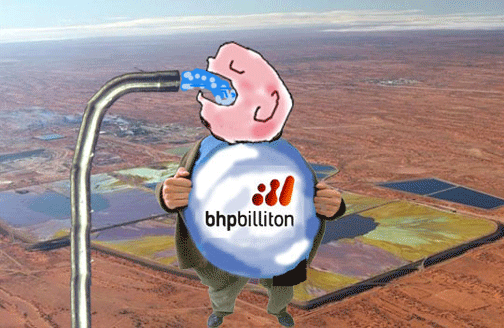
The nuclear cycle of destruction, Red Flag, James Plested, 12 July 2019 “……..The first stage of the cycle – the mining of uranium, the fuel used in nuclear power stations – is particularly relevant to Australia, home to an estimated 31 percent of the world’s known uranium reserves.
Uranium mining requires huge volumes of water – an obvious problem in arid Australia – and produces large quantities of toxic “tailings” which threaten the surrounding environment and people.
The historical record speaks for itself. According to the Gundjeihmi Aboriginal Corporation, over the 38 years of operation of the Northern Territory’s Ranger mine, there have been around 200 leaks, spills or other breaches of the mine’s operating licence. In 2013, the collapse of a leach tank resulted in a spill of about 1 million litres of radioactive waste over the mine site.
Beyond the risk of accidents, there are many other downsides to nuclear power. One particularly relevant factor for Australia is that nuclear reactors require massive amounts of water. A typical US reactor, for example, consumes 114 million litres of water an hour. To put this in perspective, total residential water consumption in Melbourne, a city of 4.8 million people, in 2018 was around 32 million litres an hour.
Australian business heads and governments have long had an eye on further uranium mines. The anti-nuclear movements of the 1970s and early 1980s, as well as the later campaign against the proposed Jabiluka uranium mine (see article in this issue), kept this aspiration in check. In recent years, however, state and federal governments have renewed the push.
The South Australian government is supporting a proposal by BHP to expand massively the operations of its existing Olympic Dam mine – which contains the largest single uranium deposit in the world. And the day before the last election was called, the federal government abruptly announced its approval of a new uranium mine in  Western Australia…….
The need for water means that reactors must be located close to rivers, lakes, dams or the ocean. In Australia, this would inevitably mean reactors would need to be built in or near densely populated areas…..” …… https://redflag.org.au/node/6835
South Australian communities DID NOT voluntarily enter into process for hosting nuclear wastes
 Katrina Bohr No Nuclear Waste Dump Anywhere in South Australia, 12 July 19
However please take note of the wording at the finish:
‘The department will examine the decision in detail in the coming days, before advising the communities who voluntarily entered into the process, of the next steps.’
When did the communities Voluntarily enter into the process?
The landholders volunteered their land, but the communities didn’t voluntarily enter into the process. https://www.facebook.com/groups/1314655315214929/
BIRDS VS BHP: Evaporation ponds at BHP’s Olympic Dam mine are killing hundreds of birds
BIRDS VS BHP: Evaporation ponds at BHP’s Olympic Dam mine are killing hundreds of birds
Hundreds of birds are dying each year after mistaking Olympic Dam’s evaporation ponds for wetlands. Environment campaigners want the miner to stop using them. Clare Peddie, Science Reporter, The Advertiser, July 10, 2019
Conservationists want BHP to stop using evaporation ponds at Olympic Dam that kill hundreds of birds, including threatened species.
They want BHP to cancel plans for a new pond and phase out 146ha of existing ponds, which are used for the disposal of acidic waste water………
Scientist and environment campaigner David Noonan says it’s shocking that birds are drowned, choked or scalded by BHP’s highly acidic, toxic wastewater.
“They see this as a wetland in an arid region as they’re travelling through,” he said. “They’re typically poisoned by contact, they die on site or they’re poisoned and die later.”
BHP found 224 dead birds during weekly monitoring in the 2017-18 financial year and that included 39 banded stilts, a vulnerable species in SA. The number of dead birds found annually has hardly changed since 2011-12, when the banded stilt, red-necked avocet, whiskered tern, grey teal, black swan, hoary-headed grebe, …..
Plans for a huge open cut mine that were shelved in 2012 would have required a phase-out of evaporation ponds, but BHP says that condition is no longer relevant or applicable to current growth and expansion of the underground mine.
BHP is preparing to make a submission to both state and federal governments for a sixth evaporation pond.
A separate submission on a the new tailings storage facility – about the size of the Adelaide CBD and ten storeys high – has already been made, triggering an Environment Protection and Biodiversity Conservation Act referral, as in the case of the endangered bird in the path of the interconnector. https://www.adelaidenow.com.au/news/south-australia/evaporation-ponds-at-bhps-olympic-dam-mine-are-killing-hundreds-of-birds/news-story/1b886e4946f87fb7a729e201282f5cfb
Uranium contamination in groundwater in an Adelaide suburb
|
Uranium among contaminants sparking proposed bore water ban in Thebarton, ABC News By Eugene Boisvert, 5 July 19 About 1,500 Adelaide residents and businesses have been told not to use groundwater because of contamination from uranium and degreasing chemicals.
Key points:
The Environment Protection Authority (EPA) is proposing a permanent groundwater ban for the area, which includes most of Thebarton and a small part of Mile End, just west of Adelaide’s CBD. The authority has also found contamination from degreasing chemicals tetrachloroethene (PCE) and trichloroethene (TCE) that were used in the area. Similar groundwater bans are in place in Adelaide suburbs including Edwardstown, Clovelly Park, ……. https://www.abc.net.au/news/2019-07-04/uranium-among-contaminants-leading-to-thebarton-bore-water-ban/11277300 |
|
South Australia the leader in energy efficiency
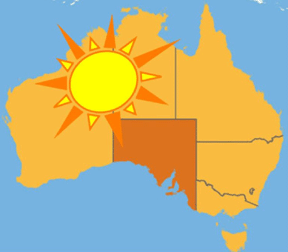
 South Australia leads push for energy efficiency, India Murphy,
  ,
,
1 This month

of the week – Australians for War Powers Reform (AWPR)
To see nuclear-related stories in greater depth and intensity
 Antinuclear