How Australian governments gave BHP special treatment, and free groundwater
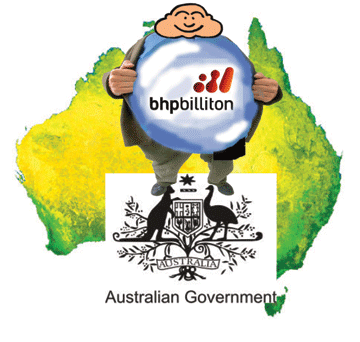
 Public resources for private profit: free water for the largest open-pit mine in the world Coober Pedy Regional Times, by: Nectaria Calan, 13 Oct 11 In August mining giant BHP Billiton announced record financial results for the 2011 financial year, recording a total net profit of US$23.95 billion, nearly double its 2010 figure of US$13.01 billion.
Friends of the Earth call for transparency on proposed Whyalla In Situ Leach uranium trial
14 oct 11, Public submissions for Samphire Uranium’s application for an In Situ Leach trial mine closed yesterday. Better known as the Mullaquana project, the proposed trial site is located 20km from Whyalla, 3.6km from the Upper Spencer Gulf. Samphire Uranium is wholly owned by UraniumSA, a new entrant in the uranium mining industry.
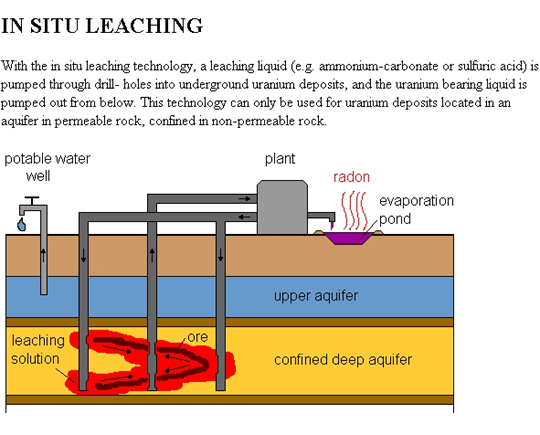
In Situ Leach mines pump highly acidic substances into an aquifer to mobilise uranium. The liquid is then pumped out of the aquifer and processed to remove the uranium. The waste liquid is then pumped back into the aquifer.
Two grassroots environmental groups, Friends of the Earth Adelaide and West Mallee Protection, stated in their joint submission that:
“Given the number of risks involved with the proposed Mullaquana trial, particularly the routine contamination of groundwater by heavy metals and radioactive materials associated with In Situ Leach mining…we strongly recommend that this proposal is rejected.”
“Using…questionable, fuzzy logic, attempts are made to argue that low soil productivity and the low quality of groundwater negate potential risks and minimise the impact of contamination…this is essentially saying that it’s okay to pollute soil and groundwater with radioactive materials and heavy metals simply because it is of a lower quality.”
Friends of the Earth Adelaide and West Mallee Protection are calling on PIRSA to reject the application.
“The In Situ Leach method of mining has left numerous sites in Eastern Europe heavily contaminated. In South Australia, there have been over 20 spills at the Beverley In Situ Leach mine. In January 2002 a pipe burst, releasing 62, 000 litres of contaminated water. UraniumSA claim that they have recruited heavily from within this sector,” said Nectaria Calan, of Friends of the Earth Adelaide.
No commercial acid leach mine in the USA has ever been given environmental approval because of the high risk of contamination.
“Given UraniumSA’s public commitment to transparency, we are calling on the company to commit to making publically available the In Situ data that will be obtained during the trial, and the models they use to obtain it,” stated Ms Calan.
Soouth Australia’s Mike Rann gives freehold to BHP over Olympic Dam uranium mining lease
 “They have a code of silence at that mining lease that’s stronger than any code in downtown
 Calabria,” “They even have the government tied up because when BHP says jump, the government says how high.”
Yesterday, Rann again signed off on BHP’s powerful proprietary interests over the site. BHP gets freehold over the extended Olympic Dam mining lease. Few mining companies have this ultimate level of control.
The estimated mining royalties for South Australia ($350 million) from the “world’s biggest mine in human history” are around one tenth of what Western Australia pulls every year from iron ore.
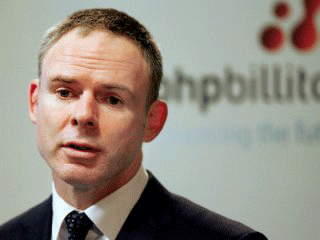 Mike Rann delivers Kloppers’ Kingdom in Melbourne, Crikey, by Kevin Naughton of InDaily, 13 Oct 11,
“…….Rann was in Melbourne at BHP Billiton’s headquarters to sign the indenture agreement that specifies several of the terms under which BHP can expand its mine at Olympic Dam. Marius Kloppers, the busy global boss of the company with more than $72 billion turnover, held the whip hand on the Premier of a state with annual turnover of about $13 billion.
The indenture agreement goes before Parliament next week where there will be some token debate, but little in the way of exhaustive analysis of the terms of a deal that gives BHP 45 years of certainty, control and exclusive access rights that make this mine site look more like Kloppers’ Kingdom than a part of South Australia. Continue reading
Australia’s Environment Minister lying about safety of BHP’s Olympic Dam uranium mine


( Once again – so much news on Olympic Damn that we have put a selection of other items on http://nuclearnewsaustralia.wordpress.com/)
A headache of Olympic proportions The Drum, Scott Ludlam, 13 Oct 11 The concept of ‘environmental protection’ has taken on new meaning with the announcement of Commonwealth environmental approvals for BHP Billiton’s Olympic Dam copper/gold/uranium mine in South Australia.
“We have the toughest environmental conditions that you’ll ever find imposed on a uranium mine,” Commonwealth Environment Minister Tony Burke stated proudly.
This is known in the technical literature as a ‘bald-faced lie’. We know that, because the toughest environmental conditions found at a uranium mine are 2,000 kilometres northward, at the Ranger Uranium mine on a lease chopped out of Kakadu National Park in the NT. There, the company is required to backfill the mine voids with their radioactive wastes, removing somewhat more than a hundred million tonnes of the stuff from the surface and dumping it back in the pit to be capped and revegetated as best as possible. In Kakadu, the company is required to isolate these wastes from the wider environment for a period not less than 10,000 years. This is clearly an impossible task, but a worthy ambition at least.
No such duty of care will be applied for the benefit of South Australians. Mr Burke has earnestly reassured us that conditions will apply for 10 years after the life of the mine. He has granted approval for the mine tailings waste to be dumped and left out on the surface in apparent ignorance of the fact that the residual inventory of Uranium 238 has a half-life of 4.5 billion years, and that the mine wastes will contain a cocktail of unwanted daughter isotopes including radium, protactinium, radon gas and radioactive lead. Continue reading
Not all smooth sailing for BHP’s plan to expand Olympic Dam uranium mine
 agreement is conditional on the Indenture Act passing through South Australia’s Parliament. And with the Greens and Opposition poring over the details, that progression is far from assured.
The company has signed a preliminary agreement with the state’s Premier Mike Rann. BHP Billiton now has a year to reach a final investment decision. Mr Rann says today will go down in history.
But the Opposition says he has compromised important negotiations. Nance Haxton reports. Continue reading
With Diesel rebates, BHP’s Olympic Dam Royalties likely to return poorly to South Australian Government
Mike Rann has claimed that the new open-pit mine will be his “economic legacy to the state.” However, a consideration of the financial return to BHP through diesel rebates alone indicates that this legacy may be somewhat overstated…
 BHP stands to gain $128 million per year in diesel rebates in the initial development period of the mine, $144 million per year in the intermediate stage, and $178 million per year at full production.
Public resources for private profit: free water for the largest open-pit mine in the world Coober Pedy Regional Times, by: Nectaria Calan, 13 Oct 11, “………With approval of the new mine announced on Monday, the next stage of the approval process is the negotiation of a new Indenture Act which will apply to the new mine. It is expected that the revised Act will be introduced into the South Australian parliament next week, given Mike Rann’s commitment to finalising the indenture agreement before his retirement on October 20.
It is within the power of the South Australian government to negotiate a substantially different indenture agreement, or to repeal the Indenture Act completely. Continue reading
Olympic Dam an unprecedented attack on Australia’s environment
 BHP Billiton’s Olympic Dam mine expansion will leave an uprecedented environmental legacy THE AUSTRALIAN, BY:PAUL CLEARY October 11, 2011 FUTURE generations of Australians will have to contend with an unprecedented environmental legacy from the expansion of Olympic Dam’s copper-uranium mine, but our system provides no way of compensating them.
BHP Billiton’s open-cut expansion of mining to extract an estimated $800 billion in mineral wealth will leave behind an above-ground heap of radioactive tailings spread over 44sq km and as high as the Sydney Opera House.
After 40 years of production, the mine will also leave behind a toxic crater measuring 4km wide and more than 1km deep.
Both legacies pose significant risks to ground water, according to BHP’s environmental impact statement . . . although these were dismissed yesterday by Environment Minister Tony Burke.
Under Australia’s federal-state system, the South Australian government has no incentive to set up a future fund so that it can compensate future residents for having to live with much less mineral wealth, and with the environmental costs of this development. Nor has the federal government or opposition shown any interest in measures to compensate our grandkids, and their descendants, for having used our inherited mineral wealth to inflate our standard of living….. the mineral resources rent tax won’t collect any of the above-normal profits earned from developing one of the world’s biggest ore deposits, because it only taxes coal and iron ore production. http://www.theaustralian.com.au/business/opinion/counting-the-cost-of-bhps-olympic-dam/story-e6frg9if-1226163362958
You’ve heard of Penis Envy? Now Rio Tinto brings Dirty Great Uranium Hole envy
Under today’s announced agreement, Tasman will get an immediate cash injection of A$10 million from Rio Tinto and that would see Tasman undertake a A$5 million search programme over Vulcan in the next 12 months. Tasman’s executive chairman Greg Solomon said Rio has the right but not the obligation to earn up to 80% in the project by committing to a two-stage farm-in arrangement by spending up to A$75 million and, in addition, paying Tasman up to A$17 million including the initial A$10 million payment….
The ambitious programme would see Olympic Dam transformed from a big underground mine to an open pit, but the ore system is under about 400 metres of sterile cover and would involve creating mountains of stockpiles in the pancake-flat terrain.
The market is awaiting a decision on Olympic Dam going open cut and it was considered imminent given the fact that South Australian Premier Mike Rann, who is soon to depart, indicated that he wanted to stay in the chair to be able to announce the mine upgrade…. http://www.mineweb.com/mineweb/view/mineweb/en/page103118?oid=137193&sn=Detail&pid=102055
A better plan for South Australia than accepting BHP Billiton’s toxic radioactive plan at Olympic Dam
“There is an alternative model that would see a lower greenhouse footprint and skilled jobs retained in South Australia. A peer-reviewed study by Monash University’s Dr Gavin Mudd demolished the myth that uranium is central to the mine’s expansion. His model for the expansion is safer, would use much less water and energy, and would mean more jobs and greater economic return for the local economy.
 Scott Ludlam, 10 Oct 11, The Federal Government’s approval of the Olympic Dam expansion will see the creation of a carcinogenic mountain range of finely powdered radioactive waste in South Australia, the Greens warned today. Australian Greens spokesperson for nuclear issues Senator Scott Ludlam said the proposed expansion of the BHP Billiton site to will be a disaster for the environment, human health and local jobs.
“BHP Billiton has designed a world’s-worst-practice uranium mine. Continue reading
Deep mining might increase Australia’s earthquake risks
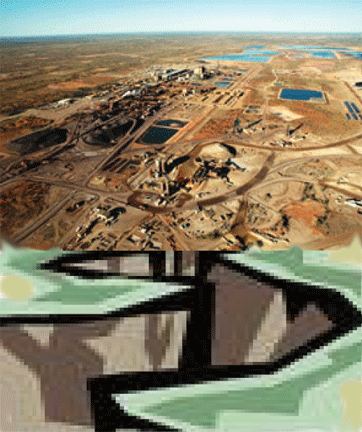 about every five years there’s a potentially devastating quake of magnitude 6.0 or more.
some scientists have suggested that mining might have been to blame in that case [Earthquake in Newcastle 28 December 1989,] …..Some experts think this [ deep-core mining] might be enough to destabilise pre-existing faults in the Earth’s crust, and to trigger an earthquake. Certainly, human activity – like large dams being filled – has been linked to quakes overseas….
Earthquakes in Australia, AUSTRALIAN GEOGRAPHIC BY:EMMA YOUNG | OCTOBER-6-2011 Earthquakes don’t only occur near our neighbours Japan and New Zealand – they’re common in Australia too “……..Australia doesn’t sit on the edge of a tectonic plate. However, the Indo-Australian plate, at the centre of which our continent lies, is being pushed to the north-east at about 7cm per year. It’s colliding with the Eurasian, Philippine and Pacific plates, causing stress to build up in the 25km-thick upper crust. This build-up of pressure within the plate can cause earthquakes in Australia.
In fact, Australia has more quakes than other regions that sit in the middle of plates and are considered relatively stable, Continue reading
Expansion of Olympic Damn uranium mining is not yet certain
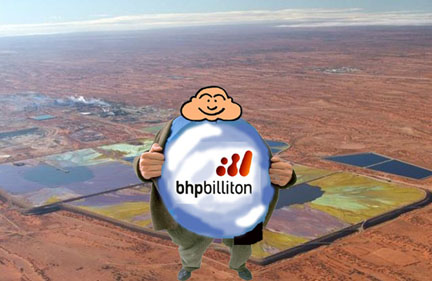 it is a lengthy process as BHP lines up all the necessary government approvals before taking the project to its board next year.
South Australia digs deep to take part in mining boom Telegraph UK 28 Sept 11, Deep in the South Australian outback, change is in the air. Quite literally in fact, since the plans under way to develop the Olympic Dam mine will create a site so vast that it is expected to affect local weather patterns.
Negotiations are now in advanced stages to give BHP Billiton the go–ahead to turn its existing operation some 560km (350 miles) north of Adelaide into the world’s biggest open cast mine. Continue reading
Danger of transporting nuclear waste through Australia’s major food bowl
 Nuclear waste transport opposed in South Australia 9 News, 29 Sept 11, A plan to ship nuclear waste through the South Australian Riverland puts one of Australia’s major food bowls at risk, the state opposition says. Riverland Liberal MP Tim Whetsone said the state government was totally opposed to a nuclear waste dump being located in South Australia and must take the same stand against the transport of nuclear waste.
A federal government report has advised against transporting waste from the Lucas Heights nuclear reactor in Sydney throughthe Blue Mountains to a proposed nuclear dump in the Northern Territory.
Instead it suggests shipping the waste by road through South Australia. Mr Whetstone said that would put the Riverland’s food production at risk of contamination along with water supplies from the Murray. “Much of this production is export focused and transporting nuclear waste through the Riverland sends a bad message to critical export markets,” he said.
“Transporting waste along the Sturt Highway will involve nuclear waste being in close proximity to the River Murray for much of the journey. “The risk to SA’s water supplies is unacceptable….
South Australia’s Liberal Party says nuclear power uneconomic, goes for gas and trigeneration
South Australian Liberals to look at trigeneration power, VERITY EDWARDS, The Australian, September 23, 2011 SOUTH Australian Opposition leader Isobel Redmond has committed a future Liberal government to investigating trigeneration power, despite concerns about its cost and reliability.
Delivering a headland speech to the Australia-Israel Chamber of Commerce in Adelaide, Ms Redmond yesterday criticised the introduction of a carbon tax and price as “economically insane”, described nuclear power as uneconomical and said gas would be the state’s logical source of future energy.
“If elected, a Redmond Liberal government will conduct a feasibility study into a trigeneration network in Adelaide,” Ms Redmond told the lunch. Gas-fired trigeneration plants produce electricity and harness the heating and cooling by-products for use within buildings.
The City of Sydney last year announced it wanted to establish a network of trigeneration plants capable of generating 330MW of electricity by 2030, or up to 70 per cent of Sydney’s needs….http://www.theaustralian.com.au/national-affairs/state-politics/south-australian-liberals-to-look-at-trigeneration-power/story-e6frgczx-1226144067671
South Australian government secrecy on expansion of BHP’s Olympic Damn
 Release ‘secret’ Roxby report, 22 Sept 11, The Greens have called for the immediate release of a hidden report that captures the views of State Government agencies on the Olympic Dam
Mega-expansion.
Called the ‘Assessment Report’, it is a compulsory step in the approval process for a major development. It summarises the responses by various government agencies to the proponent’s Supplementary Environmental Impact Statement (EIS) and is supposed to be released before the Government announces its approval of a project. However, for recent controversial projects the Rann Government has chosen to only release the Report after they have announced their decision. “The only reason the Government is choosing not to release the Assessment Report now is to avoid scrutiny,” said SA Greens Parliamentary leader Mark
Parnell.
“The Government is holding back the Report’s release for political reasons – keeping the SA community in the dark. This means that the public doesn’t get a chance to respond. It also allows the Government to dodge tricky questions as the media and others tend to focus on the approval decision, rather than what Government agencies actually think.
“The Rann Government has form in releasing the Assessment Report only after they announce their decision on a project. They did it for Buckland Park and they did it for the Port Stanvac desal plant. “For a project as important as the Olympic Dam expansion, the Government should be giving the SA community more opportunities to be involved in the
final decision, not less. “For example, the Assessment Report will be able to tell us what
Government agencies like SARDI really think about the proposed desalination plant at Pt Lowly.
“The Greens call on the State Government to immediately release the Assessment Report, well before they announce their decision on the OlympicDam Expansion.
Misleading headlines and terms in uranium propaganda
 We’ve been seeing a lot of “wobbly words” lately – from the nuclear/uranium industry. You’ll recognise them – “the fundamentals” (always great, of course). And in today’s hype for Uranium SA’s Whyalla plan – “robust” economics.
But the headline is the best in this one – “numbers stacking up”. – Well – the information that the share price of Uranium SA has fallen, and that it hasn’t secured financing – doesn’t bear out the enthusiastic headline. – C.M.
The numbers stack up for Uranium SA, The Age, Barry Fitzgerald, September 20, 2011 SOUTH AUSTRALIA is in line to get another uranium mine, this time from a new uranium province being opened up by ASX-listed Uranium SA to the south of the industrial city of Whyalla, on the Eyre Peninsula.
A study by USA into the likely financial returns from the development of one of the sediment-hosted uranium deposits it has outlined at its Samphire project – the Blackbush deposit – has confirmed ”robust” project economics…..
USA’s managing director, Russel Bluck, said USA’s financing options for the project development would include discussions with global integrated nuclear power groups. USA shares closed 0.5¢ lower at 15¢.
1 This month


Help Aunty Sue Protect Her Land and Sacred Sites From Destructive Rocket Testing.
.

Australians deserve the truth
about
AUKUS – https://aukuspublicinquiry.com/

PETITION – To: Prime Minister Anthony Albanese and the Australian Labor Government

of the week – Australians for War Powers Reform (AWPR)
To see nuclear-related stories in greater depth and intensity

