Yami Lester’s daughters continue his fight against the nuclear industry
Yami’s daughters take up anti-nuclear fight https://nit.com.au/yamis-daughters-take-anti-nuclear-fight/ – Wendy Caccetta –reporter@nit.com.auSisters Karina and Rose Lester know all too well the tragedy nuclear weapons can bring.
Their late father Yami Lester, a Yankunytjatjara man of northern South Australia, lost his sight after  being exposed as a boy to nuclear testing by the British Government at Maralinga in remote SA.
He went on to become a prominent anti-nuclear campaigner.
Now his daughters have taken up the battle, collecting and sharing stories that have helped the International Campaign to Abolish Nuclear Weapons (ICAN) win a Nobel Peace Prize.
The prestigious prize will be presented in Oslo on December 10, with an event at Melbourne Town Hall to be held the same day.
 Karina Lester, who lives in Adelaide, said when she was growing up her father did not talk much at home about what had happened to him as a boy when the nuclear testing took place.
But in public Mr Lester, who passed away in July at the age of 75, felt it was important to share with the world the events that shook the Wallatina community in the ’50s.
“There’s a role a parent plays in protecting your children from really knowing some of the sad, sad stories that did take place across our community,” Ms Lester said.
“He spoke a bit about where the camp was, he remembers that day, he remembers the ground shaking and this black mist rolling and the fear in the community.
“There was a huge loss for us as an Aboriginal community and we were so badly done by when the British came in and tested in our backyard that we still suffer to this day.”
Ms Lester said conditions in the community deteriorated over a week after the testing.“When the fallout happened, that evening, people were violently ill,” she said. “There was a lot of vomiting going around in the camp. People became sick. Their eyes started getting sore and tender.
“By day two, people were really starting to suffer. By week two, people’s eyes were either burnt out or people had bad burns on their bodies. “There were lots of rashes appearing and there was a trail of black-like soot that fell over the whole of the community.
“The oranges had shrivelled up and by that week were non-edible.”
Ms Lester said the story was a painful one, but needed to be heard. She said it was important to take a stand against anything nuclear from weapons to waste storage facilities. The Lester sisters gave NIT permission to reproduce the photo of their late father.
Hot weather in South Australia: Tesla battery turned on a day ahead of schedule
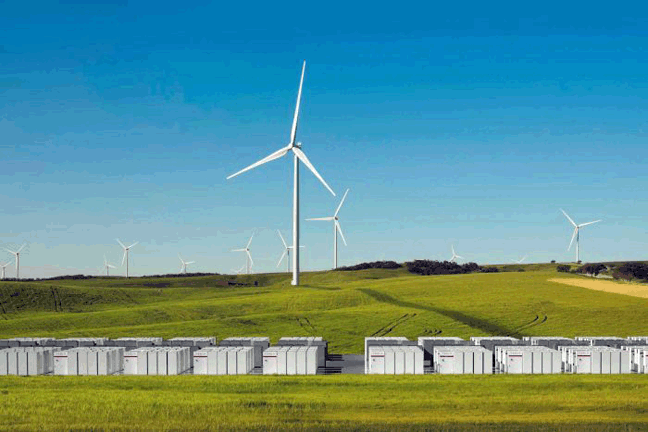 South Australia’s Tesla battery called on a day ahead of schedule as hot weather takes hold, ABC News 30 Nov 17 By politics reporter Nick Harmsen, South Australia’s giant Tesla battery has begun dispatching stored wind power into the electricity grid a day ahead of its scheduled switch-on.
Premier Jay Weatherill will visit the battery site — alongside the Hornsdale windfarm near Jamestown in the state’s mid north — on Friday, to mark its official opening on the first day of summer.
But with temperatures across South Australia and Victoria hitting the mid 30s, and output from the state’s wind farms low, the battery was called upon early to help meet Thursday afternoon’s peak demand.
The battery dispatched a maximum of 59 megawatts of power. The 100MW/129MWh battery is capable of powering about 30,000 homes for a little over an hour.
The manufacturer, Tesla says the lithium-ion device — made up of PowerWall 2 batteries — is both the “largest” by storage and “most powerful” of its type in the world……..http://www.abc.net.au/news/2017-11-30/sa-tesla-battery-begins-producing-power-a-day-ahead-of-schedule/9212794
South Australian law: government now prohibited from spending money to promote nuclear waste importing
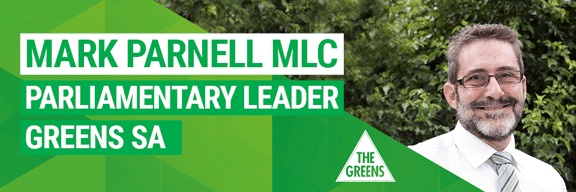 29 Nov 17, Today the Lower House of the SA Parliament passed my Greens Private Members Bill to remove the clause in the Nuclear Waste Storage Facility (Prohibition) Act 2000 that allowed the Government to spend public money on spruiking the benefits of an international high-level nuclear waste dump in SA.
That means that this will now become South Australian law as it has passed both Houses of the SA Parliament.
The Government will no longer be able to spend public money on pursuing an international nuclear waste dump.
With the focus now on fighting the Turnbull Federal Government’s plans for an intermediate-level nuclear waste dump in Kimba or the Flinders Ranges, it’s important to show your opposition to these plans. Come along to the “Don’t Dump on SA Rally” at 11am this Saturday, 2 December 2017 on the steps of Parliament House.
I will be speaking at the rally, outlining the Greens position on this important issue.
The Greens stand with the people of South Australia who choose a nuclear-free future for our State.
BHP aims to make a decision about a $2.76 billion expansion of Olympic Dam in the next few years
Cameron England, Business Editor, The Advertiser, 28 Nov 2017
BHP is considering a $2.76 billion expansion at Olympic Dam which it expects to make a decision on by mid 2020.
The company also said it has already started a $1 billion program to upgrade surface infrastructure as part of the Southern Mine Area Expansion, currently under way, which will increase its copper production to 230,000 tonnes per year.
The mine produced 166,000 tonnes last financial year which is expected to drop to 150,000 this year due to a major smelter upgrade. At an investor briefing in Adelaide today, Jacqui McGill, asset president Olympic Dam, said the company was working on a three phase expansion plan for Olympic Dam
The first phase — the SMA — will increase production to 230,000 tonnes of copper equivalent by 2020.
The term “copper equivalent” refers to the value of the mine’s production when also taking into account the gold, silver and uranium it produces.
The second phase of the project — brownfield expansion or BFX — would cost $US2.1 billion with the company currently running the numbers on the project with a view to making a decision on going ahead in mid 2020…. http://www.adelaidenow.com.au/business/jobs/bhp-aims-to-make-a-decision-about-a-276-billion-expansion-of-olympic-dam-in-the-next-few-years/news-story/1a9f517cb561e7f46ea58cfbdc7983f3
Proposed Federal nuclear waste dump threatens South Australia’s environment and economy

Susan Craig Fight To Stop Nuclear Waste Dump In Flinders Ranges SA November 22
• The current uranium waste storage facility is at Lucas Heights, NSW which has the capacity to continue storage for another 30 years. We are asking that this facility continue to be used until we have established a sound and safe resolution for the disposal of this waste and in collaboration with community and all interested parties.
• The waste dump proposed is not for underground storage, but rather a precarious and interim above ground storage site.
• Should the waste dump for Flinders Ranges be achieved, it will open the flood gates for the world to use South Australia as a dumping ground for many years to come, knowing they can dispose of their radioactive waste away from their own countries.
• South Australia has WORLD CLASS agriculture, food, wine, fibre and forestry industries.
• These industries are S.A’s LARGEST EXPORT INDUSTRIES and our products are transported directly to more than 100 countries.
• Our production systems are sustainable and makes use of CLEAN and SAFE environments.
• These industries are well supported and well positioned to meet the GROWING GLOBAL demand for CLEAN and SAFE food and wine.
• The total value of Australia’s farm exports is expected to hit a NEW RECORD OF $48.7 BILLION in 2016-17, $1 billion higher than the previous year.
• The value of Australia’s agricultural sector is tipped to BREAK ANOTHER RECORD this financial year, peaking at $63.8 BILLION
• Gross wine revenue increased by $329 million to $2.11 BILLION
• The value of wine exports increased by $119 million to $1.34 BILLION
• The value of the tourism market in the FLINDERS RANGES is worth $421 MILLION
• FLINDERS RANGES is the SECOND MOST VISITED regional site in South Australia.
• The value of S.A’s tourism market is worth $6.3 BILLION
• These industries show significant growth on previous years and forecast to CONTINUE GROWING, but a radioactive waste facility in our state will threaten all of this.
• Say NO to nuclear waste in South Australia and keep our farming, our tourism, our people and our future safe. https://www.facebook.com/groups/344452605899556/
www.dontdumponsa.net #dontdumponsa #sa2good2waste
Australia’s govt and nuclear lobby soften up South Australians for nuclear waste dumping
 National Radioactive Waste Management Facility:21 November 2017
Industry has one week left to tender for Site Characterisation Works
Industry is invited to get involved in the process to build a National Radioactive Waste Management Facility, with tenders now open for Site Characterisation works.
The tender is to deliver a range of technical assessments that will form part of Phase Two of the process in relation to the proposed National Radioactive Waste Management Facility, including:
- Assessing flora and fauna, geology, seismic activity, risks, the surrounding environment, transportation and other infrastructure.
- Inputting into the Detailed Business Case, with reference to the site specific design and cost estimates that arise from site characterisation.
- An additional option, following site characterisation, for the preparation and development of submissions for licensing and approvals process…….
Bruce McCleary, General Manager of the National Radioactive Waste Management Facility Taskforce said that site characterisation is an important activity in the next part of the project.
“Three sites, two in Kimba and one at Wallerberdina Station were voluntarily nominated by their landowners and moved to Phase Two assessment after the community supported continuing the discussion,” McCleary said.
“Phase Two involves building a detailed understanding of the nominated sites, through in depth community consultation and technical assessments.
“Community consultation is now well underway, including appointment of locally engaged officers and establishment of site offices at both sites, creation of committees and working groups, and regular visits from members of the project team and experts to provide information on the project.
AGL to expand energy plan that allows householders to sell or share excess solar power
South Australia’s biggest electricity company AGL has announced the successful trial and expansion of a so-called “peer-to-peer” trading scheme in Adelaide, which uses an app to share the power. ….(subscribers only)
http://www.adelaidenow.com.au/news/south-australia/agl-to-expand-energy-plan-that-allows-householders-to-sell-or-share-excess-solar-power/news-story/7cadc833f2a17ce0a77de24509925296
High level nuclear wastes, planned for South Australia dumping, but not mentioned by Australian Government
 Tim Bickmore Fight To Stop Nuclear Waste Dump In Flinders Ranges SA https://www.facebook.com/groups/344452605899556/ November 15
What the Barndioota Consultative Committee was presented in August 2017 regarding the nature of material storage in the proposed suppository. The guidelines (Waste Acceptance Criteria = WAC) are yet to be formalised, so we are expected to accept the unknown.
No reference to the decommissioned HIFAR & MOATA Reactors demolition waste – hunks of steel & concrete of unknown volume – & no mention of returned processed fuel.
http://www.radioactivewaste.gov.au/…/4.%20WAC%20presentatio…
Australian Aboriginal concerns will now be addressed in Scotland discussions on destination of reprocessed nuclear wastes
 Herald 13th Nov 2017, ABORIGINES challenging proposals to dump nuclear waste from northern Scotland to a sacred Australian site have won a breakthrough meeting with
government officials about their concerns.
Wallerberdina, 280 miles north of Adelaide, has been identified as a potential location for Australia’s
first nuclear waste dump as part of a deal that returns spent fuel processed at the nuclear facility currently being decommissioned in Dounreay, Caithness, to its country of origin.
This is despite claims that it is a priceless heritage site rich in archaeological treasures including
burial mounds, fossilised bones and stone tools. Some have claimed the
impact would be similar to “building a waste dump at the heart of the
Vatican”.
Campaigners who have appealed to the Scottish Government to halt
the plans to ship nuclear waste processed at Dounreay in Caithness to
Australia, have now been told that their concerns should be addressed
before any final decision is taken.
The Dounreay Waste Substitution Policy, agreed in 2012, sees waste from Australia, Belgium, Germany and Italy processed at the Scottish facility to make it safe for storage after being
returned to its country of origin. Campaigners have complained that the
intended South Australian destination forms part of an Aboriginal heritage
site rich in burial mounds, fossilised bones and stone tools.
http://www.heraldscotland.com/news/15655056.Breakthrough_in_Australian_aboriginal_challenge_to_nuclear_waste_transfers_from_Dounreay/
South Australian government: local Aboriginal community has final veto on nuclear waste suppositary
Tim Bickmore shared ENuFF South Australia‘s post. No Nuclear Waste Dump Anywhere in South Australia, 13 Nov 17
Oct 24 letter from SA Premier J to the PM regarding proposed radioactive waste suppository in the Flinders Ranges.
“….. the South Australian government committed to provide a local Aboriginal community with a final veto right over any future facility proposed on their lands.
I recommend the Commonwealth Government now consider adopting a similar policy position ….” https://www.facebook.com/groups/1314655315214929/
Dean Johnson, Kimba mayor, ecstatic about Kimba getting Federal govt bribe for radioactive trash dump search
 Make the most of the funding for Kimba Eyre Peninsula Tribune http://www.eyretribune.com.au/story/5039693/make-the-most-of-the-funding-for-kimba/ Kathrine Catanzariti , 7 Nov 17
It has been refreshing to have our nearby regional cities in Whyalla and Port Augusta in the news lately, having secured government and private funding for major projects and improvements in or near those cities. However, despite our continued optimism and positive ‘can do’ attitudes, we still find our rural towns and smaller community centres are battling to receive our fair share as we struggle to show population and economic growth that would build the case for increased funding.
With this in mind, the Kimba community is fortunate to benefit from a substantial injection of funds as a result of our continued consultation and engagement in the national radioactive waste management facility search. Continue reading
The world is watching South Australia’s record consumer-powered electricity grid
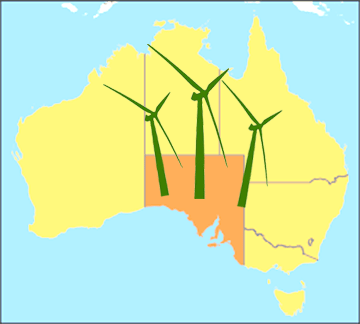 “South Australia gets half of its electricity from wind and solar …. and they are
  in the process of overcoming their problems and making systems of high penetration of renewables work,” Garnaut said. That is of international interest.”
Battery storage will also play an interesting role. South Australia has the Tesla big battery under construction – and due to be in operation in three weeks – as well as two other grid-scale batteries at Wattle Point wind farm, and proposed for Whyalla.
 South Australia’s stunning transition to consumer-powered grid http://reneweconomy.com.au/south-australias-stunning-transition-to-consumer-powered-grid-20463/ [good graphs] By Giles Parkinson on 6 November 2017 South Australia is already being hailed – or in some quarters demonised – for its leadership on renewable energy technology. But a new report from the Australian Energy Market Operator highlights how far out front it is in the tradition to a consumer-powered grid.
The new AEMO report highlights that 9.2 per cent of the electricity generated in the state over the last financial year came from small-scale (sub 100kW) of solar PV on the rooftops of households and businesses in the state.
That level of rooftop solar penetration is a record for any major grid in the world, and the contribution of rooftop solar is likely to have been well over 10 per cent in the last year when larger rooftop solar installations of more than 100kW are included.
The total will likely at least double over the next 10 years – according to AEMO forecasts – to more than 20 per cent, at which time rooftop solar will be pushing “minimum demand” from the grid to zero on occasions.
It’s already having an impact. As we report here, rooftop PV sent grid demand to a new record low of 554MW on Sunday, just six weeks after a previous low – which had in turn beaten the earlier low set a week earlier than that by nearly 25 per cent.
It’s a taste of what is to come. Major studies by the likes of the CSIRO and the networks association predict that by 2050, half of all demand will be met by what they describe as “distributed generation” – a mix of rooftop solar, battery storage, and “localised” generation.
This represents a major shift from the recent and current state of the industry from centralised energy controlled by major corporations, to local supply and demand – leading to new players and new business models.
But in South Australia – as is the case with so much of the energy transition – it could come quicker than that. By 2025/26, AEMO says rooftop solar could generate 2,500GWh a year. That would be around 22 per cent of total demand in the state.
Add in the proposals by the Liberty OneSteel, the new owners of the Whyalla steelworks, and more than one third of the state’s demand could be met by such distributed solar, and possibly up to half if its plans for 600MW of solar – for itself and other business users – comes to fruition. Continue reading
Record low electricity demand in South Australia, due to rooftop solar
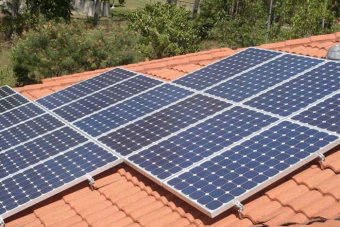
 Rooftop solar pushes South Australia to record low demand (again) http://reneweconomy.com.au/rooftop-solar-pushes-south-australia-to-record-low-demand-again-47836/By Giles Parkinson on 6 November 2017
The combination of growing rooftop solar installations, mild temperatures and sunny weather has pushed South Australia’s grid demand to yet another record low, this time shaving around 6 per cent off the previous low set just six weeks ago.
The new low was set just before 1.30pm in South Australia (just before 2pm on National Electricity Market time) when the minimum grid demand hit 554MW.
This shaved some 33MW off the previous low of 587MW set on September 17,which itself was nearly 200MW or 25 per cent the previous record low demand of 786MW set just a week earlier.
For six hours, according to the APVI solar map, rooftop solar PV provided more than 30 per cent of the state’s demand. For nearly three hours, rooftop solar provided more than 40 per cent of the state’s demand. As we explore in this article here, rooftop solar provided 9.2 per cent of the state’s local generation in 2016/17 and would likely be more than 10 per cent if larger rooftop solar installations were included.
Within a decade, that share is expected to double to more than 20 per cent, at which times on days like this Sunday, minimum demand may actually fall to zero because of the amount of solar being generated.
The Australian Energy Market Operator, which includes these forecasts in a new report into the South Australia grid, suggests that by that time it will be necessary to store some of that excess solar for use later in the day.
The same situation may occur in West Australia, too, because of the amount of rooftop solar being installed in a small grid. The uptake of rooftop solar is accelerating because of high grid prices and the falling cost of solar technology, and grid demand fell in W.A. to an 8-year low last week.
“At these times, South Australia could store or export its excess generation to the rest of the NEM via the interconnectors, provided they are in service,” AEMO notes in its report.
“This, in turn, will provide market participants with greater opportunity to manage their energy use.”
AEMO noted, as it has previously, that South Australia is the first region in the NEM in which high rooftop PV penetration has caused minimum demand to shift from overnight to near midday – a transition that occurred five years ago.
Many argue this is a good reason to shift the “controlled load” of electric hot water systems from the night-time to the mid-day hours, particularly since the closure of the coal fired generators which could not be switched off at night and needed something to power during the night time.
However, problems with the nature of the metering, and the potential expense of the shift, are barriers to the migration of hot water systems to the day-time hours.
GREENS BILL PASSES SOUTH AUSTRALIA’s UPPER HOUSE – STOPS THE WASTE OF MONEY ON NUCLEAR WASTE DUMP
 1st November 2017, Nuclear Fuel Cycle Watch The Greens Bill to finally end wasteful government spending on the proposed South Australian international nuclear waste dump passed through the upper house late tonight. As the Bill had support from the Government, we expect it to also pass the lower house in coming weeks.
“I’m delighted that this sorry saga of wasted public funds is now over”, said Mark Parnell MLC, Greens SA Parliamentary Leader. “Now that the dump has been comprehensively dumped, it is important to draw a line under any further public spending on this ill-conceived project. We don’t have final figures on what was spent on this folly but at least $14 million is a conservative estimate.
“The Greens’ Bill strengthens existing laws against using public money to “encourage or finance nuclear waste storage facilities” by removing the reference to spending money on further public consultation and debate over the dump. Of course, if a future government wants to spruik the merits of turning SA into the world’s nuclear dumping ground, they can always come to Parliament for approval. In a democracy, that’s the right approach.
Importantly, the Greens’ Bill does not prevent the Government managing or sharing the information that has been gathered over the last 2 years or engaging with the Federal Government over plans for a separate national nuclear waste dump in South Australia.
“The Greens will continue to oppose plans to send Lucas Heights’ intermediate-level nuclear waste to the Flinders Ranges or Kimba pending a proper review of Australia’s stores of domestic nuclear waste and how to deal with them. The State Labor Government in the past has fought tooth and nail to stop the Federal Government dumping domestic nuclear waste in our State. Spending public money to deal with other State and Territory governments in relation to nuclear waste will still be allowed.
The Greens now urge all political parties to focus on supporting industries and opportunities that will enhance our State, rather than those which risk South Australia’s economy, environment and reputation”, concluded Mr Parnell https://www.facebook.com/groups/1021186047913052/
1 This month

of the week – Australians for War Powers Reform (AWPR)
To see nuclear-related stories in greater depth and intensity
 Antinuclear