Australian government’s nuclear waste dump for Barndioota – a sly prelude for importing nuclear waste
It seems there is no way that the federal plan could develop into that grandiose project [the South Australian Nuclear Fuel Chain Royal Commission importing plan].
But the federal nuclear waste project starts the process in some important ways.
Environmentalists had better stop rejoicing and start examining the machinations behind the Federal Government plan.
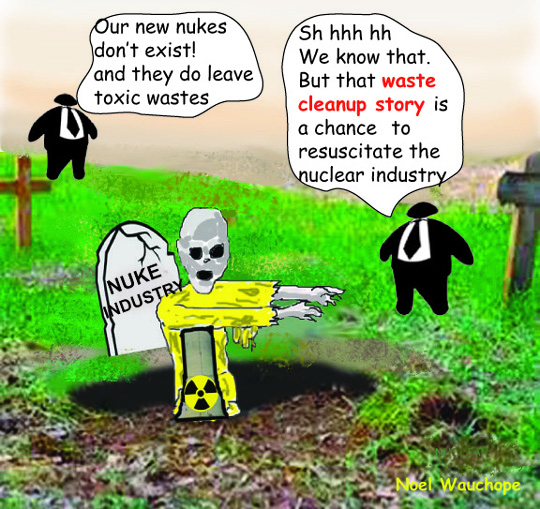 Exhuming South Australia’s nuclear waste import dump plan, Independent Australia, 7 December 2016, The SA nuclear waste dump may be dead in the water but a nuclear waste import plan may now be a Federal affair, writes Noel Wauchope.
POLITICAL SUPPORT for South Australia’s nuclear waste import project has collapsed……..
You would think that, with an election coming up in 2018, Jay Weatherill might ponder on the advantages of making a gracious retreat, respecting the remarkably strong recommendation from his own Citizens’ Jury, that the international nuclear dump was not to go ahead “under any circumstances“.
But Jay Weatherill is persisting with the plan, even though it is a bell tolling his political suicide. We can only suspect that Weatherill has some very poor advisers, or that he is beholden to the nuclear lobby.
Let not the anti-nuclear movement rejoice
The plan for importing nuclear waste to South Australia has been several decades in the making and this recent government push has cost at least $13 million. The nuclear lobby is not giving up so easily. The focus now shifts to the plan for a Federal Government nuclear waste dump in Barndioota.
It would be naive to think that these two plans are not connected.
Australia has a relatively small but enthusiastic pro-nuclear lobby, led by Ben Heard and Barry Brook. Ben Heard – who has just started a pro-nuclear group seeking charity status – made the connection between the two waste dump plans, explaining why South Australia could take not only Australia’s but also the world’s nuclear waste.
It is a simple, and in a way logical, idea to say that once a place is radioactively polluted, well, why not choose that place to dump more radioactive pollution? ……..what if we got a nuclear waste dump in South Australia? One that started out storing “low level medical” nuclear waste but then got “intermediate level” nuclear waste originally derived from Sydney’s Lucas Heights nuclear reactor? Especially as medical nuclear wastes are so short-lived — radioactivity lasting generally for just hours, or a few days, it would be pretty silly to have a great big repository site, with not enough wastes to fill it.
……..if medical wastes are radioactive for only hours, or a few days, why would they need to be transported for thousands of miles across the continent? They are produced in very small quantities and currently stored near the point of use — in hospitals. (There’s actually a strong argument for the use of non-nuclear cyclotrons to produce these isotopes close to the hospitals, rather than at the centralised nuclear reactor at Lucas Heights in Sydney.)
So, an underground nuclear waste facility for medical wastes, at remote Barndioota, in South Australia, doesn’t seem necessary.
But then there’s the processed nuclear waste returning to Lucas Heights, from France and the UK. The Australian Government describes this as intermediate-level waste that isn’t harmful unless mismanaged. The French Nuclear Safety Authority (ASN) has classified it as high-level (long-life) waste according to standards set by ANDRA, the French national radioactive waste management agency. High-level waste is ANDRA’s most severe nuclear waste classification.
Nuclear Shipment Truth Exposed
It is pretty clear that the purpose of the proposed Barndioota nuclear waste dump is the disposal of Australia’s intermediate to high-level waste returning from overseas…….
It seems there is no way that the federal plan could develop into that grandiose project [the South Australian Nuclear Fuel Chain Royal Commission importing plan].
Federal nuclear waste project to start the process
But the federal nuclear waste project starts the process in some important ways.
First, the plan must navigate several legal difficulties. In 2010, former premier Mike Rann brought in laws to prevent a national nuclear waste dump being placed in South Australia — laws which would have to be repealed before the Federal Government could proceed. Federally, the National Radioactive Waste Management Act 2012 did water down prohibitions on nuclear waste dumping but there are still provisions that have to be overcome, particularly in relation to Aboriginal rights.
Secondly, there is that Aboriginal question. I think that the State and Federal governments are justifiably wary of the opposition they might meet from Indigenous communities — and they are working on that problem. The South Australian Government recently imposed Aboriginal Regional Authorities upon the State’s Indigenous communities. These are being used to fast-track and rubber stamp development over much of the land. They would be integral to Jay Weatherill’s strategy of manufacturing consent……
An unspoken part of the process must surely be the development of the Federal Government’s nuclear waste facility in South Australia, which would conveniently overcome some big hurdles and would make that State look like an attractive place for a nuclear hub.
Environmentalists had better stop rejoicing and start examining the machinations behind the Federal Government plan. https://independentaustralia.net/politics/politics-display/exhuming-south-australias-nuclear-waste-import-dump,9814
Sisters of St Joseph make a powerful case against radioactive trash dumping
Why would any reasonable society actually WANT to expose themselves to danger and the
greatest known risk to human kind and for a completely incomprehensible time of at least
100,000 years till the danger of contamination of earth, waters and human beings subsides!!!
For money? For jobs?
What substitute is money and jobs for some at the cost of clean air, uncontaminated water,
uncontaminated land for food growing, a safe environment to bring up children, a healthy
environment to bring up children, a clean environment for every generation?
What extraordinary motivation is driving those who want to risk all this to involve South
Australia our homeland further into the contamination from which there will be no return?

 Josephite SA Reconciliation Circle
Royal Commission into the Nuclear Fuel Cycle
SUBMISSION TO ISSUES PAPER 4 “…Regarding the storage of high level (or nuclear long lived) waste, the Royal Commission must
• accept and
• make perfectly clear to the citizens of South Australia
that there are simply NO World’s Best practice for the storage of high level (or nuclear long
lived) waste.
The material is simply too dangerous, will live on dangerously for an outrageous 200,000
years (CCSA 2015) – and despite the fervent hopes ofthe nuclear industryIlobby- there are
no technological solutions to its safe storage – now or likely to be in the foreseeable future
and quite possibly never.
Unfortunately there is no safeguard in the assurances of those who claim that the situation is
safe and weapons proliferation won’t happen ‘because we say it won’t ‘.
As long term South Australian citizens our members are well placed to know that –
in the Ernul Maralinga nuclear explosions and the later even more damaging so called ‘minor
trials’ which contained plutonium there were ready assurances given by those whose vested
interests were served by the nuclear explosions going ahead. (as quoted in 1.8. above)
The effects of the Emu and Maralinga fallouts affected many South Australians particularly
those living in the remote Far West and North West of our state and in the areas around
Coober Pedy. Many were Aboriginal and their life style of ground cooking and other factors
placed them in an extremely vulnerable position. This experience – personal in most cases
and to their families in others – is what galvanised the Senior Women Elders of Coober Pedy,
known as the Kupa Piti Kungka Tjuta (KPKT) to lead what became the national successful
campaign of 1998-2004 against the Federal Government’s imposition of a national radioactive
dump on their land.
All of us were living when the Government used the country for the bomb…Some were living at
Twelve Mile, just out ofCoober Pedy… Whitefellas and all got sick. When we wereyoung, no
women got breast cancer or any other kind ofcancer. Cancer was unheard of with me either and
no asthma. We were people without sickness.
The Government thought they knew what they were doing then. Now again they are coming
along and telling us poor blackfellas, ‘Oh, there’s nothing that’s going to happen, nothing is going
to killyou.’And that will still happen like that bomb over there. KPKTApril 1998 Continue reading
South Australian Labor govt clings to its nuclear waste dream
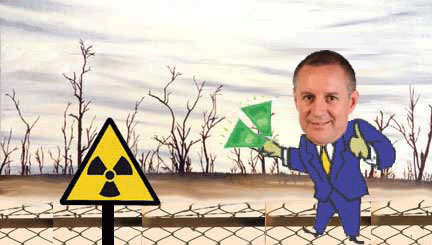 Nuclear roadblock warning but door still open, says Tom Kenyon
 http://www.adelaidenow.com.au/news/south-australia/nuclear-roadblock-warning-but-door-still-open-says-tom-kenyon/news-story/e19a89bfb94a87bbe14d2a18d082da0a Adam Langenberg, Political reporter, The Advertiser November 15, 2016 A SOUTH AUSTRALIAN high level nuclear facility looks further off into the distant future after one of its most strident backers outlined a series of roadblocks before a statewide referendum could be held.
“I think if you go to a population with a vague question, should we have a nuclear waste facility in SA, to be honest I think the result of that referendum would be not much better than what we saw from the Citizens Jury,” Mr Kenyon said.
“If it was ever going to happen firstly it would need bipartisan support to at least continue those investigations and continue discussions.
Then you would need to have quite a lot of information, and I would suspect you would need to know how much you were going to get paid and how much it was going to cost you to store and to know that you almost certainly need to know a site and you would need to have most likely an agreement of a community around a site.”
Asked if the Government could expect support of the Parliament to continue those discussions, Mr Kenyon responded “not at the moment”.
Liberal Treasury spokesman Rob Lucas, the first opposition MP to publicly air concerns about the proposal, told the conference the economic risks were “too great”.
“I always thought it was a naive and ill informed view that you would ever get majority support, whether it be from a Citizens Jury or any other process.
“Frankly if you were going to take on this particular challenge it was going to be an issue of leadership where ultimately the government of the day and the Parliament would have to say, we think it’s in the best interests of South Australia and even though there’s a majority view against it; we’re prepared to support it in terms of the public interest.” http://www.adelaidenow.com.au/news/south-australia/nuclear-roadblock-warning-but-door-still-open-says-tom-kenyon/news-story/e19a89bfb94a87bbe14d2a18d082da0a
Kimba, South Australia, may rejoin the discussion on hosting a federal nuclear waste dump
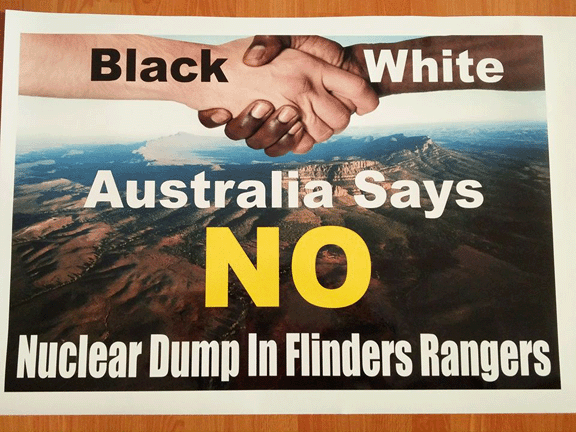 Fight To Stop Nuclear Waste Dump In Flinders Ranges SA, 30 Nov 16 TheNational Radioactive Waste Management Facility project team was invited to Kimba, South Australia, last week by the local group Working for Kimba’s Future.
The team discussed with locals the possibility of Kimba rejoining the process to nominate a site to host the National Radioactive Waste Management Facility.
The team will visit Kimba again on December 6, 7 and 8.
Tiny outback town divided over plan for federal nuclear waste dump
 One misapprehension in this otherwise excellent article.
Residents of Hawker say it has been incredibly confusing that the proposed intermediate-level facility in their community is being discussed at the same time as plans for future high-level nuclear storage elsewhere.
Despite the government saying that many of the jobs and development opportunities near Hawker will benefit the indigenous people at Yappala, McKenzie says they will continue fighting the proposal to the end.
Australian nuclear waste dump divides tiny outback town“This land is our past, present and future and we don’t want a nuclear waste dump on it.”, Aljazeera, by Jarni Blakkarly, 29 Nov 16
While the mountains are named after the British explorer who trekked them in the early 19th century, the indigenous Adnyamathanha people have lived in the region for tens of thousands of years.
This arid and remote part of South Australia has become the unlikely centre of a heated public debate after it was named the preferred site for the country’s first nuclear waste dump. Continue reading
“Medical” uses do not justify Lucas Heights nuclear reactor, nor a Flinders Ranges nuclear dump
Solid forms of low-level waste include materials that have been contaminated – at Lucas Heights or in hospitals using isotopes, or in industrial firms using isotopes, and so on. Waste of this kind has accumulated at scores of places throughout Australia, but it amounts to only a tenth of all radioactive waste, the rest coming from Lucas Heights
A NEW REACTOR? It’s the worst possible option! Nuclear Study Group Sutherland Shire Environment Centre 1998 By R.D. (Bob) Walshe, OAM
Chairman, Sutherland Shire Environment Centre
- Medical isotopes can be produced by non- reactor technology, such as cyclotrons, which are much cheaper and safer and are powered by electricity.
- Claims that a reactor serves Australia’s ‘national interest’ do not withstand scrutiny……
‘Medical uses’ don’t justify a new Reactor
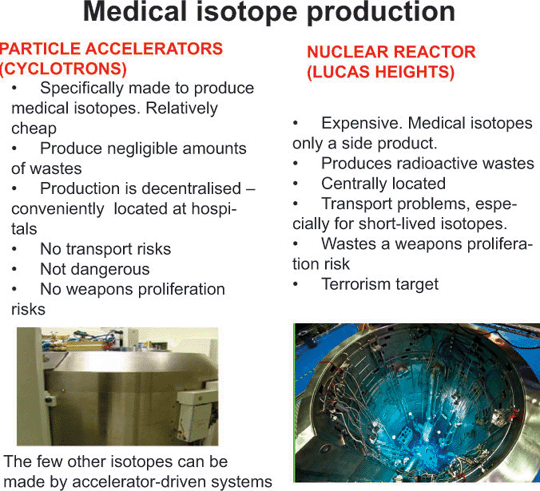
Life-saving? In fact reactor-produced medicine won’t save many lives, if only because over 98% of it is used in diagnosis, not in life-saving therapy.
The Minister should have spoken more moderately. Reactor-based nuclear medicine is only one among many medical technologies used in diagnosis. The Minister didn’t explain why he was favouring it over all other diagnostic technologies by heavily subsidisingit through a new hugely expensive reactor. Nor, indeed, why a new reactor is needed when the bulk of nuclear medicine consists in the supplying of medical isotopes that can be obtained much less expensively from sources other than a Lucas
Heights reactor? Consider…
- Most importantly, cyclotrons increasingly produce isotopes and so render a reactor unnecessary (see cyclotrons, p.13); they are cheaper and safer and produce only small quantities of low-level radioactive waste.
- Nearly all countries in the world import the isotopes they need.
- ANSTO, the Australian Nuclear Science and Technology Organisation, itself imports them when it shuts the reactor for maintenance.
- ANSTO’s isotope operations are indeed heavily subsidised, and thus are not really competing economically with those of large overseas suppliers.
- While ANSTO argues that its most-used isotope technetium-99m can’t be
imported because it has a currency (technically, a ‘half-life’) of only six
hours, ANSTO neglects to say that an equally effective, longer-lived
isotope, molybdenum-99, is widely transported all around the world.
So, by using two cheaper alternatives – importation of some isotopes and production of others in cyclotrons – Australia would save itself the huge expense of this new reactor. It’s as simple as that. And safer too……
ANSTO has been stockpiling such waste for 40 years, and there it sits at Lucas Heights….
Not that ANSTO and the Federal Government haven’t tried to get rid of all this embarrassing waste. They have continually invited any and every state government to set up a dump-site (a ‘repository’) for it. But until 1998, no government would have it.
Only in February of 1998 did one government, that of economically troubled South Australia, hesitantly indicate it might accept it, at a site it considers to be ‘remote’ – but Aboriginal communities have expressed opposition. If established, such a dump would soon become ANSTO’s dump for all levels of its waste.
The long failure of the Federal Government to find a remote dump-site for radioactive waste is conclusive proof – though proof is surely not needed – of the dangerous nature of nuclear waste. So why go on creating such waste? No community wants to be saddled with the burden Sutherland Shire has carried for 40 years.
Three ‘levels’ of waste – and all dangerous
There are three general categories of radioactive waste. First, the high-level kind, chiefly the highly radioactive spent fuel rods; second, intermediate-level waste, such as results from reprocessing of spent fuel rods; third, low-level waste, such as the continual gaseous and liquid discharges from nuclear plants, and contaminated materials like gloves and instruments.
But ANSTO chooses not to follow this high-intermediate-low classification, arguing that high-level waste comes only from nuclear power-generating reactors, and since Australia’s reactor is the ‘research’ kind, its operation results only in intermediate-level and low-level waste. This is a semantic quibble which puts ANSTO at odds with US and Canadian terminology.
More than 1600 of the spent fuel rods, high – level waste, have accumulated at Lucas Heights in the past 40 years. ….. the resulting waste will be returned to Australia as ‘intermediate-level waste’, which will again constitute a problem here. Such shipments are never trouble-free: they involve safety, health and environment risks; they spark anti-nuclear protest along the route, resistance from residents around the destinations, and charges of unethical behaviour for dumping what should be one’s own responsibility onto others…. Continue reading
Why dump nuclear reactor waste in Flinders Ranges? Lucas Heights is the best place.
Regina McKenzie to Fight To Stop Nuclear Waste Dump In Flinders Ranges SA November 26
Cyclotrons for medical isotopes needed in other States, not monopolised by ANSTO in Sydney
Trisha Dee Fight To Stop Nuclear Waste Dump In Flinders Ranges SA, 28 Nov 16 ANSTO want to pick up where Canada has stepped off. Canada used to provide a significant part of the world’s radioactive isotopes. Now Australia wants to get in on this dying industry. They need to make room at Lucas Heights to do so. Hence their push to bury their toxic waste in the outback. There is no strong case for co-location.Mystery of South Australian Labor tying the State’s prosperity to a nuclear waste toilet
 Nuclear Poker: The Premier declares his hand, but who will win?, Adelaide Review, John Spoehr, NOVEMBER 24, 2016 You Don’t generally establish a Royal Commission on a major economic question unless you have an answer in mind. Tom Playford initiated a Royal Commission into the Electricity Industry in South Australia to bring the industry under greater public control. He was fed up with the privately run Adelaide Electric Supply Company (AESC) and was open to radical change. By the mid-1940s, most states had nationalised their electricity industries…..
It is against the weight of this history that the Premier and the State Government push. They also push against great disappointment – disappointment that the state’s prosperity should, in any way, be tied to becoming a nuclear waste dump. Surely we can do better than that, many South Australians are saying. More than 3000 protestors on Parliament House steps made it clear that a dump was not an option.
What frustrates many about the latest twist in the nuclear waste dump debate is the apparent abuse of process when the State Government didn’t get the result it wanted. It has created an expectation that the Citizens’ Jury would guide the decision. When the Jury came out against the dump, the Premier had a plan B – put it to a referendum.
The election of Donald Trump sharpened views about the political cost of not listening to the Citizens’ Jury. While the Premier was prepared to take the risk and face accusations of having a tin ear, Opposition Leader Steven Marshall made a captain’s call to oppose the dump on economic grounds. While the Premier alienated many in his traditional support base by being the architect of the impossible, he won new friends on the other side of politics by daring to do what they would not have done themselves. Whether this translates into Labor votes from disgruntled Liberal voters at the March 2018 State election is difficult to know.
Having criticised the Opposition Leader for abandoning bi-partisan support, the Premier has few cards left to play in his game of nuclear poker. There has been talk of trying to lock in a customer nation to demonstrate that there is real demand for the dump, but customers will remain cautious, preferring not to declare their hand. Steven Marshall has laid his cards on the table and so too has the Premier. Their parties are divided on the stance they have both taken. …..
Just why the development of a nuclear industry in South Australia should be so attractive to some is a fascinating question. Those who support a waste dump generally also support the enrichment of uranium and nuclear power generation. Some also see merit in South Australia manufacturing nuclear-powered submarines. I doubt that the pursuit of a dump will satisfy the ambitions of the nuclear lobby. https://adelaidereview.com.au/opinion/politics/nuclear-poker-premier-declares-hand-will-win/
South Australian government herded Citizens Jury towards a “yes” vote on nuclear waste importing
 EP citizen juror loses trust in state government on nuclear process, http://www.eyretribune.com.au/story/4292223/loss-of-trust-in-nuclear-process/?cs=1447 14 Nov 2016, CLEVE resident Deb Carlaw, who was one of 10 Eyre Peninsula representatives on the Nuclear Fuel Cycle’s Citizens’ Jury, has returned from her time on the jury, with a “strong feeling” of distrust in the state government.
“We felt we were being herded toward making the middle vote (go ahead with investigations into the facility) and I was horrified by the manipulation and subterfuge underway – it really opened my eyes,” Mrs Carlaw said.
The jury was a collective of 350 people from across the state which Mrs Carlaw said did not include many regional or rural people. Two thirds of the jury voted to not go ahead further with the waste proposal, with economic benefits, trust, safety and lack of indigenous consent key points in their decision. Mrs Carlaw said 100 per cent of the EP representatives voted a strong ‘no’ to the proposal.
South Australian Premier Jay Weatherill has now said the discussion should continue on the proposed facility, which will only be achieved by political party bipartisanship and a state wide referendum. Mrs Carlaw said she was disappointed but not surprised Mr Weatherill was continuing on with the proposal, regardless of the fact the jury was “supposed to be the voice of the state”.
“Fuorteen million dollars down the drain because the government won’t accept the verdict we came up with,” she said.
Mrs Carlaw had used social media as a platform to ask what people on Eastern Eyre felt regarding the nuclear proposal before she attended the jury, with the majority saying ‘no’ to the idea.
“We had people stand up, including a representative from PIRSA, who advised the jurors that country people wanted this facility, which I couldn’t believe, as from the information we had received from community members, this was not the case.”
She said the responses to any questions regarding nuclear accidents were met with a blanket statement of “there will never be any”. Mrs Carlaw said the facts she received while on the jury firmly made her mind up to not support the proposed facility.
She said the experience had been challenging, physically and mentally and had missed out on important family events, because she wanted to be able to see the experience to the end.“I wanted to be able to devote myself to this responsibility – I studied, I talked, I listened and I learnt,” Mrs Carlaw said.
Indigenous leaders Micklo Corpus and Regina McKenzie win Rawlinson Award for Environmental Justice
25 Nov 16, Micklo Corpus, a Yawuru Traditional Owner from the Kimberley region of West Australia, and Regina McKenzie, an Adnyamathana Traditional Owner from the Flinders Ranges of South Australia, have jointly won the 2016 Rawlinson Award for outstanding leadership in their efforts for Indigenous and environmental justice in their regions.
“ACF is thrilled to announce that Micklo Corpus and Regina McKenzie have been chosen by the selection committee as joint winners of the 2016 Peter Rawlinson Award for their great leadership in caring for their people’s land against environmental threats from fracking and nuclear waste,” said ACF CEO Kelly O’Shanassy.
“For over two years, Micklo Corpus has camped on his own traditional country, 70 kilometres east of Broome in West Australia at the gates of Buru Energy’s Yulleroo fracking site, sharing his knowledge of culture and love of country while engaging the community and industry to keep the Kimberley frack free.
“Through this award we commend his efforts in highlighting the threats from potential contamination of his land and groundwater.
“For many years, Regina McKenzie and other Adnyamathana Traditional Owners have worked to regenerate and protect their homelands around Yappala Station in the Flinders Ranges.
“In April 2016, they woke to the news the area was being considered for a nuclear waste dump – without their consultation or consent.
“Since that time, Regina has lead the opposition to this proposal among her people and the broad Australian community.
“Although engaged in very different struggles, Micklo Corpus and Regina McKenzie have both shown extraordinary leadership standing up for their country against the interests of dirty energy and inappropriate development – for this we salute them and stand beside them.
“The Australian Conservation Foundation has a long history of working closely with Indigenous people around the country and we are pleased to have the opportunity to honour the work of these two remarkable Aboriginal leaders,” she said.
The Peter Rawlinson Award is named after former ACF Councillor Peter Rawlinson, who made his own outstanding contribution caring for our unique natural environment and wildlife.
Adelaide campus of University College London (UCL) – a nuclear Trojan horse

Dennis Matthews, 24 Nov 16
The Adelaide based campus of University College London is a Trojan Horse for the nuclear industry which, as I recall, was the brain-child of Mike Rann and Alexander Downer and was (I think) conceived on a train when the opening of the Ghan line extension from Alice Springs to Darwin, which just happens to be a great boost for exporting minerals such as uranium and for importing nuclear waste.
Michael West casts a satirical searchlight on South Australia’s nuclear waste import plan
“By removing this tricky “back end problem” of where to store the waste Australian taxpayers can really assist foreign investors to make more money”
It’s not simply a matter however of digging a best-of-breed hole with the taxpayer bearing 100 per cent of the cost – and sanctioned by a cost-benefit analysis focused on benefits but not costs.
The nuclear dump proposal probably couldn’t have got where it is today without the helpful influence of UCL Australia, the “international campus” of the University College London, which is located in Adelaide.
This university campus was started in 2008 with helpful funding from BHP (Olympic Dam – the world’s largest known deposit of uranium in South Australia) and Santos.
 Visit Australia, home of the world’s nuclear waste dump! http://www.michaelwest.com.au/visit-australia-home-of-the-worlds-nuclear-waste-dump/ November 23, 2016 “Come visit Australia, home of the world’s nuclear waste dump!”
It’s got a ring about it, no doubt about that. Imagine the tourism potential, imagine the premium prices our agricultural produce would fetch! We would be the envy of the global community. Yet this visionary proposal by South Australian premier Jay Weatherill is being white-anted, shot down by naysayers, people who have little understanding of the benefits of hosting the world’s high-level nuclear waste.
Thankfully Rupert Murdoch’s quality newspaper, The Adelaide Advertiser, has thrown its wisdom and authority behind the shrewd plan for the state’s glowing future.
There is still some conjuring of consent to be done though. Despite the Premier and his crack cabinet holding a Royal Commission which recommended the waste dump; and despite expert’s advice in the guise of the Jacobs report, the naysayers have kept their dastardly campaign afoot.
They even alleged this Jacobs report was somehow lacking in independence just because it was written by paid advocates of the nuclear industry. Continue reading
Nuclear Fuel Cycle Watch South Australia queries Nathan Paine’s statement
Steve Dale to Nuclear Fuel Cycle Watch South Australia, 22 Nov 16 Nathan Paine has been engaged by AREVA as a consultant. In his recent article for the Advertiser he mentioned: “..it may not have been publicly stated but global companies like AREVA, Posiva and others from North America were  already starting to look at investing in South Australia.”
Two things from this statement: First, I wonder whether the “others” included Jacobs, and second, whether Posiva are looking for a cheap dump-and-run option for its own waste in South Australia – their “mock-up” of a nuclear dump might be proving too expensive to turn into a reality. https://www.facebook.com/groups/1021186047913052/
Nuclear lobbyist Nathan Paine rubbishes the economic experts who informed South Austraslia’s Nuclear Royal Commission
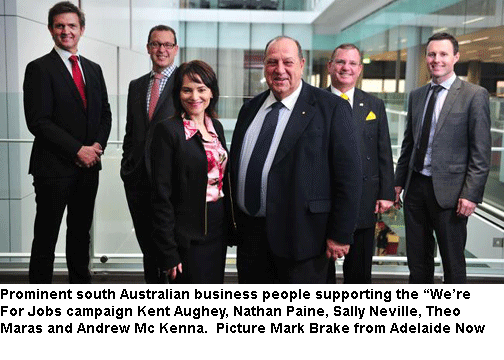
Nathan Paine: Yet again South Australia throws the opportunity to have a sensible debate about a big, contentious issue under the bus Nathan Paine, The AdvertiserNovember 21, 2016 AS a business person and proud South Australian, it appears to me that we have once again seen the opportunity to have a sensible debate about big, contentious issues get thrown under the bus in favour of the appeasement of a vocal minority. I am of course talking about the nuclear waste debate cum debacle……
there are people with economics degrees opposed to the proposal and holding themselves out as experts to the Jury.
I personally prefer to consider the facts.
The simple facts are that there are countries which have nuclear waste in short and medium term repositories for which there are large sums of money already held in trust for the long term management of the waste…..
As a consultant engaged by AREVA, one of the world’s biggest nuclear energy companies, I have been fortunate to visit Finland, France and England to tour their facilities and meet the experts on the systems and industry.
Having met and talked with the experts, there was a common consensus that there is a significant opportunity for South Australia.
It has been said by the Jury and others that if this such a good idea, why is industry not supporting it — it may not have been publicly stated but global companies like AREVA, Posiva and others from North America were already starting to look at investing in South Australia.
Yes, the business case is full of assumptions and the next step would have been to prove up those assumptions and secure MOUs with potential customers…..
We must not allow the debate to wither and die on the political vine rather let’s take breath, check the numbers and if they stack up continue the discussion.
1 This month


Help Aunty Sue Protect Her Land and Sacred Sites From Destructive Rocket Testing.
.

Australians deserve the truth
about
AUKUS – https://aukuspublicinquiry.com/

PETITION – To: Prime Minister Anthony Albanese and the Australian Labor Government

of the week – Australians for War Powers Reform (AWPR)
To see nuclear-related stories in greater depth and intensity

