Just where does South Australia’s Senator Nick Xenophon stand on nuclear waste importing?
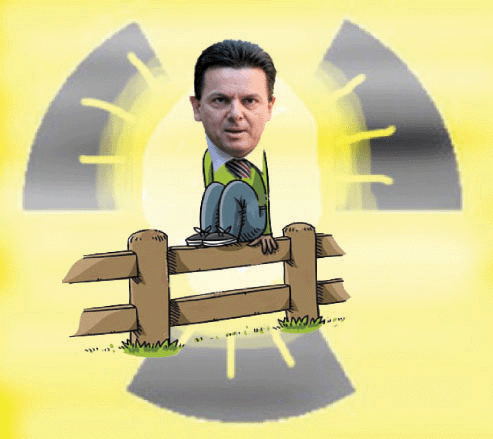
 Nuclear caution vital, Port Lincoln Times, 18 Apr 16 ROAD funding, nuclear waste and drilling in the Great Australian Bight are among the issues on the agenda for recently announced candidate for Grey, Andrea Broadfoot.
Ms Broadfoot was last week announced as the Nick Xenophon Team’s candidate for the seat of Grey and said she hoped to make the safe Liberal seat marginal to attract the resources the region needed.
“We’re very committed in the community about getting out and talking to people and finding out what their issues are.”
Speaking in Port Lincoln on Thursday, Senator Nick Xenophon said Ms Broadfoot would give current member for Grey, Liberal Rowan Ramsey, a “run for his money”…….
Ms Broadfoot said the potential for a nuclear waste storage facility at one of three sites in South Australia was another issue she was concerned about.
She said the region needed to look at the long term impact on the perception of the region rather than the short term monetary gains that may be made.
“We need to be really cautious and careful about the decisions we make,” Ms Broadfoot said……..
She said the community was divided on the issue, with even the former Liberal member for Grey Barry Wakelin publicly coming out and saying Kimba was not the place for nuclear waste.
Mr Xenophon said it did not make sense to have a nuclear waste storage facility in a premium agriculture region……http://www.portlincolntimes.com.au/story/3855319/nuclear-caution-vital/?cs=1500
South Australia could save water by adopting India’s brilliant solar energy plan
 Today’s story from India – about setting up solar panels over water channels – set me thinking about South Australia. I think South Australia is the most beautiful State, and with a proud and interesting history.
It is also, arguably, the nation’s most water stressed State.
It is so frustrating that the politics and economics of beautiful South Australia are in the hands of ignorant neanderthals. That want to damage the country, and extract even more water than BHP Billiton now does at Olympic Dam uranium mine, – by expanding the water intensive nuclear industry. And all this with the risk of radioactively polluting the precious groundwater.
India’s solar panels over water channels not only provide electricity. They also reduce evaporation. What a boon for a hot climate! South Australia’s SunDrop Farms have also made use of the water-saving abilities of solar panels.
South Australia has the expertise to lead the world in clean energy and water management.
What a pity it is run by deadheads!
Greens manage to put some brakes on South Australian govt’s pro nuclear promotion
 Nuclear waste dump ‘spruiking’ with taxpayers’ money stopped by Greens http://www.abc.net.au/news/2016-04-14/nuclear-waste-dump-‘spruiking’-with-taxpayers’-money-stopped/7325076 An attempt to change the law in South Australia to allow public money to be spent on promoting a nuclear waste dump has been stopped with the Greens claiming a victory.
A law passed in 2000 to stop public funds from being used in any activity associated with a nuclear waste facility.
The State Government had tried to amend the law to allow consultation with the community on the results of the Nuclear Fuel Cycle Royal Commission.
Greens MLC Mark Parnell said the proposed change was too wide ranging and the Upper House had stepped in to protect taxpayers.
“The Greens do accept that we do need to have a public debate,” he said.
“We’re confident we know what the result will be but nevertheless the Government says they only want to consult, they don’t want to spruik and they don’t want to plan for a nuclear waste dump.”
He said the Government had attempted to “overreach”.
“The law now says that the Government can use public money to consult the community but they’re not to use public money for promoting or designing or even buying land for a nuclear waste dump.”
As CSIRO slashes jobs, water science in South Australia a big loser
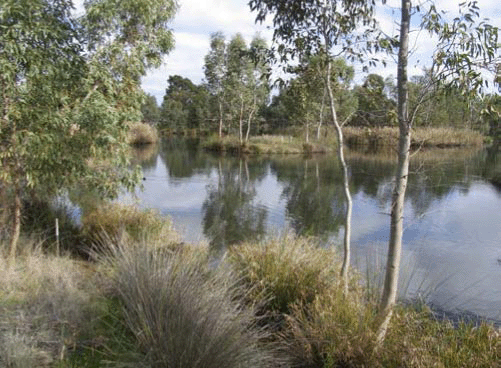
Water science in South Australia could evaporate as CSIRO looks to slash 350 jobs across the country April 12, 2016 CLARE PEDDIE SCIENCE REPORTER The Advertiser SOUTH Australian water science at the CSIRO is in the firing line as the national research organisation prepares to cut 350 staff across the country in the next two years.
Staff in SA have been told job losses are inevitable with “reductions in headcount” at CSIRO Land and Water, which has 103 people at its Urrbrae base.
Other research areas could also be impacted………
Former CSIRO scientist Dr Peter Dillon said the anticipated job cuts were “economic nonsense”. He said 35 of 50 staff were set to go from the CSIRO’s urban water research area, while rural research was also thought to be on the chopping block.
“Just like building submarines, in research it takes years to develop world-leading teams and shutting down a productive area can’t be quickly reversed,” he said.
CSIRO Staff Association deputy president and Waite Campus staff representative Sonia Grocke said staff felt strongly about the fundamental change to the type of work the CSIRO had done on water, agriculture and the environment.
“We think the current round of cuts and particularly the areas of science that are being targeted will severely impact CSIRO’s ability to address major environmental events as they impact South Australia,” she said. “The Murray-Darling Basin is a good example of that.”…….http://www.adelaidenow.com.au/news/south-australia/water-science-in-south-australia-could-evaporate-as-csiro-looks-to-slash-350-jobs-across-the-country/news-story/647fd6fdbfebfca28d4c683c4166336e
Michele Madigan remembers Bob Ellis and that other nuclear royal commission
 In July 2004, a six-year anti-nuclear campaign spearheaded by Aboriginal women, who themselves had suffered in the British nuclear tests, was successfully concluded with the federal government’s announcement: ‘No national radioactive dump for SA.’
who could have imagined that just 11 years later, a new and far more dangerous plan would be launched by another royal commission, perhaps the first royal commission to plan a future scheme rather than examine one past?
Since this royal commission’s ‘tentative findings’ in February for South Australia to import international high-level nuclear waste, which it actually names as radioactive for ‘many hundreds of thousands of years’, the scepticism among South Australians is growing.
Bob Ellis and the other nuclear royal commission http://wwweurekastreet.com.au/article.aspx? aeid=47194#.VwrLvtR97Gg Michele Madigan | 07 April 2016
The passing of Bob Ellis recalls his faithful accompanying of the 1984–1985 royal commission into the British nuclear tests conducted in South Australia in the 1950s and 1960s. He went ‘to England and back’ and, as he described it, ‘to each black polis’ of the royal commission hearings.
Ellis’ article on the Wallatina hearings (The National Times, 3–9 May 1985), described what he named as the commission’s ‘worst story of all’ — Edie Milpudie’s telling of herself and her family camping, in May 1957, on the Marcoo bomb crater.
She told of being ‘captured by men in white uniforms … forcibly and obscenely washed down, miscarrying twice and losing her husband who to prove to the soldiers he knew English, sang, “Jesus loves me, this I know. For the Bible tells me so.”
‘And how the soldiers shot their beloved irradiated dogs.’
‘The bad parts of the story,’ Ellis went on, ‘the miscarriage and afterward, were communicated to Jim (Commissioner McClelland) in secret session, in the distance in the bush, with Edie’s women friends giving her comfort, and prompting with giggles and nudges her reminiscence of a story they knew by heart, already an old legend.
‘Jim called these women the best in the world, unstinting comforters, inextinguishable friends”
Five years later I had the privilege myself of meeting Edie Milpudie at her Oak Valley camp in the SA Maralinga lands. Many of the Yalata elders had prepared me in a way with the constant mantra: ‘Milpudie — she went through the bomb.’ Continue reading
South Australia’s Nuclear Fuel Chain Royal Commission virtually ignored dangers of transporting radioactive trash
As the days get a bit closer to #NuclearCommissionSAust’s announcement of its (predetermined) findings, we need to remember that the Commission’s “Issues Papers” almost completely ignored the question of the dangers of transporting highly radioactive trash across land and sea.
Paul Langley, in his fine response to the Commission’s “Tentative Findings” raised this very important matter – in the extract below
Response to the Tentative Findings of the SA Nuclear Fuel Cycle Royal Commission A Submission by Paul Langley Nuclear Exhaust 16 Mar 16 “……Transport of HLNW from around the world to a SA HLNW geologic repository
 The Royal Commission apparently assumes that the movements of many hundreds of thousands of tonnes of spent nuclear fuel from many countries around the world to the Gawler Craton will be low risk, no problems and perfectly safe. As contradictory as those stances are. I do not accept that position of default safety. Further I do not accept that the unloading of the HLNW will be perfectly safe. I do not accept that road transport from port to repository site will be perfectly safe, even on a dedicated purpose built road.
 I would recommend that Super Freighters laden with the contents of countless reactor cores not sail down the Somali coast nor in the waters to the south of Thailand for fear of pirates. They should avoid man made Islands in the South China Sea. I suppose the ships will be guarded by 6 English policemen each with two revolvers between them. Rather than half the Pacific Fleet they would actually warrant. If they ever get to leave their home ports. What is the Somali coast going to be like in 40 years? Peaceful or short of rad weapons?…….” https://nuclearexhaust.wordpress.com/2016/03/15/response-to-the-tentative-findings-of-the-sa-nuclear-fuel-cycle-royal-commission/
6 April – 6 May : Assessing the Nuclear Fuel Chain Royal Commission before its results are released on 6 May
 It’s one month until the South Australian Nuclear Fuel Chain Royal Commission will announce its findings. And everyone knows what they will be – “nuclear waste importing will be a bonanza for South Australia”
This is the first of the significant posts that will appear on this site each day, ,until 6th May.
Kevin Scarce has dismissed opposition to the plan as largely “emotional”, not “factual” . I suspect that will be the way in which the Commission will deal with the opposing Submissions. Here’s today’s:
The Greens SA’s submission to the Nuclear Royal Commission’s Tentative Findings rejects the suggestion that an economic bonanza awaits our State if South Australians would only resign ourselves to becoming the world’s nuclear garbage bin.
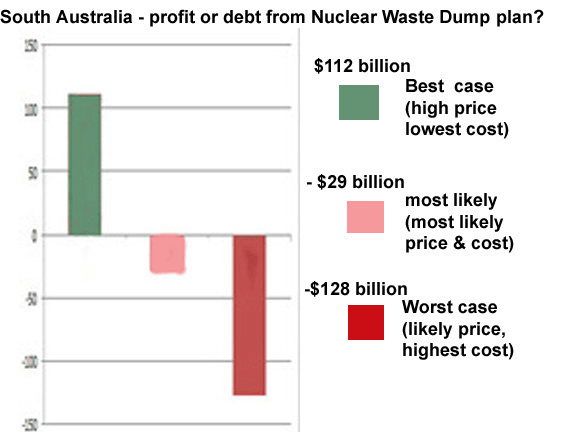
“The Royal Commission has been blinded by imaginary wealth and sucked into believing that a project that has never succeeded anywhere else in the World is South Australia’s for the taking”, said Greens SA Parliamentary Leader, Mark Parnell MLC.
“The most obvious question is being ignored: If this is such a great deal, how come no other country has grabbed it before now?
“The Greens are urging the Royal Commission to “get real” and critically examine the supposed economic benefits alongside the ongoing economic, social, environmental and reputational costs.
“Washing your hands of responsibility for a toxic legacy left to future generations is just immoral.
“The solution to South Australia’s current unemployment problems won’t be solved with mythical jobs that are decades into the future with the creation of toxic liabilities that last hundreds of thousands of year.
On releasing the “Tentative Findings” Report to the media on 15th February 2016, Commissioner Kevin Scarce stated, “The community needs to understand the risks and the benefits.” The Royal Commission’s “Tentative Findings” highlights many purported benefits but is scant on detail when it comes to the profound risks.
According to the Greens’ submission, the “Tentative Findings” suffer from:
1.Unrealistic expectations of the magnitude of the project;
2.Failure to appreciate 6 decades of international failure to solve the nuclear waste problem;
3.Missing costs, unfunded liabilities, missing contingencies and failure to recognise inevitable cost blow-outs
4.Heroic assumptions of other countries’ willingness to pay for SA to take their nuclear waste;
5.Lack of recognition of the potential for irrecoverable sunk costs and unlimited future liabilities;
6.Failure to address reputational damage and impact on other sectors of the economy; and
7.Naïve expectations that South Australia would get to keep all the profits from a nuclear waste dump in our State, without having to share them with other States.
“The Commission’s final report due on 6th May should recommend that the folly of South Australia’s increased involvement in the nuclear industry be abandoned.
“In relation to the other Terms of Reference, increased uranium mining, uranium processing or nuclear power were never really an option for SA and the Royal Commission was an expensive way to tell us what we already knew”, concluded Mark Parnell.
Kevin Scarce bemoans the “emotion” and “opinion” of opponents of nuclear waste dump
 Wealth beyond measure? Scarce commission backs SA nuke ‘dump’ Tom Richardson, INDaily, 11 Feb 2016 “…… “This commission is not driven by emotion or opinion,” Commissioner Kevin Scarce told reporters today. However, he conceded emotions and opinions would be divided by his findings on nuclear storage.
“The debate has been formed upon fear,” he said……..
Under questioning, however, he bristled at the use of the term “waste dump”, saying he “wished people would stop using” it.
“It’s a sophisticated engineering site… it has no bearing whatsoever on a dump,” he said. The case for nuclear waste storage was overwhelmingly the strongest of the four terms of reference considered, with Scarce finding nuclear electricity generation “would not be commercially viable in the foreseeable future… taking account of future demand and anticipated costs”……..
Greens MLC Mark Parnell insisted the economic case was flawed and “illusory”, because it only analysed the short-term benefits, rather than long-term environmental damage and reputational risk.
“If it looks too good to be true, it probably is,” he said, ignoring Scarce’s distaste for the terminology.
“A dump is a dump is a dump… if it looks like a dump and serves the purpose of a dump – it’s a dump.”…….
The commission has cost $5.5 million since it was established last year, but Scarce said that would be “value for money if the community has the opportunity to consider the facts”….
Dr Jim Green from Friends of the Earth denounced the commission’s “optimistic view of potential profits”. “Costs are likely to be astronomical, even over relatively short timeframes… just to build a repository would cost A$39 billion, according to the latest estimate in France, or A$43 billion according to an estimate from Japan,” Green said. ra ra http://indaily.com.au/news/2016/02/15/wealth-beyond-measure-scarce-commission-backs-sa-nuke-dump/
Political terms versus environmental time-lines – the South Australian nuclear waste folly
Saving the Environment or Centralized Control of a Monopoly in Power (Electricity)? Pan Chemistry, Gareth Lewis 03/03/15 “………Political terms versus environmental time-lines  This section raises an important point with environmental issues or challenges: the short duration of political terms (often three to six years) limits the amount that can be done in the field of environmental protection. This means that global problems, such as air pollution and global warming that have no geographic boundaries and are likely to be long-term challenges may not be attempted. Even ‘smaller’ challenges like preserving the Great Barrier Reef and ensuring the viability of water supply and usage along the River Murray cannot be addressed in any one political term (nor have they been): there’s just insufficient time and funds to do so. Additionally, the political fallout from such ventures may not ensure the duration of the political term (a political paradox). A case could easily be argued that such issues should be written into Federal politics and once initiated they should go ahead regardless of the social and political climate.
The proposed nuclear industry and global radioactive nuclear waste dump in South Australia is similarly a complex issue and will affect many generations to come. However, given the comparatively simple challenge of managing water supply and usage along the Murray River how likely is it that a proposed nuclear industry would be managed efficiently? I am not being overly ‘emotive’ here, I’m simply saying this: any proposed nuclear industry will ‘outlive’ a Royal Commission, a State and Federal Government and all of us! So; very careful consideration is needed, not only for the current generation of Australians, but for future generations who will not have a say in the decision making process that will determine the cleanliness and viability of ‘their’ environment………
Is the notion of establishing a nuclear industry in South Australia really about centralized control in the creation and distribution of energy (electricity)?
A skeptic  could easily argue that the use of nuclear energy has nothing at all to do with ‘saving the environment:’ but that it’s really about centralized control in the production and sale of electricity in a monopoly system. After all, it’s easy to control a centralized supply and demand system, and it’s exactly what we have in place today in the world-wide production and sale of fossil fuels.
This notion of ‘centralized control’ is a whole topic in itself and is beyond the scope of the original question: ‘should a nuclear industry (uranium mining, sale of uranium and storage of global radioactive nuclear waste) be established in South Australia. My personal opinion (emphasis) and answer to this question at this time is no. I believe we have sufficient solar energy and land mass in Australia to develop and perfect the solar cell industry and such technology could then be licensed and sold overseas. Besides, the success of this approach has been clearly demonstrated in other countries, many of which have far less sunshine and land mass than Australia.
Additionally, the inherent risks of initiating what may be an untethered proliferation of nuclear (fission) power plants has also been demonstrated in the past at Chernobyl and Fukushima, with close calls in Long Island. However, what has not been demonstrated (thankfully) is what could happen to our environment (groundwater and surrounds) if global radioactive nuclear waste was compromised in transit or in storage by man-made or natural means. It remains to be seen whether the proposed Royal Commission will make the ‘right recommendation’ to the government in South Australia that will benefit and protect not only the current generation, but also of many future generations of Australians: so; fingers crossed :-\ 😉 http://www.gareth-panchem.com/347345675?pagenum=2
Why take the risks of polluting South Australia with nuclear wastes?
 why take the risk(s)? Well, the short answer is that it would be worth taking the risk by the few and their families who would profit from the proposed venture in the short-term; but not the rest of us. Additionally, it will not be their families and their descendants that will suffer the consequences of a poor decision at this time since they will be able to afford to move elsewhere: the same may not be possible for future generations of Australians.
So, (hypothetically) what would Australia end up with should a nuclear industry go ahead in a self-promoting process? There would likely be many disused mining sites and disused nuclear reactors, the largest radioactive nuclear dump in the world, possibly a compromised water table and ecosystem and a few wealthy individuals (who may not be based in South Australia 😉
Saving the Environment or Centralized Control of a Monopoly in Power (Electricity)? Pan Chemistry, Gareth Lewis 03/03/15“……….Domestic and global transporting of nuclear waste is inherently risky and ocean, rail and road accidents do occur. Additionally, security in the transport of such waste would have to be assured to prevent the misuse of waste in our age of terrorism (would risks of nuclear weapons or dirty bombs increase in our attempt to curb global warming using nuclear energy?): such security would be complicated and expensive………
The Royal Commissioner commented that the notion of establishing a nuclear industry and waste dump in South Australia was ‘an emotive issue…’ Well, yes it is, and why shouldn’t it be based on the track records in Chernobyl, the Fukushimadisaster (with ongoing environmental pollution of the sea ecosystem) and a near miss in Long Island (there may be ‘other events’ that students could research).
What is also an issue is the destructive power of nuclear weapons and ‘dirty bombsthat can be manufactured from uranium and its radioactive waste products. Such devices could be made ‘anywhere’ in the world that may operate beyond the political term of any one local government that may initiate a nuclear industry in South Australia.
The Proposed South Australian Storage Depot
The grade and amount of waste will depend on the type of nuclear reactor. So, what then happens to radioactive waste? It would likely arrive in steel or
plastic drums and then be stored in geologically stable strata within
South Australia. The strata would have to be stable since radioactive nuclear waste takes thousands of years to reach safe levels (or levels that are unlikely to cause harm to
biota).
South Australia is well known for being one of the ‘driest places on the driest continent,’ but that’s not always been the case. We also get flooding events that may increase in intensity and severity as global weather pattern change, caused in part by our use of fossil fuels? Well, the vast majority of scientists seem to think so, and so do many politicians.
Let’s play ‘what if’ at this point, since it’s just a hypothesis or ‘one of those ideas.’ What if an extreme weather event caused massive flooding in the northern parts ofSouth Australia as often occurs in Queensland? That would mean that salts would be dissolved to create a hypersaline corrosive liquid. If this solution came into contact with the steel drums that contain radioactive waste they would begin to corrode. Alternatively, even plastic drums will deteriorate over time as their inner surfaces are bombarded by particles emitted from the
decaying radioactive waste. At that (hypothetical) stage, which may take thousands of years,
it would not be possible to move such a large mass of radioactive waste accumulated from throughout the world, it would simply be too risky. There is the argument that spent radioactive waste can be recycled and then reused, however the remaining residue (on reprocessing) will also provide another source of waste. Additionally, by that time other sources of energy (maybe even fusion) may provide economic benefits that far exceed the reclamation and reuse of fissionable material that has been accumulated over time and the original radioactive waste may simply remain where it was initially stored.
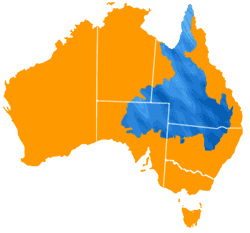 The northern parts of South Australia has a large Artesian Basin of fresh water deep beneath its surface which may then be put at risk from contamination by global radioactive nuclear waste that may have been stored over the millennia…….
why take the risk(s)? Well, the short answer is that it would be worth taking the risk by the few and their families who would profit from the proposed venture in the short-term; but not the rest of us. Additionally, it will not be their families and their descendants that will suffer the consequences of a poor decision at this time since they will be able to afford to move elsewhere: the same may not be possible for future generations of Australians.
So, (hypothetically) what would Australia end up with should a nuclear industry go ahead in a self-promoting process? There would likely be many disused mining sites and disused nuclear reactors, the largest radioactive nuclear dump in the world, possibly a compromised water table and ecosystem and a few wealthy individuals (who may not be based in South Australia ;-)……… http://www.gareth-panchem.com/347345675?pagenum=2
Kevin Scarce buys expert pro nuclear opinions from Switzerland and Belgium
Swiss and Belgian experts to front nuclear commission as green light looms. by Simon Evans, Financial Review, 31 Mar 16 Experts from Switzerland and Belgium will give South Australia’s nuclear royal commission advice on whether nuclear waste can be safely stored underground in Australia.

Royal commissioner Kevin Scarce has just visited both countries to scrutinise high-level waste disposal sites and their licensing regimes. All three places have similar soil, which means Swiss and Belgian experts should be able to give him detailed information about the danger of storing nuclear waste in the South Australian outback.
Mr Scarce said on Thursday his final report due on May 6 on whether the state should expand from just being a uranium miner and venture into nuclear waste storage was unlikely to differ greatly from his preliminary findings in mid-February.
He rejected suggestions that it was inevitable that South Australia would undertake some form of nuclear expansion……..
Mr Scarce said he had received 170 direct responses in the past few weeks to his tentative findings unveiled on February 15 in which he concluded that a nuclear waste storage facility housing spent nuclear fuel rods and other waste could deliver $5 billion in revenue annually over 30 years.
He said some of those submissions had accused him of exaggerating the economic benefits, but he said he was confident that his economic modelling had been robust and said he had taken a “conservative” approach.
Mr Scarce said he had visited Sweden and Finland earlier in his commission’s work but in the wake of the tentative findings had made a special visit to Belgium and Switzerland because they had similar sedimentary soil structures to South Australia………http://www.afr.com/news/policy/swiss-and-belgian-experts-to-front-nuclear-commission-as-green-light-looms-20160331-gnv15s
Anti-nuclear opinions don’t count for much with SA’s elitist Royal Commission
Comments today from Nuclear Royal Commissioner, Kevin Scarce, show that the elitist and dismissive processes that dominated the Commission’s early days are still alive and well.
“Clearly the Commission doesn’t want to hear from ordinary South Australians. At the outset, they refused to accept submissions that weren’t sworn before a JP (including mine) and now they are devaluing submissions from concerned South Australians.”  said Greens SA Parliamentary Leader,
Mark Parnell MLC.
On radio today, Mr Scarce described 850 submissions to the Commission’s Tentative Findings as “computer-generated views” and “spam”. He also said “you can’t do anything with them because they’re expressing opinions as opposed to going with the tentative findings”.
“What the Commissioner conveniently ignores is that the ONLY rationale for an international nuclear waste dump in South Australia is its supposed economic advantages. The economic case for the dump is derived from the assumptions and opinions of consultants. However, if ordinary South Australians dare to present “opinions”, then the Royal Commission “can’t do anything with them”.
“Barely two weeks after the close of public submissions and six weeks before handing down its final report, the Royal Commissioner appears to have already locked himself into the waste dump idea saying, “I’m convinced it’s safe”.
“When it comes to economic criticism, the Commissioner appears to value the number of economists involved and the number of pages they write as key considerations. He promised to “take apart piece by piece” the economic analysis of The Australia Institute, whilst acknowledging that the Commission’s own economic analysis was based on assumptions because there is no equivalent operating facility to compare it with and after 50 – 60 years of nuclear waste, “no one has found a solution yet.”
“Commissioner Scarce has consistently emphasised the need for community support, yet seems oblivious to the elitist approach taken by the Commission which devalues those South Australians whose support is needed if any of the Commission’s ideas are to be taken seriously”, concluded Mark Parnell.
Scarce determined to recommend nuclear waste import and dump for South Australia
Scarce final report not for turning on nuclear dump, INDaily, Tom Richardson, 30 Mar 16 The former South Australian Governor and retired naval officer has flagged a conclusion largely in keeping with his tentative findings, which found a compelling business case for a high-level nuclear waste dump to be based in SA, arguing it would contribute billions of dollars annually to the state’s economy.
The assumptions underlying that conclusion were scoffed at in a response by left-wing think tank the Australia Institute last week, which believes the prognostications of wealth beyond measure are grossly exaggerated.
But Scarce says despite heated backlash since his initial report was published last month, “I don’t think I’ve changed my fundamental findings” in the subsequent community consultation……..
he insists: “I’m convinced that it’s safe.”
“I’ve been now to five countries, I’ve been to facilities, I’ve been to organisations that assure the communities of those countries that this is safe to do,” he said.
“What I always expected I had to do in the final report is explain how countries come to that conclusion that it’s safe to do over these long periods of time.”……
He denied the economic merits of his conclusions were predicated on providing “cheap, above-ground storage for nearly a century”.
“That’s not what the scenario is: we do put it in an interim storage site to collect the revenue to enable us to build the deep geological storage, but it’s not there for hundreds of years,” said Scarce.
He said he would “put more work [into] the financial analysis” for his final report, but added: “I don’t believe that will change the magnitude of the positive [impact] – you know, the revenue versus the cost.”……..http://indaily.com.au/news/local/2016/03/31/scarce-final-report-not-for-turning-on-nuclear-dump/
Desert Liberation Front to rally outside Olympic Dam
 Anti-uranium protesters Desert Liberation Front to rally outside Olympic Dam again http://www.adelaidenow.com.au/news/south-australia/antiuranium-protesters-desert-liberation-front-to-rally-outside-olympic-dam-again/news-story/90234853dc42563677ee190b87da3841#load-story-comments March 28, 2016 ANTI-URANIUM protesters who want to shut down the Olympic Dam site are planning a “party at the gates of hell”, four years after a similar event forced police to send 500-plus officers to monitor the dangerous situation.
The Desert Liberation Front has issued an open invitation to artists, musicians, activists, community groups and media wanting to attend the protest festival to be held from July 1-3.
Under the banner “The Lizard Bites Back” the group is encouraging people to learn moves to a Zombie Lizard Flash Mob dance for its “party at the gates of hell” outside the BHP Billiton site.
Hundreds of police and protesters are expected to travel to Roxby Downs for the event, four years on from similar protests which police at the time estimated had cost the state $1 million.
During the 2012 protest more than 500 police — including STAR Group and mounted officers — worked around the clock for more than a week to monitor protesters.
Eighteen people were arrested for offences varying from loitering to resisting arrest.
South Australia’s changes to Aboriginal Heritage Act – a precursor to nuclear waste dumping?
Minister rejects nuclear dump spectre in Aboriginal heritage overhaul , INDAILY 29 Mar 16 Tom Richardson The State Government insists changes to the Aboriginal Heritage Act pushed through parliament last week will have “absolutely no impact whatsoever” on the debate over a potential future nuclear waste dump, which indigenous communities fear could end up on traditional lands.
Aboriginal advocates and the Greens expressed concern at the haste with which the bill was passed, arguing there was inadequate consultation on its final draft.
Legislation to amend the Heritage Act passed parliament with Labor and Liberal support, despite opposition from the South Australian Native Title Services and the Aboriginal Legal Rights Movement, who argued the changes “have not been put before Parliament with the support of Aboriginal People”.
Sue Tilley, an indigenous social policy advocate, told InDaily: “One has to wonder about the rush to get this bill through parliament and the critical timing of this.” “South Australia is currently facing a number of contentious developments that may significantly impact on Aboriginal land and on the protection of heritage, such as the consideration of potential sites for a nuclear waste dump, and the development of the Northern Connector Road Project, amongst others,” she said in a written statement.
“Was the motivation driven by the need to have the seemingly constraining Aboriginal Heritage Act out of the way to enable these and other developments to proceed unhindered?”
But Aboriginal Affairs Minister Kyam Maher rejected the suggestion, insisting the changes safeguarded Aboriginal communities ……..
Advocates are unconvinced, particularly with the minister ceding his authority to delegate his decision-making powers to traditional owners of a site.
“This provision gave traditional owners a powerful tool to make decisions and enter into agreement-making about protecting their heritage,” Tilley said. “The amended legislation deletes this all-important provision.”
Andrew Beckworth, the principal legal officer with South Australian Native Title Services, provided advice to Greens MLC Tammy Franks that “this bill will come as a shock to many Aboriginal People in SA, as it has done for us”.
“This bill flies in the face of what previous governments or ministers have attempted and does so without any respect for the primacy of Aboriginal people’s voices and their rights and interests in managing and protecting Aboriginal Heritage,” the submission argues.
“This is against the United Nations Declaration on the Rights of Indigenous Peoples.”………http://indaily.com.au/news/local/2016/03/29/minister-rejects-nuclear-dump-spectre-in-aboriginal-heritage-overhaul/
1 This month
15 April – Zoom –Nuclear Power is Not the Solution
Apr 15, 2026 01:00 AM in Canberra, Melbourne, Sydney

Join the International Physicians for the Prevention of Nuclear War (IPPNW) on Tuesday, April 14th for a timely webinar exploring the risks associated with nuclear power and challenging the myth that it offers a simple, safe, carbon-free solution to the climate crisis

21 April Webinar: No Nuclear Weapons in Australia
Start: 2026-04-21 18:00:00 UTC Canberra, Melbourne, Sydney (GMT+10:00)
End: 2026-04-21 19:30:00 UTC Canberra, Melbourne, Sydney (GMT+10:00)
Event Type: Virtual
A virtual link will be communicated before the event.
Host Contact Info: australia@icanw.org

of the week – Australians for War Powers Reform (AWPR)
To see nuclear-related stories in greater depth and intensity
 Antinuclear