Govt secretive about 4 sites volunteered in South Australia for nuclear waste storage
 Remote sites in South Australia offered for nuclear dump , THE AUSTRALIAN, 9 May 15 Michael Owen Up to four sites in South Australia’s far north have been put forward as potential radioactive waste dumps.
The federal government, however, is officially remaining tight-lipped about the response to its call in March for voluntary site nominations for a national radioactive waste facility, which closed on Tuesday.Industry Minister Ian Macfarlane’s office refused yesterday to say how many nominations had been received or where they had originated.
“There won’t be details or a breakdown of nominated sites released at this early stage,” a spokeswoman said. “Information about shortlisted sites will be released after an initial assessment period and after consideration by the minister. That is expected to be completed around July.”
A preferred site is not expected to be identified until at least the middle of next year.
This week the government released a request for tender on Austender, seeking expressions of interest from “suitable companies to undertake the necessary site characterisation work”.
The request also seeks the successful tenderer to assist in the “development of a detailed business case which will inform the government’s decision as to whether to proceed with the project and its cost”.
Federal Liberal MP Rowan Ramsey said his vast electorate of Grey, in South Australia’s far north, was an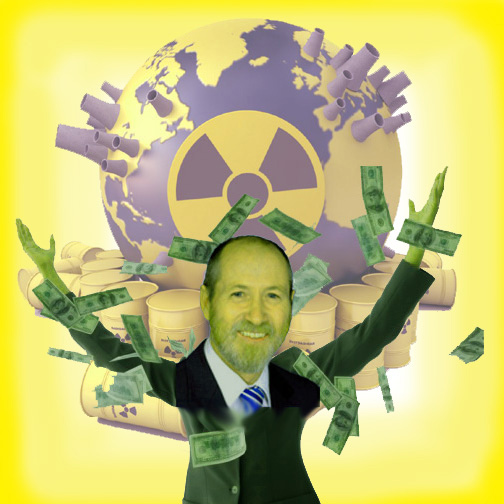 ideal site for a radioactive waste dump as it was remote, sparsely populated and geologically stable. He said he had tried to nominate his own 2400ha farm, but was asked not to by Mr Macfarlane because of concerns of a potential conflict of interest.
“But as a consequence my understanding is there have been a number of other properties nominated in my community. I’ve encouraged people right across the board to nominate,” Mr Ramsey said. “I understand as many as four sites have been nominated in my electorate.”
The search for a site intensified last year after the federal government failed to convince a Northern Territory community to build a facility on its land.
This comes as South Australia’s royal commission into an expansion of the state’s role in the nuclear cycle picks up pace. Among other issues, the commission will examine whether to store international radioactive waste……..http://www.theaustralian.com.au/national-affairs/remote-sites-in-south-australia-offered-for-nuclear-dump/story-fn59niix-1227347545498
South Australia Nuclear Royal Commission Issues Paper 4 – misleading and serious omissions
the issues paper appears to be talking about a so-called public-private-partnership (PPT).
There is no mention of “user pays” or “polluter pays” principles. Nor is there any discussion of the role of Government economic regulation of such a venture.
Dennis Matthews, 8 May 15 NUCLEAR FUEL CYCLE (sic) ROYAL COMMISSION
ISSUES PAPER FOUR
MANAGEMENT, STORAGE, AND DISPOSAL OF NUCLEAR AND RADIOACTIVE WASTE
Once again, the word “ionising” has been omitted from “ionising radiation”. It is hard to believe that this is an oversight and appears to be a deliberate move by the nuclear industry to play down the fact that radiation from radioactive substances is very different in its effect on living tissue from other forms of radiation such as visible light and radio waves.
In addition a new ploy has emerged, not only has nuclear waste been differentiated from radioactive waste but in the majority of cases it is simply referred to as “waste” and we end up with terms like “waste disposal facility”.
I anticipate that in the near future the nuclear industry, its fellow travellers, and the unsuspecting public will be using these sterilised and misleading terms. For example, it would be a simple matter to quote sections of the issues papers out of context in such a way that terms like “radiation”, “waste” and “waste disposal facility” can be bandied about until they become the standard.
As previously, there is widespread use of terms like “proposed”, “under development”, “being developed”, “would involve”, and research is “ongoing”. Such terms have no place in a document that is being used to determine government policy, especially on such a contentious issue as expansion of the nuclear industry.
This issues paper is in three sections: Nuclear and Radioactive Waste, Facilities and Techniques for the Management, Storage and Disposal of (nuclear and radioactive) Waste, and Risks and Opportunities.
- NUCLEAR AND RADIOACTIVE WASTES
Dennis Matthews exposes South Australia Royal Commission “Issues Paper 2” spin
In relation to the dangers of ionising radiation the issues paper refers simply to “radiation” thereby lumping it together with electromagnetic radiation including such innocuous things as visible light and radio waves.

Dennis Matthews, 8 May 15 NUCLEAR FUEL CYCLE (sic) ROYAL COMMISSION
 ISSUES PAPER TWO
FURTHER PROCESSING OF (uranium and thorium) MINERALS AND MANUFACTURE OF MATERIALS CONTAINING RADIOACTIVE AND NUCLEAR SUBSTANCES
Two things stand out in this the second Issues Paper for the Scarce Nuclear Industry Commission.
One is the consistent use of pro-nuclear jargon/spin, the other is the frequency with which statements are accompanied by provisos.
The pro-nuclear jargon/spin started right from the beginning of this whole process with the name of the Commission. Instead of using the neutral, straight forward term “nuclear industry”, the value –laden, scientifically incorrect, misleading phrase “nuclear fuel cycle” was chosen. This was accompanied by similarly misleading, nuclear industry, feel-good phrases such as “value adding” and “enrichment”.
The most obvious nuclear industry ploy used in this discussion paper is to refer to “radiation” rather than “ionising radiation”. This is unscientific, misleading and potentially confusing to many readers who are familiar with the fact that “radiation” includes microwaves, radiowaves, visible light, and infrared radiation, none of which is ionising.
This issues paper makes frequent use of vague terms such as “may allow”, “ongoing”, “possible”, “currently being developed”, “may be”, “could be influenced”, “being developed”, and “emerging technologies”. These are hardly encouraging or appropriate terms for producing serious policy, especially on such a contentious issue as expanding the nuclear industry in SA.
This issues paper is in four sections: Further Processing, Manufacture, Viability, and Risks and Opportunities. Continue reading
South Australia gets world class floating solar system – by an Australian company
Australian company creates world-first floating solar system NEWS.COM.AU MAY 02, 2015 AN AUSTRALIAN company is leading the way for renewable energy after creating a world-first floating solar system.
Infratech Industries selected the Northern Areas Council Waste Water Treatment Plant in South Australia as the first location to implement the new system.
Director Felicia Whiting said it is expected the innovative technology will generate an estimated 57 per cent more power than fixed land-based systems.
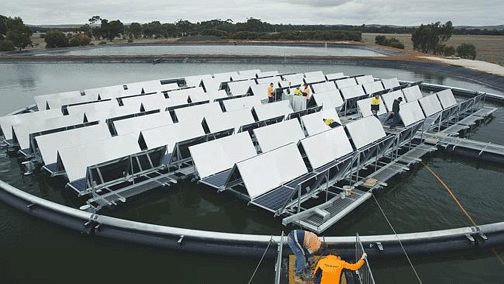
“The proprietary tracking, cooling and concentrating technology uses water to counteract the gradual loss of output caused by overheating solar panels to create a better performing and more efficient system,” she said.
“The Northern Areas Council will reap additional economic benefits with a cost saving of approximately 15 per cent on their current energy expenditure, plus an additional one per cent margin on the excess energy provided to the local community.”
- Ms Whiting said the biggest challenge in implementing the technology was changing the mindset of government officials and bureaucrats who questioned the need for renewable energy.
“Just how strong Australia’s post-2020 emissions reduction targets remain unknown, however we do know solar innovation is a milestone towards Australian councils, communities and businesses making a difference,” she said.
“As Australians evangelise this type of technology, it is our hope that renewable energy becomes the mainstream rather than niche solution.
“Change is not beyond us and this is definitely a strong step forward.”………http://www.news.com.au/technology/innovation/australian-company-creates-world-first-floating-solar-system/story-fnjwucti-1227331868879
Next Australian stock exchange winner could be renewable energy
 Could Renewable Energy be the Next Big ASX Winner? Money Morning 5 May 15 On Wednesday, Infratech Industries announced their intention to list on the ASX. It’s a bold move for the fledgling renewables company, which was established in April 2012.
The company is behind the $17.5 million floating solar panels project currently being expanded in South Australia. They say their tracking and cooling technology produces 57% more power than land-based solar panels. It’s a big deal for the entire solar industry.
Chief executive Raj Nellore says that soon, more capital will be required to keep up with demand. Of listing on the ASX, he said ‘once we get to a certain size, [it] makes sense’.
Infratech has partnered up with the Centre for NanoScale Science and Technology at Flinders University (CNST) for research. CNST has backing from the South Australian state government. So their funding — and the partnership with Infratech — is subject to budget changes.
There are other forces that might pressure Infratech to go public sooner rather than later. For example, they may need to raise money to expand their US operations too. Their US entity was opened in June 2014. They signed their first US customer — the City of Holtville, California — in November. That’s pretty much all they’ve done there.
Whenever they do float, they won’t be alone. A small group of renewable energy companies are already listed on the ASX.
Which renewable energy companies are currently on the ASX?
Wave power Carnegie Wave Energy [ASX:CWE] ………
Solar Dyesol [ASX:DYE] ……Enviromission [ASX:EVM]……..
Geothermal The Raya Group [ASX:RYG]……http://www.moneymorning.com.au/20150505/could-renewable-energy-be-the-next-big-asx-winner-cw.html
Recycling of rare earths – an industry already under way
Recycling gives old electronics new life JAMIE DUNCAN AAP MAY 01, 2015 Herald Sun
IMAGINE a world in which billions of dollars of gold, silver, platinum and other precious metals are thrown into a pit like rubbish.
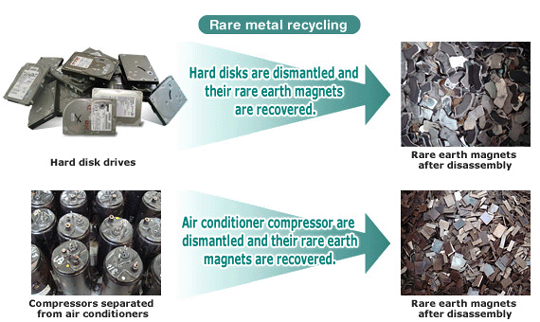
IT seems unlikely, but it’s happening now at landfills around the globe.
- A recent United Nations University report found consumers threw out 41.8 million tonnes of unwanted electronics, or e-waste, in 2014 but recycled only 6.5 million tonnes.That discarded e-waste included an estimated $US52 billion ($A65.78 billion) of precious and other metals.Rose Read, recycling manager with MobileMuster (MobileMuster), says recycling components from e-waste is good for the economy and the environment.”The benefits are massive, and not just in terms of dollar value, but also the environmental benefits of slowing the rate of mining,” Ms Read told AAP.”The amount of energy it takes to recover product materials from a mobile phone is a tenth of digging them up.”MobileMuster is a federal government-accredited product stewardship scheme funded voluntarily by a range of mobile phone manufacturers and retailers that collects unwanted mobiles to recycle components.A similar scheme operates for end-of-life televisions.Consumer thirst for the latest technology is forcing the need to recycle e-waste, Ms Read said…….
- Recycling e-waste entails significant costs, hence the need for industry-funded stewardship schemes, but Ms Read says Australia could build a new, self-sustaining e-waste industry.
- Already, a lead smelter in South Australia is considering expanding to recycle circuit boards locally rather than send them overseas, she said.”There is a whole range of opportunities to create a new industry and employment,” she said.”A lot of new jobs could come out of this. There is some innovative new technology that we can use.”
What Australia’s nuclear lobby is most worried about
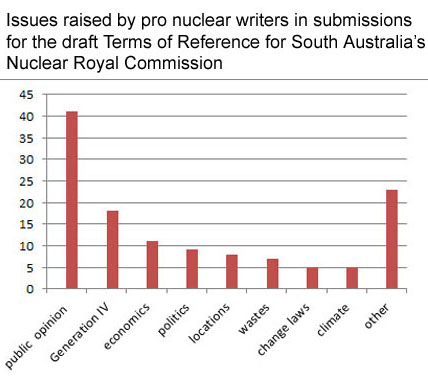
 Pro nuclear Submissions for the Draft Terms of Reference for South Australia’s Nuclear Royal Commission gives an insight into the preoccupations of Australia’s nuclear lobby.
Dennis Matthews, of South Australia, took the trouble to analyse the themes raised in pro nuclear submissions.
The overwhelming concern of the nuclear lobby appears to be – the need to win over the public to supporting the nuclear industry – the necessity of “educating” the public. (It struck me that their idea of education might be similar to British tobacco’s idea of informing the public of the benefits of cigarette smoking.)
The second most important topic was the benefits of “Generation IV nuclear technology”, particularly Small Modular Recators. (They don’t even exist yet – but never mind)
Way behind these two topics, were arguments for the nuclear industry on grounds of economics, politics, locations for reactors, waste disposal, need to change Australia’s laws, and fixing climate change.
A very few submissions dealt with (in this order) military advantages, radiation no real threat, energy demand, Australia’s international role, benefits to Aborigines, expertise, and medical uses.
So I guess we can expect that the first onslaught of the pro nuclear campaign will be an allout publicity and “educational” effort – no doubt supported by a sycophantic media, and by educational institutions who know which side their bread is buttered.
ISSUES RAISED BY THE PRO-NUCLEAR SUBMISSIONS TO THE
DRAFT TERMS OF REFERENCE
SCARCE COMMISSION INTO EXPANDING THE NUCLEAR INDUSTRY Continue reading
Even the pro Nuclear Royal Commission admits the threat of the nuclear industry to precious groundwater
Groundwater a significant issue: nuclear royal commission, IN Daily,  Adelaide Indpendent News, 30 April PETER GILL | 30 APRIL 2015 The potential impact of a nuclear waste storage facility on South Australia’s groundwater systems is one of the “significant issues” that need to be addressed in any consideration of expanding the nuclear fuel cycle, according to the royal commission.The second issues paper published by the royal commission says the siting and operation of a waste storage or disposal facility must take potential environmental impacts into account.
“In addition to the management of radiative exposure, a significant issue is the potential for the contamination of groundwater sources.
“Addressing that issue requires an understanding of the current frequency, flow and volume of surface and ground waters. “Management of water resources from sourcing and storage will be required if such a facility were to be sited in South Australia.
“Also significant is the potential risk of land contamination at handling, storage and disposal sites.
“Aside from its ecological impact upon animals and plants, contamination of the environment has implications for the health and safety of humans who use those resources.”
The issues paper, entitled Management, Storage and Disposal of Nuclear and Radioactive Waste,was released last week and followed the royal commission’s first public forum in Mt Gambier. Similar forums will be held in Port Augusta today (Thursday 30 April), Port Pirie tomorrow, and Berri on 5 May………http://indaily.com.au/business-insight/2015/04/30/groundwater-a-significant-issue-nuclear-royal-commission/
Minerals Council pushes for overturning of Australia’s environmental laws
When Oscar Archer spruiked on ABC Radio National for then entire nuclear chain to be set up, he left the first and most important step as a little addition near the end of his spruik. That was the necessity of overturning Australia’s Federal and State environmental laws. The Nuclear Lobby now takes this up
Review emissions target, nuclear ban: Minerals Council The Minerals Council of Australia has called for a review of the ban on nuclear power and warned that Australia’s post-2020 emission-reduction target cannot be properly formulated without extensive economic modelling……
Fibs and half-truths told by the South Australian Nuclear Royal Commission
Confusing and dishonest propaganda is already the modus operandi of South Australia’s Nuclear Royal Commission.
How Kevin Scarce, the (only known) Commissioner reported on their visit to Mt Gambier:
1. Public response “It is clear from our first public forum held in Mount Gambier this week that the community is keenly interested in having their say on the nuclear fuel cycle.
2. Information provided “It was also clear that the Issues Papers were a valued source of information for the community, as the information is evidence-based and provides helpful guidance on the topics which submissions will best assist the inquiry”.
What really happened at Mt Gambier.:
1. Public (dubious) response Royal Commission (presumably Kevin Scarce + unknowns) held public forum at Mt Gambier on April 20. Only 35 people attended. Then Commissioner talked with “business leaders” . – a lot of secrecy about who’s involved in this Royal Commission.
2, Information (not) provided. Out of 4 Issues Papers touted by the Commission, in fact only one EXPLORATION, EXTRACTION AND MILLING (of Uranium and Thorium) (very narrow and inadequate) has yet been released..
Pro nuclear vested interests predominate in submissions to Nuclear Royal Commission
Dennis Matthews 24 Apr 15 In 2011 The Chief Executive, Prof. Stephen Martin, of the influential Committee for Economic Development of Australia (CEDA) wrote in an article on nuclear power calling for “a rational debate, not one based on vested interests” (The Australian, 10/11/11).
Less than four years later, at least 14 of the submissions to the draft terms of reference for the inquiry into the nuclear industry are from individuals, companies or organisations with a clear vested interest in the nuclear industry.
The SA Government and the inquiry commissioner have constantly assured us that the inquiry will be objective and rational.
This raises the question “why have so many pro-nuclear vested interests felt emboldened to try to influence the inquiry’s terms of reference?”
This is a question that only the SA Government can answer.
In the meantime, for an objective, rational debate it is incumbent on the commissioner to either ignore or heavily discount the views of vested interests.
35 people attended Kevin Scarce’s Nuclear Royal Commission Forum at Mt Gambier
Royal Commission (presumably Kevin Scarce + unknowns) held public forum at Mt Gambier on April 20. 35 people attended. Then Commissioner talked with “business leaders” . – a lot of secrecy about who’s involved in this Royal Commission.
Dennis Matthews on the agendas and style of submissions to the draft ToR of the Nuclear Royal Commission
Dennis Matthews, 23 Apr 15 I have just finished reading submissions to the draft terms of reference of the inquiry into the so-called “nuclear fuel cycle”. I was struck by the fawning attitude of many submissions from those who have a vested interest in the nuclear industry, and by the derogatory language used to describe those who oppose the nuclear industry.
One submission from an organisation with an apparent vested interest offered to help the commission with “independent” experts, whilst another claimed to be neither “pro nor anti-nuclear”.
Concerns about the Chernobyl and Fukushima disasters were dismissed as based on ideology.
 Pro-nuclear submissions referred to “every anti-nuke zombie” “lurching out of their coffins”, to “an ignorant and anti-scientific audience”, to “fear mongers”, to the “anti-nuclear lobby fear industry”, to “anti-nuclear propaganda”, and to “emotive arguments”.
The confidence with which supporters of the nuclear industry addressed their inappropriate remarks to the inquiry does nothing to allay fears that there is a strong pro-nuclear undercurrent to the inquiry.
Australia breaches international law in evicting remote Aboriginal communities
 In 2011, Barnett’s government displayed a brutality in the community of Oombulgurri which the other homelands can expect. “First, the government closed the services,” wrote Tammy Solonec of Amnesty International:
It closed the shop, so people could not buy food and essentials. It closed the clinic, so the sick and the elderly had to move, and the school, so families with children had to leave, or face having their children taken away from them. The police station was the last service to close, then eventually the electricity and water were turned off. Finally, the 10 residents who resolutely stayed to the end were forcibly evicted [leaving behind] personal possessions. [Then] the bulldozers rolled into Oombulgurri. The WA government has literally dug a hole and in it buried the rubble of people’s homes and personal belongings.
In South Australia, the state and federal governments launched a similar attack on the 60 remote Indigenous communities.
The closure of Indigenous homelands breaches Article 5 of the International Convention for the Elimination of Racial Discrimination
Evicting Indigenous Australians from their homelands is a declaration of war John Pilger, Guardian 23 Apr 15 Australia occasionally interrupts its ‘normal’ mistreatment of Aboriginal people to deliver a frontal assault, like the closure of Western Australia’s homelands
Australia has again declared war on its Indigenous people, reminiscent of the brutality that brought universal condemnation on apartheid South Africa. Aboriginal people are to be driven from homelands where their communities have lived for thousands of years. In Western Australia, where mining companies make billion dollar profits exploiting Aboriginal land, the state government says it can no longer afford to “support” the homelands.
Vulnerable populations, already denied the basic services most Australians take for granted, are on notice of dispossession without consultation, and eviction at gunpoint. Aboriginal leaders have warned of “a new generation of displaced people” and “cultural genocide”.
The prime minister, Tony Abbott, has revived this assault on a people who represent Australia’s singular uniqueness. Soon after coming to office, the federal government cut $534m in Indigenous social programs, including $160m from the Indigenous health budget and $13.4m from Indigenous legal aid. …….
In announcing that the Australian government would no longer honour the longstanding commitment to Aboriginal homelands, Abbott sneered, “It’s not the job of the taxpayers to subsidise lifestyle choices.” Continue reading
France’s involvement in South Australia’s Nuclear Royal Commission
This Nuclear Royal Commission is becoming a bigger farce with each passing day!
We already knew that the Royal Commission was seeking help from Canada- notorious for the corruption in its nuclear industry
The Advertiser (South Australia’s voice for the nuclear industry) has informed us , apparently with joy and delight, that:
“The French want to sell the state their world-leading uranium enrichment and electricity-generating nuclear technology.”
“Suggestions proposed by the French have already been incorporated into its terms of reference”
“the French Ambassador, Christophe Lecourtier, also briefed Mr Weatherill on the transformation of the regional economy of Normandy, as host to significant sectors of French’s nuclear industry.
The ambassador argued parallels could be found with the South Australian economy if it were to become the home of a fledgling Australian uranium enrichment and nuclear energy industry.
Normandy has the French government’s most modern and main export reactor design, the so-called European pressurised reactor (EPR), which is currently under construction.”
It all sounds so very fine and dandy.
EXCEPT for:
1 France’s Nuclear Financial Crisis France’s State owned nuclear company AREVA now a costly burden France’s nuclear corporation AREVA in deep financial trouble – needs tax-payer bailout.
2. France’s Nuclear Safety Crisis UK nuclear strategy faces meltdown as faults are found in identical French project. Future of the entire Flamanville-3 project in doubt, with more problems at EPR nuclear reactor
1 This month


Help Aunty Sue Protect Her Land and Sacred Sites From Destructive Rocket Testing.
.

Australians deserve the truth
about
AUKUS – https://aukuspublicinquiry.com/

PETITION – To: Prime Minister Anthony Albanese and the Australian Labor Government

of the week – Australians for War Powers Reform (AWPR)
To see nuclear-related stories in greater depth and intensity

