Pro nuclear spin hides the real motive behind South Australia’s Royal Commission – a nuclear waste import industry
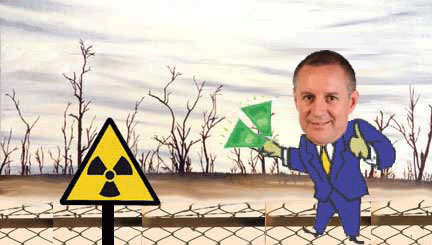
When announcing the commission last month, SA Premier Jay Weatherill said it would “explore the opportunities and risks of South Australia’s involvement in the mining, enrichment, energy and storage phases for the peaceful use of nuclear energy”.
The move caught many by surprise, not least federal opposition leader Bill Shorten, who – unlike his Labor colleague Weatherill – remains opposed to nuclear.
The announcement also generated huge amounts of free PR for the nuclear industry, as shown in the avalanche of media coverage that ensued – some deliberately balanced, some sceptical of the commission and its value, but much of it highly favourable, especially in the business press.
It is not hard to see why. As Naomi Klein contends, nuclear power is an industrial technology, organised in a corporate manner. And as psychiatrist Robert Jay Lifton points out, no technology does more to underline humanity’s dominion over nature than our ability to split the atom.
The positive spin Continue reading
Highly respected South Australian Aboriginal, Yami Lester, speaks out on nuclear waste dump plan
I’m hoping you will support us with this very important issue which has arisen from SA Goverenment regarding a Royal Commission into Nuclear Energy and proposal to store high-level nuclear waste at Maralinga, South Australia
Please read. With thanks, Yami Lester, Yankunytjatjara Walatinna Station, South Australia (08) 8670 5077
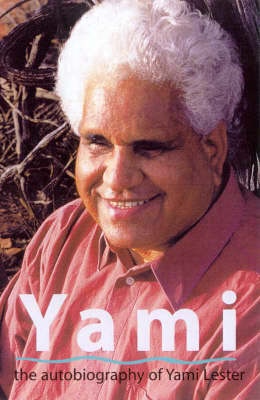 Statement on Royal Commission into Nuclear Energy and proposal to store high-level nuclear waste at Maralinga, South Australia:

In 1953 I was just ten years old when the bombs went off at Emu and Maralinga, I
didn’t know anything about nuclear issues back then, none of us knew what was happening. I got sick, and went blind from the fallout from those tests, and lot of our people got sick and died also.
Now I’m 73 years old and I know about nuclear issues, and I have some friends who know about nuclear waste, and they will fight the South Australian Government on their plans to put high-level nuclear waste at Maralinga and to develop nuclear energy in South Australia.
Why does the government keep bringing back nuclear issues when we know the problems last forever?
The Royal Commission into British Nuclear Tests in Australia (1984-85) revealed
what happened at Maralinga but it never told what happened to Aboriginal people; the findings were left open.Lawyers proved that there was radiation fallout over Walatinna, but because wenever had any doctors records to document what happened to us, (the closest clinic was Ernabella, 160km away as the crow flys and we didn’t have any transport to get there), we only had our stories and they were never written down.
A few years ago they cleaned up Maralinga from the waste that was leftover from the bomb tests; they spent $1 million, and now they’re going to put more waste back there?
That’s not fair because it’s Anangu land and they won’t be able to use that land.
Members from the APY, Maralinga-Tjarutja and Arabunna, Kokatha lands say we don’t want nuclear waste on our land.
The best thing the government can do is the leave the uranium in the ground, stop mining it.
We ask the South Australian Premier, Jay Weatherill, to talk to Aboriginal people on the lands, and to everyone who has been directly affected by the atomic tests and nuclear industry in Australia before he makes any decisions for South Australia.
South Australia’s proud history of the win against nuclear waste, a win led by Aboriginal women
One media narrative, as espoused in the AFR, is that this defeat was the result of a revolt by SA politicians. But this version of the story ignores the powerful campaign led by the Kupa Piti Kungka Tjuta, the senior aboriginal women’s council of Coober Pedy.
This story has been recorded by movement researchers Nina Brown and Sam Sowerwine and in a book, Talking Straight Out: Stories from the Irati Wanti Campaign.
Many members of the Kunga-Tjuta were survivors of the British government’s atomic testing in the 1950s and 60s, and so understood the devastating history of the nuclear industry. Upon hearing about the waste dump proposal, the group issued this statement:
We are the Aboriginal Women. Yankunytjatjara, Antikarinya and Kokatha. We know the country. The poison the Government is talking about will poison the land. We say, “No radioactive dump in our ngura – in our country. It’s strictly poison, we don’t want it.

The traditional residents of this supposedly “benign and sparsely populated geology” fought hard to protect their country using the tools they had available. They explained, demanded, marched and sang. They worked with green activists and wrote passionate letters. They urged politicians to “get your ears out of your pockets”. They won.
As South Australia faces another push from the nuclear industry, we would do well to remind ourselves of these stories. To paraphrase the late historian Howard Zinn, we need to emphasise what is possible by remembering those moments in our recent history when people demonstrated their capacity to resist, come together, and occasionally, to win.http://theconversation.com/south-australias-broad-brush-nuclear-review-is-meant-to-sideline-opponents-38110
Will South Australia’s Royal Commission be genuinely independent, or just excuse for importing radioactive trash?
If the Royal Commission brings a genuine spirit of independence and rigour, and is willing to take evidence on the nuclear sector’s performance in Australia and overseas, the report will provide a valuable contribution to domestic energy and industry policy.
An inquiry into how to get to zero emissions electricity as cheaply and rapidly as possible would have made a far more timely and valuable contribution to debates over energy policy and rebooting South Australia’s manufacturing sector than another rake through the slowly cooling ashes of the nuclear dream. Nonetheless, the lid has been lifted once again, and we can only hope that the Royal Commissioner is willing to take an unblinking look at the evidence, so that the failed hopes and broken promises of the atomic age can be set to rest once and for all
the probability that this whole exercise is designed to build the case for a national or international radioactive waste dump.
 Nuclear Industry On Trial? Scott Ludlam Hopes So, New Matilda, 26 Feb 15 The debate about nuclear power in South Australia needs to be had, if only to put the issue to bed once and for all, writes Scott Ludlam.
At first glance, the decision to call a Royal Commission into nuclear technology in South Australia seems like a curious aberration from the ‘Yes Minister’ rule of inquiries: never call one unless you know in advance what it will tell you.
At the outset of this most polarising of debates, I’d like to propose a truce; particularly with those whose pro-nuclear views are motivated by the overwhelming imperative of climate change. If we respect that not all nuclear advocates intend to contaminate the gene pool and plunge us into nuclear winter, I’d ask in return that you consider the possibility that the anti-nuclear case is based on rational assessment of risks and performance, rather than pure emotion as is sometimes asserted.
For those whose motivation is a safe climate, this is a disagreement over means, not ends. Continue reading
Renewable energy leader Port Augusta does not need nuclear power – Mayor
Local mayor unhappy with city counterpart’s nuclear comments, The Transcontinental, 27 Feb 15 Port Augusta has been suggested as a “convenient” site for a nuclear reactor, just weeks after the state government announced it will establish a Royal Commission into nuclear power in SA.
Port Augusta mayor Sam Johnson is not happy, saying the suggestion treats those living in regional areas like Port Augusta as second-rate citizens……
Port Augusta mayor Sam Johnson said he’s open to an informed debate on nuclear power, but hit fiercely back at the Port Adelaide mayor’s comments, labelling the idea a “cop out”. (picture from The Transcontinental )
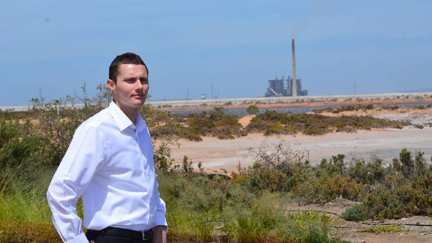
He said there’s no reason to consider putting nuclear power in Port Augusta, given the city is already leading the way in renewable energy.
“Why in the hell would we want nuclear power in Port Augusta when we’ve done so much work on renewable energy, in particular the solar thermal plant?” Mr Johnson questioned.
“We’ve had international experts actually say to us, why isn’t the government in Australia exploring renewable energy such as solar thermal given we have the best geographical climate in the world to do it?
“If the government wants to talk about nuclear, fine, happy to talk about it – but we’re already heading down a successful path…they can go and build the nuclear power plant in Unley or Norwood for all I care.”
Repower Port Augusta chairperson Gary Rowbottom suggested nuclear power is a higher risk option than renewable energy, and doesn’t see why it’s worth exploring when there’s a better option on the table for the city.
“Our current belief is that it is simply not required to take the risks and overcome all the implementation difficulties involved in ‘going nuclear’,” Mr Rowbottom said.
“We can substitute a suite of proven and developing renewable technologies in place of any need to go down the nuclear path…the commercial, health and environmental risks of nuclear are too high to justify it.
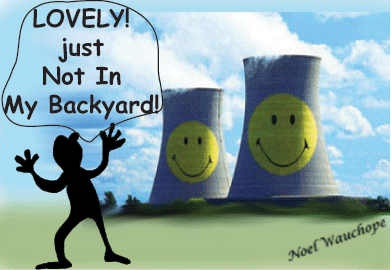 “It can be taken as somewhat offensive that the Port Adelaide/Enfield areas (Mr Johanson) are clearly saying that they are not prepared to have a nuclear reactor in their area but it is ideal and more convenient for Port Augusta to have one.”……
What do you think about having a nuclear reactor in Port Augusta?
Send your thoughts to the editor at ryan.smith@fairfaxmedia.com.au http://www.transcontinental.com.au/story/2903676/local-mayor-unhappy-with-city-counterparts-nuclear-comments/
Senator Scott Ludlam on “new generation” nuclear reactors that “emit only unicorn dust”
Nuclear Industry On Trial? Scott Ludlam Hopes So, New Matilda, 26 Feb 15 “……The unthinkable consequences of a well-executed terrorist attack on an operating reactor or high-level waste store keep national security planners awake at night, with the potential for nuclear power plants to be used as pre-deployed radiological weapons by those with malevolent intent.
It seems likely that in the face of this evidence, the Royal Commission will see the industry play its last remaining card: an invitation to set aside the actual performance of existing reactors and imagine the potential of a new generation of nuclear technology: safe, clean, reliable, cheap, modular, proliferation-proof; reactors that consume only nuclear waste and emit only unicorn dust.
Forgive the scepticism: no-one has ever come remotely close to designing and building such a device, and commercial application of imaginary Generation IV reactors lies well over an indefinitely receding horizon; always just a few more years and decades away.
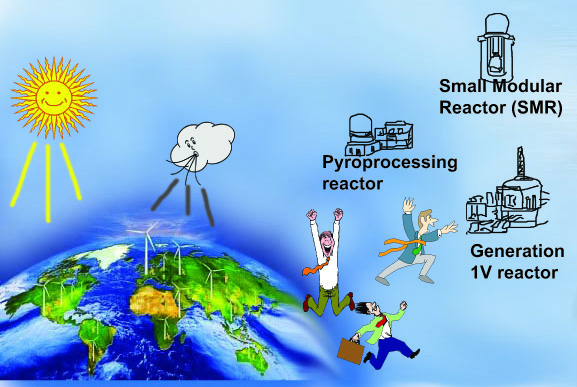
Perhaps more to the point, it may be that there are simpler ways to boil water or induce electrons to flow down a wire than the absurdity of plutonium-burning fission reactors cooled by liquid sodium.
Turning to face the timeless abundance of free solar energy presents a much simpler way forward. It is time that advocates of terrestrial nuclear power instead used their efforts to advocate for better use of the celestial nuclear reactor that sustains rather than threatens life on Earth.
The very qualities of scale, baseload delivery and centralisation that so appealed to energy planners of the 1950s make nuclear technology uniquely unsuited to the realities of the 21st century.
Emerging industrial economies like India, Africa and China’s rural hinterlands are vastly better served by decentralised renewable generators feeding local or regional-scale microgrids.
The plunging costs of solar, wind and micro-hydro generators are combining with cheap, decentralised energy storage technology – driven largely by developments in the IT and automotive industries – to drive the final nail into the fallen potential of nuclear power.
In March 2013 the cover and feature piece of the Economist magazine put the case succinctly: Nuclear Power – the dream that failed.
For the indefinite future, there will still be a need for reliable, dispatchable utility-scale power plants, but even here clean-technology has emerged to checkmate atomic energy: large-scale concentrating solar thermal plants have come online in Spain and the United States, paving the way for vastly more ambitious developments in South America and the Middle East combining cheap photovoltaics with heliostat fields heating overnight molten salt energy storage.https://newmatilda.com/2015/02/26/nuclear-industry-trial-scott-ludlam-hopes-so
Significant omissions from the Terms of Reference for the SA Nuclear Royal Commission
Will anyone take this Royal Commission seriously?
 Some Significant omissions from the Terms of Reference for the SA Nuclear Royal Commission Margaret Beavis 25 Feb 15,
Focus on Mining expansion only
No mention of old mines and contaminated areas
No mention of water issues- huge supply required for reactor and risks of contamination of waterways and aquifers. SA is a dry state.
Opportunity cost of focussing on nuclear industry instead of becoming world leader in renewables
Ignores high cost of nuclear power compared to other sources
Large subsidies needed from government preventing spending on other important issues
Lack of financial/professional conflict of interest declarations being required from all witnesses and commission members
No mention of health impacts of radiation
No provision for how state would respond to Fukushima type scenario from accident/deliberate damage
No mention of possible impacts on SA tourism, food and wine exports (especially fisheries)
Vast majority of medical waste has a very short period of radioactivity and is not the main reason for a dump.
Conservation Council of South Australia : points on Terms of Reference for the Royal Commission.

 If the Royal Commission is to be a genuine inquiry, the draft terms of reference need significant revision. Otherwise it will lack credibility.
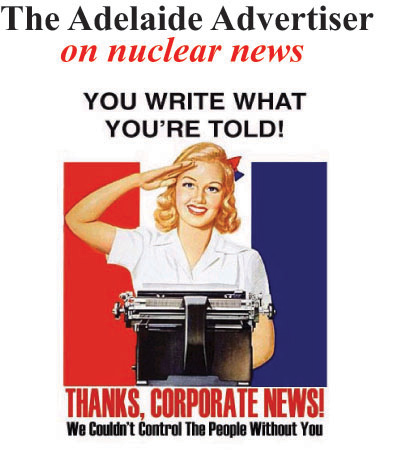
The Adelaide Advertiser misleads public on medical nuclear isotopes
The Editor
The Advertiser
Your correspondent Phil Day (The Advertiser, 24/2/15) is a victim of those nuclear industry spin doctors who try to use nuclear medicine to justify the use of nuclear reactors.
The nuclear waste that is being considered for dumping in South Australia does not come mainly from medical grade isotopes, it comes from nuclear power stations and from facilities for producing the fuel for nuclear power stations and nuclear weapons. The nuclear waste from medical grade isotopes is comparatively trivial.
I also hope I never need a CAT scan or X-ray because both use ionising radiation. However, neither CAT scans nor X-rays use radioactive isotopes or produce nuclear waste and hence their use to justify generating and importing nuclear waste is misleading.
Dennis Matthews
South Australia’s Royal Commission should investigate the costs of uranium mining
The draft terms of the reference for the royal commission, released on Monday, are focused on nuclear power generation, uranium enrichment and waste storage. But the government has ruled out scaling back the state’s involvement in uranium mining, while also precluding the use of nuclear for military purposes.
Australian Conservation Foundation spokesman Dave Sweeney says the decision to exclude consideration of uranium mining is deeply disappointing. “The nuclear industry starts with uranium and so should any genuine assessment of the nuclear sector in South Australia,” he said.
The next step in South Australia’s Nuclear Farce
OK – Now it has turned up on http://yoursay.sa.gov.au/blogs/draft-terms-of-reference
 The Premier’s media release says that you can find the Terms of Reference at www.yoursay.sa.gov.au.
I couldn’t find anything there about the subject. Perhaps later?
Symptomatic of the clumsy and inept rush that characterises this tacky Royal Commission idea.
Also no mention of personnel – other than the pro nuclear former S.A Governore Kevin Scarse. (at right) Independent, my foot!
Anyway – here are the Draft Terms of Reference Continue reading
South Australia’s Premier Jay Weatherill announces the Terms of Reference for Royal Commission
Nuclear royal commission draft terms of reference announced by SA Premier Jay Weatherill http://www.abc.net.au/news/2015-02-23/nuclear-royal-commission-terms-of-reference-jay-weatherill/6224192 South Australia’s nuclear royal commission is to inquire into enrichment, storage of waste and power generation, but not uranium mining.
The State Government has r eleased draft terms of reference and announced there would be public consultation until March 13.
Premier Jay Weatherill said the inquiry would focus on three key areas, but the terms of reference had deliberately been kept general.
“These are the broadest possible terms of reference … they won’t be settled for a further week,” he said.
“The only caveats really are the non-military uses will be the only things explored and it’s not our intention to suggest any retreat from the current involvement in uranium mining.”
The Premier said it would be the broadest possible analysis of South Australia’s involvement and potential for future involvement in the nuclear fuel cycle.
“We think it’s important to go through what is a thorough process of debate and discussion in the community about this important issue,” he said.
When asked if the state were mindful of a looming federal deadline to deal with the issue of nuclear waste storage, he said: “We don’t think this is something that should be rushed.
“The Commonwealth’s been talking about nuclear waste storage for decades so I don’t think our timeline is going to threaten any key decisions.”
Before the year is out, nuclear fuel rods that are being reprocessed by the French are due to be returned to Australia and by 2020 more nuclear waste being reprocessed in the United Kingdom is due to be returned as well.
A Dangerous Farce – South Australia’s Nuclear Royal Commission
 SA nuclear royal commission a farce, Independent Australia 22 February 2015 The South Australian government’s royal commission into our nuclear future is a farce, and a dangerous farce, warns Noel Wauchope.
FIRST OF ALL, it is not the province of one State to determine by a State royal commission that a nuclear industry should be introduced in Australia. That is a protected issue as a ‘A Matter of National Environmental Significance’ under the National Environment Protection and Biodiversity Conservation Act 1999.
Secondly, this royal commission would be a mammoth waste of money for South Australia The cost would run into hundreds of $millions. The Royal Commission into Institutional Responses to Child Sexual Abuse was allocated over $434 million in 2013 for its first four years of operation. Given that nuclear issues are the province of national law, not South Australian, this is a totally unnecessary expense.
Thirdly, the ‘public involvement‘ in the terms of reference for this royal commission is a farce in itself. Just look at how this was dealt with by the South Australian government:
8 February:
The announcement was made. Despite the fact that this whole initiative is clearly of national importance, it has received minimal publicity outside Adelaide. The Adelaide Advertiser ran a poll. The Adelaide Advertiser is pretty much regarded as the nuclear lobby’s free propaganda vehicle. No surprise if their readership turns up the required positive result.
9 February:
Consultations began on the Terms of Reference for the royal commission. Premier Jay Weatherill touted nuclear power for climate change action, though he said it was not economically viable. The better options, he said, were importing and storing radioactive waste, and uranium enrichment.
Pro-nuclear former governor, Kevin Scarce, was appointed as “independent” head of the inquiry. No mention of what scientists, etc. might be on the panel.
16 February:
(closing day for comments on the Terms of Reference for the royal commission)
There is no need for a royal commission into the nuclear industry for Australia. Nuclear proponent, Ziggy Switkowski, concluded in the 2006 Switkowski Report that the industry is not economically viable here. Nuclear reactors often far exceed their construction budgets. The last nuclear power plant built in Canada cost AUD$15.1 billion.
Mr. Switkowski predicted the capital cost at $4-6 billion for our first 1000MWe reactor.
However, we already know that, despite some pious statements by Jay Weatherill about nuclear power’s ability to reduce greenhouse gas emissions, action on climate change is not the motivator for this new inquiry.
According to a report by The Australian on 10 February 2015:
‘He [Premier Jay Weatherill] said he was open to the prospect of remote parts of the state hosting a nuclear waste deposit but played down the prospect of a power plant being built.
“I think that’s the least likely outcome of the royal commission,” he told ABC radio on Monday.
“I think what’s most likely is that it will be regarded as not viable for either the state or the nation.” ‘
In the same interview on ABC’s The World Today, Weatherill’s enthusiasm for storing the world’s nuclear waste is clear: ……..https://independentaustralia.net/environment/environment-display/sa-nuclear-royal-commission-a-farce,7399
Dirty, Unsafe, Unsound, Uneconomic – yes – that’s the nuclear industry chain
The case to expand the nuclear industry in South Australia and the world is weak. It stands neither on its life-cycle carbon dioxide emissions, nor increased safety, nor economy. New nuclear technologies under construction are far over budget and over time. Future nuclear technologies are not close to being commercially available.
These and other nuclear issues are discussed in more detail in Chapter 6 of my bookSustainable Energy Solutions for Climate Change.
Uncritical acceptance of the claims of nuclear proponents would set back safer, cleaner, faster and cheaper methods of mitigating climate change.
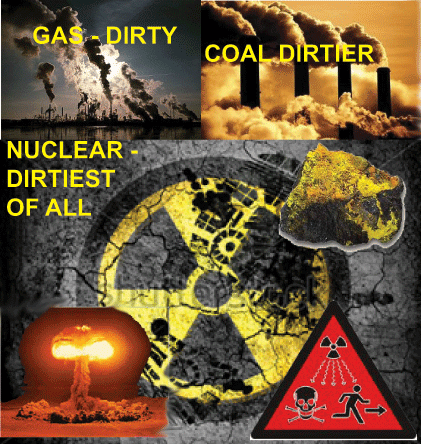 Nuclear Energy Is Dirty, Unsafe And Uneconomic: Environmental Scientist https://newmatilda.com/2015/02/21/nuclear-energy-dirty-unsafe-and-uneconomic-environmental-scientist by Dr Dr Mark Diesendorf , Associate Professor and Deputy Director within the Institute of Environmental Studies at the University of NSW..At present there is no market for expanding South Australia’s uranium mining and exports. In 2012, BHP Billiton put on hold its expansion plan for the Olympic Dam uranium-copper mine and since then has shed hundreds of jobs. That there is an excess of uranium enrichment capacity in the world is even acknowledged by the World Nuclear Association.
And, as explained below, wind energy is already much less expensive than nuclear and, on current trends, large solar power stations based on photovoltaic modules will also be cheaper within the 15-year period that it would take to plan and build a nuclear power station in Australia.
We should add to the 15 years the indefinite time-period it would take to gain public acceptance.
Looking beyond South Australia to the world, there seem to be three shaky legs upon which proponents attempt to stand their campaign to expand nuclear energy:
1. Nuclear energy has allegedly no or low greenhouse gas emissions.
2. New nuclear reactor technologies are allegedly safer than the present generation of reactors.
3. New and existing reactors are allegedly cheaper than other low-carbon technologies, notably renewable energy.
Let’s examine these claims. Continue reading
South Australia faces choice of a Renewable or a Radioactive future
Rather than make SA a hub for renewable energy and other sustainable technologies (the state already derives 26 percent of its energy from wind power), the corporate board rooms are determined to press ahead with the most dangerous “alternative” available.
 The Murdoch press, which previously defended the state from the imposition of a nuclear waste dump, has changed its tune accordingly. Its pages, usually dominated by climate change denying pens-for-hire, now carry bogus “carbon-free” claims for the water-guzzling, weapons proliferating, tax-payer supported nuclear power industry.
The Australian Financial Review refers to opponents of the nuclear industry as the “loony, left-progressive class”. The same editorial says the locating a dump for the world’s nuclear waste in SA would be an “act of good global citizenship” given that we supply the uranium. The dishonesty of this position is plain. A good global citizen wouldn’t have supplied the uranium in the first place.
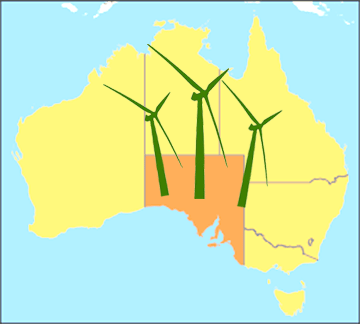 A renewable or radioactive future http://www.cpa.org.au/guardian/2015/1673/02-editorial.html South Australian Premier Jay
  Weatherill’s announcement that there will be a Royal Commission into the extension of the nuclear industry into enrichment, waste storage and nuclear power has rocked the state and sent shock waves across the country.
The Labor Party reversed its anti-uranium mining stance in the 1980s with a promise to limit to three the number of mines extracting and exporting the radioactive material. Kevin Rudd later lifted the cap to five. Widespread security and safety concerns in the community meant that political leaders had to step carefully in advancing the interests of the uranium industry.
Long decades of pressure from the industry via lobbyists, servants in academia, the media and the bureaucracy appear to have changed all that. There have always been advocates of hosting the riskier parts of the nuclear cycle, including nuclear-powered vessels and even nuclear weapons, but their views were considered extreme and hawkish. The SA Premier’s choice of an open-ended Royal Commission to inquire into the matter appears to be an effort to make the impending policy shift appear “scientific”, “arm’s length” and “impartial”. Continue reading
1 This month

of the week – Australians for War Powers Reform (AWPR)
To see nuclear-related stories in greater depth and intensity
 Antinuclear
