South Australia: huge solar project from Origin Energy
 Origin Energy to build Australia’s biggest rooftop solar array http://reneweconomy.com.au/2015/origin-energy-build-australias-biggest-rooftop-solar-array-78459 By Giles Parkinson on 19 February 2015
Origin Energy and Zen Energy Systems are to build a 3MW solar system on the rooftop of the old Mitsubishi factory in Tonsley, Adelaide, in what will be the largest rooftop solar array in the country.
The awarding of the contracts was announced by the South Australian government this week. The intention to build the array was first announced late last year. Origin Energy will own the rooftop array and sell the output to the tenants of the Tonsley high tech centre (artists impression to the right), under a power purchase agreement that it is looking at replicating elsewhere in the country.
Indeed, Origin Energy managing director Grant King says the company is “changing its view” on electricity markets, and is particularly interested in the economics of utility-scale solar in Australia.
“We are working hard to understand economics of utility scale solar in Australia,” King told an analysts briefing.
Origin has also revealed it has bought a 40 per cent stake in the 69MW Javiera solar project in Chile (pictured right), which is being built by SunEdison in the Atacama desert, without subsidies, and will supply electricity mainly the nearby Los Pelambres copper project.
Origin Energy says this will also help it understand the economics of large-scale solar – both in international markets, and in Australia.
Zen – a tenant in the Tonsley complex – has been awarded the installation and maintenance contract.
“It’s a great job to get to ramp up our capacity and profile with a number of multi-megawatt jobs in the pipeline currently evolving for ZEN around Australia,” managing director Richard Turner said.
South Australia Innovation Minister Kyam Maher said the tender for the 3MW solar project had attracted a huge response from tenderers. “Tonsley is fast gaining a reputation as an innovation precinct with a focus on sustainability and urban renewal, so it’s not surprising that a project of this size has attracted significant interest,” he said.
Climate Change Minister Ian Hunter said the project would add to South Australia’s credentials as a national leader in renewable energy.
Hunter noted that South Australia has 41 per cent of the nation’s operating wind farm capacity and one in four households have rooftop solar panels.
“If South Australia was a nation, we would rank second only to Denmark as the world leader in terms of installed wind power on a per capita basis,” he said.
Origin’s head of energy markets, Frank Calabria, said the company was delighted to be named preferred partner for the innovative Tonsley project, which will see Origin build, own, and retail the electricity generated by the 3MW solar array.
“We are excited about this project, which will be the largest rooftop solar array Origin has installed, as it builds on our solar leadership and demonstrates our renewed focus on our solar business.
South Australian Labor – a nuclear waste dump to fix money problems?
 Isn’t that just a lovely idea? Have South Australia’s labor politicians no brains? It”s like advocating cigarette smoking in order to fix obesity ( an idea I pinched from that great South Australian, Dr Helen Caldicott)
 Labor eyed outback nuclear waste ‘windfall’ to wipe out state debt http://www.theaustralian.com.au/national-affairs/state-politics/labor-eyed-outback-nuclear-waste-windfall-to-wipe-out-state-debt/story-e6frgczx-1227224599605 Michael Owen SA Bureau Chief ADELAIDE Sarah Martin Political Reporter
The revelation comes after Premier Jay Weatherill last week announced a royal commission into nuclear power, saying it was time for a “mature” discussion about the potential to expand the state’s role in the fuel cycle.
However, the most senior South Australian Liberal, Christopher Pyne, yesterday rejected Mr Weatherill’s inquiry, putting him at odds with Tony Abbott.
“We have all the energy we need here in Australia … whether it’s coal energy — I do not support an extension to nuclear energy,” the Education Minister told ABC radio.
The Prime Minister has backed the royal commission, saying Mr Weatherill had offered “a gale of common sense”.
Mr Weatherill was Premier when then employment minister Tom Kenyon presented the “silver bullet” proposal to a cabinet planning day, arguing that a pro-nuclear policy to build on the state having one of the world’s largest uranium mines, Olympic Dam, would turn around the state’s finances. It flags the problems of spiralling debt of more than $10 billion, “no sign of a turnaround in budget” and flagging confidence in the economic future of the state as reasons for building a nuclear storage facility.
“Rather than suffering a ‘death by a thousand cuts’ in the lead up to 2014, a single decision could turn the budget on its head,” the document says.
A series of bilateral deals with targeted nations such as Taiwan, South Korea, Japan and the US are flagged to provide “an unprecedented revenue windfall” in exchange for taking thousands of tonnes of nuclear waste.
“It is proposed this windfall be used to wipe out state debt, and implement a state infrastructure fund to enable a huge program of building works to drive the economy and deliver a boom to the state well in excess of any ‘mining boom’,” the report says.
Hosting Australia’s low-level waste would be conditional on allowing imported waste — a “non-negotiable aspect of the arrangement”.
Yesterday, Mr Kenyon — who remains a backbench MP — said all ministers received the November 2012 document, but he would not comment on cabinet deliberations.
“I think it has a lot of potential for the economy and I will certainly be putting that to the royal commission,” he said.
Mr Weatherill told The Australian yesterday that Mr Kenyon had been a “long-time advocate for increased involvement in the nuclear fuel cycle”.
“There are many views both in the Labor Party and in the wider community on this issue and I would ask anyone interested to make a submission to the royal commission,” Mr Weatherill said.
Mr Kenyon’s proposal raises the idea of locating the storage facility at sites previously earmarked by the commonwealth for a nuclear dump site, despite these being fiercely opposed by former Labor premier Mike Rann in 2004
Port Adelaide doesn’t want a nuclear reactor – “Put it in Port Augusta”
Port Adelaide community leaders say they don’t want a nuclear power plant in the heart of the Port KURTIS EICHLER PORTSIDE MESSENGER FEBRUARY 18, 2015
THE Port Adelaide Mayor and a local MP say they do not want a nuclear reactor built in their patch.Port Adelaide Enfield Mayor Gary Johanson and State Labor Port Adelaide MP Susan Close say any such plan for the heart of the Port would not be viable.
Mr Johanson said because the district was only 14km from the city it should not be an option for generating nuclear energy.He said Port Augusta, 322km north of Adelaide, was a better and more “convenient” option for the state.
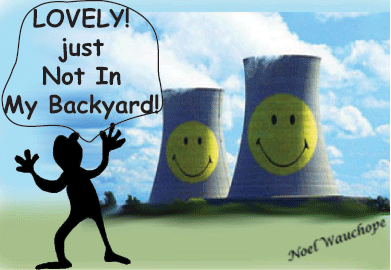
While Mr Johanson would not be drawn on the viability of storing the state’s nuclear waste on the Le Fevre Peninsula, he said a power plant would not work even if it did create jobs………
“There are benefits in job creation in other areas such as freight but I don’t think it is feasible to have a nuclear power plant in the Port,” Mr Johanson said.
“I can’t see you would want to build it anywhere in metropolitan Adelaide.” Mr Johanson said most Port Adelaide residents would not want to live near a nuclear reactor……..
Dr Close agreed the Port was ill-suited for nuclear power. “The idea of a nuclear plant in the Port is a ridiculous and inflammatory suggestion and I don’t support it,” she said.Local real estate agent Rob McLachlan said a nuclear power plant in the heart of the Port would not attract people to live in the area.
Port Augusta mayor Sam Johnson did not return calls before the Portside Messenger’s deadline. http://www.adelaidenow.com.au/messenger/west-beaches/port-adelaide-community-leaders-say-they-dont-want-a-nuclear-power-plant-in-the-heart-of-the-port/story-fni9llx9-1227223707411
Dry Future for Adelaide ( very unwise to bring water wasting nuclear industry)
Makes you question the intelligence of South Australia’s businessmen and politicians – even contemplating the high water use, and high water-polluting industries of nuclear industries, and expanding uranium mining
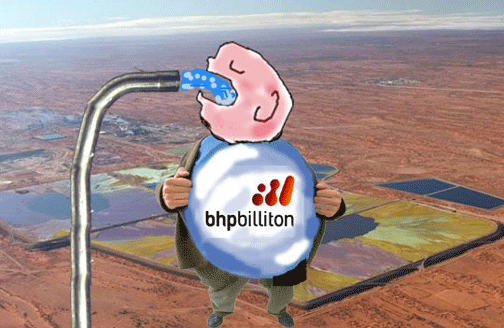
This means Adelaide needs to start planning climate change adaption strategies for its water supply now, in combination with reducing greenhouse gas emissions.
Declining supply
The finding is based on one of the most detailed modelling efforts that has been conducted into the water security of an Australian city. Based on the outputs of 15 recent global climate models combined with downscaling rainfall to the catchment scale and hydrological modelling, we assessed how changes in rainfall and evaporation and transpiration (water evaporating from plants) will affect runoff in the Onkaparinga Catchment. Historically, this catchment has supplied on average about 50% of Adelaide’s water supply, with the remainder supplemented by pumping from the Murray River.
The findings suggested that a high level of confidence can be placed in projections of a decline in runoff. In fact, 98% of the model simulations suggested a decrease in runoff by the end of the century (the remaining 2% suggest little change).
However, the magnitude of change is highly uncertain – some projections suggest only small levels of change; others as much as 75% or more.
Dealing with the dry
The results paint a bleak future, but there are things we can do. The most obvious solution is to collectively reduce our greenhouse gas emissions. By looking at a low-emission trajectory (i.e. one that assumes that society will take active measures to reduce emissions) the reduction of reservoir inflows might only be 25%.
As well as reducing emissions, we need to start preparing to adapt to a drier future…….http://theconversation.com/adelaide-is-facing-a-dry-future-it-needs-to-start-planning-now-37750
Concern that the Nuclear Royal Commission is really about a radioactive trash import business
MARK PARNELL: Giving one week is a ludicrous short time frame.
 NATALIE WHITING: The Premier, Jay Weatherill, has said he thinks it would be more likely that the commission recommend the establishment of a waste dump rather than power station.
Craig Wilkins from Conservation SA says that’s concerning.
CRAIG WILKINS: The only real market gap in the nuclear cycle is around receiving the world’s top nuclear waste. Certainly nuclear power and nuclear enrichment are just not feasible in the short term in our state. So that’s a big conversation. So I suppose part of our concern is that this inquiry is a bit of a Trojan horse for that agenda.
NATALIE WHITING: He says it has been difficult getting a submission up in the time frame
AUDIO Nuclear Royal Commission moves forward in SA MARK COLVIN: A royal commission is the biggest, most thorough, but often most expensive way Australia has of investigating an issue. ABC Radio P.M.
But in South Australia, just a week after the surprise announcement that of a royal commission into developing a nuclear industry, submissions on what the terms of reference should be are already closing. There’s been some criticism of that short time frame. Continue reading
Crikey explores the purpose of a Royal Commission into Nuclear Power
Crikey clarifier: why is a royal commission investigating nuclear power? http://www.crikey.com.au/2015/02/13/crikey-clarifier-why-is-a-royal-commission-investigating-nuclear-power/ by Crikey Intern The South Australian Labor government has called for Australia’s first royal commission into the nuclear fuel cycle, raising questions about the use of nuclear power. Royal commissions are mostly held to explore issues and events that have already taken place, so it is unusual that a royal commission has been appointed to analyse the case for nuclear power. Why a royal commission? And is that really the proper forum to investigate the potential use of nuclear power?
Why is a royal commission being used instead of a normal inquiry process?
A royal commission is a form of “public inquiry” where government-appointed bodies provide advice on or investigate an issue. Royal commissions are used to analyse issues of high importance or controversy, and they can last for several years.
The royal commission itself follows a recent call by Julie Bishop for a renewed discussion about nuclear power, as she says it is an “obvious direction” for reducing greenhouse emissions.
The infamous nuclear disasters that took place in Chernobyl and Three Mile Island have made people wary of nuclear power, and there is concern nuclear power stations could be “potential targets for terrorist attacks”.
Energy expert Mike Sandiford told Crikey the “irrationality in nuclear debate” requires a mature discussion. Continue reading
South Australian government continues to promote uranium industry, despite its gloomy market situation
SA Govt to give Uranium One green light for exploring new sites in state’s north-east, ABC News By Gavin Coote 13 feb 15 The owner of Honeymoon mine in South Australia’s north-east is set to be granted three new uranium exploration licenses in the region.
Honeymoon has been mothballed for 15 months but Uranium One was successful in an application to explore in three sites near the existing mine, 75 kilometres north-west of Broken Hill.
It came as the State Government planned to hold an inquiry into the potential opportunities that could come from the state’s expanding nuclear energy industry.
The SA Department of State Development said Uranium One put forward a strong case to play a part in future discoveries.
The Department’s Mineral Resources executive director Ted Tyne said the exploration licences would be finalised in the next few weeks…….http://www.abc.net.au/news/2015-02-12/sa-govt-expected-to-give-uranium-one-green-light-to-explore-new/6087340
Only till Monday February 16 for public comment in nuclear inquiry!
We’ve already had the nuclear debate: why do it again? The Conversation Ian Lowe Emeritus Professor, School of Science at Griffith University 11 Feb 15 “…….In principle, there is a process for public involvement in establishing the terms of reference, but the 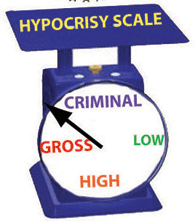 timescale for that exercise suggests it is a complete charade. The web site gives only until next Monday, a bare week after Weatherill’s announcement, for public comment on the terms of reference.
Also, there has been no announcement of any independent scientific or environmental expertise to guide former governor Kevin Scarce…”. http://theconversation.com/weve-already-had-the-nuclear-debate-why-do-it-again-37420
Pro nuclear Former SA governor Kevin Scarce to lead nuclear inquiry
 Scarce has previously expressed support for a renewed debate on nuclear energy.
Former SA governor to lead nuclear inquiry SBS World News, Source: AAP 9 FEB 2015 Former South Australian governor Kevin Scarce will lead a royal commission into the role of nuclear power in the state’s energy mix.
Premier Jay Weatherill has revived debate on whether SA should embrace the production, enrichment and storage of nuclear power to boost its lagging economy.
He said Mr Scarce, who served as governor of SA from 2007 to 2014, was a strong communicator who was well-placed to lead the contentious debate, despite his lack of legal expertise.
Mr Scarce, who was last year appointed Chancellor of the University of Adelaide, said he expected the work of the royal commission to be completed within a year.
“I come to this with no preconceived views,” he told reporters on Monday……..
The premier has said that a nuclear power plant is unlikely to be built in SA but there was potential for remote parts of the state to host a nuclear waste deposit.
He said the federal government had offered its support and promised the co-operation of agencies.
Business and mining lobby groups have welcomed the inquiry but environmentalists said the state’s clean energy credentials would be in tatters if the government allowed nuclear waste dumping.
The Liberal opposition has offered bipartisan support but criticised the timing of the inquiry after the government last week confirmed plans to close several hospital emergency departments. http://www.sbs.com.au/news/article/2015/02/09/former-sa-governor-lead-nuclear-inquiry
Pro nuclear South Australian Premier sides with Liberals, against federal Labor
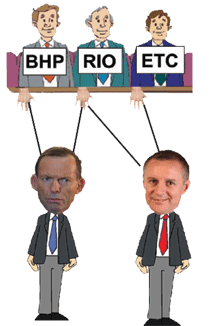
‘We don’t need federal ALP’
SOUTH Australian Labor Premier Jay Weatherill has dismissed Bill Shorten’s rejection of his royal commission.(subscribers only)
http://www.theaustralian.com.au/national-affairs/state-politics/weatherill-dismisses-shorten-on-nuclear-energy-royal-commission/story-e6frgczx-1227215197031
S.A. Premier Jay Weatherill says nuclear power ‘not viable’ (he prefers nuclear waste import?)
 Nuclear likely not viable in Aust: Weatherill THE AUSTRALIAN AAP FEBRUARY 10, 2015 A nuclear power plant is unlikely to be built in South Australia despite the government reviving debate about the industry, Premier Jay Weatherill says……..
He said he was open to the prospect of remote parts of the state hosting a nuclear waste deposit but played down the prospect of a power plant being built.
“I think that’s the least likely outcome of the royal commission,” he told ABC radio on Monday.
“I think what’s most likely is that it will be regarded as not viable for either the state or the nation.
“There is no doubt that there are some technological changes that are occurring which are bringing small reactors into play … (but) these are highly speculative matters.”
The premier is expected to reveal further details of the royal commission on Monday but it’s not yet clear who will lead the investigation…….http://www.theaustralian.com.au/business/latest/nuclear-likely-not-viable-in-aust-weatherill/story-e6frg90f-1227214183408
South Australia has a shameful nuclear history and the Royal Commission must be allowed to investigate it.
Mr Weatherill says “storing of nuclear waste” will be on the Royal Commission’s agenda. South Australians fought hard to defeat Canberra’s proposal for a national dump for low- to medium-level waste — so an international high-level nuclear waste dump is a non-starter.
The Premier says the Royal Commission will not be used to “look backwards at things that have gone wrong.” But failing to learn from the mistakes of the past makes it all the more likely that they will be repeated.
South Australia has a shameful nuclear history and the Royal Commission must be allowed to investigate it.
 Examine SA’s shameful nuclear legacy Advertiser Dr Jim Green, 9 Feb 15 THE first test with Premier Jay Weatherill’s proposed Royal Commission into nuclear issues comes with his statement that it will be carried out by independent experts.
Is that what he really intends? Or does he plan a re-run of the Switkowski commission established by the Howard federal government in 2006? That commission was comprised entirely of “people who want nuclear power by Tuesday” according to comedian John Clarke. Continue reading
Nuclear royal commission – likely to be just free PR for the nuclear industry
 A company called South Australian Nuclear Power Systems Pty Ltd has been lobbying the South Australian and federal government to remove the significant legal and political roadblocks to advance nuclear power in the state. The group is headed by former News International director Bruce Hundertmark and includes veteran American nuclear spruiker Richard Cherry, a former executive of the secretive General Atomics that operates South Australia’s Beverley uranium mine; Ian Kowalick, the former head of Premier and Cabinet; and professors Tom Wigley and Stephen Lincoln from the University of Adelaide, home to a chorus of atomic fellow travellers.
Adding to this push has been the repeated promotion of the money to be made by storing the world’s  radioactive waste. Senior executives of the World Nuclear Association have joined
 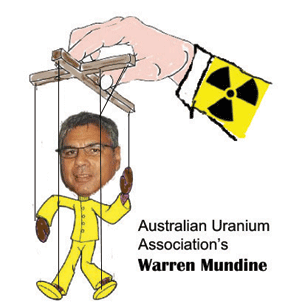 with former prime minister Bob Hawke, Warren Mundine and others to talk up the dollar signs while covering up the danger signs. Their approach ignores South Australians, particularly Indigenous South Australians’ sustained and successful efforts to oppose radioactive waste dumping in their country.
Dave Sweeney The nuclear royal commission is a response to South Australia’s poor fortune, the nuclear lobby, and concerns over climate change. It must remain independent. e announcement this week of a Royal Commission into the nuclear industry in South Australia has raised both stakes and eyebrows around the nation.
Many South Australian politicians have been enamoured with the economic allure of nuclear power. After all, the world’s biggest mining company sits atop the world’s largest uranium deposit at BHP Billiton’s Olympic Dam mine, 500km north of Adelaide. But opening the door to talk of uranium enrichment, domestic nuclear power and international nuclear waste is a major escalation in radioactive rhetoric.
The move comes in stark contrast to the current run of play in relation to the domestic and international status of the nuclear industry. Continue reading
Now wonder the nuclear lobby targets South Australia
The USA and UK nuclear lobby has worked on gullible South Australians for decades – happily encouraging fame-seeking pretend environmentalists like Barry Brook and Ben Heard, as well as career academics like Stefan Simons and Pamela Sykes. Then there are the pack of straight out greedy business people.
But why did they pick South Australia?
Because South Australia already has the ignominious nuclear history of Maralinga, and the great white elephants of the uranium industry – Olympic Dam, Beverley, FourMile (with its military connections)
 Why are they pushing nuclear power now?
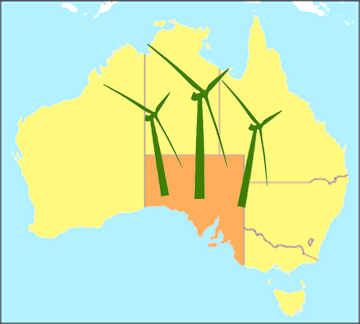
Because South Australia has been, and continues to be a dazzling success in  renewable energy.
Panic is no doubt setting in – and there are plenty of Aussie politicians glad to get on the well-funded nuclear bandwagon.
Clean energy vs nuclear: the battle intensifies http://safeenergy.org/2015/02/06/clean-energy-vs-nuclear/ Michael Mariotte February 6, 2015
“…../The war on solar, which is real, is really a war over what kind of energy system we will have in the 21st century. Will it be the 21st century model we at GreenWorld and NIRS advocate, based on clean renewable energy, distributed generation and the rest?
Or will it be a continuation of the 20th century model of large baseload power plants, whether they be coal or nuclear? That’s the fundamental issue and how it is resolved may well determine the future of our planet….”
The greedy people who want to make money out of importing radioactive trash
 These are some of the people behind the push that got South Australia’s Premier Jay Weatherill to change his tune and open the door to the toxic nuclear chain in Australia. Note that I write “chain” – not “cycle”
Directors at SA Nuclear Energy Systems Pty Ltd – the list includes former Labor federal MP Bob Catley, Ian Kowalick, a former head of the Department of Premier and Cabinet during John Olsen’s Liberal Government and later an information technology consultant to the Rann Labor Government, and climate scientists Professor Stephen Lincoln and Professor Tom Wigley
The nuke lobby would have us believe in a cycle, whereby suddenly, by magic – radioactive trash is no long trash. It becomes a “valuable resource” – recycled into gee-whiz new (exiting only in blueprint) innocuous little nuclear reactors.
Apart from all the disecoomics, and health and environment aspects – the promised new reactors themselves create highly toxic radioactive wastes, and eventually themselves become highly toxic radioactive corpses.
1 This month

of the week – Australians for War Powers Reform (AWPR)
To see nuclear-related stories in greater depth and intensity
 Antinuclear