Rear Admiral Scarce joins the South Australian pro nuclear clique
Let’s talk nuclear, says ex-governor Kevin Scarce THE AUSTRALIAN Verity Edwards DECEMBER 13, 2014 AFTER seven years of political silence in his role as governor of South

Lest we forget: Aboriginal victims of Maralinga atomic bomb testing- theme for June19
 Australian atomic massacre still ignored By David T. Rowlands from Green Left Weekly issue 971 June 29, 2013
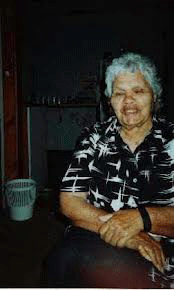 Lallie Lennon provided convincing testimony of the injuries suffered from the fall-out.
Nearly 60 years have passed since Totem 1, a British nuclear test in the Australian desert, was recklessly conducted in unfavourable meteorological conditions.Nuclear testing of any sort, even in the most “controlled” of circumstances, is inherently abusive, a crime against the environment and humanity for countless generations to come. Yet the effects of Totem 1 were particularly bad, even by the warped standards of the era.The mushroom cloud did not behave in the way it was supposed to. Instead of rising uniformly, part of it spread laterally, causing fallout to roll menacingly at ground level over a remote yet still populated corner of South Australia, sowing injury, illness and death in its wake.
The number of casualties is unknown because the secretive and unaccountable nuclear establishment has always declined to investigate the full impact of its own criminal negligence. But it has been suggested by investigators that perhaps 50 short-term Aboriginal fatalities resulted.
In addition to those who died, many others were exposed to harmful levels of radiation. The long-term health effects on these individuals have never been charted — but anecdotal reports of high cancer rates and horrendous birth defects in isolated “downwinder” communities have circulated.
At the time of the tests, it was well known by authorities that communities of Aboriginal people were close by. Yet the official attitude was that the concerns of a “handful of natives” could not be allowed to interfere with the “interests” of the British Commonwealth.
Imagine you are out with your family one morning when suddenly a loud explosion issues from the distant horizon. The ground rumbles and shakes, as though it were about to open up. Minutes later, a thick, churning dark dust cloud engulfs the surrounding desert countryside.
Terrified, with all your senses in recoil from these unnatural developments, you wonder if an event of apocalyptic proportions is taking place. And your troubles are only just beginning.
This is what happened to 22-year-old Yankunytjatjara woman Lallie Lennon and her three young children at Mintabie on October 15, 1953. A 10-kiloton device (roughly two-thirds the yield of the Hiroshima bomb) was detonated 180 kilometres away at Emu Field, near Maralinga.
Lallie and her son Bruce, aged 3, were covered in the gunpowder-smelling dust and smoke that came rushing through the trees with such intensity that it apparently created eclipse-like visibility conditions. “It went dark and dark,” recalled Lallie in 2006. “Dark — we couldn’t see anything. The place was black, you couldn’t see nothing.”
The levels of beta radiation contained in this toxic plume were so great that it felt like being “rolled in a fire”. The “kids were [ ing] … it was terrible … We was glad we was alive but we got sick. We were sicker and sicker.”
About a year later, both Lallie and her son Bruce developed a debilitating skin condition that involves the periodic eruption of oozing, agonising sores all over the body.
Lallie said: “It went away and then came back and the sores were getting bigger and bigger every time … I was in a mess after the sores.” Her two daughters, who were in a tent at the time the mist swept through, were spared the beta burns, but developed other symptoms consistent with radiological contamination.
Lallie’s story first achieved public recognition when she spoke about her experiences for a 1981 documentary, “Backs to the Blast”.
South Australia’s innovative solar powered farm Sundrop goes from strength to strength
Sundrop gets $100m injection from KKR to grow tomatoes in SA desert http://www.theage.com.au/business/sundrop-gets-100m-injection-from-kkr-to-grow-tomatoes-in-sa-desert-20141204-1208fm.html December 4, 2014 Simon Evans
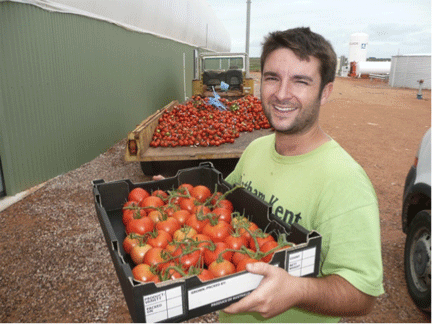
Sundrop Farms has received a capital injection from private equity firm Kohlberg Kravis Roberts to aggressively expand its operations, which grow tomatoes on desert land north of Port Augusta in South Australia using solar thermal energy and desalination. Continue reading
Family First Senator Bob Day pushing for nuclear submarines for Australia
Poor South Australia! I don’t know what it is about South Australia. Such a beautiful State,with an amazing and interesting history.
And – it’ s the State that can truly boast of success in renewable energy.
 Unfortunately, South Australia is also saddled with that white elephant – the uranium industry.
It is also the hub of pro-nuclear promotion. There are the nuclear propagandists like Barry Brook, the universities infiltrated by pro nuclear proponents like Prof Simons, and the pro nuke business groups – all promoted by BHP. (Below Adelaide pro nuke promoters of nuclear power)

Now we have Senator Bob Day urging the government to develop nuclear submarines, as a recent Family First media release (3/12/14)revealed
In brief: how Maralinga nuclear bomb caused illness and environmental destruction
Secret Outback nuclear testing site handed back to traditional land owners 50 years after British did HUNDREDS of nuclear tests causing fatal radiation poisoning
- The British nuclear testing site in outback Australia has been returned to its Aboriginal owners
- Seven atomic bombs were detonated on ‘Section 400’ in the 1950s
- There were also about 600 smaller nuclear tests on the area
- The land traditionally belonged to the Maralinga-Tjarutja community
- Britain’s nuclear tests in Australia caused widespread radiation poisoning
- Aborigines and Australian and UK soldiers suffered disease and death
- Radioactive fallout in remote Australia was three time greater than predicted
- Australia spent $100 million cleaning up the traditional lands
- The government held on to the 1782sq km testing range until this week
By CANDACE SUTTON FOR DAILY MAIL AUSTRALIA and AAP, 6 November 2014……………………Hundreds of nuclear trials were carried out. Britain dropped twelve nuclear bombs at Maralinga, and then went on to test nuclear warheads.

Although many Aboriginal people were forcibly removed from their land, more than a thousand were directly affected.
The widespread radioactive fallout of the bombs across the environment, which the local Aboriginal people called ‘puyu’ or ‘black mist’, caused disease and death……..http://www.dailymail.co.uk/news/article-2822906/Secret-nuclear-testing-site-Australian-outback-known-Section-400-finally-handed-Aboriginal-traditional-land-owners-50-years-British-dropped-atomic-bombs-causing-radiation-poisoning-death.html
South Australia’s largest wind farm now fully operational
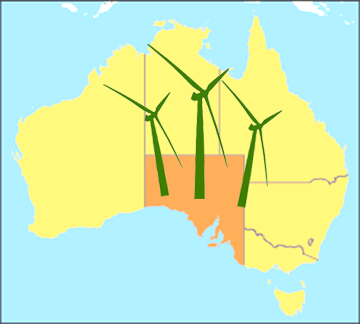 “This plant confirms South Australia’s commitment to being the nation’s leader when it comes to providing efficient renewable wind energy programs. It is a key platform in our plan for renewable energy to supply 50 per cent of the state’s annual power by 2025,”
South Australia’s 270MW Snowtown takes wind energy to new highs http://reneweconomy.com.au/2014/south-australias-270mw-snowtown-takes-wind-energy-to-new-highs-43971 By Sophie Vorrath on 3 November 2014
Project to document the health effects from atomic bomb testing in South Australia
Uranium the Silent Killer By Hilary Tyler
http://www.pozible.com/project/187985 The story of the project At the ANFA (Australia  Nuclear Free Alliance) meeting in Oct 2014 Indigenous Elders called for documentation of the health effects from the Maralinga and other atomic bomb tests in the 1950’s and 1960’s. See https://ausnukefreealliance.wordpress.com for the meeting statement.
Permission was never sort from the Aboriginal nations.
“Just remember that the fallout at Maralinga affected the whole lot of us. Black, white, brindle; we all breathe the same air, and we’re all being affected in various ways, even though that happened a long time ago. It’s still around.” Sue Coleman-Haseldine (Kokatha Mula – Ceduna)
From 1952 to 1963 atomic testing covered vast areas of South Australia including Maralinga and Emu Fields test sites.
In November 2014 there will be a 3 week road trip to archive the stories of the people from Arabuna, Walitina, Ceduna, and Yalata country to produce film, audio and digital documentaries. We will begin a data base of the families affected, the geographical distributions of fall out and detrimental health repercussions of these unconsented tests.
Nuclear weapons are the most destructive, inhumane and indiscriminate weapons ever created. Both in the scale of the devastation they cause, and in their uniquely persistent, spreading, genetically damaging radioactive fallout, they are unlike any other weapons.
For more information on nuclear weapons, including an article on Yami Lester, one of the survivors of the nuclear tests in South Australia, see http://www.icanw.org/au/
Many Aboriginal people in South Australia still rely on bush foods – plants and animals sourced from land that still is contaminated. The possibility of bioaccumulation is very real. Certainly the stories of early death from cancer, thyroid disease and congenital deformities are continuing.
“I’ve lost a lot of my family members through early death – and a lot of it was through cancer, and I do blame the Maralinga fallout.”
Aunty Martha – Arabana (Lake Eyre) Contact us at: uraniumthesilentkiller@gmail.com

No recognition, no compensation, for Aborigines made sick by Maralinga nuclear bomb tests
Backgrounder: Why was Maralinga used for secret nuclear tests?SBS News 5 Nov 14 “…….
 What happened to the people who lived there?

The nuclear testings lead to widespread dispersion of radioactive material in the local environment. The Anangu Aboriginal people who lived the area called it “puyu” or “black mist”.
UK servicemen, Australian soldiers and civilians, including Indigenous people, were all exposed to radiation. Illnesses reportedly included cancer, blood diseases, eye problems, skin rashes, blindness, vomitting, which are all symptoms of radioactive poisoning.
Between 1953 and 1957, two nuclear devices were detonated at Emu and seven at Maralinga, the Department of Industry reported. According to the Australian Radiationn Protection and Nuclear Safety Agency (ARPANSA) these “major trials” have largely decayed and are “no longer a significant health risk” as these nuclear devices were conducted at higher altitudes (from balloons).
However, the biggest cause of contamination was from “minor trials”, which were weapons development trials that investigated the performance of various components of a nuclear device. Although minor trials didn’t involve nuclear explosions, they did contain radioactive material.
Since contamination remains on or close to the ground surface, there is a significant health risk for locals. Three sites, Taranaki, TM100/101 (TMs), and Wewak remained highly contaminated with plutonium 40 years later……..
Were victims compensated by the British government?
Aboriginal people exposed to British nuclear tests in South Australia during the 1950s are being told they have no hope of compensation. British firm Hickman and Rose had hoped to represent more than 150 civilians, if a huge class action by 1,000 British veterans had succeeded.
But the class action was blocked – the UK Supreme Court ruling that 60 years after the event their claims were too late, the causes of their illnesses apparently unprovable. (Read the full judgment here)
The Australian Greens’ nuclear spokesman Scott Ludlam said the dangers of radiation are well known and it’s unfair to ask Aboriginal people with scant medical records to prove a direct link between exposure to fallout and subsequent sickness.
“The British courts have blocked the application from Defence personnel and Aboriginal people in central Australia by saying you can’t prove those radiations exposures are what caused your illness,” he said. “Now, we know that ionising radiation is harmful for health – we know that for a fact. The right thing for the British Government to do is make an Act of Grace payment to the people who they injured in their nuclear weapons tests.”
In response, UK Defence Personnel Welfare and Veterans Minister of State Mark Francois said: “[The] Ministry of Defence’s position with respect to paying compensation is unchanged. I am sorry to have to send a disappointing reply, but I hope I have explained the reasons for doing so.”……http://www.sbs.com.au/news/article/2014/11/05/backgrounder-why-was-maralinga-used-secret-nuclear-tests
Part of Defence Department’s Woomera Prohibited Area returned to Aborigines
 Defence force releases last Maralinga ancestral lands to traditional owners theguardian.com, Wednesday 5 November 2014
Former weapons testing range at Maralinga in outback South Australia is returned to Maralinga Tjarutja people Traditional owners finally have full access to their homelands at Maralinga after the defence force gave up its weapons testing range on Wednesday. Maralinga, in the South Australian outback, was the site of British atomic bomb testing from 1955 to 1963 and was contaminated by nuclear waste.
The federal government formally acknowledged the excision of an area of the Maralinga Tjarutja lands from the defence department’s Woomera Prohibited Area in a ceremony at Maralinga Village on Wednesday…….http://www.theguardian.com/australia-news/2014/nov/05/defence-force-releases-last-maralinga-ancestral-lands-to-traditional-owners
Maralinga nuclear test site returned to Aborigines, though still some contamination there
 British Nuclear Test Site Returned To Aborigines, Yahoo News UK 5 Nov 14 A former British nuclear test site in the depths of the Australian outback has finally been handed back to its Aboriginal owners after more than half a century.
Codenamed Section 400, the secret Cold War atomic weapons testing base was used in the 1950s and 60s and covered 1,782 square kilometres (688 square miles) of remote South Australia.
Now the Australian Government has formally given the site at Maralinga back to its traditional owners, the Maralinga Tjarutja, who hope to turn it into a tourism attraction.
Maralinga Tjarutja general manager Richard Preece says the community is establishing a business to take visitors round the nuclear test sites.
“We’re going to set up bus tours so people can be taken round by Robin (the local caretaker), who is a walking encyclopaedia of Maralinga,” he told the Australian Broadcasting Corporation.
He added the area still had some contamination but would be safe for visitors if they were escorted………https://uk.news.yahoo.com/british-nuclear-test-returned-aborigines-130655845.html#vPKBkL8
BHP is firm on mothballing Olympic Dam uranium mine expansion
BHP offers little hope of revisiting Olympic Dam expansion The global miner shelved plans for the multi-billion-dollar expansion in 2012 after a year-long study. MineWeb 03 Nov 2014 SYDNEY (REUTERS) – Expansion by BHP Billiton’s giant Olympic Dam mine in Australia, once considered among its prized growth assets, is off the agenda due to low metals prices and productivity inefficiencies, the company said on Friday.
BHP shelved plans for a multi-billion-dollar expansion of the copper, gold and uranium mine in 2012 after a year-long study, citing a need to reign in spending as the Australian mining boom started to fade.
Since then business leaders and politicians, including Australian Prime Minister Tony Abbott, have implored BHP to reconsider its decision, hoping to alleviate job losses caused by the exit of car manufacturing inAustralia.
But BHP has stood firm and on Friday reiterated its mothballing of expansion plans for Olympic Dam. http://www.mineweb.com/mineweb/content/en/mineweb-gold-news?oid=258553&sn=Detail
Wind power surging ahead in South Australia
The $450 million addition of 90 turbines increases the farm’s capacity from Sunday by 1350 gigawatt hours a year, enough to power 230,000 homes.
The wind farm in the state’s mid-north is now the largest in the state, the government says.
The Premier has also warned projects such as the Snowtown wind farm are at risk if the federal government scaled back the Renewable Energy Target.
Mr Weatherill told media the project is creating ‘a new future for this region in South Australia’, but a scaling back of the RET would see large scale renewable initiatives become unviable.
South Australian Greens call for transparency on ‘uranium appendices’ for Yorke Peninsula mine
Hillside mine: Greens call for release of ‘uranium appendices’ for Yorke Peninsula open pit, ABC News 19 Oct 14
The Greens are calling for the release of documents relating to uranium deposits at a copper mine approved for South Australia’s Yorke Peninsula.
Earlier this year mining company Rex Minerals submitted a document to the South Australian Government that responded to community concerns about the potential contamination of prime farmland from the Hillside mine.
The Government responded by approving the 2.4-kilometre-long, 1km-deep and 450m-deep open pit near Ardrossan that would extract 2 million tonnes of copper, 1.7 million ounces of gold and 44 million tonnes of iron ore over 15 years.
Some parts of the mining lease proposal documents, however, were deemed “commercial-in-confidence” and withheld from publication.
State Greens leader Mark Parnell has submitted a freedom of information application to view the documents and see how much uranium is at the site.
He said appendices 36 and 37 related to uranium and were being “kept secret”.
“If the company says ‘nothing to worry about’, then they should have nothing to worry about releasing the documents that explain exactly where the radioactive hotspots are,” Mr Parnell said………

EPA regulation levels to be reduced
South Australian Environment Protection Authority (EPA) regulations take effect at 200ppm – a level that would soon be reduced to 80ppm in line with national guidelines……..http://www.abc.net.au/news/2014-10-20/greens-call-for-the-release-of-uranium-appendices-hillside-mine/5826048
South Australia’s leading renewable energy system
 Graph of the Day: Australia’s renewable energy generation, REneweconomy, By Giles Parkinson on 20 October 2014 “…………As RenewEconomy has noted on many occasions, South Australia has the highest level of variable renewable energy in Australia – quite possibly the world (in major economies), with an average 43 per cent wind generation in July, and days in September when wind and solar provided all of the state’s electricity demand, and more.
The AEMO study says that the SA power system can operate securely and reliably with a high percentage of wind and PV generation, including in situations where wind generation comprises more than 100 per cent of SA demand, as long as one of the following two key factors apply:
a) The Heywood Interconnector linking SA and Victoria is operational.
b) Sufficient synchronous generation is connected and operating on the SA power system.
The AEMO study notes that South Australia already has the highest wind and PV generator penetration of any NEM region. As the graph shows, it has 1,470 MW of installed wind generation and 540 MW of PV generation. This represents about 50 per cent and 17 per cent of total installed wind and PV capacity in the NEM respectively.
In terms of residential rooftop PV installations, SA leads the NEM with a penetration rate of almost one in four of all rooftops. And the rate of penetration is likely to grow: the AEMO says that under favourable market and policy scenarios, it is projected that at least 1,000 MW of wind and 500 MW of PV capacity will be added in SA by 2020 – doubling the amount of rooftop solar, and lifting the amount of wind by two-thirds.
The AEMO notes that these developments are a “benefit” to both SA and the NEM. But it also underlines the importance of a strong interconnector with the rest of the NEM – for obvious reasons. Without it, the state would have issues with the required controls to ensure system security. (The report does not address this issue, but Germany is rolling out battery technologies that assume the role of “synchronous” generators and could usurp the primacy of fossil fuel generation. AEMO says the chance of a disconnection is so low is it rated as a “non-credible” event – but just in case ….http://reneweconomy.com.au/2014/graph-of-the-day-australias-renewable-energy-generation-88841
A backward move for Australia’s environment: Federal govt abandons regulation to South Australia’s control
 South Australia’s Assessment Bilateral Agreement with the Commonwealth is finalised
As part of its broadly criticised ‘One Stop Shop’ agenda the Federal Government has announced that its Assessment Bilateral Agreement with South Australia has been finalised and signed by both parties. The Bilateral Agreement will come into force 30 days after execution, on or about 24 October.
The Agreement allows the Commonwealth to now rely on South Australian environmental impact assessment processes in assessing ‘matters of national environmental significance’ defined under the Federal Environment Protection and Biodiversity Conservation Act 1999. This change has been widely criticised. There is significant doubt as to whether existing State regulations can actually be brought up to meet the standards required under the EPBC Act. There is also concern about whether the cash-strapped states are likely to make effective champions of our environmental assets when at the same time they are under increasing pressure to jettison environmental safeguards in order to pump through development and replenish state coffers.
1 This month

of the week – Australians for War Powers Reform (AWPR)
To see nuclear-related stories in greater depth and intensity
 Antinuclear