South Australia’s remarkably high renewable energy production
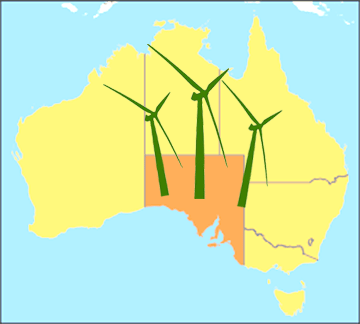
 South Australia Achieves 100% Renewable Energy For A Whole Working Day Clean Technica October 13th, 2014 by Giles Parkinson (good graphs)_ RenewEconomy. There have been several instances in recent months when wind energy has accounted for all, or nearly all, electricity demand in South Australia. Last Tuesday, however, set a new benchmark – the combination of wind energy and rooftop solar provided more than 100 per cent of the state’s electricity needs, for a whole working day between 9.30am and 6pm.
The data comes from Hugh Saddler, at consultants Pitt & Sherry, and is part of his monthly overview of electricity market, emissions and pricing trends in Australia.
Saddler notes there were several periods in South Australia from Saturday September 27, and over the following days, when wind generation was greater than total state NEM demand. (South Australia has nearly half the country’s wind capacity with around 1.5GW of wind energy).
It occurred briefly on Saturday afternoon, for much of Sunday, and again, most strikingly, between about 9.30am and 6.00pm on Tuesday, September 30, a normal working day.
In reality, renewables contributed well over 100 per cent because they were generating and consuming their own electricity from rooftop solar – the state has 550MW of rooftop solar, with nearly one in four houses with rooftop modules.
That meant that “true” demand by consumers on that day, i.e. the amount of electricity being used by consumers, including rooftop solar, was in fact considerably higher than NEM demand — up to 20 per cent according to the Australian Photovoltaic Institute — because of the contribution of rooftop PV to total electricity supply…….
Interestingly, the South Australia government has already exceeded its target of generating 33 per cent of the state’s electricity needs from renewables (over a full year), and has now set a 50 per cent target by 2025. In reality, it will likely reach that mark well before that, particularly if the Ceres wind farm and the Hornsdale wind farm are built. It could even be the first mainland state towards 100 per cent renewables over the whole year.
Considerable volumes of electricity were exported to Victoria. “In simple arithmetic terms, though not of course in how the grid actually operated, the state’s electricity supply was 100 per cent renewable while coal and gas-fired electricity was exported,” he says…..http://cleantechnica.com/2014/10/13/s-australia-achieves-100-renewable-energy-whole-working-day/
Senator Nick Xenophon will not commit to full support of the Renewable Energy Target (RET)
 AUDIO: Listen to Natalie Whiting’s report (PM) Renewable Energy Target campaigners fail to win Nick Xenophon’s commitment, ABC Radio PM By Natalie Whiting 9 Oct 14 Climate change campaigners in South Australia have kept up pressure on the independent Senator Nick Xenophon to commit himself to protecting the Renewable Energy Target (RET). Hundreds of people attended a forum this week to demand the Senator commit to blocking any potential changes to the RET. They said renewable energy employment could make up for some of South Australia’s job losses in other fields.
But Senator Xenophon refused to promise anything, saying only that he was open to RET negotiations……..
Mr Green was worried the potential changes to the target could produce more job losses.
“There are 13,000 people employed in the solar industry at the moment and conservative estimates suggest that between a third and a half of those jobs would be lost if these [federal] recommendations were adopted,” he said.
“There are also 21,000 people employed in the renewable energy sector as a whole, so including wind, and many of those wind workers would be out of a job by Christmas as well.”
Mr Green was among a number of pro-RET speakers at the Adelaide forum……..
Forum attendees demanded Senator Xenophon commit to blocking any potential changes to the RET, but he refused……… Continue reading
Four Mile uranium mine ships batch to Canada
Alliance Resources ships first batch of uranium ore Four Mile mine, Australia http://nuclearfuels.energy-business-review.com/news/alliance-resources-ships-first-batch-of-uranium-ore-four-mile-mine-australia-061014-4395242 EBR Staff Writer 06 October 2014 Alliance Resources has shipped first batch of uranium ore concentrate from its Four Mile mine in South Australia.
The ore concentrate has been shipped to Cameco’s facility at Blind River, Ontario, in September for further testing prior to sale.
The company is set to make a second shipment in mid-October to Canada.Alliance said that the first shipment comprised 300,000lb, while second shipment contains 210,000lb.
Due to limited availability of maritime transport, the first shipment of uranium was delayed.
Located 550km north of Adelaide, the Four Mile project is a joint venture of Alliance Resources and Quasar Resources, which owns 75% of the mine. It was commissioned in March and was opened in June.Alliance’s, Alliance Craton Explorer holds 25% of ML6402 and EL5017.
$30 billion expansion of Olympic Damn uranium mine will go ahead, says Tony Abbott
 Prime Minister Tony Abbott predicts $30 billion Olympic Dam expansion will go ahead POLITICAL EDITOR TORY SHEPHERD THE ADVERTISER SEPTEMBER 30, 2014 A $30 billion Olympic Dam expansion is likely to go ahead “in the months and years ahead”, Prime Minister Tony Abbott says.
BHP Billiton shelved the expansion plans in the face of low commodity prices and spiralling costs. However the expansion moved a step closer recently, after the Government waived stringent environmental tests to let them trial a cheaper way of processing minerals…….
BHP Billiton is expected to give more detail on their plans at their AGM in Adelaide in November. Chief executive Andrew Mackenzie has said they have reduced costs and might be able to go ahead with a smaller or incremental expansion.
Before the election Mr Abbott pledged to create the economic conditions that would give the expansion the best chance of going ahead.
Federal ministers have met with BHP and have been talking up the prospects of the expansion …….http://www.adelaidenow.com.au/news/south-australia/prime-minister-tony-abbott-predicts-30-billion-olympic-dam-expansion-will-go-ahead/story-fni6uo1m-1227075708200
A $1.5 BILLION wind farm in jeopardy, as Australian govt plans slashing RET
Renewable Energy Target review leaves wind power in doldrums: Senvion http://www.theaustralian.com.au/national-affairs/climate/renewable-energy-target-review-leaves-wind-power-in-doldrums-senvion/story-e6frg6xf-1227074429666 THE AUSTRALIAN SEPTEMBER 30, 2014 A $1.5 BILLION wind farm, slated to be the largest in Australia, is at risk from potential changes to the national Renewable Energy Target, the proponent says.
Senvion Australia chief executive Chris Judd said the 197-turbine Ceres wind farm proposed for the Yorke Peninsula would be jeopardised if the federal government adopted changes proposed in the Warburton review.
The Abbott government is yet to finalise its response to the RET review overseen by businessman Dick Warburton, which recommended either closing the program to new entrants or moving to a demand-limited scheme that was reviewed each year.
A spokesman for Environment Minister Greg Hunt said the government would not make any changes that would adversely affect companies that had already invested in the sector.
Mr Judd said if changes removed the revenue stream for renewable energy, significant investment would be at risk. “We are still progressing with the project, but there is a cloud over it in regards to the Renewable Energy Target policy. We need the policy framework to be able to create an investment environment where people would view investment in renewable energy favourably.
“There is no logic in what has been put forward to make the case for change — the review confirms that the policy is working, creating jobs and lowering emissions.”
The wind-farm project, which will underpin 500 jobs, is among $4.5bn worth of investment in South Australia that Premier Jay Weatherill says is stalled as a result of the federal review.
“We have billions of dollars worth of investment queuing up waiting to occur, but it is stalled because the commonwealth government in an extraordinary act has decided to review the Renewable Energy Target,’’ he said.
Mr Hunt’s spokesman said the government was not scrapping the RET. “The government will not make changes that will impact those who have already made an investment — small or large — under the RET,” he said.
Brad Davy, a Senvion technician, said the Snowtown wind farm 150km north of Adelaide had supported many local jobs. “It’s been good for everyone, “ he said.
South Australia goes for 50% renewable energy by 2025
South Australia commits to 50pc renewable energy target by 2025 (includes AUDIO), ABC News 23 Sep 2014, The South Australian Government says it will increase its Renewable Energy Target (RET) and aim for 50 per cent of the state’s power to be generated by renewables by 2025.
Premier Jay Weatherill said figures from last financial year showed 31.5 per cent of energy produced in the state came from renewable sources.
He said updated figures were expected to show SA had since exceeded its current target of 33 per cent by 2020.
“Modelling shows that the RET has underpinned $5.5 billion of expenditure to date,” he said.
“[It is] forecast to support a further $4.5 billion by 2025. “This new target of half of the state’s power to be generated by renewable sources will create jobs and drive capital investment and advanced manufacturing industries.”
Mr Weatherill said SA had demonstrated that with appropriate policies and incentives, highly ambitious targets were achievable.
This new target of half of the state’s power to be generated by renewable sources will create jobs and drive capital investment and advanced manufacturing industries.
Jay Weatherill
He said the Federal Government needed to heed that message.
“The sovereign risk created by the Federal Government’s unnecessary and unexplained review into the national RET has caused a number of projects to be placed on hold, putting many construction projects and ongoing jobs at risk,” he said.
“There are hundreds, if not thousands, of SA jobs in the renewable energy sector and these are the growth areas we should be supporting, not undermining.”…..
Conservation Council CEO Craig Wilkins urged the SA Government to keep fighting the federal move to downgrade the RET.
“We have reaped the benefits of the Commonwealth Renewable Energy Target over the last decade with enormous investment in wind and solar infrastructure, particularly in regional SA,” he said
“This new state target of 50 per cent renewable energy generation by 2025 will be extremely difficult to achieve if the federal RET is dismantled.”
Andrew Bray from the Australian Wind Alliance said South Australia had proved itself a wind power success story.
“While more wind and solar power in SA is being fed into the grid, the wholesale cost of power has stayed the same,” he said.
“South Australians are paying the same for wholesale power as they were eight years ago, even accounting for the cost of renewable energy certificates.
“This decision to increase the target shows that with the rise of renewable energy is inevitable and beneficial to Australians’ costs and standard of living.”http://www.abc.net.au/news/2014-09-23/sa-commits-to-50-per-cent-renewable-energy-target/5763640
Australian government allows BHP new uranium mine to avoid environmental impact statement
Abbott’s Olympic dodge on environmental protections The Australian Greens say the Abbott Government is shirking responsibility by waiving a new environmental impact statement for the proposed expansion of Olympic Dam.
“The Federal Government needs to do its job and stop putting the private profits of the big mining companies ahead of the environment,” said South Australian Greens Senator Penny Wright. “This is a short-sighted measure, which shows how little the Government cares about environmental protection.”
Senator Wright said BHP’s original environmental impact statement did not mention acid leaching but there were serious concerns around about this process in South Australia, with previous leaching in a copper mine near Copely resulting in leaks and contamination.
“We need to be sure that chemical pollution from BHP’s trial will be contained. If the Federal Government is cutting corners, what’s to stop BHP from skimping on environmental protections?
Senator Wright urged the Weatherill Government to guarantee environmental safety, but said their record was not cause for optimism.
“Just because the Commonwealth doesn’t care about the environment, doesn’t let the State Government off the hook. They should demand a full environmental impact statement before taking any further steps,” she added.
Sad news for the nuclear free movement. Vale Mrs Wingfield.
Suzanne Haseldine wunyie@gmail.com 22 Aug 14, After an amazing life fighting for country and culture Kokatha Elder Mrs Wingfield passed away at her home in Port Augusta on August 8,2014.
Mrs Wingfield experienced first hand the impacts of the nuclear testing in the South Australian desert. She dedicated her life to protecting her desert country and future generations from the effects of the nuclear industry. At Cane Grass Swamp in the early 1980s she lay in front of bulldozers to try and stop the construction of the Olympic Dam uranium mine. Her tireless work continued in the 1990s with the Kupa Piti Kungka Tjuta, a senior women’s council based in Coober Pedy who led and won a successful campaign against the federal government’s plan for a nuclear waste dump in SA.
Mrs Wingfield worked with people and groups of many backgrounds, she traveled extensively to attend forums and events and lobby politicians. In 2009 she was made honorary president of the Australian Nuclear Free Alliance in recognition of her significant involvement. Mrs Wingfield will be widely remembered and acknowledged for her contribution to the nuclear free and peace movements in Australia and worldwide. Her resilience, passion and dedication remains an inspiration to everyone that met her.
May she Rest in Peace.
Funeral details: Friday August 29, 2014. 11am at the Lutheran Church, cnr of Dartmouth and Fern St, Port Augusta. The family have asked that everyone feel welcome to attend.
You can send a message to Mrs Wingfield family: 2 Cain Street, Port Augusta SA 5700.
Memories or photos to be passed on to the family when appropriate, can be emailed to: wunyie@gmail.com
Financial contributions towards Mrs Wingfield’s wake would also be greatly appreciated by her family and friends. Donate to:
Janice Wingfield Commonwealth Bank SAV BSB: 065507 AC: 10213429
Sundrop Farms in the news again for all the right reasons
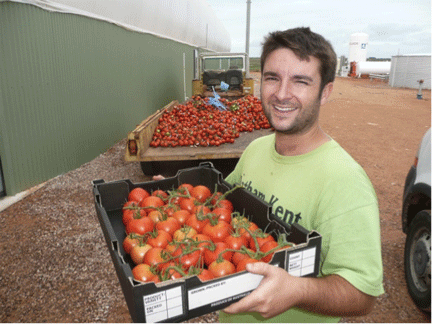 Sundrop Farms’ greenhouse expansion project approved by council | PHOTOS, The Transconntinental By Steph Say and Ryan Smith Aug. 13, 2014,
Sundrop Farms gets the green light Sundrop Farms’ innovative greenhouse expansion project has been given the green light with the support of Port Augusta City Council.
Provisional development approval was granted at Tuesday night’s Development Assessment Panel meeting.
Sundrop Farms will now start making detailed designs for the 20 hectare expansion before getting a final construction price from a selected contractor. This process is expected to take two months when the final decision on whether the development will go ahead will be made.
If the expansion does go ahead it is expected to create 200 ongoing jobs for the city and a major economic boost.
Sundrop Farms chief technology officer Reinier Wolterbeek said the provisional approval was one of the major boxes that needed to be ticked to get the expansion underway. “It’s a major milestone, we’ve worked a long time to get to this stage,” he said. We’ve worked with the .2 hectares here [inPort Augusta] for about four years…with ups and downs but we’ve achieved the yields we are after.”
Sundrop Farms uses cutting-edge solar thermal technology to desalinateseawater for irrigation and to heat and cool greenhouses.The expansion would involve the building of a 20 hectare, four greenhouse facility which will produce more than 15,000 tonnes of tomatoes a year for metropolitan markets across Australia.
Solar energy will be harnessed using a power tower which absorbs heat reflected from a field of mirrors………http://www.transcontinental.com.au/story/2484815/sundrop-farms-greenhouse-expansion-project-approved-by-council-photos/?cs=1286
Solar power used for greenhouse farming in a dry harsh area
Growing Food In The Desert With Solar Power http://www.energymatters.com.au/index.php?main_page=news_article&article_id=3488 by Energy Matters, 27 Nov 12,
Australia is home to a food production revolution – Sundrop Farms near Port Augusta is successfully growing high-value crops using seawater and sunlight in what would be considered extremely hostile conditions for horticulture.
With energy and water costs responsible for up to 70% of total farm expenses in some regions and irrigation accounting for 70 percent of the 3,240 cubic kilometres of water withdrawn for human use, Sundrop Farms’ progress is being keenly monitored.
The Sundrop Farms System uses solar power to desalinate seawater to produce freshwater for irrigation and to generate electricity to power its climate-controlled greenhouse.
The seawater based greenhouse ventilation also cleans and sterilises the air, making it possible to grow crops without chemical pesticides.
The Sundrop Farms System allows land normally not deemed suitable for agriculture or horticulture to produce large quantities of food. The company claims its hydroponics based greenhouse growing methods yield 15-30 times more produce per hectare than conventional field production. Each hectare of Sundrop Farms greenhouses also directly employs between 5-7 people
Even the salt by-product of desalination has value – it’s mostly sold to third parties and some of the minerals are at times re-used in Sundrop Farms’ greenhouse as plant nutrients.
In addition to horticultural applications, the system can also be used for floriculture and aquaculture.
With modern food systems sometimes resulting in production occurring thousands of kilometres away from the point of consumption, Sundrop Farms type systems can also play a role in substantially reducing food miles; which can significantly add to the carbon footprint of food.
A planned 8 hectare expansion of the Port Augusta facility aims to produce 2.8 million kg of tomatoes and 1.2 million kg of peppers annually while saving the equivalent of approximately 4.6 million barrels of oil equivalent and 280 million litres of fresh water per year compared to a standard greenhouse in a similar location.
South Australia’s wind energy breaks another record
Another Wind Power Record For South Australia, Energy Matters 12 Aug 14 Wind farms in South Australia generated enough electricity to meet 43 percent of the state’s power requirements last month.
A new wind generated power benchmark for July was also set across the entire National Electricity Market (NEM) according to the Clean Energy Council (CEC) – around 6 percent.
“Australia’s wind farms were working overtime in the cold conditions during July. South Australia comfortably powered ahead to set a new wind power record, helped by a bit of extra renewable grunt from the new Snowtown II wind farm,” said CEC Acting Chief Executive Kane Thornton.
“With more than 40 per cent of the state’s power demand provided by wind energy for the entire month, it is clear that large amounts of renewable energy can be added to the system without the need for extra backup generation to be built.”
Mr. Thornton stated more than $5 billion of wind power investment had poured into South Australia in the last decade, creating hundreds of greatly-needed jobs and providing the state with a low-cost, cleaner power supply……… http://www.energymatters.com.au/index.php?main_page=news_article&article_id=4439
South Australia: Bill to back renewable energy on pastoral lands
Bill backing pastoral lands renewable energy projects passes Legislative Council http://www.abc.net.au/news/2014-08-06/bill-backing-pastoral-lands-renewable-energy/5652118 6 Aug 2014, A bill supporting renewable energy developments on South Australian pastoral lands will go to State Parliament’s House of Assembly, after passing the Upper House.
The Government says the Pastoral Land Management Bill is the first of its kind in Australia.
It aims to make it easier to establish wind farms or solar energy projects on pastoral properties.
Environment Minister Ian Hunter says it would allow a wind farm developer to apply for a licence to build and operate a wind farm on Crown land subject to a pastoral lease and for the wind farm to co-exist with a pastoral leaseholder’s activities.
He says the views of affected pastoralists will be taken into account. Ninety-five per cent of wind farm licence payments would go to lessees and native title holders.
How the Aboriginal people of Maralinga lost traditional knowledge due to atomic bombing
The Radiation That Makes People Invisible: A Global Hibakusha Perspective Robert Jacobs The Asia-Pacific Journal, Vol. 12, Issue 30, No. 1, August 3, 2014.
“…….Loss of traditional knowledge– In some remote places survival is dependent on centuries old understandings of the land. In Maralinga, Australia the areas where the British conducted nuclear tests between 1956 and 1963 are very difficult places to live. Traditional communities in these areas often have songs that hold and transmit essential knowledge about how to survive in such a harsh environment, such as where to find water, when to hunt specific animals, when to move to various locations. But can knowledge gathered over millennia be effectively applied to radiation disasters?
When the British relocated entire communities to areas hundreds of kilometers from their homes, the local knowledge chain was broken. It became impossible for the refugees to sustain a traditional life in areas where they had no knowledge of the rhythms of the land and animals. This removal from their lands led to ever increasing dependence on governmental assistance and severed what had been millennia of self-reliance. While self-reliance had been dramatically impacted by the brutal rule of the Australian government and its policies towards aboriginal peoples, the people living near the test site were still living on the land in the 1950s. Relocation led to the further erosion of community, familial and personal wellbeing………….http://japanfocus.org/-Robert-Jacobs/4157
Uncertainty over Renewable Energy Target is hurting South Australia’s economy
Renewable Energy Projects at Risk Across Australia http://www.businessreviewaustralia.com/finance/1209/Renewable-Energy-Projects-at-Risk-Across-Australia Laura Close – Finance – Jul 20, 2014 With the uncertainty over the Renewable Energy Target renewal, several project meant to add hundreds of jobs and millions of investment dollars for South Australia are on hold or at risk of getting shut down. The Renewable Energy Target’s goal was to increase renewable energy generation to 20 percent by 2020. This included energy produced from sources like wind, solar or geothermal.
Companies involved in the renewable energy game have been reconsidering their plans eversince the Federal Government decided to review the RET. The review is expected to be completed soon – sometime by the middle of this year – but it has left several companies with an unsure future.
Pacific Hydro, a clean power firm has made it clear that shelving their 42-turbine, $240 million project near Keyneton is having a negative effect on several players. With the ability to power 68,000 homes a year and provide 500 construction jobs, the hit to the region is noticeable.
In a letter to Premier Jay Weatherill, the company says it has $550 million in South Australian projects “ready to go if the current renewable energy target is retained.” “These projects could provide hundreds of jobs in construction and deliver around $260,000 annually through community fund grants,” the letter says. “While the RET review uncertainty continues these projects will remain on the shelf, depriving the state of potential jobs and investment.”
Energy Minister Tom Koutsantonis has been lobbying for the RET to remain, but to instead make changes like extending the timeline and cutting compliance costs. He has also made the request that the scheme should not be reviewed more than once every four years.
A decision is expected in the next couple months, but until then several companies are left waiting to move forward with millions of dollars worth of projects.
Coober Pedy a great test case for off-grid renewable energy
 Coober Pedy Converts to Renewable Energy http://sourceable.net/coober-pedy-converts-to-renewable-energy/ Marc Howe 31 July 14 A new renewable energy project in outback South Australia is set to prove the viability of solar and wind power for remote locations.The project calls for the widespread deployment of solar and wind power in the outback town of Coober Pedy and promises to radically increase the community’s usage of renewable energy, thus reducing its dependence upon costly fossil fuels trucked in from afar.
It is being developed by Clean Energy Council member Energy Developments Limited with funding from the Australian Renewable Energy Agency (ARENA) and is expected to supply as much as 70 per cent of Coober Pedy’s electricity needs.
The EDL project will see the construction of a two-megawatt solar photovoltaic installation and three megawatts in wind power installation, as well as a short-term energy storage facility. These extensive renewable energy facilities provide will take significant pressure off of Coober Pedy’s 3.9-megawatt diesel power station, which is currently the mining town’s chief source of electricity.
According to Clean Energy Council acting chief executive Kane Thornton, Coober Pedy’s sustainability experiment will prove the viability of solar and wind power for outback communities and mining operations in remote areas.
Thornton hailed the project for providing “clean and reliable power to an outback opal mining community which has to weather the constant challenges of extreme heat and dust.”
He pointed in particular to reduction in dependence on diesel fuels, which must be trucked in from elsewhere at significant cost, as a major advantage of renewable energy in remote locations.
“Reducing the amount of expensive diesel that needs to be used is a big win for these communities,” he said. “It will also show other outback towns and remote mining operations what is now possible using renewable energy.”
Thornton said the EDL project is part of a rising trend of mixed energy portfolios which make use of multiple supply sources.
“As renewable energy gets cheaper and fossil fuels such as diesel become more expensive, these kinds of hybrid renewable-diesel projects start to make more and more sense,” he said.
Coober Pedy’s EDL project arrives just as leading figures in the mining industry advocate the increased usage of renewable energy to deal with the remote and power-intensive nature of many operations in the resources sector.
1 This month

of the week – Australians for War Powers Reform (AWPR)
To see nuclear-related stories in greater depth and intensity
 Antinuclear