Australia’s very misplaced enthusiasm for Small Modular Nuclear Reactors (SMRs)
 Strange time to suggest a LEGO nuclear future for Australia , Independent Australia, Noel Wauchope 21 April 2014, By 2022, Australia could have many “Lego-like” small nuclear reactors in operation, dotted about the nation. This is being proposed now, not just by the long-term fervent believers in Small Modular Reactors (SMRs), but in formal submissions to the coming Energy White Paper.
Last month, the Department of Industry’s submission to the Energy White Paper pitched Small Modular Reactors as an energy solution for isolated areas in Australia, where there is no access to the electricity grid.
The Energy Policy Institute of Australia (EPI) agreed in its submission, suggesting in its submission small modular reactors (SMRs) are particularly suitable for use in mines and towns in remote locations around Australia.
The BHP-funded Grattan Institute’s submission envisages a string of these little nuclear reactors, connected to the grid, along Australia’s Eastern coast.
Keith Orchison reports on the Grattan Institute submission:
‘The Abbott government is being told that now is the time to flick the switch to “technology neutral,” opening the way for nuclear options.’
Orchison described the advantages of SMRs as ‘Lego-like’.
Why now?
In 2014, it was becoming clear that Small Modular Reactors (SMRs) were not likely to become an operational reality for many decades — and perhaps never.
America was the pioneer of small reactor design in the 1970s. Again recently, Westinghouse and Babcock and Wilcox have been the leaders in designing and developing SMRs.
But in 2014, the bottom has fallen out of these projects………..
It should be noted that nowhere in [the original article about China, does the author] Chen mention “small” reactors. However, Australian proponents of ‘small’ reactors welcomed this article, as the Thorium Small Nuclear Reactor is the favourite type proposed for Australia from all 15 possible small designs.
So, while we’re being told that China is racing ahead in the scramble to get these wonderful SMRs, in fact, China has been very much encouraged and helped into this by the U.S. Department of Energy.
This is understandable, seeing that for China it is a government project, with no required expectation of being commercially viable.
In their enthusiasm for China’s thorium nuclear project, writers neglected to mention the sobering points that Stephen Chen made in his South China Morning Post article, such as:
- ‘Researchers working on the project said they were under unprecedented ‘war-like’ pressure to succeed and some of the technical challenges they faced were difficult, if not impossible to solve.’
- ‘… opposition from sections of the Chinese public.’
- ‘… technical difficulties – the molten salt produces highly corrosive chemicals that could damage the reactor.’
- ‘The power plant would also have to operate at extremely high temperatures, raising concerns about safety. In addition, researchers have limited knowledge of how to use thorium.’
- ‘… engineering difficulties .…The thorium reactors would need years, if not decades, to overcome the corrosion issue.’
- ‘These projects are beautiful to scientists, but nightmarish to engineers.’……….
Australia’s SMR enthusiasts discount the known problems of SMRs. Some brief reminders from the September 2013 report, from the United States’ Institute for Energy and Environmental Research:
- ‘Economics: $90 billion manufacturing order book could be required for mass production of SMRs …the industry’s forecast of relatively inexpensive individual SMRs is predicated on major orders and assembly line production.’
- ‘SMRs will lose the economies of scale of large reactors.’
- ‘SMRs could reduce some safety risks but also create new ones.’
- ‘It breaks, you bought it: no thought is evident on how to handle SMR recalls.’
- Not a proliferation solution. ‘The use of enriched uranium or plutonium in thorium fuel has proliferation implications.’
- Not a waste solution: ‘The fission of thorium creates long-lived fission products like technetium-99 (half-life over 200,000 years).’
- Ongoing technical problems. ……….http://www.independentaustralia.net/environment/environment-display/strange-timing-to-suggest-a-lego-nuclear-future-for-australia,6404
BHP getting out of uranium mining
 BHP weighs divestment options Mining Weekly By: Esmarie Swanepoel 1st April 2014 PERTH – Mining giant BHP Billiton on Tuesday said it was “reviewing” and “assessing” its divestment options, after media outlets in Australia reported that the company was considering a $20-billion demerger plan……..
As we have said previously, the simplification of our portfolio is a priority and is something we have pursued for several years,” BHP said in response to the market speculation, adding that in the last two years, the company had completed a number of divestments in Australia, the US, Canada, South Africa and the UK.
Divestments included petroleum, copper, coal, mineral sands, uranium and diamond assets……….
BHP told shareholders that the company would actively continue to study the next phase of simplification, including its structural options, but noted that it would only pursue those avenues that maximised value for the company’s shareholders.
BHP CEO Andrew Mackenzie has previously said that Australia would remain a focal point for the company, pointing out that the country accounted for about 70% of its profits……..http://www.miningweekly.com/article/bhp-weighs-divestment-options-2014-04-01
Adelaide wake up: the nuclear lobby is trying to put it over you!
Adelaide is under attack from nuclear advocacy fraudsters who tell lies to promote their evil nuclear fantasies.
Our universities and our politicians have been “influenced” by junk science that falsely claims that nuclear power is “safe”.
Our universities and our politicians have been “influenced” by junk economics that falsely claims that nuclear power is “cheap”.
Our newspapers falsely claim that we want nuclear power in South Australia – this page is a place where you can register your protest at this false claim, where you can say “No Nukes In South Australia”.
Nuclear industry interests helped along by South Australian government

Dennis Matthews 27 March 14 Today’s (Adelaide) Advertiser contains an article about a new uranium mine in SA. Apparently the SA Government has given $50,000 of taxpayers money to the Ian Wark Institute at the University of SA for them to study a way of recovering the uranium from this proposed in-situ-leach uranium mine.
ANSTO is also involved. The Ian Wark Institute was set up by someone with a long history of involvement in the nuclear industry. I think he was involved in the early days of the Synroc project, another ANSTO project which seems to have fizzled out after spending umpteen million of taxpayer’s money.
Australia’s regressive politics – rejected in South Australia?
De nnis Matthews, 26 March 14, Is it possible that South Australians are smarter than the average voter? The results of the state election would seem to support this proposition.
Just when it seemed that there would be a change of government many voters decided that they would rather stay with the devil they know. Signals from Canberra that the former liberal party, which in recent decades has become the conservative party, was now becoming the regressive party did not go unnoticed.
It appears that regressive politics is being foisted on everyday life with the new political correctness being intolerance, rudeness, and downright bigotry. This may work in political circles but is it the way a civilized society should behave?
Should politicians take their lead from decent citizens or should we follow the example of those in the houses of parliament?
The answer to this question may well shape Australia’s future.
Disinformation about Fukushima from Australia’s nuclear advocates
 Fukushima apologies and apologists Jim Green, Climate Spectator, 12 March 2014 “…..Nuclear apologists Sadly, nuclear apologists have been slow to apologise for peddling misinformation. Adelaide-based nuclear advocate and conspiracy theorist Geoff Russell and Adelaide University’s Barry Brook insist that the Fukushima disaster was “deathless” despite a growing number of scientific studies giving the lie to that claim.
Last year the World Health Organisation released a report which concluded that for people in the most contaminated areas in Fukushima Prefecture, the estimated increased risk for all solid cancers will be around 4% in females exposed as infants; a 6% increased risk of breast cancer for females exposed as infants; a 7% increased risk of leukaemia for males exposed as infants; and for thyroid cancer among females exposed as infants, an increased risk of up to 70% (from a 0.75% lifetime risk up to 1.25%).
Estimates of the long-term cancer death toll include:
- a Stanford University study that estimates “an additional 130 (15-1100) cancer-related mortalities and 180 (24-1800) cancer-related morbidities”;
- an estimate of 1000-3000 cancer deaths by physicist Ed Lyman (based on an estimated collective whole-body radiation dose of 3.2 million person-rem to the population of Japan); and
- an estimate of around 3000 cancer deaths, from radiation biologist and independent consultant Dr Ian Fairlie.
Indirect deaths must also be considered, especially those resulting from the failure of TEPCO and government authorities to develop and implement adequate emergency response procedures. A September 2012 editorial in Japan Times noted that 1632 deaths occurred during or after evacuation from the triple-disaster; and nearly half (160,000) of the 343,000 evacuees were dislocated specifically because of the nuclear disaster. A January 2013 article in The Lancet notes that “the fact that 47 per cent of disaster-related deaths were recognised in Fukushima prefecture alone indicates that the earthquake-triggered nuclear crisis at the Fukushima power plant caused extreme hardship for local residents.”
In Fukushima Prefecture, 1656 people have died as a result of stress and other illnesses caused by the 2011 disaster according to information compiled by police and local governments and reported last month. That number exceeds the 1607 people in Fukushima Prefecture who were drowned by the tsunami or killed by the preceding earthquake.
“The biggest problem is the fact that people have been living in temporary conditions for so long,” said Hiroyuki Harada, a Fukushima official dealing with victim assistance, “People have gone through dramatic changes of their environment. As a result, people who would not have died are dying.”
The claim by Brook and Russell that Fukushima was “deathless” has no basis in truth. They ought to take a leaf from Naomi Hirose’s book, bow deeply and apologise..www.businessspectator.com.au/article/2014/3/12/energy-markets/fukushima-apologies-and-apologists
South Aust election: Mr Van Den Brink candidate for Fisher opposes import of nuclear wastes
By Dennis Matthews, 11 Mar 14 Three to four weeks ago I sent a questionnaire to the candidates in Fisher. Of the five candidates only Bob Such and Daryl Van Den Brink responded.
On the issue of expanding the nuclear industry in South Australia, both candidates wanted more debate on nuclear power and uranium enrichment but Mr Van Den Brink was opposed to importing nuclear waste.
In relation to electricity, Mr Van Den Brink supported the feed-in tariff for electricity from solar cells, tighter regulation of the electricity network business, and government incentives for energy efficient homes. He opposed making exporters of solar electricity pay more for the electricity network or higher tariff for users of air conditioners. Dr Such considered that the National Electricity Market needed an overhaul.
Dr Such opposed recent changes to the South Australian Electoral Act but Mr Van Den Brink opposed only the increased nomination fees.
Neither candidate supported an official apology to Aboriginal people for past injustices. Mr Van Den Brink wanted more debate, whilst Dr Such supported alternative measures.
South Australians not taken in by Business S.A.’s pro nuclear spin
Dennis Matthews, 4 March 14 Business SA has clearly not been paying attention (The Advertiser,4/3/14). We have had debates on all manner of nuclear issues off and on for decades including uranium processing and enrichment, nuclear power and importing nuclear waste.
The resounding response has always been NO.

Or is it possible that Business SA is not happy with the answer and think that by badgering the public every election year that they will finally get their way?
As shown by recent debates on nuclear power and nuclear waste disposal the general public is well and truly a wakeup to the likes of Business SA. The price of freedom is eternal vigilance.
NUCLEAR WEAPONS PROLIFERATION IN SOUTH AUSTRALIA 1945 – 1965
 Nuclear Information Centre, Conservation Council of South Australia INTRODUCTION The ways in which a country or state can contribute to the proliferation of nuclear weapons are many and varied. They include direct and indirect, overt and covert, subtle and not so subtle; the line between contributing and not contributing is fuzzy and elusive. What may be ignored at one time may later be seen to be highly significant.
We will concentrate on the obvious and widely acknowledged contributions.
A successful nuclear weapons program requires:
- A pool of knowledge
- A supply of highly trained specialists
- Research and development
- A source of fissionable material
- The facilities for converting the fissionable material into weapons grade
- Testing of guidance and delivery systems, firing mechanisms, various materials, and complete weapons.
We will limit this article to contributions made in the post-war period 1945 to 1965, which constitutes the first phase of South Australia’s contribution to nuclear weapons proliferation.
History will probably record that the second phase started with the discovery of uranium at Beverly east of Mt. Painter (1969), at Honeymoon about 75 km north-west of Broken Hill (1972), and at Olympic Dam on the Roxby Downs station (1975).
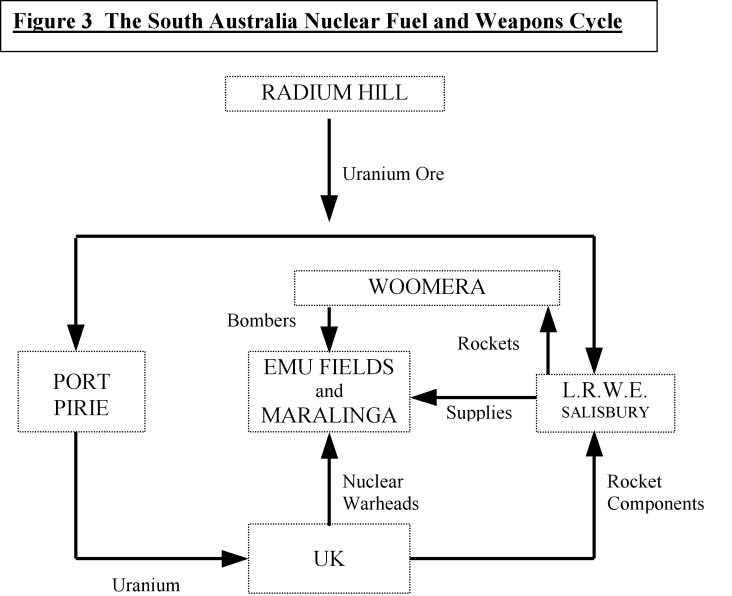
The Olympic Dam mine at Roxby Downs has been exporting to nuclear weapons states since it began production in 1988. Continue reading
Preference fixing for the South Australian election
The Editor The Advertiser from Dennis Matthews, 2 March 14 John Patterson has the right idea (The Advertiser, 1/3/14), there is a lack of transparency in what happens to our vote in the Legislative Council.
However it is not as simple as requiring the minor parties and independents to let us know how their preferences are distributed. This is already done and the information can be found on the South Australian Electoral Commission’s website.
The problem is that some candidates participate in a preference fixing cartel, the members of which agree to give preferences to each other. On their own, none of the cartel members are likely to get a seat, but together they are assured of enough votes for at least one member of the cartel to get a seat.
You would think that preference fixing would be illegal, but it is not, and recent changes to the Electoral Act have not solved the problem but instead gave the Liberal-Labor duopoly an equally anti-competitive advantage in the House of Assembly.
Bizarre election in South Australia, rigged by Liberal-Labor duopoly
Dennis Matthews, 27 Feb 14, Thanks to dangerously defective changes to the Electoral Act rushed through the South Australian Parliament at the last minute by the Liberal-Labor duopoly, organized harvesting of preferences in the 2014 Legislative Council elections appears to be in full swing.
This “gaming” of the system produces unpredictable preference flows such as those that gave bizarre results in the recent Senate elections.
It is highly likely that gaming will result in the balance of power being held by a party that the vast majority of voters had no intention of electing to the Legislative Council.
Thanks to the Liberal-Labor duopoly, governing South Australia could soon become more difficult.
South Australia’s low level radioactive waste spots
Environment Protection Agency reveals where ‘low level’ nuclear waste is stored in Adelaide suburbs http://www.adelaidenow.com.au/news/south-australia/environment-protection-agency-reveals-where-low-level-nuclear-waste-is-stored-in-adelaide MILES KEMP THE ADVERTISER FEBRUARY 25, 2014 SOME of Adelaide’s most prominent residential suburbs are home to radioactive waste, the Environment Protection Authority has revealed.
Other than the CBD, the Adelaide Hills with 39 sites has the most number of small storages which include low and intermediate low-level radioactive waste.
The details are revealed in documents released under the Freedom of Information Act, even though this has previously been denied by the EPA.
An EPA spokeswoman said most of the sources were being stored or used in machines that required radiation, but could not say home many were waste.
The majority would be unsealed radioactive substances used in premises such as nuclear medicine departments and sealed radioactive sources in plant and equipment used in mining, industrial, medical and scientific applications,’’ she said.
“The majority of sealed radioactive sources and unsealed radioactive substances in premises within SA are currently being used or stored.
“Any waste would be very low-level to intermediate low-level waste.’’
Other Adelaide suburbs which have sites include: Thebarton 27 sites, Bedford Park 26, Mawson Lakes 23, Osborne 21, Urrbrae 19, Norwood 17, Keswick 14, Woodville 13, Black Forest 10, Wingfield 11, North Adelaide 7, Glenside 7, Export Park 5, Gillman 5, Bellevue Heights 3, Cheltenham 3, Glenelg 3, two each at Camden Park, Edwardstown, Elizabeth,
Ashford, Kent Town, Regency Park, and one each at Evanston Park, Blackwood, Burton, Gepps Cross, Golden Grove and Noarlunga.In total the EPA lists 928 sites, mostly at mine sites in remote locations.
Family First MLC Robert Brokenshire said he sought the information using the Freedom of Information Act because people had a right to know what was being stored in their suburb.
Support Independents in South Australian election
The Editor. The Advertiser from Dennis Matthews, 25 Feb 14 Now that the positions on the Legislative Council ballot paper have been chosen by lottery people are starting to become aware of something very odd.
Apparently by chance, all the independents are listed at the end of the ballot paper. This is not bad luck but a deliberate act of the Liberal-Labor duopoly.
This discriminatory act , like the large increases in nomination fees and large increases in nominators required for each independent nominee, appears designed to marginalize independents.
However the duopoly may have done the voters a favour because it is now easier to find the independents amongst the 25 groups listed from A to Y on the ballot paper. The independents are those listed at the end of the ballot paper from O to Y.
If you feel that the Liberal-Labor duopoly have abused their power through undemocratic changes, at very short notice, to the Electoral Act then you can show your disgust by voting for one of the independents listed in the columns O to Y.
Now that the positions on the Legislative Council ballot paper have been chosen by lottery people are starting to become aware of something very odd.
Apparently by chance, all the independents are listed at the end of the ballot paper. This is not bad luck but a deliberate act of the Liberal-Labor duopoly.
This discriminatory act , like the large increases in nomination fees and large increases in nominators required for each independent nominee, appears designed to marginalize independents.
However the duopoly may have done the voters a favour because it is now easier to find the independents amongst the 25 groups listed from A to Y on the ballot paper. The independents are those listed at the end of the ballot paper from O to Y.
If you feel that the Liberal-Labor duopoly have abused their power through undemocratic changes, at very short notice, to the Electoral Act then you can show your disgust by voting for one of the independents listed in the columns O to Y.
Labor-Liberal skullduggery in coming South Australian election
To The Editor The Advertiser, 25 Feb 14
from Dennis Matthews
 Nominations for the March 15 state elections have now closed and the magnitude of the Labor-Liberal skullduggery are now clearer.
The recent changes to the Electoral Act have failed to do anything about voting problems in the Legislative Council. The voting paper will still be very large, comprising some 25 columns. If you want to vote below the line you will have to correctly number some 63 boxes.
There are 20 micro parties or groups of independents totaling some 40 candidates, many of whom will be involved in preference deals that have outcomes that even experienced political commentators will be unable to decipher. Most of these candidates will lose their $3000 deposit, netting the state government a handy $120,000.
Meanwhile in the House of Assembly, for which the voting paper was straightforward, democracy has been dealt a serious blow. Thanks to the exorbitant nomination deposit the number of micro parties and non-sitting independents has been decimated.
South Australia gets wave energy unit to power 1,000 homes
 $7m wave energy unit heads to Port MacDonnell http://www.abc.net.au/news/2014-02-24/7m-wave-energy-unit-heads-to-port-macdonnell/5279420 24 Feb 2014, A 20 square metre wave energy unit will be towed from Adelaide to its position off South Australia’s south-east coast today.
The $7 million unit, developed by wave energy company Oceanlinx, will be tugged to Port MacDonnell. CEO Ali Baghaei says the unit will produce enough electricity to power 1,000 homes. He says the unit was meant to be connected to the grid last year but it was delayed.
“It’s been delayed because of weather and obviously it’s very important that we ensure that the unit commences its journey of four to five days during the best weather window period, as much as we can predict of course, hence why we have to assess the weather report and see what the tide master’s opinion is of the journey and so forth,” he said.He says it is a unique opportunity for South Australia.
“I believe that certainly this is the first of its kind, it’s the largest of its kind in the world, it’s one megawatt power and hopefully we will be able to demonstrate that successfully within coming months,” he said.
1 This month

of the week – Australians for War Powers Reform (AWPR)
To see nuclear-related stories in greater depth and intensity
 Antinuclear