New obstacles to Tasmania’s solar industry
New Building Codes Threaten Tasmania’s Solar Industry http://www.energymatters.com.au/index.php?main_page=news_article&article_id=3883 12 Aug 13 Additional and pointless red tape threatens the solar industry in Tasmania say the Greens. The Tasmanian Greens have called for the Minister for Workplace Standards to review proposed new building codes for solar installations that it says would increase the cost of installing solar – and ultimately lead to job losses in the industry.
Greens Energy Spokesperson Kim Booth MP says the proposed new regulations will see Councils requiring planning fees and an accredited builder to install a solar panel system – even though solar installations are already required to be engineered, installed and inspected according to Australian Standards.
The additional costs could add 25% – 100% on to the contracted value of solar installation.
Mr. Booth says the industry is concerned only accredited builders will be legally permitted to perform installs, while suitably accredited solar installation experts are “driven off the site.”
“Ultimately, pointless red tape drives the price up for consumers and potentially drives companies out of business, something that the Property Council and the HIA should reflect on given their role in wrapping the building industry up in worthless over regulation.” The solar industry in Tasmania is facing a number challenges; including an uncertain future for the state’s feed in tariff. However, for households that install solar power systems before January 1, 2014, Tasmania’s government has proposed to keep the state’s 1:1 feed in tariff in place until 2017 – making the best time to go solar in Tasmania likely right now.
According to solar solutions provider Energy Matters, a good quality 3kW solar panel system installed in the Apple Isle can return a financial benefit of approximately $890 a year.
More than 12,500 households in Tasmania have already installed solar PV systems. In doing so, these households have not only slashed their own power bills, but have also generated employment, diversified electricity generation and allowed increased export of the state’s hydropower to mainland states; providing additional revenue for Tasmania.
Aboriginal Cultural Landscape Rangers for Tasmania
Federal funds secure Tasmanian Aboriginal rangers to care for land http://www.abc.net.au/news/2013-08-09/federal-funds-secure-tasmanian-aboriginal-rangers/4875112?section=tas Aug 9, 2013 The Federal Government has allocated almost one million dollars funding for Tasmanian indigenous rangers.
The $980,000 would be provided over three years to the Environment Department to help traditional custodians care for their land.
The money comes from an existing program. The Federal Environment Minister, Mark Butler, says the new Aboriginal Cultural Landscape Rangers would hit the ground next year.
“To ensure that there are indigenous employment opportunities connected to those values but also that there is the maximum opportunity possible to have those values explained to the broader Australian opportunity,” he said.
King Island shows the way towards 100% renewable energy

“The way these technologies are being used and integrated is world-leading and another example of the clever solutions to real-world problems that have been developed in Tasmania and can be exported globally.”
100% renewables: The King Island example, Business Spectator Laurie Guevara-Stone 9 Aug 13, Halfway between Tasmania and mainland Australia, in the heart of the Bass Strait, is rugged, windswept King Island. With a population of just under 2,000 and an area of just over 400 square miles, tiny King Island is becoming a big leader in electricity generation, demonstrating that a high-renewables future is possible.
King Island, and especially greater Tasmania, face many challenges due to climate change including water availability, flooding of coastal settlements, a rise of bushfires, and decreased agriculture and aquaculture industries. Although Australia’s contribution to global greenhouse gas emissions is small – and Tasmania’s even smaller, largely due to singificant amounts of hydro – the island has a goal of reducing carbon emissions by 60 per cent from 1990 levels by 2050.
Tasmania is on track to meet that target, thanks in part to lessons learned and the success at King Island. King Island is providing a significant demonstration of the potential opportunities for Tasmania through its King Island Renewable Energy Integration Project (KIREIP). Initiated by the government-owned electricity provider,Hydro Tasmania, KIREIP’s goal is to not only reduce dependence on fossil fuels, but also to help constrain power prices on the island. Continue reading
Wind energy company wins award, but still faces problems on King Island
 Hydro Tasmania wins engagement award http://www.weeklytimesnow.com.au/article/2013/07/26/577753_national-news.html
Shannon Twomey | July 26, 2013 HYDRO Tasmania has won the Community Engagement Award at the Clean Energy Council Awards.
The awards are hosted by the Clean Energy Council as part of Clean Energy Week.
Hydro Tasmania won the award for their community engagement on the Musselroe Wind Farm Project in the north east of Tasmania.
The Musselroe Wind Farm is a 56-turbine, 168-megawatt wind farm that provides power to 50,000 homes and prevents the emission of 450,000 tons of greenhouse gas emissions.
Project director Andrew Hickman said from the start Hydro Tasmania have worked closely with communities in the area.
“Many members of the project team have lived and worked in the north east region over the entire construction period and have become a real part of that community,” Mr Hickman said.
“Hydro Tasmania have engaged with local schools, tourists bodies, indigenous elders and business groups to build the relationships that have resulted in genuine community ownership of this project.”
Friends of the Earth and Yes 2 Renewables spokesperson Leigh Ewbank said Hydro Tasmania have a good reputation for strong community engagement.
Hydro Tasmania are currently working on another wind farm development, the TasWind Project, on King Island. Continue reading
100% Renewable Energy Supply From Off-grid achieved by King Island
Australia’s King Island Achieves 100% Renewable Energy Supply From Off-grid System http://cleantechnica.com/2013/07/24/australias-king-island-achieves-100-renewable-energy-supply-from-off-grid-system/ July 24, 2013 Mridul Chadha
The island, which otherwise would be dependent on imported electricity and fuel, now seems well equipped to generate its usual as well as back up electricity through renewable energy sources.
Hydro Tasmania used its own automated power control systems and flywheel technology to supply uninterrupted power last month. For the first time, the company did not use diesel backup systems to keep the power supply going. Of course, the ample availability of wind and solar energy resources on the small island to the north of Australia’s island state helped the company achieve this milestone.
Currently, according to the company, the backup system could be diesel free when there is sufficient wind and solar energy available or during the off-peak demand hours (night and dawn). But Hydro Tasmania is working to make this system foolproof.
Demand side management and energy storage solutions are being planned to make the backup system completely diesel free at all times.
The automated diesel-free system, accompanied with demand side management and energy storage, could prove to be a blessing for small island nations and remote regions across the world. Island nations in the South Pacific cannot afford to be dependent on imported diesel nor can they have extensive transmission systems spanning hundreds of kilometres across open seas.
Hydro Tasmania is implementing these systems under the King Island Renewable Energy Integration Project (KIREIP).
Among the many renewable energy, energy efficiency, and energy storage solutions implemented under this project is a 100 kW solar PV project. This project was installed in 2008 and uses dual-axis tracking, making it more efficient than conventional solar PV projects. The project will soon see increased use of biodiesel produced from recycled cooking oil and tallow and installation of Australia’s largest energy storage battery system.
Tasmanian government acting on UV radiation danger of solariums
Tasmania to outlaw use of solariums Examiner By Alex Druce July 7, 2013, WIDELY publicised cancer risks and strict operating laws have seen tanning beds almost phased out of Tasmania. And in 18 months, they will be outlawed completely.
Health Minister Michelle O’Byrne said Tasmania would join New South Wales, Victoria and South Australia in banning solariums from commercial use by December 2014.The move comes four years after the government slapped heavy restrictions on solarium owners, including bans for customers aged under 18, bans for people with very fair skin, and mandatory training for all operators. Continue reading
Anti wind farm lobby has not given up, on King Island wind project
Clean Energy Council policy director Russell Marsh said scaremongering by groups such as the “deceptively-named” Australian Environment Foundation created stress and division in the communities they claimed to be helping.
“There are more than 200,000 wind turbines at wind farms all over the world, many of them much closer to people’s houses than is possible under Australia’s strict planning regulations,” Mr Marsh said.
 Wind farm issue smolders The Mercury HELEN KEMPTON | June 26, 2013 THE mood on King Island is still tense as residents mull over news Hydro Tasmania will move on to the next stage of its proposal to build a 200-turbine wind farm.
Mayor Greg Barratt said the community was still fiercely divided on the issue and he did not expect that division to ease any time soon.
Hydro Tasmania expects it will take two years to conduct a feasibility study into its $2 billion wind project, which will need outside investment. Cr Barratt said he hoped the community could come back together as it learned more about the project.
“I encourage people to quieten down and take a deep breath and see what the feasibility study brings,” he said “I understand the ‘no’ people are very disappointed that the study is going on despite Hydro Tasmania not quite achieving the 60 per cent support they were seeking.”
A poll of residents and off-island property owners on whether Hydro Tasmania should take the project to the feasibility stage showed 58.77 per cent were in support. The company’s board decided that was close enough to proceed.
More than 400 people who were eligible to have their say did not bother…………….. Continue reading
King Island resists anti-wind propaganda, votes for wind farm feasibility study
 King Island community votes ‘yes’ to wind farm feasibility, rejects scare campaign http://yes2renewables.org/2013/06/24/king-island-community-votes-yes-to-wind-farm-feasibility-rejects-scare-campaign/ June 24, 2013 by Leigh Ewba In 2012, King Islanders were trusted to determine the fate of a proposed wind farm. Today, the results of a community vote are in.
Despite an anti-wind energy scare campaign backed by wealthy NIMBYs and big PR, the community has voted for a wind farm feasibility study. The result shows that King Islanders won’t be fooled by anti-wind energy spin.
TasWind, the firm proposing a 600MW wind farm for the island, has won community backing for a feasibility study. It gave the feasibility study the green light at a press conference in Hobart. The two-year feasibility study will examine the economic, technical and environmental aspects of the wind farm proposal. The community will now be able to get all the information to needed to make an informed choice about the wind farm proposal.
King Islanders, who have lived with wind turbines for a decade and a half without complaint, have dismissed absurd claims of ‘wind farm noise disease’. Now it’s time for the anti-wind energy campaign accept the community’s endorsement of a feasibility study and end its divisive campaign. Yes 2 Renewables have visited King Island several times in 2013 to observe the community consultation process. It’s apparent to us that the wind farm proposal has the potential to transform the King Island economy for the better. It can diversify the economy as it struggles in the wake of the closure of an abattoir, shrinking population and increased shipping costs.
The King Island community’s decision will put the island on the radar of new economy firms such as Google, Facebook and Apple, who are seeking renewable energy of the scale proposed by TasWind to power data centres. The island has the opportunity to become a truly clean, high-tech economy, mixing it’s renowned dairy and meat industry of today with clean renewable and web-based economy of the 21st Century.
Can’t have cheap clean wind energy causing fewer people to play golf, can we now?
 King Island’s golf, turbine debate KING Island’s TasWind project is becoming a debate about golfing tourism versus wind energy, Weekly Times Now, Shannon Twomey | June 11, 2013 But the Cape Wickham project, one of the golf courses proposed for the island, is sick of being associated with the anti-wind farm movement.
The TasWind project is a 200-megawatt wind farm proposed for King Island by the state-owned company Hydro Tasmania, with voting on the project’s feasibility study currently taking place. There are two new, world-class golf course projects occurring on the island – Ocean Dunes and the Cape Wickham project.
Oceans Dunes director Graeme Grant stated his concerns over the TasWind project in April and Cape Wickham were labelled as having the same view point. Darius Oliver, a consultant for the Cape Wickham golf project has said that the company are frustrated by the fact that somehow the Cape Wickham project is associated with the anti-wind farm movement……
Mr Oliver’s frustration comes as the results from an independent study conducted by CH2M HILL, comparing growth forecasts for King Island both with and without the wind farm, were released.
The study factored in likely tourist numbers with the development of the two new golf courses and found significant growth would occur under both scenarios. However that growth was likely to be $36 million less with the wind farm in the period until 2044.
Friends of the Earth and Yes 2 Renewables spokesperson Leigh Ewbank said it was important to set the record straight, that only one of the golf courses is opposed to the TasWind project. http://www.weeklytimesnow.com.au/article/2013/06/11/573268_latest-news.html
Tasmania could become net exporter of renewable energy by 2020
 Blueprint For Renewable Energy Action In Tasmania http://www.energymatters.com.au/index.php?main_page=news_article&article_id=3764 29 May 13 An ambitious plan from the Tasmanian Climate Action Council would see the Apple Isle become a net exporter of renewable energy to the mainland by 2020. The blueprint calls for Tasmania to become Australia’s renewable energy powerhouse, generating 100 percent of its annual stationary electricity needs from renewable sources by 2020 under a Low Carbon Economic Strategy, with the surplus exported via Basslink.
The plan also recommends the implementation of improved feed in tariffs arrangements for small and medium-scale renewable energy generators such as homes and businesses with installed rooftop solar energy systems. More money will go into promoting tidal, geothermal and wind power, along with developing a smart grid power network for the state.
Tasmania has previously identified that climate change will have widespread negative effects on people living in the state and has legislated to cut greenhouse gas emissions by at least 60 per cent by 2050 compared to 1990 levels.
The blueprint states: “By positioning itself as a low carbon, forward looking, renewable electricity producer, Tasmania will help grow its industry sectors, including agriculture and tourism.”
By 2050, the blueprint states, Tasmania’s transport system will be largely decarbonised through the use of public transport, alternative energy vehicles and removing the need to travel by using advanced technology such as the National Broadband Network. The plan employs Tassie’s farmers in the fight against climate change by further research into developing energy-efficient farming technologies to reduce and sequester carbon emissions through farming practices.
The Tasmanian Climate Action Council was established in 2008 to provide high level advice to the Tasmanian Government on emerging climate change issues and propose best practice solutions to the challenges of climate change. A Blueprint For Action can be downloaded here (PDF)
King Island community split by influx of anti wind energy campaigners
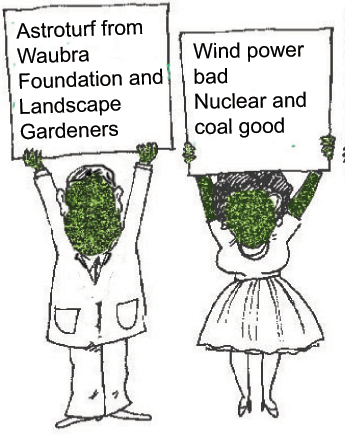 it didn’t take long for the discredited anti-wind group – the so called “Waubra Foundation” and their backers – to line up the locals opposed to the proposal. How this can be called a “Foundation” escapes this correspondent. Sandi Keane has written extensively in Independent Australia about the dubious credentials of this group, their murky sources of finances and clear links to the fossil fuel lobby. A mind-boggling chart of the web of interests can be found in Professor Simon Chapman’s article in Crikey…..
King Island’s collateral damage from anti-wind forces Independent Australia 28 May 13 Part-time King Island resident, David Looker, despairs of what he calls “collateral damage” as TasWind engages with residents in a battle to win support for its $2 billion proposal to build Australia’s biggest wind farm.
KING ISLAND sits at the western end of Bass Strait and is bisected by the 40th degree of latitude, which puts the lower half of the island literally in the Roaring Forties. The weather may be fine and windy, wet and windy, cloudy and windy — but it will be windy……
The consistent winds of the Roaring Forties have attracted TasWind, a division of Hydro Tasmania, to target the Island as the potential site of a 200-tower, 600MW capacity mega wind farm that would include a high voltage, undersea cable, enabling the electricity to be exported to the mainland, probably nearGeelong.
E3 Planning in Hobart prepared a Preliminary Socio Economic Impact Study for TasWind. This is a respected company, well-known on King Island but, of course, in the eyes of critics, suddenly not “independent” as this study was commissioned by Hydro Tasmania. E3 estimates the economic benefits to King Island to be between $255.75 and $310.65 million and points to substantial benefits to Australian renewable energy targets: Continue reading
Tasmania’s remarkable renewable energy opportunities
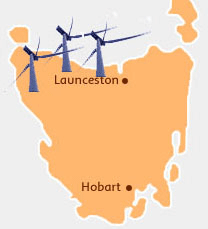 Plug into renewable energy, report urges http://www.examiner.com.au/story/1528260/plug-into-renewable-energy-report-urges/?cs=12 By CALLA WAHLQUIST, May 26, 2013, TASMANIA would become a net exporter of renewable energy by 2020 under a blueprint for climate action due to be released by the Tasmanian Climate Action Council tomorrow.
It suggests a range of measures to ensure Tasmania reaches its target of reducing carbon emissions by 60 per cent of 1990 levels by 2050, including introducing new energy efficiency standards for buildings and establishing fair renewable energy feed-in tariffs to encourage homes and businesses to generate their own electricity.
Homes that feed back into the grid from solar panels currently get 27 cents per kilowatt hour, but that could drop as low as eight cents per hour when Aurora Energy is split and the retail arm privatised in July.
Council chairwoman Lesley Hughes said the council would discuss the impending reduction of the tariffs in a meeting today and make a submission to government.
Climate Change Minister Cassy O’Connor said the council was the government’s peak advisory body on climate change, and its blueprint would inform the development of the government’s own climate plan, to be released later this year.
Ms O’Connor said Tasmania had already reduced its emissions by 30 per cent on 1990 levels. “There’s a huge economic opportunity here for Tasmania if we continue to build resilience into our economy, if we continue to move toward a low-carbon economy, then we can have a prosperous and sustainable future,” Ms O’Connor said.
“We can be a beacon to the world of sustainability and innovation.”
Opposition Leader Will Hodgman said he would not comment on the blueprint until he had seen it, but said the Liberal Party’s priorities were the re-establishment of frontline police, education and health services and revitalising the state’s economy.
A Big Lobbying Force for Small Solar Power – SOLAR CITIZENS launched today
 Solar Citizens Officially Launches Today http://www.energymatters.com.au/index.php?main_page=news_article&article_id=3736 by Energy Matters, 14 May 13 Solar Citizens aims to bring together existing and future solar owners in Australia and to help see solar installed on every suitable rooftop in the nation. The project is an offshoot of 100% Renewable; a non-partisan organisation established to help move Australia towards a renewable energy future.
 While the solar revolution is well under way and millions of systems have been installed in Australia; there are some dark clouds on the horizon. “But despite the many reasons to go solar, some big energy companies don’t want to see Australians take back control of their own energy needs. They want to make connecting to solar harder, not easier,” says part of a statement on the Solar Citizens web site.
According to Solar Citizens, Australians have invested $8 billion so far in small scale solar power systems.
Calculations performed by national solar provider Energy Matters estimate that collectively, the 1 million plus solar panel arrays in the nation will generate around $913 million worth of electricity (retail value) over the next 12 months – making these households a threat to Big Energy in Australia.
Solar Citizens says it will strive to protect the rights of solar households, lobbying to ensure they are treated with respect and paid a fair price for the power they contribute to the mains grid. With potentially nearly 2 million households as participants including solar hot water system owners; the group could become a powerful voice.
Solar Citizens’ first two campaigns focus on looming issues in Tasmania and Queensland. The Queensland campaign highlights concerns regarding a proposal from the Queensland Competition Authority to move solar power owners on to a different electricity billing system that could see increased charges for solar households.
The campaign for Tasmania is in relation to the privatising Aurora’s electricity retailer arm, to occur in January 2014. There are fears that as a result, solar feed-in tariffs could be slashed. Both campaigns involve petitions that will be presented to relevant authorities.
Solar power in Tasmania is an endangered species!
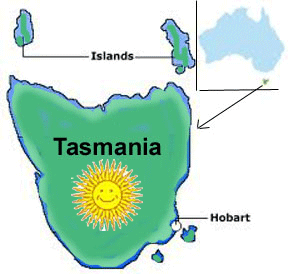 A Call To Save Solar In Tasmania http://www.energymatters.com.au/index.php?main_page=news_article&article_id=3683 11 April 13, An alliance of householders, community groups and businesses including Energy Matters have called on the Tasmanian government to safeguard the state’s renewable energy future.
“The government is rushing headlong into arrangements for the privatisation of Aurora’s retailing of electricity, including putting legislation to Parliament this week, but has been conspicuously non-committal on the future of feed in tariffs,” said Jack Gilding, spokesperson for the group.
Earlier this week we reported Tasmania’s feed in tariff is one of the most generous active programs in the nation – a 1 for 1 arrangement – but it’s a program without a set duration. This has led to growing concern the incentive could be slashed when Aurora Energy is replaced by private companies in 2014.
Such a change could affect 10,000 households in Tasmania that have already installed solar PV systems and have a dramatic impact on the state’s renewable energy sector.
“It’s not just about solar panels on houses,” said Mr Gilding. “Tasmania has the potential to be the renewable energy powerhouse of Australia. Changes to the electricity market could be an opportunity to harness the potential for many Tasmanians to be producers, not just consumers of electricity. Households, communities, farmers and businesses are keen to invest in these opportunities, but the government needs to provide a supportive policy environment.”
The group is calling for a public consultation and review process that sets a fair price for solar and other small renewable energy technologies; with “fair” being more than the wholesale price of electricity as it does not take into account the many additional benefits of distributed generation.
The group is also seeking guarantees existing tariff arrangements will continue for people who have already installed solar PV systems and those who order before new arrangements are finalised.
Further details can be viewed and a petition signed on the Save Solar Tasmania web site.
Windy Flinders Island aims for 100% renewable energy
 Flinders Island’s windy future http://www.abc.net.au/news/2012-12-16/flinders-island27s-windy-future/4430334 Dec 16, 2012 Flinders Island in Bass Strait plans to produce all its power from renewable energy sources.
The plan to put up three or four wind turbines and a mini hydro storage system would cost up to $25 million.
A privately-run turbine is already producing 25 per cent of the island’s energy.
Flinders Island Council general manager Raoul Harper said residents wanted to make that 100 per cent. “Being in the top five wind resource areas on the planet the concept of continuing to burn diesel to power the island does seem absurdreally,” he said.
In the long run Mr Harper said the project would be cost effective because the government would no longer need to pay Hydro Tasmania $3 million a year to supply diesel. The council is seeking Federal Government funding through its new
renewable energy agency.

1 This month

of the week – Australians for War Powers Reform (AWPR)
To see nuclear-related stories in greater depth and intensity
 Antinuclear