Victorian Liberal leader distances state party from Peter Dutton’s nuclear proposal: ‘Our focus is gas’
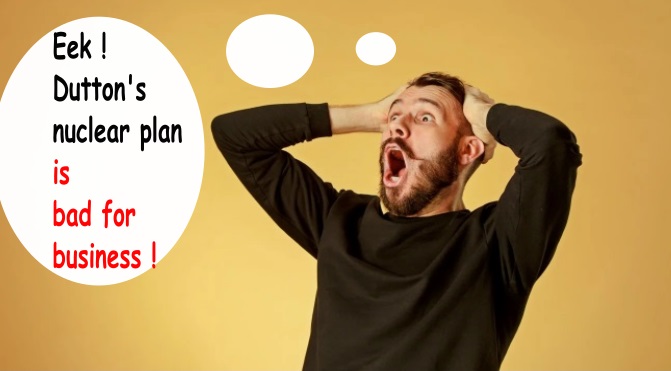
Brad Battin says he had a conversation with the federal opposition leader about the ‘language’ he would use about plans to build a nuclear reactor in eastern Victoria
Benita Kolovos Victorian state correspondent, https://www.theguardian.com/australia-news/2025/apr/15/victorian-liberal-leader-brad-battin-distances-state-party-from-peter-dutton-nuclear-proposal
The Victorian opposition leader says he discussed the language he would use to distance the state party from the federal Coalition’s campaign to build a nuclear reactor in the Latrobe Valley, telling Peter Dutton “it’s your campaign”.
The Loy Yang coal-fired power station in the Latrobe Valley east of Melbourne is one of seven proposed sites for the federal Coalition’s proposal to build nuclear reactors, the centrepiece energy policy the federal Liberal leader will be taking to the 3 May poll.
But in his first interview with Guardian Australia since becoming the state Liberal leader in December, Brad Battin was clear to separate his team from the proposal, saying: “Our focus is gas, let the feds get on with what they’ve got to get on with.”
He confirmed he had not spoken to anyone in the federal Coalition about its two-and-a-half-year consultation plan for each proposed nuclear site, with the issue “barely raised” at all on the campaign trail.
However, Battin said a conversation had taken place with Dutton and his office about how he would handle questions on the policy.
“I’ve had the conversation with Dutton and his office around what my language is going to be, which is basically saying, ‘We’re happy to have a conversation at the right time. But for us, it’s your campaign at the moment. Our priority, our focus, is on gas,’” he said.
Battin said the federal Coalition would need state parliament to overturn Victoria’s Nuclear Activities (Prohibitions) Act of 1983, which bans the construction and operation of nuclear facilities in the state. Asked if he would be happy with that law being overturned, he said: “I’ll let you know on 4 May.”
Without the support of state parliament, Battin said a Dutton government would face a “difficult process” under section 109 of the constitution, which allows federal law to override state law in the case of conflict.
At his campaign launch on Sunday, Dutton vowed that Australia would become a “nuclear-powered nation” under the Coalition if elected. He said nuclear energy would reduce the need for “sprawling solar and windfarms or laying down 28,000km of transmission lines”.
Battin, however, said most Victorians wanted cheaper energy but “don’t know what the answer to that is yet”.
He said that as existing gas fields in Victoria’s Gippsland and Otway basins continue to deplete, the state should prioritise expanding onshore gas exploration instead.
The comments mark a shift in tone for Battin, who has spent months sticking to a carefully worded position that the Victorian Coalition was open to an “adult conversation” about the policy. He has also repeatedly refused to provide a personal view on nuclear energy.
The Lizard’s Revenge
topnrosdeS146ag, https://www.facebook.com/profile.php?id=100064594993745
Anti-nuclear activists target BHP headquarters and block Collins St to mark the 14th anniversary of the Fukushima nuclear disaster.
Just after 10am today around 20 anti-nuclear activists dressed in white radioactive suits used barrels marked with the radioactive symbols and a car decorated with anti-nuclear statements to block the BHP head office. Inside the car a man in his 60s
secured himself to the steering wheel using a bike lock.
The Desert Liberation Front, who organised the protest highlighted the relationship between uranium mined by BHP and the Fukushima disaster:
“BHP makes its billions from destroying the planet and it is not only complicit in Fukushima by supplying the uranium but is part of the push for nuclear power in Australia, a plan that puts all of us and our planet in danger of another Fukushima.”
“The 14th anniversary of the Fukushima nuclear disaster comes at a time in Australia when the Liberal Party is attempting to dress up nuclear power as safe and the Labor Party is continuing with its commitment to AUKUS, a plan that will not only bring nuclear subs to ports around the country but will also result in nuclear waste dumps on sacred land.”
“We call on all political parties and private companies operating in this country to commit to banning the mining of uranium and the banning of all forms of nuclear power, both for weapons of war and as a false alternative to renewable energy.”
Peter Dutton cops backlash over push to build seven nuclear power stations in Australia

Opposition wants nuclear power plants over Anthony Albanese’s renewables
Daily Mail 4th Dec 2024, By BRETT LACKEY FOR DAILY MAIL AUSTRALIA
Aussies have hit back at plans to build nuclear power stations in the country as the Coalition ramps up its push to establish seven sites as part of its election promise.
Parliament’s House Select Committee on Nuclear Energy is investigating the proposal and is travelling around the country hearing views from local communities.
At a meeting in Traralgon in Victoria’s Gippsland region on Tuesday angry locals fired up at the plan, which would see one of the new nuclear plants built at the currently winding down Loy Yang coal plant just 10 minutes out of town.
The other six locations Peter Dutton has outlined for nuclear plants are at the coal plant sites of Tarong and Callide in Queensland, Liddell and Mount Piper in NSW, Port Augusta in SA and Muja in WA.
‘We do not need nuclear in Australia. We need to be pushing more renewable energy and the technology will develop more and more as we go to keep the lights on,’ president of community group Voices of the Valley, Wendy Farmer, told the meeting.
Shadow energy minister Ted O’Brien, also the committee’s deputy chair, asked if it was ‘just a no’ from Ms Farmer or if she was interested in studying whether nuclear could be a safe and effective form of electricity.
‘The Coalition have told us that they would consult with us for two and a half years but then they would go ahead with nuclear, whether we wanted it or not and our community would have no rights of veto,’ Ms Farmer fired back.
‘How can we trust the Coalition to have an independent study when you say proposal but where’s the proposal?’
Darren McCubbin, the CEO of Gippsland Climate Change Network, got a standing ovation when he told the meeting renewables were ‘ready to go’ while nuclear power stations would require years of consultations and reports.
‘I’d like to congratulate Mr O’Brien for recognising that we don’t have the science, that we need a work plan, that we need two and a half years of consultation,’ Mr McCubbin said.
‘Good on him for coming here and saying we don’t know the answers and we need to find them because they don’t have the answers.’
Mr McCubbin pointed to the 2GW of Victorian offshore wind power projects slated to be online by 2032, which would increase to 5GW by 2035.
Look right now we’ve got a stream towards renewables, we’ve got targets in place. We’ve got an industry waiting to go, we’ve got people coming from all over the world looking in Gippsland and saying we have a way of transitioning out [of coal-fired electricity].
‘We’ve got the science, we’ve got the community [support]. We’ve had Star of the South [wind farm project] here for five years doing community consultation and I appreciate that you recognise you haven’t done that.
‘So we’re ready to go and putting things off for two and a half years to have work plan after work plan and work plan is not a solution for jobs and growth within our region.’
A recent Demos AU poll of 6709 adults between July 2 and November 24 found that 26 per cent of women said nuclear would be good for Australia, compared with 51 per cent of men.
But only one in three of the men surveyed were willing to live near a nuclear plant.
Almost two-thirds (63 per cent) of women said they don’t want to live near a nuclear plant and more than half (57 per cent) said transporting radioactive waste isn’t worth the risk.
The report card follows polling by Farmers For Climate Action that found 70 per cent of rural Australians support clean energy projects on farmland in their local areas and 17 per cent were opposed.
That support came with conditions, including proper consultation and better access to reliable energy.
Sanne de Swart, co-ordinator of the Nuclear Free Campaign with Friends of the Earth Melbourne, claimed nuclear electricity would ‘increase power bills, increase taxes and increase climate pollution’.
The independent Climate Council said it was concerned the coalition was relying on one private sector ‘base case‘ for nuclear costings rather than expert advice such as from the Australian Energy Market Operator.
‘What’s crucial is that any new investment is made at the least cost to Australian consumers,’ a council spokesperson said. ‘Only renewables – solar, wind, hydro – together with energy storage is capable of delivering on this, and it’s being built right now,’ the council said.
Minister for Climate Change Chris Bowen recently took a swipe at Peter Dutton and the Coalition’s nuclear proposal saying that it would take too long to get the plants up and running.
‘Net zero by 2050 is not optional. Which means the critical decade is now.’
With six years to go to reach the legislated target of a 43 per cent reduction in greenhouse gas emissions, he said the nation was on track to meet it and to make 82 per cent renewable electricity in the national grid by 2030.
On Wednesday the House Select Committee was told legal requirements to make the former coal sites safe to build nuclear reactors will take decades of rehabilitation before they can be used.
‘We’re talking significant periods of time of two or three decades,’ Victoria’s Mine Land Rehabilitation Authority chief executive Jen Brereton said. https://www.dailymail.co.uk/news/article-14154479/Australia-nuclear-power-plant-locations-backlash.html
Greens welcome Victorian government ending agreement with Elbit
Guardian, 28 Nov 24
The Greens MP Gabrielle de Vietri has welcomed the news the Victorian government has ended its agreement with weapons manufacturer Elbit Systems:
Relentless community pressure has forced Victorian Labor to end its partnership with Elbit – a company whose drones killed Australian aid worker Zomi Frankcom and countless Palestinian and Lebanese civilians. It shouldn’t have taken this long for Labor to cut its ties with genocide.
She questioned why the government hadn’t announced the Elbit decision since writing to the Labor MP Bronwyn Halfpenny last week:
This is an important step in the right direction, but why are Labor still leaving Victorians in the dark, they clearly have something to hide. https://www.theguardian.com/australia-news/live/2024/nov/28/australia-politics-live-climate-super-social-media-ban-senate-anthony-albanese-peter-dutton-question-time
Protecting the Merchants of Death: The Police Effort for Land Forces 2024
September 12, 2024, by: Dr Binoy Kampmark, https://theaimn.com/protecting-the-merchants-of-death-the-police-effort-for-land-forces-2024/—
September 11. Melbourne. The scene: the area between Spencer Street Bridge and the Batman Park–Spencer Street tram stop. Heavily armed police, with glinting face coverings and shields, had seized and blocked the bridge over the course of the morning, preventing all traffic from transiting through it. Behind them stood second tier personnel, lightly armed. Then, barricades, followed by horse mounted police. Holding up the rear: two fire trucks.
In the skies, unmanned drones hovered like black, stationary ravens of menace. But these were not deemed sufficient by Victoria Police. Helicopters kept them company. Surveillance cameras also stood prominently to the north end of the bridge.
Before this assortment of marshalled force was an eclectic gathering of individuals from keffiyeh-swaddled pro-Palestinian activists to drummers kitted out in the Palestinian colours, and any number of theatrical types dressed in the shades and costumery of death. At one point, a chilling Joker figure made an appearance, his outfit and suitcase covered in mock blood. The share stock of chants was readily deployed: “No justice, no peace, no racist police”; “We, the people, will not be silenced. Stop the bombing now, now, now.” Innumerable placards condemning the arms industry and Israel’s war on Gaza also make their appearance.
The purpose of this vast, costly exercise proved elementary and brutal: to defend Land Forces 2024, one of the largest arms fairs in the southern hemisphere, from Disrupt Land Forces, a collective demonised by the Victorian state government as the great unwashed, polluted rebel rousers and anarchists. Much had been made of the potential size of the gathering, with uncritical journalists consuming gobbets of information from police sources keen to justify an operation deemed the largest since the 2000 World Economic Forum. Police officers from regional centres in the state had been called up, and while Chief Commissioner Shane Patton proved tight–lipped on the exact number, an estimate exceeding 1,000 was not refuted. The total cost of the effort: somewhere between A$10 to A$15 million.
It all began as a healthy gathering at the dawn of day, with protestors moving to the Melbourne Convention and Exhibition Centre to picket entry points for those attending Land Forces.
Over time, there was movement between the various entrances to prevent these modern merchants of death from spruiking their merchandise and touting for offers. As Green Left Online noted, “The Victorian Police barricaded the entrance of the Melbourne Convention Centre so protestors marched to the back entrance to disrupt Land Forces whilst attendees are going through security checks.”
In keeping with a variant of Anton Chekhov’s principle, if a loaded gun is placed upon the stage, it is bound to be used. Otherwise, leave it out of the script. A large police presence would hardly be worthwhile without a few cracked skulls, flesh wounds or arrests. Scuffles accordingly broke out with banal predictability. The mounted personnel were also brought out to add a snap of hostility and intimidation to the protestors as they sought to hamper access to the Convention. For all of this, it was the police who left complaining, worried about their safety.
Then came the broader push from the officers to create a zone of exclusion around the building, resulting in the closure of Clarendon Street to the south, up to Batman Park. Efforts were made to push the protests from the convention centre across the bridge towards the park. This was in keeping with the promise by the Chief Commissioner that the MCEC site and its surrounds would be deemed a designated area over the duration of the arms fair from September 11 to 13.
Such designated areas, enabled by the passage of a 2009 law, vests the police with powers to stop and search a person within the zone without a warrant. Anything perceived to be a weapon can be seized, with officers having powers to request that civilians reveal their identity.
Despite such exercisable powers, the relevant legislation imposes a time limit of 12 hours for such areas, something most conspicuously breached by the Commissioner. But as Melbourne Activist Legal Support (MALS) group remarks, the broader criteria outlined in the legislative regime are often not met and constitute a “method of protest control” that impairs “the rights to assembly, association, and political expression” protected by the Victorian Charter of Human Rights and Responsibilities.
The Victorian government had little time for the language of protest. In a stunningly grotesque twist, the Victorian Premier, Jacinta Allan, defended those at the Land Forces conference as legitimate representatives of business engaging in a peaceful enterprise. “Any industry deserves the right to have these sorts of events in a peaceful and respectful way.” If the manufacture, sale and distribution of weapons constitutes a “peaceful and respectful” pursuit, we have disappeared down the rabbit hole with Alice at great speed.
That theme continued with efforts by both Allan and the opposition leader, John Pesutto, to tarnish the efforts by fellow politicians to attend the protest. Both fumed indignantly at the efforts of Greens MP Gabrielle de Vietri to participate, with the premier calling the measure one designed for “divisive political purposes.” The Green MP had a pertinent response: “The community has spoken loud and clear, they don’t want weapons and war profiting to come to our doorstep, and the Victorian Labor government is sponsoring this.”
The absurd, morally inverted spectacle was duly affirmed: a taxpayer funded arms exposition, defended by the taxpayer funded police, used to repel the tax paying protestors keen to promote peace in the face of an industry that thrives on death, mutilation and misery.
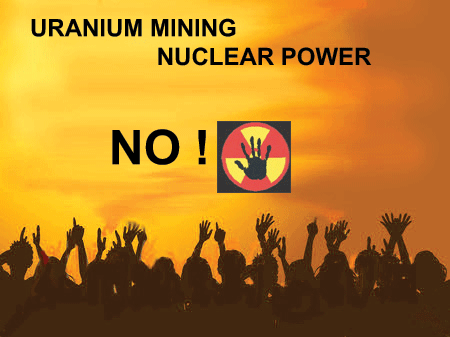
No to nuclear in the Latrobe Valley
9 July 2024, Cormac Mills Ritchard, https://redflag.org.au/article/no-to-nuclear-in-the-latrobe-valley
“Don’t dump on us again”, says Wendy Farmer, president of the Latrobe Valley community group Voices of the Valley and a local community organiser for Friends of the Earth. The Latrobe Valley is one of Liberal Party leader Peter Dutton’s proposed sites for nuclear power reactors, which would replace the Loy Yang coal power station.
The region is already saddled with several toxic industries. As Farmer explains to Red Flag, “We have a waste-to-energy, we have a lead smelter, we have a magnesium smelter, we have the power stations … Just today I’ve gone outside and you should see the coal dust on my rubbish bins. It is just everywhere. People are like, ‘Why are we being the dumping ground again? Why are we just being told once again what’s good for us and what we need?’”
Wendy knows what it’s like for a community to be treated as expendable. She became an activist in 2014 during the Hazelwood coal mine fire, which lasted for 45 days. The fire blanketed the area with smoke, causing the deaths of at least 60 people according to extensive research carried out by Voices of the Valley. This was no accident, but a result of the owner ENGIE’s cost-cutting and negligence. “They knew the risks two days before the fire got into the mine and chose to ignore it. I think they put a couple of extra staff on over the weekend, when we were gonna have the hottest, windiest weekend. Any fool could have read that.”
The fire might also have been prevented through the mine’s watering system, a critical safety measure meant to keep the coal face wet and guard against bushfires, which the owners had previously dismantled.
“My husband at the time worked at Hazelwood”, Wendy says. “Hazelwood knew that things needed to be repaired. Hazelwood knew that they didn’t have the water where they needed it.” You can never completely trust a company, she says. “Industry has known about asbestos, yet they’ve used it. Industry has known about the stone [in kitchen bench-tops], yet they’ve used it. Industry has known about dangers before and covered them up.”
If companies like ENGIE axe safety measures and governments cover up their crimes, why should we expect nuclear to be any different? Wendy describes Dutton’s nuclear proposal as a fantasy: “No plan, no proposal, no detail”. But her objections run deeper than that. The risks of a nuclear failure weigh heavily on a community with such a recent history of disaster and injustice.
“If there’s a failure and the kids are at school or anywhere else”, Wendy says, “nuclear disaster would kill … That sort of radiation you don’t have much chance. If the kids are at school, it’s too late to go and get them. And if they’re not dead, the damage is done. You can’t reverse the damage”. Worse still, Wendy explains, the valley sits on an earthquake fault line. “We’ve had many earthquakes. It’s only a matter of time before we have a big one.”
Fortunately, through Hazelwood the community taught itself how to fight toxic industries. On the morning Dutton’s proposed sites were revealed, Wendy organised a snap protest outside local Nationals MP Darren Chester’s office. “The people who joined the anti-nuclear rally were pretty upset, pretty pissed off”, Wendy says. “‘How dare they? We don’t want nuclear reactors.’”
Not everyone is opposed to nuclear, however; the community’s views are mixed. According to a News Corp survey last month (which polled only 113 people), 59 percent of Latrobe Valley residents would be comfortable with a nuclear reactor being built in their state or region. “A lot of people who support nuclear are supporting it because there will be jobs. But in fact there won’t be jobs for 30 or 40 years”, says Wendy. Construction on the nuclear power plant cannot begin, Wendy explains, until after Loy Yang has been shut down and rehabilitated, which won’t be for at least a decade.
Affordable energy is the other argument opening people to nuclear. But nuclear-generated power is far more expensive than renewables, given the extensive capital costs. According to the GenCost 2023-24 report published by the CSIRO and the Australian Energy Market Operator (AEMO), while wind and solar PV combined are estimated to cost between $73 and $128/MWh, large-scale nuclear will cost between $141 and $233/MWh, or $230 to $382/MWh for small modular reactors.
“Hazelwood was a David and Goliath”, Wendy says. “I felt the community won. For sure the company weren’t punished enough, but the community won. We have to stand together and we can win this.”
The cloud of coal has long hung over the Latrobe Valley. Now nuclear power is dividing it
Cait Kelly, Mon 24 Jun 2024 https://www.theguardian.com/australia-news/article/2024/jun/23/the-cloud-of-coal-has-long-hung-over-the-latrobe-valley-now-nuclear-power-is-dividing-it
No matter where you are in the Latrobe Valley, you can see the smoke haze. The transmission lines that punctuate the region’s dairy farms and clusters of blue gums all lead to some of the country’s biggest coal-fired power plants, where the plumes of smoke soar from smokestacks and steam from cooling towers.
This valley provides most of Victoria’s electricity, but it’s been on the edge of a precipice. Over the next 11 years, Loy Yang A and Yallourn are expected to be decommissioned. Residents know the writing is on the wall for coal, but confusion over what comes next is creating a deep chasm.
Now the valley’s communities – and those of six other locations around Australia – are on a new energy frontline. On Wednesday, the Coalition promised that, if elected to government, a part of the Loy Yang station would be one of seven sites to host a nuclear reactor.
The announcement spread quickly down the valley. Some welcome it, seeing it as a lifeline for their dying community. And then there are pockets of outrage.
Wendy Farmer is an unlikely advocate for renewables because coal is in her blood. She is a miner’s daughter; her father was a miner’s son. Her husband worked at the Hazelwood plant before it was decommissioned in 2017. The plant was infamous for two things – the 2014 fire that burned for 45 days and for being Australia’s dirtiest power station.
But Farmer is helping lead a group of advocates for a healthier and more sustainable valley – and she’s outraged by the nuclear proposal when “we have the technology we need to move forward without it”.
“It’s a slap in the face,” she says. “It’s them going, ‘You’re desperate, so you’ll take it’.”
There are many questions about the Coalition policy, including the cost, what to do about the waste, how the plants could be built and when, how many jobs would it actually create – and how geographically safe would it be to have a nuclear plant near a faultline.
“Why would you even consider putting nuclear on earthquake faultlines?” Farmer says.
“It doesn’t feel like it’s community-driven – no one in the community has been asked about it. They’ve just been told this is what our plan is.”
On Wednesday, Farmer led a snap protest outside the Gippsland National MP Darren Chester’s office. Chester has cautiously welcomed the nuclear policy, saying in a statement it could create “enduring social and economic benefits to our community”, before adding that “more detailed investigations will be required in the years ahead”.
‘Always looking for more jobs’
Traralgon is the biggest town in the valley and is wedged between the power plants and the big hole left by Hazelwood – between a brown coal past and Australia’s commitment to get to net zero emissions by 2050.
Of the 125,000 people who live in the valley, 26,000 call Traralgon home.
In the newsagent it’s buzzing. People are queueing for their Lotto ticket or a copy of the paper. The workers behind the counter won’t say much about nuclear – one thinks it’ll just get her in trouble and the other says she’s supportive but will grab the boss.
The boss is Gary Garth. He’s upfront with his opinion and cares about his community and the number of jobs. He loves the nuclear idea.
“I think there are a lot of hurdles, obviously, they’ve got to get through to do it. But I think the vision is good. And it would be great for the area,” Garth says.
“We are always looking for more jobs for locals and that’s probably the most important thing a society can have: people in employment.”
Decades ago, this area was booming – high-paying jobs created a cashed-up community. But coal is no longer king. The most recent census had unemployment sitting at 6.6%, higher than the Victorian average of 5%.
“If the governments can come up with a way of turning energy into nuclear where it’s safe, safe for the environment, safe for everyone, it’s very clean, so if it can be done, that would be a real benefit to the area,” Garth says.
In parts of the community, renewables are also seen as a threat. Garth describes windfarms as “a disaster for the environment” – he’s worried about the birds and what we do with the materials when they come to the end of their lifespan.
But it’s not a concern he holds for nuclear waste.
“Australia is a big place. They need to be able to come up with something – they seem to do in other countries around the world,” he says.
He thinks the community will vote for it and says the Coalition will have a mandate to proceed with it if it wins power – and that the state government would be foolish not to listen to the electorate.
Before the announcement, the Coalition reportedly polled each of the seven communities, with 55% of the Latrobe Valley respondents said to be supporting nuclear.
But on the streets of the valley, not everyone is convinced by the Coalition’s promise.
Ian, a former geologist, says the opposition leader, Peter Dutton, “hasn’t done his homework”.
But another resident, Jesse, thinks it will be a good creator of jobs.
“I think it’s a good thing, especially with all the coal shutting down,” Jesse says.
“I think the nuclear side of things will offer more ongoing jobs [than windfarms]. And we’ll have a stable power supply. Everyone needs the power to keep warm and cook and all that sort of stuff … We need to have a stable power supply.”
‘Softened up for nuclear’
Penelope Swales is sitting in a rare slither of winter sun on her organic farm at the bottom of the Strzelecki Ranges. It’s cut from a different cloth to Traralgon – there’s a rail trail, a brewery and a beloved community band. It lures former city slickers with its shaggy green hills and bush walks, and turns them into locals. Swales was a lawyer before she took up the plough.
“I feed 20 local families with this farm,” she says.
“That cloud between the two trees” – she points to the distance where the smoke is slowly filling the air, making a large cloud that drifts east towards Melbourne – “that’s Loy Yang. So pretty close.”
Swales is joined by her friends Marge Mackay and Lisa Mariah, who have also moved to the valley for its natural beauty and relaxed lifestyle. They don’t want nuclear.
“The demographic here is a little bit odd,” Swales says.
“While most people work in Morwell and Traralgon, progressive and pro-renewable voices don’t get a lot of a look in because most of us live up here in the Strzelecki corridor, which is bisected by the electoral boundary.
“So a bunch of us are on one side and a bunch of us are on the other side.”
She says that, over the past four years, the region has been “softened up for nuclear”. There has also been a bitter campaign over plans to build a windfarm in a pine plantation overlooking the former Hazelwood coal plant.
“People came in from outside, held public meetings, ran a very slick campaign telling people, ‘this is going to be bad for your community, this is going to destroy your community, this is going to ruin your property values, infrasound will keep you awake at night’,” Swales says.
The fight spread misinformation and put the sleepy community at loggerheads, she says.
“The more progressive people tend to keep their heads down,” she says. “There’s been some very vicious stuff going on. We’ve had vandalism. One of their friends had ‘sell-out’ sprayed on the footpath outside at home. You know, she’s a pensioner.”
The long campaign against renewables has created “fertile ground”, Swales says. If someone says “jobs”, they get the votes.
But the group of friends is determined to fight – they say they’ve done it before. Mackay jumps in and says her community was dumped with coal, was not supported after the Hazelwood fire and is now getting shunted with nuclear. She wants a different future.
“The valley has been the dumping ground for Victoria for a very long time,” she says.
“There is a lack of forward vision for future generations – this is your children and your grandchildren.
Summary of Australian federal and state/territory nuclear/uranium laws and prohibitions.

Current prohibitions on nuclear activities in Australia: a quick guide
From Jim Green, 30 May 2024
https://www.aph.gov.au/About_Parliament/Parliamentary_departments/Parliamentary_Library/pubs/rp/rp2324/Quick_Guides/NuclearActivitiesProhibitions
PDF Version [564KB]
Dr Emily Gibson
Science, Technology, Environment and Resources; Law and Bills Digest Sections
This quick guide provides an overview of current prohibitions on nuclear activities under Commonwealth, state and territory laws. It considers the primary legislation most relevant to current policy debates about domestic nuclear energy only and consequently does not consider recent changes to Commonwealth law to facilitate Australia’s acquisition of conventionally-armed, nuclear-powered submarines under the AUKUS partnership.[1] It also does not include consideration of Australia’s international obligations in respect of nuclear activities, including the safeguarding of nuclear materials and the non-proliferation of nuclear weapons.
If a domestic nuclear energy industry were to progress, it is expected that a comprehensive framework for the safety, security and safeguarding of the related nuclear material would need to be legislated to accommodate such an industry.[2] Consideration of these issues is beyond the scope of this paper.
What are nuclear activities?
A nuclear activity is any process or step in the utilisation of material capable of undergoing nuclear fission; that is, any activities in the nuclear fuel cycle.[3] Nuclear activities therefore include:
- mining of nuclear or radioactive materials such as uranium and thorium milling, refining, treatment, processing, reprocessing, fabrication or enrichment of nuclear material
- the production of nuclear energy
- the construction, operation or decommissioning of a mine, plant, facility, structure, apparatus or equipment used in the above activities
- the use, storage, handling, transportation, possession, acquisition, abandonment or disposal of nuclear materials, apparatus or equipment.
Prohibitions on nuclear activities
Commonwealth
Nuclear activities are regulated under the Australian Radiation Protection and Nuclear Safety Act 1998 (ARPANS Act) and the Environment Protection and Biodiversity Conservation Act 1999 (EPBC Act).
Australian Radiation Protection and Nuclear Safety Act 1998
The ARPANS Act establishes a licensing framework for controlled persons (including a Commonwealth entity or a Commonwealth contractor) in relation to controlled facilities (a nuclear installation, a prescribed radiation facility, or a prescribed legacy site).[4] A nuclear installation includes a nuclear reactor for research or the production of radioactive materials for industrial or medical use, and a radioactive waste storage or disposal facility with an activity that is greater than the activity level prescribed by the Australian Radiation Protection and Nuclear Safety Regulations 2018.[5]
The ARPANS Act allows the CEO of the Australian Radiation Protection and Nuclear Safety Agency (ARPANSA) to issue licences for controlled facilities.[6] In issuing a facility licence, the CEO ‘must take into account the matters (if any) specified in the regulations, and must also take into account international best practice in relation to radiation protection and nuclear safety’.[7]
However, subsection 10(2) of the Act expressly prohibits the CEO from granting a licence for the construction or operation of any of the following nuclear installations: a nuclear fuel fabrication plant; a nuclear power plant; an enrichment plant; or a reprocessing facility.[8] This prohibition does not appear to apply to a radioactive waste storage or disposal facility.
Environment Protection and Biodiversity Conservation Act 1999
The EPBC Act establishes 9 matters of national environmental significance (MNES) and provides for the assessment and approval of these actions if the action has, will have, or is likely to have a significant impact on the MNES.[9] ‘Nuclear actions’ are one of the MNES.[10] Where a nuclear action is determined to be a controlled action (that is, one likely to have a significant impact and requiring assessment and approval under the Act), the assessment considers the impact of a nuclear action on the environment generally (including people and communities).[11]
The Act establishes offences for the taking of nuclear actions in those circumstances.[14]
Similarly, the Act provides that a relevant entity (as set out below) must not take an action (including a nuclear action) unless a requisite approval has been obtained under Part 9 of the Act or a relevant exception applies:
- a person must not take a relevant action on Commonwealth land that has, will have or is likely to have a significant impact on the environment[15]
- a person must not take a relevant action outside Commonwealth land if the action has, will have or is likely to have a significant impact on the environment on Commonwealth land[16]
- the Commonwealth or a Commonwealth agency must not take inside or outside the Australian jurisdiction an action that has, will have or is likely to have a significant impact on the environment inside or outside the Australian jurisdiction.[17]
The Act establishes offences and civil penalty provisions for the taking of an action in those circumstances.[18]
Subsection 140A(1) prohibits the Minister for the Environment from granting an approval for a nuclear action relating to specified nuclear installations. These installations are a nuclear fuel fabrication plant, a nuclear power plant, an enrichment plant, and a reprocessing facility.
Potential reform of the nuclear action trigger
The second independent review of the EPBC Act, completed in October 2020 by Professor Graeme Samuel (Samuel Review), recommended that the nuclear actions MNES be retained.[19] The review recommended that ‘the EPBC Act and the regulatory arrangements of [ARPANSA] should be aligned, to support the implementation of best-practice international approaches based on risk of harm to the environment, including the community’.[20]
In 2022, the Government’s Nature Positive Plan adopted this approach and stated, ‘[a] uniform national approach to regulation of radiation will be delivered through the new National Environmental Standards’.
In February 2024, a policy draft of the National Environmental Standard for Matters of National Environmental Significance indicates that ‘nuclear actions’ will be renamed ‘radiological exposure actions’ and states:
Relevant decisions must:
Not be inconsistent with the ARPANSA national codesfor protection from radiological exposure actions including in relation to:
- human health and environmental risks and outcomes; and. radiological impacts on biological diversity,
- the conservation of species and the natural health of ecosystems.[22]
States and territories
States and territories generally regulate nuclear and radiation activities through either the health or the environmental protection portfolios. The relevant legislation provides for the protection of health and safety of people, and the protection of property and the environment, from the harmful effects of radiation by establishing licensing regimes to regulate the possession, use, and transportation of radiation sources and substances.[23] Mining of radioactive materials is regulated through the resources portfolio.
In addition, as outlined below, the states and territories have legislation prohibiting certain nuclear activities or the construction and operation of certain nuclear facilities. Importantly, where permitted, nuclear activities (including mining) would also be subject to assessment and approvals under a range of other legislation, including planning and environmental impact assessment, native title and cultural heritage, and radiation licensing laws at the state or territory and Commonwealth level.
New South Wales
Exploration for uranium has been permitted under the Mining Act 1992 since 2012.[24] However, the mining of uranium is prohibited by the Uranium Mining and Nuclear Facilities (Prohibitions) Act 1986 (NSW Prohibitions Act).[25]
The NSW Prohibitions Act also prohibits the construction and operation of certain nuclear facilities, including uranium enrichment facilities, fabrication and reprocessing plants, nuclear power plants, and storage and waste disposal facilities (other than for the storage and disposal of waste from research or medical purposes, or the relevant radiological licensing Act).[26]
Northern Territory
The Atomic Energy Act 1953 (Cth) provides that the Commonwealth owns all uranium found in the territories.[27] Uranium exploration and mining in the Northern Territory (NT) is regulated under both NT mining laws (the Mineral Titles Act 2010 and the Mining Management Act 2001) and the Atomic Energy Act.[28] The Ranger Uranium Mine operated until 2021 and is now undergoing rehabilitation.[29]
The Nuclear Waste Transport, Storage and Disposal (Prohibition) Act 2004 (NT) prohibits the construction and operation of nuclear waste storage facilities, as well as the transportation of nuclear waste for storage at a nuclear waste storage facility in the NT.[30] Nuclear waste is defined as including waste material from nuclear plants or the conditioning or reprocessing of spent nuclear fuel.[31]
This Act also:
- prohibits public funds from being expended, granted or advanced to any person for, or for encouraging or financing any activity associated with the development, construction or operation of a nuclear waste storage facility
- would require the NT Parliament to hold an inquiry into the likely impact of a nuclear waste storage facility proposed by the Commonwealth on the cultural, environmental and socio‑economic wellbeing of the territory.[32]
Queensland
Exploration for and mining of uranium are permitted under the Mineral Resources Act 1989. However, it has been government policy to not grant mining leases for uranium since 2015.[33] The government policy ban extends to the treatment or processing of uranium within the state.[34]
The Nuclear Facilities Prohibition Act 2007, in similar terms to the NSW Prohibitions Act, prohibits the construction and operation of nuclear reactors and other nuclear facilities in the nuclear fuel cycle.[35]
Unlike other state and territory prohibition legislation, the Nuclear Facilities Prohibition Act would require the responsible Queensland Minister to hold a plebiscite to gain the views of the Queensland population if the Minister was satisfied that the Commonwealth Government has taken, or is likely to take, steps to amend a Commonwealth law or exercise a power under a Commonwealth law to facilitate the construction of a prohibited nuclear facility, or if the Commonwealth Government adopts a policy position of supporting or allowing the construction of a prohibited nuclear facility in Queensland.[36]
South Australia
The exploration and mining of radioactive material (including uranium) is permitted in South Australia (SA), subject to approvals under the Mining Act 1971 and the Radiation Protection and Control Act 2021 (RP&C Act).[37] For example, uranium is mined at Olympic Dam, Four Mile and Honeymoon. However, conversion and enrichment activities are prohibited by the RP&C Act.[38]
The Nuclear Waste Storage Facility (Prohibition) Act 2000 prohibits the construction or operation of a nuclear waste storage facility, and the import to SA or transport within SA of nuclear waste for delivery to a nuclear waste storage facility.[39]
The Nuclear Waste Storage Facility (Prohibition) Act prohibits the SA Government from expending public funds to encourage or finance the construction or operation of nuclear waste storage facilities.[40] The Act would also require the SA Parliament to hold an inquiry into the proposed construction or operation of a nuclear waste storage facility in SA authorised under a Commonwealth law.[41]
Tasmania
The exploration and mining of atomic substances (which includes uranium and thorium) is permitted under the Mineral Resources Development Act 1995 (Tas), subject to approval.
Victoria
The Nuclear Activities (Prohibitions) Act 1983 prohibits a range of activities associated with the nuclear fuel cycle, including the exploration and mining of uranium and thorium, and the construction or operation of facilities for the conversion or enrichment of any nuclear material, nuclear reactors and facilities for the storage and disposal of nuclear waste from those prohibited activities.[42]
Western Australia
Exploration for and mining of uranium is permitted under the Mining Act 1978. A state policy ban on mining approvals was overturned in November 2008;[43] however, this was reinstated in June 2017, with a ‘no uranium’ condition on future mining leases.[44] The ban does not apply to 4 projects that had already been approved by the previous government.
The Nuclear Activities Regulation Act 1978 aims to protect the health and safety of people and the environment from possible harmful effects of nuclear activities, including by regulating the mining and processing of uranium and the equipment used in those processes. The Nuclear Waste Storage and Transportation (Prohibition) Act 1999 also prohibits the storage, disposal or transportation in Western Australia of certain nuclear waste (including waste from a nuclear plant or nuclear weapons).[45]
Can the Commonwealth override a state ban on nuclear activities?
The Commonwealth Parliament only has the power to make laws in relation to matters specified in the Constitution of Australia, including in sections 51, 52 and 122. Assuming the Commonwealth has a sufficient head of power to legislate, section 109 of the Constitution specifically provides for circumstances in which there might be an inconsistency between Commonwealth and state laws:
When a law of a State is inconsistent with a law of the Commonwealth, the latter shall prevail, and the former shall, to the extent of the inconsistency, be invalid.
Therefore, even though some states have enacted prohibitions on certain nuclear activities within their jurisdictions, the Commonwealth Parliament could enact specific legislation in relation to nuclear activities so that such activities can take place within those jurisdictions. One such example is the National Radioactive Waste Management Act 2012 (Cth), which provides for the establishment of a national radioactive waste management facility at a site to be declared by the responsible Commonwealth Minister. Section 12 of that Act provides that state and territory laws have no effect in regulating, hindering, or preventing such a facility
Further information
- ‘Who we regulate’, ARPANSA
- ‘State & territory regulators’, ARPANSA
- ‘Uranium and thorium’, in Geoscience Australia, Australia’s Energy Commodity Resources, 2023 Edition, (Canberra: Geoscience Australia, 2023).
MP says coalition ‘must’ explain plan for nuclear power near Anglesea on the Victorian Surf Coast
March 3, 2024 by Tim Lamacraft, https://www.bay939.com.au/local-news/mp-says-coalition-must-explain-nuclear-coast-plan/—
The federal member for Corangamite says the coalition needs to explain where it would build a nuclear reactor on the Surf Coast.
It follows suggestions from Liberal leader Peter Dutton the former Anglesea power station would be a suitable location for nuclear power generator.
Anglesea was in Labor MP Libby Coker’s seat of Corangamite before it moved into the electorate of Wannon for the 2022 election, held by senior Liberal MP Dan Tehan who’s now seeking to downplay nuclear talk there.
Asked last week if Anglesea could host a small modular reactor (SMR) as suggested by his leader, Mr Tehan said Alcoa’s former coal mine and power generator there was already earmarked for an eco-tourism site by the UK based Eden Project.
“Planning is already taking place, and we’re looking at the first small modular nuclear reactor occurring in 2035, obviously the community and everyone hopes that the Eden Project will be up and running by that stage,” he said.
The Eden Project is facing increasing pushback from the Surf Coast community, including from the local shire where the deputy mayor is opposed to it.
“There are a lot like me who are wary of the proposal and definitely question the need, probably very, very sceptical about their being a need for it,” Cr Mike Bodsworth said, who also represents the Anglesea ward.
When asked by Geelong Broadcasters what he thought the chances of nuclear reactor going into Anglesea were, Dan Tehan said he was “on the record as supporting the Eden Project.”
“The community strongly supports the Eden Project, like I do,” Mr Tehan said.
“As we continue to investigate sites around the country, there’ll be other sites which will tick the box more so than Anglesea, where there is already – I think – a very worthwhile proposal.”
Libby Coker remains unconvinced, and says the opposition is yet to outline much of the detail behind its push for nuclear power, including the disposal of spent fuel.
“Peter Dutton and the Coalition must tell us where on the Surf Coast they’re planning to build this nuclear reactor and put its waste,” she said.
The Victorian towns where Peter Dutton is considering going nuclear

Josh Gordon and Benjamin Preiss, February 25, 2024, https://www.theage.com.au/politics/victoria/the-victorian-towns-where-peter-dutton-is-considering-going-nuclear-20240223-p5f7a3.html
The Coalition is leaving the door open to building nuclear reactors in the Latrobe Valley and Anglesea using land from retired coal-fired power stations as a solution to Victoria’s energy troubles.
But locals warn there would be significant opposition to nuclear reactors being built in their towns, even if the huge legal hurdles to constructing and running them could be overcome.
With Victoria’s energy security under scrutiny after a wild storm earlier this month left hundreds of thousands of homes without power and triggered the shutdown of the state’s largest coal-fired generator, the federal opposition has confirmed it is now in the “advanced stages” of developing an energy policy. Nuclear is set to be a key part of the mix.
Opposition energy spokesman Ted O’Brien told The Age potential locations remained a “work-in-progress”, but he had been advised that “communities with experience hosting coal plants could be ideal potential hosts for zero-emissions nuclear plants”.
That leaves Victoria’s three remaining coal-fired power plants, plus the now decommissioned site of the Hazelwood mine and power station, as strongly preferred locations – with existing connections to the energy grid, and a ready-made workforce preparing for the end of coal-fired generation over the next 15 years.
“We have been very transparent about the fact we are considering zero-emissions nuclear energy as part of Australia’s future energy mix, and we will remain open about the details of our policy when it is announced,” O’Brien said.
The state opposition remains more cautious about the prospect of nuclear in the Latrobe Valley, but it too is not ruling out the idea. Asked about using retired coal-fired power stations as sites for nuclear energy, Opposition Leader John Pesutto said a commonsense approach was needed.
“But for any new industry to succeed it would first need detailed inquiries and thorough examination,” Pesutto told The Age. “It would also require bipartisan support, as this is crucial for investment certainty and to eliminate sovereign risk.”
Other sites in Victoria have also been flagged. Federal Opposition Leader Peter Dutton recently hinted at the possibility of a small modular reactor on the Surf Coast at Anglesea, on the site of Alcoa’s former mine and power station.
“It’s zero emissions, you can put it into an existing brownfield site, so when the coal-fired generation comes to an end, you can put the nuclear modular reactors into that facility,” Dutton said in September.
The argument for nuclear is that plugging into existing infrastructure would be significantly cheaper and would reduce the need for thousands of kilometres of new transmission lines needed to connect wind and solar energy dotted across the grid.
O’Brien has previously pointed to a September 2022 study for the US Department of Energy that found using the infrastructure of an existing coal plant could reduce a nuclear plant’s capital costs by up to 35 per cent. He suggested Australia should look to the US state of Wyoming, which is planning to replace its coal-fired generators with nuclear by about 2030.
But any move towards nuclear power in Victoria would likely encounter strong resistance from communities worried about safety, waste disposal and the cost.
Voices of the Valley president Wendy Farmer said nuclear power would face major opposition from communities worried about the risks.Farmer said residents in the Latrobe Valley had already suffered the consequences of the Hazelwood mine fire in 2014, which burned for 45 days and caused health concerns for those living amid the smoke.
“I would be surprised if there would be any enthusiasm for a reactor,” she said.
Deputy Mayor Mike Bodsworth, who represents the Anglesea ward, said residents were excited by the potential for renewable power generation at the former Alcoa site.
“But nobody I know has ever mentioned nuclear,” he said. “Knowing the general preferences of the local population, I doubt it would be supported.”
The Coalition has been talking up the potential to use small-scale modular reactors to generate power, and argue this, along with gas, will be a key part of Australia’s future energy mix to provide so-called base-load generation along with variable renewables.
In May last year, US company Westinghouse released plans for a small modular reactor. Reuters reported Westinghouse planned to begin building the reactor by 2030.
But many experts say this approach would be prohibitively expensive in Australia, particularly if forced to compete against lower-cost renewable wind and solar generators now being installed at a rapid rate across the country.
The CSIRO’s best guess is that in 2030 the capital cost of a small modular reactor will be $15,844 per kilowatt of electricity generated, compared to $1078 for solar and $1989 for wind.
That suggests replacing Victoria’s three remaining coal-fired plants, which combined to produce up to 4730 megawatts of electricity, with nuclear would involve a capital cost of about $74.9 billion, before even considering the ongoing running, maintenance and waste disposal costs.
The Coalition would also need to get the numbers in state parliament to repeal existing state and federal laws, including Victoria’s Nuclear Activities (Prohibitions) Act of 1983, which bans the construction and operation of nuclear facilities in Victoria.
Victorian Energy Minister Lily D’Ambrosio said nuclear energy was “toxic, risky, will take years to develop and [is] the most expensive form of energy there is”.
“Not only are the sites of our former coal plants privately owned, but there is currently no regulatory framework for approving a nuclear power plant in Australia, there are no nuclear waste storage sites in Australia, and no modular nuclear reactors have made it past the trial phase,” she said.
Federal Energy Minister Chris Bowen said claims of a boom in small modular reactors was a myth, and suggested Dutton should explain to the people around Gippsland why they should accommodate multiple reactors “for no good reason”.
“Anyone who has done their homework knows nuclear is not viable,” Bowen said. “The alleged boom in small modular reactors is a furphy. It’s striking that a party that once prided itself on economic rationalism could embrace a frolic so spectacularly uneconomic.”
In the US, a project run by NuScale Power to build the first commercial small modular reactor was scrapped last year because of soaring costs, leaving taxpayers facing a significant bill. Other projects promising commercially competitive nuclear energy have similarly failed to materialise.
Radiation leaked from cancer treatment room at Monash Medical Centre in Melbourne, documents reveal
ABC By Danny Tran,8 Dec 23
- In short: Monash Medical Centre discovered a cancer treatment room did not have adequate shielding to prevent radiation exposure to staff
- It self-reported to the Victorian health department, which told the hospital it had provided misleading information about the thickness of the concrete slabs separating the building’s floors
- What’s next? A doctor has raised concerns about radiation risk to hospital staff, however the health department says radiation levels are too low to be of concern
……………………………………………………………………………………………more https://www.abc.net.au/news/2023-12-08/monash-medical-centre-radiation-leak-cancer-treatment-room/103201728
Nuclear power on Surf Coast “incomprehensible”, says Greens MP
Surf Coast Times, September 28, 2023 BY James Taylor
GREENS MP and former City of Greater Geelong councillor Sarah Mansfield has pushed back against Opposition Leader Peter Dutton’s support for nuclear power at old mine sites, saying it would be “incomprehensible” to build a reactor at the former Anglesea mine.
During a visit to Ocean Grove last week, Mr Dutton said he wanted a “mature discussion” about nuclear energy in Australia, and touted the benefits of small modular reactor (SMR) technology as a viable solution to decarbonising the economy.
Alcoa’s Anglesea coal mine and power station supplied power to the former Point Henry smelter and closed in August 2015.
Asked if a nuclear reactor would be a hard sell for people in Geelong, the Bellarine and the Surf Coast, Mr Dutton replied: “Well, is there a coal mine that’s operating here at the moment that’s coming to end of life?”…………………………………………………………………………………….
Ms Mansfield, who became a Member for Western Victoria at the 2022 state election, said in a letter to this newspaper that she was “deeply concerned” by Mr Dutton’s comments.
“His arguments promote dangerous misinformation about nuclear technology.
“Moreover, the suggestion that these reactors could be placed at old mine sites (such as the Anglesea Alcoa site) is incomprehensible.”
She said nuclear power was not safe, clean, or renewable.
“The health risks associated with uranium mining and nuclear reactors are well established. Imagine the devastation to our beautiful coast and communities if there was a nuclear accident? Then the waste – where will it go? Australia already struggles to deal with medical industry nuclear waste.
“And to claim it is zero emissions is simply wrong. No energy source is completely emissions-free when you consider whole of life emissions (e.g. transport, materials, construction) – and nuclear produces greater emissions than renewables like solar and wind.
“It’s hard to believe the Coalition is serious about this proposal. They know that coal and gas are on the way out, but they’re blocking renewables and have come up with a nuclear fantasy that no reasonable economist or energy expert is willing to back.”
Labor has rubbished the Coalition’s proposal, with Energy and Climate Change Minister Chris Bowen saying modelling from his department found replacing Australia’s coal-fired power stations with SMRs would cost $387 billion. https://timesnewsgroup.com.au/surfcoasttimes/news/nuclear-power-on-surf-coast-incomprehensible-says-greens-mp/
Merri-bek City Council is a Nuclear-Free Zone
Council stands against the use of nuclear power and weapons and has declared Merri-bek as a Nuclear-Free Zone. Nuclear weapons pose a significant threat to our world. This decision reflects our commitment to the safety and wellbeing of our community, and our support for global peace and security.
As part of our Nuclear-Free Zone declaration:
- We oppose the storage and transportation of uranium, nuclear waste, or any other materials connected to the nuclear industry in Merri-bek, including nuclear submarines. This excludes the use of radio-isotopes in hospitals.
- We oppose the establishment of nuclear facilities or nuclear submarine repair facilities in Merri-bek.
- We will display signage at the entrances to our municipality declaring our nuclear-free position.
In addition to this declaration, Merri-bek is one of 43 Australian councils that support the Treaty on the Prohibition of Nuclear Weapons and call on the Australian Government to take this action.
Merri-bek has also joined the International Campaign to Abolish Nuclear Weapons’ Cities Appeal. The Cities Appeal includes cities and towns across the world in support of the treaty.
Our nuclear-free stance aligns with Council’s Human Rights Policy 2016-2026. The danger presented by nuclear weapons impacts on humanity, our right to life, international law, and sustainability.
We encourage Merri-bek community members and other councils to join us in advocating for a safer and more sustainable future, free from the risks associated with nuclear power and weapons.
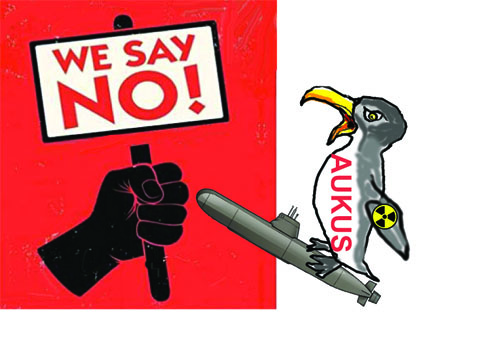
The Labor Party Victorian state conference and AUKUS
By Greg Bailey, Jun 21, 2023, https://johnmenadue.com/the-alp-victorian-state-conference-and-aukus/
An attempt by certain Labor affiliated left-wing unions to put a motion critical of AUKUS at the recent ALP Victorian State Conference was deferred by factional bosses even before it was put. That it was deferred tells us as much about the hierarchy ignoring the rank and file of the party as it does about the massive folly that is AUKUS.
On the weekend of 17-18 of June the Victorian branch of the ALP held its state conference attended by over six hundred delegates, the first one since 2019. Previous conferences had been postponed because of COVID, but also because of federal intervention as a response to branch stacking. Tension had already been built up because some left-wing unions had announced they would ask for a vote against AUKUS, being just the latest of other prominent ALP members and past ministers who have come out strongly against it.
The Age, the AFR and the Guardian began reporting on this four days before the conference began, speculating on who would control the factions and what would happen to the AUKUS motion which had the potential to embarrass the Prime Minister. Even before the conference began Mr Albanese had declared that AUKUS would go ahead, rendering any debate pointless given that there is much support for AUKUS in the federal parliamentary ALP. And rank and file members can be ignored–at least in the short term.
Phillip Coorey had already reported on June 14 that two weeks earlier the Queensland branch of the ALP, at its state conference, had “refused to support a motion congratulating the Albanese government “for investing in the AUKUS agreement”.”
Given that there has been considerable disquiet expressed about the AUKUS decision as a threat to Australian sovereignty and a departure from traditional Labor policy to seek rapprochement as opposed to aggression, it is hardly surprising that some elements of the rank and file expressed their anger about the decision to go with AUKUS. And this especially when it had been essentially imposed upon the party from above, and when prominent former ALP luminaries led by Paul Keating and Bob Carr had decisively spoken out against it.
As Phillip Coorey wrote in the AFR on 18/6, “The motion expressed disappointment with, or criticised, all aspects of the AUKUS deal between Australia, the United Kingdom and the United States, including its quick embrace by Labor in opposition when Scott Morrison announced it. The motion demanded “federal Labor caucus to be more politically diverse and avoid being swept along by the interests and priorities of America’s corporate, political, and military elites”.
Indeed, as Royce Millar and Broede Carmody reported in the Age three days (15/6) before the conference, “AMWU Victorian secretary Tony Mavromatis said he expected his motion would win strong support from the conference floor.” “We will push ahead with our motion, no matter who is at the conference, including prime ministers,” he said. “The AUKUS deal is a terrible arrangement for Australia. It lets down Australian workers, apprentices and trainees and Australian manufacturing. We should not be getting into nuclear.”
In other words, he was expressing the criticisms that have already been made in so many other forums, yet only mutely in most of the main stream media.
Yet in Melbourne the factional leaders got together and voted to defer this motion until the forthcoming Labor National Conference in Brisbane. No doubt there will be sufficient support for the Prime Minister to defeat any such motion going forth, and even if it did go forth would this be enough for the government to withdraw from AUKUS?
If the internal pressure continues building against what is such an obvious foreign affairs folly, one which has so much negative impact on internal spending by the government on social housing, climate change mitigation, education and so forth, will the decision to go with it be reversed? I fear this is unlikely as Mr. Albanese seems to be adopting the practice of his LNP predecessors, never to back down because it will make him look weak in the eyes of the public. Implicitly, this will also be justified by the party hierarchy’s belief that this is what the Australian population wants, irrespective of how little the opposite arguments have been advanced to them.
Labor Premiers’ dispute over location for AUKUS nuclear wastes, – but planned Kimba waste dump is”now dead in the water”?

Mr Wilkins told ABC Radio Adelaide that the proposed Kimba nuclear waste dump no longer made sense, and that any future site to store submarine reactor spent fuel should also accept waste that would have gone to Kimba.
“The proposed Kimba nuclear waste dump must now be dead in the water,” he said
Nuclear waste divisions intensify between Labor premiers over AUKUS submarine deal
ABC, 18 Mar 23
South Australia’s premier has hit back at suggestions from Labor counterparts that his state should take nuclear waste from the future AUKUS fleet, saying the decision on where the waste goes should be based on the “nation’s interests”…………….
Divisions within Labor ranks over AUKUS — including over its $368 billion cost, and its strategic aims and consequences — have become increasingly apparent since Paul Keating’s blistering attack on what he described as the “worst international decision” by a Labor government since conscription.
While Prime Minister Anthony Albanese yesterday rebuked Mr Keating, Labor premiers have since voiced opposition to accepting nuclear waste from the AUKUS subs in their states.
Victorian Premier Daniel Andrews said yesterday it was not “unreasonable” to suggest that, since South Australia is gaining jobs, it should also accept the spent fuel rods when the submarines reach the end of their service.
“I think the waste can go where all the jobs are going,” he said.
West Australian Premier Mark McGowan voiced similar sentiment, suggesting South Australia take on a nuclear waste facility.
But while Mr Malinauskas said that the possibility of SA taking waste could not be ruled out, he rejected Mr Andrews’s claim that SA had a responsibility to take the waste because it was taking the jobs.
“No, because that implies that somehow that this isn’t a national endeavour,” he said……………………
Conservation Council of SA chief executive Craig Wilkins said discussion of a “short-term political stoush between state premiers” overlooked the major challenges involved in storing nuclear waste.
“We’re talking about waste that needs to be kept safe from humans for tens of thousands of years, basically beyond our civilisation, so this needs to be an incredibly well-considered decision,” he said.
“[There] needs to be a multi-billion-dollar project to house the waste.”
Mr Wilkins told ABC Radio Adelaide that the proposed Kimba nuclear waste dump no longer made sense, and that any future site to store submarine reactor spent fuel should also accept waste that would have gone to Kimba.
“The proposed Kimba nuclear waste dump must now be dead in the water,” he said………………………. https://www.abc.net.au/news/2023-03-17/sa-premier-hits-back-at-nuclear-waste-claims/102109026
1 This month

of the week – Australians for War Powers Reform (AWPR)
To see nuclear-related stories in greater depth and intensity
 Antinuclear