Hi-tech renewable energy jobs reviving south-west Victoria’s economy
 High-tech, clean energy jobs key to future of Geelong, south-west Victoria, ABC News, 5 June 16 By Cameron Best Steve Garner understands how important his wind farm manufacturing business is for the town of Portland in south-west Victoria.
As the state’s traditional manufacturing base continues to decline, jobseekers and the wider economy are looking for the jobs of the future.
Six months ago, Mr Garner’s Keppel Prince Engineering facility lay idle under the Federal Government’s freeze on new wind energy investment and former prime minister Tony Abbott’s desire to reduce the growth rate of what he labelled as “visually awful” wind farms.
Now, under a new Clean Energy Finance Corporation mandate, the production line at Keppel Prince is back up and running with about 300 workers making towers for a project near Ararat.
It has come just in time for Portland, which is facing the possibility of life without its major employer……
“the stronger we can grow something like this [facility], that actually does create a lot of jobs, the better off we’re going to be.
“And if we get government support to do that, we’ve then got a sustainable business for a long period of time.”…
New-wave tech replacing manufacturing of old
High-tech industries are springing up to utilise some of the skilled workers coming out of the automotive industry but in order to remain globally competitive, this new wave of advanced manufacturers cannot afford to be as labour-intensive as the companies of old…….http://www.abc.net.au/news/2016-06-05/high-tech,-clean-energy-jobs-the-key-to-geelong-future/7476816
Infrastructure Victoria draft report includes nuclear power as an option
 ‘Bicycle highways’ through Melbourne CBD backed by cycling advocate, ABC News, 2 June 16 “….Infrastructure Victoria has proposed the cycle “highways” at a cost of $100 million, one of more than 200 ideas put forward in an options paper looking at state projects for the next 30 years…..
Export industry potential for Victorian solar energy project, backed by Australian Renewable Energy Agency
 Victorian solar project wins government grant to take its technology to world, The Age, April 24, 2016 –Tom Arup A Victorian technology company striving to produce more efficient and cheaper solar power has won financial backing from the national renewable energy agency to expand its plans.
RayGen Resources, based in Melbourne, will receive a new $2.9 million government grant to help it commercialise what the company says is ground-breaking solar technology that has already received overseas interest.
The technology involves laying out a large array of mirrors that tracks the sun throughout the day and creates a concentrated light beam onto a highly efficient solar photovoltaic receiver sitting on top of a central tower.
In March last year, RayGen opened a 200-kilowatt pilot plant at Newbridge, near Bendigo, to showcase the technology, which the company has dubbed “PV Ultra”. The pilot was built with support from the Australian Renewable Energy Agency, also called ARENA.
The company has now won another ARENA grant, to be announced on Monday, to upgrade the Newbridge project with later versions of the technology and to bolster its solar receiver manufacturing operations at its Blackburn headquarters.
All up it is expected to cost $5.8 million and be completed by December.
RayGen chief executive Alex Wyatt said the expansion would help the company deliver its solar receivers to overseas buyers, including solar-concentrating projects in China.
The RayGen solar PV receivers use a compound called gallium arsenide, commonly used in satellites and space stations, instead of the more typical silicon-based technology. While gallium arsenide is more expensive than silicon, it is also more efficient and when enough sunlight is concentrated it can become cost effective to use, particularly in very sunny areas.
RayGen and ARENA were also partly involved in a 2014 project at the University of NSW, called Power Cube, which set a world record for converting sunlight into power for a solar PV system……
The Turnbull government recently announced it would retain ARENA, dropping Abbott-era plans to axe the agency. But it is seeking to slash the $1.3 billion that ARENA was still due to receive in coming years to help foster new renewable energy development. http://www.theage.com.au/environment/victorian-solar-project-wins-government-grant-to-take-its-technology-to-world-20160422-god18z.html
Victoria making coal mine owners pay for rehabilitation
Victoria’s coalmines forced to pay more towards site rehabilitation costs http://www.theguardian.com/australia-news/2016/apr/15/victorias-coalmines-forced-to-pay-more-towards-site-rehabilitation-costs The state’s premier says owners of Latrobe valley mines are profitable enough to absorb tens of millions of dollars in extra costs without cutting jobs Victoria’s coalmines are being ordered to hand over hundreds of millions of dollars more for the rehabilitation of their sites when mining ceases.Latrobe coalmines not paying enough for cleanup: Hazelwood fire inquiry

The state’s premier, Daniel Andrews, maintains the additional payments will not put jobs at risk.
The Victorian government announced on Friday the existing rehabilitation bonds would be increased in June from $15m or less to $34.25m for Yallourn, $36.7m for Hazelwood and $56m for Loy Yang.They will all then double again – to the current estimated rehabilitation liability for each mine – by January. On Thursday, the fourth and final report into the Hazelwood mine fireconcluded Latrobe valley mines were not making sufficient paymentsto cover rehabilitation costs.
It urged an immediately increase of tens of millions of dollars in the bonds until a review into the system was complete.
Andrews said on Friday the mines’ owners were profitable enough to absorb the additional costs. “We’ve had companies for too long that have been allowed to put aside just a fraction of what it costs to keep their mines safe and return those mine sites to the community … at the end of their useful life,” Andrews told reporters in Morwell.
“These are profitable companies. Let’s not have any of this talk that jobs are at risk – they are not at all.”
Impact of climate change on Victoria worse than previously thought
 Climate change fears worsen following University of Melbourne and CSIRO research April 1, 2016 CHRIS McLENNAN The Weekly Times THE impact of climate change on Victoria’s weather could be twice as bad as previously thought.
A team of University of Melbourne and CSIRO researchers believes popular computer predictions over-estimate the flow of rain run-off into rivers.
Victorian Government scientists believe the state faces a much warmer and drier future which could result in longer fire seasons, less rainfall in winter and spring south of the Great Dividing Range, and less rainfall in autumn, winter and spring in the north.
Scientists say climate change is already being felt across Victoria, with a rise in temperature and a drop in rainfall since 1950.
The university research found climate modelling failed to adequately cater for drought. Under prolonged dry conditions, modelling predicted twice as much run-off into rivers and catchments than was occurring,” Prof Andrew Western said……..http://www.weeklytimesnow.com.au/news/climate-change-fears-worsen-following-university-of-melbourne-and-csiro-research/news-story/cac037efb28f859f6f491d0fbc70ef46
At last Victoria might now get going, farming solar energy
Has Victoria’s moment in the sun finally arrived? http://www.theage.com.au/victoria/has-victorias-moment-in-the-sun-finally-arrived-20160327-gnrs6l.html, The Age, Tom Arup March 27, 2016 Despite a decade of promises and plans from governments, policy uncertainty and project collapses has meant very little has materialised but now a handful of proposed Victorian projects are again on the table.
Phil Galloway stands in an open field between vast stretches of almond trees. The empty land is marginal and the sun above it bright.
One day soon he hopes to roll out 220,000 solar panels across the empty space on the Almas Almonds farm at Bannerton, generating enough electricity to power about 30,000 homes.
“The sun is really just another crop”, Mr Galloway, a former BHP executive, said during a meeting with the local council this week.
“And we’re utilising land that would have otherwise stood empty.”
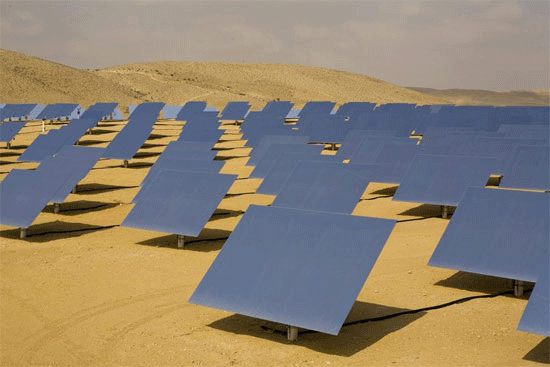
His company, Syncline Energy, is the latest in a long line of proponents that have sought to kick start a large-scale solar industry in Victoria’s sunny north west.
But despite a decade of promises and plans from governments, policy uncertainty and project collapses have meant that very little has materialised. And a celebrated concentrated solar project near Mildura was axed by its proponents in 2014, with the land and equipment later sold.
Now a handful of proposed Victorian projects are again on the table.
The latest bout of activity was sparked by $100 million in competitive grants on offer from the Australian Renewable Energy Agency (ARENA), which is looking to drive innovation in large-scale solar and drive down costs.
It is understood seven Victorian projects were among the 77 that registered initial interest with ARENA. Syncline Energy’s proposal, and another from Solar Choice located near Kerang, were the only two from Victoria to make a recently announced shortlist of 22. Continue reading
Victorian town Newstead set for 100% renewable energy within 5 years
PowerCor’s Thomson says it is clear that the majority of the population in Newstead are passionate  about their goal for 100% renewables, and at least five other townships are looking to follow suit.
Newstead could be the host of Victoria’s first solar-powered micro-grid.
The Victorian government is also heavily involved, allocating $200,000 in the hope that the model created for Newstead can be replicable in other communities across Victoria.
Australian first: Newstead aims to run on 100% renewable energy within five years, http://www.theguardian.com/sustainable-business/2016/mar/01/australian-first-newstead-aims-to-run-on-100-renewable-energy-within-five-years Guardian, Giles Parkinson, 1 Mar 16
Agreement with energy company Powercor will see Victorian town move to solar power, save money and perhaps become a model for other towns. The quiet Victorian town of Newstead – population approaching 500 – has a big ambition: to source all its electricity needs without burning any fossil fuels at all. Within five years, it wants all of its power to come from renewable energy sources.
Newstead is not unique in that goal. At least a dozen towns around Australia, including Yackandandah, Tyalgum, Byron Bay and Lismore, have declared a similar ambition, even if most are allowing themselves more time to reach the target.
What makes Newstead’s situation particularly interesting is it is going ahead with the support, indeed the encouragement, of its local network provider, Powercor.
An agreement struck between the network and Newstead 2021 – the local group driving the township’s ambition – is being hailed as a “game-changer” for the way communities and network operators work together to accelerate the transition to renewable energy.
Glen Thomson, the head of the energy solutions division of Powercor, says renewable generation is now a reality, and solar, wind power and energy storage are increasingly being integrated into electricity networks. Continue reading
Melbourne Girls’ College’s original approach to becoming carbon neutral
Melbourne Girls’ College pedals toward carbon neutral status with outdoor cinema, solar installations, ABC News, 19 Feb 16 774 ABC Melbourne By Clare Rawlinson An all-girls Melbourne high school is on its way to becoming the first Victorian school to go carbon neutral.
Melbourne Girls’ College is working towards carbon neutral status through the installation of solar arrays and energy reduction projects, spearheaded by the school’s Sustainability Collective.
The passionate young environmentalists are hosting an outdoor cinema powered by bicycles and ergo machines on Friday, to share their quest with the public and draw attention to the true cost of energy.
The students will pedal all day to charge the cinema batteries for the screening of movie Oddball, as well as the power for coffee carts and popcorn machines.
“The idea behind it is to show people what a watt hour is and how much electricity goes into these events,” former student Ruby Wynn Williams said.
Sustainability coordinator Andrew Vance said the first step towards the school’s goal of carbon neutrality was awareness. “It’s really easy to burn some coal to watch a movie but it’s completely out of sight and out of mind,” he said. “When you get on the bike and pedal two watts, it’s like an epiphany.”
Reputation for environmental sustainability
The school’s reputation for environmental sustainability has already earned it acclaim through a major international competition, the Zayed Future Energy Prize. In 2015 it was selected as one of five schools globally to receive the competition’s $US100,000 funding grant for sustainability projects.
The majority of the prize money has been spent on converting the school’s permanent power source to solar, with the installation of a 33kW solar array on one side of the gymnasium roof.
It plans to cover the other side of the roof with community-funded solar arrays.
“[Each person] who buys a panel will get their name on it … so they can go and look at how much carbon they’ve offset and the equivalent in trees,” Mr Vance said.
“That will get us close to our carbon neutral goal.”…….http://www.abc.net.au/news/2016-02-19/melbourne-girls-college-pedals-toward-carbon-neutrality/7180684
Clean Energy Finance Corporation funding exciting solar initiative by Melbourne University
Melbourne Uni taps CEFC loan to cut power costs, grid dependence, http://reneweconomy.com.au/2016/melbourne-uni-taps-cefc-loan-to-cut-power-costs-grid-dependence-70503 REneweconomy, By Sophie Vorrath on 16 February 2016 The Clean Energy Finance Corporation has announced it will loan up to $9.1 million to the University of Melbourne, to accelerate the installation of solar PV and other renewable and energy efficiency technologies in an effort to cut energy costs and improve sustainability.
The University says the measures – including voltage optimisation, freezer upgrades, and the installation of solar PV, solar thermal and wind micro-turbines – will reduce its grid electricity use by around 8 per cent; not bad considering the university has the energy requirements of a town the size of Warrnambool.
The voltage optimisation equipment – which controls and corrects incoming power voltage to increase building energy efficiency – is expected to produce the biggest energy saving, reducing consumption by more than 4GWh per annum. It also has the added benefit of reducing operating and maintenance costs.
The funding will also see a total of 1.5MW of solar PV installed across 18 roof spaces, which will offset grid energy by generating more than 2.2GWh of electricity a year. The university also plans to install three micro wind turbines on three separate buildings, to demonstrate their potential.
A concentrated solar thermal power system will also be installed, to be used for space and swimming pool heating, with expected energy savings of 0.75GWh. The measures are also expected to cut the university’s emissions by more than 9,000 tonnes a year, thus contributing to its commitment to achieve carbon neutrality by 2030.
For the CEFC, the project falls under the green bank’s investment mandate of financing emerging and innovative renewable energy technologies and energy efficiency for cities and the built environment.
“Australia’s 39 universities make a major contribution to the national economy and to the Australian community,” said the CEFC’s executive director of corporate and project finance, Paul McCartney.
“Yet they face the ongoing challenges of public budget restraint, intensifying global competition and the need to use cutting edge technologies to meet increasing student expectations.
“Clean energy installations like those being undertaken by the University of Melbourne can help universities meet these challenges through an investment that results in reduced environmental impact, higher productivity and stronger financial performance.”
McCartney said the CEFC was looking to work on similar projects with other Australian universities, to help them achieve increased sustainability and cost cuts through energy efficient and renewable technologies.
“The CEFC’s finance can be structured over a longer term than traditionally offered by banks, tailored to match the cost savings delivered through the reduction in grid energy usage,” he said.
In bushfire season, Solar microgrids and batteries are safer than conventional grid
 Turner says his company has been in productive talks with Victorian energy minister Lily D’Ambrosio over the prospect of subsidising Zen Energy systems capable of running as a localised backup for periods when the grid needs to be switched off
|
Solar microgrids and batteries could prevent another Black Saturday bushfire, Guardian, Max Opray 9 Feb 16, The cause of the Kilmore East fires that contributed to Victoria’s 2009 Black Saturday bushfires was found to be an ageing SP AusNet power line
Smaller sustainable energy systems are a better option than trying to maintain ageing Australian energy infrastructure, say experts On 7 February, Australia solemnly marked the anniversary of an electrical fault.It was on this date in 2009 that Melbourne endured its hottest conditions on record – a sweltering 46.4C. To make matters worse, hot winds blasted through the region at speeds in excess of 100km/h. In Kilmore East, just north of Melbourne, a critical failure in a 43-year-old power line caused bursts of 5000C plasma to arc out and ignite the tinder-dry vegetation in the gully below. Fanned by such extreme winds, the fast-growing inferno would by the end of the day be responsible for the majority of the 173 lives lost in the dozens of fires that engulfed Victoria on Black Saturday, Australia’s worst bushfire disaster. Several of the other blazes that day were started by felled power poles and other electrical issues. This was also the case for many other fires before and since, including Australia’s previous-worst bushfire tragedy, the 1983 Ash Wednesday fires, which claimed 75 lives. Richard Turner, director of South Australian renewable energy powerhouse Zen Energy, has a plan to stop such a thing happening again. Continue reading |
Giles Parkinson: Australia’s dirtiest coal-fired power station launches global campaign for 1,000GW of solar
Here’s a turn up! Engie, the owner of Hazelwood, Australia’s dirtiest coal-fired power station, is spruiking global solar — an eye-watering 1,000GW by 2030. …
ABU DHABI: French energy giant Engie, the owner of the Hazelwood brown coal power generator in Victoria, has launched a major public-private initiative that aims to ensure that 1,000GW of solar capacity is installed around the world by 2030.
The plan has been dubbed the Terrawatt initiative – the equivalent of one trillion watts of solar electricity, or one million megawatts – and it is the first significant engagement from the private sector to deliver on the ambitious climate target agreed in Paris in December by 195 governments.
(Article originally published 19/1/16 under headline ‘Hazelwood owner Engie launches push for 1,000GW of solar’ at:
http://reneweconomy.com.au/2016/hazelwood-owner-engie-launches-push-for-1000gw-of-solar-36363.)
City of Melbourne leads new renewable energy project
 New renewable energy play launches in Melbourne November 30, 2015 Tom Arup Environment editor, The Age Melbourne businesses, local councils and universities will pool resources to build new renewable energy plants under an innovative push to boost the supply of clean power to the city.
To be launched on Monday, just as the Paris climate summit gets under way, the project is a first for Australia. At least a dozen backers will pool their electricity purchasing power with the aim of encouraging new wind or solar energy.
It is being led by the City of Melbourne, which carried out a year-long test of the market to see whether there was enough interest for it to be viable.
On the way, the project has collected partners including the National Australia Bank, the University of Melbourne, RMIT and Federation Square.
The group is looking to purchase 120 gigawatt-hours of new renewable energy – enough to power 31,000 homes for a year.
Early next year the consortium will put out a tender calling for projects to come forward. If a viable project is found, those involved will look to buy power from it for 10 years…….
Other participants that have so far agreed to be named include RMIT, NEXTDC, the City of Port Phillip and Moreland City Council. http://www.theage.com.au/victoria/new-renewable-energy-play-launches-in-melbourne-20151127-gl9urr.html#ixzz3t77su419
Huge Melbourne rally kicks off Australia’s marches for climate action
Thousands gather at Melbourne CBD rally ahead of Paris climate summit, The Age, [excellent photos and video] November 27, 2015 -Chloe Booker, Timna Jacks, With Tom Cowie and AAP
- 10 things you need to know about the summit
- Activists plan to defy ban on Paris protests
- Business singing a new song on climate
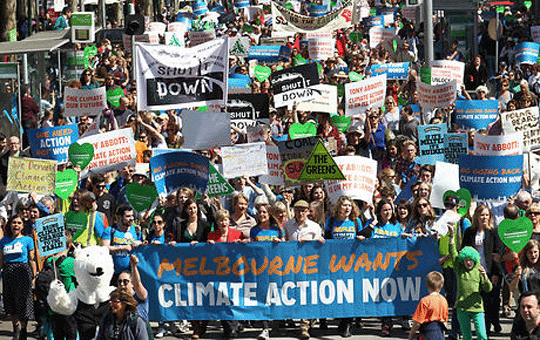
Tens of thousands of people have gathered in Melbourne’s CBD to demand world leaders take strong action to protect the planet at the Paris climate change conference.
The so-called People’s Climate March was one of hundreds of rallies being held around the world in the lead up to the crucial meeting. Members of The Cat Empire performed for the crowd, which included Opposition Leader Bill Shorten and Greens Senator Richard Di Natale.
A sea of placards stretched down Bourke Street from Spring Street to Swanston Street and along Swanston Street from Bourke Street to La Trobe Street. There was a stand-off between banked-up traffic and protesters at Exhibition Street as frustrated drivers honked their horns and the crowd erupted in cheers and shouts.
Stunned diners observed the march from outside Bourke Street cafes, and some heckled the demonstrators. Sections of the crowd were more like a party, with some dancing and clapping to a marching band dressed in green-glittered uniforms, while others swayed to the strumming of a guitar. ……..
Andy Parsons, an Environment Victoria volunteer who attended both rallies, said environmentalists supported the right of Aboriginal people to live independently.”The Aboriginal people lived sustainably for thousands of years. Us white people could learn a lot from them,” he said.
Aboriginal man Robbie Thorpe said he saw a parallel between the “genocide” of his people and what he called the “ecocide” of Australia’s natural environment. “We are the custodians of the land and the language. Only we know how to talk to our land. Without the Aboriginal people the land can’t survive and without the land, we can’t survive.” http://www.theage.com.au/victoria/thousands-expected-at-melbourne-cbd-rally-ahead-of-paris-climate-summit-20151127-gl9lz8.html
Iluka Resources to subdivide West Victoria land with radioactive trash tomb
 Miner Iluka Resources gets Horsham Council approval to subdivide Douglas mine land http://www.abc.net.au/news/2015-11-04/miner-iluka-gets-nod-to-subdivide-douglas-mine-land/6910420 Horsham Council has approved an Iluka Resources’ application to subdivide land at its Douglas mine in western Victoria.
The approval is subject to a range of planning and environmental conditions.
“The mineral sands miner said it did not need some parts of the site, including Pit 19 where radioactive mining by-product was buried.
The council’s planning committee has been reviewing the application for the past month and it has now been approved with conditions. Future activities on the land deemed sensitive will trigger an environmental audit and previous use of the land would be disclosed to any future buyer.
The conditions require a plan which clearly outlines land previously used for mining purposes and the disposal of radioactive by-product.
Kerang, Victoria, gets economic boost from Lalbert solar farm
 Lalbert solar farm near Kerang tipped to boost jobs as Solar Choice secures investor for $550m project ABC News, The company behind one of the largest solar farms in Australia says it expects the project to create up to 150 jobs for northern Victoria.
Construction of the $550 million solar farm on a 526 hectare property at Lalbert, west of Kerang, should start midway through next year, after the company Solar Choice secured an investor to finance the project.
The farm will have a production capacity of 350 megawatts and has the potential to power about 220,000 homes…….
Gannawarra Shire’s Roger Griffiths said the farm was another step towards developing Kerang’s future as a centre for renewable energy investment.
“What this does is just offers that bit of diversity, it props up our rate base and it provides a lot of other benefits right throughout the community,” he said.
“So we’re more than happy to have it on board and fingers crossed that everything runs smoothly and we see a booming new industry in and around Kerang in the next five to 10 years’ time.” http://www.abc.net.au/news/2015-10-16/lalbert-solar-farm-near-kerang-tipped-to-boost-jobs/6859508
1 This month

of the week – Australians for War Powers Reform (AWPR)
To see nuclear-related stories in greater depth and intensity
 Antinuclear