 East Gippsland fights mineral sands mine https://www.greenleft.org.au/content/east-gippsland-fights-mineral-sands-mine, Alan Broughton, Bairnsdale,March 23, 2018
A packed meeting in Bairnsdale in eastern Victoria on March 21 was horrified as the implications of a planned mineral sands mine in the area were revealed.
The Kalbar Resources mine has been in the planning stage for several years and is due to start next year. The site is at Glenaladale, about 20 kilometres from Bairnsdale in grazing country, but only 350 metres from the $200 million a year vegetable growing industry in the Mitchell River Valley.
The mine will be open-cut, with up to five holes operating at any one time, each 1 kilometre long, 500 metres wide and up to 40 metres deep. It will be the biggest mineral sands mine in Australia and will mine zircon, rutile, titanium and ilmenite. Mining is planned to last 20 years, processing 800 tonnes an hour, 24 hours a day, 7 days a week.
There are many serious concerns.
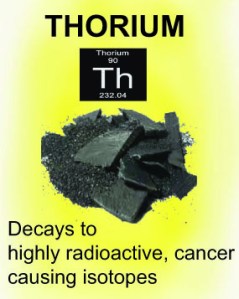
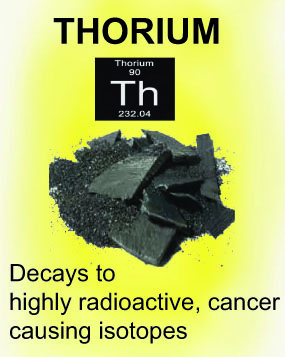
Kalbar declares mining will cease on windy days to prevent dust laden with radioactive and or/carcinogenic chromium, vanadium pentoxide, thorium and titanium dioxide from blowing across the farmland and urban areas. However, this was not the experience of people in the Victorian Wimmera who were promised the same; it never happened. One farmer who challenged the mine owners (Iluka in that case) was told he would be charged $70,000 a day for lost production!
The mine requires about the same amount of water as used by the 29,000 households supplied by the Mitchell River. This water is not available locally. It is planned to be piped from the Sale aquifer, but that aquifer is fully committed and can only be released by purchasing existing water rights.
There will be an extra 40 B-double 72 tonne trucks a day, with road maintenance costs to be met by the East Gippsland Shire.
Run-off and siltation of the Mitchell River and Gippsland Lakes is inevitable in heavy rain, further damaging the world-renowned Silk Jetties, the Ramsar-listed wetlands and the tourist industry based on recreational fishing. There will be six tailings storage dams, each 10 hectares in size, at the head of the Perry River, which also flows into the Gippsland Lakes.
Speakers from the Wimmera talked about their experience of the Iluka Douglas mineral sands mine in their area. All promises of consultation, employment, compensation, monitoring, dust control and rehabilitation were reneged. Conditions imposed on the mine operation were not enforced. Radioactive materials were not buried as promised. The community was destroyed. Several people developed brain tumours. There were several Workplan Variations, which bypassed environmental regulations. Dust monitoring stations were placed upwind of the mine and only checked every seven days.
The Victorian Labor Government in 1990 legislated the Mineral Resources (Sustainable Development) Act to give mining priority over all other land uses. Farmers are forced by regulation to accommodate mining. This has not been changed by subsequent governments.
Promised rehabilitation does not occur. Of the 150 mines operating in Victoria, 122 are in care and maintenance mode, which can continue indefinitely, and only one has been classified as fully rehabilitated.
Communities receive no benefit from mines but suffer the costs of pollution, falling land values, impaired health and community destruction. Local councils lose revenue because mines do not pay rates.
While East Gippsland is a strong National Party area, people have fought and won major victories against governments before and will do so again. The battle against the proposed Very Fast Train land speculation proposal was successful in the early 1990s, the closure of the railway line was reversed, the Tambo Upper School closure was prevented, and more recently community action defeated coal seam gas mining.
The opposition to the mine is led by the East Gippsland Community Action Group and Mine-Free Glenaladale, which screened The Bentley Effect two weeks before the mineral sands meeting, increasing people’s determination to fight and win.
March 29, 2018
Posted by Christina Macpherson |
opposition to nuclear, Victoria |
1 Comment
 Peat fires burning near Cobden could smoulder for months, cause further evacuations ABC South West Vic By Matt Neal 24 Mar 18
Peat fires that have forced residents in Victoria’s south-west to evacuate their houses could continue smouldering for months, farmers say.
About 100 houses have been evacuated due to the fires burning near Cobrico over the last two days, with locals urged to leave the area until wind conditions change.
Cobrico farmer John Errey had to leave his home for a night on Thursday — and will probably have to do so again.
One of the blazes that tore through the region on St Patrick’s Day burnt three-quarters of his pasture, yet miraculously spared his house, dairy and livestock.
But the fires continue to smoulder in the peat swamp at the bottom of his farm.
“In 1983, we had spot fires from the Ash Wednesday fires down in there. It burnt for months,” Mr Errey said………http://www.abc.net.au/news/2018-03-24/cobden-peat-fire-farmer-fears-could-smoulder-for-months/9583410
March 25, 2018
Posted by Christina Macpherson |
climate change - global warming, Victoria |
Leave a comment
 Neighbours’ fury as man builds bunker for nuclear war, news.com.au, By Luke Mortimer • A Current Affair Producer Mar 20, 2018 He’s a former Yugoslavian who spent years guarding plutonium stockpiles and he refuses to be a sitting duck the day they may go off, preparing for all out nuclear war.
Jakov Loncarevic migrated to Australia in 1979 but in 1996 he fled Melbourne for Minyip, a tiny town 337 kilometres west. He purchased a block of land that he’s spent the past two decades making “nuclear proof” with a four-metre deep bunker in which he plans to wait out a nuclear winter.
Mr Loncarevic took A Current Affair reporter Martin King down into the bunker in which he claims he built by digging out 40,000 buckets of soil and constructing with 2500 bags of concrete, 40 tonnes of recycled steel and 20 tonnes of wood.
“(It’s my) emergency survival place,” he told King.“In case of unforeseen events … I will survive.“When the conditions become unbearable at floor level … I’m down here.
Mr Loncarevic says he has the supplies to wait out two years once a nuclear winter sets in, with a staggering 900 kilograms of sugar stored in industrial fridges, 200 kilograms of rice and dried beans, 6000 litres of water, 40 kilograms of washing detergent, 200 pairs of socks, 200 pairs of under wear, 100 t-shirts, and 120 kilograms of honey.
But despite being prepared for nuclear war, Mr Loncarevic is losing the war with his neighbours after council issued him with an order to stop building.
Neigbours fed up with living next door to the military-compound-style structure have told King of their embarrassment living next to it.
Mother Bec, a nurse who works in the nearby regional centre of Horsham, said her property’s value is in decline as no-one would want to buy in next to Mr Loncarevic’s house.
“It’s embarrassing. It’s frustrating. It’s wrong,” Bec said.
Her parents-in-law, Joe and Rae, lifelong Minyip residents who live another two doors up, told A Current Affair of how the house had transformed from a “lovely, little” weatherboard home owned by an elderly lady into a Soviet-style military compound. And Mr Loncarevic is losing popularity with his neighbours by the day.………..https://www.9news.com.au/national/2018/03/20/19/05/neighbours-fury-as-man-builds-bunker-for-nuclear-war
March 21, 2018
Posted by Christina Macpherson |
Victoria, weapons and war |
Leave a comment
 The Age , Cole Latimer, 6 Dec 17,
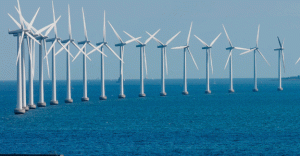
 Australia’s first offshore wind farm, an $8 billion 2000 megawatt project, has secured financial backing from a major international green energy investment fund.
Offshore Energy has joined with Danish fund management group Copenhagen Infrastructure Partnership to develop the renewable energy project.
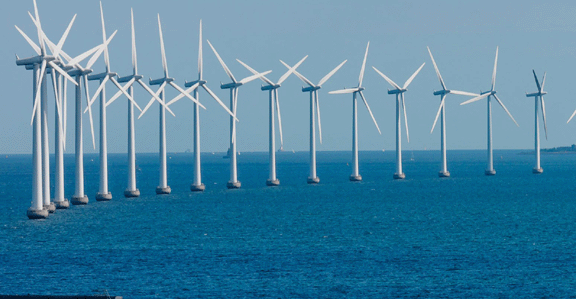
The offshore wind farm, dubbed the Star of the South, will be built 10 to 25 kilometres off the coast of Victoria’s Gippsland region, in the Bass Strait, and could provide one and a half times the energy of the now-closed Victorian Hazelwood coal-fired power station.
Offshore Energy managing director Andy Evans told Fairfax Media the partnership would transform the company and lift the viability of offshore wind for Australia………
Star of the South is currently Australia’s only offshore wind project.
“The industry doesn’t really exist at the moment,” Mr Evans told Fairfax Media.
He said there is currently a greater focus on solar and onshore wind projects in Australia, as they are currently cheaper than offshore wind, however, “the cost of offshore will come down, and has already seen falling costs in Europe.”
However, it is not Australia’s only offshore renewable energy project in development.
There are a number of wave energy projects currently underway around the nation’s coast. Wave Swell Energy is one wave energy generator that is also using the Bass Strait as its testing grounds.
The group is carrying out commercial validation of its technology off King Island, in the Bass Strait.
It has signed an offtake agreement with Hydro Tasmania for an initial 200-kilowatt trial unit, and will operate during 2018 after its initial funding goals are reached. http://www.theage.com.au/business/energy/australia-s-first-offshore-wind-farm-international-funding-20171205-p4yxfb.html
December 8, 2017
Posted by Christina Macpherson |
Victoria, wind |
Leave a comment
 Global hot spot: Exceptional heat pushes up ocean temperatures off Australia http://www.theage.com.au/environment/weather/global-hot-spot-exceptional-heat-pushes-up-ocean-temperatures-off-australia-20171125-gzsrey.html, Peter Hannam
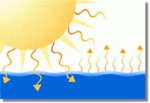
Australia is home to a global hot spot for sea-surface temperatures, with a record burst of prolonged heat in the country’s south-east helping to make conditions several degrees warmer than average.
Daily weather charts generated by the US National Oceanic and Atmospheric Administration show the unusual warmth is almost unmatched around the world, compared with normal temperatures.
Only patches off Greenland and New York in the US are as abnormally warm compared with long-run averages. (See chart below.)
“It’s clear sea-surface temperatures around south-eastern Australia, and Tasmania in particular, are well above average,” Blair Trewin, senior climatologist for the Bureau of Meteorology, told Fairfax Media.
Record warmth
Continue reading →
November 26, 2017
Posted by Christina Macpherson |
climate change - global warming, New South Wales, Victoria |
Leave a comment
 Renewable energy trial provides King Island with free power http://www.theage.com.au/business/energy/renewable-energy-trial-provides-tasmania-with-free-power-20171117-gznwk7.html, Cole Latimer
New technology will provide free power to King Island as it aims to prove low-cost energy generation claims.
Wave Swell Energy, a group developing ocean wave energy generation technology, is carrying out commercial validation trials off Tasmania’s King Island ahead of a potential listing.
The group has built what Wave Swell chief executive Tom Denniss described as “big concrete caverns”, which use the constant back and forth flow of the ocean to generate energy.
“As waves pass into the inside of the cavern the water level rises, this causes pressure on the air, which blows open valves at the top of the unit and turns a uni-directional turbine; as the water recedes it causes negative pressure which closes the valves, creating a cyclical process. The air opening and closing the valves turns a turbine, generating a consistent flow of power.
“What sets this apart from other wave generation technology is its lack of moving parts,” Mr Denniss said. “It sits just below the water line, it’s like an iceberg, but with only two-thirds underwater.”
The blocks are located in water depths of around 10 metres, and typically found up to 500 metres offshore. They connect to the mainland via undersea cables and provide energy to the onshore grid via a transformer unit.
A single, one-megawatt generation offshore unit weighs about 4500 tonnes. It is built onshore and moved into place using semisubmersible barges.
The group is carrying out commercial validation of its technology on King Island, and has signed an offtake agreement with Hydro Tasmania for an initial 200-kilowatt trial unit, and will operate during 2018 after its initial funding goals are reached.
Denniss said all energy generated will initially be provided to the King Island grid and Hydro Tasmania for free.
Current tests put generation costs at $100 per megawatt hour, or 10¢ a kilowatt hour.
“This is really about ensuring independent verification, and Hydro Tasmania verifying that we can produce at the low cost of 10¢ per kilowatt hour,” Mr Denniss said.
Typical solar systems cost around 13¢ per kilowatt-hour and wind about 7¢ per kilowatt-hour, not including grid costs.
Mr Denniss added that the units can also be used as breakwaters or as an artificial reef, with trials demonstrating an increase in marine life where they are installed.
Wave Swell is still looking to investors to raise $8.3 million over the coming months, having secured $2 million in investment to date, and has set a goal of raising $10 million in total funding, Mr Denniss told Fairfax Media.
“We are targeting anyone for funding, from energy companies, construction companies, or individuals who see upside in investing.”
It has used RFC Ambrian to arrange a private placement of 1.73 million shares at a value of $4.80, and anticipates having a total of 6.9 million shares on issue, putting a potential value of $33 million on the company.
The group plans to list after the successful commercial viability trials of the technology on King Island.
Mr Denniss said it will most likely carry out an initial public offering on London’s AIM exchange, although it will not rule out a listing on the ASX.
November 20, 2017
Posted by Christina Macpherson |
energy, Victoria |
Leave a comment
 Victoria Renewable Energy Target written into law, without support of LNP, REneweconomy, By Sophie Vorrath on 23 October 2017 Victoria has become the first state in Australia to have its renewable energy target written into law, after the Labor Andrews government’s Renewable Energy (Jobs & Investment) Bill was passed by Parliament on Friday.
State energy minister Lily D’Ambrosio said on Friday the governments’ VRET of 25 per cent renewable energy by 2020, and 40 per cent by 2025, had passed the Legislative Council with 20 votes to 18, and despite not winning a single vote from the opposition Coalition party.
The “historic” vote comes amid growing confusion and concern about what the federal Coaltion’s National Energy Guarantee means for Australia’s energy sector, and particularly for the renewable energy industry, with no national renewable energy target in place beyond 2020, and the suggestion development could go backwards under the new plan, resulting in just 28-36 per cent renewables by 2030.
The state governments, in particular, have reacted with frustration to the NEG, which – as Giles Parkinson pointed out here on Friday – is a decision by the Turnbull government to essentially rely on the same state-based renewables targets it has so often derided as reckless.
All of Australia’s Labor states and territories have their own renewable energy targets, each of them more ambitious than the federal government’s goal of 20 per cent by 2020.
Queensland and the Northern Territory are aiming for 50 per cent by 2030; South Australia is already there but looking to add more; while the ACT has already signed contracts with wind and solar farms to take it to 100 per cent renewables by 2020.
Victoria’s own target, now legislated, is expected to cut the average cost of power for households by around $30 a year; $2,500 a year for medium businesses and $140,000 a year for large companies. It is also forecast to drive a 16 per cent reduction in the state’s electricity sector emissions by 2034-35, and create up to 11,000 jobs.
Despite these projected benefits, the state targets have been used regularly by the federal government as scapegoats for rising electricity prices and the closure of ageing coal plants – an irony that is not lost on the states, particularly considering the federal Coalition needs their approval for the NEG to be put into place, because it requires significant changes to the National Electricity Market rules…….http://reneweconomy.com.au/victoria-renewable-energy-target-written-law-without-support-lnp-31448/
October 23, 2017
Posted by Christina Macpherson |
energy, politics, Victoria |
Leave a comment
Anti-Adani protest censored by operators of Melbourne’s Federation Square
Exclusive: Operators demand images of newspaper headlines and politicians, and ‘explicitly negative’ environmental messages be removed, Guardian, Michael Slezak, 20 Sept 17 The operators of Melbourne’s Federation Square have censored the content of an anti-Adani slideshow presented there, demanding that all images of newspaper headlines and politicians, as well as “explicitly negative” environmental messages be removed.
On Saturday, a coalition of environmental groups held a screening of the documentary Guarding the Galilee at Federation Square, attended by about 300 people. The film is about the fight to stop Adani’s Carmichael coalmine, which would be the biggest coalmine ever built in Australia and one of the biggest in the world.
In the week before the event, Federation Square demanded to see the slideshow that would be presented before the screening and then demanded much of it be removed.
In email correspondence a Federation Square representative told the event organisers they “cannot permit any slides with protest messaging, slogans or memes together with slides that show pictures of politicians, newspaper headlines or any explicitly political messaging”.
The operators objected to any content that was “negative and inflammatory” and demanded the majority of the slides be removed or significantly altered.
Federation square also demanded that the “stop Adani” logo be changed to black and white, and that it not take up a whole slide……….
The event was organised by groups including Bayside Climate Change Action Group, StopAdani Eltham, Crochet for Coral not Coal, Darebin Climate Action Now, GetUp Melbourne East, AYCC Victoria, Melbourne Ports Stop Adani Group and Market Forces.
The groups crowdfunded the event and major sponsors included the National Tertiary Education Union and Melbourne builders Jenkinson Building. https://www.theguardian.com/business/2017/sep/20/anti-adani-protest-censored-by-operators-of-melbournes-federation-square
September 20, 2017
Posted by Christina Macpherson |
Victoria |
Leave a comment
Mixed Response as Victoria Moves on Renewable Energy Targets, Pro Bono, Lina Caneva, Editor, 5 Sept 17 The Victorian government has become the first Australian state to introduce legislation in a bid to have its renewable energy targets enshrined in law, but the move has received a mixed response. The state government said it was “harnessing the power of renewable energy to drive down prices, attract billions of dollars of investment and create thousands of local jobs.”
Premier Daniel Andrews said the Victorian Renewable Energy Targets (VRET) legislation was the largest renewable energy auction in Australia.
The legislation, introduced into parliament last week, set new renewable energy targets for Victoria of 25 per cent by 2020 and 40 per cent by 2025.
“It’s the first time such ambitious renewable energy targets have been enshrined in state legislation anywhere in Australia,” Andrews said.
“Importantly, the VRET will cut the average cost of power for Victorians by around $30 a year for households, $2,500 a year for medium businesses and $140,000 a year for large companies, while driving a 16 per cent reduction in Victoria’s electricity sector greenhouse gas emissions by 2034-35.”
The government said the competitive VRET auction for up to 650 megawatts (MW) of renewable energy capacity would provide enough electricity to power 389,000 households – or enough energy to power Geelong, Ballarat, Bendigo and the Latrobe Valley combined.
However Grattan Institute energy program director Tony Wood said Australia desperately needed a nationally consistent energy and climate change policy, with bipartisan support……..
Clean Energy Council chief executive Kane Thornton said the commitments made by the state government would “turbocharge” the renewable energy industry in Victoria.
“The renewable energy auction is a major step forward for communities, businesses and the state’s renewable energy industry,” Thornton said.
“This will turbocharge significant private investment in low cost renewable energy to fill the gap and bring power prices down.
“Victoria is realising an immense opportunity to grow its economy and preserve its future energy security through the establishment of a strong and long-term VRET scheme, which will ensure the roll-out of renewable energy projects well beyond 2020.”
Thornton said the auction round was the largest renewable reverse energy auction program to date in Australia, building on the success of the ACT government’s program.
“This is a significant addition to the Victorian government’s clean energy commitments to date, which include solar trams, solar schools, an energy storage initiative and a renewable energy certificate purchasing initiative,” he said.
Victoria’s opposition leader Matthew Guy said the Coalition would oppose the plan. https://probonoaustralia.com.au/news/2017/09/mixed-response-victoria-moves-renewable-energy-targets/
September 6, 2017
Posted by Christina Macpherson |
energy, Victoria |
Leave a comment
One of the main financial burdens on Australian families and businesses in recent years has been the sharp increase in the price of electricity, which has been driven by a surge in gas prices, and, many contend, by over-investment in transmission infrastructure – poles and wires – by power companies. Another key reason is the lack of investment in renewable energy, which is becoming increasingly competitive even with the cheap coal that still provides most of our baseload electricity.
The main reason investment in renewable energy has slowed is political; a lack of policy consistency and the perplexing anti-renewables stance of former Coalition prime minister Tony Abbott undermined confidence by generating uncertainty. Australia’s total greenhouse gas emissions rose in the March quarter by 1.6 per cent, the biggest rise in almost a decade, making it all the more difficult for the country to meet its international commitments.
So the Victorian government’s decision to provide some certainty is welcome, and should help lead to affordable, reliable renewable energy. The government is asking green energy companies to tender for a contract to supply 650 megawatts of power, which is sufficient to meet the demand of every household in Geelong, Ballarat, Bendigo and the Latrobe Valley. The move comes a month after the government announced new battery storages that can deliver four hours of power to two regional Victorian towns of 100,000 people, and two solar farms to power Melbourne’s entire tram network, the world’s biggest.
The measures are fundamental to achieving the state government’s renewable energy targets of 25 per cent by 2020 and 40 per cent by 2025. At the moment, about a 10th of the state’s power comes from renewable sources. The policy is all the more necessary following the recent closure of the Hazelwood coal-fired power station, which provided more than a fifth of Victoria’s electricity.
The government’s modelling suggests the renewable energy “reverse auction” will spark $1.3 billion of investment in wind and solar, and ultimately reduce power prices for businesses and households. That remains to be seen. It will be important to monitor prices to prevent those least able to afford power from carrying a disproportionate cost. Again, the move to renewable energy is not optional, so there should be consideration of policies to relieve the burden on those on the lowest incomes.
August 25, 2017
Posted by Christina Macpherson |
energy, Victoria |
Leave a comment
Renewable energy boost to power Victoria’s four biggest regional cities, The Age, Adam Carey, 23 Aug 17, In a huge boost to Victoria’s electricity supply, renewable energy companies will compete to supply Victoria with 650 megawatts of power – enough for the energy needs of every household in Geelong, Ballarat, Bendigo and the Latrobe Valley.
The competitive “reverse auction” will be the biggest of its kind in Australia, as corporations tender for the contracts to power 389,000 households. This is expected to trigger investment of about $1.3 billion in renewable projects such as construction of wind and solar farms.
Expressions of interest will open in October.
The projects are critical to the government’s target to increase Victoria’s renewable energy level to 40 per cent by 2025.
The government will seek to lock in its renewable energy target – 25 per cent by 2020 and 40 per cent by 2025 – by tabling legislation today. Currently about 10 per cent of the state’s power needs are met with renewable sources.
Premier Daniel Andrews said he was confident the legislation would pass…….
Energy minister Lily D’Ambrosio said modelling indicated households would save $30 a year on energy bills on average, and large companies would save $140,000 a year, over the life of the renewable energy target scheme.
“We know for a fact that more supply, in a pure economics 101 sense, means cheaper prices and that’s what we’ll be delivering,” Ms D’Ambrosio said.
“We are getting solar projects built, we’ve already got two wind farms under way … so the sooner we can get that in there, the sooner people will see that flow through their energy bills,” she said…..
Kane Thornton, chief executive of the Clean Energy Council, said the government’s move to legislate its “ambitious” 40 per cent target would give the renewable energy industry more confidence to invest in Victoria.
“It will deliver billions of dollars of investment and thousands of jobs into regional and rural parts of this state and help to put Victoria back on the map in terms of attracting investment back into this sector,” Mr Thornton said.
He predicted renewable energy would “ultimately replace coal-fired generation” in Victoria, although Ms D’Ambrosio said coal would continue to help power the state for “many years to come”…..http://www.theage.com.au/business/energy/renewable-energy-boost-to-power-victorias-four-biggest-regional-cities-20170822-gy22gs.html
August 25, 2017
Posted by Christina Macpherson |
energy, Victoria |
Leave a comment
Snowy retreat: Climate change puts Australia’s ski industry on a downhill slope, SMH, Peter Hannam, 8 Aug 17 Australia’s ski resorts face the prospect of a long downhill run as a warming climate reduces snow depth, cover and duration. The industry’s ability to create artificial snow will also be challenged, scientists say.
Resorts are also going to become more reliant on big snow dumps such as this weekend’s blizzard – after a poor start to the season – as the frequency of smaller, top-up snowfalls diminish.
A snow retreat has been observed for half a century, with rising temperatures rather than reduced precipitation to blame, according to a major CSIRO-Bureau of Meteorology report. Under high greenhouse gas emissions pathway, snow at lower-elevation sites such as Mt Buffalo could all but disappear by 2050.
Warming springs have led to stark impacts at the end of the ski season. Early October snow depths fell 30 per cent during the 2000-13 period compared with 1954-99, a separate study in 2015 found.
Snow is a “threshold variable”. A slight temperature rise can turn snowflakes into rain that washes away, rather than adds to, snow cover.
That’s why all climate projections point in one direction, says Tom Remenyi, a researcher at the Antarctic Climate & Ecosystems Cooperative Research Centre. It’s both “encouraging and terrifying” that observations have matched models, giving researchers confidence about their bleak predictions, he said…….
Snow guns are becoming less efficient as humidity rises, reduce output of artificial snow by as much as 70 per cent as they ice up, Dr Remenyi said.
New “snow factories” have been introduced to Mt Buller and Mt Selwyn in Victoria, and more are likely. They create ice shavings with longer durability than gun-fired snow.
But warming temperatures will raise costs to maintain artificial snow cover, Dr Remenyi said. A study he helped write on the potential impact of climate change on Victoria’s resorts found that “by 2020- 2030 conditions suitable for snowmaking are projected to decline substantially”………..
‘Fragile ecology’
And as the NSW Nature Conservation Council notes in a new study on the effects of a warming planet, impacts in alpine regions aren’t restricted to humans’ winter pastimes.
The endangered pygmy possum, for instance, has had its range shrunk to a little as 10 square kilometres.
“The wildlife that lives in the Australia snowfields are at the front line of global warming because they are so sensitive to rising temperatures and changed snowfall patterns,” Kate Smolski, council chief executive, said.
“If deep, long-lasting snow cover disappears, the fragile ecology of snowfields will unravel because the plants and animals that live there have nowhere else to go.” http://www.smh.com.au/environment/climate-change/snowy-retreat-climate-change-puts-australias-ski-industry-on-a-downhill-slope-20170804-gxp74h.html
August 9, 2017
Posted by Christina Macpherson |
climate change - global warming, Victoria |
Leave a comment
 Heading to the slopes this winter? Why much of the snow you’ll see comes from a machine, not the sky, ABC Rural , By Catherine McAloon, 5 Aug 17
, With below average rain and warmer than usual temperatures, this Australian winter has produced conditions that would have once spelled disaster for the local ski industry.
The first month of winter was the driest June on record in much of the country’s south, while July brought record-breaking heat and little rain.
But despite the mild conditions, it has been pretty much business as usual at many of the major alpine resorts, with visitor numbers tracking around average.
That is because Australian ski resorts have invested heavily in advancements in snowmaking machines that can produce enough snow to cover ski runs, even when Mother Nature provides no natural snowfall.
This season, for the first time, some mountains have introduced a new generation of snowmaking technology that can churn out machine-made snow in just about any weather conditions.
And with predictions climate change could slash Australia’s ski seasons, resorts are making big investments in ramping up their snowmaking equipment to ensure the industry can keep drawing tourists to alpine regions in the winter months……….
Coping with climate change Australian ski seasons have always been hugely variable from year to year, but the long-term trend for natural snowfall is towards declining levels of natural snowfall.The CSIRO’s latest climate change modellingpredicts, under a low-risk scenario, the average snow season across Victoria and some of New South Wales will become 20 to 55 days shorter and, under a worst-case scenario, 30 to 80 days shorter.
Victoria’s Alpine Resorts Co-ordinating Council also commissioned a report into how climate change could affect the state’s alpine resorts, published last year, which found seasons had been getting shorter with less overall snow depth since the 1960s.
That trend was tipped to accelerate, while winter weather would become more unpredictable……http://www.abc.net.au/news/2017-08-05/snowmaking-the-future-in-face-of-climate-change/8752210
August 5, 2017
Posted by Christina Macpherson |
climate change - global warming, Victoria |
Leave a comment
 States harden threat to got it alone on clean energy target, THE AUSTRALIAN, 15 July 17 ROSIE LEWIS, Reporter, Canberra @rosieslewis and SID MAHER, NSW Editor, Sydney@sidmaher
Labor states have ramped up pressure on the Turnbull government to adopt a clean energy target but refused to lift bans on gas exploration, triggering warnings from industry leaders that time was running out for a national approach to lowering electricity costs and securing supply.
A crucial meeting of the nation’s state and federal energy ministers yesterday signed 49 of the 50 recommendations handed down by Chief Scientist Alan Finkel, but Queensland, Victoria, South Australia and the ACT stuck to their threat to “go it alone” on a target and moved to “immediately develop and design” options for implementing the mechanism………
The Australian Energy Council, representing major gas and electricity businesses, said brokering a national and bipartisan CET was fundamental to overcoming the energy crisis.
“Successful reform and lower energy bills will only come from bipartisan support and national implementation. Investment behind this reform will run for decades, so we need to find broad and enduring agreement to give it the confidence to proceed.’’
Key Finkel recommendations agreed to at the Council of Australian Governments Energy Council meeting in Brisbane include an obligation on intermittent sources of generation such as wind and solar to provide appropriate levels of backup power to guard against blackouts; a requirement for large generators to give at least three years’ notice before closing; and the establishment of an energy security board to scrutinise the National Electricity Market’s health, security and reliability.
The states also backed the federal government’s decision to abolish the Limited Merits Review — a tool the government says has been used by power companies to increase electricity prices — and accelerate the timetable for gas pipelines reform.
The price and availability of long-term electricity retail contracts will be published so big consumers can understand the market they are competing in.
Grattan Institute energy director Tony Wood said the only factors likely to drive any easing of prices were a decision by the Queensland government to order its generators to lower their returns, and the final commissioning of the Gladstone LNG export facilities, which could see more gas made available for domestic use and ease gas prices……
The Australian Pipelines and Gas Association was dismayed that energy ministers had brought forward reforms to pipeline operations by a month. Information disclosure and arbitration rules will now begin on August 1.http://www.theaustralian.com.au/national-affairs/climate/states-harden-threat-to-got-it-alone-on-clean-energy-target/news-story/2cd2a87bd563c1e940aeeee83a831cc2
July 15, 2017
Posted by Christina Macpherson |
ACT, energy, politics, Queensland, South Australia, Victoria |
Leave a comment
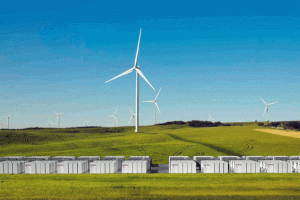 What Elon Musk’s investment tells us about our energy crisis, The Age, Perry Williams and Jason Scott JULY 14 2017 – Elon Musk’s intervention in Australia’s energy crisis is widening a divide over the future of coal.
The billionaire Tesla founder, who’s promised to help solve South Australia’s clean energy obstacles, sees no place for the fossil fuel. That conflicts with the federal government’s push for it remaining a mainstay source of electricity generation, as well as the “clean, beautiful coal” technologies that US President Donald Trump sees helping to save American mining jobs.
“Coal doesn’t have a long-term future,” Musk told reporters in Adelaide last week during a short trip to Australia. “The writing’s on the wall.” His declaration in energy-strapped South Australia, where the 46-year-old entrepreneur announced plans to build the world’s biggest battery to support the state’s blackout-plagued power grid, has rankled politicians.
Energy minister Josh Frydenberg, 45, accused the state of tapping a celebrity to paper over its patchy clean energy record. Tesla’s battery plan “is a lot of sizzle for very little sausage”, Frydenberg, a member of the conservative Liberal-led federal government, said on Monday. Deputy Prime Minister Barnaby Joyce, 50, said Musk’s plan “doesn’t make a hell of a lot of difference” to the nation’s struggles over energy security.
Most of Australia’s states and territories – free to determine their own energy and climate policies independent of the national government – beg to differ. Just hours after Musk’s announcement, the neighbouring state of Victoria closed the door on new coal-fired power stations, saying energy companies would rather invest in renewables.
Adani project
Queensland, where India’s Adani Group is planning to develop the $16.5 billion Carmichael coal mine, expects a move to clean energy will completely wipe out its carbon emissions by 2050.
Energy policy is a fraught subject with a push by the majority of Australians for more renewable power sources from the Australian majority is clashing with the government’s political imperative to keep a lid on soaring power prices. Currently, some 76 per cent of Australia’s electricity is drawn from coal-fired power stations which, while a cheap supply source, are at odds with a commitment to lower climate emissions……
The economics of building new coal plants don’t stack up and increasingly renewables will dominate base-load power, AGL chairman Jeremy Maycock said last week. Australians overwhelmingly want the government to focus on clean energy, according to a June poll by the Sydney-based Lowy Institute.
‘Highly improbable’
“It’s highly improbable that AGL will be constructing new coal-fired power stations because we don’t think the economics are likely to favour that,” Maycock said in a phone interview. “As the largest generator, we want to play our fair share in the country’s emissions reduction targets.”
For Prime Minister Malcolm Turnbull, banging the drum on coal is proving a treacherous task…….
the existing and perceived political and environmental costs attached to coal are deterring lenders.
“The high risk and cost associated with new coal plants make investors and financiers run a million miles from it in Australia,” said Ali Asghar, an analyst with Bloomberg New Energy Finance in Sydney. “The only way new coal could get built is if the government funds it and indemnifies any private entity against all future carbon risks.”
And doing so makes little sense, given that the cost of building cleaner, so-called high-efficiency, low-emission coal plants in Australia exceeds that of new projects relying on solar, wind, or gas, Asghar said.
“As solar and wind become cheaper and continue to undermine the economics of operating coal, investment in new coal plants become an even riskier proposition.” http://www.theage.com.au/business/energy/what-elon-musks-investment-tells-us-about-our-energy-crisis-20170714-gxb3i7.html
July 14, 2017
Posted by Christina Macpherson |
AUSTRALIA - NATIONAL, energy, politics, South Australia, Victoria |
Leave a comment




 Antinuclear