Western Australian Govt’s costly and racist move to get 137 Aboriginal communities off their land
 Cost of closing remote communities greater than tackling issues, Aboriginal leaders say, ABC News, 13 Nov 14 By Nicolas Perpitch and Anna Vidot Aboriginal leaders and advocates are warning the “chaos and dysfunction” caused by closing down remote Indigenous communities will cost the West Australian Government far more than addressing existing issues.
Premier Colin Barnett has acknowledged his decision to shut about half the state’s 274 remote communities will cause distress to the more than 12,000 Aboriginal people living there and cause problems in the towns they move to………
Amnesty International’s indigenous peoples’ rights manager Tammy Solonec said there was no plan to help people evicted from Ooombulgurri integrate into Wyndham or other towns, leaving them “highly traumatised”……..
She said governments needed to support communities rather than shutting them down.
Greens MLC Robin Chapple has gone one step further, accusing the Government of peddling a racially-motivated agenda. “It’s smacks of the assimilation policies over the early 60s,” he said. “It’s horrendous. This is a diabolical, in my view, highly racially motivated agenda.”
The Barnett Government has said it was forced to accept a $90 million payment from the Commonwealth to take over responsibility for the remote communities.http://www.abc.net.au/news/2014-11-13/closing-remote-aboriginal-communities-cause-chaos-leaders-say/5889278
Residents of Leonora, Western Australia, oppose Shire Council’s offer to site radioactive wastes dump
 Residents Of Leonora have written to Ian MacFarlane, Minister for Resourcs, opposing the Shire’s proposal for hosting radioactive wastes, and demanding that no site be selected until after an independent commission of inquiry has examined the question of Australia’s radioactive wastes, and of the best way to mange his matter.
Their letter can be read at
Scientists and Aboriginal land-managers work together to reduce greenhouse gas emissions
Scientists working together with indigenous land-managers have reduced Australia’s greenhouse gas emissions by half a million tonnes. IMPROVING FIRE MANAGEMENT in the tropical savannah of northern Australia has reduced greenhouse gas emissions by more than 500,000 tonnes over the past year.
By reintroducing traditional fire knowledge and practices, local land managers have benefited through the sale of carbon credits, as well as helping the environment.
“Methane and nitrous oxide emissions from savannah burning represent about three per cent of Australia’s total greenhouse gas emissions,” said the CSIRO’s Dr Garry Cook at the 2014 annual conference of the Ecological Society of Australia in Alice Springs in September.
“Since European settlement, fires in the north have increased in size and severity. This has threatened biodiversity as well as increased greenhouse gas emissions,” he said.
Australia’s tropical savannah landscape is enormous — it covers an area of some 1.9 million square kilometres, or about one quarter of the entire continent. The landscape is mainly forests and woodlands consisting of wide fields of grass with scattered eucalypt trees.
The savannah stretches from Rockhampton on the Queensland coast up to the tip of Cape York and across to the Kimberley region of Western Australia on the Indian Ocean.
Frequent fires are a characteristic of the landscape, and the vast majority are deliberately lit without any authorisation. Tens of thousands of square kilometres burn every year during the northern dry season.
Many local Aboriginal communities have retained their traditional fire knowledge, and these communities hold deep aspirations to fulfil long-held cultural obligations regarding country. Dr Cook said the Commonwealth’s Carbon Farming Initiative provided the impetus to restore traditional fire management practices on aboriginal homelands, combining modern environmental and fire science with traditional mosaic burning practices.
“In order to reduce greenhouse gas emissions under the methodology, land managers need to burn early in the dry season to protect the landscape from the more intense fires that would otherwise occur later in the dry season,” he said.
“Early dry-season fires are generally low in intensity; they trickle through the landscape and burn only some of the fuel, creating a network of burnt firebreaks. These stop the late dry-season fires sweeping through large areas and releasing large amounts of methane and nitrous oxide.
“Most savannahs burn on average once in every two to four years, in the late dry season, and it’s these fires that produce between three and four per cent of Australia’s accountable greenhouse emissions. The methodology helps reduce these emissions by using low-intensity, patchy early dry-season fires to reduce the overall fire frequency and proportion of late dry-season fires, which tend to be much larger and more intense,” Dr Cook said.
The savannah burning methodology for reducing methane and nitrous oxide emissions was developed by a team from CSIRO, the Charles Darwin University’s Centre for Bushfire Research, the Northern Australia Indigenous Land and Sea Management Alliance, and Aboriginal landowners and rangers in northern Australia.
Dr Cook said, “It’s lovely to see science being applied to improve land management in that part of the world: we’re talking very remote country, very limited resources for land management, and very sparse populations. It’s had a great impact.”
Esperance ideal area for localised, distributed renewable energy generation
 Report finds renewable energy supply critical to Esperance future By JESSE McCARTHY-PRICEhttp://www.esperanceexpress.com.au/story/2645482/renewable-energy-key-to-esperance-development/?cs=1268 Oct. 23, 2014 ESPERANCE’S economic future would be bolstered by investment in renewable energy, according to a report Esperance Region Economic Development Strategy.
It identifies Esperance as a viable place for renewable energy generation opportunities due to an abundance of natural assets, available land and being close to infrastructure. “Esperance has a strong history of embracing renewable technology with the Ten Mile Lagoon wind farm one of the state’s first commercial-scale renewable projects,” the report said.
“Energy cost and access is currently a critical barrier to economic development for a significant proportion of the Esperance region. “Enabling reliable access to cost-effective energy will greatly enhance the viability of new and existing operations and make the region more competitive with alternative residential and investment destinations.”
Not being connected to the South West Interconnected System power grid prevented large scale energy generation and export for the region.
“However, the isolation of the region may make it attractive as a trial area for new renewable technologies given appropriate marketing, incentive and inducement,” it said.
“The isolation also makes the region ideal for localised, distributed generation.” Esperance Chamber of Commerce and Industry chief executive Grant Shipp said lowering energy costs would benefit local business.
Renewable energy plays a role in reducing Western Australia’s greenhouse emissions
Despite the result, WA continues to be one of the world’s biggest emitters on a per person basis.
According to Synergy, reasons for the fall included WA’s first large-scale solar power plant and a big wind farm near Geraldton coming online last year.
A spokesman noted the utility had generated more electricity from its cleaner gas-fired power stations, while closing a coal-fuelled generating unit earlier than expected. Adding to the turnaround had been an unprecedented fall in electricity demand across Australia.
The trend, which bucked decades of uninterrupted growth and has confounded industry players, has been caused by sharply higher power prices, more efficient energy appliances and rampant demand for rooftop solar panels. Another cause has been the recent closure of energy-hungry manufacturing plants.
Conservation Council of WA director Piers Verstegen welcomed the figures as good news and suggested the trend would continue on the back of the growing viability of renewable power. https://au.news.yahoo.com/thewest/wa/a/25241234/greenhouse-emissions-fall/
Aboriginal poverty increased through self-serving corporations and highly paid executives
according to the Office of the Registrar of Indigenous Corporations, mining is returning millions to Aboriginal owned corporations. Western Australia’s Pilbara is the engine room of the nation’s mining boom. But the two billion years old 400,000 square kilometres Pilbara is home to some pretty sad poverty, all of it First Peoples – Roebourne and Wickham for starters, and any of the cluster of communities around Marble Bar, Tom Price, Nullogine, Port Hedland.
Port Hedland is Australia’s busiest port, with ships leaving daily filled with iron ore extracted from Aboriginal land but with the profits returned to multinationals – next-to-nothing for the communities where many of the native title claimants live . Native title owners? A fool’s gold many say.
But if not billions of dollars there are millions of dollars going the way of Aboriginal corporations. Continue reading
Toro Energy hoping against hope that the uranium market picks up in the future
 Toro seeks to expand planned WA uranium mine ABC News By David Weber 8 Oct 14
A company hoping to become the first to export uranium from Western Australia has released plans for an expansion of its currently untapped mine in the state’s mid-west.
Toro Energy last year received federal environmental approval for the Wiluna project to exploit the Lake Way and Centipede deposits.
But a new environmental scoping document included two more deposits, Millipede and Lake Maitland.
The plans are open for comment with the state’s Environmental Protection Authority (EPA)………
the WA Conservation Council said the existing conditional approval should be revoked and a completely new assessment done.The council’s Mia Pepper said the added impacts of an expansion needed to be considered.”While they might think that they know a lot, there’s a lot of impacts that are unknown when you add additional deposits,” she said.
“You add additional land clearing and impact area.”What they need to do and what they should be doing as any responsible company would is look at the cumulative impacts of that increase.”
Mr Yeeles said the start of mining was some way off.
“The market is not right, the price is not right for mining at the moment but by the time we complete the assessment for Millipede and Lake Maitland, we would expect the market conditions to have improved,” he said.
Toro expects the assessment process may take up to two years. http://www.abc.net.au/news/2014-10-06/uranium-miners-toro-seek-project-expansion-at-wiluna-site/5794318
Anglican Church transfers investments from fossil fuels to renewables, calls for carbon pricing, and assessment of fracking
 Anglican Church divests from fossil fuels, calls for fracking scrutiny in WA http://www.abc.net.au/news/2014-10-06/anglican-church-moves-out-of-fossil-fuels/5793884 By Jacob Kagi and Katrina Alarkon 6 Oct 2014, The Anglican Diocese of Perth has decided to divest itself of fossil fuel investments over what it says is a responsibility to act on climate change.
The diocese made the decision at its annual synod over the weekend and now plans to put funds into renewable energy investments. It also passed a motion calling on the Federal Government to put in place an “effective carbon pricing mechanism”.
Father Evan Pederick said he hoped the measures would help to increase pressure for action to stop climate change.”Divestment was used very successfully in relation to apartheid,” he said. “It’s people power basically, it means we’re actually withdrawing energy from the offending industries and there’s no more effective message than the price message.
“In the absence especially of effective government action in this country, I think it is actually up to private institutions, or private individuals and institutions, to show the way,” he said.
Another motion appealed for the State Government to evaluate the effects of fracking in Western Australia. Father Pederick said he feared health concerns and social impacts in relation to fracking were not being adequately explored.”At the moment shale gas fracking proposals aren’t subject to the usual environmental protection agency controls,” he said.
Its investment board, the Perth Diocesan Trustees, will release a report within the next 12 months detailing how it will redirect investments into renewable energy. In August, the Uniting Church in Australia also moved to divest itself of investments in companies involved in the extraction of fossil fuels.
Aboriginal Leaders Reject Western Australian govt’s changes to Aboriginal Heritage law
 “Speaking with one voice” – WA’s changes to Aboriginal Heritage law rejected at bush meetings, anthropologist Dr Stephen Bennetts. Be careful what you pray for. By proposing to strip away protection for Aboriginal people’s heritage across the board, and throughout the State, the Barnett Government appears to have unwittingly conjured up a strong, united and angry Aboriginal coalition which is now mobilising against the AHA amendments. Crikey, 30 Sept 14 BOB GOSFORD | SEP 30, 2014
ABORIGINAL LEADERS IN THE KIMBERLEY, PILBARA AND PERTH HAVE REJECTED WA GOVERNMENT PLANS TO AMEND THE STATE’S ABORIGINAL HERITAGE ACT TO FURTHER STREAMLINE PROVISIONS UNDER SECTION 18 OF THE AHA WHICH ALLOW FOR THE DESTRUCTION OF ABORIGINAL SITES BY DEVELOPERS. Continue reading
Greens urge that Western Australia get a nuclear emergency plan.
 Greens want Barnett to make emergency nuclear plan for WA http://www.watoday.com.au/wa-news/greens-want-barnett-to-make-emergency-nuclear-plan-for-wa-20140919-10iutv.html September 18, 2014 Brendan Foster With Australia on the brink of new conflict with Iraq, Greens MP Lynn MacLaren says she can’t believe the Barnett government doesn’t have an emergency plan if a nuclear accident happened at Fremantle Port.
On Monday, Prime Minister Tony Abbott said Australia would send 600 troops, including SAS soldiers and eight FA18 Super Hornets, to the Middle East in preparation for military action against the Islamic State terror group.
And on Thursday, more than 800 police officers raided homes in Sydney in an attempt to foil a plot to “commit violent acts”, including plans to behead a member of the public.
Ms MacLaren asked Attorney-General Michael Mischin on Wednesday night in State Parliament if the Liberals had an action plan for workers and residents living near the port in the event of the nuclear reactor incident from a nuclear-powered warship. Mr Mischin said a nuclear detonation was not a defined hazard prescribed within the Emergency Management Act 2005.
“The state emergency management arrangements allow for a controlling agency to be appointed for any hazard not prescribed in the act,” Mr Mischin said.
Ms MacLaren said as Australia prepared to send troops to Iraq, “we cannot afford to have a head-in-the-sand approach to an emergency response”.
“Since nuclear-powered vessels visit our shores, we need to be ready in the event of an accident or incident. The report tabled in response to my question was last updated in 2010,” she said.
“Nuclear weapons have been a major threat to world peace for decades, how can the state government not have an emergency response to the risk of a nuclear weapon detonation or accident?
“The consequence of even a small incident would be catastrophic. Yet, we should have a plan which factors in health care facilities and staff to provide triage care in the event of a nuclear detonation or other nuclear incident.” Ms MacLaren said with the Mayors of Peace Conference in Fremantle next week, the call to prohibit nuclear weapons was more important than ever.
Junko Morimito who will describe her experience as a 13-year-old in Hiroshima when the atomic bomb went off is one of the guest speakers at the conference.
“I will be attending the Fremantle Peace Walk which will take place on International Peace Day, Sunday 21 September – celebrating the opening of Fremantle Peace Grove. Tthis issue must be kept as a priority for leaders and the community,” Ms MacLaren said.
Double benefit in farming both cattle and wind, in Western Australia
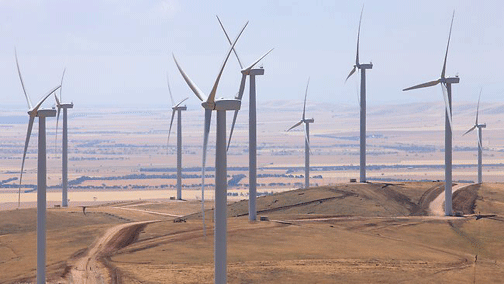 WA farmer living amongst wind turbines backs keeping Renewable Energy Target 7 NEWS BY CLAIRE MOODIESeptember 14, 2014 Living amongst 15 massive wind turbines might not be everyone’s idea of paradise, but West Australian Mid West farmer Bruce Garratt believes he is investing in the future.
Eight years ago, he agreed to accommodate the turbines as part of WA’s first privately-built wind farm, south of Geraldton, and is still enjoying the serenity.
“People tell me how noisy they are, people tell me how they affect your health,” he said. “I’ve had lots of people tell me different things that honestly, unless they have lived on a wind farm, they don’t really know what they are talking about.”
Mr Garratt, who manages cattle and crops on his 2,000 acre property, said the turbines — part of the Alinta Walkaway Wind Farm — provided an additional passive income, as well as a sense of purpose.
“No-one in their right mind could put up an argument and say that wind turbines aren’t of benefit,” he said. “They’re not producing C02.”
Mr Garratt is critical of the recent Warburton review that recommended either closing the Renewable Energy Target (RET) to new entrants or scaling it back…….
Coal-fired generators the winners: wind farm owner
Western Australia to lose 1000s of jobs if RET is scrapped – Senator Ludlam
 Ludlam warns of job losses in wake of Renewable Energy Target review http://www.watoday.com.au/wa-news/ludlam-warns-of-job-losses-in-wake-of-renewable-energy-target-review-20140914-10gu11.html Liam Ducey WA Greens Senator Scott Ludlam has warned $800 million will be slashed from the WA renewable energy sector if the Abbott Government dumps the Renewable Energy Target.
The Warbuton Review into the RET, commissioned by the federal government in February, has recommended scrapping the target, which Senator Ludlam says will see up to $10.7 billion in renewable energy investment head overseas, threatening 21,000 jobs.
In WA, 16 per cent of households are solar-powered, and Mr Ludlam said the RET had benefited Perth’s poorer suburbs.
“A study by the Greens shows that WA’s poorer suburbs have the highest uptake in solar, which has collectively saved $87million a year or $560 per household,” he said. “WA is in a unique position to be the best investors in clean energy with our plentiful sunshine and independent energy market.
“WA now boasts 414 accredited solar installers and scrapping the RET would result in a loss of thousands of local jobs. The Greens has shown that if more investment into clean energy was supported, another 27,000 jobs could be created.”
A spokeswoman for State Environment minister Albert Jacob said the potential scrapping was federal government issue.
Comment is being sought from Federal Environment Minister Greg Hunt.
Growing public anxiety in Greenland, over Australian uranium miner Greenland Minerals and Energy Limited (GMEL)
 the people of Greenland are “split down the middle regarding the repeal of the ban.”
Hooge explains that the “mineral authorities” have fed the public disinformation over the last years but the tide may be turning, with growing concerns over environmental effects and the leftist party Inuit Ataqatigiit pledging to roll back the repeal if it wins back power.
The prospect of a relatively unknown Australian company exploiting massive untapped resources in Greenland deserves a robust public and political debate. It has thus far received nothing in Australia, and little in Denmark and Greenland.
In an age of worsening climate change, mining uranium is an arguably unsafe and potentially explosive answer to the problem
Australian uranium mining in Greenland is tearing the country in half jagadees.wordpress.com August 23, 2014 Antony Loewenstein. source theecologist.org
This is a story about an Australian company you’ve never heard of, operating in a nation that rarely enters the global media: Greenland. It’s a story about the intense search for energy sources in a world that’s moving away from the dirtiest fossil fuels.
Aleqa Hammond, the prime minister of Greenland, is the first woman to lead this autonomous country within the Kingdom of Denmark. She also welcomes the financial opportunities from climate change and a melting Arctic Circle……..
In October last year, Hammond pushed legislation through Greenland’s parliament to overturn a 25 year old ban on the extraction of radioactive materials, including uranium, despite countless leading environmental NGOs urging otherwise.
It attracted global interest from the rare earth and uranium industries, including from China. Concerns were also raised about Greenland’s ability to manage a toxic substance in the wake of Fukushima and Chernobyl.
The company Greenland Minerals and Energy Limited (GMEL) is based in Perth, Western Australia. This year GMEL announced a major step forward in their plan to open one of the world’s largest uranium mines in southern Greenland, at Kvanefjeld, near Narsaq. The mine will also produce fluoride, thorium and other rare earths.
There is still significant opposition to the Kvanefjeld project. The Ecological Council, a Danish NGO, organised a conference to discuss the potential contamination risks in March, noting that the mine poses serious risks for the inhabitants of the nearby village, Narsaq.
Many locals told the BBC that they worried about pollution and challenges to traditional ways of life if GMEL moved ahead with its plans.
Unsurprisingly, Danish green groups have pushed for a continued ban on uranium mining. They claim that rare earth elements can be extracted without uranium mining in Greenland.
Who owns GMEL?
This would have been an important but fairly typical contest over resources, but after issues surrounding the ownership and status of Perth-based GMEL were raised in the Greenlandic parliament, the prospects of the Australian firm may be in jeopardy. Continue reading
Kintyre uranium project will poison groundwater
 Proposed WA uranium mine will poison groundwater opponents say http://www.sbs.com.au/news/article/2014/08/12/proposed-wa-uranium-mine-will-poison-groundwater-opponents-say Environmental groups say they fear a proposed WA uranium mine will poison groundwater and affect food supplies. By Ryan Emery 12 AUG 2014 LEADING ENVIRONMENTAL GROUPS ARE CLAIMING THAT A PROPOSED URANIUM MINE WILL POISON GROUNDWATER AND AFFECT FOOD SOURCES IN WESTERN AUSTRALIA’S EASTERN PILBARA REGION.
The Kintyre project, 260km northeast of Newman, will be WA’s second most advanced uranium mine if it gets final environmental approval from the state’s Environment Minister Albert Jacob.
Uranium mining had been banned in the state until the then Liberal-National government was elected in 2008.
The state’s Environmental Protection Authority has recommended that the project, backed by Canadian uranium miner Cameco, be given conditional environmental approval.
However, opponents of the mine say the assessment was flawed.Mia Pepper from the Conservation Council of Western Australia says a hydrology report failed to consider the traditional owners’ knowledge of rainfall patterns and water flow at the proposed site.
She says they claim water flows from the site into the nearby Karlamilyi National Park, not into the Great Sandy Desert.
“The difference between those two scenarios are really significant when you’re talking about a uranium mine and the pathways for radioactive mine waste to leak into that groundwater and just how far that contamination could spread and what areas it could impact on,” she said.
“And we’re talking about a national park, and we’re talking about communities so the impacts are really significant.”
Concerns have also beeing raised over radioactive waste management, and the impactof the mine on rare and threatened species.
The mine’s proponent Cameco has previously said it is confident it can mine in the area “in a way which maintains the ecological functions and environmental values in the area.”
A decision on ministerial environmental approval is expected in the coming months.
Western Australian Uranium mine abandoned but what about taxpayer subsidies it gets?
 http://tonyserve.wordpress.com/2014/08/12/uranium-mine-abandoned-but-what-about-taxpayer-subsidies-to-mining-co-australia-wapol-auspol/ Uranium miner Areva quizzed over Royalties for Regions payment, 12 August 2014 Greens Member for Mining and Pastoral Region, Robin Chapple MLC has quizzed the State Government over its funding support of a subsidiary of French uranium miner Areva, for its North Canning Project.
Earlier this week, Areva Resources Australia announced that it would move to abandon the Kimberley uranium project because it is not technically feasible.
“Did they get Royalties for Regions funding? Was it utilised or if not, was it returned? If not, why not?” Mr Chapple said.
“I am gobsmacked at the constant allocations of funding being poured into the pockets of those already at the very top of the super-rich mining pyramid. It’s an inequity of the highest order.
“The Royalties for Regions Scheme should be taking from the exploitative, extractive industries and supporting true regional development. We should be funding future industries, affordable housing and community infrastructure that will ensure sustainability beyond this limited mining boom. Why are we using these precious funds to facilitate unsustainable mining practices?
“It’s obvious that the State is struggling to provide affordable housing, energy infrastructure, good public transport options, community and health services, let alone take care of our fragile environment.
“Whichever way we look at it, we cannot justify this expenditure,” Mr Chapple said.
1 This month

of the week – Australians for War Powers Reform (AWPR)
To see nuclear-related stories in greater depth and intensity
 Antinuclear