Solar power proving a good investment for Western Australians
 Solar Helps Delay New Power Station In Western Australia http://www.energymatters.com.au/index.php?main_page=news_article&article_id=4319 26 May 14, WA’s solar households and businesses are collectively generating as much power as a major traditional power station. According to The West Australian’s Daniel Mercer, given forecasts from Synergy of a continuing increase in solar uptake, the State Government now says a new power station would not need to be constructed in the state until 2029.
Synergy predicts there could be as much as 1500MW of solar capacity feeding into Western Australia’s electricity grid by 2020.
The rate that Western Australians have embraced solar is quite stunning. The numbers of solar power systems connected to the grid has grown from just three in June 2007 to 135,419 (Synergy customers) as of March 2014.
According to solar provider Energy Matters, a 5kW solar panel system installed in Perth can return a financial benefit of between $1,577 and $2,196 annually. In some cases, a system of this size can basically blow away an average household’s power bills.
Energy Matters’ Australian Solar Index estimates the internal rate of return of a system installed in Perth to be 17.8%; making it one of the best investments around.
However, as is the case in the rest of Australia, clouds are gathering on the horizon for WA’s solar industry and potential new solar households. The Renewable Energy Target review is currently under way and concerns have been expressed regarding possible outcomes; including a gutting of subsidies.
Current support for acquiring systems can translate to thousands of dollars off the cost of going solar. The uncertainty surrounding the review means the best time to go solar in Western Australia could be right now.
Going solar in WA doesn’t necessarily mean a significant up-front financial outlay. Energy Matters offers a zero-deposit “Save As You Go” arrangement to eligible customers where monthly repayments can be less than what would otherwise be spent on mains-grid supplied electricity.
Western Australian MP ‘s first speech in Parliament makes a strong call for renewable energy
Hughes: future in renewable energy http://www.whyallanewsonline.com.au/story/2290965/hughes-future-in-renewable-energy/?cs=12 By KAYLEIGH BRUCE May 19, 2014, Member for Giles Eddie Hughes made his maiden speech before state parliament recently in which he called for greater federal investment into developing renewable energy in South Australia.
During his parliamentary debut, Mr Hughes focussed on the role renewable energy and mining could have in creating employment and economic growth in the region.
“BELOW THE GROUND WE HAVE MINERAL RESOURCES, BUT ABOVE THE GROUND WE HAVE AN ENERGY SOURCE THAT DWARFS ALL OTHER ENERGY RESOURCES: THE DIRECT SOLAR RESOURCE AND INDIRECT SOLAR RESOURCE THAT IS WIND, CAN TURN SOUTH AUSTRALIA INTO A RENEWABLE ENERGY POWER HOUSE AND, IN THE PROCESS, GIVE US A FAR GREENER MINING INDUSTRY WHILE ALSO GREENING ALL OTHER SECTORS OF OUR ECONOMY.”- MEMBER FOR GILES EDDIE HUGHES
Mr Hughes said the electorate of Giles was already playing a role in wind energy production and noted Whyalla’s role in the manufacturing of wind tower parts by E & A Contractors.
However Mr Hughes said the city was also well-positioned to harness solar energy.
“What we are looking at now – and the process has started, but we have further to go – is developing and applying technology to capture the sun’s energy,” Mr Hughes said.
Mr Hughes took the opportunity to voice his passions to see the region’s role in producing renewable energy further developed.
“Manufacturing communities like Whyalla could increase tower production,” Mr Hughes said.
“Hubs, nacelles and blades are all imported; with investor certainty, local manufacturing facilities could be developed.
“If we captured the wind resource on the Eyre Peninsula and captured the manufacturing opportunities, it would be a big boost to employment.
“Rounding the numbers off, the stage development of 2000 megawatts on the Eyre Peninsula would mean the fabrication of 800 towers, 800 hubs, 800 nacelles and 2400 blades in addition to a wide range of job-generating ancillary services.”
Mr Hughes called on the Abbott government to realise the future of renewable energy in Australia and back the research and development needed to shape the industry. “Companies in the past have expressed their willingness to invest in Australian manufacturing, but each time that desire has been undermined at a federal level, initially when the Howard government failed to increase the two per cent mandatory renewable energy target, and now with the Abbott government’s review headed up by a man who rejects the science behind global warming,” Mr Hughes said.
“A review held just 18 months after the last review found that the mandatory renewable energy target was working to deliver cost-effective clean energy.”
Mr Hughes said with the right support, South Australia could easily achieve outstanding renewable energy production results and be a model example of renewable energy supporting the mining industry.
“The target to reach 33 per cent of the state’s electricity from renewables by 2020 is likely to be met within a year,” Mr Hughes said.
“WHY NOT SET A TARGET TO BECOME THE GREENEST MINING PROVINCE IN THE WORLD, AND WHY NOT MARRY OUR RENEWABLE ENERGY RESOURCE TO OUR MINERAL WEALTH, OR AT LEAST ANNOUNCE THE ENGAGEMENT SO THAT DOWN THE TRACK THEY CAN TIE THE KNOT?”- MEMBER FOR GILES EDDIE HUGHES
Why the Walinu Martu People will do everything possible to prevent Toro Energy’s Wiluna Uranium project
 WESTERN AUSTRALIA’S WILUNA MARTU CONDEMN EXPANSION OF URANIUM MINING PROJECT , InterContinental Cry, by Curtis Kline on May 7, 2014 In Western Australia, plans of expanding Toro Energy’s mine site into a much larger uranium mining wasteland–spanning 100km and two lake systems–has been condemned by elders of the Wiluna Martu people.
“The lives of not only our people today are at stake but the future of our people into time immemorial. This uranium mining if it goes ahead will spell the end of us as custodians of the land. It will make toxic the land, preventing us from caring for the land, it will poison the rivers that we swim in, drink and fish from,” said Wiluna Elder, Glen Cooke to The Stringer.
On March 25, Western Australia’s EPA made the Toro Wiluna uranium expansion project open for public review. Wongi anti-nuclear campaigner, Kylie Fitzwater, commented that Toro had a long way to go before gaining new approvals to expand their single-mine approved project. “The company needs to complete additional environmental management, mine closure, tailings management and transport plans for assessment before any mining can commence at the Wiluna site,” she said.
Included in the proposal, Toro Energy wants to double its water consumption and store radioactive mine waste from several mine sites in a Lake bed. The company’s new plan also involves four more deposits covering over one hundred kilometers – Lake Way, Centipede, Millipede and Lake Maitland, with longer term plans including mining an additional three deposits at Nowthanna, Dawson Hinkler and Firestrike – covering another one hundred kilometers in the other direction.
Stop the bull – the Wiluna uranium program
This region is also home to Western Australia’s largest uranium deposit at Yeelirrie, owned by the Canadian uranium mining giant, CAMECO. This project has been consistently opposed for forty years by Traditional Owners, now led by Kado Muir. Mr. Muir has said “The only safe place for uranium is in the ground, where it belongs. For 40 years my people have campaigned to protect Yeelirrie. We have walked this Country for thousands of years, it should not become Country that we fear to tred.”
While Toro’s original mine plan is expected to be operational next year, the traditional lands on which it is situated is covered by two native title claims at an advanced stage towards a consent determination of native title under the Native Title Act………
As the majority of uranium exploration and mining occurs on Indigenous lands all over the world, this project would continue the denial of the Walinu Martu Peoples right of free, prior and informed consent and their self-determination. They have particularly been striving for the right to negotiate with uranium explorers directly to ensure that their culture and rights are adequately protected.
As the first of Western Australia’s mining projects, the government and industry are hoping this will be the first of many. This is why, the Walinu MArtu People will do everything possible to prevent it. http://intercontinentalcry.org/western-australias-wiluna-martu-condemn-expansion-of-uranium-mining-project-22980/
Accurately measuring the solar energy potential for South West Australia
South-west Australia’s potential solar output measured with accuracy Phys Org 7 May by Rebecca Graham Researchers have developed an algorithm that can be used to simulate the hour-by-hour power output of both photovoltaic and concentrated solar thermal power systems for any location in the south-west corner of Australia. The model is simple enough to run inside a web-browser by the general public and could be tailored to other regions around the world.
Led by Murdoch University’s Dean Laslett, an engineering PhD candidate, the research forms part of a series of studies originated by Sustainable Energy Now aimed at developing an accessible and interactive computer simulation of renewable energy power systems for the South-West Interconnected System (SWIS); WA’s main electricity grid.
As clouds affect how the three main components of solar radiation – direct, diffuse and reflected – reach the earth’s surface, the algorithm was developed through a series of calculations using seasonal rainfall patterns and the three solar radiation components; leading to estimates of daily and hourly cloudiness across the region.
“The seasonal rainfall pattern across WA generally decreases with distance from the coast, with a zone of high rainfall in the south-west corner and the Kimberley,” Mr Laslett says.
“Seasonal cloudiness follows the same pattern. Hence if the longitude and latitude of a location is converted into a distance along the coast-line and a distance inland, estimation of seasonal cloudiness can be simplified.
“An estimate of all three solar radiation components is [also] needed…………”Because the model can be used to estimate all three components of solar irradiance, it’s possible to change the location of one or several photovoltaic or concentrated solar thermal systems and get an idea of how overall energy generation might change.”
“Also because our model can run inside a web-browser, this ability becomes widely accessible to the general public … they can play around and see for themselves what a solar energy power system for the SWIS might look like.” : http://phys.org/news/2014-05-south-west-australia-potential-solar-output.html#jCp
Uranium mining plans by Toro Energy – expensive, polluting, and under investigation
 Toro uranium expansion plan: premature and polluting http://www.ecovoice.com.au/toro-uranium-expansion-plan-premature-and-polluting/
Western Australia’s peak environmental group has condemned a move by uranium mining hopeful Toro Energy to expand their unrealised Wiluna mine plan into a much larger uranium mining precinct spanning 100km and two ecologically sensitive lake systems in the East Murchison region.
The state EPA has released details of the expansion plan while the company is under investigation by the Australian Securities Exchange for a second time over claims they have released misleading information to shareholders and the market. (See background below).
“Toro have never successfully mined anything before and have a long way to go to get their original single-mine project approved – let alone any new expansion,” said CCWA Nuclear Free campaigner, Mia Pepper.
“Contrary to their statements to shareholders, the company needs to complete additional environmental management , mine closure, tailings management and transport plans for assessment before any mining can commence at the Wiluna site.”
The company has struggled to find investors and currently needs $300 million in start-up costs and a further $300 million in upfront bonds.
“This new plan to attract investors is likely to draw further scrutiny from both regulators and the wider community who will be looking at the cumulative impacts of a regional uranium precinct covering 100km and two arid zone Lake Systems.”
“Toro plans to double its water consumption and store radioactive mine waste from several mine sites in a Lake bed. This idea lacks credibility and the company lacks capacity, experience and financial backing.”
Toro’s new plan involves four deposits over one hundred kilometres – Lake Way, Centipede, Millipede and Lake Maitland, with the company’s long term plans including mining an additional three deposits Nowthanna, Dawson Hinkler and Firestrike – covering a hundred kilometres in the other direction.
Also in the region is WA’s largest uranium deposit – Yeelirrie, which is now owned by Cameco. Traditional Owners have consistently opposed this project for forty years.
CCWA is partnering with a range of public health, union and faith groups to call for a public inquiry into the Toro mine plan.
ASX investigation
The Mineral Policy Institute and the Conservation Council of WA received formal notification that the Australian Securities Exchange is investigating Toro Energy for the second time over the release of potentially misleading information. Continue reading
First operating wave energy array scheme in the world, in Western Australia
 Western Australia wave energy project on the brink of commercialisation Oliver Milman theguardian.com, Wednesday 9 April 2014 A major sustainable energy plan has come closer to fruition with the launch of three giant buoys in Perth Australia could be set for a breakthrough in energy derived from waves, following the launch a major new project in Western Australia.
Carnegie Wave Energy unveiled three large buoys in Perth on Wednesday as part of a new $70 million technology which will feed energy into the Australian grid later this year.
The enormous buoys, called buoyant actuators, will be towed out into the ocean near Garden Island, off the coast of Perth.
The buoys will then be submerged and attached to underwater pumps. The movement of the ocean’s waves will cause the buoys to shoot high-pressure water through pipes which, in turn, will drive turbines and generators onshore, creating electricity.
The high-pressure water will also be fed into an onshore desalination plant, creating fresh water without the need for pumps.
Electricity and water provided by the project will be used by the department of defence for HMAS Stirling, Australia’s largest naval base, which is on Garden Island. The government, which has provided $13.1 million in funding through the Australian Renewable Energy Agency (ARENA), said the project will be the first operating wave energy array scheme in the world……
Ivor Frischknecht, chief executive of ARENA, said Carnegie should be congratulated for helping push forward the viability of wave energy in Australia.“Australia’s wave energy resources along our south and south-west coasts are among the best in the world and, importantly, can be reliably predicted days ahead,” he said.
“There is great long-term potential for wave energy in Australia, with a range of competitive Australian technologies being developed towards commercialisation.” http://www.theguardian.com/environment/2014/apr/09/western-australia-wave-energy-project-on-the-brink-of-commercialisation
The Greens’ Scott Ludlam polled16% of the primary vote, in Western Australia’s Senate election
 Western Australia Senate election: is this a new moment for the Greens? Ben Eltham theguardian.com, Monday 7 April 2014 Scott Ludlam’s victory in Western Australia has some important implications for those keen to write off the Greens as a political force
Saturday’s Senate by-election in Western Australia is certainly good news for the environmental party. The Greens polled nearly 16% of  the primary vote, a result that saw Scott Ludlam handily re-elected with quota to spare. The result represented a swing to the Greens of more than 6%.
Ludlam’s result is a personal triumph for the soft-spoken Western Australian. After narrowly losing his seat in the contested result of 2013, Ludlam has roared back into the Senate for another six years on the back of a highly effective Greens campaign.
Beginning with the unexpected social media success of his “Welcome to Western Australia, Tony” speech, Ludlam honed a re-election campaign that was well targeted and technologically savvy. He leveraged his excellent online profile and policy expertise on issues like the NBN andsurveillance to attract a wider following of voters under 40. In just a month, Ludlam has tweeted and DJ’d his way from likely has-been to future leader.
While Saturday’s result may not herald a new age of verdant ascendancy, it does have some important implications for those keen to write off the Greens as a political force in Australia. Their demise is regularly forecast by major party figures and journalists, many of whom appear to believe that the environmental party will one day share the fate of the Australian Democrats……….http://www.theguardian.com/commentisfree/2014/apr/07/western-australia-election-is-this-a-new-moment-for-the-greens
Western Australian election – so far – 7 % swing to the Greens
WA Senate count shows swing to Greens, PUP, The Age, April 6, 2014 – Rebecca Le May Greens Senator Scott Ludlam appears to have retained his seat in the re-run West Australian Senate election, with early results showing a big swing to the party.
At 12.44pm local time, when 70.88 per cent of polling places had counted first preferences, there was a 5.91 per cent swing against the Liberals and a 5.33 per cent swing against Labor, while the Greens had put on 6.69 per cent.
At the same time, there was a 7.51 per cent swing towards the Palmer United Party (PUP).
Labor’s member for Perth, Alannah MacTiernan, said it appeared some of her party’s traditional voters had backed the Greens……….<>Greens Senator Rachel Siewert said it appeared from comments made to her at polling booths that the party had gained votes from both of the majors.
She said one woman told her: “I’ve been a Liberal voter but we need to keep a check on Tony Abbott.”
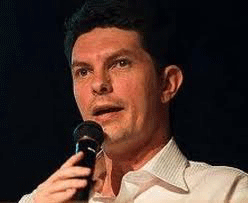 “This is the strongest vote [for the Greens] I’ve seen,” Senator Siewert said……Both major parties had low-profile lead candidates, he said, but the Greens had promoted a lead candidate – Mr Ludlam – who made the others look dull.
And the party was creative in its campaign, said Former Labor workplace relations and tertiary education minister Chris Evans………”It looks like Scott’s home and hosed,” Labor Senator Sam Dastyari said……”It will be interesting to see where the Greens end up – how much over a quota they’ll get.”
Inaction on Climate Change will harm Western Australia (- THE AUSTRALIAN Newspaper!)
 WA has a ‘lot to lose‘ http://www.theaustralian.com.au/business/latest/wa-has-a-lot-to-lose/story-e6frg90f-1226873306480 APRIL 03, 2014 West Australia stands to lose a great deal in terms of economic growth and quality of life as a result of inaction on climate change, according to a paper released today by Businesses for A Clean Economy.
The group – an alliance of the Carbon Markets Investors Association, the Clean Energy Council, the Climate Institute, the Investor Group on Climate Change and the WWF – said the state’s long term economic resilience and prosperity depend on national policies that factor in carbon pricing, regulation and catalyse private sector finance and investment.
Complementary measures such as the RET and energy efficiency programs, can provide for a decarbonised, productive and balanced growth pathway for WA’s economy.
“WA and the Clean Economy” highlights for Western Australia the specific impacts, costs of inaction and the economic opportunities in relation to climate change across a range of economic and environmental factors including employment, tourism, agriculture, and lifestyle and quantifies the risk of complacency and inaction.
Risks – key points
- Significant risk to WA coastal infrastructure due to WA’s sea levels rising at twice the global average;
- A 30% yield loss by 2050 due to WA’s drying trend (already causing a 43% reduction of wheat and winter crop production across the southwest wheat belt in 2010- 11 compared to the previous season).
- Threats to WA’s attractiveness as a tourist destination due to the loss of marine biodiversity caused by continued increases in oceanwater pH levels.
“The risks to Western Australia from inaction on climate change are alarming, more so because it is clear that reasonable policies could not only reduce the negative environmental impact but importantly provide WA with considerable opportunity and economic benefit,” said Kirsten Rose, CEO, Sustainable Energy Association of Australia.
“To unlock the opportunities in Western Australia business needs a long term, stable, cost effective policy that can achieve long term emission reduction targets now and facilitate the transition to a competitive low carbon economy”.
Opportunities – Key points
- 4500 new direct WA jobs created by the renewable energy sector by 2030;
- Identified opportunities for WA clean investment in new jobs in manufacturing, retail and agriculture as well as energy;
- Investment in WA’s regional economies due to abundant renewable energy resources (8% of WA’s produced energy being already being renewable)
“Western Australia’s access to the world’s best renewable resources; sun, wind, marine provide the opportunity for WA to lead low carbon growth, attract ongoing investment and create jobs,” said Kirsten Rose.
“WA has significant scope to further diversify the state’s economic development as well as efficiently reduce its emissions and accelerate the transition to a clean economy,” said Ms Rose.
“Business for a Clean Economy are calling for a return to bipartisan support for a market- based price mechanism linked to international markets, to provide greater certainty for business and stimulate investment in new technologies,” said Andrew Petersen, CEO, Sustainable Business Australia.
The B4CE (Businesses for a Clean Economy) Initiative was formed in 2011 by The Carbon Markets Investors Association, the Clean Energy Council, the Climate Institute, the Investor Group on Climate Change and the WWF. Sustainable Business Australia is the B4CE Secretariat. The Initiative has over 400 signatories from a broad range of business and industry sectors. (www.b4ce.com.au)
Scott Ludlam’s speech went viral -by 13 March 700,000 viewings
Scott Ludlam’s speech worth paying attention to, SMH, Elizabeth Farrelly 13 March 14 Australian politics measures itself in landmark speeches. Menzies’ ”forgotten people” speech, 1942. Keating’s ”Redfern” speech, 1992. Gillard’s misogyny speech, Hockey’s entitlement speech. And now, Scott Ludlam’s ”Welcome to WA, Tony Abbott” speech.
I like such speeches, if only for their comforting illusion that there’s more to our political life than the mundane squabble over money and resources. Not exactly ”I have a dream” territory, perhaps, but they do at least imply core principle.
And apparently I’m not the only one hungry for it. Sorry to say I don’t mean our political leaders, whose indifference to the parlay for which we pay them is so profound that Ludlam found himself delivering his adjournment speech to a near-empty Senate, occupied by just one of his 75 elected colleagues.
But it was the populace came thundering through on horseback. Ten days on YouTube garnered Ludlam’s speech 700,000 views; more than Cate Blanchett’s Oscar win. This kind of response makes Australian politicians’ disdain for principle the more surprising. Take, for example, Tony Abbott’s recent address to the ForestWorks dinner. It was a classic crowd-pleaser, a cynical exercise in wrongful and duplicitous nonsense.
Abbott told the logging industry lobby group that ”too much” of our pristine forest is protected, that loggers are the ”true conservationists” and that the Greens – which he characterised as ”the devil” – are to blame for Tasmania’s high unemployment, low life-expectancy and low school retention rates. It was dumb. It was embarrassing. But it worked.
The subtext was appeasement; a placatory sop to an angry state for Abbott’s shameless downgrade of his national broadband network optic fibre promise to slow old copper.
Against such background blather, statements of principle stand in stark contrast. True, even principled speeches can have destructive consequences. Menzies’ ”forgotten people” speech, in validating the middle classes, helped justify a century of bloat and sprawl. Helped feed the entitlement from which we are now forced painfully to resile.
Far more dangerous, however, are those speeches that appear principled and are not. A comparison of Ludlam’s ”Abbott” speech with Joe Hockey’s ”entitlement” speech is edifying here. The first, marked by a kind of reckless candour (driven, no doubt, by Labor’s threat to redirect preferences on April 5) is a lucid, point-by-point explication of principle. The other merely deploys principle to cloak economic expedience.
As opponents, the Liberals and the Greens could hardly be more adamant. Yet the weird thing is, if Hockey were serious about ending entitlement he would adopt just about every principle Ludlam so eloquently voiced……..
by far the bigger and more urgent picture is how entitlement on all our parts, and most especially the parts of wealthy hyper-consumers, drives our wanton planetary destruction.
Ludlam’s speech showed where Hockey’s reasoning should have taken him, if he’d only had the courage and imagination to go there.
Ludlam begged Abbott to see Western Australia as ”a place where the drought never ended, where climate change from land clearing and fossil fuel combustion is a lived reality that is already costing jobs, property and lives”. He sketched a moving vision of ”Australia as it could be – an economy running on infinite flows of renewable energy; a society that never forgets it lives on country occupied by the planet’s oldest continuing civilisation; and a country that values education, innovation and equality”.
He went on to log some of the ways in which Abbott’s government has allowed its agenda to be driven by expectations of entitlement. Entitlement to what? Well, broadly, to exploit natural resources for immediate financial gain, entitlement to predator capitalism, whatever the long-term cost.
Ludlam cited Abbott’s ”blank cheque” for West Australian Premier Colin Barnett’s ”bloody and unnecessary” shark cull (over which an unprecedented 12,000 public submissions were received), and his summary cancellation of half a billion dollars’ worth of funding for Perth light rail.
He also cited Abbott’s support for gas-fracking and uranium mining, despite the known dangers and evident toxicity. And Abbott’s determination to log Tasmania’s old-growth forests, pretending that they’re already ”degraded” when in fact only a fraction of the world’s-tallest flowering forest has ever been logged.
And Abbott’s support for Monsanto and other global biotechs, in proposing the so-called Investor State Dispute Resolution clauses for the Trans-Pacific Partnership agreement. ISDRs will effectively allow these massive biotechs, their clanking war-chests bigger than many state budgets, to sue Australian states that try to legislate against coal-seam gas or GM crops or for consumer labelling.
The writer Tim Winton says WA’s ground-wealth has bred a ”smugness that has paralysed parts of the communal brain”. Ludlam insists otherwise. This is his gamble, that we’re wrong to act ”as though the western third of our ancient continent is just Gina Rinehart’s inheritance, to be chopped, benched and blasted”.
Ludlam finished by thanking the PM because ”every time you open your mouth the Green vote goes up”. In three weeks, we’ll know whether he was right.http://www.smh.com.au/comment/scott-ludlams-speech–worth-paying-attention-to-20140312-34ml1.html
University of Western Australia has resisted intimidation from climate denialists
 ‘Conspiracist’ climate change study withdrawn amid legal threats April 2, 2014 Peter Hannam Lunar landings? Made in Hollywood. Smoking causes cancer? No way. And as for climate change, better not ask.
Or rather, better not study – at least if the case of a Swiss-based journal is any guide. It means that if a paper is published that the climate deniers don’t like the look of, they can bombard the journal with complaints or threats
Climate change academics say the decision by a publisher to retract their paper examining the links between conspiracy theorists and denial of global warming because of legal threats could have a “chilling effect” on research.
A year-long investigation “did not identify any issues with the academic and ethical aspects of the study,” it said. However, the probe found “the legal context (to be) insufficiently clear”.
The paper, though, is being carried by the website of the University of Western Australia where one of its authors, cognitive scientist Stephan Lewandowsky, was based.
“Sadly, it has turned into a routine for outsiders with no scientific standing to approach, bully, or intimidate journals, editors, and academics,” said Professor Lewandowsky, now at the UK’s University of Bristol.
One person commenting on the Frontiers’ website asked for the ‘‘full details of the investigation,’’ saying the paper had been ‘‘derogatory and insulting’’ by naming people as conspiracy theorists who were ‘‘merely pointing out errors in the previous paper’’.
According to Graham Readfearn ofDeSmogblog.com, the legal threats were that the paper was defamatory.
Scientific rejection
The genesis of the rejected paper was a 4000-word paper in Psychological Science in 2012 by Professor Lewandowsky and co-authors that explored the links between an endorsement of free-market economics and a rejection of climate change science.
Support for free markets was also a predictor of rejection of mainstream science in other fields, such the link between smoking and cancer, the authors wrote.
Endorsement of a range of conspiracy theories, such as a belief NASA faked the moon landing in a Hollywood studio or that the FBI had killed US civil rights campaigner Martin Luther King Jr., also predicted a climate change denial stance.
Professor Lewandowsky and co-authors then studied how internet bloggers reacted to their initial work, producing the Recursive Fury paper that Frontiers published in February 2013 and has now retracted.
“The extent and vehemence of contrarian activity provided a particularly informative testbed for an analysis of how conspiracist ideation contributes to the rejection of science among web denizens,” the authors wrote.
Responses took several paths: opponents objected to UWA alleging misconduct by Professor Lewandowsky; requests for freedom of information were submitted seeking emails and documents; findings were re-analysed to show the facts did not exist; and several theories began circulating “with arguably conspiracist content”, the researchers said.
Two typical conspiracist attributes emerged: an immutable belief that “something must be wrong” and that the authors were engaged in intentional malfeasance”, they wrote.
‘Bombard’ the journal
John Cook, a researcher at the University of Queensland and a co-author of the second paper, said the Frontiers’ decision to retract the work might have a “chilling effect” on research.
“It means that if a paper is published that the climate deniers don’t like the look of, they can bombard the journal with complaints or threats,” Mr Cook said.
“Knowing they have had success once might embolden them to try to retreat the strategy again.” (Mr Cook also helms the Skeptical Science website.)
Kim Heitman, a lawyer for the UWA, said the university had done its own risk analysis before publishing the paper online. “There’s no reason to take it down,” Mr Heitman said.
The university had also received complaints from some groups. “It’s quite relentless,” he said.
“There’s always a close interest in everything that Steve (Lewandowsky) does,” Mr Heitman said. “We are conscious that we are going to be targeted by people opposed to his works.”
The university, though, had also received plaudits from around the world for its decision to publish the paper.
“I couldn’t list them,” Mr Heitman said. “And I wouldn’t list them, having regard to the fact that anyone who issues a ‘thanks UWA’ will probably get their own enquiry.”
‘Spineless’
Elaine McKewon, one of the retracted paper’s three independent reviewers, said Frontiers had been “spineless” in its response to complaints. Kim Heitman, a lawyer for the UWA, said the university had done its own risk analysis before publishing the paper online. “There’s no reason to take it down,” Mr Heitman said.
The university had also received complaints from some groups. “It’s quite relentless,” he said.
“There’s always a close interest in everything that Steve (Lewandowsky) does,” Mr Heitman said. “We are conscious that we are going to be targeted by people opposed to his works.”
The university, though, had also received plaudits from around the world for its decision to publish the paper.
“I couldn’t list them,” Mr Heitman said. “And I wouldn’t list them, having regard to the fact that anyone who issues a ‘thanks UWA’ will probably get their own enquiry.”
‘Spineless’
Elaine McKewon, one of the retracted paper’s three independent reviewers, said Frontiers had been “spineless” in its response to complaints……….http://www.smh.com.au/environment/climate-change/conspiracist-climate-change-study-withdrawn-amid-legal-threats-20140402-35xao.html
Wiluna Martu peoples condemn Toro Energy’s expanded uranium mining plan
 Wiluna Martu peoples against uranium mining, The Stringer, by Gerry Georgatos March 29th, 2014 Elders have condemned a move by Toro Energy to expand their yet unrealised Wiluna mine plan into a much larger uranium precinct spanning 100km and which will destroy ecologically sensitive lake systems. Local Wiluna Elder Glen Cooke said everything must be done to prevent this mine which is intended as Western Australia’s first uranium mine – the first of many.
“The lives of not only our people today are at stake but the future of our people into time immemorial. This uranium mining if it goes ahead will spell the end of us as custodians of the land. It will make toxic the land, preventing us from caring for the land, it will poison the rivers that we swim in, drink and fish from,” said Mr Cooke.
First Peoples anti-nuclear groups have coalesced to stand in the way of uranium mining in Western Australia
But the mine is destined to be operational next year.
WA’s Environmental Protection Authority (EPA) released details of the Toro Energy expansion plan. But Wongi anti-nuclear campaigner, Kylie Fitzwater said that Toro had a long way to go in gaining new approvals in expanding from their single-mine approved project. “The company needs to complete additional environmental management, mine closure, tailings management and transport plans for assessment before any mining can commence at the Wiluna site.”
“But we need to stop this mining proposal altogether which will only risk people and communities from toxic radiation,” said Ms Fitzwater.
“It is not just about the cumulative impacts of a regional uranium precinct covering 100km and two lake systems but about the lives lost, the communities destroyed, and the door opening in WA for a rush of nuclear mad investors.”
“Toro plans to double its water consumption and store radioactive mine waste from several mine sites in a Lake bed.”………..
The Central Desert Native Title Service released a statement on the uranium mining proposal. “The Wiluna Martu People’s previous experience with uranium exploration in the Wiluna region has left them with serious and genuine concerns about the health effects of radiation. It also raised questions about the Government’s capacity to properly regulate uranium exploration and mining on their Traditional Lands.”
“The issue of uranium mining is not something that Martu have invited. Rather under the current policy and State regulatory environment it is something they are forced to confront in order to ensure that their Traditional Lands and their people are sufficiently recognised and protected.”http://thestringer.com.au/wiluna-martu-peoples-against-uranium-mining/
Greens leader Christine Milne is scathing about Tony Abbott’s lack of climate policy
 Tony Abbott a fool on climate change says Greens leader Christine Milne WA Today, April 1, 2014 Judith Ireland “………We have a government with its head buried in the 19th without a plan for the nation in the 21st century.
With no plan for the future, Tony Abbott will fail as Prime Minister.
No one can lead at this moment without a plan to address global warming. It is a defining characteristic of leadership to identify the risks and threats to the nation and lead people to address them. The IPPC has made it clear. Time has run out, we are suffering already and are on track for 4 degrees of warming and we are not prepared. The Greens are the only party in the Australian Parliament who recognise the two possible futures, as the IPCC has said: “one of inaction and degradation of our environment, our economies, and our social fabric. The other, to seize the moment and the opportunities for managing climate change risks and making transformational changes that catalyses more adaptive and resilient societies where new technologies and ways of living open the door to a myriad of health, prosperity and job- generating benefits. The path of tomorrow is undoubtedly determined by our choices today. We must decide which path to follow.”
The Greens have chosen the future of transformational change – the government has not.
Nowhere is this lack of a plan for a climate change dominated future more obvious than in WA.
Yesterday’s report from the Intergovernmental Panel on Climate Change emphasised the enormity of the global task to avoid climate. In WA, the south west of the state is drying out, and Perth recently recorded its second hottest summer on record and sweltered through their hottest night on record ever, at 29.7 degrees, life will get harder with more heatwaves and extreme fire danger days resulting in loss of life and reduced productivity.
Tony Abbott is a fool to pretend climate change is not happening and even more foolish to try to prevent action that would help people, create jobs and create a future for WA, and the country, after the mining boom………
This election offers WA the chance to vote for a future which takes the science of climate change into account, delivers billions of dollars and jobs in renewable energy, public transport, housing and education, saves money on power bills by supporting solar and gives hope and the promise of happiness to this and the next generation by standing up for people and the environment in the face of the biggest power grab for the greedy seen in generations.
If you’re feeling the “vibe” Vote Green! http://www.watoday.com.au/federal-politics/political-news/christine-milnes-speech-to-the-national-press-club-april-1-20140401-35vnj.html
Aboriginal elder treated with disrespect by Toro Energy uranium company
Wiluna Martu peoples against uranium mining, The Stringer, by Gerry Georgatos March 29th, 2014 “……. “The Senior Lawmen acknowledge that there are divergent views about uranium mining within the wider Martu community and these divergent views have to be accommodated in this negotiation.”
Late last year and earlier this year Mr Cooke walked into Toro Energy AGMs and expressed his concerns at the prospective impacts on Martu Country were the uranium mines to proceed. He is also concerned that signatories to the mining proposal from within his people have been “misled”.
“The signatories have been persuaded to believe the uranium operation will have low environmental impacts.”
“These people are targeted and influenced by deals to sign over the rights of the land. These people Toro talked to are now driving around in Toyotas they didn’t have before. About eleven Toyotas just appeared,” said Mr Cooke.
“We must care for our land and children and not put our future at risk. These corporations only want to make money, they are full of broken promises.”
Ms Fitzwater accompanied Mr Cooke into the Toro Energy AGM. “When Elder Glen Cooke asked a question he was treated abruptly by Toro and with complete disrespect. He was not permitted to reiterate any questions. It is clear the company tolerates no opposition and has been unfair and biased during their submission period no matter what their convictions.”
“The EPA should seriously reconsider this approval basis and commit to protecting our ecosystem. Our State cannot afford this mistake, we will pay the consequences for an incomprehensible amount of time. This concerns all Australians,” said Ms Fitzwater.
Mr Cooke said he has a complete understanding of the effects of radiation. He was eight years old when the Maralinga atomic tests took place.
Former radiation worker, Bill Macham said that Governments must amend legislation from measures of understanding radiation effects in terms of “half lives and instead to baseline measures of what are biologically safe levels”. With anti-nuclear activists relocating to Alice Springs and the Arnhem to support communities and Elders against uranium expansion, the call for the closure of Jabiluka and for Muckaty to not be used as a radiation waste dump, it appears the next generation’s tensions will highlight the proliferation of uranium mining and the rapacious rise of nuclear reactors.
“For those who care about the earth and people, this is our duty, if those who don’t care about the earth and people win their war to make piles of money, then there will come the day that this earth and its people will pay very high, at what cost to the earth and to people, well we’ve seen Fukishima and Chernobyl,” said Mr Cooke. http://thestringer.com.au/wiluna-martu-peoples-against-uranium-mining/
Western Australian election: is Clive Palmer’s Party FOR or AGAINST the Renewable Energy Target?
 RET And PUP – Confusion (Still) Reigns http://www.energymatters.com.au/index.php?main_page=news_article&article_id=4244 The Palmer United Party (PUP) still appears not to have a solid stance on the future of Australia’s Renewable Energy Target (RET).
PUP’s WA candidate, Zhenya ‘Dio’ Wang, recently expressed support for the Renewable Energy Target to be left as is and Clive Palmer appeared to indicate the same view. Shortly afterwards, Mr. Palmer clarified; stating it perhaps shouldn’t be a “mandatory thing”.
Nearly 2 weeks later and it seems there still isn’t a unified position at PUP.
According to the Guardian, a PUP spokesman told the publication on Monday “the policy is what Clive says; the target has to be voluntary”. However, when Mr. Wang was again asked about when asked about the RET policy on Monday; he told Guardian Australia, “We are still discussing our policy. We are working out what it is.”
With voters set to go to the polls in Western Australia this Saturday, the mixed signals from PUP wouldn’t be very encouraging for solar supporters considering the party – and the outcome of WA’s election could have major implications nationally for renewable energy.
According to the Australian Solar Council, 500,000 WA residents live in solar households and hundreds of thousands more will go solar if the RET is left as is; something that is in doubt due to the Federal Government’s RET review.
“By putting barriers up for 350,000 people in WA who want to install solar on their homes and slashing large-scale solar projects back from the current path of 700 MW, the Federal government looks set to break a key election promise,” says Australian Solar Council CEO John Grimes.
Mr. Grimes says Western Australian householders and small businesses will invest their own money to build 445 megawatts of generating capacity if the RET is retained for rooftop PV systems and hot water. With regard to large-scale solar, the existing RET could deliver more than 700 MW of projects in WA, employing an additional 7,000 people during the construction phase between now and 2020.
With solar so popular in the state; the parties that clearly support the RET in its current form may have a bit of an edge this Saturday.
1 This month

of the week – Disrupting War & Militarism in Oceania. Active solidarity. Radical practice.
 Antinuclear