It turns out that W.A.’s ‘Poles and Wires’ (not renewable energy) are the culprit in high electricity costs
The news is cold comfort to those who have been fighting myths and misinformation for years regarding the true villains of electricity price rises and extolling the benefits of clean, distributed energy generation – including a reduction in infrastructure spending. Sadly, it appears the message still may not be getting through to some.
$1 Billion Power Pole Price Blowout For Western Australia http://www.energymatters.com.au/index.php?main_page=news_article&article_id=4039 21 Nov 13 ‘Poles and wires’ have been the major culprits behind electricity price increases in recent years – and there’s more bad news on this front for Western Australia. Western Power’s 5 year maintenance plan for its wood pole network may have originally been just a little optimistic on the expense and time side of things. It was initially estimated to cost $1.35 billion. Continue reading
Renewable energy project for Perth
Power station plan promises ‘renewable energy to the south-west’ ABC News, Mon 18 Nov 2013, A private company is proposing to build a renewable energy station in Perth that would add power to the south-west energy grid using recycled waste.
A six-week public consultation period is open for New Energy Corporation’s proposal for the gas-fired power station in east Rockingham. Gas produced from waste material will be burnt to produce electricity for the grid.
The Environmental Protection Authority (EPA) has already approved the technology for the company at a similar facility in Port Hedland.
New Energy’s Jason Pugh says renewable energy is a sustainable option considering the struggles of the south-west coal industry.”Certainly with some of the issues that the coal industry is going through and also the price of energy in the market at the moment, this project represents a real opportunity to get renewable energy to the south-west,” he said.
He says renewable energy is becoming vital considering the struggles faced by the coal-fired energy industry in Collie. “The technology that we’re employing has already been approved by the EPA in our Port Hedland facility at Boodarie but we acknowledge that the community is the major stakeholder in this project, so we’re working really hard to inform the community through this process, firstly through the six-week period,” he said…….http://www.abc.net.au/news/2013-11-18/power-station-plan-promises-renewable-energy-to/5099426
Government may target Western Australia for radioactive trash dump
 Mr Sweeney said substantial nuclear waste was created at Australia’s nuclear reactor Lucas Heights, 31 kilometres from the Sydney CBD, and not medical waste from cancer treatments and scientific research as the government has previously stated.
“Nuclear medicine is not the driver,” Mr Sweeney said.
“It’s deeply misrepresentative. The government has been asked not to use this language.”
 Western Australia in nation’s nuclear waste dump sights SMH, Leanne Nicholson, 12 Nov 13 Australia’s nuclear waste could be dumped in Western Australia if a Federal Court challenge by traditional owners against a Northern Territory site selected by the federal government is successful.
WA, the only state with a dedicated low-level nuclear waste storage facility, has been identified by leading environmental group Australian Conservation Foundation as a legitimate option for a national nuclear waste dump if a challenge by Muckaty Station traditional owners is upheld.
Traditional owners will contest plans for the proposed low-level and intermediate level nuclear waste dump, selected by the then-Gillard government in 2010, on the Aboriginal freehold landholding, also known as Warlmanpa. The challenge states the nomination of Muckaty is invalid and the Northern Land Council did not correctly identify the traditional owners, did not consult adequately and did not get proper consent before recommending the site.
ACF’s nuclear free campaign director Dave Sweeney told Fairfax Media that if the challenge was successful, WA – previously named as a possible site for nuclear waste storage – would be considered a feasible location. “Clearly if Muckaty falls over,” Mr Sweeney said, “everywhere is going to come back into the frame and WA wasn’t ticked off but it was in the frame. Continue reading
Western Australia’s biggest national park faces uranium threat
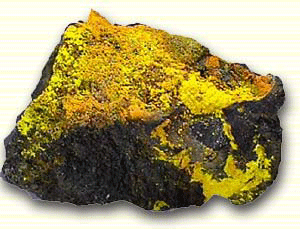 WA’s biggest national park faces uranium threat National and state environment groups have vowed to fight plans for a uranium mine that would directly threaten Western Australia’s largest national park. The Australian Conservation Foundation and the Conservation Council of WA will join groups across the nation to challenge plans by the Canadian multinational Cameco, which today lodged an Environmental Review Management Plan for the Kintyre uranium mine at Karlamilyi National Park (Rudall River) with the WA Environment Protection Agency.
“Kintyre is in one of the most unique and diverse ecosystems in the country and is directly connected to WA’s largest national park,” said ACF campaigner Dave Sweeney. “The proposal to mine at Kintyre has been actively contested since the 1980s and will continue to be a priority issue for the environment movement given the high conservation values of the area and the unique risks of uranium mining.
“Many things have changed since the first proposal to mine Kintyre, including a severe and sustained slump in the uranium price and increased pressure on nuclear power from the growth in renewable energy and concerns fuelled by the continuing Fukushima crisis.“This is not the time – and certainly not the place – to give a green light to yellowcake.”
The Kintyre uranium deposit is nestled between two branches of Yanadagodge Creek which feeds springs and lake systems throughout the Karlamilyi National Park and the communities of Punmu and Parngurr. Radioactive contamination of water sources is already an issue in the area with elevated uranium levels found in Parngurr’s (Cotton Creek) drinking water.
“We will use every available avenue to challenge this dangerous proposal,” said CCWA campaigner Mia Pepper. “Cameco’s plan for a 1km wide, 1.5km long open pit only 500 metres from the Yanadagodge Creek could have devastating impacts on this fragile desert ecosystem.”
“Uranium poses unacceptable and unnecessary risks to the environment and public health. Cameco’s plan is a long way from being economically viable or environmentally approved.”
Cameco’s plan will be open for public comment for fourteen weeks.
Contact: Dave Sweeney 0408 317 812 or Mia Pepper 0415 380 808
Energy storage batteries could soon make solar households independent of the grid
 Solar has power to cut grid reliance http://au.news.yahoo.com/thewest/a/-/wa/19635839/solar-has-power-to-cut-grid-reliance/ Thousands of WA households with solar panels could begin disconnecting from the electricity grid once batteries became “affordable and reliable”, Australia’s peak renewable energy lobby has claimed.
Warning about the huge financial implications for traditional energy businesses unless governments got policy settings right, the Clean Energy Council said residential solar customers could soon become independent of the network. Continue reading
Climate change brings longer bushfire season to Southern Western Australia
Fire season is longer E Daniel Mercer, The West Australian October 30, 2013 Southern WA’s bushfire season is up to six weeks longer than 20 years ago, according to a leading firefighter who has warned that preparations are increasingly being hampered by climatic and urban obstacles.
Ahead of 35C temperatures forecast for Perth today, the Department of Parks and Wildlife’s Roger Armstrong said firefighters faced a double whammy as bushfires became more extreme but prescribed burning became harder.
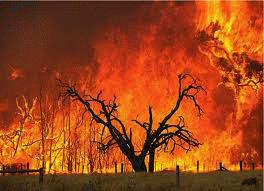
The ominous comments from Mr Armstrong, the department’s principal fire planner, come after his agency burnt just 21,000ha out of a controlled burning target of 200,000ha across the South West last year.
Mr Armstrong said though an overhaul of the department’s prescribed burning policies had contributed to the most recent shortfall, in general it was becoming more difficult to do burns.
He said this was because weather conditions most suitable for burning – which usually happens in spring and autumn – were becoming less frequent so fewer burns could be carried out. He said that added to this was a growing intolerance in urban communities such as Perth of smoke associated with prescribed burns – a trend Mr Armstrong said was exacerbated by the tree-change culture.
Amid a dramatic decline in South West rainfall and rising temperatures, the upshot was likely to be more intense bushfires that would cause more damage to lives and property, he said.
“Certainly our observations are that our bushfire season tends to be about six weeks longer now compared to what it was 20-odd years ago,” Mr Armstrong said.
“Our prescribed fire opportunities have been constrained, which means we don’t get to treat as much of the landscape as we would like to. So the potential for bushfire, the area that’s available in high-fuel condition for bushfire, is greater.
“It’s a circuitous route and it’s here to stay.
“It is challenging, particularly where people with the sea-change, tree-change thing.”………………. Weather Bureau regional manager Neil Bennett said conditions typically associated with spring and autumn were becoming rarer as winter and summer increasingly prevailed in the South West. http://au.news.yahoo.com/thewest/a/-/wa/19597504/fire-season-is-longer/
ASX investigation casts shadow over Toro uranium company’sAGM
 18 Oct 13 At today’s AGM Toro Energy is expected to face strong criticism from shareholders over an investigation by the ASX into claims that the company has released misleading information.
The investigation follows complaints to the ASX and ASIC by the Conservation Council and a shareholder, claiming that Toro has misled shareholders and investors by inferring that a newly discovered uranium deposit is included in their existing uranium mine proposal at Wiluna.
Toro Energy has an existing application to mine uranium at Wiluna which is limited to its Lake Way and Centipede deposits. This mining proposal has received a conditional environmental approval but requires a number of other approvals from both State and Federal regulators.
Nuclear Free Campaigner, Mia Pepper explained “The new deposit mentioned in Toro’s latest release to the ASX is not part of the current Wiluna mining proposal as suggested, and will require new and separate environmental and mining approvals which will add further delays and costs to Toro’s mining plans at Wiluna.
“This is not only misleading for shareholders, but we are concerned Toro Energy is attempting to avoid proper environmental assessment for their long-term plans for a uranium precinct at Wiluna.
“Toro want the ‘best of both worlds’ by promoting an expanded project to their shareholders and investors, while withholding the details of this expansion from the community and government regulators.
“We have also written to State and Commonwealth regulators calling on them to halt further approvals for Toro’s Wiluna proposal until they are able to undertake a full cumulative impact assessment of the company’s long-term plans.”
In addition to the lack of approvals, there are a range of serious environmental and other constraints to the expansion of the already problematic Wiluna proposal.
Ms Pepper continued “The Wiluna uranium proposal as it is, is an environmental catastrophe waiting to happen with plans to dump 9.1 million tonnes of radioactive mine waste in a Lake bed, and with only enough water for a third of the life of the mine.
“If Toro were to incorporate additional deposits, the proposal would be drastically different. A 100km network of small shallow uranium mines and waste dumps across two Lake Systems is very different to a single mine. The cumulative impact of these operations must be fully assessed.
People will be handing out economic reports to shareholders entering the AGM from 8.30am – 9am at the Celtic Club – 48 Ord St West Perth.
Media Comment – before and after the shareholders meeting:
No new renewable energy for Western Australia – says State government
 WA government says no to new renewable energy REneweconomy, By Giles Parkinson on 8 October 2013 Western Australia has some of the best solar and wind resources in the world. But for the foreseeable future they are likely to go largely undeveloped because the state government has indicated that it will not support any new large scale renewable energy developments on its main grid. It will prefer instead to subsidise the construction of wind farms and solar farms in the eastern states.
The admission came in a series of speeches delivered recently by WA Energy Minister Mike Nahan which highlighted what a dog’s breakfast – and a very expensive dog’s breakfast at that – the state’s electricity grid had become. Continue reading
Western Australian Aboriginal call for voices other than Warren Mundine’s
NACCHO health political update week 4: National and WA peak bodies express concerns about Indigenous voice NACCHO Aboriginal Health News Alerts 2 Oct 13
As we enter week 4 of the new Abbott led Government , the future of Aboriginal affairs and specifically Aboriginal health is still uncertain. Last week in Western Australia a number of Aboriginal organisations including NACCHO affiliate Aboriginal Health Council of Western Australia (AHCWA), the Kimberly Land Council and the National Congress of Australia’s First Peoples expressed concerns about “Indigenous voices”. Aboriginal Health Council of Western Australia (AHCWA)
Western Australia’s peak Aboriginal health body says they agree wholeheartedly with recent statements by the Kimberly Land Council that 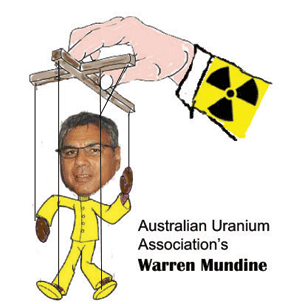 Warren Mundine is not the only Indigenous voice but urges the government to remember that land isn’t the only Indigenous issue.
‘Tony Abbott’s Indigenous Advisory Council needs a strong voice from Western Australia, but that voice needs to represent all the interests and needs of Aboriginal people and their communities,’ says Des Martin, Aboriginal Health Council of Western Australia (AHCWA)
While Mr Martin acknowledges land rights are an important issue, the health and wellbeing of Aboriginal people cannot be forgotten, he says.
‘I agree wholeheartedly with Kirstie Parker’s statement that Warren Mundine isn’t the only voice for Indigenous people and I support what the Kimberley Land Council does, it is extremely important for all Aboriginal people to have their country and care for it to secure their future but if their health is still suffering then that isn’t a good thing for them or future generations,’ Mr Martin says.
‘We need broad representation on the Indigenous Advisory Council, not just land or business interests. Tony Abbott does need to take advice from more than one source when it comes to Aboriginal people. Continue reading
Western Australia’s Mumbida Wind Farm officially opened
The WA Water Corporation will purchase 100 percent of the wind farm’s output for its Southern Seawater Desalination Plant near Binningup. That plant is also powered by the 10 megawatt Greenough River Solar Farm – Australia’s first utility-scale solar farm.
“In a typical year electricity production from the wind farm will be equivalent to the electricity consumption of 35,000 homes and will displace 200,000 tonnes of greenhouse gas emissions,” says Verve Energy.
The Mumbida Wind Farm has been designed to be expanded to 85MW in the future.
 All Systems Go For Mumbida Wind Farm http://www.energymatters.com.au/index.php?main_page=news_article&article_id=3964 1 Oct 13 The 55MW Mumbida Wind Farm in Western Australia has been officially opened. A joint venture of Verve Energy and Infrastructure Capital Group (ICG), the facility is located on farmland situated approximately 40km southeast of Geraldton in the mid-west of Western Australia. Continue reading
Visy group seeks funding grant for waste to energy plan, but will proceed anyway
Visy Group backs waste plan as funding flees http://www.theaustralian.com.au/business/companies/visy-group-backs-waste-plan-as-funding-flees/story-fn91v9q3-1226724734376 DAMON KITNEY SEPTEMBER 23, 2013
THE Pratt family’s Visy Group will not rule out proceeding with a revolutionary $300 million project to turn household garbage into energy that would generate 3000 jobs across the economy, despite federal government moves to slash funding for clean energy projects.
The government last week scrapped the Climate Commission and has previously indicated it wants to wind up the $10 billion Clean Energy Finance Corporation created by Labor to fund renewable energy projects that would otherwise struggle to get commercial backing.
Visy is seeking $100m in government funding for the $200m waste-to-energy plant from the Australian Renewable Energy Agency, or ARENA, the independent statutory body established to provide financing assistance for projects that strengthen renewable energy and energy efficiency technologies. Continue reading
Investors warming to Western Australia’s Wave Energy Project
 Wave Energy wins over wary investors CRITERION THE AUSTRALIAN SEPTEMBER 27, 2013: “……….a jack-up rig is being towed from the North West Shelf to Perth’s naval base, to put in place Carnegie’s wave-power installation at Perth’s Garden Island naval base.
The 720-kilowatt plant will be the first manifestation of Carnegie’s CETO wave technology, which employs bulbous sub-sea structures anchored to the sea floor.
With the funding, an offtake deal and pesky state approvals in place, Carnegie is winning over hitherto wary investors.
While the construction aspect is not new — it’s akin to installing an oil rig — CETO technology is novel.
Carnegie so far has sunk $70 million into the technology, $50m sourced from its 7000-odd holders (whose patience and passion exceeds that of even the Dockers’ member base).
French utility EDF has chipped in $10m and is funding a joint pilot plant at Reunion Island, where power is generated from expensive diesel.
Carnegie has drawn down only $4m of $22m of federal and WA government grants. The federal money is sourced from the Australian Renewable Energy Agency, which the Coalition has no plans to gut (unlike the Clean Energy Finance Corporation). http://www.theaustralian.com.au/business/opinion/wave-energy-wins-over-wary-investors/story-e6frg9lo-1226727885953#sthash.yuNFQiqh.dpuf
Ambitious community wind farm project for Fremantle?
Fremantle Community Wind Farm , Pozible, By Claire Vanderplank, Raoul Abrutat, Louis Kent, Rowan Gallagher, Michael Fuller and Jamie Ally The Fremantle Community Wind Farm is an ambitious project to build 8 to 12 community-owned wind turbines along the breakwaters at Fremantle Port. With 8 turbines sized to fit within the port landscape, the project would produce enough electricity for 3300 average Australian homes.
We are so passionate about this project. It will produce clean energy and distribute profits locally. With Fremantle’s connection to the wind and water and its identity as a progressive city, the project has great potential to produce cultural and social capital. It also has educational and awareness-raising potential due to the prominent location. Check out our website and Facebook page for all the details.
The project is at a critical point in time; ready to go ahead however facing one key barrier, land access. The community’s voice is required to make it happen. There are too many myths and misperceptions blowing around regarding wind farms that are holding this, and other projects, back. We are on a mission to set things straight.
Toro’s Vanessa Guthrie optimistic in the face of uranium’s financial disaster
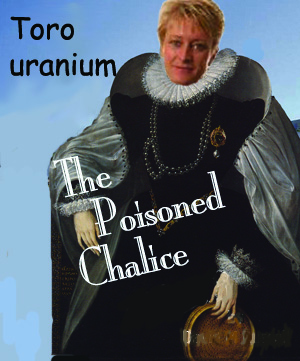 INTERVIEW -Uranium miners face new hurdles as Fukushima disaster worsens Reuters, Aug 21, 2013 By James Regan
* Uranium miners face uncertainty as new Fukushima nuclear disaster unfolds
* Australia’s Toro says need for new uranium mines still stands
SYDNEY, Aug 21 (Reuters) – Revelations of more toxic leaks from Japan’s Fukushima Daiichi nuclear power plant will raise second-thoughts about Japan’s nuclear future, but won’t halt the long-term global expansion of the industry, the head of a uranium mining company said.
“It reinvigorates the heightened state of nervousness, it surely will make the Japanese government and nuclear regulatory authorities more cautious and conservative in the decisions about the restart,” said Vanessa Guthrie, managing director of Australia’s Toro Energy Ltd, which expects to start mining uranium in Australia in 2016.
Japan is set to raise the severity rating of the leak to level 3, or “serious incident”, on an international scale for radiological releases, underlining a deepening sense of crisis at the site.
The price of uranium, used mainly as fuel for nuclear reactors, plunged after the March 2011 meltdown at the Fukushima plant 240 km (150 miles) from Tokyo and has struggled to recover ever since. August uranium futures stood at $35.15 per pound on Wednesday compared with $68 per pound before the earthquake and tsunami that triggered the disaster.
However, Guthrie said contract prices between uranium miners and buyers standing at around $58-$59 a pound more accurately reflect the supply and demand balance than the spot price.
Operating costs in the industry range between $22-$25 per pound up to the high $40s, Guthrie said……
Deluded optimism in uranium industry, with price in free fall
Since the Fukushima disaster — a continuing nuclear crisis fuelled by Australian uranium — the price has been in free fall.
Industry advocates remain adamant or delusional that there will be a commodity price recovery but, looking at the sector’s vital signs, we find a weak pulse….. people outside of the uranium industry do not share the optimism about a uranium price recovery.
For new comers like WA uranium hopeful Toro Energy this does not bode well.
When a small inexperienced company like Toro are competing with existing operating mines for scant finance and market access, the $260 million needed to start the proposed Wiluna mine and the further $150-$260 million in upfront bonds looks more and more like “the dream that failed” a term coined by The Economist.
 Uranium industry in crisis of confidence http://www.greenleft.org.au/node/54727#sthash.TOxcBrLT.dpuf August 11, 2013 By Mia Pepper, Perth While Australia’s mining sector shows signs of resilience, there is one mineral whose outlook may be terminal.
There are five significant events that have occurred recently that send a clear message about the future of the uranium sector and the wider nuclear industry.
The uranium price dropped to US$34.50 a pound Energy Resources of Australia, the operator of the Ranger uranium mine in Kakadu, announced a $54 million loss.
Perth-based uranium miner Paladin Energy failed to sell a stake in its Langer Heinrich mine in Namibia. French nuclear giant EDF announced its exit from nuclear power in the US and Duke Energy cancelled two proposed reactors in Florida.
These incidents are neither isolated nor unrelated — they are significant indicators about the health of nuclear industry. The uranium price was around US$20 through much of the 1980s and 1990s. It increased dramatically around 2005 with the promise of a “nuclear renaissance” but began a steady drop in 2007 through to the end of 2010.
Since the Fukushima disaster — a continuing nuclear crisis fuelled by Australian uranium — the price has been in free fall. Continue reading
1 This month

of the week – Australians for War Powers Reform (AWPR)
To see nuclear-related stories in greater depth and intensity
 Antinuclear