Solar Citizens bring about Government U-turn in Western Australia – national repercussions?

 Barnett Backs Down From Solar Backflip http://www.energymatters.com.au/index.php?main_page=news_article&article_id=3885 13 Aug 13, Solar supporters rejoiced after the Western Australian State Government yesterday reversed its decision to slash the feed in tariff rate for tens of thousands of solar households.
“Quite simply, we got this decision wrong and we have to fix it,” Premier Colin Barnett said in a short statement.
“We understand that this measure would have had an unfair impact on one section of the community and it has to be reversed.”
Within hours of the original decision to slash the incentive, solar households and supporters mobilized. Mainstream and social media was buzzing with condemnation. A Solar Citizens petition was launched that very quickly attracted over 9,000 signatures protesting the reduction.
Even within the State Government’s ranks, there was dissent. Overall, the backlash was such that it had the potential to impact results in the Federal Election. Continue reading
Toro Energy and Mega Uranium making a big mistake in acquiring Lake Maitland

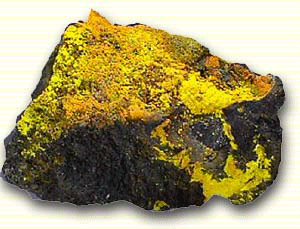 Toro’s mega mistake Mia Pepper – Conservation Council of WA 12 August 2013 WA uranium hopeful Toro Energy’s acquisition of Lake Maitland, another small calcrete uranium deposit in a sensitive Lake system, is based more on optimism and need rather than any measured assessment of the deeply depressed uranium price and nuclear sector said the CCWA today.
The acquisition between Toro and Mega Uranium does little to change the fundamental constraints facing each company and may well be Toro’s mega mistake.
It is a further sign of the difficulties facing junior uranium companies in a time of falling commodity prices and rising costs. Toro and Mega may share big dreams but they do not have big capacity, experience or dollars.
Toro cannot begin construction at Wiluna and do not have final and formal approval to mine at Wiluna. Instead the company has a conditional Federal approval that involving 35 conditions and requires further assessment from the Federal Minister.
The conditional nature of the approval prohibits Toro Energy from clearing vegetation or using heavy machinery for breaking ground for mining or infrastructure. Toro must also complete a mine closure plan for both State and Federal level assessment.
A recent independent economic analysis of the Wiluna project (attached) found that:
The Wiluna project’s lack of scale and high sensitivity to changes in operating or capital costs means our estimate of its position on the mine production cost curve is perilously high. The project would be highly vulnerable under our model, in the event of sustained lower long-term contract prices in the next decade. On both a cash and total economic cost basis our model suggests Wiluna is a high cost project that will struggle to compete against either existing mines or most greenfield and brownfield projects. For the full report: http://www.ecolarge.com/work/osos-sobre
Western Australia: Liberals rebel against govt reneging on solar energy deal
Liberal rebellion on solar heats up, The West, Gareth Parker and Daniel Mercer, The West Australian August 12, 2013, 2 Colin Barnett is facing a backbench revolt over the State Government’s decision to halve its rooftop solar panel subsidy, with a pair of Liberal MPs accusing the Government of lacking integrity.
The growing rebellion came as a letter from Synergy sent in 2011 emerged as a key piece of evidence in any potential legal fight over
the changes. The letter – sent soon after the Government cut the tariff in a previous revision to the scheme – says that customers entitled to the
40 cent payment would get it “for the full term of your 10-year contract”.
Government MPs have been flooded with complaints from irate voters about the decision to cut to the so-called solar feed-in tariff from
40 cents to 20 cents, with the issue spilling over to the Federal election campaign as a vote turn-er against Liberal candidates.
Maverick Hillarys MLA Rob Johnson threatened to cross the floor for the first time in his 20-year career to vote against the measure,
while Southern River MLA Peter Abetz said the Government had acted unethically.
Mr Johnson said the Government was acting with a “lack of integrity” by reneging on a deal with 75,000 solar panel owners in a bid to save
$51.2 million over the next four years. Continue reading
Western Australian government’s solar rate cuts will be fought by Labor
WA Labor promise fight over solar rate cut http://www.heraldsun.com.au/news/breaking-news/wa-labor-promise-fight-over-solar-rate-cut/story-fni0xqi4-1226695095998 AAP AUGUST 11, 2013 WEST Australian opposition leader Mark McGowan has promised to “take on” Premier Colin Barnett after the state government reneged on a 10-year undertaking for households that feed in solar power to the grid.
Mr McGowan tweeted on Sunday: “Anyone unhappy with Mr Barnett ripping up their families solar contract should come to parliament at 2.45pm Tuesday where we will take him on.” It follows Thursday’s state budget in which Treasurer Troy Buswell announced that the government would halve the residential solar feed-in tariff rate to save $51 million.
The state government believes it is safe from legal action over the decision, despite many householders expressing their outrage on talkback radio.The program, introduced in 2009, was such a success that the Liberal government had to admit in 2011 the take-up cap had been breached, costing about $46 million more than planned.
The Sustainable Energy Association says more than 75,000 WA households will be affected. Mr McGowan described the solar backflip as another “broken promise” from the Barnett government.
Senator Ludlam asks awkward questions on Wiluna uranium mine project
 WILUNA URANIUM PROJECT – MINE CLOSURE PLAN http://www.greens.org.au/wiluna-uranium-project-mine-closure-plan Senate Standing Committee on Environment and Communications
Legislation Committee Answers to questions on notice Sustainability, Environment, Water, Population and Communities portfolio
Budget Estimates, May 2013
Topic: Wiluna uranium project – mine closure plan
Senator Ludlam asked: But how much work around mine closure had been assessed by the minister? Presumably, something must have been done or he would not have had the confidence to give this thing the tick, even a conditional tick?
Ms Jones: Through the assessment process there were assessment documentation in draft and final form. Supplementary information was sought by the minister from the proponent on issues that cut across this matter. To give a succinct response, I would probably have to take that on notice and come back to you, Senator.
Senator LUDLAM: Maybe if you could, yes. I am interested in the degree to which the approval conditions side is open-ended. Does it have any lapse date at all, or is this an approval in eternity? If the company comes back in 20 years, will it be live, or does it have a lapse date?
Answer:
The proposed action was assessed by the Western Australian Environment Protection Authority under the bilateral agreement between the Commonwealth and Western Australian Government. The State assessment report addressed the issue of mine closure, including assessment of an Environmental Management Strategy for Mine Closure and Rehabilitation provided by the proponent. The Minister considered the State assessment report. The Minister also sought further information from the proponent in relation to the long-term integrity of the tailings storage facility, which was reviewed by the Supervising Scientist Division, Geoscience Australia and the Australian Radiation Protection and Nuclear Safety Agency.
The approval is valid until 31 March 2043. Condition 2 of the approval states that if, at any time after five years from the date of this approval, the person taking the action has not commenced the action, then the person taking the action must not commence the action without the written agreement of the Minister.
For Western Australia’s Toro Energy uranium project, the outlook may be terminal
 Nuclear not worth digging or dealing http://ccwa.org.au/blogs/nuclear-not-worth-digging-or-dealing#.UgWPQ9Jwo6I August 9th 2013 by Mia.Pepper Article published in the Kalgoorlie Miner 9th August 2013
At this week’s Diggers and Dealers, low commodity price and high production costs have been a focus of attention for the entire minerals sector. While, overall, Australia’s mining sector shows signs of resilience, there is one mineral whose outlook may be terminal.
There are five significant recent events that have occurred recently that send a clear message about the future of the uranium sector and the wider nuclear industry. The uranium price dropped to US$34.50lb. Energy Resources of Australia, the operator of the Ranger uranium mine in Kakadu, announced a $54 million loss. Perth –based uranium miner Paladin Energy failed to sell a stake in its Langer Heinrich mine in Namibia. French nuclear giant EDF announced its exit from nuclear power in the US and Duke Energy cancelled two proposed reactors in Florida.
These incidents are neither isolated nor unrelated – they are significant indicators about the health of nuclear industry. Continue reading
Western Australian wind farm will benefit farmers across twp shires
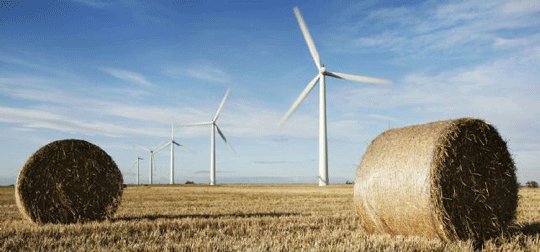 Conditional Approval For Western Australian Wind Farm http://www.energymatters.com.au/index.php?main_page=news_article&article_id=3866 1 Aug 13, The Great Southern Joint Development Assessment Panel has given Moonies Hill Energy conditional approval for a stage of the proposed Flat Rocks Wind Farm.
Moonies Hill Energy director Sarah Rankin saysconstruction of the wind farm could commence in late 2014, early 2015. Construction had originally been intended to commence in 2012/13.
If fully developed, the Flat Rocks Wind Farm will be a 150 MW project. Situated 25km south east of Kojonup, in the Great Southern region of Western Australia, the facility will produce 562,000 GWh of electricity annually – enough to power 90,000 homes – and avoid up to 451,000 tonnes of carbon dioxide equivalent each year. Moonies Hill Energy says the project would inject $130 million into the local community over its lifespan – $30 million during construction and $5 million a year during operation.
The Flat Rocks Wind Farm will host 74 wind turbines perched on 84m towers and will be compatible with existing agricultural activities such as stock grazing and broadacre crops. After construction, the facility will occupy less than 1% of productive farmland.
The wind farm will spread over 6 farming operations and across two shires. The five landowners involved will all be financial beneficiaries of the project. The wind farm will be patched into the South West Interconnected System (SWIS) via the proposed 330kV Muja-Wellstead transmission line, construction of a 132kW line into the Kojonup substation or via the existing 132kV line that traverse the southern part of the project area.
Electricity produced by the Flat Rocks wind farm will be sold into the SWIS under a commercial agreement.
As part of the project, Moonies Hill Energy will establish a Sustainable Communities Fund to operate during the life of the wind farm that will provide support for surrounding community programs.
Western Australian Goldfields ready to lead on solar thermal energy
 Solar Thermal Touted For Western Australia’s Goldfields http://www.energymatters.com.au/index.php?main_page=news_article&article_id=3858 25 July 13, Greens Senator Scott Ludlam was in the gold mining city of Kalgoorlie in Western Australia on Tuesday; convening a meeting to plan the Goldfields’ renewable energy future.
Senator Ludlam says the Australian Greens’Connecting Clean Energy plan (PDF) was a perfect fit for the Goldfields. The plan focuses on the identification and creation of new Renewable Energy Zones to help remove investment and infrastructure barriers.
“The community and business sector in the Goldfields are showing they are ready to take the leadership on solar energy,” said Senator Ludlam. Continue reading
Western Australia’s Noongar land deal not in the best interests of Aboriginals

It will be a mistake for Noongars and taxpayers to let this deal go through and allow the argument that all future claims have been extinguished.
If the deal goes through, future Noongars will have courts telling them that their ancestors signed their rights away
LAND DEAL FAILS IMPORTANT TESTS Lateral Love Australia Doubts surround the State Government’s native title deal, say Len Collard and Gerry Georgatos. 16072013 Doubts surround the State Government’s native title deal, say Len Collard and Gerry Georgatos. Much has been made of the State Government’s billion-dollar-plus offer to the Noongar people via the South West Aboriginal Land and Sea Council.
But is it a genuine native title offer or a politicised move to coerce a proposition that native title rights have been settled for all those considered Noongars and that all future rights are extinguished?
Noongar is a generic term and not representative of all the different cultural clans across Perth and southern WA — others include Whadjuk, Yuet, Mineng, Koreng, Ballardong, Bibbelmun and so on.
Legally, these Aboriginal clans and families will maintain connection to country that are exclusive domains and do not overlap one another. Continue reading
Planning report recommends go ahead for Western Australian wind farm
 Report gives conditional nod to wind farm http://www.abc.net.au/news/2013-07-11/report-gives-conditional-nod-to-wind-farm/4814128 Jul 11, 2013 A planning report, compiled for a panel that will decide whether a Great Southern wind farm proceeds, has recommended it go ahead with strict conditions.
Moonies Hill Energy’s Flat Rock Wind Farms project would create a 150-megawatt facility in the shires of Kojonup and Broomehill-Tambellup.
The company says the project could power 90,000 homes and inject $130 million into the local economy.
However, it hit a snag earlier this year when the Great Southern Joint Development Assessment Panel refused to give planning approval to the part of the development in Broomehill-Tambellup.
The company appealed against that decision and another hearing is scheduled for next Friday, when the panel will decide whether to accept the Broomehill-Tambellup Shire planner’s recommendation to approve it.
That recommendation includes strict conditions, including noise regulations and that the development begins within four years of the issuing of a building permit.
Western Australians stand to benefit with employment from tourism, rather than mining
 Tourism is a much more important job provider than is mining. And – it must be noted – mining is transient – and usually leaves a nasty looking degraded environment, and a dying town, when it ends. Tourism goes on, can go hand in hand with environmental conservation, and provide ongoing employment.
Tourism a jobs winner http://au.news.yahoo.com/thewest/a/-/wa/17874412/tourism-a-jobs-winner/ Yolanda Zaw, 5 July 13, Tourism will overtake mining and construction as one of the biggest employers in WA, according to statistics to be released today. Tourism accounts for 7 per cent of all jobs in the State, just behind mining with 8 per cent, construction 10 per cent and health care and social assistance, the top employer with 11 per cent.
Tourism Council chief executive Evan Hall said tourism would become more important to the WA economy as the resources boom slowed.
“The trend is for tourism jobs to grow as mining jobs decline,” he said. “With the lower Australian dollar, cheaper hotel rates and more flights to Perth, WA can win back the leisure tourists we lost over the last few years.”
Mr Hall said in all other States tourism employed more people than mining. Continue reading
AUDIO: Obstacles in the way for Toro Energy’s Wiluna uranium project
Wiluna uranium mine not officially protested http://www.abc.net.au/local/stories/2013/06/19/3785317.htm By Glenn  Barndon, Sarah Taillier, Chloe Papas
ABC’s Sarah Taillier spoke to Mia Pepper from the Conservation Council of WA. Have a listen to the interview
Toro Energy’s potential uranium mine at Wiluna has been the subject of much controversy – but was not officially appealed during the required period. So, what happens next?
Toro Energy’s plans to build a uranium mine in Wiluna have been the subject of considerable controversy since the $269 million project was proposed last year. Recently, the company announced that no appeals were launched during the four-week protest period allowed by the Federal government.
Though this takes the company one step closer to putting plans into action, Mia Pepper from the Conservation Council of WA told ABC’s Sarah Taillier that a formal appeal was not the only avenue of protest.
“The fight against the Wiluna uranium mine is definitely not over just because of not lodging one out of many possible appeals.” Pepper told the ABC that not only are there other ways to attempt to stop the mine, but the company may have bigger issues than a formal protest. “They’ve been trying to take it to market for a long time and haven’t been successful, and I think they’re using this event or non-event as a platform to try and fundraise for the project – which is and has been their main problem for a long time.”
Hear about Western Australia’s wave energy project
 AUDIO: Renewable wave energy project to begin in Western Australia http://www.radioaustralia.net.au/international/radio/program/pacific-beat/renewable-wave-energy-project-to-begin-in-western-australia/1147652 18 June 2013, Wave energy is one of the great renewable energy hopes because it can create electricity through the power of the ocean
The technology has huge potential for the Paccific Islands and their search for sustainable energy sources
Construction on a major wave energy project is about to begin in Western Australia at Australia’s largest naval base, HMAS Stirling.
The technology behind the Perth Wave Energy Project has been developed over the past 10 years, and promises to make Australia a global leader in wave energy.
Fran Kelly asked Tim Sawyer, the Project Development Officer for Carnegie Wave Energy for more details.
Presenter: Fran Kelly Speaker: Tim Sawyer, the Project Development Officer for Carnegie Wave Energy
Australian uranium industry should be aghast at ever lower uranium prices
Sluggish uranium prices put pressure on industry http://www.miningaustralia.com.au/news/sluggish-uranium-prices-put-pressure-on-industry 11 June, 2013 Vicky Validakis With uranium prices hitting a four-year low last week, analysts predict a resurgence of the rare earth is not expected for 12 months.
The price of uranium fell below $40 a pound for the first time since 2009, to $39.87 a pound. Despite industry claims the demand for uranium would increase, prices have not pushed through the $45/lb mark since December last year. The West Australian reported low uranium prices is causing concern on local uranium juniors such as Toro Energy who are in the bid for partners to help fund the $269 million Wiluna project.
Toro have previously said if financing arrangements went to plan the mine would be in production by the end of 2015.
The $269 million Wiluna mine, is set to become Western Australia’s first uranium mine. With world energy demands increasing, last week Resource Minister Gary said the uranium industry in Australia needs to ramp up. Speaking to the Australian Uranium Association(AUA),Gray said with the demand for uranium set to rise, Australia was in the perfect position to supply them more of the precious metal.
However, some analysts now predict a turn-around in price is still twelve months away, leaving many asking if new projects will get off the ground.
A report commissioned by Greens senator Scott Ludlam into the economic viability of Toro Energy’s proposed Wiluna project, claimed the company may struggle to make the project viable. “The Wiluna project sits very high on the cost curve of global uranium projects,” the report’s author said.
“It’s difficult to see why any of the major uranium players would invest in this project when there’s a lot of cheaper projects out there.”
In 2012, production from Australian mines rose more than 17 per cent to top 8000 tonnes. However, the level is well below the period between 2003 and 2009 when it was 9000 to 11,000 tonnes. http://www.miningaustralia.com.au/news/sluggish-uranium-prices-put-pressure-on-industry
Fear and loathing about prices hits the Western Australian uranium market
 Uranium price hits four-year low Nick Sas, The West Australian June 7, 2013, A new wave of nervousness swept through WA’s already under-pressure uranium explorers yesterday after the uranium spot price hit a four-year low.
The price fell below the $40 a pound threshold for the first time since April 2009, closing at $39.87 a pound.Despite industry assurances of a price rebound over the past 12 months, uranium has failed to get any traction.
The price has not pushed through the $45/lb mark since December 14.
The lethargic price places further pressure on local uranium explorers such as Toro Energy, which is looking for a strategic partner to help fund its $269 million Wiluna project.
If funding is found, Wiluna will become WA’s first uranium mine. A hearty increase in the spot price is needed to force WA’s fledgling uranium sector into first gear, with Canadian giant Cameco indicating a price of more than $70/lb is needed before it can give the green light to its massive Yeelirrie or Kintyre deposits……http://au.news.yahoo.com/thewest/business/a/-/wa/17512668/uranium-price-hits-four-year-low/
1 This month

of the week – Australians for War Powers Reform (AWPR)
To see nuclear-related stories in greater depth and intensity
 Antinuclear