No-one can get finance to build a uranium mine in Australia.

NO-ONE CAN GET FINANCE TO BUILD A URANIUM MINE IN AUSTRALIA https://www.ccwa.org.au/no_finance_toro?utm_campaign=nuclear_news172&utm_medium=email&utm_source=ccwa
BY K-A GARLICK JULY 26, 2021 CCWA nuclear-free campaigner Kerrie-Ann Garlick attended last week’s Toro meeting to raise concerns that the company’s most recent uranium proposal differs from its currently approved plan.
Toro Energy’s general meeting last Friday heard the death toll sounding on WA’s uranium hopefuls.
Toro Chair Richard Homsany told the meeting that no one can get finance to build a uranium mine in Australia. He also acknowledged that Toro’s conditional environmental approval for its stalled Wiluna project expires on January 9, 2022. From this date, Toro will not be able to mine without making project changes that would require further state government scrutiny and approval.
In 2017 the McGowan Labor government introduced a policy ban on uranium mining in WA but inherited four uranium mine proposals with existing approvals granted by the former Barnett government. By the end of January 2022, the current Ministerial approvals for all four of the states proposed uranium mines will expire if they do not commence mining.
Approval for Cameco’s Kintyre expired and was not renewed in March 2020, Vimy Resources Mulga Rock project approval expires in December 2021 and both Yeelirrie (Cameco) and Wiluna (Toro) are set to expire in January 2022. If any of these companies want to mine they will need to seek approval for amendments to Ministerial conditions. This may trigger a new assessment or a suite of other conditions being applied.
CCWA nuclear-free campaigner Kerrie-Ann Garlick attended last week’s Toro meeting to raise concerns that the company’s most recent uranium proposal differs from its currently approved plan. “Toro is now focused on developing a JV uranium project at Lake Maitland. This is completely separate from the existing approval for the Wiluna project and would require a whole new environmental assessment. It is our view that this could not be advanced because of the existing policy ban on uranium mining in WA.”
“The Wiluna uranium mine proposal is uneconomic and they don’t have the funding to develop it. There is almost no scenario in which the Wiluna uranium mine could be developed ahead of the approval expiry in January 2022”
“It is refreshing that the Toro Board are realistic about the current highly negative market conditions for uranium. No one is financing uranium mines and that is unlikely to change by January. It is increasingly likely that we will reach a point in January 2022 where there are no operating mines and no active approvals for uranium mining in WA,” Ms Garlick concluded.
Mulga Rock Uranium Project – VIMY’S MINE – UNWANTED AND UNECONOMIC
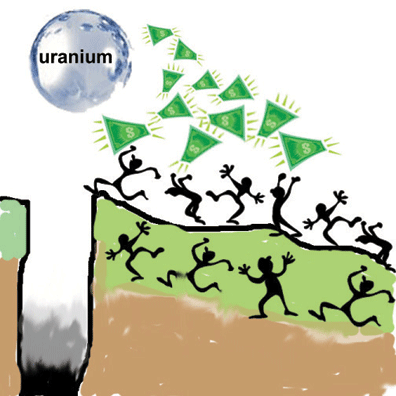
VIMY’S MINE – UNWANTED AND UNECONOMIC, https://www.ccwa.org.au/vimy_s_mine_unwanted?utm_campaign=nuclear_news164&utm_medium=email&utm_source=ccwa By Mia Pepper
Deputy Chair of the Mineral Policy Institute. BY KIM SMITH JUNE 02, 2021
Vimy Resources (aka Narnoo Mining) advertisement in Saturdays Kalgoorlie Miner is part of an extended last-ditch attempt to start a mine that is unwanted, uneconomic, does not have full and final approval or the financing needed to start mining.
Saturday’s ad suggests that Vimy will begin work at the site in Q4 2021. There are several critical elements for mining to commence that are not yet in place and are unlikely to be resolved by Q4 2021. The companies Mine Closure Plan and Mine Plan are not yet approved by the Department of Mines and previous attempts to have these plans approved have failed. There are also Works Approvals, export and other licenses and permits that are still required. The company does not have an Indigenous Land Use Agreement with the Upurli Upurli Nguratja Native Title claimant group – pre-empting mining without an ILUA drastically impacts that groups ability to negotiate or determine what should or shouldn’t happen on their country.
Perhaps the clearest pre-requisite to begin mining is a company’s Final Investment Decision and the finances to cover the capital costs. Without the ability to fund the project and meet the requirements of mining any ground-disturbing activities are pre-emptive and irresponsible. The capital cost for the Mulga Rock project is $493 million. Vimy’s March quarterly report shows Vimy raised over $18 million, since then they have raised a further $9 million. $27 million is a far cry from the $493 million needed to meet full capital costs. But it is enough to do some serious damage in the Yellow Sandplain Priority Ecological Community in the Great Victoria Desert, home to the endangered Sandhill Dunnart and other important vulnerable, migratory and priority species of flora and fauna. The company’s share value is down 97% since their inception in 2008 and has a long way to go to secure finance for a project that is just not economic. Until the company can demonstrate they have the capital funds to get the project off the ground they should not be allowed to embark on pre-emptive ground-disturbing activities.
One thing more dangerous than a uranium mine is an uneconomic uranium mine and ideologically driven company. Despite the lack of funding, final licenses and permits, an ILUA, social license and bipartisan support Vimy’s Mulga Rock project still presents a very real threat to the environment and the WA taxpayer. The WA government should make decisions based on evidence, not enthusiasm and should not facilitate this poorly considered project.
Senior Morrison government ministers support Iluka’s plan to reprocess rare earths (no mention of what they would do with the radioactive wastes)
Iluka finds favour in bid to build rare earths refinery, W.A. Today, By Nick Toscano, May 11, 2021
A proposal to build the country’s first full-scale rare earths refinery has secured the support of senior Morrison government ministers, as Australia works to position itself as a key supplier of raw ingredients in smartphones, electric cars and wind turbines.
The board of ASX-listed Iluka Resources, a $3.6 billion company, is assessing the feasibility of developing a refinery at Eneabba in Western Australia to process rare earths – a group of elements used in a range of high-tech products and military weapons systems…….. https://www.watoday.com.au/business/companies/iluka-finds-favour-in-bid-to-build-rare-earths-refinery-20210511-p57que.html
New research into the effects of nuclear bomb tests on Montebello islands
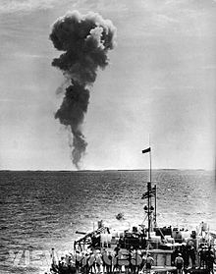 By Susan Standen 22 Mar 21, A new Edith Cowan University research project hopes to collect important data on the impact of historical nuclear testing in the remote Montebello Islands area. Key points:
Sixty years after the British government conducted nuclear explosion testing on the islands, there is little data available to find how much residue plutonium still exists. The project hopes to be the first study to outline how and where man-made radioactivity is still existing in the marine sediment. Collections of sediment are being collected from remote field trips to the islands to analyse amounts of residue plutonium radionuclides.,,,,,,,,,,,, Ms Hoffman says other island nations affected by nuclear blasts will be able to use the Montebello Islands research as a reference baseline to start their own investigations. Will it inform health research? Ms Hoffman says the first step is to find out what remains there as a legacy………….. The project is a collaboration between the Edith Cowan University, the Department of Biodiversity and Conservation and the Australian Radiation Protection and Nuclear Safety Agency. https://www.abc.net.au/news/2021-03-22/montebellos-nucelar-fallout-research/13260242 |
|
Time for Australia to clean up uranium mining damage, and end this toxic industry
 It’s time to clean up not start up! https://www.onlineopinion.com.au/view.asp?article=21352 On this 10th anniversary of the Fukushima nuclear disaster, it is time to learn one simple lesson; radioactive risk is more constant than a politician’s promise. It is time to move beyond the risk of opening a uranium mine to safely rehabilitating existing exploration and trial mine sites. If we fail to act and allow small unproven company assurances to take the place of evidence, then we are both failing those affected by Fukushima and increasing the odds of fuelling a future one.
| By Kerrie-Ann Garlick – , 12 March 2021 |
|
The plan to use nuclear bombs for fracking in Western Australia
Most recently, his dives into the archives led him to a largely forgotten episode in Western Australia’s past — the serious discussions that took place about using a nuclear weapon to create a deep harbour at Port Hedland in the state’s north.
The discussions were between the WA Government, United States nuclear scientists, and mining companies.
In 1961, the US Government began Operation Plowshare, a program investigating using atomic technology for civil purposes.
“[The US] had the bomb at the end of the war and they were looking for ways to get some value back out of it after all the money they had spent developing it,” Mr Clancy said.
The original fracking was atomic fracking. But it was too strong for that. It was doing too much damage underground.”
Various Plowshare ideas floated included using atomic bombs to cut a highway through southern California or duplicate the Panama Canal in Nicaragua, but they were deemed too big and too risky.
“They’d have needed 30 or 40 bombs to do that,” he said.
“There would have been too much leftover waste and they didn’t quite know what a big concentration of it in one place would end up doing.”
His interest in the connection to WA was first roused years ago on a trip to the United States.
“You can do a public tour of the Nevada [nuclear] Test Site (NTS), and I did that,” he said.
“They had one particular test that they (the NTS) had set up with Port Hedland in mind, seeing how much dirt they could shift with one blast and how big the hole would be. That’s the first I heard of this.”
Recently, his online research led to an array of documents held in the State Records Office including reports, correspondence, and newspaper clippings about the plans during the 1960s.
“I never thought there would be this much information on it,” he said.
The files reveal numerous discussions the State Government, north-west mining companies, and nuclear scientists had around using nuclear technology in the Pilbara.
At the same time, the discovery of vast iron ore deposits in the Pilbara meant that the region was rapidly opening up to mining and industrial development.
A port was needed to ship million of tonnes of iron ore offshore.
Mr Clancy said the project in Australia’s remote north-west, requiring only one or two bombs, would have seemed an ideal first project.
“The Plowshare operation was quite prominent, they were shopping around anywhere they could for someone that was interested,” he said.
“While this was going on, they were still doing underground testing in America, they were gathering information all the time.
“They [Operation Plowshare] were open to anything.”……….
While it’s not entirely clear who first suggested it, the flurry of correspondence between the Western Australian government, engineering firms and mining companies throughout the 1960s shows the idea was firmly on the drawing board.
In one letter to Charles Court, a former premier and minister for regional development and the north-west from 1959 until 1971, an engineering firm wrote they had met with Australia’s atomic energy attache at the embassy in Washington and were eager to proceed:……..
A report of a visit by Australian Atomic Energy officers to BHP’s Deepdale iron ore development, dated February 1, 1966, gives some hint of the magnitude of the political challenge faced.
It also raised the inconvenient problem of the existence of the Test Ban Treaty:
The report goes on to discuss how an exemption may have been possible, but it would have required the Australian Government to be the first in the world to propose changing the treaty.
Mr Clancy also suspects the fallout from the British tests on the Montebello Islands in Western Australia’s north-west and in Maralinga in South Australia also played a part in why the ideas came to nothing.
By 1971, the Liberal government under Premier David Brand had been defeated and the records come to an end.
In 1977, the United States Government formally ended Operation Plowshare, never having found a site for the peacetime application of nuclear weapons……..https://www.abc.net.au/news/2020-11-08/documents-reveal-plans-to-use-nuclear-bombs-in-port-hedland/12848004
Repower WA with Renewables: 90% by 2030
|
Repower WA with Renewables: 90% by 2030, https://www.cleanstate.org.au/repower_wa Western Australia’s energy sector is one of the best places to start to create thousands of jobs and drive down emissions. With the best sun and wind resources in the world, it’s time to harness the economic benefits and renewable potential of our state. All Australia’s other states & territories are embracing the clean energy transition with renewable energy targets, and WA’s lack of such a plan is a failure to grasp an excellent opportunity.
Repowering WA with renewable energy provides a once in a generation opportunity for infrastructure investment, jobs and value creation that will be a powerful driver for economic activity for decades to come. The proposalPowering WA’s Southwest electricity grid with renewable energy by 2030 is both affordable and achievable. The costs of building and delivering renewable energy solutions are reducing every year, and large scale wind and solar are already able to deliver cheaper electricity than coal and gas. Repowering WA can reduce energy bills for homes and businesses, and support significant growth in manufacturing, minerals processing and other energy-intensive industries that can employ more people here in WA. A report commissioned by Clean State has found the move to 90% renewable electricity on WA’s South West Interconnected System (SWIS) is technologically possible by 2030 and would create over 8600 jobs. The 90% Renewable Energy Roadmap created by expert group Sustainable Energy Now provides a transition blueprint for the SWIS – WA’s main electricity grid covering most of the population and spanning from Geraldton to Kalgoorlie. For this plan, new renewable energy generation capacity totalling 11.7 GW of will be required by 2030. Optimising the mix of technology to take into consideration electricity demand, weather, cost, technology and the design of the SWIS grid, the SEN model suggests that this should be made up of:
This investment would provide a significant number of jobs to build the infrastructure required. Each year, 800MW of new renewable energy capacity would need to be added, which is, roughly equivalent to the sum of the following:
There would also be additional investment and employment opportunities in providing energy storage and grid services to compliment this generation mix. Much of the rooftop solar can be delivered by private investment if WA’s electricity market is reformed to enable rooftop solar and battery systems to link into the grid productively. Increased battery storage would stabilise the network, and with 78,000 houses in WA coming off a 40c feed in-tariff this year, there is a prime opportunity to encourage these households to upgrade and battery. Besides the climate benefits and direct employment gains accompanying these investments and reforms, a timetable for the staged and managed closure of WA’s coal-fired power stations will avoid energy and business uncertainty, both for the state and for those currently working in the industry. Many credible studies have found that the SWIS, WA’s main grid, can transition to 100% Renewable sources by 2030. These include:
|
|
Western Australia: call for Mt Walton hazardous waste facility to accept toxic material from across Australia, i(includes radioactive wastes
 Call for Mt Walton hazardous waste facility to accept toxic material from across Australia, ABC Goldfields By Madison Snow, 26 June 20 The closest neighbour to a toxic waste facility in Western Australia’s Goldfields region is calling for licence changes that will allow it to accept hazardous material from across Australia. Call for Mt Walton hazardous waste facility to accept toxic material from across Australia, ABC Goldfields By Madison Snow, 26 June 20 The closest neighbour to a toxic waste facility in Western Australia’s Goldfields region is calling for licence changes that will allow it to accept hazardous material from across Australia.Key points:
The Intractable Waste Disposal Facility (IWDF) at Mt Walton East is only licensed to take waste from within WA, a condition was set following consultations with the community before its establishment in 1992. The state-owned facility is Australia’s only long-term disposal site for intractable waste and accepts chemicals such as arsenic trioxide and pesticides, along with low-level radioactive waste, permanently storing them underground. But the approval of a commercial waste facility at nearby Sandy Ridge, which has a licence to take hazardous materials from around the country, has some residents worried. Anna Killigrew, who lives 120 kilometres away in Boorabbin National Park, is a member of Mt Walton’s Community Liaison Committee (CLC) and supports the existing site’s management. She said she was concerned Mt Walton would be left “dead in the water” and unable to compete unless it too could accept waste from around the country.
|
|
Western Australian uranium projects floundering, as Cameco’s Kintyre environmental approval lapses
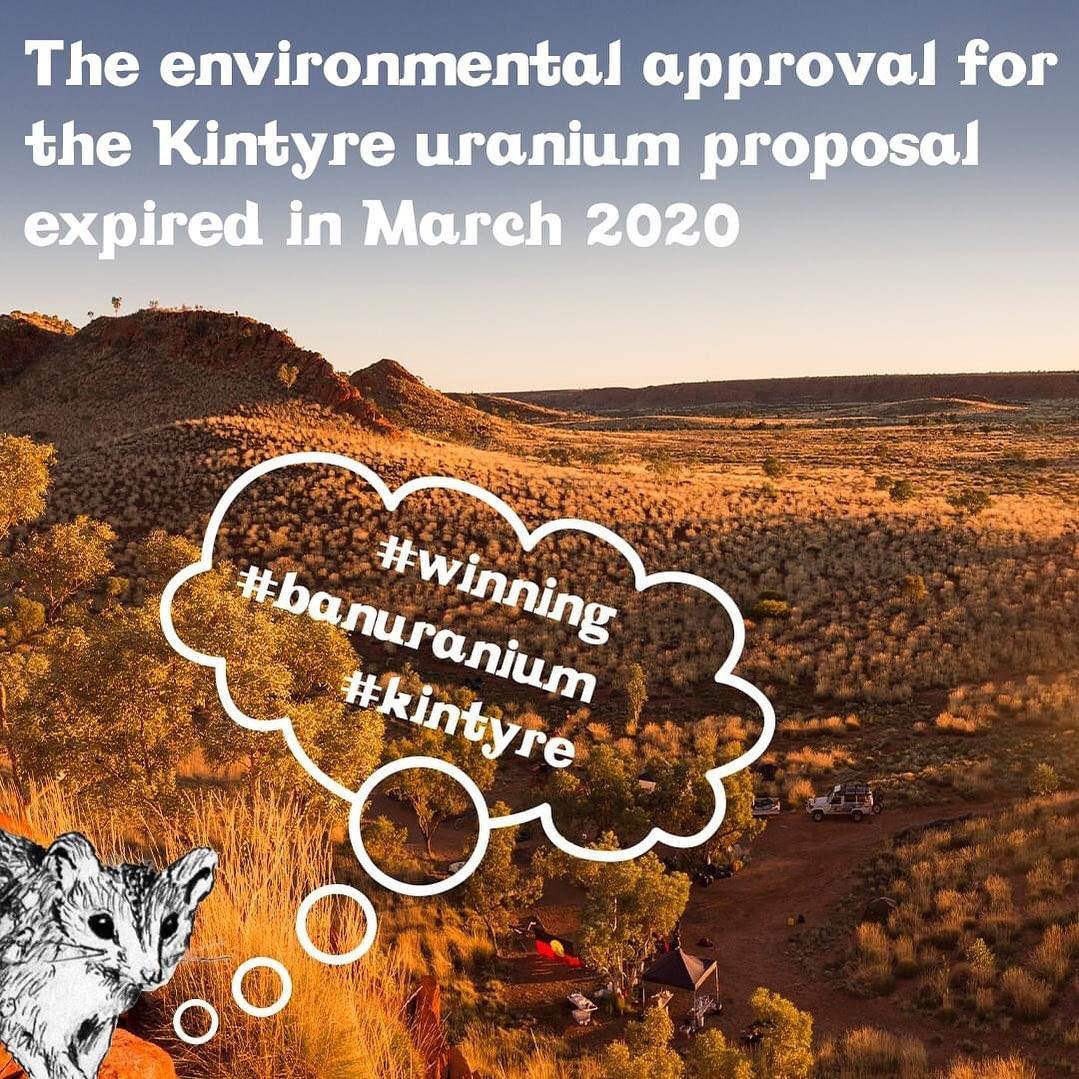 K-A Garlick at Nuclear Free WA, 6 May 20 The environmental approval for the Kintyre uranium project expired in March this year. So there is no valid environmental approval for Cameco. There can be no mining without changing or getting new environmental approval. This is great news for the campaign and shows the uncertainty of the uranium industry and Cameo who had applied for an extension but latter withdraw their application. It is great for the Martu community who have held strong and resisted over these many years. Let’s hope their beautiful country will one day be given back!
Keeping a track on all four projects and the process of asking questions on notice through State Parliament, we have found that Toro Energy, have failed to submit their annual environment reports on the Wiluna uranium project. This matter is now being pursued by the Department of Mines, Industry Regulation and Safety to ensure the report and plans are provided and any appropriate compliance action is taken.
Further good news, Yeelirrie is getting some really good attention with some upcoming media from the Freedom of Information process that has been investigated through the Australian Conservation Foundation that found an alarming lack of transparency in the Federal approvals process. The documents show that Cameco lobbied the former Federal resource Minister, Matt Canavan to fast track the approvals process and to change the conditions. If you haven’t seen the presentation from ACF, please click here.
We are excited organising a series of webinar nuclear talks that will focus on local, national and international impacts of Australian uranium industry. We will announce next week further details, but lock in Wednesday 10 June 5.30pm – 7 pm (tbc).
The importance of strengthening the Environment Protection and Biodiversity Conservation Act (EPBC)
 On April 2, environmentalists across Australia met online, in a webinar focussed on the EPBC Act. The federal government is holding a Review of the Environment Protection and Biodiversity Conservation Act , with Submissions due 17 April The Conservation Council of Western Australia, and Nuclear Free WA hosted the webinar. The case of the Yeelirrie uranium project was discussed, as a case especially relevant to the EPBC Act. As it turns out, the EPBC is weak, in relation to having power over this project. It relies on the Western Australian EPA for the relevant decision. Extraordinarily, in this case, the EPA advised against the project. However, the Environment Minister at the time, overrode this advice, and approved the project anyway.
Piers Verstagen, of CCWA, outlined the history of CCWA’s work in holding the Wester Australian EPA’s assessments to account. The Yeelirrie uranium project would threaten the extinction of up to 11 stygofauna, which are tiny groundwater species. The EPA therefore did not recommend the project. However, in approving the project , the Minister also inserted a clause into the legislation, which now will allow the extinction of any species. CCWA has challenged that approval. The project has not proceeded.
But – this Yeelirrie case is a fine example of the reasons why the EPBC Act needs to be strengthened, not weakened. Weakening the Act is the goal of the Mining Council and others, who seek unfettered development of mining and other polluting projects.
Ruby Hamilton pointed out the need for Australia’s Environmental Protection Act to relate to international treaties on environment.
ACF’s Environmental Investigator described ways in which the Act should be strengthened, emphasising that:
- We need to keep the right for 3rd parties to challenge bad decisions.
- We need an independent authority to administer the EPBC Act.
- WE need way more transparency in the way that the Act is used
Flooding events highlight the danger to proposed uranium mining sites Yeelirrie and Wiluna

K-A Garlick at Nuclear Free WA |
6 Feb 20, In an area where two uranium mines are proposed ~ Yeelirrie and Wiluna, there have been massive rain influx, leading to widespread floods across the Goldfields country.
Toro Energy Wiluna uranium project expands over two lake systems and over 100 kms. The project includes four uranium deposits – Lake Way, Centipede, Millipede and Lake Maitland.
The project proposal includes a high risk inappropriate site to attempt disposal of up to 50 million tonnes of radioactive tailings that would be stored in mined out pits on the edge of Lake Way in a floodplain and in the drainage channel of a creek.
The company’s studies of hydrogeology, hydrology and geochemistry were all heavily criticised in Peer Reviews submitted as part of the environmental assessment. With these floods today, the planned emplacement of 50 million tonnes of long-lived radioactive mine waste in a floodplain poses a very serious risk to the environment and public health.
In blistering heat, Perth’s bushfire will keep burning for days
Perth bushfire emergency continues as firefighters spend a fourth day trying to protect lives, homes, BY GIAN DE POLONI AND JAMES CARMODY, ABC, 16 Dec 19, A bushfire threatening lives and homes in Perth’s north has remained at emergency level for a fourth consecutive day — and it may stay there for several more, with flames being fanned further up the coast.
Key points:
- The fire has burnt through 12,000 hectares, destroying several structures
- DFES’ commissioner says difficult times are ahead and warns of further damage
- Authorities say they don’t believe arson is to blame for the fire
Hundreds of firefighters battling the blaze were able to slow its spread on Friday night but they spent Saturday dealing with changes in wind direction and another day of blistering heat.
The emergency warning is in place for a 45-kilometre stretch of coast including the towns of Guilderton, Seabird and parts of Two Rocks.
The smaller communities of Woodridge, Caraban, Gabbadah, Neergabby, Wilbinga, Yeal, Redfield Park, Sovereign Hill, the Seatrees and Breakwater estates and parts of Beermullah, Muckenburra, Wanerie, Neergabby and Yanchep remained in the the emergency warning zone on Sunday morning.
Fire danger has been declared for the metropolitan region, the Pilbara, Goldfields Midlands, the Great Southern, the mid-west Gascoyne, as well as the south-west and lower south-west of the state. ……..
Fire will burn for days
Department of Fire and Emergency Services (DFES) superintendent Gary Baxter said the fire could burn for more than a week.
“I don’t suspect that we’re going to extinguish it anytime in the next week or so but certainly we’ll try and get containment lines strengthened,” he said.
“Controlling it is a different thing but containing it over the next few days is an objective you’d hope in the next couple of weeks to fully extinguish the fire.
“That’s to completely extinguish 100 per cent of the fire ground — that’s a complete blackout — so that over the next few weeks and into the next couple of months of over summer we don’t have to revisit the same patch.”……
No relief from blistering heat
The fire has been fuelled by heatwave conditions that saw temperatures in the city top 40 degrees Celsius on Friday and Saturday, with similar conditions expected for Sunday.
The blaze has so far burnt through close to 12,000 hectares of bushland, tearing through the Yanchep National Park………
Yanchep National Park and the Wilbinga Conservation Park remains closed.
There was a total fire ban across the Perth metropolitan area on Saturday.
The Red Cross has established a hotline number for people affected by the fire to get in touch with family and friends; 1800 351 375 https://mobile.abc.net.au/news/2019-12-14/yanchep-and-two-rocks-bushfire-could-burn-for-days/11800060
Traditional Aboriginal owners will not give up fight against planned WA uranium mine, despite legal loss
 Traditional Owners lose another fight against planned WA uranium mine, https://www.sbs.com.au/nitv/nitv-news/article/2019/08/01/traditional-owners-lose-another-fight-against-planned-wa-uranium-mine?fbclid=IwAR3fZ4v8xEAU1sPLXNPznPMbbgTM0YSa97czCEvMfQacuYNB2XTsWaOhUgo 1 Aug 19, Environmental approval for Cameco’s Yeelirrie uranium mine proposal in WA still stands after another appeal by Traditional Owners failed. Traditional Owners and the Conservation Council of WA have lost their fight against a proposed uranium mine that the Environmental Protection Authority refused to back, saying risks to subterranean fauna in the project area were too great.Former state environment minister Albert Jacob approved Cameco’s Yeelirrie mine plan in January 2017, just 16 days before the pre-election caretaker mode began. Traditional Owners lose another fight against planned WA uranium mine, https://www.sbs.com.au/nitv/nitv-news/article/2019/08/01/traditional-owners-lose-another-fight-against-planned-wa-uranium-mine?fbclid=IwAR3fZ4v8xEAU1sPLXNPznPMbbgTM0YSa97czCEvMfQacuYNB2XTsWaOhUgo 1 Aug 19, Environmental approval for Cameco’s Yeelirrie uranium mine proposal in WA still stands after another appeal by Traditional Owners failed. Traditional Owners and the Conservation Council of WA have lost their fight against a proposed uranium mine that the Environmental Protection Authority refused to back, saying risks to subterranean fauna in the project area were too great.Former state environment minister Albert Jacob approved Cameco’s Yeelirrie mine plan in January 2017, just 16 days before the pre-election caretaker mode began.
Together with members of the Tjiwarl native title group, CCWA challenged the approval in the Supreme Court but lost, and on Wednesday had their the Court of Appeal challenge dismissed. Traditional Owner Vicki Abdullah said the native title group was disappointed, but taking the case to court had exposed problems with WA’s environmental laws. “We won’t give up – our country is too important. We will continue to fight for Yeelirrie and to change the laws, ” Ms Abdullah said. CCWA director Piers Verstegen said the judgment was appalling and demonstrated WA’s environmental laws urgently needed to be strengthened. “This case has confirmed our worst fears – that it is legally admissible for a minister to sign off on a project against the advice of the EPA and in the knowledge that it would cause the extinction of multiple species, ” he said. “We will consider options for further appeal of this decision. “The mining company can expect a long, expensive process if they want to continue pursuing plans to mine uranium at Yeelirrie.” |
|
Three Tjiwarl women from WA’s goldfields win conservation award for uranium mine campaign
 https://www.miragenews.com/three-tjiwarl-women-from-wa-s-goldfields-win-conservation-award-for-uranium-mine-campaign/ 29 Nov 19, Over the decades they have seen off at least three mining companies, including BHP, and in the process they have given strength and courage to their own community and many others.”
Three Tjiwarl women, Shirley Wonyabong, Elizabeth Wonyabong and Vicki Abdullah, have been awarded the 2019 Peter Rawlinson Award for their decades-long campaign to protect their country and culture from a proposed uranium mine at Yeelirrie in outback Western Australia.
The award, which celebrates outstanding voluntary contributions to protect the environment, will be conferred on the women at the Australian Conservation Foundation’s (ACF) annual general meeting in Melbourne tonight.
“Shirley, Elizabeth and Vicki, along with other Tjiwarl people, have spoken up for their country and culture around campfires, in politicians’ offices, on the streets of Perth and in Western Australia’s highest court, all the while looking after their grandchildren and each other,” said ACF’s Chief Executive Officer, Kelly O’Shanassy.
“Every year for the last eight years, these women have taken people from all over the world through their country on a one-month walking tour. In this way, hundreds have seen their land.
How are Australian States progressing on renewable energy? South Australia way ahead
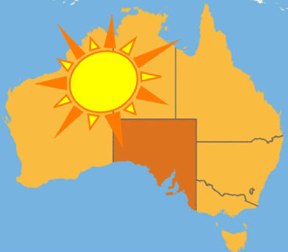 South Australia leading the nation in renewable energy, https://thenewdaily.com.au/news/national/2019/11/25/renewable-energy-winners/ Samantha Dick
South Australia is shifting to renewable energy faster than any other state or territory.
This is despite the federal government’s “lack of leadership” and continued support for major fossil fuel projects, says the Climate Council.
|
Progress is based on how much electricity is derived from renewable energy, proportion of households with rooftop solar, large-scale wind and solar capacity per capita, and policies to support the transition. South Australia earned this year’s top spot for generating more than half of its electricity from wind and solar, and for setting a target of net 100 per cent renewable energy in the 2030s. Following closely in second place was the Australian Capital Territory, which is on track for 100 per cent renewable energy from 2020. The ACT has also announced impressive plans to achieve net zero emissions by 2045 by cutting emissions from transport and cities. Tasmania was in third place for making headwinds toward 100 per cent renewable energy by 2022, and for researching three pumped hydro sites that could supply energy to Victoria over the next 10 to 15 years. Victoria was ranked fourth, winning points for planning the nation’s most ambitious large-scale wind and solar projects, and for legislating a renewable energy target of 50 per cent by 2030. However, more than 80 per cent of the state’s power still comes from fossil fuels, meaning it has a long way to go to catch up to the frontrunners. Further behind in fifth place was Queensland, where nearly half of Australia’s large-scale renewable energy projects were completed last year. But despite making big improvements, the Queensland government lost marks for continuing to support new fossil-fuel projects like the Adani coal mine. The Adani coal mine, backed by the federal government, will put out an estimated 7.7 billion tonnes of greenhouse gases over 60 years through extracting 2.3 billion tonnes of coal. It is also unlikely the Sunshine State will meet its target of 50 per cent renewable energy by 2030.
|
|
1 This month

of the week – Australians for War Powers Reform (AWPR)
To see nuclear-related stories in greater depth and intensity
 Antinuclear