Traditional owners and Western Australia’s Conservation Council continue legal action, to uphold environmental law
 WA are continuing their fight against a proposed uranium mine, fearing unique subterranean fauna in the project area will be made extinct if it proceeds.
 “Stygofauna might be a relatively obscure species. In fact, these particular species of stygofauna were not known to science until the proponent started exploring for uranium in that area,” Mr Verstegen said on Tuesday.
“But the legal precedent here has much broader implications.
“We’re certainly very keen to be upholding environmental laws … which were never intended to be used by a minister or a government to approve the extinction of species.”
The matter was heard on Tuesday and a decision will be handed down at a later date.
Conservation Council of Western Australia (CCWA) and three Tjiwarl Traditional Owners in court battle against uranium mining
WILDLIFE AND TRADITIONAL OWNERS REPRESENTED IN LANDMARK LEGAL CHALLENGE http://www.ccwa.org.au/landmark_legal_challenge?utm_campaign=nuclear_news68&utm_medium=email&utm_source=ccwa
The Conservation Council of Western Australia (CCWA) and three Tjiwarl Traditional Owners have continued their landmark legal bid to prevent the extinction of multiple species and protect Aboriginal lands from uranium mining at Yeelirrie, with a hearing in the WA Court of Appeal today.
The Yeelirrie mine proposal by uranium miner Cameco in the Northern Goldfields on Tjiwarl Native Title land was approved by the Minister for the Environment in the final days of the Barnett Government, against the advice of the Environmental Protection Authority (EPA), and against the outcome of an appeals process.
The EPA found that the proposal would cause the extinction of multiple species of subterranean fauna.
Bret Walker SC, Dr Hannes Schoombee, and the Environmental Defenders Office WA (EDOWA) represented Traditional Owners and CCWA in the legal challenge to the environmental approval for the Yeelirrie uranium mine.
CCWA Director Piers Verstegen said, “This important case is seeking to prevent the extinction of multiple species at Yeelirrie, and uphold the rights of Traditional Owners to protect sacred country from uranium mining.
“Mr Walker is one of Australia’s most eminent legal minds and his involvement with this case is an indication of its national legal significance.
“The approval of extinction at Yeelirrie at the stroke of a Minister’s pen cannot go unchallenged because it sets a dangerous precedent for all wildlife across Western Australia.
“We are proud to stand with three members of the Tjiwarl Native Title Group, Shirley and Elizabeth Wonyabong and Vicky Abdullah, who have been fighting to protect their country from uranium mining for many years.
“As well as the threat of extinction, Cameco’s uranium project would have a major impact on the landscape and ecosystems at Yeelirrie. It would involve a 9km open mine pit and processing plant, clearing 2421 hectares of native vegetation, and generating 36 million tonnes of radioactive mine waste to be stored in open pits.”
EDOWA Principal Solicitor Declan Doherty said, “This is a landmark case to test how Western Australia’s primary environmental law should be applied.
We argued that in approving the Yeelirrie uranium mine, Minister Albert Jacob failed to correctly follow the process set out in the relevant legislation.
“It will be an important test for how the legislation should be applied, which could have significant implications for future decisions of this kind.”
Western Australia bushfire a threat to homes and lives
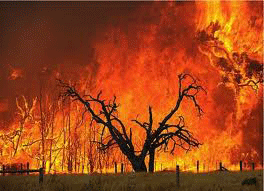 WA bushfire a threat to homes and lives https://www.sbs.com.au/news/wa-bushfire-a-threat-to-homes-and-lives 26 Jan 19 Authorities in Western Australia say a bushfire burning in Perth’s northern suburbs is a threat to lives and homes. An emergency warning has been issued for a bushfire burning out of control in Perth’s northern suburbs with authorities warning of a threat to lives and homes.
The fire at Jandabup is burning in an area near Sydney Road and Ross Street and a nearby pine plantation.
“The bushfire is moving fast in a north-westerly direction. It is out of control and unpredictable,” Emergency WA says.
Spot fires are also starting up to 300 metres ahead of the fire front.
Authorities say the best escape route is to the southwest, using Badgerup Road but anyone still planning to leave should follow the directions of fire crews.
Ngalia man Kado Muir opposed Warren Mundine’s pro nuclear campaign for Western Australia
 Response to Warren Mundine, letter published in the Australian Financial Review, Kado Muir, April 2012, http://nuclearfree.wordpress.com/media/?preview=true&preview_id=11&previ…
(at left Kado Muir) It’s time to stop radioactive racism
Globally the nuclear industry is in decline and has been for a long time. The price of uranium was briefly inflated along with false dreams of a nuclear renaissance, in reality the industry is waning. The Fukushima disaster reminded both communities and financial institutions that nuclear power is far too risky for life on this planet.
In Western Australia we have a very aggressive uranium exploration program, sponsored by the State Government, yet deeply opposed by the people. We have a strong history of resistance against uranium mines and a proud history of stopping these mines. In the 1970′s my elders fought against uranium mining at Yeelirrie. In the 1980′s people from the Western Desert marched down St Georges Terrace in the thousands against uranium mining on their lands and we are proud to say we’ve never had a uranium mine in WA. We are going to keep it that way.
Warren Mundine wrote to the Financial Review promoting the nuclear industry. He wants uranium mining, he wants nuclear power and he wants the international community to dispose of its nuclear waste here, all on our lands. Mr Mundine does not speak for us here in Western Australia and has no right to talk about what should or should not happen on our country.
Some of the communities who are being barraged by these wanna be miners have generations of knowledge about uranium ‘poison’. We know better than most, the dangers of uranium. We also have generations worth of experience in dealing with mining companies , of witnessing their broken promises and the deep enduring failures of government to protect our country and people.
We don’t need someone from the East Coast, from Canberra or Canada to tell us what we should or shouldn’t do. Uranium stays in the ground. We have a saying, “Wanti* Uranium, leave it in the ground!” (*leave it)
The nuclear industry across Australia takes it’s toll on Aboriginal communities; from the nuclear weapons testing in Maralinga and Monte Bello island, from the trial mines in Wiluna, Yeelirrie and Manyingee in WA, to the abandoned mines in the NT & Queensland at Rum Jungle and Alligator River and Mary Kathleen, the existing mines at Ranger and Beverley and Roxby Downs in SA. The defeated proposed waste dump in South Australia now proposed for Muckaty Station in the NT. This industry preys on remote Aboriginal communities keeping everything out of sight and out of mind.
Across Australia there has never been a uranium mine that has not leaked radioactive mine waste into the environment, this industry has been tried and consistently failed.
The risk to our lands, to life itself far outweigh the measly rewards, the few jobs on offer, the State government royalties. It is not worth the long term damage to our country and to our water.
These mines will only last for 10 years or 20 years but as custodians we have thousands of years of waste. Long after this State government is a memory, long after the mining companies have gone broke we will be living with the radioactive legacy of their greedy short term ambitions. I and the people of West Australian Nuclear Free Alliance will not sell future generations short.
Kado Muir is the Chairperson of the West Australia Nuclear Free Alliance, he is a Ngalia man and a custodian for Yeelirrie – one of the uranium deposits under exploration by BHP Billiton.
Scorching temperatures sweep across Western Australia
|
|
|
|

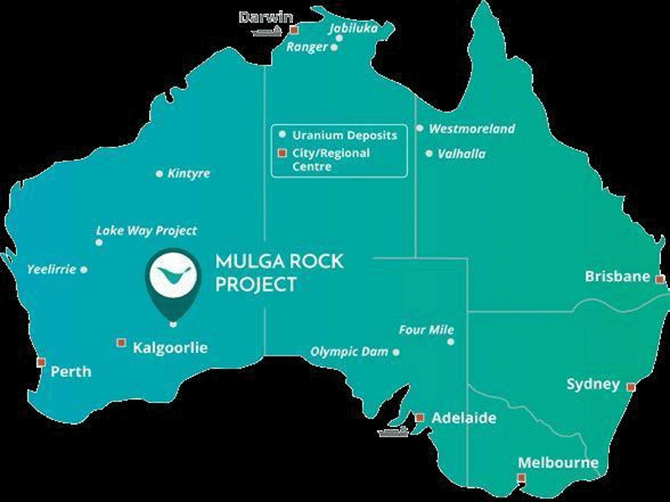
REPORT CASTS DOUBT OVER THE VIABILITY OF THE MULGA ROCK URANIUM PROJECT
|
Vimy Resources has relied on heroic assumptions about prices, unfounded optimism about a booming nuclear industry, and has ignored regulatory risks and mine closure costs in its Definitive Feasibility Study (DFS) for the proposed Mulga Rock uranium mine to the east of Kalgoorlie, a new report by the Australia Institute has found. The report, commissioned by the Australian Conservation Foundation (ACF) and the Conservation Council of WA (CCWA), will be released tomorrow as shareholders gather at Vimy Resources AGM in Perth. Dr Cameron Murray of The Australia Institute said, “The report clearly shows that, based on plausible assumptions about exchange rates and uranium prices, the proposed Mulga Rock uranium mine is unprofitable. “The Mulga Rock DFS is ambitious to the point of heroic. The projections for the future role of nuclear power are extremely optimistic, and the economic assessment of the project’s position in the global uranium marketplace fails to accurately reflect the international situation,” Dr Murray said. CCWA Nuclear Free Campaigner Mia Pepper said, “This report is a reality check for shareholders making investment decisions that would not only adversely affect their back pocket, but also impact a unique part of WA’s backyard.” “Vimy Resources is putting a brave face on a speculative roll of the dice,” said ACF Nuclear Free Campaigner Dave Sweeney. “The company lacks finance, full approvals, social licence, and a market. Having a gamble is hardly news in the mining sector, but gambling with the product that fuelled Fukushima and always generates long lived radioactive waste is not acceptable, and will be actively contested.” For the full report go to http://www.ccwa.org.au/nuclearfreewa scroll down to Reports. |
|
Western Australia set for a scorching summer

Perth cruises through dry, ‘benign’ November as BOM flags glimpse of hot summer to come, ABC  News, By Irena Ceranic 30 Nov 18 As Queensland sweltered through heatwave conditions which fuelled catastrophic bushfires, and torrential rain flooded New South Wales, Perth cruised through a mild November, recording its driest in 61 years and coolest in a decade.
Key points:
- Perth’s spring rainfall totalled 78.4mm, compared to the average of 148.9mm
- The average temperature in Perth in November was a cooler-than-usual 25.3C
- The temperature in the city on Monday is forecast to soar to 36C
There were only two wet days in the month and between them, they delivered just 3.2 millimetres of rain to the Perth metro gauge — far less than the 23.2mm average — making it the driest November since 1957.
Bureau of Meteorology (BOM) spokesman Neil Bennett said the days were also cooler than usual, with an average of 25.3 degrees Celsius………
Get set for a summer scorcher
Perth had an unusually cool summer in 2017-18 and did not record a single day over 38C. But above-average temperatures are expected over much of WA this time around, according to the outlook for December to February from BOM.
“We don’t have a strong signal one way or the other for the rainfall, so that sort of suggests that we’re likely to see average rainfall for the next three months,” said Mr Bennett.
“Temperature-wise though, it does look as if the odds are favouring warmer-than-average temperatures.”
Perth will get a glimpse of what is to come on Monday, when the temperature is forecast to soar to 36C. https://www.abc.net.au/news/2018-11-30/perths-cool-benign-november-the-driest-in-more-than-six-decades/10571178
Noongar traditional owners challenge settlement that will extinguish native title
The ILUA extinguishes native title over the settlement area in exchange for a benefits package which includes depositing $50m a year over 12 years into the Noongar Boodja perpetual trust and transferring 320,000 hectares of freehold and leasehold land to that trust, to be developed and used by the Noongar community.
“It is not about money, it is about the land, and saving our land from mining,” Smith said. “If this deal goes through, the south-west will not be worth living in.”
|
It is not about money’: Australia’s largest native title settlement challenged again, Guardian, Calla Wahlquist, 30 Nov 18
A group of Noongar traditional owners lodge application for judicial review Australia’s largest native title settlement is facing a second legal challenge from a group of traditional owners who say the process was unfair and did not represent the will of all 35,000 Noongar people. Continue reading |
Native title win for Nanda people in Western Australia
Federal Court Justice Debbie Mortimer held an on-country hearing at the Kalbarri foreshore on Wednesday to deliver her judgment.
Nanda Aboriginal Corporation chairman Carrum Mourambine said the hearing was emotional because some Elders had died since the original claim.
“(They) were not here to witness this historic occasion,” he said.
“This determination means that we can continue to pass on our knowledge of culture and traditional customs to future generations.”
The Nanda people native title claim is a combination of two claims.
The first was lodged with the National Native Title Tribunal in 1994 and the second came two years later, then they were combined in 2000.
The determination was by consent, which means it was reached by agreement with other parties to the claim, including the state government.
“The court’s determination will preserve, protect and recognise in contemporary Australian law what the Nanda people already know, and have always known, about their connection by traditional law and custom to their country,” Justice Mortimer said in her judgment.
“They are to be admired for their persistence and determination, in light of the many obstacles facing Aboriginal people and their communities.”
 |
ReplyForward
|
Western Australia’s uranium promise: 10 years later it’s a complete flop
|
10 years ago this week the Barnett government lifted thpr The reality has been far more like morose miners on methadone. After a decade that has seen sustained Aboriginal and wider community resistance to mining plans, the uranium price plummet in the wake of Fukushima and a surge in renewable energy production, there is not a single operating uranium mine in WA. Uranium exploration companies were a dime a dozen but just four projects surfaced as having potential in WA. Three of them raced through the environmental assessment process under the Barnett government and emerged with environmental, but not final, approvals just weeks before the state election in a clear move to wedge the incoming Labor government. The McGowan government felt the wedge and let the four mines with partial approvals continue ‒a clear breach of Labor’s pre-election promise not to allow mines to proceed unless they had full approvals. But the sustained low uranium price and community opposition has thwarted plans to develop any of the four mines. Cameco has written off the entire value of the Kintyre project, Toro Energy has shelved its uranium plans and is now trying to strike lucky with gold, Cameco’s Yeelirrie project is the subject of a legal challenge by the Conservation Council of WA and three traditional owners and then there is Vimy’s Mulga Rock project. Vimy released its Definitive Feasibility Study for Mulga Rock earlier this year and the company is reportedto be “confident of securing contract prices of about $US60/lb this year or next for delivery in 2021 when it hopes to be in production with Mulga Rock.” There was supposed to be an investment decision by July but instead Vimy was handing out pay cuts and scaling back or bunkering down for the sustained lull in the uranium price (currently around $US30/lb). And while Toro is looking for gold ‒and other uranium companies have diversifiedinto medicinal marijuana production or property development ‒Vimy is hedging its bets by setting up a subsidiary to explore for base metals. Globally there are 115 nuclear reactors undergoing decommissioning‒double the number under construction. The International Energy Agency is warning about the lack of preparation and funding for a “wave of retirements of ageing nuclear reactors” and an “unprecedented rate of decommissioning”. A growing number of countries are phasing out nuclear power, including Germany, South Korea, Switzerland, Belgium and Taiwan. The world’s most experienced reactor builder, Westinghouse, went bankrupt last year and the debts it incurred on reactor projects almost bankrupted its parent company, Toshiba. After the expenditure of at least $A12.4 billion, construction of two partially-built reactors in the US was abandoned last year, and the only other reactor construction project in the US was almost abandoned this year after cost overruns of $A14 billion. No wonder that nuclear lobbyists are themselves acknowledging a “crisis that threatens the death of nuclear energy in the West” and are already writing eulogies about the “ashes of today’s dying industry”. Globally there are 115 nuclear reactors undergoing decommissioning‒double the number under construction. The International Energy Agency is warning about the lack of preparation and funding for a “wave of retirements of ageing nuclear reactors” and an “unprecedented rate of decommissioning”. A growing number of countries are phasing out nuclear power, including Germany, South Korea, Switzerland, Belgium and Taiwan. The world’s most experienced reactor builder, Westinghouse, went bankrupt last year and the debts it incurred on reactor projects almost bankrupted its parent company, Toshiba. After the expenditure of at least $A12.4 billion, construction of two partially-built reactors in the US was abandoned last year, and the only other reactor construction project in the US was almost abandoned this year after cost overruns of $A14 billion. No wonder that nuclear lobbyists are themselves acknowledging a “crisis that threatens the death of nuclear energy in the West” and are already writing eulogies about the “ashes of today’s dying industry”. |
|
Western Australia’s “uranium bonanza” just not happening
 WA’s uranium promises fail to appear, Midwest Times, Dave Sweeney, 21 Nov 18 Ten years ago this week then premier Colin Barnett ended Western Australia’s long-standing ban on uranium mining.
Industry promoters boasted of a new mining sector that would be “iron ore on steroids” and the speculation and exploration began in earnest.
In the intervening decade widespread community concern and resistance, combined with a depressed commodity price and a growing appetite for renewable energy, has seen the uranium dream fade.
Today there is not one commercial or fully approved uranium mine despite years of promotion and preferential treatment, and the few projects that continue to seek approval are strongly contested.
This is good news for WA and beyond as uranium is a mineral with unique properties and risks that cause local damage and fuel global risk.
Thanks to those who have helped keep the brakes on this contaminating trade and who have a perspective that lasts longer than a politician’s promise.
Legal action in Western Australia means delay, uncertainty, for Cameco’s Yeelirrie uranium mine
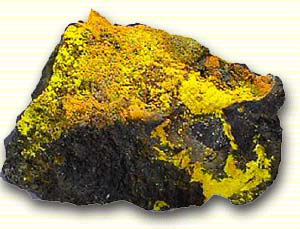  Federal nod for Cameco’s Yeelirrie uranium mine hinges on WA court challenge https://www.kalminer.com.au/?business/mining/federal-nod-for-camecos-yeelirrie-uranium-mine-hinges-on-wa-court-challenge-ng-b881003720z Federal nod for Cameco’s Yeelirrie uranium mine hinges on WA court challenge https://www.kalminer.com.au/?business/mining/federal-nod-for-camecos-yeelirrie-uranium-mine-hinges-on-wa-court-challenge-ng-b881003720z
It means the environmental status of Australia’s largest undeveloped uranium deposit, Canadian major Cameco’s Yeelirrie project near Wiluna, will likely remain uncertain until at least the second half of 2019, almost three years after its approval by former WA environment minister Albert Jacob. Yeelirrie is particularly sensitive because WA’s Environmental Protection Authority initially recommended it be refused on the basis it would make 11 species of rare subterranean invertebrates, known as stygofauna, extinct. WA-based Federal Environment Minister Melissa Price, whose sprawling Durack electorate includes Yeelirrie, told the Kalgoorlie Miner a legal challenge led by anti-nuclear campaigners and a handful of traditional owners was one reason for the delay, with Cameco previously stating it believed the process would be complete early this year. “My department advised that it was prudent to wait for the result of the WA Supreme Court proceedings before finalising the Federal assessment,” she said. “This ensures that we know the State decision is valid and we can avoid overlapping with any State approval conditions.” A Cameco spokesman said the company was working with Ms Price to achieve an outcome as soon as possible. The Conservation Council of WA is hopeful of winning a second appeal against Mr Jacob’s decision in WA’s Supreme Court, after an initial challenge was thrown out in February. Even if the action is unsuccessful the delay could buy opponents of the mine time to see out the conservative Morrison Government and leave the final decision in the hands of a Labor minister, with a hearing not expected to take place until next year. The group’s director Piers Verstegen said it would be “irresponsible” for Ms Price to make a decision on the project while the legal action was afoot. Yeelirrie was discovered by Western Mining Corporation in 1972 and prepared for development in the early 1980s before Labor leader Bob Hawke’s defeat of Malcolm Fraser in 1983 brought in the “three mine policy”, halting new uranium developments. It was sold for $430 million to Cameco by BHP in 2012, but the 128 million-pound yellowcake deposit has remained on ice since then in the face of a subdued uranium market and tricky approvals process. Federal Labor does not currently oppose the development of uranium mines, unlike their WA counterparts who agreed to let Yeelirrie and three other mines in WA, approved under the watch of the Barnett government, be mined in the future on ‘sovereign risk’ grounds. Mr Verstegen claimed Mr Jacob’s Yeelirrie decision set a bad precedent for future decisions on developments that posed a threat to wildlife. “The legal precedent is the same, it could be applied to any species that could be signed off for extinction by the minister,” he argued. “We’re taking that very seriously and that’s why we’re taking these steps to challenge it in the courts.” |
Spain’s government blocks Western Australian company’s bid to open uranium mine
Spain to block Berkeley uranium mine project – sources, CNBC , Belén Carreño, 16 Oct 2018 The Spanish government has decided not to deliver the permits necessary to open the European Union’s only open-cast uranium mine near Salamanca, dealing a serious blow to Australian mining company Berkeley Energia’s plans.
WA Indigenous community tries to rid water supply of unsafe level of uranium
Western Australian government refused to install water treatment plant due to size of Buttah Windee, Guardian, Calla Wahlquist, 3 Oct 18, An Aboriginal community in Western Australia is trying to raise money to fix its water supply, which contains unsafe levels of uranium.
Buttah Windee is a community of four houses about 3km from Meekatharra, a mining town that’s name means “place of little water” in the local Yamatji language.
It has 12 permanent residents and is supplied with bore water that is contaminated with uranium at more than twice the maximum safe level.
The WA government was notified of the uranium contamination in 2012 but refused to install a water treatment plant, saying the cost of doing so was “excessive given the small size of the community”.
Instead it put up signs warning residents not to drink or cook with the water and offered alternative public housing in Meekatharra itself.
Yamatji man Andrew Binsiar has been fighting to stay put. He has raised more than $10,000 through crowdfunding and an art auction and hopes to install a water filtration system to supply both the community and a new fish farm, which is part of a remote Indigenous employment program.
Binsiar discovered the uranium contamination nine years ago when all of the fish in his backyard koi pond died. He sent the water away to be tested and found that it had uranium levels of 0.04mg/L.
Health guidelines state that the maximum safe level is 0.017mg/L.
“I had it tested again this year, it’s still exactly the same,” Binsiar told Guardian Australia.
He installed a 9,000-litre tank on each house, which he fills with tap water from the town supply, to be used for drinking and cooking.
Uranium is a naturally occurring contaminant throughout parts of outback Australia.
A 2015 report by the state auditor general’s office found that the water in one in five remote Aboriginal communities in WA exceeded safe levels for nitrates or uranium.
The Department of Communities currently tests the water supply in 82 remote Aboriginal communities, and said it had seen a significant improvement in water quality since installing chlorine treatment units and reverse osmosis filtration systems in some communities.
“The community elected to continue to reside at Buttah Windee and accept responsibility for the provision of housing and associated services to residents,” assistant director Greg Cash said. “The department ceased providing management services in 2013 and has had no formal relationship with the community since then.”
Binsiar said: “They came and sat on the veranda over here and said they were going to put a bulldozer through my house and put be back into [public housing provider] Homeswest.”
In 2014, then premier Colin Barnett said up to 150 remote Aboriginal communities faced “closure” because they were “not viable” after the federal government withdrew municipal services funding.
The current government opposed that policy but has adopted the remote community reform process started under Barnett which focuses investment on larger communities. It has also cited funding woes linked to the end of the remote housing agreement.
Binsiar said many remaining residents – Wadjarri people and his wife’s extended family – had lived there since it was established on Wadjarri land in 1993.
He said the community was a safer place to raise children, away from the drug and alcohol issues of Meekatharra.
Unless the community’s water supply can be fixed, the new aquaculture enterprise, which is part of the federal community development program, will have to close.
“If we get this thing to a stage and we can’t fix the water, all the young fellas are going to say, ‘Oh, we have to get this far and then stop again’,” Binsiar said. “I want to show people that Australia is truly a generous, generous mob of people. If you are willing to work, people will help.”
MAKE A SUBMISSION BY 24 SEPTEMBER : SENATE INQUIRY INTO RADIOACTIVE WASTE
K-A Garlick , Nuclear Free WA, 21 Sept 18
 To have your voice heard about Flinders Ranges nuclear waste dump plan, make a submission to Federal Minister for Resources Senator Matt Canavan via email at radioactivewaste@industry.gov.au by 24 September.
On 6 February 2018, the Senate referred an inquiry into the selection process for a national radioactive waste management facility in South Australia to the Senate Economics References Committee for inquiry and report by 14 August 2018. Read our submission here. Read all submissions on the government website here. The report acknowledged and validated many of the concerns about the process but unfortunately did not call for an end to the process and for a better way to manage the process of selecting a site for Australia’s most hazardous waste. You can read the Senate report here. Read the Conservation SA media release here.
Points to mention for WA are;
- CCWA calls for an independent inquiry to explore the full range of options to deal with radioactive waste. This should include consideration of the option of keeping waste at ANSTO’s Lucas Heights site, keeping in mind that much of the waste is already securely stored at Lucas Heights (over 90% measured by radioactivity).
- Leonora should not be Plan B, as stated by Minister Canavan in The Australian June 18, 2018. https://www.theaustralian.com.au/national-affairs/race-to-lock-in-nuclear-dump-before-federal-election/news-story/b2ea0780ec1e6971cbce51abddb8ee6e
1 This month

of the week – Australians for War Powers Reform (AWPR)
To see nuclear-related stories in greater depth and intensity
 Antinuclear