Australia’s Nuclear CONference on the defensive
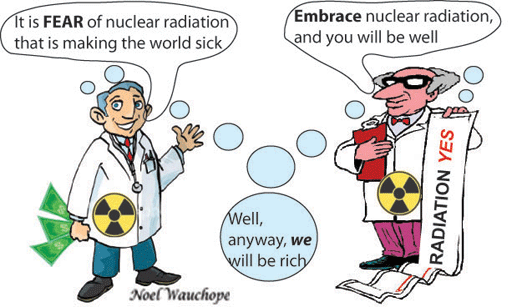 Christina Macpherson, 26 july 13 The spin about ‘Australia’s Nuclear Future” has been buzzing around the media for a while now. The latest headlines – “Embrace nuclear power” “Nuclear power would save $150 billion” spread the spin from the pro nuclear lobby – worthy gentlemen of middle age or beyond, mainly from backgrounds of nuclear physics and engineering. They produce the usual stuff about solving climate change, radiation from Fukushima not a worry, how cheap nuclear power is, and the Australian public coming to like nuclear.
But the key to where Australia’s nuclear lobby is at, is to see what long time nuke spruiker Michael Angwin has to say in today’s Sydney Morning Herald.
Michael Angwin knows what the real situation is, and what the Australian nuclear lobby’s campaign must be. It has to educate, or as Angwin tactfully put it “to advocate”.
Here’s some of Angwin’s spiel:
“People are very susceptible to having their fears stoked by the clever PR people from anti-nuclear NGOs who know how much impact a mushroom-cloud superimposed on the image of a small boy will have.
Nuclear experts know radiation risks associated with nuclear power are very small; but that is little comfort for the targets of NGO spin doctors….
nuclear advocates [must] engage with Australians directly – both broadly and locally – and systematically.
Nuclear advocacy in Australia has mainly been carried out by knowledgeable and informed individuals, science-based organisations and, to some extent, the uranium industry. It has been opportunistic and enthusiastic. If nuclear advocates wish to build on that base, a more strategic and organised approach will be necessary. It still needs to be discovered”
One might ponder why Michael Angwin expects us to believe him, and not those anti nuclear people, seeing that he has an obvious career and financial motive as head of the Australian Uranium Association, and they clearly don’t.
Anyway, from recent articles n by nuclear enthusiasts,it is pretty clear that they see – not cost, not regulation, not renewables competition – but public opinion as the big stumbling block to nuclear power.
Get ready for a renewed media onslaught – as those few news journailists who have not yet been sacked are force fed tripe from the nuclear and uranium industries.
This week in Australian nuclear news
 Accentuating the Positives – Right now, Brisbane is hosting Clean Energy Week. In Fremantle, the clean energy people had a jolly breakfast, celebrating: they didn’t bother to protest, while while nuclear lobby held another flop of a conference. A new Australian invention Flat Pack Solar Buildings . Australia’s Dr Helen Caldicott was a hit, lecturing in Taiwan.
The Negatives: War Rehearsals – USA-Australia Talisman Sabre war games going on in Shoalhaven N – thousands of troops and military hard-ware – wreckinhg that beautiful environment. You wouldn’t get to hear of it except that two American soldiers were injured – Oh and yes, they dropped two unexploded bombs on the Great Barrier Reef. Courageously, Peace Convergence protestors Graeme Dunstan and Greg Rolles have broken into the venue
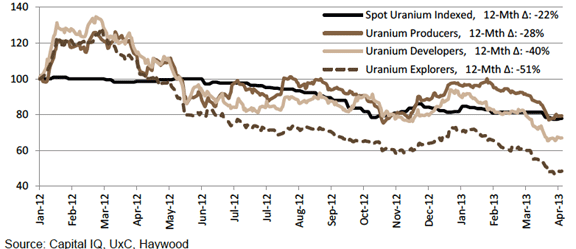
Australian media With the uranium spot price, and the term contract price, very slow, and going lower fast, you might think that the uranium/nuclear story in Australia is dead in the water.
Wrong. First of all the mainstream media continues to give glowing coverage to the fine market situation for uranium – that’s a pack of lies. Fairfax media did not see fit to publish an article correcting the sloppily written nuclear advertorial, by John Watson, that they published last week. The ABC is covering a pro nuclear conference in Sydney this week. We wait to see what the ABC does with this.
I am pessimistic about Australian news media. They have pretty much sacked all their science journalists. Science writing will now be done by journalists who will call upon the Australian Science Media Centre to provide information. So far this Centre has toed the corporate/government line on Fukushima – that’s the line – “it’s not so bad really: they’re getting it under control” etc. They’re likely to toe the corporate line on matters nuclear – but the generalist journalists might not be able to pick up on the bias.
Australia’s Paladin Energy uranium miner continues to be in trouble in Malawi, getting a bad report from the UN Human Rights Commission, for its operations there.
USA’s secret military operations in Pine Gap, and influence in dismissing Prime minister Gough Whitlam – after over 30 years, whistleblower Christopher Boyce speaks out.
The week that was in nuclear news Australia
Legal case; Traditional owners; led by Dianne Stokes, in Melbourne for their federal case opposing the Muckaty nuclear waste dump. Next hearing in August.
Climate Institute did a survey. Surprise surprise – they found that older men favour nuclear power, and women (of all ages) favour solar power.
The good news – New South Wales students taking their zero emissions house to China’s Solar Decathlon. Mildura’s concentrated solar power plant officially launched. Victorian and New South Wales wind farms kick-started by Clean Energy Finance Corporation. New South Wales to get advanced wind power turbines with energy storage. Central Victorian Greenhouse Alliance keen to keep energy efficiency and renewable energy investment
Politics. Kevin Rudd’s Emissions Trading Scheme is far from satisfactory. Still, it looks good compared to Abbott’s love affair with climate denialists. Greens launch an energy efficiency/renewable energy program directed towards helping farmers.
Nuclear issues in Australia would seem to be forgotten, with all the election – Rudd- Abbott – stuff,
And yet – and yet – Pro nuclear propaganda is rife. Australia’s new Energy Minister, Gary Gray, showed us again how he is as big an enthusiast for nuclear power, as Martin Ferguson was before him. A pity, in this new age of renewable energy, that the Labor government saw fit to appoint a mining man to the role. Gary Gray spoke in Perth at a uranium conference. He gave a rose-tinted view of the current disastrous state of the uranium industry, brushed off that minor “incident” at Fukushima, and displayed his ignorance of the world nuclear industry’s decline, and of climate change action.
Meanwhile, in South Australia, Family First Senate candidate Bob Day urges that Australia manufacture nuclear submarines – a good job provider, he reckons. Also from South Australia, nuclear lobby front groupers – Barry Brook, Ben Heard etc, gear up for a conference to be held in Sydney July 25-26 – to promote nuclear power for Australia.
The Age published a sloppily written article promoting nuclear power Want to kill fewer people? Go nuclear. I am hoping that The Age will publish a response to this article. (I’m adding my own comment below)
Australia’s uranium industry – in the doldrums, as even The Australian admits. Retiring soon, Paladin Energy boss John Borshoff admits that the industry is “in crisis” and faces years of uncertainty
COMMENT Continue reading
The week in nuclear and energy news, Australia
Former Senator Jean Melzer died on 18 June. She will be remembered for many achievements and her lifelong  dedication to the causes of lifting conditions of underprivileged groups, and of protecting the environment. Jean Melzer was Victoria’s first woman Labor senator, and first woman elected as the Secretary of the Labor Caucus. She was Convenor of the Movement Against Uranium Mining. Her anti-nuclear stance resulted in 1980’s pro nuclear Labor Party ousting her. She then stood as the lead Victorian senate candidate for the Nuclear Disarmament Party. A celebration of Jean Melzer’s life will be held in Queens Hall, Parliament House, Victoria at 12.30 on Wednesday 3rd July.
Federal politics. What will Kevin Rudd do about climate change, energy etc? What will Tony Abbott do?. I recommend Glies Parkinson’s REneweconomy of you want to learn about this. Indeed, I recommend Crikey – http://www.crikey.com.au/ Independent Australia New Matilda , even the Liberal leaning Online opinion Why bother with the Murdoch, Fairfax etc press and media? Even the ABC – they’re all happy doing personality politics – much more fun than policies and issues – and the media have been a large contributor to the mess that Australian politics is in today.
Carbon tax – A national poll finds that Only a third (37 per cent) of Australians believe that the Coalition should repeal carbon pricing if it is elected government at the next federal election. The full fact sheet is here
Northern Territory. Popular Aboriginal singer Warren H Williams is standing again for the Senate, and looking to be a strong contender for a winnable Senate seat – standing against ALP’s parachuted in political novice Nova Peris. Williams is uncompromisingly anti nuclear.
Wind Energy Australia’s wind generation is cost effective, says International Energy Agency. Despite an anti-wind energy scare campaign backed by wealthy anti wind front groups , the King Island community has voted for a wind farm feasibility study. However, many in the community remain apprehensive and confused following influx of “Waubra Foundation style anti wind campaigners.
“Ugly Australian” Paladin Energy uranium miner continues to slide in share price, as it tries to sell off its flagship Langer Heinrich operation in Namibia, to raise funds to pay off debts.
Retransfers of Australian obligated plutonium from Europe to Japan come into force, and at the same time, Japan takes in its first shipload o mixed uranium and plutonium (MOX) from Europe – to add to its already huge and dangerous pile of plutonium.
The week that was in Australian nuclear news
AUSTRALIA
While the uranium industry is stagnant, due to record low prices, the pro nuclear lobby is busy. South Australia appears to be the pro nuke hub.:
- This week we have the Property Council of S.A. pushing the plan for the full nuclear fuel cycle in South Australia, and for importing the world’s nuclear wastes to South Australia. Businessmen Nathan Paine, Chris Burns,and Theo Maras promoted the idea that South Australia should become the nuclear energy “Dubai of Asia”. The worst part of this is that these men are pitching this as an investment idea for “mums and dads” , as part of a campaign “We’re for Jobs in SA” to be run by The Advertiser.
- South Australia’s two nuclear front group lobbies (Decarbonise S.A and Brave New Climate) are promoting a conference – “Nuclear Energy For Australia” (Sydney July 25-26)
- At Flinders University, USA’s Dept of Energy funds a program aimed at showing that low dose radiation is good for health.
Renewable Energy got quite a boost on 18th July – with two rallies in Canberra, which drew respectable gathering of 500 . Speakers included Professor Simon Chapman and Greens leader Christine Milne.
Meanwhile the much touted anti wind farm rally was a bit of a fizzer. It drew 100 people, who listened to radio shock jock Alan Jones, and politicians Liberal Senator Chris Back , National Senator, Ron Boswell, DLP Senator John Madigan. Senator Nick Xenophon was expected but didn’t turn up.
Climate change – more bad news, as Australia is predicted to be especially affected, and Canberra to become especially vulnerable to bushfires. But good news – Australia’s Uniting and Catholic churches have taken renewable energy initiatives, encouraged by the Pope and other religious leaders.
Renewable energy programs going ahead in remote locations, under the Federal Governmnent’s Regional Australia Renewables (RAR) 60 communities are lobbying the government – Coalition for Community Energy – for funding community energy projects. Construction beginning on South Australia’s Port MacDonnell wave energy project
Australia hosted first World Indigenous Network Conference in Darwin.
The latest Australian nuclear news
It seems as if nothing is happening in the nuclear and uranium scene in Australia. However, a renewed propaganda effort is going on – in both departments. Articles in national and South Australian media have promoted an old, (but never discarded) idea of the Liberal Party, to make Australia the world’s nuclear waste dump. The uranium industry has been strongly promoted by Australia’s new Minister for (Nuclear) Energy, Gary Gray, and of course, by the Australian Uranium Association and their faithful business journalists.
The nuclear waste dump idea, (to enrich a few entrepreneurs like John White of Australian Nuclear Fuels Leasing) comes as the world’s nuclear waste crisis becomes more apparent, and as the Australian nuclear lobby is tantalised at the thought of a Liberal Coalition win on September 14.
The uranium promotion idea looks more like a desperate effort by the uranium industry to jolly itself up, as uranium prices drop below US$40/lb with no prospect of coming up again. This puts the lid on the Western Australian Wiluna uranium mine project – unless there’s a miracle recovery in the market.
Mary Kathleen uranium mine is still a toxically radioactive place, decades after closure. But that hasn’t stopped the Queensland government from deciding to assess opportunities for mining at the site, which contains millions of tonnes of ore tailings. The Mary Kathleen mine is under a Restricted Area 232 status, meaning exploration and production are both prohibited.
Wind energy. Front groups for the fossil fuel and nuclear industry will put on an anti wind energy rally, at Federal Parliament on June 18. Prominent anti climate change sceptics will be there, representing front groups Australian Environment Foundation, Lavoisier Foundation, Galileo Movement, Waubra Foundation – and blessed by the right wing Institute of Public Affarirs (IPA) . The Liberal Colaition if elected, will impose new noise monitoring rules on wind farms – a complicated and tedious requirement that is likely to cripple the industry.
Meanwhile King Island continues to agonise over whether or not to allow a feasibility study for a wind farm there. It seems that at least one golf club is opposed – it is possible that fewer golf tourists would come to King Island if there were a wind farm there. In good old Aussie tradition, sport is having a higher priority than clean energy?
Renewable energy powers on. Regional Australia’s Renewables (IRAR) programs- will halve electricity costs in remote areas where settlements and mining projects have no connection to the grid, and which have relied almost entirely on fossil fuels to date. Households in South Australia are increasingly turning to solar power to alleviate or even obliterate energy bill woes.
Former Liberal leader John Hewson praised the (Greens) plan to push Australia’s $80+ billion Future Fund to cut global warming risk in their portfolio. Former leader Malcolm Fraser tweeted his Twitter followers to vote Green, after a discussion on global warming
The week that was in Australian nuclear news

Renewable energy and climate change are in the news – but mainly for political reasons. It is still possible for the Liberal Coalition to persuade one or more Independents to go for a double dissolution of Federal Parliament. The Coalition then they might be able to put a stop to developments in renewable energy – ones that are being contracted by the Clean Energy Finance Corporation (CEFC) , and are due to commence on July 1.- Even if the election does not happen until September 14, Australia’s Opposition Party has been able to frighten off many renewable energy investments with their promise to repeal the carbon tax, and shut down the CEFC and the Australian Renewable Energy Agency (ARENA).
- All the same, Clean Energy Australia Report showed record renewable energy use in Australia in 2012.
- In Geraldton, W.A. a large solar array has just come into operation.
- In South Australia a final government decision is due soon on the Keyneton wind farm.
- From today, residents of tiny King Island can vote on whether or not to allow for a feasibility study into hosting the largest wind farm in the Southern Hemisphere. Opponents, led by the Waubra Foundation, have hired a Sydney public relations firm to lobby residents for “no” vote.
Uranium price has hit 4 year record low, casting doubt on the future of Toro Energy’s Wiluna project in Western Australia. This would have been W.A.’s first uranium mine.
Julian Assange. Well, if you want any help from the Australian government – make sure that you do a drug crime, or manslaughter or something like that. Don’t expect any help if you just showed a video about US army atrocities in Afghanistan, or revealed cables in the public interest. Australia’s Foreign Minister, Bob Carr has made it pretty clear that the government is not interested in helping Julian Assange, (under investigation by USA for ‘treasonable’ offences)
Even Australia’s newspaper The Age fell for deceptive pro nuclear spin
5 June 13. Today’s Age article by John Watson repeats the mudd;led story put out by the latest UNSCEAR press release – carrying the general message that Fukushim aradiation is not hurting anybody, and really, we should again look upon nuclear power as safe. – Japan’s radiation disaster toll: none dead, none sick http://www.theage.com.au/comment/japans-radiation-disaster-toll-none-dead-none-sick-20130604-2nomz.html#ixzz2VNXzK6Hl
I can only think that the author is, like all too many Australian journalists – somewhat illiterate about ionising radiation and its biological effects.
Nuclear News This Week – Australia
Renewable Energy – yes the news is all about this area. The indomitable Giles Parkinson of REneweconomy just keeps on revealing interesting stuff – like:
- the growth in community renewable energy – community solar network Farming the Sun in NSW”s Northern rivers region, the first of several such groups in New South Wales. NSW government’s Office of Environment and Heritage has approved funding for up to 9 groups to develop similar proposals. Community wind farms exist in Victoria (Hepburn Wind project) and in Albany, W.A.
- Australian businesses are taking to solar energy, with 1,460 commercial solar installation in the first quarter of this year. This is causing financial distress to fossil fuel energy utilities. Australia needs to follow Germany’s lead in helping fossil fuel utilities to cope with the transition – they will still be needed as the renewable energy revolution progresses, for backup energy.
- Meanwhile the Energy Supply Association of Australia (ESAA) got a bit desperate, blaming home solar owners for ‘avoiding network charges’. As Parkinson pointed out, the ESAA ignored the cross-subsidy paid by households with no air conditioning for those who do.
- Victorian Organic Solar Cell Consortium (VICOSC) launches screen printing for solar energy – an Australian scientific first!
Federal politics. Greg Hunt Shadow Minister for Climate Action, Environment and Heritage reiterated the Liberal Coalition’s plans to repeal the Carbon Tax, remove the Clean Energy Act, and remove Federal powers over Environmental Law. Christine Milne gave a spirited stand for Australia’s environment.
Uranium
- Share prices for Australian uranium companies ERA, Paladin, Bannerman Resources, have fallen over 90% since 2007
- A new study ‘Economics at Large’ examines Toro Energy’s Wiluna uranium project., and finds that it is financially risky. It might just manage to be financially viable if Toro can avoid clean-up and decommissioning costs.
- Paladin Energy is the news again, for all the wrong reasons. Very poor and unsafe working conditions in Paladin’s Kayelekera uranium mine, in Malawi, having led to blindness in one worker. Paladin blamed all this on a”sub-contractor”. They couldn’t get away with this in Australia. Sadly, our mining companies can be “The Ugly Australian” in Africa.
.
Australia: nuclear news this week
Nuclear wastes and the old dead High Flux nuclear reactor at Lucas Heights back in the news, as Federal Government plans (listed in Budget) to move these from South Sydney, for dumping on Aborignal land in the Northern Territory. This would clear the way for further nuclear development at Lucas Heights. Nobody seems to have thought of the idea of just stopping making this radioactive trash, importing radiopharmaceuticals made by non nuclear methods. Sydneysiders are anxious about the radioactive transport.
Federal Budget.
- Uranium miners squealing as the Federal Budget moves to stop the rorts on tax exempt exploration, (but they keep all their other perks, such as the fuel rebate).
- Nuke Dump gets $35.7m over 4 years.
- ANSTO gets $38.7m for decommissioning High Flux Nuclear Reactor and $8.1 m for increasing costs of running OPAL Nuclear Reactor
- ARPANSA Australian Radiation Protection and Nuclear Safety Agency gets $ 7.8 m over four years
- Rum Jungle radioactive decontamination funds gets $1.5m this year.
- A mixed result for renewable energy and climate change action. The Australian Renewable Energy Agency survives, with funds deferred. The Clean Technology Programs did not receive rumoured cuts. It could have been worse – and certainly will be, if Abbott gets in, in September.
Uranium market gloom. .Underneath the hype of the future “uranium boom”, some analysts actually coming out now and predicting indefinite stagnation for Australia’s (and everybody’s) uranium industry.
Trans Pacific Partnership negotiations going on, in secret, in Lima, Peru. I bet you’re not hearing anything about this. So far, the Australian government has resisted conditions that would endanger the Pharmaceutical Benefits Scheme, limit access to Internet material, and permit US corporations to over-ride Australian legislation, in investor-state dispute provisions. Australia is admired, as a model for resisting this. However, this could all change very quickly if the Liberal Coalition wins on September 14. You think that this is not nuclear-related? Well, I think that it’s related to everything!
Antinuclear’s take on Australia’s Federal Budget
 Today’s special – a swathe of items about the Budget.
People are analysing the Budget all over the place. Christina Milne of The Greens is scathing about how the Labor government has backed down on its clean energy commitments.
Still – the Australian Renewable Energy Agency survives, and solar and wind power are going to keep growing. Heaven help us if Tony Abbot gets in in September and tries to wreck renewable energy and climate change action. We may well look back on this Budget as something quite good.
The uranium lobby will be squealing, as new rules tighten, to stop the rorts on tax exempt exploration. But they keep all their other $billion perks.
Nuclear agencies continue to gobble up their $millions. The old dead, but still dirty High Flux has costly cleanups indefinitely, the live OPAL nuclear reactor continues to cost. Then there’s the radioactive waste dump planning.
And there are the Counsellors in India and China being funded – their job sounds very like marketing for Australia’s uranium industry.
Uranium mining: Budget slightly dents the government handouts to this industry
The mining industry has had a royal run from the Australian government. Up until this latest Federal Budget uranium mining companies could deduct the full cost of exploration immediately, or even 150 per cent of the cost of exploration in some cases. Tax breaks on exploration and equipment cost taxpayers more than $1 billion per year.
Now – mining companies will cry poor, as the new budget contains measures to tighten the rules on exploration deductions for miners. Companies will now only be able to deduct genuine exploration spending, rather than writing off the acquisition of a company that acquired mining rights and spent money on exploration. But hey, the Government is sacking more than 100 staff from the federal environment department, staff who help assess mining proposals
 But don’t let’s feel too sorry for the uranium, or indeed, any mining corporations. For example BHP Billiton and Rio Tinto pay tax on their fuel, but the government gives nearly all of it back through the Fuel Tax Credits program. Fears the diesel fuel rebates could be targeted again proved unfounded, with no direct changes to the 32 cent rebate.
As Charles Berge wrote (in Sydney Morning Herald May 11, 2010) “And then there are direct government services. Geoscience Australia’s annual budget is $130 million, much of which goes to providing free data and services to the mining industry. The CSIRO and various government research centres chip in another $130 million per year in benefits to the industry. And for the research the miners have to do themselves, they get $160 million back per year in the form of research and development tax concessions.
A billion or two for fuel, … a billion for free pollution and a couple of hundred million for subsidised science . . . pretty soon we’re talking real money.
And that’s before we’ve even begun to talk about government-provided roads, rail, ports, electricity networks and other infrastructure.
Mining is different from most other industries because it directly accesses publicly owned, non-renewable resources. It is appropriate that it pay for this privileged access, over and above its fair share of company tax. In light of the $4 billion to $5 billion in benefits the mining industry receives each year from the Australian taxpayer, the government’s proposed resource rent tax starts to look modest (and anyway, uranium mining was exempt from that tax)…..
So don’t be snowed by the big miners’ shrieks about sovereign risk driving them out of Australia. The biggest risk is that we continue to subsidise mining operations that aren’t paying a fair return for their use of public resources and taxpayer dollars.”
This week’s nuclear news in Australia
Federal politics. Deputy Liberal leader Julie Bishop joins in the growing chorus of Liberal, and some Labor politicians urging for nuclear power for Australia. Much Liberal-Labor wrangling going on about the carbon tax, the the Clean Energy Future legislation, renewable energy promotion and demotion. And I’m sorry, but I haven’t kept up with it too well.
Western Australia. Intrepid Traditional owners and international protesters are already on their way in their 250 Km walk from Yeelirrie to Leonora in protest against uranium mining. In addition to this strong local opposition, there are still many hurdles for the uranium industry to overcome, before Wiluna, or Yeelirrie uranium projects ever become operational. The most significant hurdle is the persistent fall in uranium prices.
Which brings me to the Australian media. The business pages continue to hype the marker forecast for uranium mining. They must be relying on handouts from the uranium lobby, as the reality for the uranium market is quite the opposite – as demonstrated by the spectacular fall in earnings and share prices of leading uranium miner Cameco.
Northern Territory govt is bringing in a levy on mining companies, to raise money to clean up defunct old mines, like the still radioactive Rum Jungle uranium mine. It’s not going to be enough money – but this is still a welcome recognition that uranium mining companies should not get away scotfree, leaving their radioactive mess.
Victorian Health Department finds that wind turbines do not cause illness, but Premier Napthine and the Victorian Liberal govt apparently do not believe this, and are retaining the restrictions on wind farm development. However, a big global fund, Denham Capital Management, is joining with others to create OneWind Australia – investing in wind energy in New South Wales, South Australia, and Tasmania.
Energy issues in Australia this week
While there is nothing dramatic to report – that doesn’t mean that nothing is happening.
Uranium. The Australian Uranium Association’s annual Paydirt Conference, in Adelaide, was sad little affair this year. Poor attendances, schedule cut down from 3 days to one, venue changed from The Hilton to The Intercontinental Hotel. The star address was by the New Minister for Energy and Resources, Gary Gray. Mr Gray has just discovered that climate change is real. Gray has been an enthusiastic climate denier until now. But he has renounced his previous position that climate science was “pop science” and a “middle-class conspiracy to frighten schoolchildren”. Why? I hear your cry?
Well that’s simple. Australia’s nuclear lobby is pitching nuclear power as the cure for climate change. Well, it wouldn’t be very convincing to promote a cure for a disease that you denied existed, now would it?
Uranium economics. The Australian Conservation Foundation has produced a terrific analysis Exposing the Uranium Industry’s Economic Myth shttp://www.acfonline.org.au/sites/default/files/resources/ACF_Yellowcake_Fever.pdf
Tony Abbott promises to reinvigorate BHP’s massive Olympic Dam project, although BHP has rejected it, and the South Australia government admits that it was over- hyped.
Climate Change and Renewable Energy. Liberal Ministers of Energy in Western Australia, Queensland, New South Wales and Victoria unite in a chorus of climate scepticism, and downgrading of renewable energy . Labor’s Gary Gray joins in dismissing renewables. So you see – obeying the fossil fuel/nuclear lobby agenda is not really a party political thing. They are all equally illiterate about energy’s future trends.
Maralinga veterans. Although the UK government has rejected any claim for compensation for Australia’s nuclear veterans, the veterans, many suffering from cancer, are making an appeal to the Australian Human Rights Commission, on the illegality of their exposure to atomic radiation in the 1950s and 60s.
Lucas Heights nuclear wastes. Sutherland Council doesn’t want it stored there. Strange that they haven’t thought of the idea of just shutting it down, and not making any more radioactive wastes.
Australian Uranium Association’s Paydirt Conference a Flop
 Always a big mutual admiration society “do”, the Australian Uranium Industry’s annual Paydirt Conference in Adelaide was a sad little affair this year.
It’s getting harder and harder for the uranium industry to jolly itself up, as the economic realities for the industry become more apparent. Touted as a “major” conference, this one attracted only half as many delegates as in 2012. The conference duration was shortened from 3 days to one. The venue was changed from the Hilton to the Intercontinental Hotel.
Press releases (as far as I could find) focused on excuses for why the Paydirt conference was such a lemon. “Mr Koutsantonis blamed the Fukushima disaster in Japan – and the global review of the industry – for the lack of attendance” – (Perth Now)
Nevertheless, uranium industry spruikers will spruik on.
So – during May, I think that I will just note the antidotes to the Australian Uranium Hype – by quoting salient bits from the just released YELLOWCAKE FEVER Exposing the Uranium Industry’s Economic Myths http://www.acfonline.org.au/resources/yellowcake-fever-exposing-uranium-industrys-economic-myths
For today’s example:
AUSTRALIA’S URANIUM EXPORT REVENUE IN PERSPECTIVE
In the 2011/12 financial year:
• uranium accounted for 0.19% of national export revenue;
• uranium revenue was 4.4 times lower than Australia’s 20th biggest export earner, wool;
• uranium revenue was 8.7 times lower than Australia’s 10th biggest export earner, aluminium; and
• uranium revenue was 103 times lower than the biggest earner, iron ore.
1 This month

of the week – Australians for War Powers Reform (AWPR)
To see nuclear-related stories in greater depth and intensity
 Antinuclear