Nuclear power and the East – China special – theme for November 2013
The global nuclear lobby looks to China as its saviour. The World Nuclear Association(WNA) boasts that China has 17 working nuclear power reactors and 30 under construction, They are less enthusiastic about the safety concerns about China’s nuclear reactors, nuclear wastes, and growing nuclear arsenal – as well as about the increasing popular resistance to nuclear power. See the sidebar at right, for the negative side of China’s nuclear power – and reasons why China might not fulfil the nuclear lobby’s dream.
While the Chinese government is trying to crack down on corruption , in fact, corruption is entrenched in both public and private businesses – graft, bribery, embezzlement, backdoor deals, nepotism, patronage, and statistical falsification. No surprise that this goes on on the very secretive operations of nuclear power and nuclear waste management. And the world does not get to hear of any nuclear whistleblowers in the closed totalitarian State of China.

The danger and security issues of nuclear power make China deal more forcefully and secretly with nuclear power. For China, as with its neighbour, India, nuclear power leads to suppression of civil liberties.
As China has in fact slowed down its nuclear power programme, it has, like Japan, looked to export nuclear technology, as a way to make the industry financially viable.
Asia, Middle East and nuclear power – theme for November 2013
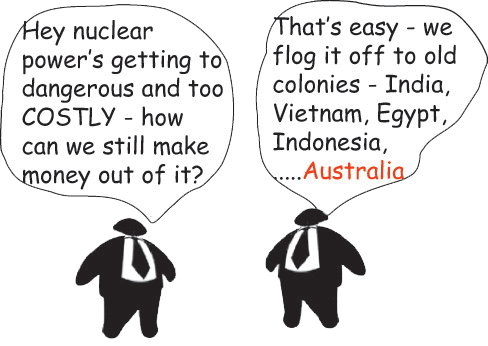
The original and greatest nuclear power country – USA – now finds nuclear power costly and dangerous, The imperative is to somehow make money out of this mess. The answer? – just as with asbestos and cigarettes – sell it off to Asia and the Middle East. France and Russia join in the nuclear marketing frenzy – as does Japan, too (desperate to pretend that all is well at Fukushima.)

And why do Asian and Middle Eastern countries want this poisonous industry? I can only suppose that, along with fashion, consumerism, cars, etc – everything Western is perhaps seen as ‘progress’.
And there’s that other factor, too. It would perhaps be nice to have the option of nuclear weapons. If you want nuclear weapons, you must first have nuclear power.
And you might just think that nuclear weapons might be a good idea. (After all, would Iraq have been invaded if it had nuclear weapons?)
The Eastern world, nuclear power and Australia – theme for November 2013
The future for Australia’s uranium industry is murky indeed. The Australian uranium lobby loves to tell us, ad nauseum, what a great future they have in uranium sales to China. What they don’t tell us is that China is determined to become self sufficient in nuclear fuels. Also China has become apprehensive about nuclear power, since the Fukushima disaster. There are serious safety concerns. China has a developing anti nuclear movement China’s renewable energy program is growing faster than its nuclear program . China has suspended inland nuclear projects and slowed its nuclear program. It is almost certainly abandoning its 3 largest nuclear projects.
And of course – with the current world glut of uranium, uranium prices are going to be low for a long time yet (perhaps forever)
The World Nuclear Association is busily touting the future of nuclear technology in Asia and Middle East – (more about that next week on this page) . This may not be all that relevant to Australia. The great leap forward in nuclear power in Asia and Middle East is not happening nearly as fast as the Australian Uranium Association would have us believe. Which means that the future of uranium sales is not looking good.
This is one big reason why the nuclear lobby is turning its attention to Australia becoming in fact like a Third World country – that is – being not so much an exporter of uranium fuel , but a customer for the nuclear materials that USA, France, Russia Japan, (and even China and South Korea) are desperate to sell off.
There’s another side to Australia’s nuclear relationship with Asia. This is the curious contradiction between Australia’s drive to develop trade with Asian countries, and especially with China – and the danger of Australia as a nuclear target. More about this on the sidebar at right.
The secret economics of nuclear power for Australia – theme for September 2013
We need to separate the (uneconomic) role of uranium in the (uneconomic) nuclear power industry, from the (thriving) role of uranium in the nuclear weapons industry.
Puzzled as to why Australia’s uranium lobby remains so optimistic, in the face of the crumbling nuclear “renaissance”? Well, there mightn’t be much money in nuclear energy any more, but there sure is money in nuclear fuels for weapons. As an important strategic military location for USA, and a blindly loyal ally of USA, South Australia is well positioned to be the supplier of uranium enriching for USA. Also handy as a dump for nuclear wastes.
So all that’s needed is the full nuclear fuel cycle in South Australia. That’ll make, well, a few selected individuals, very rich.

Nuclear power and the Australian Economy – theme for September 2013
In Australia, discussion of the economics of nuclear power is strangely quarantined from the global discussion. Under the influence and ignorance of politicians, corporate bosses, and the Murdoch media, economic information about nuclear power is marvellously skewed away from the truth.
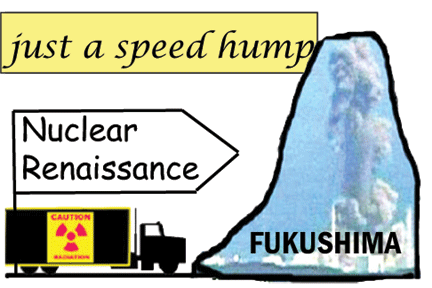
We just don’t get to hear about the collapsing nuclear industry in America, the agonies over nuclear costs in the UK, the movement away from nuclear in Europe, and doubts over nuclear economics, in Asia. The renewed emergency at Fukushima now adds to the dimming prospects for the nuclear industry
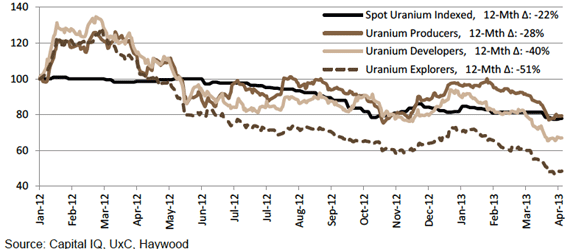
The “spot” price for uranium plunges ever downward. The “term” or contract price now tends downward, too. Australian uranium mining companies are hanging on like grim death, waiting for the fabled “nuclear renaissance” that never comes. They are bolstered by a subservient media, that seems to swallow the line that – uranium prices are so near the bottom – it is proof that that they must come up. Must they, really?
Nuclear power for Australia is a crackpot idea. You get people like Martin Nicholson advocating it as an economically viable industry. He spews out impressive figures. But he doesn’t mention what climate change is likely to do to nuclear reactors (they have to be near water). Doesn’t mention costs of waste disposal, costs of endless security. And of course – the big one – that renewable energy is fuelled for free, can co-exist with farming, can be erected quickly in small scale methods, and relatively quickly in large scale, – and does not degrade the soil underneath.
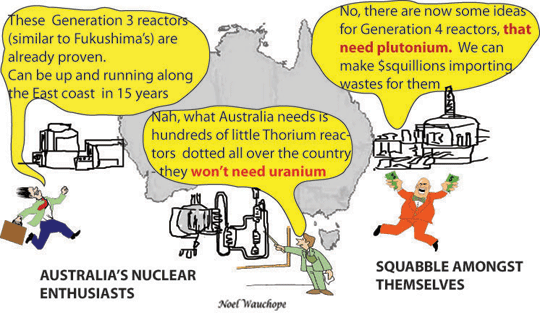
The Australian nuclear lobby might seem impressive. But – it is made up of separate wrangling interests, competing with each other.
Australian Nuclear Spinbuster – theme for June 2013
This week we’ll look at uranium – Australia’s much hyped uranium industry To read the business headlines, you’d think it was booming!
But in reality? Share prices:
- Energy Resources of Australia (ERA) $18.92 in 2007 to $1.04 now.
- Paladin Energy (PDN) hit $10.80 in 2007 to 94c now
- Bannerman Resources (BMN)
Losses – Paladin lost &39 billion in the 9 months to March 2012, and continues losses at Kayelekera mine (Malawi) to its writedown in May 2013. Cameco uranium company reported a 93% fall in earnings for the first quarter of 2013.
Events:
- BHP cut its uranium program 2012 delayed its Olympic Dam expansion, and sold its Yeelirrie deposit in Western Australia. In December BHP shut its South Australian uranium division, folding it into its base metals division.
- Cameco’s CEO Tim Gitzel February 11, 2013 stated that its Western Australian Kintyre project is not economically viable at current uranium prices and had to be written down by $168 million .
- ERA shut down Ranger uranium open-pit mining operations.
- Toro Energy’s Wiluna uranium mine economic forecast -likely to be not financially viable
HEALTH and ENVIRONMENT – post FUKUSHIMA – theme for March 2013
In New York, international doctors and scientists are meeting to apply a searching light into the medical and environmental consequences of the Fukushima nuclear catastrophe. This symposium has been many months in the making, in the organisation of gathering experts on every aspect of this important issue.
Some of these scientists are experienced nuclear physicists and engineers. But many are from other disciplines – genetics, biology, ecology, marine biology, climatology and even some from from other areas, like economics, social science areas, such as gender studies.
These are the disciplines that are ignored by nuclear lobbyists who would have us believe that these are “soft” studies, not “hard” science, like nuclear physics. “Soft” science doesn’t matter , (except for climate studies, which suddenly matters because they can con us that nuclear power is the solution). Australia’s nuclear lobbyists ignore “soft” science like genetics and ecology:
A. because if these issues were taken seriously – that would spell the end of nuclear power, the end of their industry.
B. because they don’t know anything about these sciences, anyway.
The New York symposium has the task of exploring and explaining to the world, the meaning of the Fukushima disaster – in its effects on human, other species, and the land, air, water and plants, on which we all depend for our health. They also will explain the importance of these effects for our children, grand-children, and future generations.
 Soft stuff? Trivial? “Fukushima is over” – Australia’s nuclear lobby would have us believe. Already Marin Ferguson, Australia’s (FORMER) Minister For
 Pushing the Nuclear Agenda, has come out of the woodwork (he’s rarely available) to push for nuclear power, as though the Fukushima event is now over and done with.
Australia’s Murdochracy will continue to ignore the “soft” sciences, and give Australia’s public the hard sell on nuclear. But with online journals, blogs, alternative media, the New York messages will reach us.
Health and Environment – Fukushima radiation’s long term effects – theme for March 2013
 The nuclear lobby loves to concentrate only on the dramatic – explosions, accidents, sudden deaths from acute “high level” radiation. The nuclear lobby very deliberately leaves out the more subtle effects of ionising radiation from its industry – the long term non dramatic ones, – cancers, birth defects, damaged genes.
Nuclear “experts” are, as we are always told, nuclear physicists, nuclear engineers – the “hard” scientists – the ones who know all about machines, reactor designs, functions, reactor buildings, nuclear weapons. ( But some “hard” scientists are very worried about radiation effects – these ones are called “cranks”)
 Nuclear “non experts” are the doctors, biologists, ecologists, paediatricians – the ones who know about human bodies, and the lives of humans and other species. These are the people who know, and care, about ionising radiation and its effects.
Thank goodness – these true radiation experts, (and some well informed “hard” scientists). are getting together in New York on March 11-12, to tell the world the facts about ionising radiation, health, environment – and the true long term effects of Chernobyl and Fukushima disasters. Symposium on The Medical and Ecological Impacts of the Fukushima Nuclear Accident To Be Held at the New York Academy of Medicine nuclearfreeplanet.org
Just a few of the topics they will cover:
- Chernobyl, Fukushima and Other Hot Places, Biological Consequences (Dr. Tim Mousseau,)
- Congenital Malformations in Rivne Polossia and the Chernobyl Accident (Dr. Wladimir Wertelecki)
- Thyroid Pathology in Children with Particular Reference to Chernobyl and Fukushima (Dr. Marek Niedziela)
- The implications of the massive contamination of Japan with radioactive cesium (Steven Starr)
- The Hazards of Low-level Ionizing Radiation: Controversy and Evidence.” (Dr. Herbert Abrams)
- Gender Matters in the Atomic Age (Mary Olson)
- The Nuclear Age and Future Generations (Dr. Helen Caldicott)
The terminally ill global nuclear industry – theme for February 2013
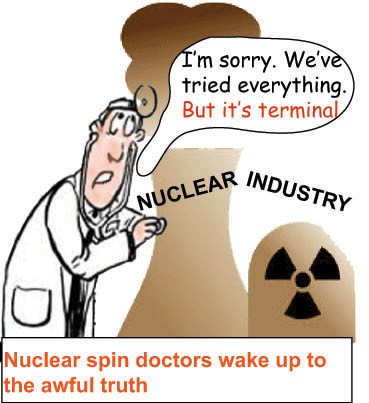 The global nuclear industry is sick, indeed, it is in palliative care. And here are 10 good reasons why: (see side bar for a little more detail on these)
1. Gloom overlies the nuclear lobby, fear of this question: the next nuclear catastrophe. Not IF it will happen, but WHEN and WHERE?
2. Aging, dangerous nuclear reactors that are too costly to make safe. .
3. “New nuclear” is a joke. The nuclear lobby will boast of so many “planned”, “proposed” reactors. But new ones actually being built? – just two and a half duds.
4 Discord and dissension in the nuclear camp. Nuclear countries cannot afford new reactors, so desperately compete to sell them to other countries.
Meanwhile nuclear companies battle it out to market their particular new gee-whiz nuclear reactor version.
5. Climate change affects nuclear reactors.
6. Nuclear weapons now out-dated. 21st Century conflict is all about 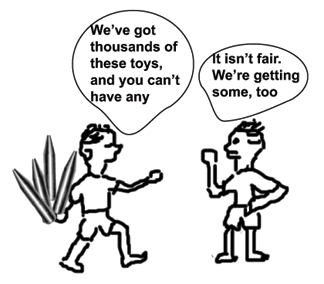 smaller, targeted
weapons, like the USA’s assassination drones. Pride and status are now the only motives for having nuclear weapons.
7. Decline in electricity use
8 Renewable energy, both centralised and small scale, is fast being developed, and widely popular (unlike nuclear).
9. Danger – whatever kind of nuclear facility – there is always the danger of accident or terrorism – they are a target for terrorists.
10 Public opinion. Worldwide – people just don’t like nuclear power.
A bit more detail on all these points – see sidebar at right
2013 – the struggle for a nuclear free, liveable world
It might be too late to prevent heating of the planet, the upheavals of climate change, and the horrors of nuclear accidents, wars, and the slow spread of ionising radiation.
But it surely is too early to give up on trying.
I am not optimistic. We know that cigarettes and asbestos cause painful, fatal cancers. The Western world is learning to abandon these killers. Yet the tobacco and asbestos companies are thriving, selling these to the “developing” nations – a pernicious form of 21st Century colonialism. So the slow killer of fossil fuel pollution continues. The fast killers of nuclear accident, nuclear war become more likely, as well as the slower killer of spreading ionising radiation. The over-developed world is all too happy also to sell these killer technologies around the world.
2013 is the pivotal year. In the words of Redgum, an old Australian band – “If you don’t fight, you lose”
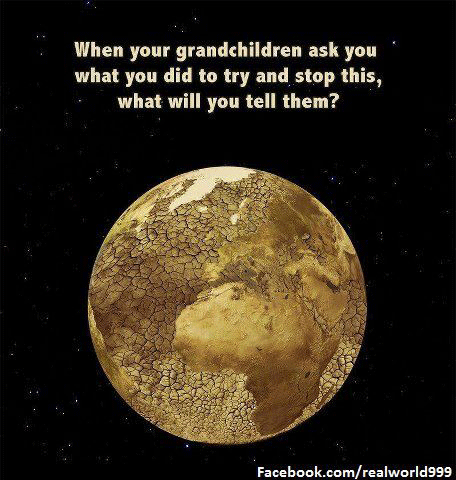
The Dirty History of Nuclear Power – theme for August 2012
 ‘The child is father to the man’ – a saying that applies so well to the nuclear industry. It was born in lies and deception, as early research into ionising radiation ( as a palliative treatment for advanced cancer) was perverted into research towards a radioactive killer. The Manhattan Project first set out to devise a weapon that would kill people, while leaving buildings etc intact – a release of radiological material.
In 1995, the US Department of Energy produced the Final Report of the Advisory Committee on Human Radiation Experiments. It states: “The first proposed military application of atomic energy was not nuclear weaponry but radiological warfare (RW) – the use of radioactive materials to produce injury“ (http://noelwauchope.wordpress.com/2012/07/15/before-the-bomb/)
Later, this aim was changed, to both devastate a city by explosive blast, (still releasing toxic radioactive materials)
After atomic bombs were dropped on Hiroshima and Nagasaki in 1945 most nuclear scientists followed the idea of the “peaceful atom” – nuclear technology would somehow be redeemed through ‘cheap’, ‘clean’ nuclear energy.
No so. Following the USA, other countries adopted nuclear reactors, in order to make nuclear bombs. This process continues today – nuclear power remains a fig leaf on nuclear weaponry – it could never have developed without the weapons industry, accompanied by government subsidies.
The nuclear lies and the nuclear killing machines have continued to this day. Nuclear power was never cheap – especially as the costs paid by indigenous peoples have never been included in estimates. Nor have the costs of the virtually endless disposal and security of nuclear wastes.
AUSTRALIA’S NUCLEAR HISTORY – theme for August 2012
In some ways, Australia’s uranium/nuclear history is a sorry story.
Australia’s very earliest involvement (up to 1915) was in mining and processing radium whichwas used for medical research. But from 1944 onwards, Australia was involved in nuclear weapons – through both providing the fuel for USA and UK weapons, and in the 1950s, hosting Britain’s nuclear weapons testing.
Australia has continued to sell uranium, under cloak of pretense that it does not end up in nuclear weapons. To our shame, the government now agrees to sell to India, which has not signed the Nuclear Non Proliferation Treaty, and which is rapidly militarising with nuclear weapons.
Australia still, by the secret facilities at Pine Gap, participates in the USA’s nuclear military system. Our greatest disgrace is the shameful way in which the Aboriginal people have been exploited, and have suffered, through the uranium/nuclear industry.

In some other ways, it is a history to be proud of.
Australia has a proud history of anti nuclear activity, going right back to the 1960s. Anti nuclear activism in Australia put the brakes on the uranium industry for along time. Among Australia’s anti nuclear activists, Dr Helen Caldicott stands out as the world’s best known and most articulate and respected speaker on the nuclear danger. Our anti nuclear movement also led to the end of France’s nuclear bomb testing in the Pacific. It has saved Australia from having nuclear power plants, and getting an international nuclear waste dump.
More recently, Australian anti nuclear activism in South Australia and Western Australia, is contributing to the slowdown, and hopefully the decline and fall of uranium mining – an industry which, by any measure, never contributed more than an insignificant amount to the economy, anyway.
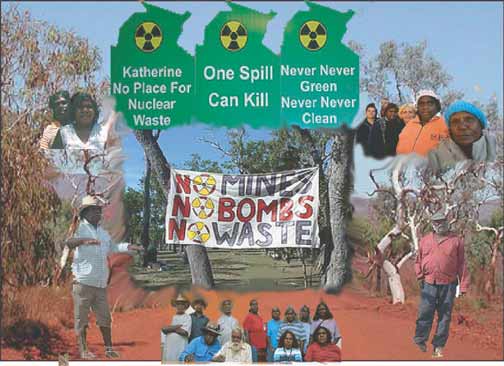
The battle continues, to save this country, and especially its Aboriginal lands, from this toxic industry – now in the fight against the government’s plan for a nuclear waste dump at Muckaty, Northern Territory.
Nuclear radiation and WOMEN – theme for May 2014
 Breast cancer and ionising radiation Ionizing radiation has long been regarded as the most established environmental risk factor for breast cancer…
..Ionising radiation from the nuclear industry affects women especially, because the breast tissue is particularly susceptible to it…..
…Developing fetuses are known to be especially sensitive to radiation
If you live or work close to nuclear power plants, or lived in the era of atmospheric testing of nuclear weapons (1945-1980) you will also have accumulated higher doses of this radiation.
Nuclear power and HEALTH – theme for April 2012
What are the health effects of ionising radiation?

Very high doses of radiation: death within hours or days, due to damage to brain and nerves
High doses: death within weeks, due to damage to the gastrointestinal tract, to the bone marrow, where blood cells are formed.
Lower doses: less severe:radiation sickness (nausea, fatigue and vomiting). Sterility. Some years later – cancer, (especially of thyroid), diseases of digestive organs, bone, & muscle.
Genetic effects: cell damage passed on to later generations
US Nuclear Regulatory Commission Fact Sheet on Biological Effects of Radiation – Cancers associated with high dose exposure (greater than 50,000 mrem) include leukemia, breast, bladder, colon, liver, lung, esophagus, ovarian, multiple myeloma, and stomach cancers. Department of Health and Human Services literature also suggests a possible association between ionizing radiation exposure and prostate, nasal cavity/sinuses, pharyngeal and laryngeal, and pancreatic cancer.
Uranium Mining and HEALTH – theme for April 2012
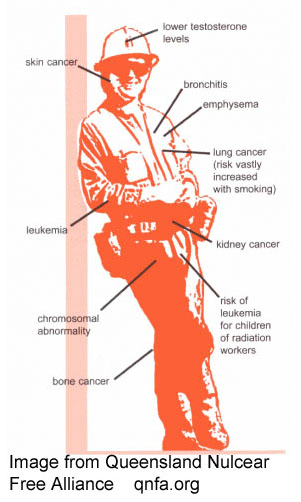
Mining is a dangerous industry. The presence of radioactive substances makes it even more so. Despite assurances and safeguards, the nuclear industry cannot stop workers from exposure, illness and even death due to the nature of the element they are working with.
There are also many instances of corporatenegligence and human error leading to workers accidents, and the nature of their work means that many insurance companies may refuse to give them personal or health insurance
The three main dangers to workers are risk of inhaling radon gas, inhaling Uranium dust and external radiation
exposure.
Mining uranium and mineral sands creates radioactive dust and radon gas. When breathed into the lungs, the dust and gas release their radiation at close range where it does the most damage to the lining of the lung and increases the risk of developing cancer. Radiation exposure can affect men and women’s reproductive health and is also associated with lower testosterone levels, chromosomal abnormality, skin, lung, kidney and bone cancer and bronchitis and emphysema.
workers are still expected to tolerate a higher level of exposure than others, between 20 and 5 mSv, compared to 0.1
for everyone else.
1 This month

of the week – Australians for War Powers Reform (AWPR)
To see nuclear-related stories in greater depth and intensity
 Antinuclear