Uranium, Nuclear Power and Health – theme for April 2012
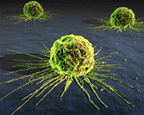 Even without commercial nuclear power – the nuclear industry has claimed many victims in Australia. Cancers and other conditions linked to the radiation, plutonium, burilium-laced lands that were left after the testing has claimed the lives of many of the men who were at Maralinga. In 1985, a survey found that of the 12,500 people involved in the British nuclear testing program in Australia, 11,000 had died. The number of Aboriginal people affected is unknown – data on Aboriginal health was carefully not kept.
IN the USA the health toll of radiation from atomic bomb testing has been officially recognised:
DISEASES ACKNOWLEDGED BY THE UNITED STATES GOVERNMENT TO BE CAUSED BY PARTICIPATION IN ATMOSPHERIC TESTING OF NUCLEAR WEAPONS, Paul Langley’s Nuclear History Blog, 2 Jan 2012
Leukaemia (other than chronic Iymphocytic leukaemia)
Cancer of the Thyroid
Cancer of the Breast
Cancer of the Pharynx
Cancer of the Oesophagus
Cancer of the Stomach
Cancer of the small intestine
Cancer of the Pancreas
Multiple Myeloma
Lymphomas (except Hodgkinís disease)
Cancer of the Bile Ducts
Cancer of the Gall Bladder
Cancer of the liver (except if cirrhosis or hepatitis indicated)
Cancer of the urinary tract, which also translates to the bladder and kidneys
Cancer of the salivary glands
Incorporated into public law 100-321, 20.5.88.
“This law gives US atomic exservicemen due recognition for the unusual service they rendered, and is an expression of gratitude of the American people toward their atomic veterans The law enables Veteran Affairs benefits to flow to US atomic veterans who are afflicted. The US government m relation to nuclear veterans considers the nature of service plus the development of any of the above diseases sufficient cause to quality for Veteran Benefits regardless of recorded dose rates received. All US nuclear test service personnel are officially Veterans.” http://nuclearhistory.wordpress.com/2011/12/31/diseases-acknowledged-by-the-united-states-government-to-be-caused-by-participation-in-atmospheric-testing-of-nuclear-weapons/
The nuclear/uranium industry and WATER – theme for February 2012
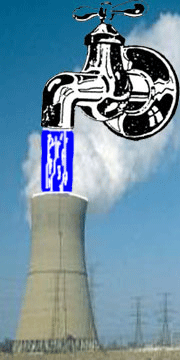 Effects of uranium mining and nuclear power on water.
Overuse of precious fresh water.One of the greatest dangers of the nuclear/uranium industry is in its use of water. Both uranium mining and nuclear reactors require enormous amounts of water. This is a threat to the world’s scarce resources of fresh water.
Pollution. Both uranium mining and nuclear reactors also pollute water. In uranium mining, water is often used to pour over radioactive dust tailings: radioactive water can leach down into groundwater. In the “in situ leach” process, radioactive water is disposed of into the aquifer.
Nuclear reactors use water for cooling – the resulting hot water is released into the source, river, or coastal sea, to thermally pollute the area, damaging plants and fish.
Effects of water scarcity, and hot water on nuclear reactors.. In heat waves, nuclear reactors often will need to be shut down, as their river sources of cooling water become too warm to function as a coolant.
As global warming brings about a rise in average temperatures and ocean levels, inland reactors will increasingly contribute to, and be affected by, water shortages. During the record-breaking 2003 heat wave in France, operations at 17 commercial nuclear reactors had to be scaled back or stopped because of rapidly rising temperatures in rivers and lake. Spain’s reactor at Santa María de Garoña was shut for a week in July 2006 after high temperatures were recorded in the Ebro River.
Paradoxically, then, the very conditions that made it impossible for the nuclear industry to deliver full power in Europe in 2003 and 2006 created peak demand for electricity, owing to the increased use of air conditioning. http://chellaney.net/2011/03/14/paradox-of-nuclear-power-water-guzzler-yet-vulnerable-to-water/
Seawater can be used to cool reactors, but it has to be purified. Corrosive elements in the seawater would otherwise ruin the reactors – so seawater is a last resort for cooling. As in the case of the Fukushima emergency – seawater was used, as ruining the reactors was preferable to a catastrophic nuclear meltdown.
Nuclear Power and WATER – theme for February 2012
Australia is at the forefront of the world’s nuclear fuel cycle. The world’s media seems to cover nuclear issues at the back end – nuclear reactor accidents, used nuclear fuel wastes.
But – at the very front end is the destruction of precious natural resources. Above all, there’s the guzzling of Australia’s fresh water. There is also the degradation of rivers, creeks and groundwater, through radioactive leakage.
Water intake. No mines are more water intensive this the uranium mines. Of these, BHP Billiton’s Olympic Dam is the prime guzzler, with its massive daily draught from the Great Artesian Basin
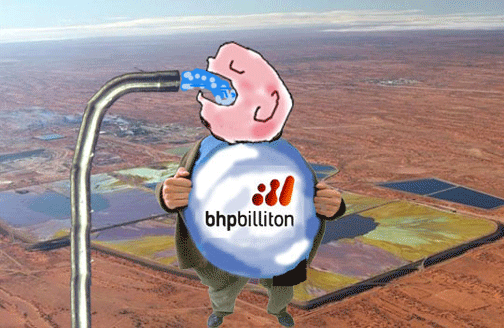
Over recent months, large areas of Australia have experienced extraordinarily large rainfall. This might have lulled Australians in the Eastern States into thinking that we have plenty of fresh water. Australians are amongst the highest consumers of water in the world.
We don’t. Australia is the driest inhabited continent, with one of the lowest rainfalls in the world. Three quarters of Australia is arid or semi-arid. We depend on the Murray River system for 50% of our water use. While surface water systems provide most of Australia’s water intake, undergoud bores alos play a significant role.
The Great Artesian Basin provides the only reliable source of fresh water through much of inland Australia. Water extraction from the GAB is essentially a mining operation, with recharge much less than current extraction rates. Australia’s extraction of water from the Great Artesian Basin (GAB) is estimated to be greater than the inflow to the GAB
Water radioactive pollution. There have been numerous spills and leaks, and seepage from Australian uranium mines, into creeks, river systems and groundwater. (from Nabarlek, Ranger, Olympic Dam. Beverly, Rum Jungle, Radium Hill, Mary Kathleen. League of Individuals for the Environment, Inc.: Uranium Mining: Australia and Globally)
In South Australia, there have been over 20 spills at the Beverley In Situ Leach mine (http://uranium-news.com/category/processes/in-situ-leach/)
Nuclear power and radiation – theme for October 2011 – the medical aspect
 Back in the early 1940s, Dr Charles Pecher pioneered radiation as a treatment for cancer – ( until his work was taken over by the military to use radiation as a weapon.). Still, medical radiation has an honourable history and valuable role in treating cancer.
But medical radiation is a two-edged sword. We need to remember the risks it can carry to radiation technologists, nurses, doctors, other patients in hospital, and family members. Children can be at particular risk.
This is illustrated in a recent news item: Radiation treatment meant mother could not touch son Hartlepool Mail, 30 September 2011 A MUM was forced to stay away from her baby son after being given potentially dangerous treatment when she found she had a rare form of cancer. New mum Jill Teasdale could not get close to little son Max just months after he was born after contracting thyroid cancer.
The 30-year-old found a lump in her neck and following hospital tests, was diagnosed with papillary thyroid cancer. Within weeks, she had undergone an operation to remove her thyroid gland and was prescribed a course of radioactive iodine treatment.
“The treatment lasted about a week, but because of the radiation I wasn’t allowed to get close to my little boy,” she said. “I had to have minimum contact.”
Although diagnosed in June 2009, it was not until the following April that Jill was given the all clear….. http://www.hartlepoolmail.co.uk/news/local/radiation_treatment_meant_mother_could_not_touch_son_1_3822684
Nuclear Power and Public Opinion in Australia – theme for Sept 2011
Who really favours nuclear power? Well, a minority of Australians enthusiastically support it. – careerists in the nuclear industry, careerists in politics, academia, careerists in the Murdoch media, highly paid uranium workers, communities that exist only because of mining, – (the latter can’t really afford not to support it)
Less enthusiastic Australian supporters are those who follow the good old Australian dictum
– ”she’ll be right mate”. You don’t need to think. You know that the “experts’ in the Murdoch media know best. It’s safest to support the Establishment. After all, there’s supposed to be money in uranium investing. Very many Australians wrongly believe that BHP and Rio Tinto are ethical, and are Australian companies.
BUT – even in Australia, land of the golden yellowcake investment dream, there is a growing minority who
enthusiastically do NOT favour the nuclear industry. And they probably number many more than the pro-nukes. Their numbers are growing, as information spreads about the diseconomics of the nuclear/uranium industry, and its global destructiveness.
As their numbers grow they form part of a world-wide movement whose aim is to shut down this toxic industry – forever.
Nuclear power – Australian public opinion – theme for September 2011
In Australia, the uranium/nuclear lobby is twisting and turning – in desperate effort to win over public opinion.
They need to do this, because the uranium industry is well and truly in the doldrums. The nuclear lobby envisages a future for Australia in which Australia hosts the entire nuclear fuel cycle, from cradle to grave – from uranium mining, through nuclear power plants, to hosting the world’s radioactive wastes.
Despite the investment pages hyping up the uranium industry, despite the mainstream media generally ignoring the continuing Fukushima disaster, despite South Australian politicians spruiking uranium and uranium enrichment – the Australian public is not fooled

Nuclear Power and Information – theme for June 2011
 In ancient times, the great philosopher Diogenes walked the streets of Athens in the daytime, with a lantern shining – he said that he was “looking for an honest man”, desperately trying to seek out the truth.
Diogenes would need a blooming blow torch, in Australia today, to cut through the crap of Australia’s worthy establishment figures talking up uranium, rare earths, and prospects for nuclear and nuclear waste industries.
Fortunately, Australia, and other countries, have some investigative journalists, and independent media, who follow in Diogenes passion for getting to the truth.
Their work is communicated to Australians, even sometimes in the mainstream media. Some intrepid journalists manage this. Others get their message across in independent media
The Emperor’s New Nuclear Spin – May 2011
Pro nuclear propaganda is turning into a joke, and not only in Australia, where it is currently intense. The Nuclear Establishment is in denial about the seriousness of Fukushima, about the dangers of nuclear waste, about the prohibitive costs of new nuclear plants, and about the collapse of the uranium industry.
With Fukushima news quietly vanishing from the mainstream media (even though that catastrophe continues), the nuclear mafia revert to their old themes – which now sound more and more like the Emperor’s New Clothes.

Radiation – April theme – PLUTONIUM
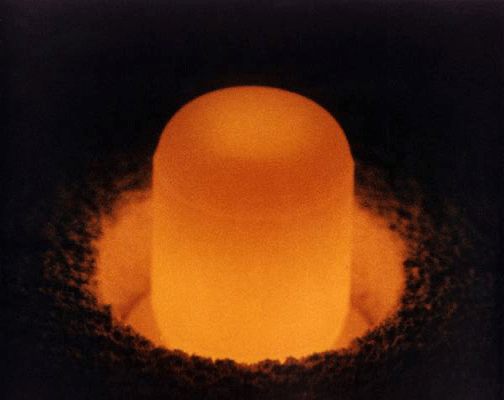
Plutonium is a manmade element created in nuclear reactors. Plutonium is fiendishly toxic. A speck of it the size of a pollen grain, if caught in the lungs after inhalation or in bone after ingestion, can cause cancer. A severe reactor accident with plutonium-based MOX fuel in one-third of the core will result in 100% more latent cancer fatalities than if the core was made up entirely of conventional uranium fuel. Such an accident with an all-MOX core would kill 300% more people than with an all-uranium core……Pu Threat
1 This month

of the week – Australians for War Powers Reform (AWPR)
To see nuclear-related stories in greater depth and intensity
 Antinuclear
