What is to be done about Climate Change? – theme for August 17
 Frogs are smarter than we are? We insult frogs when we say that they would stay in a pot of water, to die, as it was slowly heated to boiling point. Dr. Victor Hutchison, at the University of Oklahoma, dispelled that myth when he studied frogs’ reaction to temperature changes in water. He followed the procedure outlined for a proper frog-boiling; put a frog in cold water, and gradually warmed the water up. (He stopped well before the boiling point.) The frogs most definitely did jump out when the water got too warm for them.
So – the message to human society surely should be – act like a frog – and don’t let global warming keep on creeping up on us!
Current approaches to the climate change crisis:
- Some climate scientists now warn that it is probably too late.
- Some advocate geoengineering solutions.
- Climate scientists are in agreement that actions must be taken to adapt to climate change.
- Drastic reduction in greenhouse gases is necessary, whatever other actions are taken.
Al Gore’s controversial new film carries a powerful message of hope.I hope that he’ s right.
Meanwhile the tragic main point of climate change is that it is affecting those who least deserve this. Rural populations in India, China and Africa , who have contributed very little to the cause of climate change are already afflicted with unusual heat, and drought. Pacific islanders, and South Asian coastal communities are already experiencing sea surges, as sea levels rise.
The challenge for this 21st century is surely for environmental justice – for meeting the plight of environmental refugees with help and compassion, rather than with barriers and conflict.
The image below is by courtesy of the arti st Ricardo Levins Morales www.RLMArtStudio.com
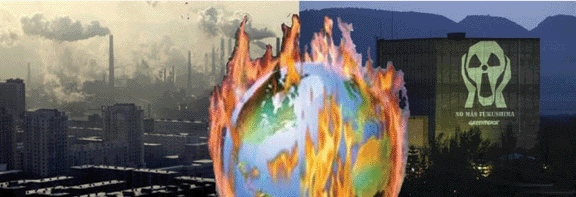
Climate change- the global emergency – theme for August 17 (nuclear is irrelevant)
Climate change may now be irreversible, and is certainly at an urgent stage. While this website is dedicated to opposing the nuclear threat, we can’t ignore the reality of its twin peril – global warming.
The scientific consensus is that the Earth’s climate system is unequivocally warming, and that it is extremely likely (meaning 95% probability or higher) that this warming is predominantly caused by humans. It is likely that this mainly arises from increased concentrations of greenhouse gases in the atmosphere, such as from deforestation and the burning of fossil fuels (Wikipedia)
The Intergovernmental Panel on Climate Change stated that warming of the climate system is ‘unequivocal’ with changes unprecedented over decades to millennia, including warming of the atmosphere and oceans, loss of snow and ice, and sea level rise.
Right now, climate experts are stressing the urgency of the situation, but offering differing ideas on what action to take. Dr Clive Hamilton, in his new book new book titled “Defiant Earth – the fate of humans in the Anthropocene.” says we will go well beyond the danger point of 2 degrees C. of warming, at least to 3 or 4 degrees. He advises that human society must adapt, and try to avoid the very worst. He warns us to avoid grandiose technological solutions.

Climate scientists agree on the need to drastically cut greenhouse has emissions, but some say that more action is needed. Paul Beckwith wants an international collaboration on further projects, to slow the warming rate – Removing excess CO2 from the atmosphere, Cooling the Arctic and saving the sea ice, Preventing Greenland Ice Sheet disintegration, Suppressing methane.
Of course, the nuclear lobby keeps promising extremely expensive solutions for the very distant future. However, nuclear reactors, of whatever type, would be far too late, even if they did combat climate change, (which they don’t). Nuclear power is irrelevant to climate change, – except for taking resources away and thus slowing up effective measures, such as energy efficiency and renewable energy.
Australia: Climate change (to which nuclear power is irrelevant) – theme for August 2017
Of course the Great Barrier Reef is important, to Australia, and globally. It is a World Heritage site, and a unique and wonderful ecosystem. It’s just that I get a bit sick of everyone talking about its economic value – as though business is the only thing that matters to Australians.
Even more, I question the emphasis on the GBR, in context where nobody seems to be talking about the appalling impacts of climate change that are already happening, and will increase, in African and Asian nations.
Climate change is a global tragedy, for humans and other species. We are now in an era, (the Anthropocene) in which global action is imperative – quite the wrong time to put up the barriers, and say “our nation first”
Even if we do think “Australia first” – we’d better realise that WE might need some international help, as Australia is predicted to be hit particularly hard by climate change. Some of these impacts: increasing heat waves, some regions drier, bushfires, changed and damaged ecosystems, sea level rise, increased severity of floods. All this has effects on agriculture, infrastructure, human health, and society, with the most disadvantaged communities suffering the most.
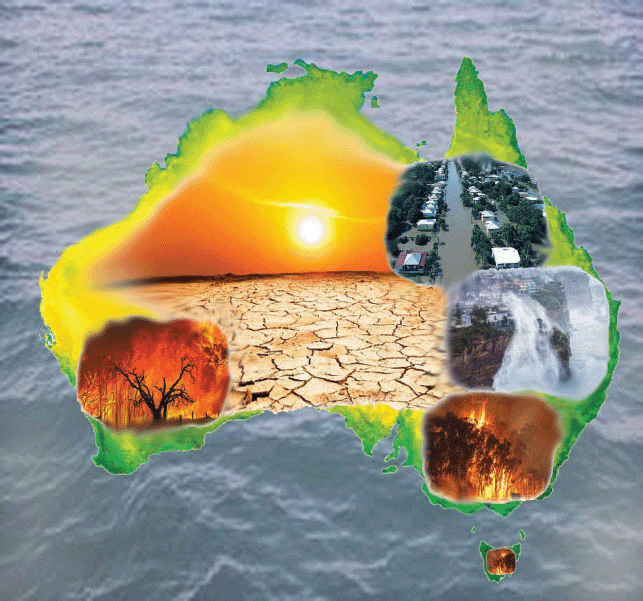
The effects of climate change elsewhere will impact Australia – sea level rise, especially affecting Pacific islands, environmental refugees, food shortages, environmental disasters, social instability, and increasing need for humanitarian aid. Australia is an island, yes, but can no longer function as though the rest of the world doesn’t matter.
Climate change is THE ISSUE right now, although the nuclear issue remains critical too – especially this month, when we remember Hiroshima and Nagasaki. The nuclear industry’s claims to fix climate change are farcical, and deserve to be ignored; the only relevance nuclear has is that its proponents are holding back REAL answers to global warming.
Russia and the Global Nuclear Industry – theme for July 17
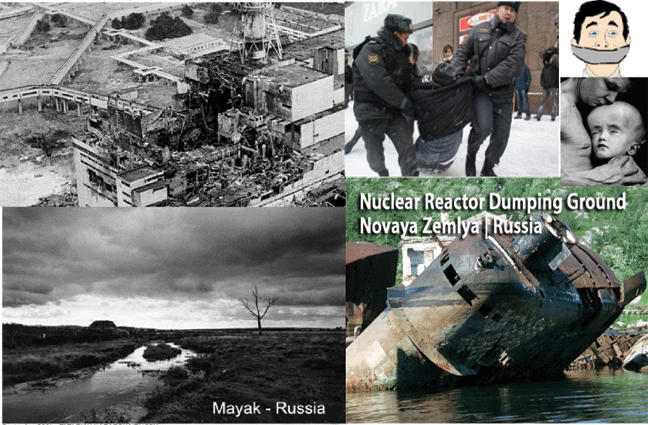
It’s high time that the global nuclear-free movement turned the spotlight on RUSSIA. THIS website, being anglophone, is continually criticising America. But it’ s not just the language problem that makes us neglect to scrutinise Russia: it is also the secrecy, media censorship, and persecution of dissidents that help Russia to avoid scrutiny.
Russia’s quite scandalous nuclear history, past and ongoing, deserves to be exposed. There are 4 main issues here:
1.Russia’s history of nuclear accidents
2. Russia’s scandalous mismanagement of its radioactive trash
3. Russia’s secrecy and cover-up of its serious nuclear problems.
Since 2007, when the Howard government signed up to a nuclear development agreement with Russia, the Australian nuclear lobby has been quietly working to develop nuclear power in co-operation with Russia. This continues today, both with an Australian presentation in Moscow’s AtomExpo, and in Australia about to join the Gen IV nuclear Framework, along with Russia.
Nuclear Marketing – Australia’s role- theme for July 17
What is Australia’s role in the continuing, desperate, global marketing by the nuclear industry?
The global nuclear marketing campaign suffered a serious blow when South Australia definitively rejected the plan to import radioactive trash. That plan had been essential to setting up nuclear power in South East Asian countries, as it promised to solve their nuclear waste problem.
Today, as the Western world’s nuclear industry collapses, there is new urgency to market nukes internationally. China and Russia (with their State-owned industries) now lead the charge – the campaign to sell the “old” big reactors, and the new (as yet non-existent) big and small ones.
New “start up” companies in America now join with other nations to market the new futuristic nuclear gimmicks. It becomes a global co-operation with Russia and China in the lead.
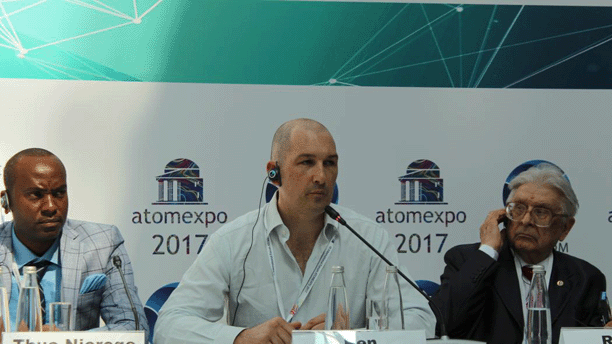
Australia’s nuclear zealots join in. Enthusiastic propagandists like Ben Heard join in Moscow’s AtomPro advertising extravaganza.
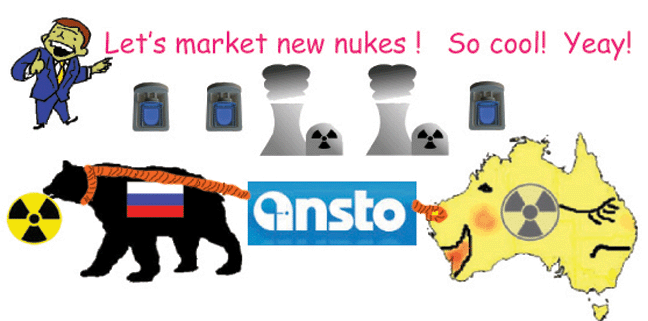
More seriously the Australian Nuclear Science and Technology Organisation (ANSTO) renews its tax-payer funded promotions. Defence hawks and various nuclear industry shills back the new push for Small Nuclear Reactors (SMRs) . The Australian government is about to rubber-stamp ANSTO’s plan for Australia to take part in developing Generation IV nuclear reactors, (ANSTO boss Dr Adi Paterson having pre-empted Parliament by already signing Australia up to GenIV International Forum)
Australia is unwilling to even attend UN international meetings to discuss a nuclear weapons ban treaty . Australia pays lip service only to the international Paris climate change accord.
Yet Australia is happy to follow Russia in a new global nuclear marketing push?
Almost certainly so – because Australia has quite a recent history in promoting nuclear power in co-operation with Russia. In 2007 the then Howard Liberal government invited Sergei Kiriyenko to Australia. On 7 September 2007, head of Rosatom Sergey Kiriyenko and Australian Minister of Foreign Affairs Alexander Downer, in the presence of Prime Minister John Howard and President Putin, signed the Agreement between the Government of Australia and the Government of the Russian Federation on Cooperation in the Use of Nuclear Energy for Peaceful Purposes
Currently, the Australian nuclear lobby works quietly with Russia, sending nuclear propagandist Ben Heard to Russia to join in Their AtomExpo global promotion of the industry.
Media and nuclear – Australia – theme for March 2017
The new media landscape – what does it mean for Australia and nuclear issues? For one thing, the decline in mainstream media means that it’s cheaper and easier for mainstream media, particularly the Murdochracy, to abandon paying for true journalism and just regurgitate propaganda from government and the nuclear industry.

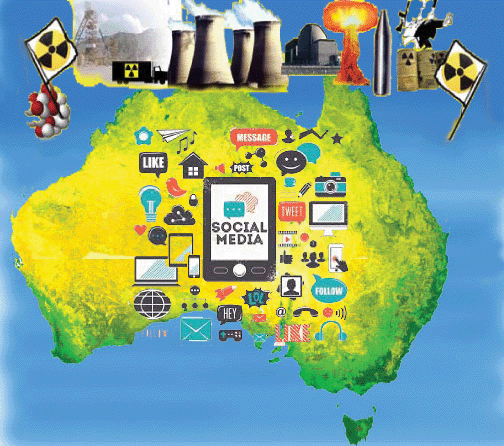
Meanwhile Australia’s pro nuclear lobbyistsare very active, and use sophisticated algorithms to churn out multiple tweets from just one source. Fortunately a lot of these seem quite stupid, spending much time on infantile trolling of Dr Caldicott. Examples: @totterdell91 @thjr19 and a lot of their fake clones, often adopting female names e.g Marcelina, EcoWife
NUCLEAR POWER and MEDIA – theme for September 2012
 Just two years ago, this website focused on “media” – mainstream and alternative. http://nuclear-news.net/information/media/ While that analysis is still appropriate – it is looking sort of out of date.
In fact – there is a revolution going on in media.
Where do you go first for news today? Not to the mainstream media. It’s all happening first in the Twitter world, the Facebook world, Blogs, Youtube, and many other “social media” worlds. Blogging merges into news, and “blog” sites become news sites, for example ENENews.com – Energy News , http://enformable.com/ and http://nowarnow.wordpress.com/ These, and other websites harvest information, often from “dry” “academic” sources – and present them in a more news-digestible form.
Investigative journalism is still the core of true nuclear news. But investigative journalists are up against the climate of financial stress in the mainstream media. Where a non profit blogger can quickly slap up a blog, investigative journalism takes great time and effort – and these true journalists must make a living. Independent investigative journalists are thin on the ground – very hard to spend the time, the effort, the fact checking, without an income.
This is the dilemma of nuclear news reporting today. Occasionally now, the true disastrous state of the world’s nuclear peril IS revealed by a mainstream media journalist.
But, government and corporate pressures mean that this is not generally to be tolerated in mainstream news media.
This is a pity – because mainstream journalists do carry a certain professional credibility and accountability.
But for the present, we all have to rely on those very modern, and freer, sources, of new
 and social media – and be vigilant in assessing their credibility.
The downside of “social media” – ONLINE ASTROTURFING. Using paid writers, and now more often bots – computer generated fake identities, corporations and goverments can churn out “comments” on websites, especially pro nuclear comments.
The nuclear industry is a financial disaster- theme for February 2017
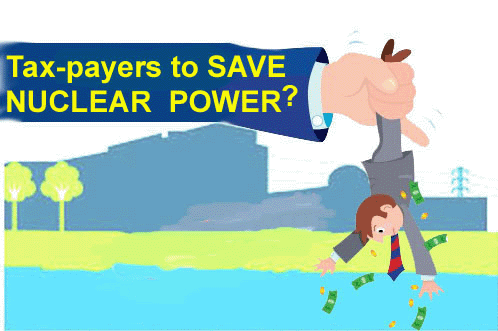
A bunch of American billionaires is trying to save the astronomically expensive nuclear industry – by getting taxpayers to pay for even more astronomically costly “little new nukes”.
Meanwhile in China, France UK, South Korea – and even in America, governments are desperately propping up the super costly “big old nukes’ .
In a world where charlatan Donald Trump can become USA President – the nuclear salesmen might well think that any fraud can be perpetrated on the public.
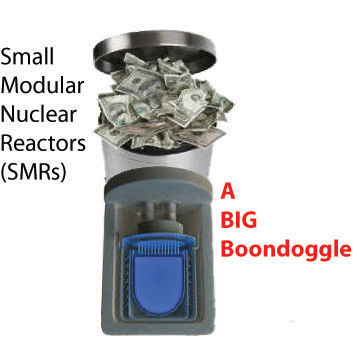 But not for long.
The genuinely clean energy transition is under way world-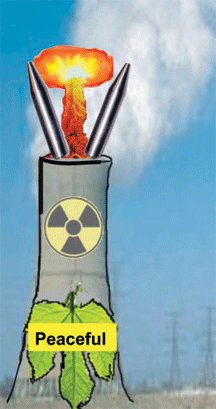 wide, and becoming ever cheaper.
The “peaceful” nuclear industry is intrinsically linked to the multi #billion nuclear weapons industry. Yet even the nuclear weapons industry is under threat, with the coming UN nuclear disarmament conference.
Even if concern for the public good does not stop the toxic nuclear industry – the unaffordable economic costs eventually will
The nuclear industry- economic disaster for Australia – theme for February 2016
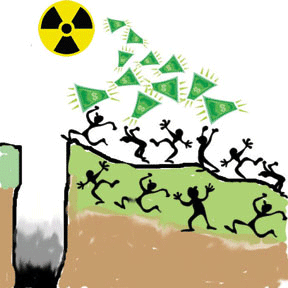
Any economic argument for the nuclear industry was blown out of the water by the absolute discrediting of South Australia’s shonky Nuclear Royal Commission (NFCRC)’s push for importing nuclear wastes.
Australia’s nuclear lobby knew that the industry is not healthy, nor safe, nor clean, and is a disaster for the Aboriginal people. But, they didn’t care – saying that importing nuclear waste would make $billions. All thorough economic research said otherwise. Far from saving South Australia’s struggling economy, expanding the nuclear industry would most likely bring that State to bankruptcy.
Now the nuclear lobbyists are at it again – touting “new nukes” – small thorium nuclear reactors, (which would require importing enriched uranium or plutonium to get them working.) Even the pro nuclear NFCRC concluded that these would not be economic for South Australia.
 The push for “new nukes” is driven partly by the vanity of a few would-be-famous young men, partly by the nuclear enthusiasts within the defence lobby, and partly by the general desperation of the global nuclear industry to make it look as if they’re succeeding.
Whichever way it is, South Australia will be the loser if nuclear lobbyists win. South Australia has the opportunity to lead in 21st Century renewable energy technologies. With no help from the climate-denying, anti-renewables, Turnbull government, South Australia is up against it.
The uranium market is in continual gloom. Any expansion of the nuclear industry in Australia is a recipe for economic disaster – and a ludicrous contrast to Australia’s wonderful opportunities in renewable energy and clean agriculture.
Australia’s nuclear history – scandals and successes
 Australia has a secret and scandalous nuclear history. But at the same time, Australia has a fine history of successes by the nuclear free movement. Aboriginals have been at the forefront, but not alone, as Australia also has a proud record of environmental and anti nuclear activism.
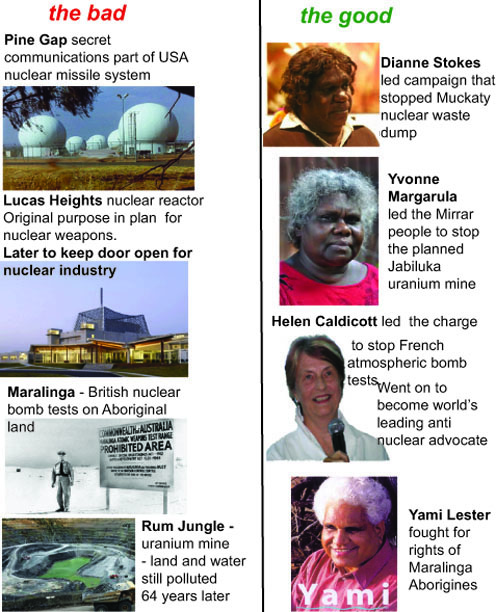
From the archives. Each week, this site will be reposting items from the past. Lest we forget:
U.S. military bases made Australia a nuclear target
Australia feared nuclear attack over US ties: archives ABC News (Australian Broadcasting Corporation) Emma Rodgers 1 Jan 2011, Malcolm Fraser’s cabinet was warned in 1980 that boosting its military ties with the US could put Australia at risk of a nuclear attack and expose it to involvement it in American operations contrary to its national interest, secret cabinet documents show. Continue reading
Nuclear history – from the archives – theme for December 2016
Today, journalism is in a sorry mess. Yet still, there are courageous examples of investigative journalism – such as the McClatchy report on nuclear workers’ health. All too often, revealing and informative reports on nuclear matters are forgotten, as celebrity sex scandals and sport dominate the mass media.
This month we will remember and refresh stories from our archives. It’s important that, while we look at current events, these events are illuminated by knowledge of their history. Especially today, as the nuclear industry struggles desperately to survive – and to portray itself as “clean, green and of course, peaceful”, the truth of its dirty history must be remembered.

From Australian nuclear archives – lest we forget – theme for December 2016
For December 2016, this website will be republishing significant articles from past issues. Historic articles are interesting in themselves, but more importantly, give insight into current problems in Australia.
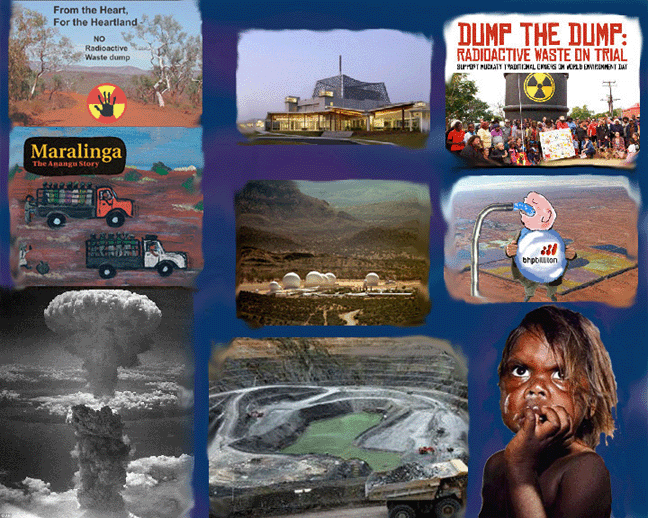
Aboriginal history – and what the global nuclear industry has done to Aboriginal people is the most important issue in Australia.
It is not, however, the only issue. The effects of the nuclear industry, in particular, of uranium mining, have not only permanently trashed some land, and threatened precious water, but have also impacted on health of white Australians , as well as black.
In Australian politics, there has been a sorry history of kow towing to the British government and nuclear industry, and to the American.
So called “Australian” companies e.g BHP Billiton ( 75% English owned) and Heathgate (owned by USA weapons maker General Atomics) portray the false idea that nuclear is an Australian industry.
Australia had a proud history of promoting nuclear disarmament – trashed more recently in its readiness to sell uranium to India ( non signatory to the Nuclear Non Proliferation Treaty) and to Ukraine – a corruption basket case).
The Nuclear Industry and Indigenous People -theme for July 16
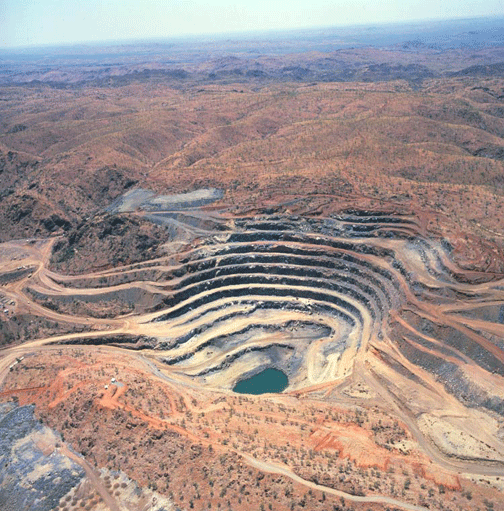 Indigenous people continue to bear the brunt of nuclear toxicity. It started with uranium mining – of course, on indigenous land in rural areas, in USA, Canada, Bulgaria, Australia, Germany , India, and of course to provide nuclear weapons material.
Then came the nuclear bomb tests – on remote rural indigenous lands and islands
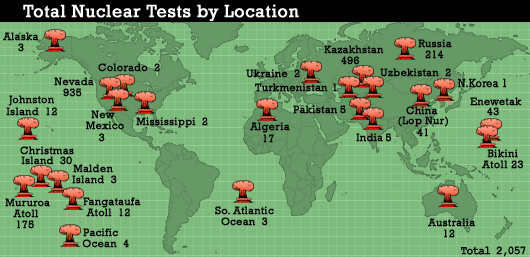
Indigenous peoples either stayed on their polluted lands, as uranium mining continued, or were removed from bomb tests sites, unable to return.
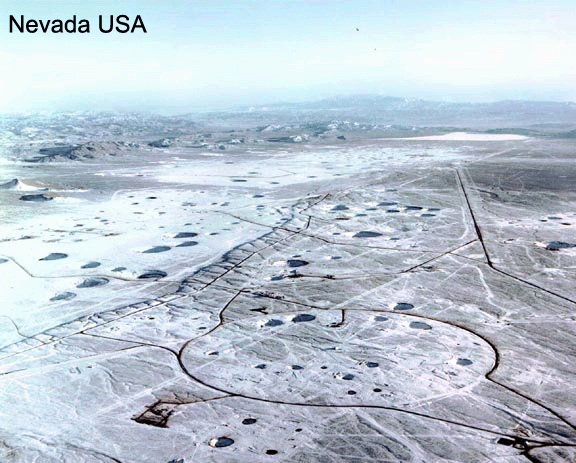
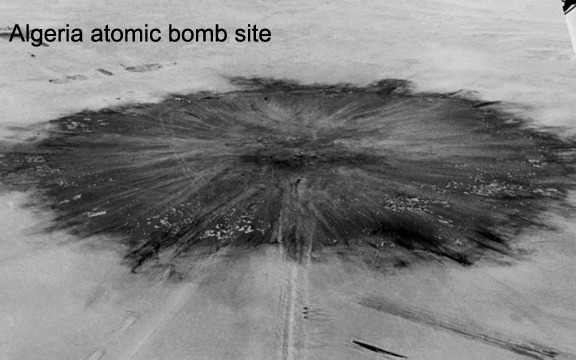
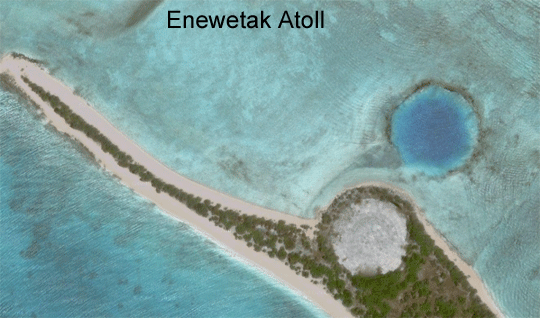
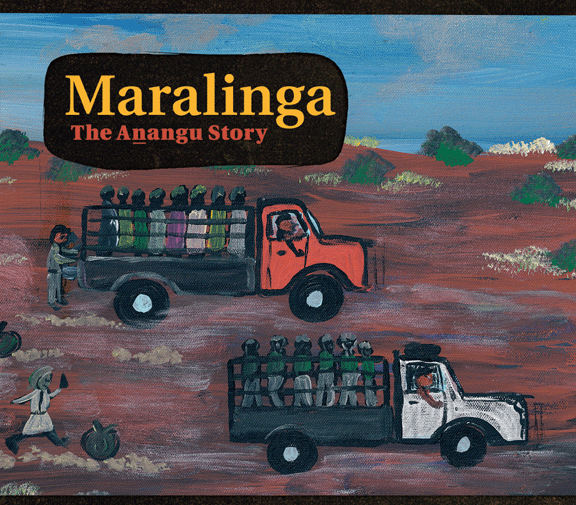
This Radioactive pollution remains today, from uranium mining in many countries – but always on or close to indigenous lands. The nuclear bomb test sites remain too radioactive for the indigenous people to return home.
Uranium mining and milling, nuclear bomb tests and radioactive wastes ... Russia is 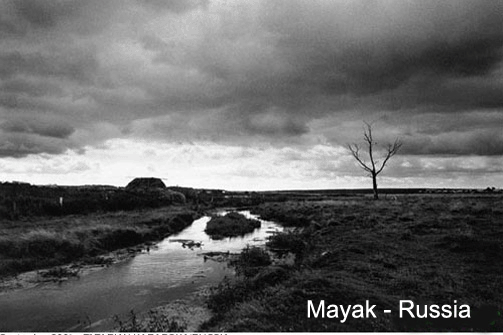 secretive about its nuclear wastes. They used to dump it in oceans, as did the French and others. Russia is notorious for its extremely polluted remote area at Mayak, where the rural people suffer the health legacy to this day
The “developed” world realises that something must be done with the growing amounts of radioactive trash.
Where to dump it? That’s a “developed society” no brainer 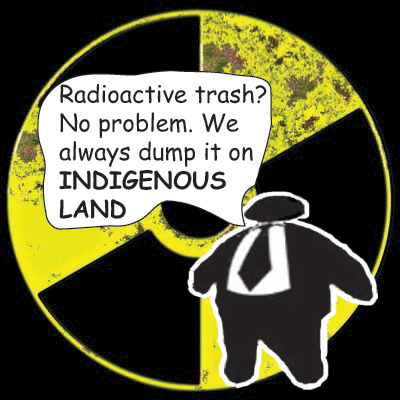
– ON INDIGENOUS LAND, of course. There’s now a movement to export radioactive trash to remote rural areas, such as the Aboriginal lands of Australia
Next week we will look at the indigenous fight against the nuclear industry
Indigenous Australians versus the nuclear industry – a story of successes – theme for July 16
The Kungkas wrote in an open letter: “People said that you can’t win against the Government. Just a few women. We just kept talking and telling them to get their ears out of their pockets and listen. We never said we were going to give up. Government has big money to buy their way out but we never gave up.”
In 1963, Aboriginal people of East Arhem Land created ochre-framed bark petitions adorned with the clan designs of all that was threatened by mining – from the snakes to the sand dunes. These petitions against mining paved the way for the Indigenous land rights movement. These were the first traditional documents to be recognised by the Australian Parliament.

In 1966 Vincent Lingiari led the walk-off of Gurindji people from Wave Hill station , leading to l Whitlam’s historic land rights declaration in 1975. The indigenous people’s struggle for their land has never ceased. The focus for this fight for over 40 years was the Tent Embassy, established in Canberra in 1972, to protest against a court decision over mining operations on Aboriginal land.
Without financial resources, but with clear determination, Aboriginal people have fought and won many battles, especially against mining , with protests, and legal action.
On the nuclear front, outstanding victories include the Cape York Olkola people’s three-decade struggle against uranium mining, the Mirrarr people’s success in preventing further uranium mining at Ranger, in Northern Territory, and Jeffrey Lee’s remarkable action in preventing AREVA from further uranium mining in Kakadu National Park
In stopping nuclear waste dump plans for South Australia, in 2004 the battle was led by the Kupa Piti Kungka Tjuta, a council of senior Aboriginal women from northern SA. Aboriginal women led the 7 year battle to prevent nuclear waste dumping at Muckaty, Northern Territory.
I hope that White Australia will gather strength in opposition to the latest onslaught from the nuclear lobby – the nefarious Nuclear Fuel Chain Royal Commission’s plan for South Australia as the global radioactive trash toilet. Very few indigenous people will be taken in by the slick spin and bribery of the nuclear lobby. Those strong, intelligent indigenous people who continue their determined fight, need all the support they can get from the rest of us.
Coal and nuclear – in it together promoting global warming. Theme for April 16
It’s really hard to estimate the full carbon footprint of the nuclear industry . Greenhouse gases are emitted in all stages of the lifecycle of a nuclear reactor: construction, operation, fuel production, dismantling and waste disposal. Leaving out any of these five stages will bias estimates towards lower values. The last two contributions, dismantling and waste disposal are particularly difficult to estimate. Not many commercial reactors have been fully decommissioned.
The ever repeated claim that nuclear power is emissions-free is simply not true.
Without subsidies for coal and nuclear The free market would choose the path to the most cost effective and cleanest sources of energy which would include wind, solar, small-scale hydro, geothermal, energy efficiency, tidal, and certainly not nuclear or “clean coal.”
The fossil fuel and nuclear industries are in this public deception together. Indeed, nuclear power is in itself a fossil fuel industry, depending on mining uranium (or thorium, which is then converted to uranium). The coal industry is confident of continuing for several decades, and then handing over to the nuclear industry, as coal runs out. The nuclear industry is happy about this, because it takes decades to get reactors set up and running.
Where these two toxic industries are also in agreement is in the aim to slow down, preferable stifle, the development of clean, and cheaper renewable energy sources, especially wind and solar power.
They also like the scenario promoted in the nuclear advertising film “Pandora’s Promise” – that is the endless growth of energy use. Coal and nuclear advocates do not like the idea of energy efficiency, energy conservation.
1 This month

of the week – Australians for War Powers Reform (AWPR)
To see nuclear-related stories in greater depth and intensity
 Antinuclear
