Hypocrisy on steroids: Frydenberg backs witch-hunt on banks that won’t lend to miners
Hypocrisy on steroids: Frydenberg backs witch-hunt on banks that won’t lend to miners Janine Perrett, 16 Dec 20,
MYEFO is obviously not keeping the treasurer busy enough — he’s taken time out to sanction a controversial inquiry led by a climate-denying backbencher.
A Legacy of Contamination, How the Kingston coal ash spill unearthed a nuclear nightmare
While no one was killed by the 2008 coal ash spill itself, dozens of workers have died from illnesses that emerged during or after the cleanup. Hundreds of other workers are sick from respiratory, cardiac, neurological, and blood disorders, as well as cancers.
The apparent mixing of fossil fuel and nuclear waste streams underscores the long relationship between the Kingston and Oak Ridge facilities.
Between the 1950s and 1980s, so much cesium-137 and mercury was released into the Clinch from Oak Ridge that the Department of Energy, or DOE, said that the river and its feeder stream “served as pipelines for contaminants.” Yet TVA and its contractors, with the blessing of both state and federal regulators, classified all 4 million tons of material they recovered from the Emory as “non-hazardous.”
A U.S. Environmental Protection Agency analysis confirms that the ash that was left in the river was “found to be commingled with contamination from the Department of Energy (DOE) Oak Ridge Reservation site.
For nearly a century, both Oak Ridge and TVA treated their waste with less care than most families treat household garbage. It was often dumped into unlined, and sometimes unmarked, pits that continue to leak into waterways. For decades, Oak Ridge served as the Southeast’s burial ground for nuclear waste. It was stored within watersheds and floodplains that fed the Clinch River. But exactly where and how this waste was buried has been notoriously hard to track.
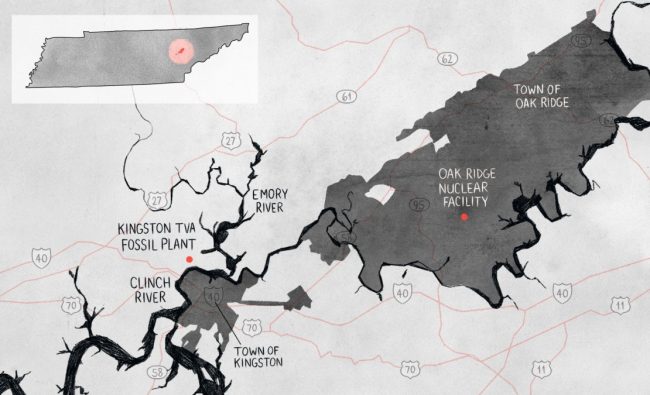
 A Legacy of Contamination, How the Kingston coal ash spill unearthed a nuclear nightmare, Grist By Austyn Gaffney on Dec 15, 2020 This story was published in partnership with the Daily Yonder.
In 2009, App Thacker was hired to run a dredge along the Emory River in eastern Tennessee. Picture an industrialized fleet modeled after Huck Finn’s raft: Nicknamed Adelyn, Kylee, and Shirley, the blue, flat-bottomed boats used mechanical arms called cutterheads to dig up riverbeds and siphon the excavated sediment into shoreline canals. The largest dredge, a two-story behemoth called the Sandpiper, had pipes wide enough to swallow a push lawnmower. Smaller dredges like Thacker’s scuttled behind it, scooping up excess muck like fish skimming a whale’s corpse. They all had the same directive: Remove the thick grey sludge that clogged the Emory.
The sludge was coal ash, the waste leftover when coal is burned to generate electricity. Twelve years ago this month, more than a billion gallons of wet ash burst from a holding pond monitored by the region’s major utility, the Tennessee Valley Authority, or TVA. Thacker, a heavy machinery operator with Knoxville’s 917 union, became one of hundreds of people that TVA contractors hired to clean up the spill. For about four years, Thacker spent every afternoon driving 35 miles from his home to arrive in time for his 5 p.m. shift, just as the makeshift overhead lights illuminating the canals of ash flicked on.
Dredging at night was hard work. The pump inside the dredge clogged repeatedly, so Thacker took off his shirt and entered water up to his armpits to remove rocks, tree limbs, tires, and other debris, sometimes in below-freezing temperatures. Soon, ringworm-like sores crested along his arms, interwoven with his fading red and blue tattoos. Thacker’s supervisors gave him a cream for the skin lesions, and he began wearing long black cow-birthing gloves while he unclogged pumps. While Thacker knew that the water was contaminated — that was the point of the dredging — he felt relatively safe. After all, TVA was one of the oldest and most respected employers in the state, with a sterling reputation for worker safety.
Then, one night, the dredging stopped.
Sometime between December 2009 and January 2010, roughly halfway through the final, 500-foot-wide section of the Emory designated for cleanup, operators turned off the pumps that sucked the ash from the river. For a multi-billion dollar remediation project, this order was unprecedented. The dredges had been operating 24/7 in an effort to clean up the disaster area as quickly as possible, removing roughly 3,000 cubic yards of material — almost enough to fill an Olympic-sized swimming pool — each day. But official reports from TVA show that the dredging of the Emory encountered unusually high levels of contamination: Sediment samples showed that mercury levels were three times higher in the river than they were in coal ash from the holding pond that caused the disaster.
Then there was the nuclear waste. Continue reading
Australia, the climate laggard, could lead the world: over to you, PM,
Australia, the climate laggard, could lead the world: over to you, PM, John Hewson, 16 Dec 20,
The world is watching Australia. We can seize this opportunity…….
Canada to support the nuclear weapons industry with Small Nuclear Reactors (SMRs)
 Canada re-engages in the Nuclear Weapons Business with SMRs, December 3, 2020, WWW.HILLTIMES.COM/2020/12/03/CANADA-RE-ENTERS-NUCLEAR-WEAPONS-BUSINESS-WITH-SMALL-MODULAR-REACTORS/274591
Natural Resources Minister Seamus O’Regan is expected to announce within weeks his government’s action plan for development of “small modular” nuclear reactors (SMRs).
SMR developers already control the federally-subsidized Chalk River Laboratories and other facilities owned by the crown corporation, Atomic Energy of Canada Limited (AECL). Canada is now poised to play a supporting role in the global nuclear weapons business, much as it did during World War II.
Canada was part of the Manhattan project with the U.S. and U.K. to produce atomic bombs. In 1943 the three countries agreed to build a facility in Canada to produce plutonium for nuclear weapons. Researchers who trained at the Chalk River Laboratories went on to launch weapons programs in the U.K. and France. Chalk River provided plutonium for U.S. weapons until the 1960s.
Canada’s Nuclear Schizophrenia describes a long tradition of nuclear cooperation with the United States: “For example, in the early 1950s, the U.S. Navy used Canadian technology to design a small reactor for powering its nuclear submarines.” C.D. Howe, after creating AECL in 1952 to develop nuclear reactors and sell weapons plutonium, remarked that “we in Canada are not engaged in military development, but the work that we are doing at Chalk River is of importance to military developments.”
The uranium used in the 1945 Hiroshima bomb may have been mined and refined in Canada. According to Jim Harding’s book Canada’s Deadly Secret: Saskatchewan Uranium and the Global Nuclear System, from 1953 to 1969, all the uranium mined in Saskatchewan went to make U.S. nuclear weapons. Canada remains the world’s second-largest producer of uranium. North America’s only currently operating uranium processing facility is owned by Cameco in Port Hope, Ontario.
Canada built India’s CIRUS reactor, which started up in 1960 and produced the plutonium for India’s first nuclear explosion in 1974. Canada also built Pakistan’s first nuclear reactor, which started up in 1972. Although this reactor was not used to make weapons plutonium, it helped train the engineers who eventually exploded Pakistan’s first nuclear weapons in 1998.
In 2015 the Harper Government contracted a multi-national consortium called Canadian National Energy Alliance – now comprised of two U.S. companies, Fluor and Jacobs, along with Canada’s SNC-Lavalin – to operate AECL’s nuclear sites, the main one being at Chalk River. Fluor operates the Savannah River Site, a South Carolina nuclear weapons facility, under contract to the U.S. Department of Energy (DOE). Jacobs also has contracts at DOE weapons facilities and is part of a consortium that operates the U.K. Atomic Weapons Establishment.
Joe McBrearty, the president of the consortium’s subsidiary that operates Chalk River and other federal nuclear sites, was a U.S. Navy nuclear submarine commander and then chief operating officer for the DOE’s nuclear laboratories between 2010 and 2019.
All three consortium partners have investments in SMRs and are ramping up research and development at AECL’s Chalk River facility. Some SMR designs would use uranium enriched to levels well beyond those in current reactors; others would use plutonium fuel; others would use fuel dissolved in molten salt. All of these pose new and problematic weapons proliferation risks.
Rolls Royce, an original consortium partner that makes reactors for the U.K.’s nuclear submarines, is lead partner in a U.K. consortium (including SNC-Lavalin) that was recently funded by the U.K. government to advance that country’s SMR program.
A military bromance: SMRs to support and cross-subsidize the UK nuclear weapons program, says “Industry and government in the UK openly promote SMRs on the grounds that an SMR industry would support the nuclear weapons program (in particular the submarine program) by providing a pool of trained nuclear experts, and that in so doing an SMR industry will cross-subsidize the weapons program.”
The article quotes a 2017 Rolls Royce study as follows: “expansion of a nuclear-capable skilled workforce through a civil nuclear UK SMR programme would relieve the Ministry of Defence of the burden of developing and retaining skills and capability.”
The SMR connection to weapons and submarines could hardly be clearer – without SMRs, the U.S. and U.K. will experience a shortage of trained engineers to maintain their nuclear weapons programs.
With the takeover of AECL’s Chalk River Laboratories by SMR developers, and growing federal government support for SMRs, Canada has become part of a global regime linking nuclear power and nuclear weapons.
Small Nuclear Reactors (SMRs) if they work, will arrive too late to make a difference to global heating
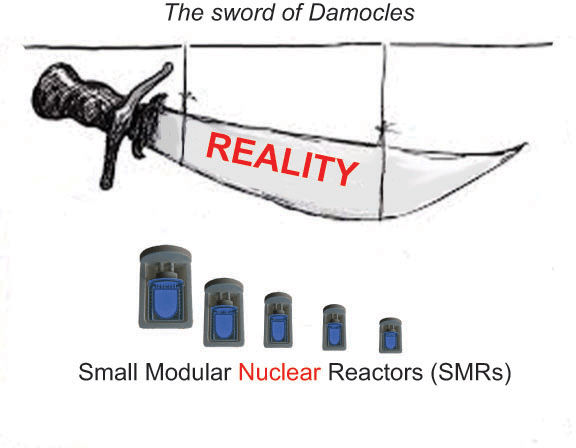 Is nuclear power the answer, DECEMBER 8, 2020 JOHN QUIGGIN
The last (I hope) extract from the climate change chapter of Economic Consequences of the Pandemic. I’m in two minds about whether this is really needed. The group of pro-nuclear environmentalists seems to be shrinking towards a hard core who can’t be convinced (and some of them, like Shellenberger turn out to have been concern trolls all along). But every now and then I run across people who seem open-minded enough, but haven’t caught up with the bad news on nuclear.
Debates about decarbonizing electricity generation inevitably raise the issue of nuclear power. Since nuclear power generates no carbon dioxide emissions (except in the construction phase) it is a potential solution to climate change, with a strong body of advocates.
Some of this advocacy may be dismissed as point-scoring. Rightwing pundits who oppose any action on climate change simultaneously promote nuclear power as carbon free, with the aim of embarrassing environmentalist. There is, however, a small but vocal group of nuclear power advocates who are convinced that a massive expansion of nuclear power is the only way to replace coal-fired power………
Today the choice is not between new nuclear and new or existing coal. It is whether to allocate investment to building nuclear plants or to accelerating the shift to solar and wind energy.
The key problem is not safety but economics. New plants are safer and more sophisticated than those that failed in the past, but they are also massively more expensive to build, and quite costly to operate. The capital costs of recent projects in the US, France and Finland (none yet complete) have been around $10/kw, compared to $1/kw or less for solar. And, whereas solar PV is essentially costless to operate, the operating costs of nuclear power plants are around 2c/kwH. Even when solar PV is backed up with battery storage, it is cheaper to build and to operate, than new nuclear.
The facts speak for themselves. Over the last decade, only two or three reactors have commenced construction each year, not even enough to replace plants being retired. This isn’t the result of pressure from environmentalists or alarm about the safety of nuclear plants. The slowdown is evident in countries like China, where public opinion has little influence on policy decisions, and in countries where public opinion is generally favorable to new nuclear power. China failed to reach its 2020 target of 58 GW of installed power, and currently has only about 15 GW of nuclear power under construction. That compares to 55 GW of new solar and wind capacity installed in 2019 alone.
It is clear by now that large-scale nuclear reactors have no future. The last hope for nuclear power rests on Small Modular Reactors. The idea is that, rather than building a single large reactor, typically with a capacity of 1 GW, smaller reactors will be produced in factories, then shipped to the site in the required number. The leading proponent of this idea is Nuscale Power, which currently has a contract with UAMPS to supply a pilot plant with a dozen 60MW modules.
It remains to be seen whether SMR’s will work at all. Even if they do, it is not clear that the reduced costs associated with off-site manufacturing will offset the loss of the scale economies associated with a large boiler, let alone yield power at a cost competitive with that of solar PV.
In any case, the issue is largely irrelevant as far as the climate emergency is concerned. NuScale’s pilot plant, with a total capacity of 720 MW, is currently scheduled to start operation in 2029. Large-scale deployment will take at least a decade more .
If we are to have any chance of stabilising the climate, coal-fired power must be eliminated by 2030, and electricity generation must be decarbonized more or less completely by 2035. SMRs, if they work, will arrive too late to make a difference. ….https://johnquiggin.com/2020/12/08/is-nuclear-power-the-answer/#more-17451
Canada’s Coalition for Responsible Energy Development sceptical about Small Nuclear Reactors
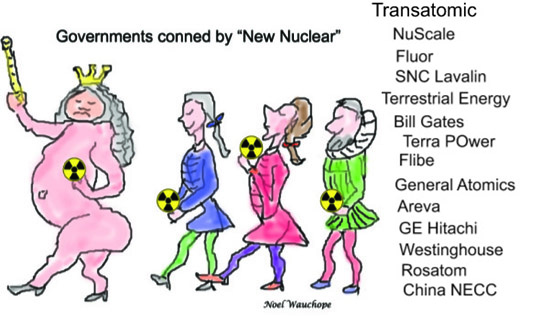
Questions abound about New Brunswick’s embrace of small nuclear reactors
Critics question business case, but CEO says the market is ‘screaming’ for the units, Jacques Poitras · CBC News Dec 07, 2020
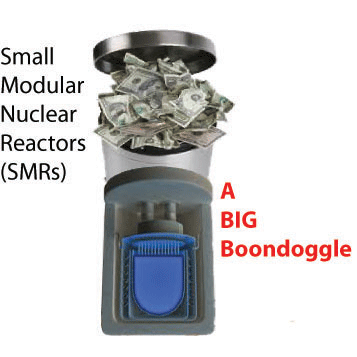 When Mike Holland talks about small modular nuclear reactors, he sees dollar signs.
When the Green Party hears about them, they see danger signs.
The loquacious Progressive Conservative minister of energy development recently quoted NB Power’s eye-popping estimates of the potential economic impact of the reactors: thousands of jobs and a $1 billion boost to the provincial economy.
“New Brunswick is positioned to not only participate in this opportunity, but to be a world leader in the SMR field,” Holland said in the legislature last month.
Green MLAs David Coon and Kevin Arseneau responded cheekily by ticking off the Financial and Consumer Services Commission’s checklist on how to spot a scam.
Is the sales pitch from a credible source? Is the windfall being promised by a reputable institution? Is the risk reasonable?
For small nuclear reactors, they said, the answer to all those questions is no.
“The last thing we need to do is pour more public money down the nuclear-power drain,” Coon said, reminding MLAs of the Point Lepreau refurbishment project that went $1 billion over budget. …….
Premier Blaine Higgs is a fervent supporter, but in the last provincial election the Liberals promised they’d do even more than Higgs to promote them.
Under Brian Gallant, the Liberals handed $10 million to two Saint John companies working on SMRs, ARC Nuclear and Moltex Energy.
Greens point to previous fiascoes
The Greens and other opponents of nuclear power fear SMRS are the latest in a long line of silver-bullet fiascoes, from the $23 million spent on the Bricklin in 1975 to $63.4 million in loans and loan guarantees to the Atcon Group a decade ago.
“It seems that [ARC and Moltex] have been targeting New Brunswick for another big handout … because it’s going to take billions of dollars to build these things, if they ever get off the drawing board,” said Susan O’Donnell, a University of New Brunswick researcher.
O’Donnell, who studies technology adoption in communities, is part of a small new group called the Coalition for Responsible Energy Development formed this year to oppose SMRs.

“What we really need here is a reasonable discussion about the pros and cons of it,” she said……..
What we didn’t see was a market analysis,” O’Donnell said. “How viable is the market? … They’re all based on a hypothetical market that probably doesn’t exist.”
O’Donnell said her group asked for the full report but was told it’s confidential because it contains sensitive commercial information………..
The market is screaming for this product,” Rory O’Sullivan, CEO of Moltex said, adding “all of the utilities” in Canada are interested in Moltex’s reactors ……
ARC’s CEO Norm Sawyer is more specific, guessing 30 per cent of his SMR sales will be in Atlantic Canada, 30 per cent in Ontario and 40 per cent in Alberta and Saskatchewan — all provincial power grids.
O’Donnell said it’s an important question because without a large number of guaranteed sales, the high cost of manufacturing SMRs would make the initiative a money-loser.
The cost of building the world’s only functioning SMR, in Russia, was four times what was expected.
An Australian government agency said initial cost estimates for such major projects “are often initially too low” and can “overrun.”
Up-front costs can be huge
University of British Columbia physicist M.V. Ramana, who has authored studies on the economics of nuclear power, said SMRs face the same financial reality as any large-scale manufacturing.
“You’re going to spend a huge amount of money on the basic fixed costs” at the outset, he said, with costs per unit becoming more viable only after more units are built and sold.
He estimates a company would have to build and sell more than 700 SMRs to break even, and said there are not enough buyers for that to happen. ….
O’Sullivan says: “In fact, just the first one alone looks like it will still be economical,” he said. “In reality, you probably need a few … but you’re talking about one or two, maximum three [to make a profit] because you don’t need these big factories.”
‘Paper designs’ prove nothing, says expert
Ramana doesn’t buy it.
“These are all companies that have been started by somebody who’s been in the nuclear industry for some years, has a bright idea, finds an angel investor who’s given them a few million dollars,” he said.
“They have a paper design, or a Power Point design. They have not built anything. They have not tested anything. To go from that point … to a design that can actually be constructed on the field is an enormous amount of work.
Both CEOs acknowledge the skepticism about SMRs.
“I understand New Brunswick has had its share of good investments and its share of what we consider questionable investments,” said ARC’s CEO Norm Sawyer….
But he said ARC’s SMR is based on a long-proven technology and is far past the on-paper design stage “so you reduce the risk.”
Moltex is now completing the first phase of the Canadian Nuclear Safety Commission’s review of its design, a major hurdle. ARC completed that phase last year.
But, Ramana said there are problems with both designs. Moltex’s molten salt model has had “huge technical challenges” elsewhere while ARC’s sodium-cooled system has encountered “operational difficulties.” …..
federal Natural Resources Minister Seamus O’Regan told CBC earlier this year that he’s “very excited” about SMRs…..
O’Donnell said while nuclear power doesn’t emit greenhouse gases, it’s hardly a clean technology because of the spent nuclear fuel waste.
Government support is key
She also wonders why, if SMRs make so much sense, ARC and Moltex are relying so much on government money rather than private capital.
…….. So far, Ottawa hasn’t put up any funding for ARC or Moltex. During the provincial election campaign, Higgs implied federal money was imminent, but there’s been no announcement in the almost three months since then.
Last month the federal government announced $20 million for Terrestrial Energy, an Ontario company working on SMRs.
…….O’Donnell said her group plans to continue asking questions about SMRs.
“I think what we really need is to have an honest conversation about what these are so that New Brunswickers can have all the facts on the table,” she said. https://www.cbc.ca/news/canada/new-brunswick/questions-small-nuclear-reactors-1.5828784
Nuclear-powered vehicles -not such a great idea.
|
One promising option, according to scientists at Argonne National Laboratory, is small nuclear reactors. Engineer Derek Kultgen is leading efforts at Argonne to develop a microreactor — about the size of two home water heaters — that is specifically designed to charge electric trucks at rest stops across the country lacking EV charging stations………… One promising, carbon-free charging option, according to scientists at Argonne National Laboratory, is small nuclear reactors………. Small nuclear reactors could be ideal for e-truck charging, he said……. In August, the Nuclear Regulatory Commission issued a final safety evaluation report endorsing NuScale Power’s small modular nuclear reactor design (Greenwire, Aug. 31). ……. Critics, however, say there’s insufficient evidence that small reactors are safer than nuclear power plants. It could also take years before they’re ready to be deployed, whereas new solar and wind resources could be built much more quickly. The microreactor being designed at Argonne, for example, is not being planned for construction at this point. NuScale’s design is the first to gain approval by the NRC, and even that project is still more than one year away from coming online, said Edwin Lyman, director of nuclear power safety at the Union of Concerned Scientists. Many proposed microreactor applications — including this one from Argonne — are inappropriate uses of nuclear energy, according to Lyman. “The Department of Energy is desperately trying to think of applications for all sorts of nuclear reactors, no matter how improbable or impractical they are, and I think this is a good example,” he said…….. Cost, security questionsWhile the concept is worth considering as a potential charging tool, some issues would need to be addressed before truck stop microreactors could become a reality, said Rick Mihelic, director of emerging technologies at the North American Council for Freight Efficiency. Opposition to nuclear power could delay the distribution of the microreactors, he said. A network of microreactors would also add to the country’s nuclear waste problem, for which there is no permanent disposal solution. It could be difficult to make the microreactors economical as well. To overcome that barrier, the researchers would need to find a way to mass-produce them, Buongiorno said. “If they are deployed each a little differently, each built at a different location with a different workforce, then achieving good economics may prove hopeless,” he said. Opposition to nuclear power could delay the distribution of the microreactors, he said. A network of microreactors would also add to the country’s nuclear waste problem, for which there is no permanent disposal solution. It could be difficult to make the microreactors economical as well. To overcome that barrier, the researchers would need to find a way to mass-produce them, Buongiorno said. “If they are deployed each a little differently, each built at a different location with a different workforce, then achieving good economics may prove hopeless,” he said……. https://www.eenews.net/stories/1063719531 |
|

Autopsy on the nuclear industry
https://energycentral.com/c/pip/39-nuclear-industry-autopsy-redefining-energy-podcast
Nuclear cleanup – a $billion here, a $billion there – pretty soon you’re talking real money
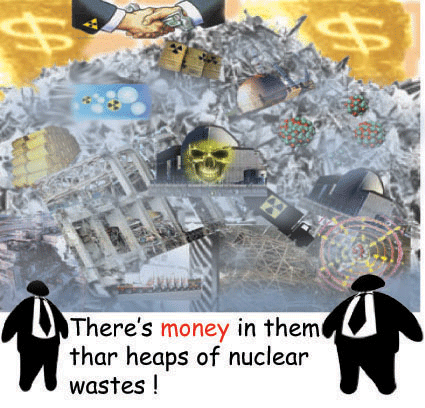 US Nuclear Site Cleanup Underfunded By Up To $70 Billion, Clean Technica, December 1st, 2020 by Michael Barnard US Nuclear Site Cleanup Underfunded By Up To $70 Billion, Clean Technica, December 1st, 2020 by Michael Barnard
Headlines out of the UK are pointing out the horrible state of affairs for nuclear generation decommissioning after a committee of Members of Parliament that the UK’s Nuclear Decommissioning Authority really doesn’t have a handle on the 17 sites, their costs, or the vendors they selected for cleanup. They are currently projecting $177 billion and 120 years for the full decommissioning, over $1 billion per site. Some of this is due to botched procurement, with two different cleanup vendors stripped of their contracts. Certainly the UK cleanup is a fustercluck of epic proportions, equivalent in fiscal sense to building Hinkley. That new reactor, billions and years over budget and schedule, required a commitment for 35 years to pay $150/MWh for every MWh they generated, at a time when onshore wind and solar in the UK are at or under $50/MWh and offshore wind is under $100/MWh. Some US commenters were feeling chuffed, although that’s not a term they would use, that the US was handling things so much better. But the USA isn’t far behind the UK in problems, it just isn’t as public. Per the World Nuclear Association: In the USA, utilities are collecting 0.1 to 0.2 cents/kWh to fund decommissioning. They must then report regularly to the NRC on the status of their decommissioning funds. About two-thirds of the total estimated cost of decommissioning all US nuclear power reactors has already been collected, leaving a liability of about $9 billion to be covered over the remaining operating lives of about 100 reactors (on the basis of an average of $320 million per unit). NRC data for the end of 2018 indicated that there was a combined total of $64.7 billion held in the decommissioning trust funds covering the 119 operational and retired US nuclear power reactors. An OECD Nuclear Energy Agency survey published in 2016 reported US dollar (2013) costs in response to a wide survey. For US reactors the expected total decommissioning costs range from $544 to $821 million; for units over 1100 MWe the costs ranged from $0.46 to $0.73 million per MWe, for units half that size, costs ranged from $1.07 to $1.22 million per MWe. For Finland’s Loviisa (2 x 502 MWe) the estimate was €326 million. For a Swiss 1000 MWe PWR the detailed estimate amounts to CHF 663 million (€617 million). In Slovakia, a detailed case study showed a total cost of €1.14 billion to decommission Bohunice V1 (2 x 440 MWe) and dismantle it by 2025. [Brief aside: I love the World Nuclear Association, because they are actually honest and report details that contradict their mission. I cite them on Germany’s wholesale electricity prices, which they freely admit are among the lowest in Europe as that country ramps up renewables rapidly and dumps nuclear. They aren’t just a lobbying organization, although they are an industry-funded lobbying association. Unlike the equivalent oil and gas organizations, they seem compelled to be honest and complete, perhaps because being honest and complete usually isn’t so disgustingly horrific for them, just simply bad.] Back to the thread. The US has collected a bunch of money from operating reactors into a cleanup fund that they acknowledge is underfunded to the tune of billions already. But the industry estimates show that they are collecting under half of what it will actually take to decommission the sites. There are about 100 reactors in the United States. Assuming they collect the $320 million per reactor (they won’t, as reactors are closing prematurely), they would have a fund of $32 billion. But they need a fund of closer to $70 billion, and they are short regardless. So the US fleet cleanup is going to cost the taxpayer probably closer to an additional $40 billion, if it all goes according to the estimates. Note that the UK and Slovakia examples show that it usually doesn’t, just as building new nuclear never seems to come in on time or budget. The reality is going to be closer to the European and Slovakian costs, so let’s assume a billion per reactor as a reasonable number. The US will have maybe $30 billion. They’ll need $100 billion. Yeah, $70 billion is the more reasonable number. “A billion here, a billion there, pretty soon you’re talking real money.” – US Senator Everett McKinley Dirksen Continue reading |
Trump’s Support for Israel’s Killing of Iranian Nuclear Scientist Could Lead to War
|
Trump’s Support for Israel’s Killing of Iranian Scientist Could Lead to War, Marjorie Cohn, Truthout, December 1, 2020, In the weeks remaining before Joe Biden’s inauguration, Donald Trump is taking actions — including aiding and abetting murder — to prevent his successor from pursuing diplomacy with Iran.
On November 27, Israel assassinated Mohsen Fakhrizadeh, Iran’s top nuclear scientist. International law expert Richard Falk called it “an outrageous act of state terrorism.” Although the Israeli government has not claimed credit for the illegal killing, there is little doubt of its culpability. Trump implicitly praised the assassination, retweeting a comment by Israeli journalist and intelligence expert Yossi Melman that the killing was a “major psychological and professional blow” to Iran. This was an “implicit approval if there ever was one,” according to Sina Toossi, a senior research analyst at the National Iranian American Council. The Israel Defense Forces have been ordered to prepare for a possible U.S. military attack on Iran before Trump’s term ends, senior Israeli officials told Axios. They expect “a very sensitive period” leading up to Biden’s inauguration. In mid-November, Trump requested plans to attack Iran’s Natanz nuclear power facility but was reportedly talked out of it. Israeli Prime Minister Benjamin Netanyahu met with Crown Prince Mohammed bin Salman in Saudi Arabia and strategized about Iran. Secretary of State Mike Pompeo visited Israel, the West Bank, the Golan Heights and several countries in the Gulf to discuss Iran. During Pompeo’s visit to the Gulf, the U.S. Central Command announced that B-52 strategic bombers carried out a “short-notice, long-range mission into the Middle East to deter aggression and reassure U.S. partners and allies.” And in an unusual move, the U.S. military sent the aircraft carrier the U.S.S. Nimitz back to the Gulf region following the assassination of Fakhrizadeh. “All options are on the table,” State Department officials who were traveling with Pompeo told reporters. Trump Appears to Have Outsourced His Iran Policy to IsraelIsraeli leaders think Iran poses an existential threat to Israel’s existence, in spite of the fact that Iran has never attacked Israel or any other country in the last 200 years. In fact, Israel is the only Middle East country that has nuclear weapons and it refuses to join the new UN International Treaty on the Non-Proliferation of Nuclear Weapons. At Netanyahu’s urging, Trump pulled the United States out of the Iran nuclear deal, which was preventing Iran from developing nuclear weapons. And in January, the Trump administration illegally assassinated Iran’s top general, Qassim Suleimani. Shortly before that assassination, Pompeo followed the same pattern — traveling and meetings with U.S. allies in the region, according to Iranian American journalist Negar Mortazavi. The Iran nuclear agreement is embodied in the 2015 Joint Comprehensive Plan of Action (JCPOA), negotiated during the Obama administration between Iran, the U.S., France, U.K., Russia, China, Germany and the European Union. Iran, which has consistently maintained that its nuclear program is only intended for peaceful purposes, agreed to restrict its uranium enrichment and other nuclear activities. In return, it received relief from the punishing U.S. sanctions. The UN International Atomic Energy Agency certified several times that Iran was complying with its obligations under the agreement. Nevertheless, Trump withdrew from the JCPOA in 2018 and reimposed the sanctions against Iran. One year after the U.S. withdrawal, Iran began to pull back from its commitments under the JCPOA, which allows a party to abandon its obligations if another party is in noncompliance. Trump intensified the sanctions that have devastated Iran’s economy, impoverished 82 million Iranians and hindered its ability to respond to the pandemic. With his campaign of “maximum pressure” on Iran, Trump has waged economic warfare against the Iranian people…….. It is becoming clear that Trump aims to cater to Israel’s agenda until he leaves office. U.S. and Israel Try to Bait Iran to Retaliate and Lead to Middle East WarHopefully, Iran will resist the apparent U.S.-Israeli attempt to provoke it into retaliating for Fakhrizadeh’s assassination and thereby provide Trump with a pretext to launch a retaliatory strike, which would ignite a war in the Middle East. The U.S. military already has more than 40,000 troops in the region on high alert. Iranian President Hassan Rouhani pledged to respond to the assassination of Fakhrizadeh at the “proper time.” Rouhani said, “The Iranian nation is smarter than falling into the trap of the Zionists. They are thinking to create chaos.” The day after the assassination, Iran’s parliament unanimously voted to end future UN inspections of Iran’s nuclear sites. The inspections had confirmed that Iran was in compliance with the JCPOA. Terminating them could spell an end to the nuclear deal……. It is up to Congress, as well as civil society, to prevent the Biden administration from continuing the U.S. policy of caving to Israel’s demands — a practice that not only deepens the oppression of the Palestinians but could also actively imperil the national security of the United States. Meanwhile, we must pressure Congress to prevent Trump from attacking Iran. The consequences to the Middle East and the entire world would be catastrophic. https://truthout.org/articles/trumps-support-for-israels-killing-of-iranian-scientist-could-lead-to-war/?eType=EmailBlastContent&eId=1a5fde20-0879-45fe-9c19-50ff3b76e37e |
|
In this time of economic stress, not all Australians applaud $billions spent on supersonic missiles
 From the Age – Comments , 1 Dec 2020,
 Hypersonic Missiles- ‘we program weapons that don’t work to meet threats that don’t exist.’
Like a Ball of Fire, London Review of Books, Andrew Cockburn on hypersonic weaponry, Vol. 42 No. 5 · 5 March 2020 “………. Putin’s bellicose claim – two weeks before the presidential election in which he was running for a fourth term – and the more recent official announcement that Avangard had now entered service, drew alarmed and unquestioning attention in the West. ‘Russia Deploys Hypersonic Weapon, Potentially Renewing Arms Race’ the New York Times blared. ‘The new Russian weapon system flies at superfast speeds and can evade traditional missile defence systems. The United States is trying to catch up.’
The ease with which the chimerical menace of hypersonic weapons has been launched into the budgetary stratosphere by the arms lobby suggests that their luck will hold for a long time yet. https://www.lrb.co.uk/the-paper/v42/n05/andrew-cockburn/like-a-ball-of-fire
Canada’s indigenous communities must not be guinea pigs for useless Small Nuclear Reactors (SMRs)
 From the Hill — Small Modular Reactors, The Rossland Telegraph , by Dick Cannings MP on Monday Nov 30 2020, Earlier this year, Seamus O’Regan, the Minister of Natural Resources said in a speech that “We are placing nuclear energy front and centre… This is nuclear’s moment.” And in discussions around building a new economy after COVID, the government is doubling down on those sentiments. The latest debates are slightly different from those of the last fifty years as they involve a new technology: Small Modular Reactors, or SMRs. Spoiler alert–I don’t necessarily share the Minister’s unbridled enthusiasm for nuclear energy as the answer to all our prayers……..can nuclear power help us in our efforts to significantly reduce greenhouse gas emissions within the next few years? SMRs represent an experimental technology that, according to industry experts, will not be producing power anywhere in Canada for about a decade. Once the technology matures and SMRs can be produced in quantity, they could theoretically be cheaper than present, very expensive nuclear plants. But those claims are very difficult to assess. From the Hill — Small Modular Reactors, The Rossland Telegraph , by Dick Cannings MP on Monday Nov 30 2020, Earlier this year, Seamus O’Regan, the Minister of Natural Resources said in a speech that “We are placing nuclear energy front and centre… This is nuclear’s moment.” And in discussions around building a new economy after COVID, the government is doubling down on those sentiments. The latest debates are slightly different from those of the last fifty years as they involve a new technology: Small Modular Reactors, or SMRs. Spoiler alert–I don’t necessarily share the Minister’s unbridled enthusiasm for nuclear energy as the answer to all our prayers……..can nuclear power help us in our efforts to significantly reduce greenhouse gas emissions within the next few years? SMRs represent an experimental technology that, according to industry experts, will not be producing power anywhere in Canada for about a decade. Once the technology matures and SMRs can be produced in quantity, they could theoretically be cheaper than present, very expensive nuclear plants. But those claims are very difficult to assess.
SMRs are often touted as a solution to get remote indigenous communities off diesel power. While I am very much in favour of helping these communities find alternate power sources, SMRs do not fit the bill. These communities want power generation solutions that they can build and manage themselves. They want alternative power sources now, not in ten years. And they do not want to be the guinea pigs for brand-new nuclear technology that will likely provide few jobs for local residents and cost significantly more than mature technologies such as solar, wind, and bioenergy. A Special Chiefs Assembly of the Assembly of First Nations passed a unanimous resolution in December 2018 demanding “that the Government of Canada cease funding and support of the Small Modular Nuclear Reactors program.” ……… [smrs] shouldn’t be relied on by present day governments as the panacea to a clean energy future. Even the Canada Energy Regulator (formerly the National Energy Board) predicts that SMRs will collectively contribute only the equivalent of half of a conventional hydro dam by 2050. To reach meaningful targets by 2030 and 2040, we need to double down on technologies we know will get us there…… And energy efficiency efforts alone could get us almost half-way to our targets. These are the routes to success.https://rosslandtelegraph.com/news/column-hill-small-modular-reactors#.X8Ven2gzbIU |
|
Grid flexibility a better choice than nuclear – could save UK $millions

When even a right wing news medium like Forbes start questioning the ”wisdom” of nuclear development , that industry must be getting worried.
Ditch Nuclear And Save $860 Million With Grid Flexibility, U.K. Told, Forbes, David Vetter Senior Contributor, 30 Nov 2,
According to the report from Finnish energy tech firm Wärtsilä, the U.K. would stand to save $860 million per year if, instead of new nuclear power, the government backed grid flexibility measures, such as battery storage and thermal generation. That equates to a saving of about $33 dollars per British household per year. Crucially, the analysis revealed that even if energy generation was to remain the same as it is today, Britain could increase renewables’ share of that generation to 62% simply by adding more flexibility (renewables currently account for around 47% of electricity used, according to the government).
The Wärtsilä report is timely because, in a ten-point plan released earlier this month, prime minister Boris Johnson promised an additional $684 million for the nuclear sector, and the building of new large and small nuclear power stations. Notably, grid flexibility was not mentioned in the plan.
The report also raises questions about the necessity of the 3.2 gigawatt Hinkley Point C nuclear power station, under development in Somerset, southwest England, which has been dogged by controversy and delays since its inception. In addition to coming with all the usual challenges associated with nuclear fission—not least the storage of radioactive waste—the project is at least $3.6 billion over budget and has been the target of numerous lawsuits and both local and international complaints.
Speaking to Forbes.com, Ville Rimali, growth and development director at Wärtsilä Energy, explained why his firm determined that grid flexibility is a preferable alternative to nuclear, as Britain looks for a pathway to achieve net zero carbon emissions by 2050.
“Flexibility unlocks more renewable energy by balancing the intermittency of wind and solar power to ensure the power supply always matches demand,” Rimali said. “For example, when more power is generated than needed, you can store the surplus in batteries to be used later. The alternative is paying renewables to switch off, which is expensive and inefficient.”
“It’s a bit like running a bath where the volume of water and the size of the plug keep changing,” he explained. “The smaller the bathtub, the more likely the water is to overflow or run out. Flexibility is like having a bigger bathtub—you can pour more water in, without the risk of running out or overflowing.” ………
investing in nuclear power could, according to Wärtsilä, entrench an inflexible grid while making renewables such as solar and wind less cost-effective.
“New nuclear sites will rely heavily on government subsidies, negatively impact market prices and ultimately weaken the business case for renewables and flexibility,” Rimali said……… https://www.forbes.com/sites/davidrvetter/2020/11/30/ditch-nuclear-and-save-860-million-with-grid-flexibility-uk-told/?sh=2733622b1975
1 This month

of the week – Australians for War Powers Reform (AWPR)
To see nuclear-related stories in greater depth and intensity
 Antinuclear