Climate change an increasing problem for nuclear power stations
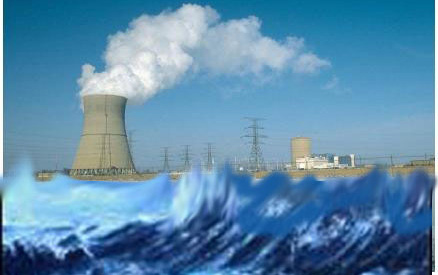 Pilgrim to move nuclear waste to higher ground, http://www.patriotledger.com/news/20181026/pilgrim-to-move-nuclear-waste-to-higher-ground By Joe DiFazio Pilgrim to move nuclear waste to higher ground, http://www.patriotledger.com/news/20181026/pilgrim-to-move-nuclear-waste-to-higher-ground By Joe DiFazioThe Patriot Ledger PLYMOUTH — Officials at the Pilgrim Nuclear Power Station said they want to move nuclear waste at the site to higher ground over the next few years with an eye toward sea level rise. Patrick O’Brien, spokesman for Entergy, the plant’s owner, said that the new proposed site will be located in what is now a parking lot 75 feet above sea level and 350 feet away from Rocky Hill Road. The site is 700 feet away from the closest point on the shoreline, O’Brien said. Pilgrim is slated to be shut down by June 1. Entergy announced in August it plans to sell the station to Holtec International who will decommission the plant. O’Brien said the plan to move the waste was made in conjunction with Holtec. O’Brien said that the proposed site was chosen as the best of three under consideration and that it was evaluated for nine regulatory and technical requirements. O’Brien saidEntergy will apply for the required permits and plans to begin construction on the new site before Pilgrim shuts down. Nuclear Regulatory Commission spokesman Neil Sheehan said that the move doesn’t need approval from his agency, but it would monitor construction of the new site and movement of the spent nuclear fuel. The NRC will need to approve Pilgrim’s sale to Holtec. |
|
USA govt cancels regulation to limit uranium pollution of groundwater
 Federal Uranium Contamination Rule Withdrawn, Wyoming Public Media By COOPER MCKIM • OCT 23, 2018 The U.S. Environmental Protection Agency (EPA) has withdrawn a proposed rule that would limit contamination of groundwater from uranium mining long-term. The regulation was proposed on former President Barack Obama’s last day in office.The form of mining is called in-situ recovery (ISR); it’s the only technique used in Wyoming. It retrieves uranium from aquifers by drilling an injection well and then using liquid to mobilize it and produce it. The problem is that same mobilization technique brings out other chemicals and heavy metals like lead, arsenic, and mercury. Those contaminate the aquifer water and potentially seep into other groundwaters. Federal Uranium Contamination Rule Withdrawn, Wyoming Public Media By COOPER MCKIM • OCT 23, 2018 The U.S. Environmental Protection Agency (EPA) has withdrawn a proposed rule that would limit contamination of groundwater from uranium mining long-term. The regulation was proposed on former President Barack Obama’s last day in office.The form of mining is called in-situ recovery (ISR); it’s the only technique used in Wyoming. It retrieves uranium from aquifers by drilling an injection well and then using liquid to mobilize it and produce it. The problem is that same mobilization technique brings out other chemicals and heavy metals like lead, arsenic, and mercury. Those contaminate the aquifer water and potentially seep into other groundwaters.
The proposed rule under Obama would have set standards requiring operators to do long-term monitoring of groundwater conditions while lowering how much of eachchemical is allowed. Both would be stricter than Wyoming’s current standards. The federal version would require quarterly monitoring over three years rather than one ensuring contaminant concentrations remained at pre-mine levels. …… The National Resource Defense Council found no groundwater near ISR mines have been returned to pre-mine conditions.http://www.wyomingpublicmedia.org/post/federal-uranium-contamination-rule-withdrawn#stream/0 |
|
Young will ‘abandon us’ Liberals: Smith
Young will ‘abandon us’: Smith
Lib Dean Smith has warned that the government risks losing the next generation by failing to address climate change. …. (subscribers only)
Holy See urges ratification of Nuclear Weapons Ban Treaty
|
Holy See urges ratification of Nuclear Weapons Ban Treaty https://www.vaticannews.va/en/vatican-city/news/2018-10/holy-see-united-nations-auza-prohibition-nuclear-weapons.htmlSpeaking on behalf of Archbishop Bernadito Auza, the Holy See’s Permanent Observer to the UN in New York, Second Counsellor, Father David Charters addressed a UN General Assembly discussion on nuclear disarmament on October 22.
By Robin Gomes
The Holy See has once more expressed grave concern over the catastrophic humanitarian and environmental effects of the use of nuclear weapons , and called on all governments of states who adopted the United Nations Treaty on the Prohibition of Nuclear Weapons (TPNW) to sign and ratify it. Speaking on behalf of Archbishop Bernadito Auza, the Holy See’s Permanent Observer to the UN in New York, Second Counsellor, Father David Charters made the call in an address on Monday at a UN General Assembly discussion on nuclear disarmament. The TPNW, or the Nuclear Weapons Ban Treaty, that prohibits the use, threat of use, development, testing, production, manufacturing and possession of nuclear weapons, will enter into force when 50 states have signed and ratified it. Fr. Charters warned that a nuclear war or even a limited use of nuclear weapons would be a catastrophe of unimaginable proportions, and would kill untold numbers of people and cause tremendous environmental damage and famine. Holy See vs nuclear weaponsThe Holy See official pointed out that the continued existence of over 14,000 nuclear weaponsheld by a handful of countries is one of the greatest moral challenges of our time. Fr. Charters said that the Catholic Church has been opposing nuclear weapons since 1943. St. John XXIII called for its ban in his encyclical “Peace on Earth” and the later popes have consistently called for the “abolition of these evil instruments of warfare that create both a false sense of security and foster distrust and disharmony”. Wasted resourcesFr. Charters pointed out that the Second Vatican Council condemned nuclear arms race as “an utterly treacherous trap for humanity, and one that injures the poor to an intolerable degree.” Fr. Charters noted that maintenance of nuclear weapons continues to siphon off immense resources that could be devoted, among other things, to the implementation and achievement of the Sustainable Development Goals, especially the eradication of extreme poverty and hunger. The Holy See the concern of Pope Francis according to whom “nuclear deterrence and the threat of mutually assured destruction cannot be the basis for an ethics of fraternity and peaceful coexistence.” |
|
One of the many posts that responded to the 60 Minutes Fukushima programme
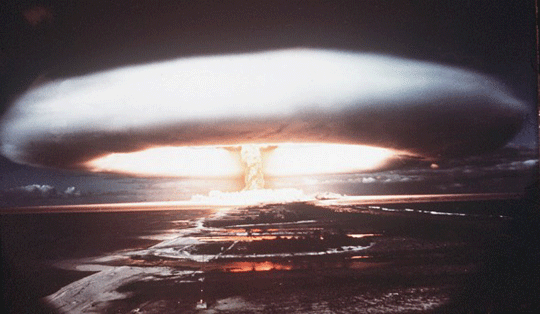
A legal precedent – France is being sued over its Pacific nuclear tests
|
Last week France was sued at the International Criminal Court for crimes against humanity over nuclear tests conducted on atolls in the Pacific Ocean. Sputnik spoke to Alexandre Dayant, a research fellow at the Lowy Institute, about the consequences of the French nuclear tests. Mururoa and Fangataufa atolls in the South Pacific saw 196 nuclear tests over three decades until President Jacques Chirac finally ended the programme in the 1990s. The French also conducted nuclear tests in the Sahara Desert. A French Polynesian opposition leader, Oscar Temaru, filed a complaint at the International Criminal Court (ICC) in The Hague on October 10 claiming France had carried out crimes against humanity, in the form of local islanders. Alexandre Dayant, a research fellow at the Lowy Institute in Australia, said the French carried out the tests between 1966 and 1996, first in the atmosphere and then in the sub-soil. French Polynesians Have Paid Heavy Toll For Tests Mr. Dayant said thousands of inhabitants have paid a heavy toll through birth deficits, congenital malformations and infirmities. “The testing programme and its intentions were kept secret, and little information was provided about the possible effects of radiation to the people who worked there. For decades, France argued that the controlled explosions were clean,” Mr. Dayant told Sputnik. “In the absence of an exhaustive epidemiological study, it was very difficult to estimate the number of potentially affected people at the time. Throughout the period of the Sahara and Polynesia trials, approximately 150,000 site workers (military contingent, contingent, civilian workers) and a local population of 80,000 were potentially exposed to doses of radioactivity,” Mr. Dayant told Sputnik. French Polynesia, an overseas territory with a population of 290,000, is best known for the tourist resort island of Tahiti, 300 miles west of Mururoa and Fangataufa. “This case aims to hold all the living French presidents accountable for the nuclear tests against our country,” Mr. Temaru said when he filed the complaint. The Armaments Observatory published a study showing “the explosions have weakened the seabed and the soil is contaminated sustainably because of the fallout and the presence of toxic and radioactive debris (heavy metals and plutonium)” which threaten the population and the environment. Despite the mounting evidence, the French government denied all suggestion that the nuclear tests were harmful to health until 2010, when it introduced the Morin Law, a programme to give compensation to victims of radiation exposure. Nevertheless, the number of compensation cases accepted between 2010 and 2017 scandalized victims’ associations — only 13 out of more than a thousand filed. The main reason came from the fact that it was still difficult for victims to prove the link between their disease and the tests,” Mr. Dayant told Sputnik. Call For French Polynesia to Become Independent He said Mr. Temaru was a separatist who wanted the islands to eventually become independent like nearby Fiji and Kiribati. Mr. Temaru claimed the Polynesians had sought a “responsible dialogue” with France since 2013 but their pleas had been “ignored and despised”. “Fifty years after the first nuclear test on Mururoa, French Polynesians are still fighting for recognition of the effects of nuclear testing. This is why this claim, in front of the ICC, can help to put events back on the agenda,” Mr. Dayant told Sputnik. “I don’t think Polynesians believe their claim will be heard. For the pro-independence party in French Polynesia, making this claim is more of a useful way to put events back on the political agenda, and on the international scene,” said Mr. Dayant who pointed out that when the ICC was set up it made it clear it would not prosecute crimes committed before July 2002. Will other countries face similar claims at the ICC? “It is a difficult question to answer to, due to the different geopolitical relationships that other Pacific Islands countries have with the US, UK and Russia. However, if successful, this particular legal procedure can be used as a precedent for future international claims,” Mr. Dayant told Sputnik. |
|

Canada’s nuclear waste nightmare
60,000 tons of dangerous radioactive waste sits on Great Lakes shores
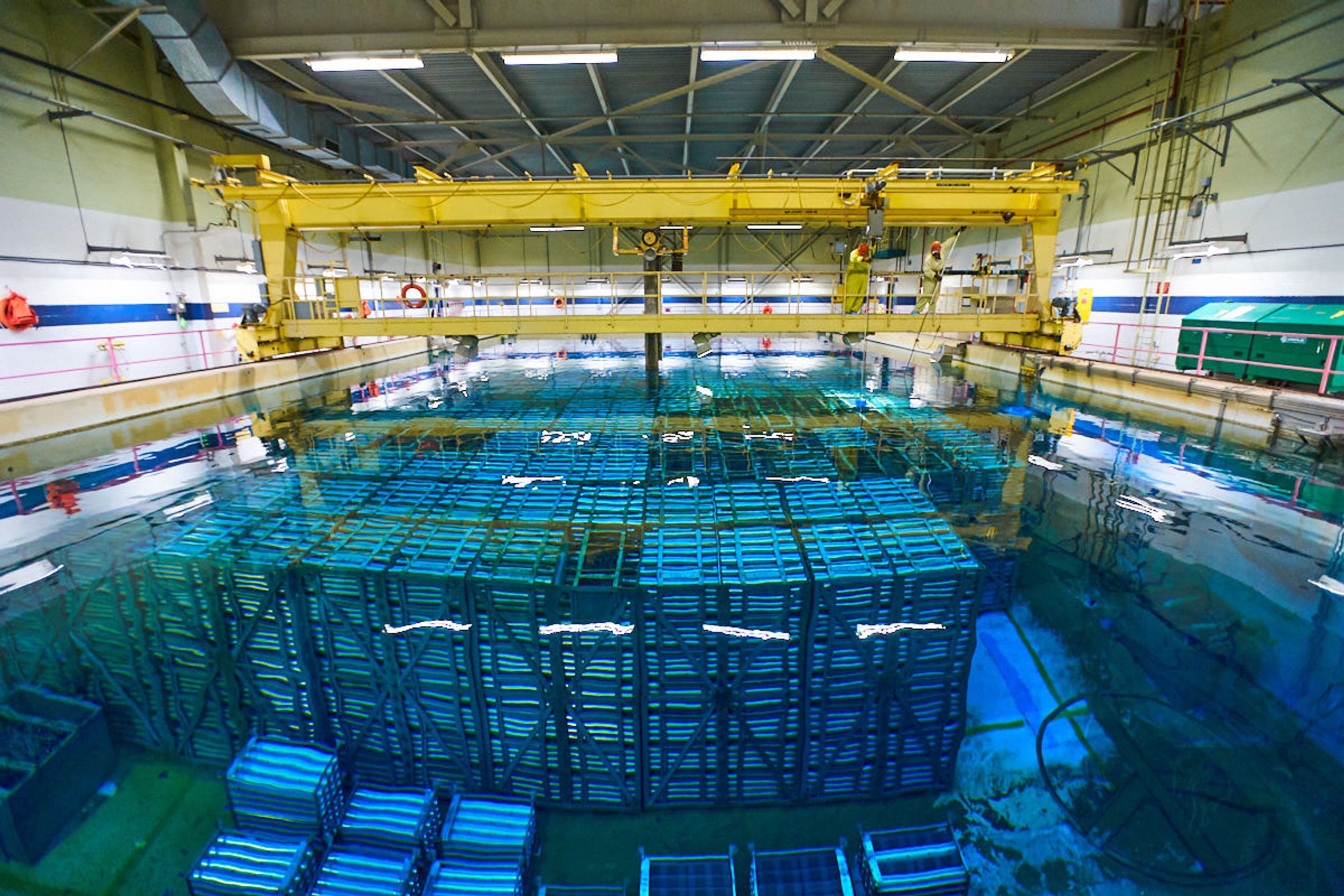 THE EFFECTS OF A WORST-CASE SCENARIO — FROM A NATURAL DISASTER TO TERRORISM — COULD CAUSE UNTHINKABLE CONSEQUENCES FOR THE GREAT LAKES REGION. Keith Matheny, Detroit Free Press Oct. 19, 2018 More than 60,000 tons of highly radioactive spent nuclear fuel is stored on the shores of four of the five Great Lakes — in some cases, mere yards from the waterline — in still-growing stockpiles.
“It’s actually the most dangerous waste produced by any industry in the history of the Earth,” said Gordon Edwards, president of the nonprofit Canadian Coalition for Nuclear Responsibility.
The spent nuclear fuel is partly from 15 current or former U.S. nuclear power plants, including four in Michigan, that have generated it over the past 50 years or more. But most of the volume stored along the Great Lakes, more than 50,000 tons, comes from Canadian nuclear facilities, where nuclear power is far more prevalent.
It remains on the shorelines because there’s still nowhere else to put it. The U.S. government broke a promise to provide the nuclear power industry with a central, underground repository for the material by 1998. Canada, while farther along than the U.S. in the process of trying to find a place for the waste, also doesn’t have one yet.
The nuclear power industry and its federal regulator, the U.S. Nuclear Regulatory Commission, point to spent nuclear fuel’s safe on-site storage over decades. But the remote possibility of a worst-case scenario release — from a natural disaster, a major accident, or an act of terrorism — could cause unthinkable consequences for the Great Lakes region.
Scientific research has shown a radioactive cloud from a spent fuel pool fire would span hundreds of miles, and force the evacuation of millions of residents in Detroit, Chicago, Cleveland, Toronto or other population centers, depending on where the accident occurred and wind patterns.
It would release multiple times the radiation that emanated from the Fukushima disaster in Japan in 2011 — a disaster that led to mass evacuations, no-go zones that exist to this day, and a government ban on fishing in a large, offshore area of the Pacific Ocean because of high levels of radioactive cesium in the water and in fish. The fishing industry there has yet to recover, more than seven years later.
“The Mississippi and the Great Lakes — that would be really bad,” said Frank von Hippel, senior research physicist and professor of public and international affairs emeritus at Princeton University.
Added Jim Olson, environmental attorney and founder of the Traverse City-based nonprofit For Love of Water, or FLOW: “The fact that it’s on the shorelines of the Great Lakes takes that high consequence that would be anywhere and paints it red and puts exclamation marks around it.”
Spent nuclear fuel is so dangerous that, a decade removed from a nuclear reactor, its radioactivity would still be 20 times the level that would kill a person exposed to it. Some radioactive byproducts of nuclear power generation remain a health or environmental hazard for tens of thousands of years. And even typically harmless radioactive isotopes that are easily blocked by skin or clothing can become extremely toxic if even small amounts are breathed in, eaten or drank, making their potential contamination of the Great Lakes — the drinking water supply to 40 million people — the connected Mississippi River and the prime agricultural areas of the U.S. a potentially frightening prospect. ……….
For five years, Michigan residents, lawmakers, environmental groups and others around the Midwest have, loudly and nearly unanimously, opposed a planned Canadian underground repository for low-to-medium radioactive waste at Kincardine, Ontario, near the shores of Lake Huron.
Meanwhile, spent nuclear fuel, vastly more radioactive, sits not far from the shores of four Great Lakes — Michigan, Huron, Erie and Ontario — at 15 currently operating or former nuclear power plant sites on the U.S. side. In Michigan, that includes Fermi 2; the Donald C. Cook nuclear plant in Berrien County; the Palisades nuclear plant in Van Buren County, and the former Big Rock Point nuclear plant in Charlevoix County, which ceased operation in 1997 and where now only casks of spent nuclear fuel remain.
Neither the U.S. nor the Canadian government has constructed a central collection site for the spent nuclear fuel. It’s not just a problem in the Great Lakes region — more than 88,000 tons of spent nuclear fuel, an amount that is rising, is stored at 121 U.S. locations across 39 states…….
Spent nuclear fuel isn’t only radioactive, it continues to generate heat. It requires storage in pools with circulating water for typically five years before it can be moved into so-called dry-cask storage — concrete-and-steel obelisks where spent fuel rods receive continued cooling by circulating air.
In practice, however, because of the high costs associated with transferring waste from wet pools to dry casks, nuclear plants have kept decades worth of spent fuel in wet storage. Plant officials instead “re-rack” the pools, reconfiguring them to add more and more spent fuel, well beyond the capacities for which the pools were originally designed.
“The prevailing practice in the United States is you re-rack the pools until they are just about as dense-packed as the nuclear core,” von Hippel said.
Only in recent years have nuclear plants stepped up the transition to dry cask storage because there’s no room left in the wet pools. Still, about two-thirds of on-site spent nuclear fuel remains in wet pools in the U.S.
That’s a safety concern, critics contend. A catastrophe or act of terrorism that drains a spent fuel pool could cause rising temperatures that could eventually cause zirconium cladding — special brackets that hold the spent fuel rods in bundles — to catch fire.
Such a disaster could be worse than a meltdown in a nuclear reactor, as spent nuclear fuel is typically stored with nowhere near the fortified containment of a reactor core.
“The long-term land-contamination consequences of such an event could be significantly worse than those from Chernobyl,” a 2003 research paper by von Hippel and seven other nuclear experts stated.
The reference is to the worst nuclear power disaster in world history, the April 1986 reactor explosion at the Chernobyl Nuclear Power Plant in the former Soviet Union, now a part of the Ukraine, where 4,000 to 90,000 are estimated to have died as a result of the radiation released. A study by the University of Exeter in Great Britain, released this June, found that cow’s milk from farms about 125 miles from the Chernobyl accident site still — more than 30 years later —- contains the radioactive element cesium at levels considered unsafe for adults and at more than seven times the limit unsafe for children.
Allison Macfarlane, a professor of public policy and international affairs at George Washington University, served as chairman of the NRC during the Obama administration from July 2012 until December 2014.
“What I think needs more examination is the practice of densely packing the fuel in the pool,” she said.
The NRC does not regulate how much fuel can be in a pool, in what configuration it’s placed, and how old the fuel is, Macfarlane said. ……….
In a Great Lakes region where magnitude-9.0 earthquakes and tsunamis aren’t a potential threat to stockpiles of spent nuclear fuel, terrorism remains possible………
In a Great Lakes region where magnitude-9.0 earthquakes and tsunamis aren’t a potential threat to stockpiles of spent nuclear fuel, terrorism remains possible.
“The NRC’s position on beyond design basis threats is essentially that this is a matter for the national security apparatus — it’s not our job, so somebody else will take care of it,” he said. “But if you look at the Pentagon, Homeland Security, I think you will look in vain to find any part of that apparatus that is addressing that area that the NRC says is not its job.”……….
Welcome to Zion, nuclear waste dump ………..
In Ontario, nearly 52,000 tons of spent nuclear fuel is stored on-site at nuclear plants along Lakes Huron and Ontario.
“There’s a huge amount of high-level, radioactive waste stored right along the water,” said Edwards, the president of the nonprofit Canadian Coalition for Nuclear Responsibility………. https://www.freep.com/story/news/local/michigan/2018/10/19/nuclear-waste-great-lakes/1417767002/
Wentworth byelection – a referendum on climate change and refugees
Greens praise ‘progressive’ Kerryn Phelps ahead of Wentworth byelection, Guardian, Katharine Murphy and Anne Davies,Exclusive: Richard Di Natale says the independent candidate’s positions on climate change and refugees are a welcome change. The Greens leader, Richard Di Natale, has urged supporters in Wentworth to “take note” of Kerryn Phelps’ progressive positions on climate change and refugees when they cast their ballots on Saturday, in a clear signal to preference the high-profile independent ahead of Labor.
Di Natale told Guardian Australia the government was clearly at risk of losing Malcolm Turnbull’s former seat, and Labor was “running dead” in the contest, so in that context “people can vote Green and choose Kerryn over yet another Liberal backbencher”.
The Greens leader urged rusted-on supporters to vote for the party’s candidate, Dominic WY Kanak, and then “take note of Kerryn’s progressive views on refugees and climate change, which are a welcome change from both the major parties”.
The Wentworth byelection has become a referendum on climate change and refugees and is a unique opportunity to send a message to the Liberals who don’t deserve to govern,” he said. …….https://www.theguardian.com/australia-news/2018/oct/19/greens-praise-progressive-kerryn-phelps-ahead-of-wentworth-byelection
Gender and radiation impact project
|
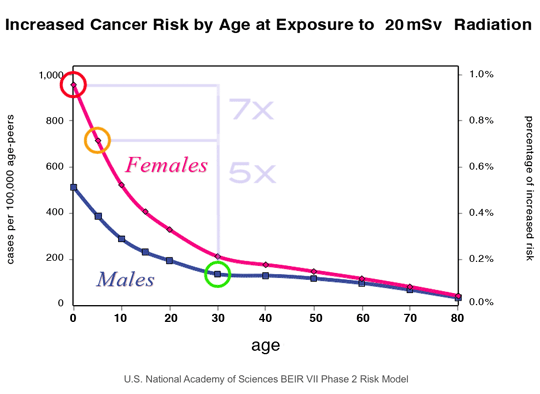
“For too long, girls and women have been invisible in the construction of radiation standards to protect heath. We are ready to expand the research base and collective will to change this – starting right now.” — Mary Olson, Founder THE BASICSIt is widely known that ionizing radiation – radioactivity powerful enough to strip electrons from atoms, break chemical bonds of molecules, and even break chromosomes – can be extremely harmful to humans. Even at low levels, ionizing radiation has the potential to cause DNA damage resulting in an uncontrolled division of abnormal cells, or what is commonly known as cancer.
While this public health threat impacts us all, the risk is dramatically greater for women and girls. For every two men who develop cancer through exposure to ionizing radiation, three women will get the disease.Further, while children as a whole are more harmed by radiation than adults, infant and young girls, when exposed, run the highest risk of cancer across their lifetime, and teenage girls will suffer almost double rates of cancer compared to boys in the same juvenile group and the same level of exposure. The information above, derived from data contained in the 2006 National Academy of Sciences Report Biological Effects of Ionizing Radiation VII, or BEIR VII, clearly shows that gender is a major factor in determining who suffers harm from exposure to ionizing radiation, yet this fact has not been widely reported and is not reflected in regulations or practice.
Yet, there is reason to hope. With the participation of 135 nations, the preamble of the 2017 UN Treaty on the Prohibition of Nuclear Weapons was written to include the following stanza: Cognizant that the catastrophic consequences of nuclear weapons cannot be adequately addressed, transcend national borders, pose grave implications for human survival, the environment, socioeconomic development, the global economy, food security and the health of current and future generations, and have a disproportionate impact on women and girls, including as a result of ionizing radiation… (emphasis added) The fact this treaty was crafted to include language referring to impact on girls and women demonstrates we have a window to examine why this is the case, which will lead to better and healthier solutions for everyone. It is time to ask the right questions and educate the public about the policy and lifestyle choices related to ionizing radiation. |
|
Japan will flush unsafe water from Fukushima nuclear plant into sea
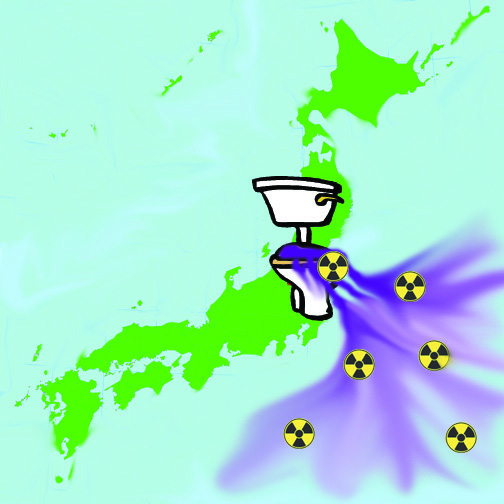 https://www.independent.ie/world-news/asia-pacific/japan-will-flush-unsafe-water-from-fukushima-nuclear-plant-into-sea-37429128.html, Julian Ryall, October 17 2018 Water the Japanese government is planning to release into the Pacific Ocean from the crippled Fukushima nuclear plant contains radioactive material well above legally permitted levels, according to the plant’s operator.
The government is running out of space to store contaminated water that has come into contact with fuel that escaped from three nuclear reactors after the plant was destroyed in the March 2011 earthquake and tsunami that struck north-east Japan.
Its plan to release the approximately 1.09m tons of water stored in 900 tanks into the Pacific has triggered a fierce backlash from local residents and environmental organisations, as well as groups in South Korea and Taiwan fearful that radioactivity from the second-worst nuclear disaster in history might wash up on their shores.
Tokyo Electric Power Co (Tepco), which runs the plant, has until recently claimed the only significant contaminant in the water is safe levels of tritium, which can be found in small amounts in drinking water, but is dangerous in large amounts.
The government has promised that all other radioactive material is being reduced to “non-detect” levels by the sophisticated advanced liquid processing system (ALPS) operated by Hitachi Ltd.
Documents provided to ‘The Daily Telegraph’ by a source in the Japanese government suggest, however, that the ALPS has consistently failed to eliminate a cocktail of other radioactive elements, including iodine, ruthenium, rhodium, antimony, tellurium, cobalt and strontium.
Hitachi declined to comment on the reports on the performance of its equipment. The Japanese government did not reply to multiple requests for comment.
A restricted document also passed to ‘The Telegraph’ from the Japanese government arm responsible for responding to the Fukushima collapse indicates that the authorities were aware that the ALPS facility was not eliminating radionuclides to “non-detect” levels.
That adds to reports of a study by the regional ‘Kahoko Shinpo’ newspaper which said confirmed that levels of iodine 129 and ruthenium 106 exceeded acceptable levels in 45 samples out of 84 in 2017.
Iodine 129 has a half-life of 15.7 million years and can cause cancer of the thyroid; ruthenium 106 is produced by nuclear fission and high doses can be toxic and carcinogenic when ingested.
In late September, Tepco was forced to admit that around 80pc of the water stored at Fukushima still contains radioactive substances above legal levels after the Ministry of Economy, Trade and Industry held public hearings in Tokyo and Fukushima at which local residents and fishermen protested against the plans.
Tepco has now admitted that levels of strontium 90, for example, are more than 100 times above legally permitted levels in 65,000 tons of water that has been through the ALPS cleansing system and are 20,000 times above levels set by the government in several storage tanks at the site.
Dr Ken Buesseler, a marine chemistry scientist with the US Woods Hole Oceanographic Institution, said it was vital to confirm precisely what radionuclides are present in each of the tanks and their amounts.
“Until we know what is in each tank for the different radionuclides, it is hard to evaluate any plan for the release of the water and expected impacts on the ocean”, he told the ‘Telegraph’.
Experts agree the danger posed by any release depends on the concentrations of radionuclides and subsequent contamination of fishery products.
The presence of strontium in the bones of small fish that might be consumed by humans could be a major concern. If ingested by humans, strontium 90 builds up in teeth and bones and can cause bone cancer or leukaemia.
Nuclear research reactor removed
Arkansas – final removal of the rector core. This what should happen to Australia’s Opal nuclear reactor at Lucas Heights

USA’s policy shaped by Trump’s financial gain from Saudi Arabia?

Saudi Arabia is putting money in Trump’s pocket. Is that shaping U.S. policy? https://www.washingtonpost.com/blogs/plum-line/wp/2018/10/16/saudi-arabia-is-putting-money-in-trumps-pocket-is-that-shaping-u-s-policy/?noredirect=on&utm_term=.434cc7237930, By Paul Waldman, October 16
As hard as it is to resist writing about the fact that on Tuesday the president of the United States called the adult film actress to whom he paid hush money “Horseface,” I want to focus on a different aspect of this presidency that we’re seeing play out right now.
.As the apparent murder of Saudi journalist and Post contributor Jamal Khashoggi complicates our relations with Saudi Arabia, we have to ask what the implications are of having a fully transactional presidency, one not just built on “deals” but where policy is determined by what is financially beneficial to the president.
We should begin by reminding ourselves that as awful as Khashoggi’s apparent murder is, it’s only the latest in a long list of Saudi abuses that administrations both Democratic and Republican have chosen to overlook for decades. The country is a cruel dictatorship that embodies none of the values we as a nation hold dear, such as democracy, freedom of expression, freedom of the press and freedom of religion. But we decided long ago that since the Saudis have a great deal of oil and they provide us with a strategic ally in the Middle East, we’ll overlook all that.
There is something unsettling about the fact that Saudi intervention in Yemen’s civil war, in which they have reportedly killed thousands of civilians, has received steady U.S. support, while the murder of a single journalist threatens to upend the relationship between the two countries.
Or so you might think. But here’s the reality: This will blow over, not only because of the complex relationship between the two countries, but also because everything in foreign policy is personal with President Trump, and he likes the Saudis.
And why does he like them so much? Because they pay him.
This is not something Trump has been shy about saying. “Saudi Arabia, I get along with all of them. They buy apartments from me. They spend $40 million, $50 million,” he said at a rally in Alabama in 2015. “Am I supposed to dislike them? I like them very much.”
Trump says so many shocking things that it’s sometimes easy to slide right past the most appalling ones, but read that again. Here you have a candidate for president of the United States saying that he is favorably disposed toward a foreign country because they have given him millions of dollars, and all but promising to shape American foreign policy in their favor for that very reason. Continue reading
Washington DC pushes 100% renewable energy bill

 https://reneweconomy.com.au/washington-dc-pushes-100-renewable-energy-bill-48151/
IPCC bets on the renewables revolution
Dr Jim Green, Nuclear Monitor #867, 15 Oct 2018
 https://www.wiseinternational.org/nuclear-monitor/867/nuclear-monitor-867-15-october-2018
The UN’s Intergovernmental Panel on Climate Change (IPCC) has issued a landmark report warning that global warming must be kept to 1.5˚C, requiring “rapid and far-reaching” transitions in land, energy, industry, buildings, transport, and cities.1
The world must invest US$2.4 trillion in clean energy every year through 2035 and cut the use of coal-fired power to almost nothing by 2050 to avoid catastrophic damage from climate change, according to the IPCC. To put the US$2.4 trillion figure in context, about US$1.8 trillion was invested in energy systems globally in 2017, of which about 42% was invested in electricity generation and about 18.5% in renewables.2
Unsurprisingly, the World Nuclear Association (WNA) used the IPCC report to promote nuclear power.
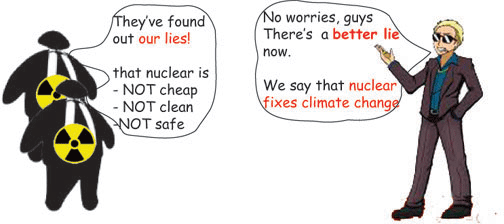 WNA Director General Agneta Rising said the IPCC report “makes clear … the necessity of nuclear energy as an important part of an effective global response” to climate change and that it “highlights the proven qualities of nuclear energy as a highly effective method of reducing greenhouse gas emissions, as well as providing secure, reliable and scalable electricity supplies.”3 In a separate statement, the WNA falsely claimed that nuclear power increases under all of the IPCC scenarios compatible with limiting warming to 1.5˚C.4
Almost all of the WNA’s claims are false or exaggerated. The IPCC report raises numerous concerns about nuclear power (discussed below). In general terms, nearly all of the scenarios presented in the IPCC report envisage a decline in nuclear power generation to 2030 followed by an upswing.5 No logical rationale ‒ or any rationale at all ‒ is provided to support the upswing from 2030 to 2050.

The points that jump out from the IPCC’s low-carbon 1.5°C scenarios are that nuclear accounts for only a small fraction of energy/electricity supply (even if nuclear output increases) whereas renewables do the heavy lifting. For example, in one 1.5°C scenario, nuclear power more than doubles by 2050 but only accounts for 4.2% of primary energy whereas renewables account for 60.8%.6 In another 1.5°C scenario, nuclear nearly doubles by 2050 but its contribution to total electricity supply falls to 8.9%, compared to 77.5% for renewables.7
The IPCC report notes that: “Nuclear power increases its share in most 1.5°C pathways by 2050, but in some pathways both the absolute capacity and share of power from nuclear generators declines. There are large differences in nuclear power between models and across pathways … Some 1.5°C pathways no longer see a role for nuclear fission by the end of the century, while others project over 200 EJ / yr of nuclear power in 2100.”8
Nuclear lobbyist Michael Shellenberger has a very different take on the IPCC report to the WNA … and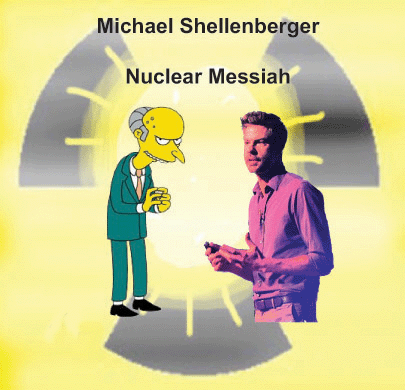 most of his claims are false as well.9 Shellenberger takes the IPCC to task for stating that nuclear power risks nuclear weapons proliferation.10,11 That is “unsubstantiated fear-mongering”, he claims, although Shellenberger himself has written at length about the manifold and repeatedly-demonstrated connections between nuclear power and weapons.12 “No nation has used its civilian nuclear plants to create a weapon”, Shellenberger now claims ‒ which is garbage.13
Shellenberger seems troubled by the IPCC’s claims about a possible connection between nuclear power and childhood leukemia ‒ but he doesn’t explain why. The IPCC’s comments are modest: “Increased occurrence of childhood leukaemia in populations living within 5 km of nuclear power plants was identified by some studies, even though a direct causal relation to ionizing radiation could not be established and other studies could not confirm any correlation (low evidence/agreement in this issue).”10 In fact the evidence of a link is stronger than the IPCC suggests.14,15
Shellenberger complains about “biased and misleading cost comparisons” in the IPCC report though the report simply notes that nuclear power provides an example of “where real-world costs have been higher than anticipated … while solar PV is an example where real-world costs have been lower”.16
Shellenberger claims that solar and wind contributed 1.3% and 3.9% to global electricity supply in 2017 ‒ the true figures are 1.9% and 5.6%.17 He fails to note that all renewables combined supplied 26.5% of global electricity supply in 2017 (2.5 times more than nuclear) or that renewable supply has doubled over the past decade while nuclear power has been stagnant.
References: Continue reading
Is nuclear radiation really “good for you” as USA’s Environmental Agency suggests?
Editorial: Attention West Lake residents: EPA says radiation is good for you. https://www.stltoday.com/opinion/editorial/editorial-attention-west-lake-residents-epa-says-radiation-is-good/article_8b288c51-b064-5646-8123-73f943459d57.html By the Editorial Board 15 Oct 18
1 This month

of the week – Australians for War Powers Reform (AWPR)
To see nuclear-related stories in greater depth and intensity
 Antinuclear