Trump says that climate change scientists have a “political agenda”
BBC 15th Oct 2018 US President Donald Trump has accused climate change scientists of having a
 “political agenda” as he cast doubt on whether humans were responsible for
the earth’s rising temperatures. But Mr Trump also said he no longer
believed climate change was a hoax. The comments, made during an interview
with CBS’s 60 Minutes, come less than a week after climate scientists
issued a final call to halt rising temperatures. The world’s leading
scientists agree that climate change is human-induced.
https://www.bbc.co.uk/news/world-us-canada-45859325
As nuclear power declines worldwide, renewable energy races ahead
Likening nuclear power to that of a living organism, however, Mycle Schneider, the lead author of the World Nuclear Industry Status Report, told World Finance the industry was like a “dying species” due to the obvious reduction in new nuclear project launches in recent years.
This is seen clearly in the International Energy Agency’s (IEA) annual World Energy Investment report, updated in July, which found that nuclear investment is falling fast.

Nuclear power continues its decline as renewable alternatives steam ahead, World Finance, Author: Courtney Goldsmith, October 15, 2018
Once thought of as the primary answer to the globe’s renewable energy requirements, nuclear energy is now viewed unfavourably in comparison to solar and wind alternatives.
Last year, the largest nuclear power builder in history went bankrupt. Japanese conglomerate Toshiba’s prolific subsidiary Westinghouse filed for bankruptcy after revealing billions of dollars of cost overruns on its US construction projects. At the start of 2018, Toshiba agreed to sell the business for $4.6bn
The high-profile sale followed the French Government’s €5.3bn ($6.2bn) bailout of state-owned nuclear company Areva, which went technically bankrupt after a cumulative six-year
loss of $12.3bn.
These distress signals were noted in the 2017 World Nuclear Industry Status Report, which claimed the debate on nuclear power is over. “Nuclear power has been eclipsed by the sun and the wind,” the report’s forward read. “These renewable, free-fuel sources are no longer a dream or a projection – they are a reality [and] are replacing nuclear as the preferred choice for new power plants worldwide.” Continue reading
China’s waning nuclear interest
Nuclear power continues its decline as renewable alternatives steam ahead, World Finance, Author: Courtney Goldsmith, October 15, 2018“…………China’s waning nuclear interest Of the 10 reactors that started up globally in 2016, half were located in China. Meanwhile, nearly 40 percent of the total reactors currently in construction are Chinese. However, China has not launched a new construction of a commercial reactor since December 2016. The country had planned for 58GW of total nuclear capacity to be in place by 2020, but having failed to get 30GW of new plants under construction by 2018, China’s lead in the field of nuclear power may be slipping. What’s more, even in this hub of nuclear activity, renewable generation is moving even faster. As of July 2017, China had 37 operating nuclear reactors with a total net capacity of around 32GW. In 2017, however, the country added a whopping 53GW of solar power. “To illustrate the speed with which things change, and [which] the invading species is taking over, if you only go back five years in 2012, Germany was the world record holder in the addition of [solar PV] with 7.5GW,” Schneider said. “Now it’s China with [53GW] five years later. The speed is just unbelievable.” The return of small reactors Proponents say SMRs will be cheaper and safer than conventional nuclear plants, and will be capable of competing with solar and wind power. Desbazeille said SMRs were a “game changer” that could put Europe back at the forefront of nuclear technology……. But while SMRs are purported to be the key to transforming the nuclear sector, history has painted a troubling picture: SMR designs have been in the works for decades, but none have reached commercial success. In fact, Westinghouse worked on an SMR design for about a decade, but the project was abandoned in 2014. At the time, then-CEO Danny Roderick said: “The problem I have with SMRs is not the technology, it’s not the deployment – it’s that there’s no customers.” A number of companies continue to work on new designs, however. US firm NuScale Power plans to develop an SMR to re-establish the country’s leadership in nuclear technology. The design is currently under review for approval by US regulators. While NuScale is seen as one of the firms closest to commercialisation, it may be too late by the time the arduous process of securing approvals is completed. Therefore, by the time SMRs are ready for mass deployment, the energy debate may already be over. “Look at what happened over the past five years,” Schneider said. “But can you imagine what will happen in the next 10 years? This is going to be a completely different world.”… Although SMRs have been talked about for decades, the progress made so far has been tiny. New technologies in the nuclear sector take a huge amount of time to develop – just look at the struggle to build EPRs in Europe. Plus, opting for a small design cuts out the economies of scale, or the cost advantages that come about due to increasing the size of a project. This is something nuclear projects often rely on. A report by researchers at Harvard University, Carnegie Mellon University and the University of California, San Diego concluded that in the absence of a “dramatic change in the [US] policy environment”, a convincing case for a domestic market for SMRs is difficult to make. Much of the nuclear debate is powered by opinions and estimates, but looking at the hard data, it’s strikingly clear that the industry is in a slow and inevitable decline. China’s plans to become a nuclear powerhouse have been overshadowed by its huge investments in renewable energy – in fact, the number of new construction starts (see Fig 2) has fallen around the world as stubbornly high costs and complex designs make new nuclear a hard sell. Even in spite of nuclear power’s role in reducing carbon emissions, the potential safety issues and environmental impact of a meltdown are too big to ignore. With the cost of renewable and battery technologies expected to continue falling, wind and solar power appear to be the next golden opportunity. https://www.worldfinance.com/markets/nuclear-power-continues-its-decline-as-renewable-alternatives-steam-ahead
|
|
|
Australian business ready to adopt its own emissions reduction scheme.
Business set to leave Coalition behind Phillip Coorey, 12 Oct 18 Appeasing the political cancers on the right of the Liberal Party has left business furious and ready to adopt its own emissions reduction scheme. https://www.afr.com/opinion/columnists/business-readies-to-leave-coalition-right-behind-20181010-h16h9c
The horrifying possibility of 15-to-20 feet of sea-level rise
What’s Another Way to Say ‘We’re F-cked’? https://www.rollingstone.com/politics/politics-news/climate-change-sea-level-rise-737012/
One of the leading climate scientists of our time is warning of the horrifying possibility of 15-to-20 feet of sea-level rise, By JEFF GOODELL,13 Oct 18
The nuclear lobby now touts SMRs – Small and Medium Nuclear Reactors – deliberate confusion about size
Small Modular Reactors don’t exist yet, and the picture below shows that the size of these speculative reactors are far from “small” (red arrow points to tiny human figure). Yet Barry Brook continues to receive funding from the “Australian Research Council” to investigate all things nuclear, including putting these reactors on small islands. How much money has gone to funding pro-nuclear fantasy research?
“Economic Feasibility of Energy Supply by Small Modular Nuclear Reactors on Small Islands: Case Studies of Jeju, Tasmania and Tenerife” Sanghyun Hong and Barry W. Brookmore https://www.facebook.com/groups/1021186047913052/

Noel Wauchope they are now referred to by IAEA as small and medium reactors (SMRs)…..A subcategory of very small reactors – vSMRs – is proposed for units under about 15 MWe, especially for remote communities……..Note that many of the designs described here are not yet actually taking shape. ……. They go on to list a bewildering array of reactor designs, listed in MWe (MegaWatts electic) -not in physical size.
The UN’s Intergovernmental Panel on Climate Change (IPCC) ’s Special Report understates the threat
 Climate report understates threat https://thebulletin.org/2018/10/climate-report-understates-threat/?utm_source=Bulletin%20Newsletter&utm_medium=iContact%20email&utm_campaign=October12
By Mario Molina, Veerabhadran Ramanathan, Durwood J. Zaelke, October 9, 2018 The UN’s Intergovernmental Panel on Climate Change’s Special Report on Global Warming of 1.5 degrees Celsius, released on Monday, is a major advance over previous efforts to alert world leaders and citizens to the growing climate risk. But the report, dire as it is, misses a key point: Self-reinforcing feedbacks and tipping points—the wildcards of the climate system—could cause the climate to destabilize even further. The report also fails to discuss the five percent risk that even existing levels of climate pollution, if continued unchecked, could lead to runaway warming—the so-called “fat tail” risk. These omissions may mislead world leaders into thinking they have more time to address the climate crisis, when in fact immediate actions are needed. To put it bluntly, there is a significant risk of self-reinforcing climate feedback loops pushing the planet into chaos beyond human control.
The report does describe how much more serious climatic impacts will be if the world lets warming reach 2 degrees Celsius above pre-industrial levels. Limiting the warming to 1.5 degrees Celsius can, for example, cut many impacts in half, including those of fresh water shortage and losses of many species and of ocean fish catch. The report is relatively optimistic that this can be done, but only with unprecedented commitment and cooperation from governments, industry, religious and secular leaders, and citizens around the world.
So far, average temperatures have risen by one degree Celsius. Adding 50 percent more warming to reach 1.5 degrees won’t simply increase impacts by the same percentage—bad as that would be. Instead, it risks setting up feedbacks that could fall like dangerous dominos, fundamentally destabilizing the planet. This is analyzed in a recent study showing that the window to prevent runaway climate change and a “hot house” super-heated planet is closing much faster than previously understood. Continue reading
What the IPCC Report says about nuclear power
Abrupt Climate Change Will Rapidly Blow Past 1.5C and 2C
Paul Beckwith, -10 Oct 18 As I filmed today, yet another massive hurricane has just come ashore in Florida’s panhandle. Hurricane Michael, at 155 mph (1 mph shy of Cat. 5) appeared almost out of nowhere and strengthened rapidly in the way too-warm Gulf of Mexico. This video is not just on this storm, but primarily on the human/media/global storm that has arisen with the release of the IPCC 1.5C report on our present state of the climate system, and whether or not we can keep global temperature rise to 1.5C or even to 2C.
Vitrification of nuclear waste – the glass corrodes, melts, long before the radioactive trash is safe
What causes nuclear waste glass to dissolve? Phys Org, University of Houston October 10th, 2018
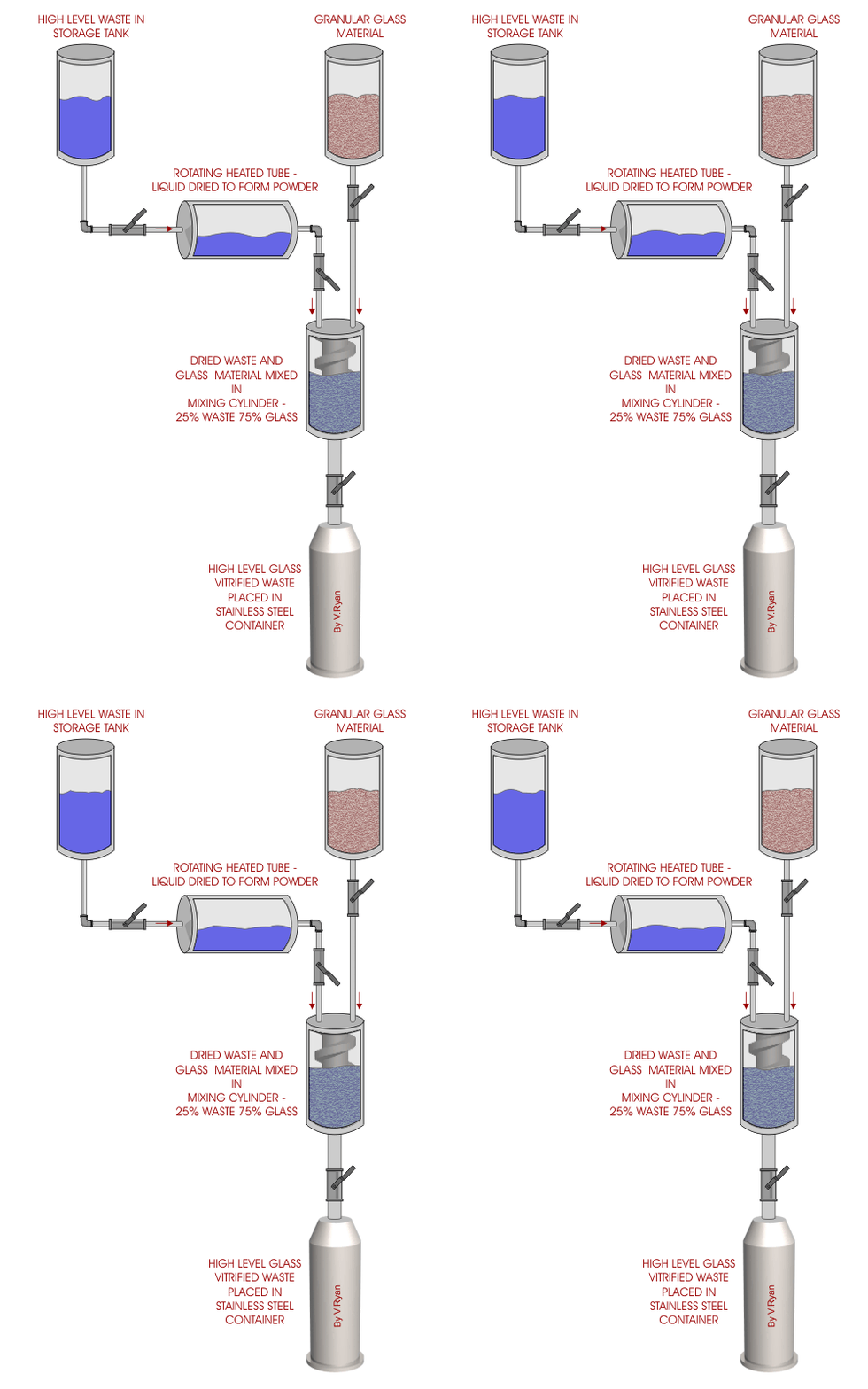 Immobilizing nuclear waste in glass logs—a process known as vitrification—is currently used in the United States to safeguard waste from sites associated with defense activities. Some other countries also use the process to capture waste from nuclear power plants.
Researchers know, however, that the glass can begin to dissolve after a long period of time, and the durability of these glass logs remains an active area of research.
Researchers from the University of Houston, the Department of Energy’s Pacific Northwest National Laboratory and the University of Pittsburgh are working on one of the most pressing issues—what causes the glass to begin to deteriorate relatively quickly at some point, potentially releasing radioactive waste at levels exceeding regulatory thresholds?……….”We have long observed from laboratory studies that zeolite formation in glass corrosion tests resulted in an increase in the glass corrosion rate,” said Neeway, a researcher at PNNL. ………
Zeolite P, the zeolite that forms from the glass, is affected by temperature—Rimer said researchers synthesize it in the lab at 100 °C—but they don’t yet know how crystallization proceeds at lower temperatures and they don’t have methods to deter its formation. But controlling temperatures in the geologic formations designated as nuclear waste repositories is not necessarily practical, thus researchers are looking for other factors that might affect crystal growth, including components of the glass. https://phys.org/wire-news/300629772/what-causes-nuclear-waste-glass-to-dissolve.html
Georgia – Florida – Hurricane Michael threatens nuclear power plants
Hurricane Michael On Path of Several Nuclear Reactors, Latest Maps, Charts, Live Data, Flooding
(Put up with the annoying advertising stuff at the beginning of this video)
Nearly 3,000 Georgia Power personnel ready to respond to Hurricane Michael
Company reminds customers to stay informed and safe during and after storm Ciston PR Newswire ATLANTA, Oct. 10, 2018 /PRNewswire/ — As Hurricane Michael impacts the Gulf Coast, Georgia Power is ready to respond to power outages as quickly and safely as possible with nearly 3,000 personnel from the company and assisting utilities. Crews are continuing to mobilize from unaffected areas across Georgia over the next 24 hours and are strategically positioning throughout the state ready to re-enter central and south Georgia, and other areas, as Hurricane Michael subsides.
Damage assessment teams will be the first to enter affected areas and will relay critical field information so restoration teams can be dispatched as safely and efficiently as possible. Additional resources are available as part of the Southern Company system, which includes multiple electric and gas companies serving more than 9 million customers…….https://www.prnewswire.com/news-releases/nearly-3-000-georgia-power-personnel-ready-to-respond-to-hurricane-michael-300729092.html
Nuclear power plants in the path of Hurricane Michael
BREAKING-NUCLEAR PLANT-CAT5 HURRICANE MICHAEL-HISTORY BOOKS!
Extensive damage and extended power outages in South Georgia expected to continue over next 24 hours due to high winds and falling trees
Georgia Power ATLANTA, Oct. 10, 2018 /PRNewswire/ — Hurricane Michael arrived in Georgia this evening and is impacting service to Georgia Power customers. The company is prepared to respond with approximately 3,900 personnel from the company, other Southern Company operating companies and assisting utilities ready to restore power as quickly and safely as possible following the storm. All of Georgia Power’s resources are being held and dedicated to storm restoration efforts in the state following Hurricane Michael.
Georgia Power expects damage due to high winds, heavy rain and fallen trees. Once the storm passes, the company must wait until conditions are safe for damage assessment teams to enter the impacted zones and begin the restoration process, followed by repair crews, which could take several days, depending on the amount of damage and safe access to the area. As weather conditions improve, restoration efforts will accelerate, but it could take an extended period of time for all customers to be restored…….
As of 8:00 p.m. Wednesday, there are more than 65,000 customers without power in Georgia …https://www.prnewswire.com/news-releases/hurricane-michael-enters-georgia-65-000-customers-without-power-300729151.html
World Medical Association backs U.N. Nuclear UN Treaty on the Prohibition of Nuclear Weapons.
At its recent General Assembly in Iceland the World Medical Association passed an unequivocal call for nations to adopt and implement the UN Treaty on the Prohibition of Nuclear Weapons.
Legal action against France over its “crimes against humanity” in nuclear tests in South Pacific
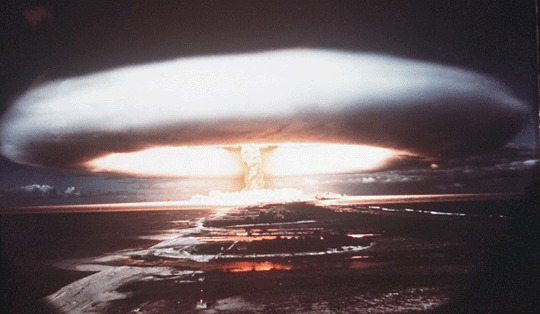 France sued for ‘crimes against humanity’ over nuclear tests in South Pacific https://www.dw.com/en/france-sued-for-crimes-against-humanity-over-nuclear-tests-in-south-pacific/a-45826054
France is being taken to the International Criminal Court for nuclear weapons tests in French Polynesia. France has long denied responsibility for the impacts of the tests and only recently began compensating civilians. France is being taken to the International Criminal Court (ICC) for carrying out nuclear weapons tests in French Polynesia, a Polynesian opposition leader announced on Tuesday.
Oscar Temaru, the archipelago’s former president and current leader of the Tavini Huiraatira Party, announced the move during a United Nations committee dealing with decolonization.
Temaru accused France of “crimes against humanity” and said that he hopes to hold French presidents accountable for the nuclear tests with the ICC complaint.
“We owe it to all the people who died from the consequences of nuclear colonialism,” he told the UN committee.
Maxime Chan from Te Ora Naho, an association for the protection of the environment in French Polynesia, told the UN that there had been 368 instances of radioactive fallout from the tests and that radioactive waste had also been discharged into the ocean — violating international rules.
Three decades of nuclear tests
The French territory, currently home to 290,000 people, is best known for the popular tourist island of Tahiti, but its atolls of Mururoa and Fangataufa were used for decades for nuclear tests.
France carried out 193 nuclear weapons tests on islands in the archipelago between 1960 and 1996 until French President Jacques Chirac halted the program.
Around 150,000 military and civilian personnel were involved in France’s nuclear tests, with thousands of them later developing serious health problems.
France has long denied responsibility for the detrimental health and environmental impacts of the tests, fearing that it would weaken the country’s nuclear program during the Cold War.
In 2010, France passed a law allowing military veterans and civilians to be compensated if their cancer could be attributed to the nuclear tests. Out of approximately 1,000 people who have filed complaints against France, only 20 have been compensated.
Renewable energy bringing a new golden age to South Australia
Ships, renewables energise SA as new golden age looms Hopes of a manufacturing renaissance are being buoyed by warships and confidence in renewable energy after the disaster expected with Holden’s closure failed to eventuate…. (subscribers only}
1 This month

of the week – Australians for War Powers Reform (AWPR)
To see nuclear-related stories in greater depth and intensity
 Antinuclear