 Independent 1st Oct 2018, The world is “already well on the way” to global temperature rises of 1.5C,
experts have warned as countries meet to finalise a major report on the issue. Representatives of 195 governments and scientists are meeting in South Korea this week to agree a report on the impacts of a rise of 1.5C above pre-industrial levels and the action needed to limit global warming to that level.
The Intergovernmental Panel on Climate Change (IPCC) was asked to draw up the report after countries agreed to curb warming to “well below” 2C above pre-industrial levels and to pursue efforts to limit rises to 1.5C. The tighter target was included in the global Paris Agreement on climate change agreed in 2015 amid fears that warming beyond 1.5C could threaten the survival of some countries, such as low-lying island states.
In order to stem rising temperatures, the world will need to cut greenhouse gas emissions to zero and the report is likely to say that carbon emissions must fall to zero by 2050 to meet the 1.5C target.
https://www.independent.co.uk/environment/global-warming-climate-change-temperature-rise-earth-experts-a8563966.html
October 3, 2018
Posted by Christina Macpherson |
General News |
Leave a comment

 Solar Power Portal 1st Oct 2018
 The UK’s solar fleet set a new generation record in Q2 2018 as flourishing renewables all but shunted coal off the country’s power mix.
The latest Digest of UK Energy Statistics (DUKES), released by the Department for Business, Energy and Industrial Strategy (BEIS) last week, confirmed that solar generation in the three months from April to June 2018 stood at 4.65TWh. That figure, reached on the back of a prolonged dry and clear spell in the UK, was a new record for solar in the UK and contributed towards total renewable generation of 24.3TWh.
https://www.solarpowerportal.co.uk/news/solar_set_new_generation_record_in_q2_as_coal_hits_fresh_lows
October 3, 2018
Posted by Christina Macpherson |
General News |
Leave a comment
With the increasing availability and affordability of imaging technologies, people are getting more tests than they used to. Today, Americans receive more than 85 million CT scans each year, compared with 3 million per year in the 1980s.
Many of those tests may be excessive, argue some researchers, who have been trying to quantify the risks of our increasing use of ionizing radiation in medical imaging. A 2009 study by scientists at the National Cancer Institute estimated that 2 percent — or about 29,000 — of the 1.7 million cancers diagnosed in the United States in 2007 were caused by CT scans.
 Should I worry about radiation exposure from X-rays, mammograms and other scans? WP, By Emily Sohn September 30 2018 “…… while massive doses of radiation are known to be harmful, the small doses used in routine tests are usually safe, especially compared with other health-care choices people make without thinking twice.
“Radiation does have some risk,” says Russ Ritenour, a medical physicist at the Medical University of South Carolina in Charleston. “But it is important for medicine. And in most cases, the risk is quite small compared to the risk of taking too much Advil over your life and other things like that.”……..
Added exposure, totaling another 3 mSV each year for the average American, comes from such man-made sources as power plants that run on coal and nuclear fuel, and consumer products including TVs and computer screens. But most of the extra radiation we get comes from X-rays and CT scans, Ritenour says. Continue reading →
October 1, 2018
Posted by Christina Macpherson |
General News |
2 Comments
Another option is not to whitewash roofs, but to green them with foliage. This is already being adopted in many cities
There is a third option competing for roof space to take the heat out of cities — covering them in photovoltaic cells. PV cells are dark, and so do not reflect much solar radiation into space. But that is because their business is to capture that energy and convert it into low-carbon electricity.
Solar panels “cool daytime temperatures in a way similar to increasing albedo via white roofs,” according to a study by scientists at the University of New South Wales. The research, published in the journal Scientific Reports last year, found that in a city like Sydney, Australia, a city-wide array of solar panels could reduce summer maximum temperatures by up to 1 degree C. …….
The lesson then is that light, reflective surfaces can have a dramatic impact in cooling the surrounding air – in cities, but in the countryside too. Whitewashed walls, arrays of photovoltaic cells, and stubble-filled fields can all provide local relief during the sweltering decades ahead.

|
Urban Heat: Can White Roofs Help Cool World’s Warming Cities?
It has long been known that installing white roofs helps reduce heat buildup in cities. But new research indicates that making surfaces more light-reflecting can have a significant impact on lowering extreme temperatures – not just in cities, but in rural areas as well.Yale Environment 360 BY FRED PEARCE • MARCH 7, 2018 Summers in the city can be extremely hot — several degrees hotter than in the surrounding countryside. But recent research indicates that it may not have to be that way. The systematic replacement of dark surfaces with white could lower heat wave maximum temperatures by 2 degrees Celsius or more. And with climate change and continued urbanization set to intensify “urban heat islands,” the case for such aggressive local geoengineering to maintain our cool grows.The meteorological phenomenon of the urban heat island has been well known since giant cities began to emerge in the 19th century. The materials that comprise most city buildings and roads reflect much less solar radiation – and absorb more – than the vegetation they have replaced. They radiate some of that energy in the form of heat into the surrounding air.
The darker the surface, the more the heating. Fresh asphalt reflects only 4 percent of sunlight compared to as much as 25 percent for natural grassland and up to 90 percent for a white surface such as fresh snow. Continue reading →
|
October 1, 2018
Posted by Christina Macpherson |
AUSTRALIA - NATIONAL, General News |
Leave a comment
Times 28th Sept 2018 , In lists of history’s most significant inventions air conditioning is
regularly cited: a technology that lets us live and work in some of the most inhospitable places on the planet.
But what if we had missed a rather simpler solution: paint. Researchers have designed a paint that reflects 96 per cent of the sun’s heat, meaning it leaves a building’s walls 6C cooler than the surrounding air. They said that the paint, which they described in the journal Science, could greatly reduce the need for air conditioning.
In hot countries cooling buildings accounts for a significant proportion of electricity consumption – 17 per cent in the US alone. This means that it is a significant contributor to global warming. Although in several Mediterranean countries there is a tradition of painting buildings white, conventional white paint reflects about 80 per cent of visible light, and is bad at reflecting that in the ultraviolet and near-infrared parts of the spectrum.
The new paint was made after physicists at Columbia University in New York noticed an unusual effect in a polymer. When this polymer turned from liquid to a thin solid film, they found that under certain conditions it went from colourless to white. It had formed a spongey consistency, from which the whiteness was derived – in the same way that colourless water turns white when it forms snow.
https://www.thetimes.co.uk/article/0c12b87c-c29b-11e8-b39e-4a881a3e11ca
October 1, 2018
Posted by Christina Macpherson |
General News |
1 Comment
 Hurricane Florence crippled electricity and coal — solar and wind were back the next day https://www.cbsnews.com/news/hurricane-florence-crippled-electricity-and-coal-solar-and-wind-were-back-the-next-day/, 25 Sept 18, Nearly two weeks after Hurricane Florence
 swamped North and South Carolina, thousands of residents who get power from coal-fired utilities remain without electricity.Yet solar installations, which provide less than 5 percent of North Carolina’s energy, were up and running the day after the storm, according to electricity news outlet
GTM. And while half of Duke Energy’s customers were without power at some point, according to CleanTechnica, the utility’s solar farms sustained no damage.
Traditional energy providers have fared less well. A dam breach at the L.V. Sutton Power Station, a retired coal-fired power plant near Wilmington, North Carolina, has sent coal ash flowing into a nearby river. Another plant near Goldsboro has three flooded ash basins, according to the Associated Press, while in South Carolina, floodwaters are reportedly threatening pits that contain ash, an industrial waste from burning coal.
The lesson, according to environmentalists: Utilities’ vulnerability to major storms underscores the urgency of shifting to energy that it is not only clean and renewable, but also more resilient.
September 28, 2018
Posted by Christina Macpherson |
General News |
Leave a comment

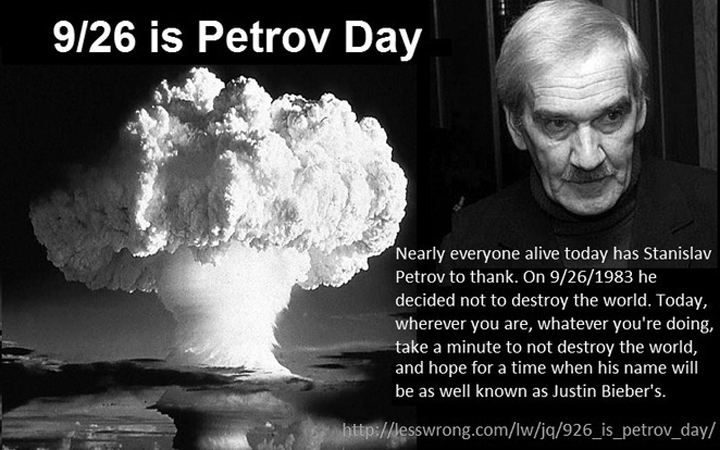
The 1983 nuclear weapons false alarm that nearly destroyed the world https://www.9news.com.au/2018/09/26/11/44/stanislav-petrov-1983-false-alarm-that-nearly-destroyed-the-world
Sep 26, 2018 It was the moment Stanislav Petrov had been dreading since childhood, and preparing for much of his adult life.After decades of Cold War tension, the early warning satellites had been triggered. The Americans had launched their nuclear missiles at the Soviet Union.
As the duty officer in the Soviet Air Defence in the command centre bunker outside Moscow, it was Lt Col Petrov’s job to call his superiors and warn of an impending nuclear strike.
Based on his word, the Soviet forces would reply with tens of thousands of nuclear missiles targeting the US and its allies. If it did not end human life on this planet, it would change it irrevocably.
But, based on nothing more than gut instinct, Lt Col Petrov, then 44, did not make the call.
And, 35 years ago today, an unheralded Armageddon was averted.
The world would not know for years how close it came to destruction. It was the day in 1983 Australia II won the America’s Cup. The nation’s attention could not have been further away.
“Launching the amount of nukes ready at the time would have severely impacted the way humans live on earth,” the University of Sydney’s US Studies Centre research fellow Brendan Thomas-Noone told nine.com.au.
“Would some humans survive? Yes. We’ve all seen Mad Max.”
A false alarm
Lt Col Petrov knew it was a race against time if US missiles were rocketing towards the Soviet Union.
“All I had to do was to reach for the phone, to raise the direct line to our top commanders – but I couldn’t move,” he told the BBC.
“I felt as if I was sitting on a hot frying pan.”
But he had a feeling that things weren’t right.
His misgivings proved fortituous for the entire planet. The early-warning satellites had made the most banal of errors.
What appeared to be missiles being launched en masse was merely an illusion caused by sunlight reflecting off the top of clouds. That error could have destroyed the planet, were it not for Lt Col Petrov’s caution.
Doomsday redux
Technology has improved dramatically since then, but another error like that could still take place, according to nuclear disarmament campaigner John Hallam.
“It could all still happen,” Mr Hallam told nine.com.au.
“The hands of the Doomsday Clock in 1983, stood at three minutes to midnight, midnight being the end of civilisation. The hands of the Doomsday clock now stand at two minutes to midnight.”
“This means that the room full of Nobel prize winners who move the hands of the doomsday clock think that the chances of nuclear war that could end civilisation right now, are worse than in 1983, a year in which the world nearly ended not just once, but twice, within a six-week period.”
Mr Hallam said the difference in 1983 was that people were protesting against nuclear weapons in their hundreds and thousands, something which wasn’t taking place today.
“Sydney had a number of peace marches that numbered in the hundreds of thousands,” he said.
“Washington had one that numbered a million. The possibility of global annihilation was then the number one issue. Why is it not the number one issue right now?”
Mr Hallam, who campaigns at the UN for nuclear disarmament, warned that “moving the deckchairs” in Canberra, was nowhere near as important as the potential end of civilisation and said the world’s leaders needed to push for the abolition of nuclear disarmament now more than ever.
“There is an urgent need for measures that would ‘take the apocalypse off the agenda’,” he said.
“Adopting strategies of ‘No First Use’ (NFU) and lowering the operational readiness of nuclear weapon systems so that Presidents and senior military do not have minutes and seconds to take decisions that might mean the end of the world are obvious ones.”
A humble end
Lt Col Petrov’s actions on September 26, 1983, has seen today marked as annual International Day for the Total Elimination of Nuclear Weapons.
His actions may be remembered forever, but Lt Col Petrov was not given the celebrity status that stopping the end of the world might warrant.
He was reprimanded by his superiors for not keeping the logbook accurate the night of the false alarm.
He retired from the military the following year, scraping by on a pension in his final days.
September 28, 2018
Posted by Christina Macpherson |
General News |
Leave a comment
 “We’re by the railroad tracks because we’re emphasizing that Texas businesses,
  hospitals and schools by the railroads are at high risk,” Hadden said. “It’s a bad idea to bring [nuclear waste] from around the country into Texas.”
The organizations instead want the used nuclear material to be kept at reactor sites in sturdier containers until a permanent storage site becomes available.
“We’re trying to raise awareness because a lot of people don’t know this is planned,”
Anti-nuclear waste tour to come through Midland, Meetings push to block a proposal to transport used nuclear fuel by train and store it in West Texas, MRT, by Matt Zdun, Texas Tribune , September 26, 2018 Organizers of the “Protect Texas from Radioactive Waste Tour” plan to travel to five Texas cities over the next week in protest of a proposed plan to store used nuclear materials in West Texas.Several Texas organizations gathered in Houston on Tuesday to kick off their “Protect Texas from Radioactive Waste Tour,” the beginning of a renewed push to block a proposal to transport used nuclear fuel by train through Texas and store it in West Texas.
Continue reading →
September 28, 2018
Posted by Christina Macpherson |
General News |
Leave a comment

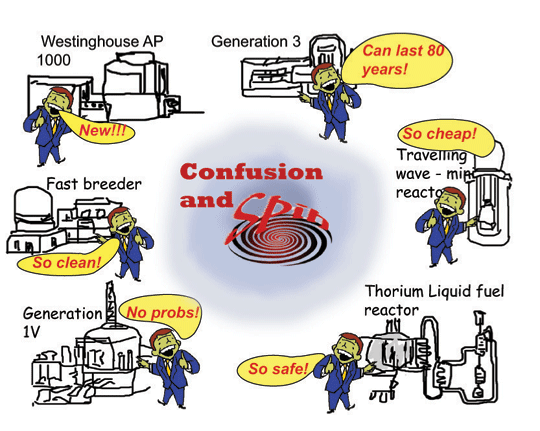
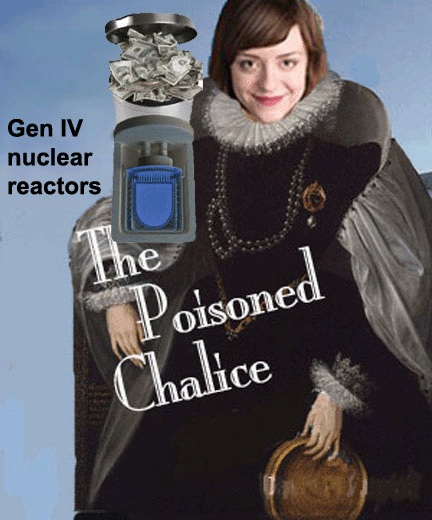
Generation IV nuclear waste claims debunked, Nuclear Monitor 24 Sept 18
Lindsay Krall and Allison Macfarlane have written an important article in the Bulletin of the Atomic Scientists debunking claims that certain Generation IV reactor concepts promise major advantages with respect to nuclear waste management. Krall is a post-doctoral fellow at the George Washington University. Macfarlane is a professor at the same university, a former chair of the US Nuclear Regulatory Commission from July 2012 to December 2014, and a member of the Blue Ribbon Commission on America’s Nuclear Future from 2010 to 2012.
Krall and Macfarlane focus on molten salt reactors and sodium-cooled fast reactors, and draw on the experiences of the US Experimental Breeder Reactor II and the US Molten Salt Reactor Experiment.
The article abstract notes that Generation IV developers and advocates “are receiving substantial funding on the pretense that extraordinary waste management benefits can be reaped through adoption of these technologies” yet “molten salt reactors and sodium-cooled fast reactors – due to the unusual chemical compositions of their fuels – will actually exacerbate spent fuel storage and disposal issues.”
Here is the concluding section of the article: Continue reading →
September 28, 2018
Posted by Christina Macpherson |
General News |
Leave a comment

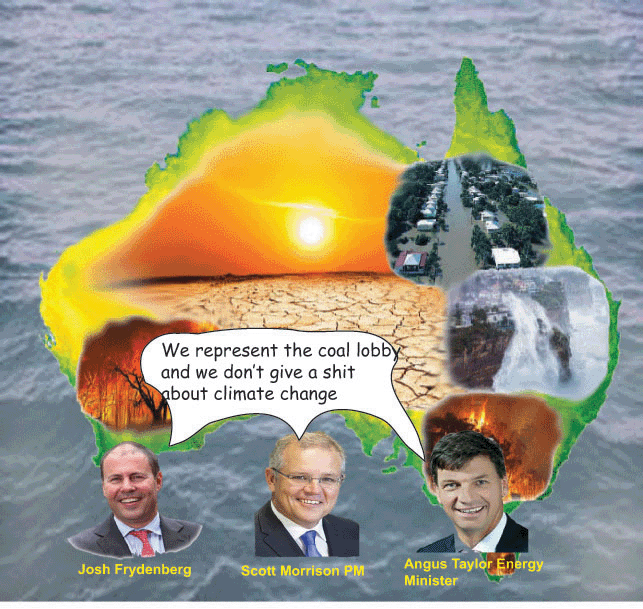
“The government has revived the default approach the Liberal-National coalition has had on emissions since the 1990s: do as little as possible, hope that economic developments reduce emissions without policy intervention, deny that there are any policy issues, and defer as many issues as possible to another day,”
In a Country So Dry Even Cows Take Showers, Climate Change Gets Ignored
Australia’s government is as far from a plan of action as it’s ever been.Bloomberg, By Michael Heath, Emily Cadman, and Jason Scott, September 27, 2018,
From cooling showers for cows to airport runways designed for higher sea levels, businesses and parts of Australia’s A$2.7 trillion ($2 trillion) pension industry are starting to find ways to live with rising temperatures.
In the world’s driest inhabited continent, enduring a devastating drought that arrived in mid-winter, private action to prepare for climate change contrasts with years of division on energy and environmental policies. Australia’s latest climate casualties are its farmers, who are being forced to slaughter livestock and watch crops wither amid one of the worst droughts on record……..
Dry conditions are set to continue with eastern states including New South Wales — the most populous and the powerhouse of the economy — the worst affected. Economists estimate the drought could cut as much as 0.75 percent from gross domestic product growth.
Shortly after taking over as prime minister last month, Scott Morrison got on a plane and toured a drought-stricken farm in Queensland, announcing measures to aid the stressed agricultural sector. Yet as for broader climate policy, Australia appears as far away as it has ever been from a consensus on what should be done. Continue reading →
September 28, 2018
Posted by Christina Macpherson |
General News |
Leave a comment
Fight To Stop Nuclear Waste Dump In Flinders Ranges SA, 26 Sept 18, There will be some individuals who will profit from setting up the National Dump, but the main beneficiaries will be the big mining and weapons manufacturing companies (many are both). The industry is in the doldrums because it can’t get rid of it’s waste. (It’s constipated, that why it wants to dump on SA!!) Given the demonstrated lack of solid arguments for need for the National Dump, the foot in the door for the International Dump is the only real argument for the National Dump, and one of the most important reasons to oppose it. It’s spelt out in as many words in Richard Yeeles’ submission to the Royal Commission. Sadly, some people here are resistant to this argument, saying, “We’ll tackle one dump at a time”. https://www.facebook.com/groups/344452605899556/
September 26, 2018
Posted by Christina Macpherson |
General News |
Leave a comment
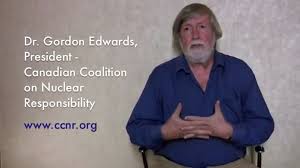 A conversation with Dr. Gordon Edwards: contemporary issues in the Canadian nuclear industry, and a look back at the achievements of the Canadian Coalition for Nuclear Responsibility (CCNR), http://www.ccnr.org/ Montreal, August 25, 2018, Nuclear waste management: an exercise in cynical thinking. DiaNuke.org, 24 Sept 2018. The elusive “willing host community”DR: I know too there have been a lot of targeted “willing host communities” that have rejected it. Do you think they’ll succeed in finding one?
GE: Here in Canada they have gone through this  process of looking for a “willing host community,” which is kind of foolish because these communities are very small. For example, I just visited two of them within the last few weeks way up above Lake Superior. In the two communities that I visited, Hornepayne and Manitouwadge, I gave presentations. These communities have less than a thousand residents in each one of them and they get $300,000 a year as basically bribe money in order to keep them on the hook, to keep them interested in learning more. It’s called the “learn more” program, and as long as they’re “learning more,” they can get $300,000 a year. Well, they are both interested in getting the money, and consequently they’re still in the running, but do they really want to be a nuclear-waste community? If this is such a good deal for them, then why aren’t other communities bidding for this—larger communities? Of course, one of the points that comes to mind immediately is that if you had a city of a million people or so, then you’d have to shell out $300 million instead of $300,000 every year, so this idea of a “willing host community” exists only because of the bribes that are given by the industry in order to keep these communities supposedly interested in receiving the waste. And in some of them, of course, there are people who see dollar signs and who see an opportunity for them to make a lot of money. In a small community, a certain small number of people can make a lot of money by capitalizing on an opportunity like that without being concerned very much about the long-term wisdom of it.
DR: Yeah, and the seventh future generation doesn’t get a voice.
I did speak to two other communities a couple of years ago in that same general area north of Lake Superior. One of them was the town of Schreiber, and one of them was White River, and both of those communities are now off the list. They’re no longer candidates, so we now have only three communities up north of Lake Superior which are still actively pursuing this program of taking money and “learning more.” I have spoken now to two of them and I haven’t yet been invited to go to the third one.
10. The great unknowable: long term care for nuclear waste. Who pays? Who cares?When I go there I try and point out to them not only the fact that this whole exercise is questionable, but also the fact that once the nuclear waste is moved up to a small remote area like this, what guarantee is there that it’s really going to be looked after properly? Because these small communities do not have a powerful voice. They don’t have economic clout, and so they can’t really control this. If a person like Donald Trump, for example in the United States, or Doug Ford in Ontario, who many people think is a kind of a mini Donald Trump, thinks, “Why are we going to spend money on that? Forget it we’re not going to spend money on that,” then it’s going to not be pursued as originally planned. And it could become just a surface parking lot for high-level nuclear waste. Who is going to guarantee that it is actually going to be carried out? Now the nuclear plants are in danger of closing down. We’re having fewer nuclear plants every year than we had the year before now in North America, and consequently there’s not the revenue generation that there used to be. The money that’s been set aside is nowhere near adequate to carry out the grandiose project they’re talking about, which here in Canada is estimated to cost at least twenty-two billion dollars. They have maybe five or six billion, but that’s not nearly enough.
So there’s also another problem lurking in the wings, and that is that if you do want to carry out this actual full-scale program of geological excavation with all the care that was originally planned, how do you generate revenue? What company is willing to spend twenty-two billion dollars on a project which generates absolutely no revenue?
There are only two ways you can generate revenue from that, and one way is to take waste of other countries and charge a fee for storing the waste. The other thing is to sell the plutonium. If you extract the plutonium, then you could have a marketable product, but both of these ideas are extremely far from what these communities are being told. In other words, the plan that’s being presented to them does not include either one of these possibilities, and it changes the game considerably. As we all know, getting the plutonium out of the spent fuel involves huge volumes of liquid radioactive waste. It involves very great emissions, atmospheric emissions, and liquid emissions. The most radioactively polluted sites on the face of the earth are the places where they’ve done extensive reprocessing, such as Hanford in Washington, Sellafield in northern England, La Hague in France, Mayak in Russia, and so on.
DR: And Rokkasho in Japan.
GE: That’s right, and so this is a completely different picture than what they’re being presented with. Now whether or not that would actually happen is anybody’s guess, but it’s written right in their documents that this is an option, and they’ve never excluded that option. They’ve always included the option. In fact, the first sentence of the environmental impact statement written by Atomic Energy of Canada Limited many years ago says that when we say high-level nuclear waste we mean either irradiated nuclear fuel or solidified post-reprocessing waste. They have always kept that door open for reprocessing.
11. A disturbed “undisturbed” geological formation is no longer undisturbed But even under the best of circumstances we know that you can’t get waste into an undisturbed geological formation without disturbing it. As soon as you disturb it, it’s no longer the same ballgame. The other thing that people are unaware of, generally, is the nature of this waste. They really don’t realize that this waste is not inert material, that it’s active. It’s chemically active. It’s thermally active. It generates heat for fifty thousand years. They have a fifty thousand-year time period they call the thermal pulse, and the degree of radio-toxicity staggers the mind. Most people have no ability to wrap their mind around that. Take a simple example like Polonium 210 which was used to murder Alexander Litvinenko, and which will breed into the irradiated fuel as time goes on… According to the Los Alamos nuclear laboratories (it’s on their website), this material is 250 billion times more toxic than cyanide. That’s a staggering concept. In fact, nobody can wrap their mind around that, really. 250 billion times more toxic?! Theoretically that means that if you had a lethal dose of cyanide, and you had the same amount of Polonium 210, the cyanide could kill one person. The Polonium 210 could kill 250 billion persons. That’s amazing. How do you possibly wrap your mind around that?https://www.dianuke.org/a-conversation-with-dr-gordon-edwards-contemporary-issues-in-the-canadian-nuclear-industry-and-a-look-b
September 26, 2018
Posted by Christina Macpherson |
General News |
Leave a comment
A conversation with Dr. Gordon Edwards: contemporary issues in the Canadian nuclear industry, and a look back at the achievements of the Canadian Coalition for Nuclear Responsibility (CCNR), http://www.ccnr.org/ Montreal, August 25, 2018, Nuclear waste management: an exercise in cynical thinking. DiaNuke.org, 24 Sept 18, :
“……….Dennis Riches (DR): Instead of a question I thought we would ask you to comment on something that has been published by an organization called Waste Management Symposia (Waste Management Symposia Inc. http://www.wmsym.org/wm2019 ). They are a non-profit organization, but they seem to be something that was set up by the nuclear industry so that different players in the field could get together and talk about waste management issues. They have a symposium coming up in March of 2019.
Gordon Edwards (GE): Well it’s an exercise in cynical thinking……….Of course, the problem is that there’s no way of destroying this stuff. There’s no way of getting rid of it that is technically or economically feasible, so all we’re really doing is repackaging. We’re not getting rid of it, and of course the packages do not last forever, so you can’t eliminate this liability by simply repackaging it and moving it from one place to another. It may be justified on the basis of environmental protection—for example, moving it away from waterways and so on so as to have less opportunity for the material to be dispersed, but once again you really can’t get rid of it. So the with language itself, they talk about “disposal.” Disposal implies that you somehow magically eliminate or get rid of this waste when in fact all you’re doing is reconstituting it in a different form, a different physical form, a different chemical form, but generally not changing the nature of the problem fundamentally.
2. Private solutions for public problems
So when the last government approached this problem they decided, being Conservative, that it’s better to get private enterprises to look after these things, so they hired a consortium of multinational corporations to solve the problem for us, and in the absence of any policy—the trouble is that Canada has absolutely no policy regarding any nuclear waste except for the irradiated nuclear fuel itself………..
3. Early days: ignorance about nuclear waste
But if we just back off on all this, the way my organization sees the picture, my organization being the Canadian Coalition for Nuclear Responsibility, which formed in the early 1970s—Well, basically in 1974 we formed, and from our view, the first thirty years of the nuclear age were characterized by a total ignorance about nuclear waste. That is, the public was not informed that there was such a thing as nuclear waste and the decision-makers who authorized the spending of billions of dollars in building a nuclear infrastructure and nuclear reactors were also not informed that this was a major unsolved problem. So it was basically a lie.
Nuclear energy was presented as an absolutely clean energy source and people interpreted that to mean, “Hey, no problem. There is no waste.” When it became clear that it is, in fact, the most dangerous industrial waste ever produced on the face of the earth, in the form of the irradiated nuclear fuel, the industry then embarked upon a second lie which was, “Yes, we do have this waste product, the irradiated fuel, and it is very dangerous, and it is essentially indestructible, but we know exactly what to do with it. We know how to solve the problem, and the solution is simply to stick it underground in an undisturbed geological formation and then it’s all safe. We just walk away from it, and no problem.”
4. Belated realization of the problem
Well, of course, that was then and this is now, and in the light of experience in the intervening years… In the mid-1970s there was a series of reports in Canada, the United Kingdom, the USA and other countries calling attention to this nuclear waste problem and basically saying quite plainly that unless this problem could be adequately solved that there should be no more nuclear power plants built. So I call this the nuclear ultimatum. It was really an ultimatum to the nuclear industry: You do not have a future if you don’t solve this problem. And because the industry said that they knew what to do with it, the expectation was that they could solve it in ten or twenty years. It would only take ten or twenty years……….
DR: But it seems like they want to keep up the impression that the solution is being worked on. It’s underway. As long as they can keep doing that, the nuclear plants can keep running.
GE: That’s correct, and people have been bamboozled by this empty promise really, and of course it’s become increasingly clear. There have been eight attempts in the United States to locate a high-level waste repository, all of which have failed. There have been two underground repositories in Germany which have failed, for low-level and intermediate-level waste. There’s no facility anywhere in the world which is operational for high-level waste, although there are some that have been built like the one in Finland, for example, near Olkiluoto.
5. Barbaric plans for nuclear waste And now we have this consortium of private companies that has come into Canada to deal with not the irradiated nuclear fuel, but the decommissioning waste and the other post-fission waste, and they have come up with what we consider to be barbaric suggestions…….
we’re calling upon the Canadian government to actually stop these plans and to launch true consultations with Canadians and with First Nations, and to follow up on the recommendations that have been made by several independent bodies in Canada, all of which have recommended that there should be a nuclear waste agency completely independent from the nuclear industry and which has on its board of directors major stakeholders, including First Nations people, in order to ensure that the sole efforts of this organization should be the protection of the public and the environment, and not the furtherance of the nuclear industry, the promotion of expansion of the nuclear industry, which is what the consortium is interested in……….https://www.dianuke.org/a-conversation-with-dr-gordon-edwards-contemporary-issues-in-the-canadian-nuclear-industry-and-a-look-back-at-the-achievements-of-the-canadian-coalition-for-nuclear-responsibility-ccnr-http-ww/
September 26, 2018
Posted by Christina Macpherson |
General News |
Leave a comment
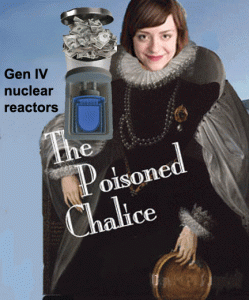 A nuclear startup will fold after failing to deliver reactors that run on spent fuel, MIT Technology Review, James Temple, 25 Sept 18
Transatomic Power, an MIT spinout that drew wide attention and millions in funding, is shutting down almost two years after the firm backtracked on bold claims for its design of a molten-salt reactor.
High hopes: The company, founded in 2011, plans to announce later today that it’s winding down.
Transatomic had claimed its technology could generate electricity 75 times more efficiently than conventional light-water reactors, and run on their spent nuclear fuel. But in a white paper published in late 2016, it backed off the latter claim entirely and revised the 75 times figure to “more than twice,” a development first reported by MIT Technology Review…….
The longer timeline and reduced performance advantage made it harder to raise the necessary additional funding, which was around $15 million. “We weren’t able to scale up the company rapidly enough to build a reactor in a reasonable time frame,” Dewan says.
Transatomic had raised more than $4 million from Founders Fund, Acadia Woods Partners, and others. ……https://www.technologyreview.com/the-download/612193/nuclear-startup-to-fold-after-failing-to-deliver-reactor-that-ran-on-spent-fuel/
September 26, 2018
Posted by Christina Macpherson |
General News |
2 Comments








 Antinuclear