But even as reactors shut down and communities eye former nuclear sites for redevelopment, a big problem remains: Despite more than 50 years of laws, regulations, lawsuits, and debates, the U.S. has no long-term repository for nuclear waste—nor even much of a plan for one. Continue reading
The danger of tropical storms to nuclear power stations

 Tropical Storm Gordon Warning For US Gulf Coast: Reminder Of The Dangers Of Mixing Severe Weather With Nuclear Power; Another Tropical Storm In Atlantic , Mining Awareness, 4 Sept 18
 It’s that time again. Time for tropical storms and hurricanes, and time to remember the increased dangers of nuclear power stations (orange skulls on map) during severe weather, which can lead to power outages and power surges, as well as storm surges, flooding and more.
Nuclear power stations are dangerous and unreliable electricity sources in extreme weather. One of the most dangerous, and often ignored, things about nuclear energy is that nuclear power stations always have need for backup energy supplies for cooling of the nuclear reactors, and spent fuel pools, as dramatically demonstrated by the never-ending Fukushima Daiichi nuclear disaster. If they lose offsite power, then they are dependent upon backup generators, which can fail to start, fail once started or run out of fuel. In Louisiana, a thunderstorm led to a scram at River Bend Nuclear Power Station due to a power surge, followed by a loss of cooling, supposedly the next day. Loss of cooling can lead to a nuclear meltdown, if not corrected quickly enough.
Waterford Nuclear Power Station is near New Orleans going toward Baton Rouge and River Bend Nuclear Power Station is near Baton Rouge)………https://miningawareness.wordpress.com/2018/09/03/tropical-storm-watch-for-us-gulf-coast-2-am-update-reminder-of-the-dangers-of-mixing-severe-weather-with-nuclear-power-another-tropical-storm-in-atlantic/
Beyond Nuclear – a resource for clear information
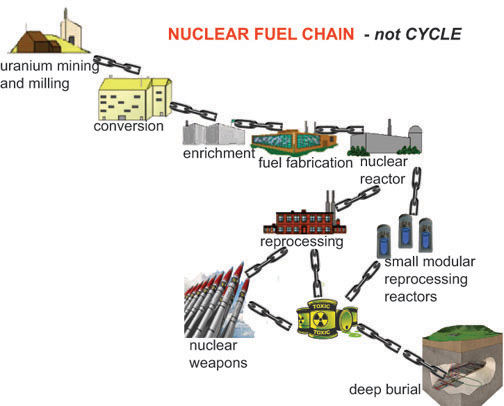
Beyond Nuclear 2nd Sept 2018 What is the difference between an open pit  and an in-situ leach uranium mine? How does a nuclear power plant produce electricity? What happens to reactor fuel once it’s no longer usable? What is the difference between high-level and low-level radioactive waste and where is it stored? Why isn’t reprocessing really “recycling”?
 and an in-situ leach uranium mine? How does a nuclear power plant produce electricity? What happens to reactor fuel once it’s no longer usable? What is the difference between high-level and low-level radioactive waste and where is it stored? Why isn’t reprocessing really “recycling”?
We may know the answers to some or all of these questions. But can we deliver a succinct, clear, accessible answer to explain them to someone not already steeped in the issue?
As any activist engaged in anti-nuclear advocacy knows, nuclear power is a complex topic and describing each phase of the nuclear fuel chain can quickly bog us down in long, technical explanations. And once we go there, eyes glaze and we lose our audience.
Proponents of nuclear energy have taken full advantage of this, downplaying and minimizing the risks and using facile and superficially appealing sound bites, unsupported by facts, to convince people that nuclear power is benign and useful for climate change.
Facts are what we believe will change people’s minds. But the idea that bombarding someone with a deluge of irrefutable facts about the dangers of nuclear power will automatically win them to our cause has proved to be an illusion. It doesn’t necessarily work.
We do need facts, of course. And that is where our Handbook — The Case Against Nuclear Power: Facts and Arguments from A-Z — comes in. We must be able to accurately describe why nuclear power is dangerous, uneconomical and unjust.
But we must do so in succinct, simple lay language. And then, once
the basics are understood, we need to move people. And that is why the
Beyond Nuclear International website came to be born, providing a natural
home for the Handbook and expanding from facts to compelling narratives.
the basics are understood, we need to move people. And that is why the
Beyond Nuclear International website came to be born, providing a natural
home for the Handbook and expanding from facts to compelling narratives.
We have already compiled three Handbook chapters which you can find on the Beyond Nuclear International website under Handbook. So far, we have
published: An Overview that offers simple explanations for every phase of
the nuclear fuel chain; Radiation and harm to human health, which lays out
the detriments to health of every phase of nuclear power operations; and
Climate change and why nuclear power can’t fix it. More chapters are in
the works.
https://beyondnuclearinternational.org/2018/09/02/an-a-z-against-nuclear-power/
published: An Overview that offers simple explanations for every phase of
the nuclear fuel chain; Radiation and harm to human health, which lays out
the detriments to health of every phase of nuclear power operations; and
Climate change and why nuclear power can’t fix it. More chapters are in
the works.
https://beyondnuclearinternational.org/2018/09/02/an-a-z-against-nuclear-power/
Who cares about the melting Arctic?
It’s not only summer weather that is changing. Earlier this year, one study showed that when the Arctic is unusually warm, extreme winter weather is two-to-four times more likely in the eastern U.S.
Think of the Arctic as our early warning system, a big screaming alarm that is alerting us to the fact that the planet we will live on tomorrow is nothing like the planet we lived on yesterday, and we better get ready

The Melting Arctic Is a Real-Time Horror Story — Why Doesn’t Anyone Care?https://www.rollingstone.com/politics/politics-news/arctic-ice-melting-716647/ This summer’s epic wildfires and other extreme weather events have a root cause By JEFF GOODELL , 2 Sept 128
Transport of uranium blocked by anti-nuclear campaigners in Germany


 Reporterre 1st Sept 2018 [Machine Translation] Since the morning of Saturday, September 1, several anti-nuclear Franco-German militants block a uranium transport.
They climbed a bridge 140 m high near Koblenz, Germany, blocking the railway on the Moselle, informs us the group Contratom Deutschland. The blocked train carries ” Yellow Cake ” from Namibia ; it left Hamburg on Thursday for the Orano uranium conversion plant in Narbonne Malvesi, in the south of France.
In Narbonne, uranium is transformed into UF4 and then used, after several transformations and enrichment, in nuclear power plants around the world. According to Orano, the Narbonne plant processes 25% of the world’s uranium.
“If we want to get out of the nuclear industry, ” says Cécile, a French climber living in Germany who takes part in the action, ” we must stop these transports and prevent them from reaching the Orano factory in
Narbonne Malvési, the gateway to European nuclear energy.
Germany, a net exporter of electricity, unlike political discourse, does not come out quite nuclear. The transports supplying the nuclear facilities continue and the Framatome Nuclear Fuel Plant in Lingen (Lower Saxony) and Urenco’s uranium enrichment plant in Gronau (North Westphalia) continue to operate. That’s why we want to stop nuclear transport. ”
https://reporterre.net/Un-train-d-uranium-a-destination-de-Narbonne-bloque-en-Allemagne
Climate change’s impact already here in the Pacific : Australia take notice!
 World leaders who deny climate change should go to mental hospital – Samoan PM https://www.theguardian.com/environment/2018/aug/31/world-leaders-who-deny-climate-change-should-go-to-mental-hospital-samoan-pm
Tuilaepa Sailele berates leaders who fail to take issue seriously, singling out Australia, India, China and the US, Guardian, Kate Lyons, 31 Aug 18 The prime minister of Samoa has called climate change an “existential threat … for all our Pacific family” and said that any world leader who denied climate change’s existence should be taken to a mental hospital.
In a searing speech delivered on Thursday night during a visit to Sydney, Tuilaepa Sailele berated leaders who fail to take climate change seriously, singling out Australia, as well as India, China and the US, which he said were the “three countries that are responsible for all this disaster”.
“Any leader of those countries who believes that there is no climate change I think he ought to be taken to mental confinement, he is utter[ly] stupid and I say the same thing for any leader here who says there is no climate change.”
Speaking at the Lowy Institute, just days before the beginning of the Pacific Islands Forum in Nauru, the Samoan prime minister seemed to take a swipe at Australia’s commitment to minimising the impact of climate change, which he called the “single greatest threat to the livelihood, security and wellbeing peoples of the Pacific
“While climate change may be considered a slow onset threat by some in our region, its adverse impacts are already felt by our Pacific islands peoples and communities,” said Sailele. “Greater ambition is necessary to limit global warming to 1.5 degrees centigrade and Pacific island countries continue to urge faster action by all countries.”
Sailele said addressing climate change required “political guts” from leaders. “We all know the problem, we all know the causes, we all know the solutions. All that is left would be some political courage, some political guts to get out and tell the people of your country, ‘Do this, this, this, or there is any certainty of disaster.’”
Sailele’s speech comes as leaders of Pacific nations are preparing to meet at the Pacific Islands Forum in Nauru next week, where Australia is expected to face questions about its emissions targets.
Australia’s new prime minister, Scott Morrison, is under pressure from some members of his party to abandon Australia’s commitment to reducing emissions under the Paris agreement.
His immediate predecessor, Malcolm Turnbull, was due to attend the forum, but Morrison has announced he is sending his new foreign minister, Marisa Payne, a move the opposition Labor party condemned as “an insult to our neighbours” as well as “a serious strategic mistake”.
Saliele’s speech also touched on China’s rising influence in the Pacific, saying the region had become “an increasingly contested space”. “The big powers are doggedly pursuing strategies to widen and extend their reach, inculcating a far-reaching sense of insecurity.”
Climate change; When will we start to protect our children?
Uncontrolled climate change could result in disaster for our kids. Will we do something?
Global warming is intensifying El Niño weather
 Global warming is intensifying El Niño weather https://www.skepticalscience.com/gw-intensifying-el-nino-weather.html 29 August 2018 by John Abraham
As humans put more and more heat-trapping gases into the atmosphere, the Earth warms. And the warming is causing changes that might surprise us. Not only is the warming causing long-term trends in heat, sea level rise, ice loss, etc.; it’s also making our weather more variable. It’s making otherwise natural cycles of weather more powerful.
Perhaps the most important natural fluctuation in the Earth’s climate is the El Niño process. Continue reading
Media must take up the issue of climate refugees
 Climate change and migration: the need for a new media narrative, Ecologist Maria Sakellari, 29th August 2018 People forced by climate change to relocate are described by the media as victims or as security threats. There is little information about vulnerable communities’ fight to secure a viable future. We need to challenge these representations to provoke policies that protect the inherent rights of people affected by climate change, argues MARIA SAKELLARI
Warm water from far away has penetrated deep into the interior of the Arctic.
 Archived’ heat has reached deep into the Arctic interior, researchers say https://www.sciencedaily.com/releases/2018/08/180829143836.htm August 29, 2018
- Source:
- Yale University
- Summary:
- Arctic sea ice isn’t just threatened by the melting of ice around its edges, a new study has found: Warmer water that originated hundreds of miles away has penetrated deep into the interior of the Arctic.
-
Arctic sea ice isn’t just threatened by the melting of ice around its edges, a new study has found: Warmer water that originated hundreds of miles away has penetrated deep into the interior of the Arctic.
That “archived” heat, currently trapped below the surface, has the potential to melt the region’s entire sea-ice pack if it reaches the surface, researchers say.
The study appears online Aug. 29 in the journal Science Advances.
“We document a striking ocean warming in one of the main basins of the interior Arctic Ocean, the Canadian Basin,” said lead author Mary-Louise Timmermans, a professor of geology and geophysics at Yale University.
The upper ocean in the Canadian Basin has seen a two-fold increase in heat content over the past 30 years, the researchers said. They traced the source to waters hundreds of miles to the south, where reduced sea ice has left the surface ocean more exposed to summer solar warming. In turn, Arctic winds are driving the warmer water north, but below the surface waters.
“This means the effects of sea-ice loss are not limited to the ice-free regions themselves, but also lead to increased heat accumulation in the interior of the Arctic Ocean that can have climate effects well beyond the summer season,” Timmermans said. “Presently this heat is trapped below the surface layer. Should it be mixed up to the surface, there is enough heat to entirely melt the sea-ice pack that covers this region for most of the year.”
The co-authors of the study are John Toole and Richard Krishfield of the Woods Hole Oceanographic Institution.
The National Science Foundation Division of Polar Programs provided support for the research.
Japan: local assemblies reject hosting nuclear waste dumps
 Assemblies make moves to reject
  playing host to nuclear waste http://www.asahi.com/ajw/articles/AJ201808280029.html By CHIAKI OGIHARA/ Staff WriterAugust 28, 2018 More local assemblies are taking measures to send a strong message to the central government not to bother asking them to host storage facilities for nuclear waste. Continue reading
 Radioactive waste stranded as U.S. shifts from nuclear energy
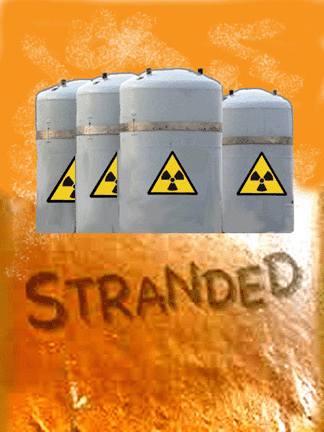 Lack of a long-term repository leaves communities as de facto storage sites, Chemical and Engineering News, by Jeff Johnson, AUGUST 28, 2018
We are in the Age of Stupid
The Ass Clown Epoch, Counter Punch, , 28 Aug 18 How do we define “dumb” in the Age of Stupid? Whether you call it the Anthropocene, or the more scientific ‘Ass Clown Epoch’, stupid is the defining feature of our “smart” everything society: From our phones to the lampshades and corkscrews that increasingly depend on them to function. When the greatest minds of your generation came up with the idea of enriching themselves to the extent that no one else can survive – financially or even physically – it’s time to acknowledge that we are in the throes of irreversible human cognitive collapse. Some would point to the Supreme Dotard at its apex as symptomatic of its underlying causes rather than the cause itself. After all, stupid is the fertile foundation from which both “intelligent life” and Donald Trump evolved. ……
For these people, “asshole” is less an insult than a badge of honor since it denotes a rugged and “alpha” disposition. Science has confirmed that the smell of sulfur has its own aphrodisiac underpinnings if it’s emanating from someone dressed as a banker or a tech bro. ……
There’s always the risk of unfairly maligning those with actual disabilities who bear the brunt by association with those who use their intellects to devise ways of driving species essential to the continuation of life to extinction, and then talk about moving to Mars and nuking it for their own survival. We can’t call the latter “retards”, since the word still has unpleasant associations with hate speech directed at vulnerable people, yet not calling them out on their intellect-driven choices misses a valuable opportunity to reassess what it means to be “smart” and how this designation puts us all at risk as in . . . “The decision by educated and well-informed bureaucrats and corporate executives to build nuclear power plants close to the coastline of a seismically active island prone to tsunamis was monumentally . . . misguided”. As was the decision to invade Iraq, Afghanistan, Libya . . . The list is as long as our capacity to unlearn history is boundless……..
Understatements like “misguided” only serve to insulate evil-doers from their evil, and even evoke sympathy and admiration for their “plight” as remorseful serial killers with the benefit of hindsight. Even “psychopaths” enjoy a sort of cult status, and considered role models in tech and banking circles. …..
Understatements like “misguided” only serve to insulate evil-doers from their evil, and even evoke sympathy and admiration for their “plight” as remorseful serial killers with the benefit of hindsight. Even “psychopaths” enjoy a sort of cult status, and considered role models in tech and banking circles. …….
The people we deem “genius”, blessed, gifted, or even capable, are too often committed to the destruction of everything or anything that sustains balance, harmony and joy for short-term, ego-driven gains that have endlessly cascading consequences for organized life on earth. Very bad ideas, once monetized, become “innovation”, while the criminal masterminds behind them them are dubbed “visionaries”. It takes a genius to devise ways to integrate banking systems, airlines, hospital equipment and vending machines so that they all crash simultaneously in some foreseeable future without running water or electricity…….
If a person is somehow able to mathematically chart a course for himself to a distant, freezing planet, having helped mastermind the destruction of his own, we somehow consider this development an achievement milestone ……..Jennifer Matsui is a writer living in Tokyo. https://www.counterpunch.org/2018/08/28/the-ass-clown-epoch/
Climate change is real. We must not offer credibility to those who deny it

If ‘balance’ means giving voice to those who deny the reality of human-triggered climate change, we will not take part in the debate, say Jonathan Porritt, Caroline Lucas, Clive Lewisand 57 other writers, politicians and academics
We are no longer willing to lend our credibility to debates over whether or not climate change is real. It is real. We need to act now or the consequences will be catastrophic. In the interests of “balance”, the media often feels the need to include those who outright deny the reality of human-triggered climate change.
Balance implies equal weight. But this then creates a false equivalence between an overwhelming scientific consensus and a lobby, heavily funded by vested interests, that exists simply to sow doubt to serve those interests. Yes, of course scientific consensus should be open to challenge – but with better science, not with spin and nonsense. We urgently need to move the debate on to how we address the causes and effects of dangerous climate change – because that’s where common sense demands our attention and efforts should be.
Fringe voices will protest about “free speech”. No one should prevent them from expressing their views, whether held cynically or misguidedly. However, no one is obliged to provide them with a platform, much less to appear alongside them to give the misleading impression that there is something substantive to debate. When there is an article on smoking, newspapers and broadcasters no longer include lobbyists claiming there are no links to cancer. When there’s a round-the-world yacht race we don’t hear flat-earthers given airtime: “This is madness; they’ll sail off the edge!”
There’s a workable model for covering fringe views – which is to treat them as such. They don’t need to be ridiculed, just expected to challenge the evidence with better evidence, and otherwise ignored. As campaigners and thinkers who are led by science and the precautionary principle, and who wish to debate the real and vital issues arising from human-triggered climate change, we will not assist in creating the impression that climate denial should be taken seriously by lending credence to its proponents, by entertaining ideas that lack any basis in fact. Therefore we will no longer debate those who deny that human-caused climate change is real. There are plenty of vital debates to be had around climate chaos and what to do about it; this is simply no longer one of them. We urge broadcasters to move on, as we are doing.
Jonathon Porritt Chair, Sustainable Development Commission 2000-11 Continue reading
New technologies for flexibility enhancing the worldwide growth of renewable energy
 Chatham House 22nd Aug 2018 Electricity Markets** As renewables become a large share of the global energy mix, greater electricity system flexibility will be critical and will originate from the Chatham House 22nd Aug 2018 Electricity Markets** As renewables become a large share of the global energy mix, greater electricity system flexibility will be critical and will originate from thesmall scale, write Daniel Quiggin and Antony Froggatt. The International
Energy Agency forecasts that ‘solar PV and onshore wind together
represent 75 per cent of global renewable electricity capacity growth over the medium-term’. Bloomberg New Energy Finance also estimates that by 2040, nearly three-quarters of the $10.2 trillion invested in new power-generating capacity will be in renewables. While this renewables rollout is a key part of global climate policy, the challenge is that the
costs associated with managing the system start to escalate once renewables exceed a 30 per cent share of generated electricity. Unless properly planned for, the growth in electric vehicle use and electric heating could further amplify these ‘system integration costs’. They include the cost of holding fossil fuel power plants in reserve for periods of low renewable supply, grid upgrades and the dumping of power from renewables when system constraints are reached. So, as renewable energy pushes beyond 30 per cent,
and as a growing number of cars and domestic-heating systems begin to add to power usage, how can governments ensure electricity is affordable? The answer is ‘flexibility’. A raft of technologies already entering the market, promise to radically enhance the flexibility of electricity systems, helping contain system integration costs while accelerating the low-carbon transition. https://hoffmanncentre.chathamhouse.org/article/decentralised-flexibility/ |
Mountaineers say that climate change is melting the French Alps
 Climate change is melting the French Alps, say mountaineers
Permafrost ‘cement’ is evaporating, making rocks unstable and prone to collapse with many trails now deemed too dangerous to use, Guardian, Simon Birch, 24 Aug 18, For the tourists thronging the streets and pavement cafes of Chamonix, the neck-craning view of Mont Blanc, the highest mountain in the Alps, is as dazzling as ever.
But the mountaineers who climb among the snowy peaks know that it is far from business as usual – due to a warming climate, the familiar landscape is rapidly changing.
“Global climate change has serious and directly observable consequences in high mountains,” says Vincent Neirinck from Mountain Wilderness, a campaign group that works to preserve mountain environments around the world.
One of the consequences of climate change is the ongoing retreat of glaciers. “In the Alps, the glacier surfaces have shrunk by half between 1900 and 2012 with a strong acceleration of the melting processes since the 1980s,” says Jacques Mourey, a climber and scientist who is researching the impact of climate change on the mountains above Chamonix.
The most dramatic demonstration of glacial retreat is shown by the Mer de Glace, the biggest glacier in France and one of Chamonix’s biggest tourist hotspots which would now be unrecognisable to the Edwardian tourists who first flocked there.
“The Mer de Glace is now melting at the rate of around 40 metres a year and has lost 80m in depth over the last 20 years alone,” says glaciologist Luc Moreau.
A stark consequence of the melting Mer de Glace is that 100m of ladders have now been bolted onto the newly exposed vertical rock walls for mountaineers to climb down onto the glacier.
Another key impact of climate change in the mountains is that it is leading to an increase in the number of rockfalls; more than 550 occurred in the Mont Blanc massif alone between 2007 and 2015.
Another key impact of climate change in the mountains is that it is leading to an increase in the number of rockfalls; more than 550 occurred in the Mont Blanc massif alone between 2007 and 2015……..https://www.theguardian.com/environment/2018/aug/24/climate-change-is-melting-the-french-alps-say-mountaineers
1 This month

of the week – Australians for War Powers Reform (AWPR)
To see nuclear-related stories in greater depth and intensity
 Antinuclear